 by Tom Gurney
Tom Gurney BSc (Hons) is an art history expert with over 20 years experience
/
Email: tomgurney1@gmail.com / Phone: +44 7429 011000
Both Members of This Club: Introduction
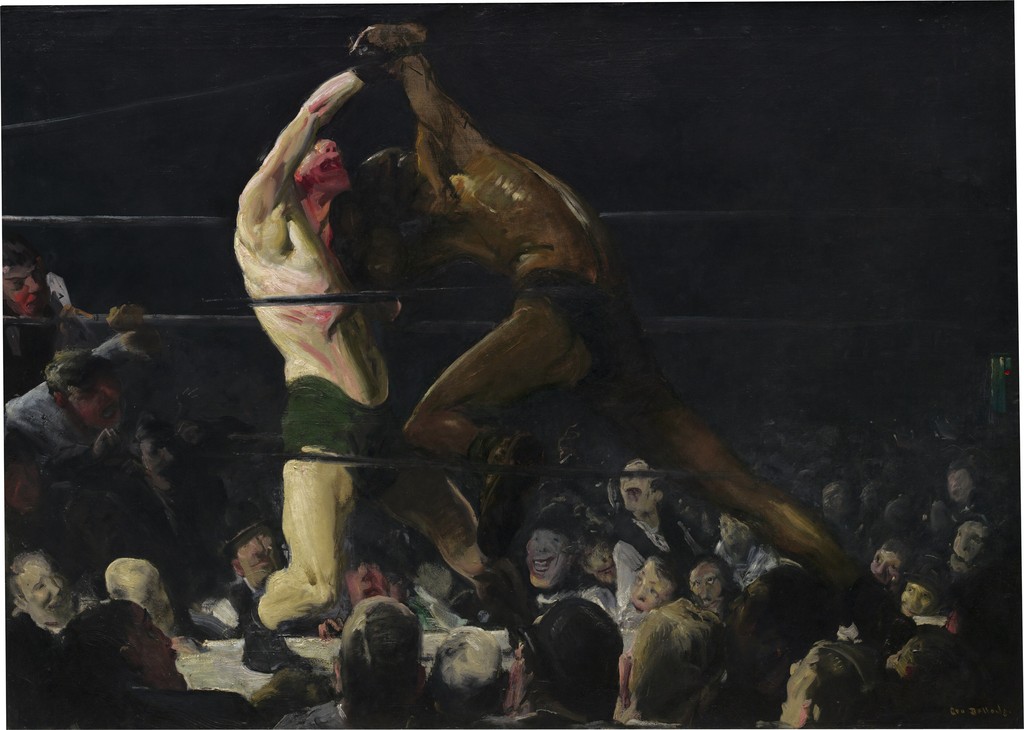
George Bellows’s Both Members of This Club turns an illicit boxing match into a confrontation with race, spectatorship and the evasions of law. Two fighters dominate a dark room while the audience presses beneath them. Painted in 1909, the work belongs to Bellows’s first great boxing sequence, yet its interracial contest and bitterly ironic title give it a social charge unlike the other canvases in that group.[1][2]
At a Glance
- ArtistGeorge Bellows (1882–1925)
- DateOctober 1909
- MediumOil on canvas
- CollectionNational Gallery of Art, Chester Dale Collection
- Accession1944.13.1
- Dimensions115 × 160.5 cm (45 1/4 × 63 3/16 in.)
George Bellows in context
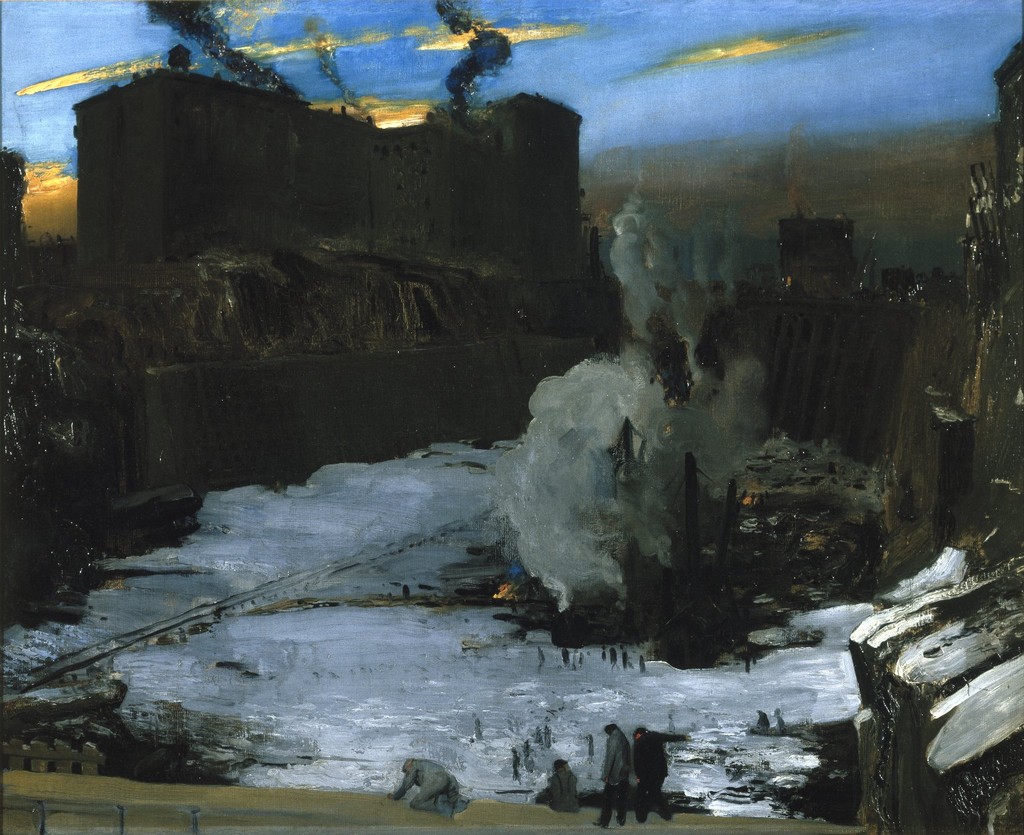
Pennsylvania Station Excavation
c. 1907–08New York
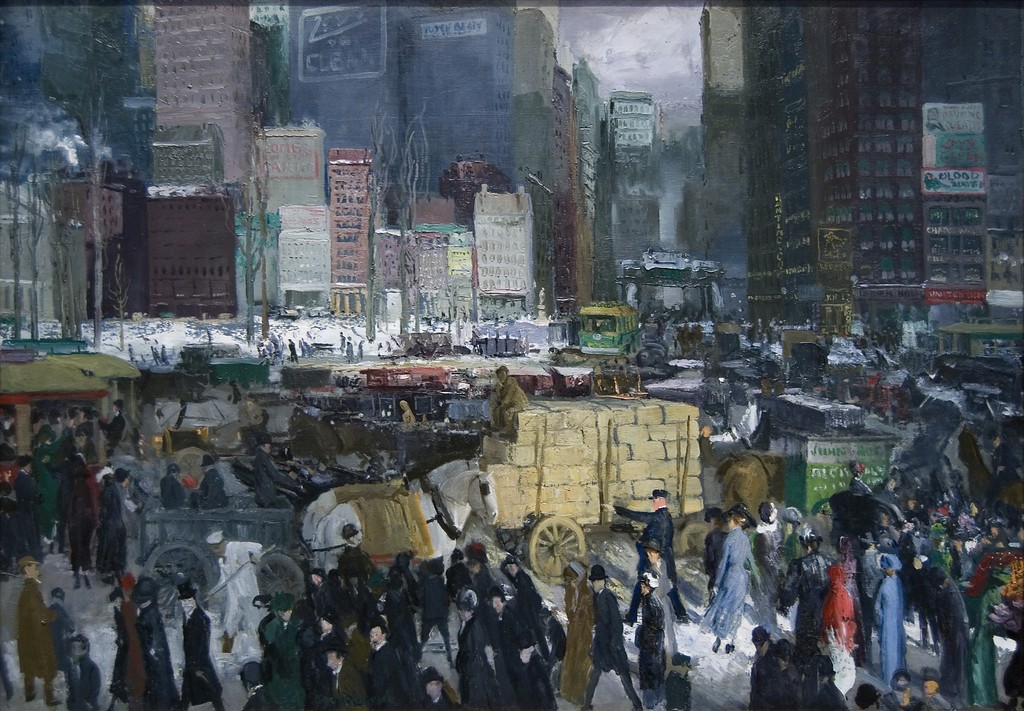
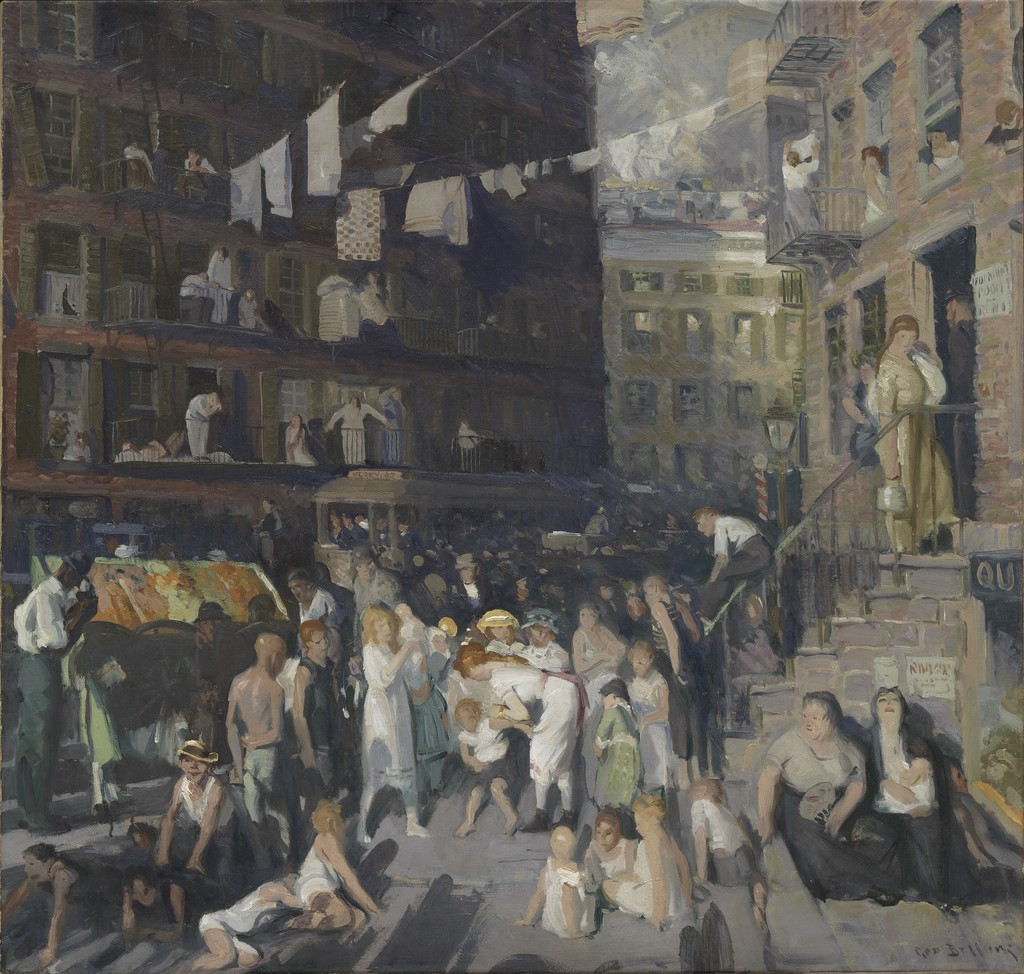
1911Cliff Dwellers
1913My Family
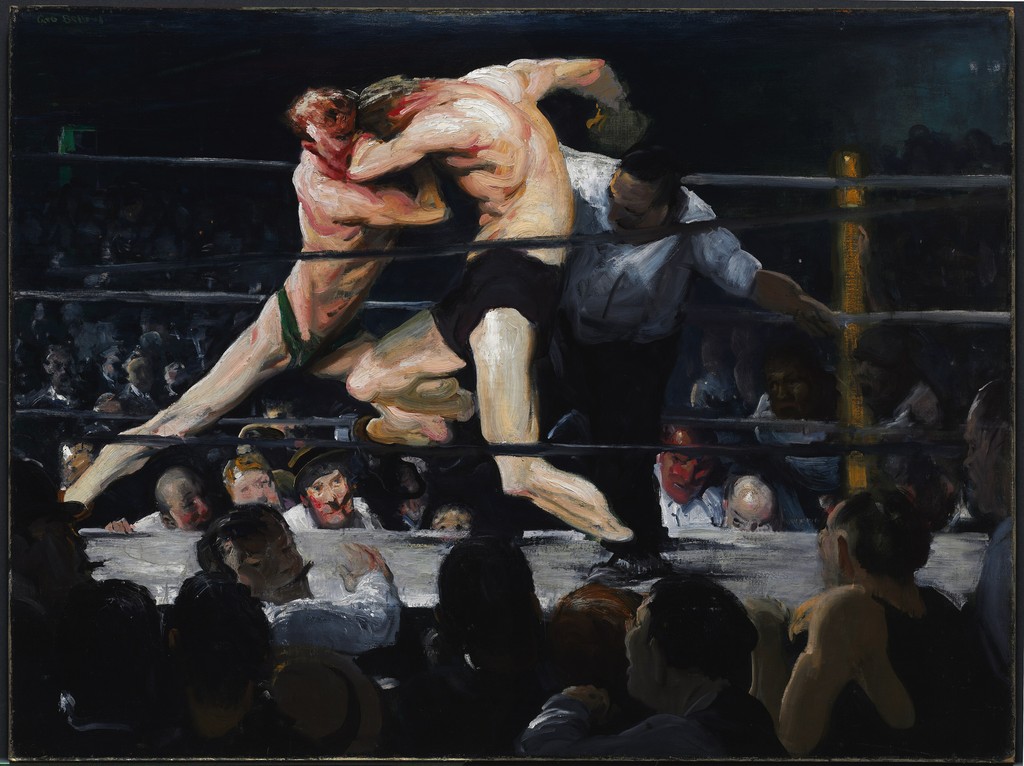
1916A Stag at Sharkey's
1917Dempsey and Firpo
1924Contents
- Introduction
- The Exact Painting
- What the Title Means
- A Triangle Under Pressure
- Electric Light, Darkness and Paint
- The Crowd Is Not Background
- Race and the Jack Johnson Era
- Why the Fighters Remain Unnamed
- Three Early Oils, Not Three Versions
- How to Look at the Painting
The Exact Painting
The National Gallery of Art holds Both Members of This Club as an oil on canvas, accession 1944.13.1. Its broad format is more than five feet wide, and Bellows signed it at the lower right. The Gallery dates its execution to October 1909 and identifies it as the third and largest of his early prizefighting paintings.[1][2]
Those particulars distinguish the canvas from related drawings, prints and other boxing oils. Bellows repeatedly revisited the ring, but a recurring subject does not make the surviving objects interchangeable. This work’s meaning depends on its scale, painted colour, current title and specific moment in 1909. It is one concentrated episode within the larger history of Bellows’s boxing pictures, not a generic image of the sport.
What the Title Means
Public prizefighting was prohibited in New York under the Lewis Law of 1900. Promoters worked around the restriction by staging contests in nominally private athletic clubs. Instead of buying admission to a public bout, spectators paid membership dues, and the contestants were presented as members for the occasion. Announcing that the men were “both members of this club” helped maintain that fiction.[2][4]
Bellows made bureaucratic language carry several meanings at once. On the surface, the title records the formula that allowed the event to proceed. It also implicates everyone in the room: fighters, organiser and paying audience share knowledge of the pretence. In a wider sense, “members” sounds inclusive, but the painting was made in a society organised by racial exclusion. The equal status claimed by the announcement lasts only within a dubious arrangement around the ring.
The title also has a difficult history. Bellows initially named the canvas with an explicitly racist phrase that identified a Black man and a white man, then soon replaced it with Both Members of This Club.[2][3] The change introduced irony and indirection, but it did not erase the first wording or the prejudiced culture in which the picture was produced. A responsible reading must hold both facts together rather than treating the later title as a complete moral resolution.
A Triangle Under Pressure
Bellows organised the scene around a triangular mass. The fighters meet high above the crowd, their joined upper bodies forming the apex while their legs spread towards the lower corners. Ropes pull horizontally through that structure, and the elevated platform converts the ring into a stage. The composition resembles the framework of Club Night and Stag at Sharkey’s, but the action has become more unstable.[2][3]
The Black fighter surges from the right on a long diagonal, driving from an extended back leg. His white opponent rises more vertically but appears to give way: one knee bends, the torso tilts backwards, and blood marks the face and ribs. Their gloves and heads approach the upper edge, leaving almost no space for the struggle to expand. Bellows selected neither a clean punch nor a settled victory. He suspended the bodies at the point when advantage is visible but the contest remains in motion.[1][2]
The lack of a referee is decisive. A referee separates the combatants in Stag at Sharkey’s; here no upright figure mediates the encounter. Bodies, ropes and canvas boundaries perform all the restraint. The result feels less like a regulated sporting exchange than a collision that the room has gathered to consume.
Electric Light, Darkness and Paint
Harsh artificial light isolates the fighters against an almost black upper field. It catches the pale boxer’s chest and the curved back, shoulder and ribs of his opponent, then breaks into smaller flashes on faces below. The illumination does not clarify the whole room. It creates a narrow zone of exposure surrounded by obscurity, making the bodies look both immediate and theatrical.[1][2]
Technical study shows how materially complex that effect is. Bellows worked wet into wet with thick paste and transparent washes. A thin brown layer over a light ground helps create luminosity in the Black fighter’s torso, while heavier impasto builds other passages. Evidence of altered forms, including a changed calf and a painted-out head, reveals revision beneath the apparent instant. The support itself was enlarged early in the process.[2]
That combination matters. Speed is the sensation; adjustment is part of the method. Bellows used broad marks and sharp tonal contrasts to make a fleeting event feel unplanned, even while he reconsidered the figures and expanded the field that contains them.
The Crowd Is Not Background
Spectators fill the lower part of the canvas, so the viewer approaches the ring from within their space. Two men at the far left climb towards the ropes. Elsewhere, open mouths, grins and lifted faces register excitement in quick, sometimes distorted strokes. The nearest watchers are individually legible, but those farther back dissolve into the darkness.[1][2]
This audience changes the ethical temperature of the scene. The boxers bear the physical risk, while the surrounding men buy access to it and turn pain into entertainment. Bellows magnifies the fighters but denies them privacy; every straining gesture is exposed to collective appetite. Looking at the picture therefore entails an uncomfortable resemblance between the museum spectator and the spectators painted around the ring.
The crowd also complicates the work’s racial meaning. A predominantly white male audience watches a Black boxer gain the advantage over a white opponent. Its absorption can be read as excitement, hostility, fascination, or some unstable mixture of all three. Bellows supplies no single expression that resolves those possibilities.
Race and the Jack Johnson Era
Jack Johnson defeated Tommy Burns in 1908 and became the first Black world heavyweight champion. His success provoked white outrage and intensified public demands for a white challenger. The National Gallery interprets Bellows’s ascending Black fighter and collapsing white opponent against that immediate climate. When the canvas was painted, promoters were trying to bring former champion Jim Jeffries out of retirement to fight Johnson.[1][2]
This connection is historical and thematic, not portrait identification. Johnson’s championship made an interracial boxing scene impossible to separate from debates about Black achievement and white supremacy, but the figure in Bellows’s painting is not securely Johnson. The picture instead transforms the era’s anxiety into posture: one man drives forward, another loses balance, and the audience gathers at the point where an expected hierarchy seems ready to fail.
The current title deepens that tension. Inside the ropes, the two contestants are declared members and ostensibly meet under common rules. Beyond the club, Jim Crow law and custom denied such equality. Yet the canvas should not be reduced to a simple progressive statement. Its racist first title and its presentation of Black power as a spectacle for white viewers belong to the same history as its challenge to assumptions of white superiority. The work exposes contradiction without standing cleanly outside it.
Why the Fighters Remain Unnamed
Scholars have proposed specific bouts and boxers, but the National Gallery finds none of those identifications convincing. Interracial contests were uncommon at Sharkey’s, and it is possible that Bellows adapted an encounter seen elsewhere to a setting he knew from repeated visits. The evidence does not justify turning that possibility into a named event.[2]
The uncertainty is productive rather than empty. It keeps attention on what the painting actually establishes: the racial identities Bellows marked, the direction of force, the spectators’ response and the legal language of the title. It also separates an allusion to Johnson’s public significance from a claim that Bellows represented Johnson’s body. A resemblance or plausible historical match is not an object fact.
Three Early Oils, Not Three Versions
Club Night, painted in 1907 and now at the National Gallery, began Bellows’s early trio. Its fighters knot together over a dim audience, establishing the high ring, compressed viewpoint and black field that he would reconsider.[4] The Cleveland Museum of Art’s Stag at Sharkey’s is a distinct 1909 oil, accession 1922.1133. There a referee leans into the action, and “stag” refers to an outsider granted temporary club membership.[5]
Both Members of This Club follows later in 1909. Bellows retains the elevated platform and triangular struggle, removes the referee, pushes the bodies nearer the frame and makes race central to the encounter. The three paintings share a visual problem, but each rearranges who acts, who watches and what the title asks the viewer to understand.[2][3]
Media must remain distinct as well. Stag at Sharkey’s is the Cleveland oil; A Stag at Sharkey’s is a separate 1917 lithograph. Bellows’s prints and lithographs carried boxing into new tonal and distributive forms, but a related design does not convert a painting and an impression into the same work.
How to Look at the Painting
Start with the long line of the advancing fighter’s back leg, then follow the opposing vertical of the reeling body. Notice how the ropes cross those movements and how little air remains above the gloves. Next, let your eyes adjust to the black field: the crowd emerges unevenly, as though attention itself were producing visibility.
Finally, return to the title. Its dry club language sits uneasily beside blood, racial difference and spectators leaning towards the action. That gap between official formula and lived violence is the painting’s sharpest instrument. Bellows makes the loophole legible, then shows how inadequate its claim of shared membership really is.
Researched works directory
This searchable evidence census was assembled from public museum records and a reproducible Wikidata snapshot. It is not a catalogue raisonné, not a claim to complete oeuvre coverage, and not a substitute for the published catalogue literature, which was not used to claim absolute completeness.
| Name | Date | Medium |
|---|---|---|
| A Cloudy Day / Hudson River: Coming Squall | 1908 | Painting |
| A Day in June | 1913 | Painting |
| A Fresh Breeze | 1913 | Painting |
| A Grandmother | 1914 | Painting |
| A Knockout | 1921 | |
| A Morning Snow--Hudson River | 1910 | Painting |
| A Stag at Sharkey's | 1917 | |
| A Winter Day - Under the Elevated near Brooklyn Bridge | 1907 | Painting |
| Allan Donn Puts to Sea | 1923 | |
| An Irish Girl | 1922 | Drawing |
| Anne | 1915 | Painting |
| Anne 1921 | 1923 | |
| Anne and Her Mother | 1917 | Drawing |
| Anne in Black Velvet | 1917 | Painting |
| Anne in White | 1920 | Painting |
| Anne with a Japanese Parasol | 1917 | Painting |
| Approach of Rain | 1913 | Painting |
| Approach to the Bridge at Night | 1913 | Painting |
| Arms of a Boxer | 1916 | Drawing |
| Artists' Evening | 1916 | |
| August Lundberg (No 2) | 1907 | Painting |
| Aunt Fanny | 1920 | Painting |
| Barnyard and Chickens | 1924 | Painting |
| Bethesda Fountain (Fountain in Central Park) | 1905 | Painting |
| Between Rounds, large, first stone | 1916 | |
| Between Rounds, small, second stone | 1923 | |
| Blue Morning | 1909 | Painting |
| Blue Snow, the Battery | 1910 | Painting |
| Both Members of This Club | 1909 | Painting |
| Boy in a Blue Coat | 1915 | Painting |
| Boy with Eton Collar (Portrait of Meredith Hare) | 1921 | Painting |
| Breaking Sky, Monhegan | 1916 | Painting |
| Bridge, Blackwell’s Island | 1909 | Painting |
| Builders of Ship | 1916 | Painting |
| California Headlands | 1917 | Painting |
| Caricature of Adam and Eve and Two Female Portrait Sketches | Date unknown | Drawing |
| Central Park | 1905 | Painting |
| Chester Dale | 1922 | Painting |
| Children Playing in a Park | 1905 | Drawing |
| Cleaning Fish | 1913 | Painting |
| Cliff Dwellers | 1913 | Painting |
| Cliffs | Date unknown | Painting |
| Club Night | 1907 | Painting |
| Coming Storm | 1914 | Painting |
| Coopers Lake, Woodstock | 1924 | Painting |
| Counted Out, first stone | 1921 | |
| Counted Out, second stone | 1921 | |
| Criehaven Wharf | 1916 | Painting |
| Cross-Eyed Boy | Date unknown | Painting |
| Dance in a Madhouse | 1917 | |
| Dancing Town (The Top of the World) | 1922 | Drawing |
| Dempsey and Firpo | 1923 | |
| Dempsey and Firpo | 1924 | Painting |
| Dempsey through the Ropes | 1923 | |
| Dempsey Through the Ropes | Date unknown | Painting |
| Deserted Factory | 1924 | Painting |
| Dock Builders | 1916 | Painting |
| Edge of the Pasture - Glow of the Sun | 1916 | Painting |
| Edith Cavell | 1918 | Painting |
| Elinor, Jean and Anna | 1920 | Painting |
| Elsie, Emma and Marjorie, First Stone | 1921 | |
| Elsie, Emma and Marjorie, second stone | 1921 | |
| Elsie Reading to Emma, First Stone | 1921 | |
| Elsie Reading to Emma, Second Stone | 1921 | |
| Elsie Speicher [verso] | 1920 | Drawing |
| Emma and Her Children | 1923 | Painting |
| Emma at the Piano | 1914 | Painting |
| Emma at the Window | 1920 | Painting |
| Emma, Elsie and Gene | 1921 | |
| Emma in a Purple Dress | 1920 | Painting |
| Emma in the Black Print | 1919 | Painting |
| Emma in the Purple Dress | 1919 | Painting |
| Evening Blue | 1916 | Painting |
| Evening Swell | 1911 | Painting |
| Excavation at Night | 1908 | Painting |
| Family in a Surrey | 1921 | Drawing |
| Fern Woods | Date unknown | Painting |
| Five Cows | 1919 | Painting |
| Floating Ice | 1910 | Painting |
| Florence Davey | 1914 | Painting |
| Fog Breakers | 1913 | Painting |
| Forty-two Kids | 1907 | Painting |
| Frankie, the Organ Boy | 1907 | Painting |
| Garaldine Lee, No. 2 | 1914 | Painting |
| Gardiner's Bay from Sag Harbor | 1899 | Painting |
| Ghost of Sergeant Pelly | 1918 | Drawing |
| Golf Course, California | 1917 | Painting |
| Gorge and Sea | 1911 | Painting |
| Grandma Bellows | 1919 | Painting |
| Gray Sea | 1913 | Painting |
| Harbor of Monhegan, Fish Boats | 1911 | Painting |
| Haystacks and Barn | 1909 | Painting |
| Head of Boy (aka Gray Boy) | 1905 | Painting |
| Hungry Dogs, second stone | 1916 | |
| Hunter and Mountains | 1920 | Painting |
| In a Rowboat | 1916 | Painting |
| In an Elevator | 1916 | |
| In the Park, Dark | 1916 | |
| Introducing Georges Carpentier | 1921 | |
| Introducing John L. Sullivan | 1916 | |
| Introducing John L. Sullivan | 1923 | Painting |
| Introducing the Champion | 1916 | |
| Introductions | 1921 | |
| Jackie (Jacqueline Hudson) | 1914 | Painting |
| Jean 1923 | 1923 | |
| Jean in a Black Hat | 1923 | |
| Jean with Blue Book and Apple | 1916 | Painting |
| Jim Twadell's Place | 1924 | Painting |
| Julie Hudson | 1914 | Painting |
| Katherine Rosen | 1921 | Painting |
| Kids | 1906 | Painting |
| Lady Jean | 1924 | Painting |
| Lady of 1860 - The Actress | 1922 | Drawing |
| Lady with a Fan | 1921 | |
| Launching | 1913 | Painting |
| Little Girl in White (Queenie Burnett) | 1907 | Painting |
| Love of Winter | 1914 | Painting |
| Lychnis and Her Sons | 1923 | |
| Madeline Davis | 1914 | Painting |
| Man and Dog | 1905 | Painting |
| Matinicus | 1916 | |
| Maud Dale | 1919 | Painting |
| May Day in Central Park | 1905 | Painting |
| Men of the Docks | 1912 | Painting |
| Mill Dam | 1924 | Painting |
| Miss Bentham | 1906 | Painting |
| Monhegan Island | 1913 | Painting |
| Mother and Children | 1916 | |
| Mother and Children, Second State | 1916 | |
| Mountain Farm | 1922 | Painting |
| Mr. and Mrs. Phillip Wase | 1924 | Painting |
| Mrs. Chester Dale | 1919 | Painting |
| Mrs. T. in Cream Silk, No.1 | 1919 | Painting |
| Mrs. T. in Cream Silk, No.2 | 1920 | Painting |
| Mrs. Walter H. Richter | 1922 | Painting |
| Murder of Edith Cavell | 1918 | |
| My Family | 1916 | Painting |
| My Mother | 1921 | Painting |
| New York | 1911 | Painting |
| North River | 1908 | Painting |
| Nude Girl, Miss Leslie Hall | 1909 | Painting |
| Nude Girl Reclining | 1919 | Drawing |
| Nude Study, Girl Standing on One Foot | 1923 | |
| Nude with Fan | 1920 | Painting |
| Nude with Hexagonal Quilt | 1924 | Painting |
| Nude with Parrot | 1915 | Painting |
| Nude with Red Hair | 1920 | Painting |
| Old Barn, Grey Day | 1920 | Painting |
| Old Fisherman | 1904 | Painting |
| Ox Team, Wharf at Matinicus | 1916 | Painting |
| Paddy Flannigan | 1908 | Painting |
| Padre | 1917 | Painting |
| Paradise Point | 1919 | Painting |
| Pennsylvania Station Excavation | c. 1907–1908 | Painting |
| Pigs and Donkey | 1920 | Painting |
| Polo at Lakewood | 1910 | Painting |
| Portrait of a Boy | 1921 | Painting |
| Portrait of a Laughing Boy | 1907 | Painting |
| Portrait of Florence Budd | 1914 | Painting |
| Portrait of Florence Pierce | 1914 | Painting |
| Portrait of Geraldine Lee, No. 1 | 1914 | Painting |
| Portrait of My Mother No. 1 | 1921 | Painting |
| Portrait of Prosper Invernizzi | 1907 | Painting |
| Portrait of Walter Littlefield | 1915 | Painting |
| Porträt der Anne | 1915 | Painting |
| Porträt der Laura | 1922 | Painting |
| Prayer Meeting, second stone | 1916 | |
| Preliminaries | 1916 | |
| Preliminaries | Date unknown | |
| Pueblo Tesuque, No. 2 | 1917 | Painting |
| Rain on the River | 1908 | Painting |
| Return of the Useless | 1918 | Painting |
| River Front No. 1 | 1914 | Painting |
| Rock Bound | 1913 | Painting |
| Rock Reef, Maine | 1913 | Painting |
| Rock Ridge Farm | Date unknown | Painting |
| Rocks and Coast | 1911 | Painting |
| Rolling Breakers | 1913 | Painting |
| Romance of Autumn | 1916 | Painting |
| Romance of Criehaven | 1916 | Painting |
| Roumanian Girl | 1921 | Painting |
| Samuel Knopf | 1922 | Painting |
| Santuario de Chimata | 1917 | Painting |
| Seated Female Nude (Emma Story Bellows) | Date unknown | Drawing |
| Seated Nude | 1910 | Painting |
| Self-Portrait | 1921 | |
| Shipyard Society | 1916 | Painting |
| Sixteen East Gay Street | 1923 | |
| Sketches of Heads, Including One of Chester Dale | Date unknown | Drawing |
| Sketches of Three Female Heads [recto] | Date unknown | Drawing |
| Snow-Capped River | 1911 | Painting |
| Snow Dumpers | 1911 | Painting |
| Society Ball [verso] | 1907 | Drawing |
| Splinter Beach | 1916 | |
| Stag at Sharkey's | 1909 | Painting |
| Steaming Streets | 1908 | Painting |
| Storm Sea | 1913 | Painting |
| Street Fight [recto] | 1907 | Drawing |
| Studies of Jean | 1920 | Drawing |
| Study for "Mr. and Mrs. Philip Wase | 1924 | Drawing |
| Study for Nude with Hexagonal Quilt | 1924 | Drawing |
| Study for "Riverfront No. 1 | 1915 | Drawing |
| Study of Emma and the Children | 1917 | Painting |
| Summer City | 1909 | Painting |
| Summer Fantasy | 1924 | Painting |
| Summer Night, Riverside Drive | 1909 | Painting |
| Sun Glow | 1913 | Painting |
| Sun Shadows (Rocks at Monhegan) | 1913 | Painting |
| Sunday 1897 | 1921 | |
| Sunlit surf | 1913 | Painting |
| Swans in Central Park | 1906 | Painting |
| Tennis | 1920 | |
| Tennis at Newport | 1919 | Painting |
| Tennis at Newport | 1920 | Painting |
| Tennis Tournament | 1920 | Painting |
| The Barricade | 1918 | Painting |
| The Beach, Newport (In the Sand) | 1919 | Painting |
| The Big Dory | 1913 | Painting |
| The Black Derby / Head of a man with a red nose | 1905 | Painting |
| The Brook | Date unknown | Painting |
| The Charge | 1918 | |
| The Cigarette | 1918 | |
| The Coming Storm | 1916 | Painting |
| The Dock | 1913 | Painting |
| The Donkey Cart | 1922 | Drawing |
| The Fish Wharf, Matinicus Island | 1916 | Painting |
| The Fisherman | 1917 | Painting |
| The Germans Arrive | 1918 | Painting |
| The Grove — Monhegan | 1911 | Painting |
| The Gulls, Monhegan | 1911 | Painting |
| The Harbor, Monhegan Coast, Maine | 1913 | Painting |
| The Kindliness Came Not from Her | 1922 | Drawing |
| The Launching | Date unknown | Painting |
| The Law Is Too Slow | 1923 | |
| The Lone Tenement | 1909 | Painting |
| The Newsboy | 1908 | Painting |
| The Novitiate | 1916 | |
| The Palisades | 1909 | Painting |
| The Red Vine, Matinicus Island, Maine | 1916 | Painting |
| The Sand Cart | 1917 | Painting |
| The Sea | 1911 | Painting |
| The Shower-Bath | 1917 | |
| The Studio | 1919 | Painting |
| The Teamster | 1916 | Painting |
| The Tournament | 1920 | |
| The Village Houses | 1920 | Painting |
| The Warships | 1909 | Painting |
| The White Hope | 1921 | |
| The White Horse | 1922 | Painting |
| The Widow | 1917 | Painting |
| Three Children | 1919 | Painting |
| Three Pigs and a Mountain | 1922 | Painting |
| Three Rollers | 1911 | Painting |
| Through the Trees, Monhegan Island, Maine | 1913 | Painting |
| Tumble of Waters | 1913 | Painting |
| Two Girls | 1917 | |
| Two Women | 1924 | Painting |
| Up the Gorge | 1913 | Painting |
| Up the Hudson | 1908 | Painting |
| Village on the Hill | 1916 | Painting |
| Vine Clad Shore--Monhegan Island | 1913 | Painting |
| Waldo Peirce | 1920 | Painting |
| War Series | 1918 | Painting |
| West Wind | 1913 | Painting |
| Willard in Training Quarters | 1916 | |
| Winter Afternoon, Riverside Park | 1909 | Painting |
| Winter Road | 1912 | Painting |
| Woodstock Road, Woodstock, New York | 1924 | Drawing |
Frequently Asked Questions
The painting belongs to the National Gallery of Art in Washington, DC. It is part of the Chester Dale Collection and carries accession number 1944.13.1.[1]
The phrase refers to the legal fiction used by private athletic clubs when public boxing was prohibited in New York. Fighters were announced as club members for the event, while spectators paid dues rather than ordinary admission.[2][4]
Their identities are not established. Several historical matches have been suggested, but current National Gallery scholarship considers the proposals unconvincing. The men should remain unnamed.[2]
No secure evidence identifies him as Johnson. The painting is strongly connected to the racial politics surrounding Johnson’s 1908 heavyweight championship, but that context is not proof of portrait identity.[1][2]
It is the third and largest of his early boxing oils, after Club Night and Stag at Sharkey’s. All three use an elevated ring, close spectators and intense light, but this canvas removes the referee and makes an interracial contest central. It is a separate object, not a later state or alternative title for either earlier painting.[2][3]
Discussion
Use this evidence-led guide as a starting point for close looking rather than a final verdict.
Share an observation about Both Members of This Club or a source that adds useful context.
Reader Insights
Which detail most changes your reading of Both Members of This Club?
How do scale, support, medium or present museum evidence shape the encounter?
What remains uncertain when visual inference is separated from documented fact?
Join the Conversation
Add your reading below, keeping observations specific and evidence clear.
References
- National Gallery of Art, “Both Members of This Club”, accessed 31 August 2026.
- Robert Torchia, “American Paintings, 1900–1945: Both Members of This Club, 1909”, National Gallery of Art, accessed 31 August 2026.
- E. A. Carmean Jr., John Wilmerding, Linda Ayres and Deborah Chotner, Bellows: The Boxing Pictures, National Gallery of Art, 1982, accessed 31 August 2026.
- National Gallery of Art, “Club Night”, accessed 31 August 2026.
- Cleveland Museum of Art, “Stag at Sharkey’s”, accessed 31 August 2026.