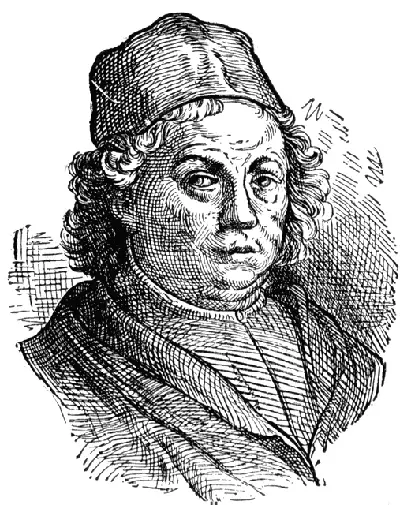
 by Tom Gurney
Tom Gurney BSc (Hons) is an art history expert with over 20 years experience
Published on June 19, 2020 / Updated on October 2, 2026
Email: tomgurney1@gmail.com / Phone: +44 7429 011000
Andrea del Verrocchio Biography: Introduction
Andrea del Verrocchio was one of the essential artists of Renaissance Florence: a goldsmith, sculptor, painter, draughtsman and workshop master whose career joins the generation after Donatello to the world of Leonardo da Vinci. Born in Florence around 1435, he worked mainly in the city before his final years in Venice, building a reputation through bronze, marble, terracotta, painting and design.[1][2]
Verrocchio often appears beside Leonardo because Leonardo trained in his workshop. That connection matters, but it does not reduce Verrocchio to a supporting role. In his own lifetime he was a major Florentine artist, trusted by patrons and active at the centre of one of the most inventive studios in Italy. The National Gallery of Art describes him as a leading sculptor, painter and teacher, while the National Gallery London emphasizes both his own art and the artists who worked around him.[1][2][3]
This biography follows Verrocchio as a practical, ambitious artist moving between metalwork, public sculpture, devotional painting, civic commissions, Medici patronage and workshop culture. His life shows how Renaissance art was made through materials, institutions, pupils, collaborators and sustained technical curiosity.
At a Glance
- Full nameAndrea di Michele di Francesco de' Cioni, known as Andrea del Verrocchio [1]
- BornAbout 1435, Florence [1][2]
- Died1488, Venice [1][4]
- Main rolesSculptor, goldsmith, painter, draughtsman and workshop master [1][2][4]
- Main artistic baseFlorence, with a late Venetian period connected to the Colleoni monument [4]
- Major settingsMedici Florence, Orsanmichele, Florence Cathedral, Pistoia and Venice [3][4]
- Pupils and collaboratorsLeonardo da Vinci, Lorenzo di Credi, Pietro Perugino and probably Sandro Botticelli [2][3]
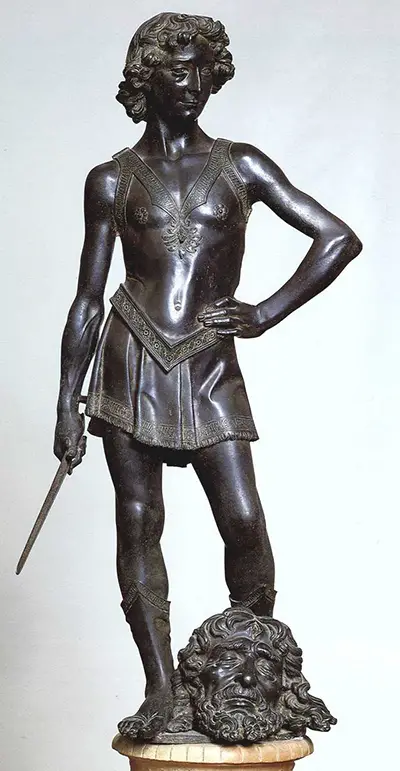
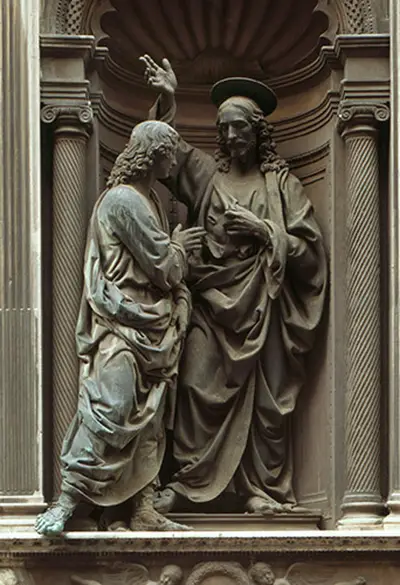
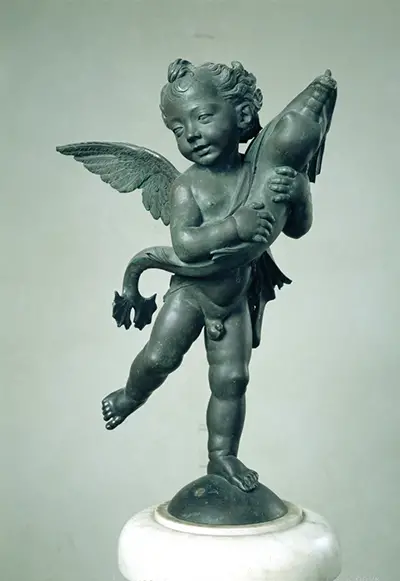
- Key worksDavid, Christ and Saint Thomas, Little Angel with Dolphin, The Baptism of Christ and the Colleoni monument [2][3][5]
Contents
- Why Verrocchio's Life Matters
- Florence and Early Training
- Medici Patronage and Public Sculpture
- Painting, Workshop Practice and Leonardo
- A Workshop of Sculpture, Drawing and Design
- Venice and the Colleoni Monument
- Pupils, Inheritance and Legacy
- How to Understand Verrocchio's Career
Why Verrocchio's Life Matters
Verrocchio's life matters because it reveals how Renaissance art was made. He was not a narrow specialist who moved from one isolated commission to the next. He designed, modelled, carved, cast, painted, drew, taught and managed work inside a Florentine studio where different materials and skills informed one another.
That range makes him a crucial figure between the worlds of Donatello and Leonardo da Vinci. He inherited a Florence transformed by earlier fifteenth-century sculpture, then helped form the environment from which Leonardo and other artists emerged. Verrocchio is sometimes described as a bridge, but that label can make him sound passive. His career was more active than that. He shaped the technical habits, workshop culture and visual language of late fifteenth-century Florence.
His sculpture is especially important. Works such as David with the Head of Goliath, Christ and Saint Thomas, the Little Angel with Dolphin and the equestrian monument to Bartolomeo Colleoni show his concern with animated bodies, crisp surfaces, elegant poses and figures that occupy space with unusual alertness.[1][2]
His reputation also depends on the studio itself. The National Gallery of Art's 2019 Verrocchio exhibition presented him as a painter, sculptor and teacher at the centre of experimentation in Renaissance Florence.[3] That framing suits the surviving evidence. Verrocchio's name stands beside secure sculptures, disputed paintings, collaborative workshop pictures and pupils whose later fame can obscure the master who trained them.
The unevenness of that record belongs to the biography rather than weakening it. Some commissions are securely documented; some pictures remain debated; some stories come through later writers and need caution. A good account of Verrocchio is therefore firm about his importance and restrained where attribution, anecdote or chronology remain uncertain.
Florence and Early Training
Andrea del Verrocchio was born in Florence around 1435. The National Gallery of Art gives his name as Andrea di Michele Cioni, and Treccani identifies him as a Florentine painter, sculptor and goldsmith who died in Venice in 1488.[1][4] His early formation is usually connected with goldsmith work, a demanding craft that trained artists in precision, surface, design and the behaviour of precious materials.
That training matters for everything that followed. Goldsmith work taught an artist to think closely about edges, texture, finish and small-scale detail. Verrocchio's mature sculpture often carries those habits into larger forms. His bronzes and marbles are not only composed well; they are worked with a refined sensitivity to how light touches metal, hair, cloth, flesh and ornament.
The National Gallery London notes that Verrocchio trained first as a goldsmith before becoming known as a sculptor and painter.[2] Treccani links his nickname to the goldsmith Giuliano Verrocchi as an early master.[4] The details of apprenticeship are not all equally secure, but the craft background is central to his artistic identity.
Verrocchio took up painting in the 1460s after training as a goldsmith and sculptor, according to the National Gallery of Art.[1] That sequence helps explain why his workshop could move across media so naturally. Painting was not a separate career sealed away from sculpture. It was another field in which drawing, design, modelling and the management of assistants mattered.
Florence gave him an unusually rich artistic environment. Donatello's achievements in sculpture, the legacy of Lorenzo Ghiberti, the rise of large workshops and the needs of civic, religious and private patrons all shaped what an ambitious artist could become. Verrocchio's early career grew out of that world of craft discipline, competition and institutional patronage.
Medici Patronage and Public Sculpture
Verrocchio's mature career was closely tied to powerful Florentine patrons, especially the Medici. The National Gallery London states that he worked extensively for the family.[2] That relationship mattered because Medici support could place an artist at the centre of Florence's cultural life, giving access to important commissions, collections and networks.
The bronze David is a key example. National Gallery of Art material connected with the Verrocchio exhibition describes the sculpture as probably made for Piero de' Medici around 1465, while other official cataloguing places it slightly later in the 1460s.[3] However the exact date is framed, the work reveals a sculptor capable of answering Donatello while creating a distinct image of courtly, youthful victory.
Verrocchio's David is often read beside Donatello's earlier bronze David and Michelangelo's later marble David. That comparison is useful, but it can flatten the work if treated only as a middle point. Verrocchio's figure has its own personality: dressed, alert, theatrical, socially poised and technically exact. It shows how a biblical subject could become a display of Florentine confidence and refined workmanship.
Public sculpture raised Verrocchio's status further. Christ and Saint Thomas, made for the Orsanmichele niche of the Mercanzia, became one of his major Florentine projects. The National Gallery of Art singles out Christ and Saint Thomas and the Colleoni monument among the works that establish his position as a leading sculptor.[1] Treccani records the long commission history, from the 1460s into the 1480s, with careful attention to the work's delivery and placement.[4]
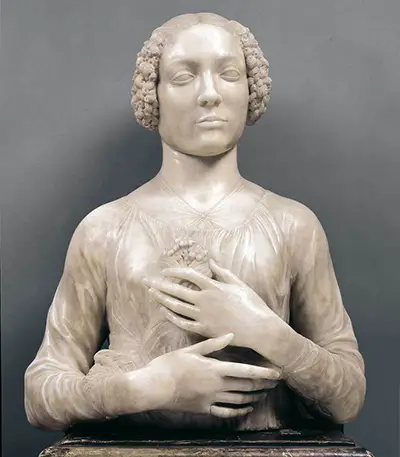
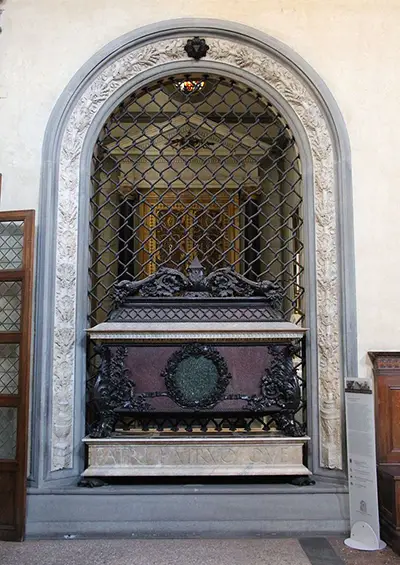
The tomb of Piero and Giovanni de' Medici, connected with San Lorenzo, also belongs to this sculptural career. It demonstrates a different side of Verrocchio: not the youthful movement of David or the public encounter of Christ and Saint Thomas, but a sophisticated memorial language built through materials, spatial setting and Medici identity.
Painting, Workshop Practice and Leonardo
Verrocchio's painting career is harder to define than his sculpture. The National Gallery of Art notes that his painted oeuvre is problematic and that attributions have been disputed among Verrocchio and artists around him, including Lorenzo di Credi, Domenico Ghirlandaio, Pietro Perugino and Leonardo da Vinci.[1] That uncertainty is not unusual for a large Renaissance workshop. It reflects the way designs, assistants and master supervision could overlap.
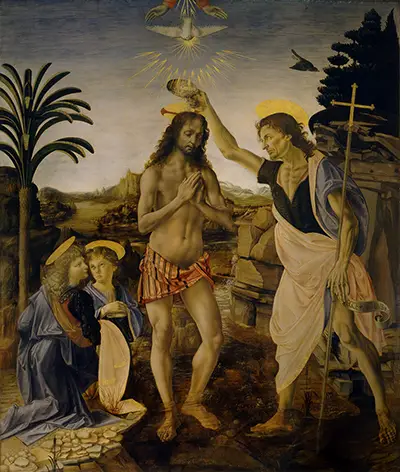
The best-known case is The Baptism of Christ, now in the Uffizi. The museum attributes the painting to Andrea del Verrocchio and Leonardo da Vinci and dates it to about 1470-1475.[5] It is central to any biography of Verrocchio because it places master, pupil and workshop practice in the same object.
Later tradition, especially Vasari, tells a famous story in which Leonardo painted an angel so beautifully that Verrocchio abandoned painting. That story is memorable, but it belongs as a literary and historiographic tradition rather than a simple fact. The Uffizi's own account emphasizes normal workshop practice: a master could design the painting and leave parts of execution to pupils or collaborators, while Leonardo's contribution may extend beyond the angel alone.[5]
This conservative approach protects both artists. Leonardo's early talent does not need exaggeration, and Verrocchio's importance does not disappear because a pupil contributed to a painting. The Baptism of Christ is better understood as evidence of a high-level workshop where painting, design, observation and collaboration met.
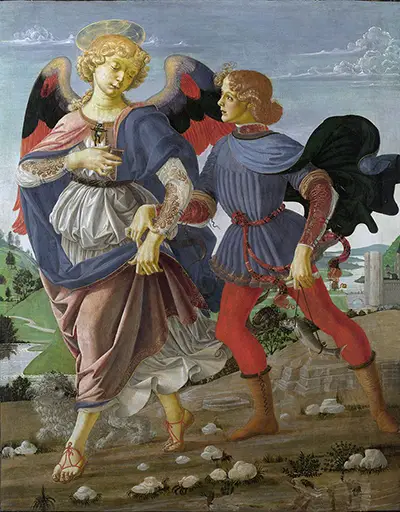
Other paintings associated with Verrocchio and his assistants, including works discussed by the National Gallery London such as Virgin and Child with Two Angels and Tobias and the Angel, belong to the same world of shared authorship and close looking.[2][6] They show why Verrocchio's biography cannot separate the artist from the workshop that carried his designs, habits and teaching outward.
A Workshop of Sculpture, Drawing and Design
Verrocchio's workshop was one of the great training environments of fifteenth-century Florence. The National Gallery London identifies Leonardo as his most famous pupil and names Lorenzo di Credi and Perugino as principal pupils or collaborators, with Botticelli probably also spending time in the studio.[2] The National Gallery of Art similarly treats Verrocchio as a major teacher whose studio shaped younger artists.[3]
The workshop joined media in practice. Sculpture trained artists to understand bodies in space. Drawing trained the hand and eye to test movement and form. Goldsmith work cultivated exactness and surface intelligence. Painting required colour, light, narrative and collaboration. Verrocchio's studio brought those habits together rather than treating them as separate skills.
This helps explain why his influence reached beyond the works securely made by his own hand. A pupil leaving Verrocchio's shop did not simply inherit a style. He inherited a way of seeing: bodies as active structures, drapery as movement, surface as light, and design as a problem shared across materials.
The evidence is visible in the works themselves. David has the precision of a goldsmith and the bodily alertness of a draughtsman. Christ and Saint Thomas turns a niche into a dramatic encounter. The disputed workshop paintings show how difficult it can be to separate design, supervision and execution when a studio functions at a high level.
For Leonardo, that environment was decisive. Yet Leonardo belongs here as one outcome of Verrocchio's world, not the only reason that world matters. Lorenzo di Credi inherited the studio after Verrocchio's death, according to Treccani, and Perugino carried Florentine training into his own highly successful career.[4] Verrocchio's legacy therefore travelled through several artists and media at once.
Venice and the Colleoni Monument
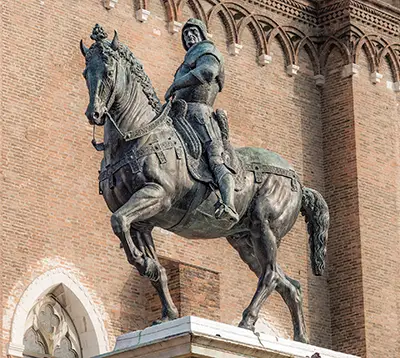
Verrocchio's final major commission took him to Venice: the equestrian monument to Bartolomeo Colleoni. The National Gallery London calls it his most ambitious sculpture, and the National Gallery of Art treats it as a major sign of his leading status as a sculptor.[1][2]
The commission placed Verrocchio in the tradition of monumental bronze equestrian sculpture, one of the most prestigious and technically demanding forms inherited from antiquity. Colleoni, a celebrated condottiere, left money to the Venetian state for a monument, and the resulting project required an image of military authority that could stand in public space with force and clarity.
Verrocchio died in Venice in 1488, before the monument was fully completed.[1][4] The work was cast and finished after his death, with Alessandro Leopardi playing an important role in completion. The later history belongs to the sculpture's own account, but for Verrocchio's biography the commission marks the culmination of his sculptural ambition.
The arc is striking. Verrocchio began from the precision of goldsmith work and the disciplined artistic world of Florence, then ended with a mounted commander designed for Venice. The shift does not mean he left Florence behind artistically. It shows that his reputation had travelled beyond it. A Florentine workshop master had become a sculptor trusted with one of the most challenging public monuments of the Italian Renaissance.
Pupils, Inheritance and Legacy
Verrocchio died in Venice in 1488.[1][4] Treccani records that Lorenzo di Credi inherited his workshop.[4] That inheritance matters because Renaissance workshops were not only workplaces; they were systems for transmitting patterns, drawings, designs, unfinished projects, patron relationships and habits of making.
Verrocchio's legacy has often been overshadowed by Leonardo. That is understandable, but it can distort the historical picture. Leonardo did not emerge from a vacuum. His early formation occurred in a workshop where sculpture, painting, drawing, anatomy, surface, light and experiment were already intertwined.
At the same time, Verrocchio's importance does not depend only on Leonardo. His own works remain central to Renaissance Florence. David brings biblical heroism into courtly bronze. Christ and Saint Thomas gives a public niche dramatic life. The Medici tomb speaks through material refinement and family memory. The Little Angel with Dolphin shows wit, motion and fountain sculpture on a domestic or garden scale. The Colleoni monument extends his ambition into the grand language of public bronze.
His influence in painting is more complicated but still important. Works made by, around or after his workshop require careful attribution, yet that complexity is itself evidence of a living studio. Designs, hands and training overlapped. What matters is not only which brushstroke belongs to whom, but how Verrocchio's workshop made collaboration productive.
For that reason, Verrocchio is best understood as both a great teacher and a major artist. He helped form famous pupils, but he also gave Renaissance Florence objects of real invention and authority.
How to Understand Verrocchio's Career
The first key to Verrocchio is material. Gold, bronze, marble, terracotta, panel painting and drawing all shaped his artistic intelligence. His art is rarely about grand theory alone. It is about how surfaces behave, how bodies turn, how hands gesture, how light catches an edge and how a figure can be made alert.
The second key is patronage. Verrocchio worked for a Florence in which Medici power, civic institutions, religious settings and private devotion overlapped. His works moved through those worlds. A sculpture could be a devotional object, a family possession, a civic sign and a museum masterpiece across its long life.
The third key is collaboration. Verrocchio's career makes little sense if the workshop is treated as a problem to be solved away. The workshop was the system through which much Renaissance art came into being. It explains the disputed paintings, the shared designs, the training of pupils and the importance of drawing as a common language.
The final key is proportion. Leonardo belongs in Verrocchio's story, and The Baptism of Christ remains one of the great places to study that relationship. But Verrocchio also belongs apart from Leonardo: as a sculptor of motion and surface, a Florentine craftsman of rare discipline, a teacher of younger artists and a designer whose career shows the breadth of Renaissance making.
Frequently Asked Questions
Discussion
Which part of Verrocchio's career most changes how you understand Renaissance Florence: his sculpture, his workshop, his Medici patronage, or his connection with Leonardo?
Reader Insights
Start with Verrocchio's sculpture. His figures often feel alert because gesture, polished surface and bodily turn work together rather than separately.
Read Leonardo in proportion. The workshop connection is essential, but Verrocchio's own career also belongs to Medici Florence, public sculpture and Venetian monument-making.
How does Verrocchio's reputation change when the workshop is treated as a creative system instead of a problem of attribution?
Join the Conversation
Share the work, source or comparison that would most help another reader understand Verrocchio as more than Leonardo's teacher.
References
- National Gallery of Art, Andrea del Verrocchio, artist record, accessed 8 August 2026.
- National Gallery London, Andrea del Verrocchio, artist record, accessed 8 August 2026.
- National Gallery of Art, Verrocchio: Sculptor and Painter of Renaissance Florence, and NGA press material for the exhibition, accessed 8 August 2026.
- Treccani, Andrea del Verrocchio, accessed 8 August 2026.
- Uffizi Galleries, The Baptism of Christ, accessed 8 August 2026.
- National Gallery London, Verrocchio unveiled, accessed 8 August 2026.
- National Galleries Scotland, Andrea del Verrocchio, artist record, accessed 8 August 2026.