 by Tom Gurney
Tom Gurney BSc (Hons) is an art history expert with over 20 years experience
Published on June 19, 2020 / Page Updated on November 5, 2026
Email: tomgurney1@gmail.com / Phone: +44 7429 011000
Introduction
John Constable's Flatford Mill (Scene on a Navigable River) is one of the crucial early statements of his mature landscape art. Painted in 1816-17 and now in Tate's collection, it brings together family business, childhood memory, river transport, outdoor study and pictorial ambition.[1] The painting is often admired as an image of Suffolk country life, but its full force depends on something more precise. Constable is not presenting the River Stour as a passive rural idyll. He is showing a managed waterway, a working mill and a landscape shaped by labour.
The title matters. Flatford Mill names the place; Scene on a Navigable River names the economic fact that gives the place its motion. The Stour was not only a beautiful river winding through familiar country. It was part of a system of locks, bridges, barges, mills and towpaths. Constable knew that system from within. His father, Golding Constable, owned Flatford Mill and ran a substantial corn-milling and transport business around the river.[3] In this painting, local knowledge becomes composition. The river is not background scenery. It is the engine of the picture.
At a Glance
- ArtistJohn Constable (1776–1837)
- TitleFlatford Mill (Scene on a Navigable River)
- Date1816–17 [1]
- CollectionTate, London
- Tate referenceN01273 [2]
- MediumOil on canvas [1]
- Dimensions101.6 × 127 cm [1]
- ExhibitedRoyal Academy, 1817 [6]
- SettingFlatford and the navigable River Stour
- Central actionUpstream barges, a tow horse and river workers [3]
Contents
- Introduction
- Object Identity
- A Large Early Ambition
- Flatford as Family Economy
- The Navigable Stour
- Composition and Viewpoint
- Drawing, Glass and Revision
- Figures and River Work
- Relation to The Hay Wain
- Why the Painting Matters
Object identity
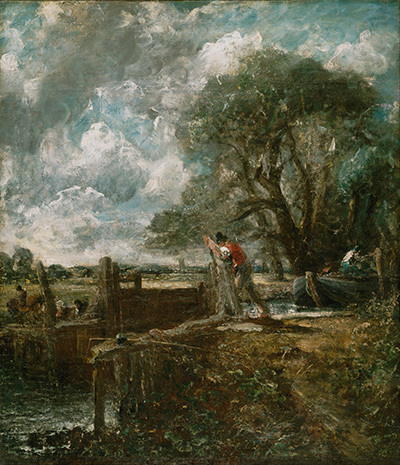
The painting is held by Tate under the title Flatford Mill (Scene on a Navigable River). Tate's accessible record gives the date as 1816-7 and identifies the work as oil on canvas measuring 101.6 by 127 centimetres.[1] The canonical Tate collection reference is N01273.[2] Those facts are important because the Constable cluster contains several closely related Flatford subjects. This work must be kept distinct from Flatford Mill, Flatford Mill from a Lock on the Stour, Boat-Building near Flatford Mill, Dedham Lock and Mill and The Lock.
The picture shows Flatford in relation to the Stour navigation. Tate describes the scene as including a pair of barges travelling upstream and a young boy on horseback.[1] The Museum of Fine Arts, Houston, in a scholarly discussion of a related Flatford oil sketch, identifies the Tate painting as Constable's definitive representation of the mill, looking downriver, with barges recently through Flatford lock and being prepared for movement under the footbridge.[3] That practical situation gives the foreground its meaning. The figures are not decorative rustic staffage. They are performing river work.
The title also has a history of small variations. Local and later accounts sometimes place the navigational phrase first, or use slightly different punctuation, but the essential identity remains the Tate painting of 1816-17.[1][6] That may sound minor, yet it is central to the Flatford group. Constable repeatedly returned to the same neighbourhood, and a broad label such as Flatford Mill can hide several distinct objects, viewpoints and moments in his development. The safest way to read this work is as the 1816-17 Tate canvas centred on the navigable Stour and the mill economy at Flatford.
A large early ambition
By 1816 Constable had already spent many years studying the Stour Valley, but Flatford Mill (Scene on a Navigable River) was a more ambitious undertaking than a small oil sketch or private drawing. The East Bergholt Society describes it as his largest exhibition canvas to that date and notes that it was shown in the Royal Academy in 1817.[6] The National Gallery catalogue for The Hay Wain also refers to Scene on a Navigable River as an exhibited work of 1817 and stresses the significance of its title.[4]
This was before the great six-foot Stour landscapes of the 1820s, but it already points toward them. Constable is testing how much of a local working landscape can be carried by a substantial exhibition picture. The answer is not simply scale. The painting's ambition lies in its integration of observed fact with pictorial order. It gives the viewer a river, a mill, a towpath, trees, barges, labouring figures and shifting light, yet it does not collapse into topographical inventory. It turns a known place into a composed world.
The timing also matters. Constable married Maria Bicknell in 1816 and settled more permanently in London, making his long summer returns to East Bergholt and Flatford increasingly precious.[3] The painting belongs to that threshold between youth and mature professional life. It looks back toward the scenery of his childhood, but it also looks forward toward the public career in which those places would become the foundation of his reputation.
Graham Reynolds's catalogue work on Constable's early paintings and drawings is important here because it places the Flatford material within the artist's formation before the major Stour sequence became famous.[9] By 1816, Constable was not beginning from scratch. He had been studying the same river world through drawings, small outdoor oils and changing viewpoints. The Tate canvas gathers that accumulated practice into a more public and resolved form. It is early in relation to The Hay Wain, but mature in its understanding of place.
That maturity is easy to miss because the scene appears calm. Constable does not announce ambition with theatrical weather or heroic scale. Instead, he lets complexity accumulate quietly. The foreground action, the recession of the water, the half-screened mill buildings, the trees and the relation of lock, bridge and towpath all have to be held together. The painting asks an exhibition audience to take ordinary Suffolk work as seriously as a grander, more conventional subject.
Flatford as family economy
Flatford Mill was not an incidental subject for Constable. It stood near the centre of the family economy. Golding Constable inherited the mill, and the surrounding business involved corn, flour, barges and the movement of goods along the Stour.[3][5] The Flatford and Constable place history explains how the mill worked through water power, with river water driving wheels and machinery, and how flour could be lowered into waiting barges.[5] Such details help the painting breathe as a working scene rather than a picturesque arrangement.
Constable had grown up around this world. He understood how river transport worked, how a towpath functioned, where the locks and bridges lay, and how the mill buildings sat in relation to water. That knowledge is visible in the painting's calm exactness. The action in the foreground is not melodramatic because it did not need to be. Everyday labour is enough. A boy on horseback, a rope, barges, trees and shallow water carry the story.
The family context also prevents a purely nostalgic reading. Constable's attachment to Flatford was emotional, but the place was also commercial, mechanical and practical. It smelled of damp wood, grain, brickwork, river mud and working horses. He could make it poetic because he knew it materially. The painting's beauty does not erase labour; it depends on it.
The National Trust's account of Constable at Flatford adds useful context for Golding Constable's position. Golding was not simply a country miller in a modest sense; he was a Suffolk businessman whose interests included Flatford Mill, Dedham Mill, a windmill at East Bergholt, farmland, lighters and Thames barges.[7] That breadth changes the social meaning of the painting. Constable is not looking at a marginal rural craft. He is looking at a family enterprise connected to wider agricultural and commercial systems.
This also clarifies the relation between personal memory and professional independence. The family business helped fund Constable's artistic formation, even though his father doubted the practicality of a landscape-painting career.[7] The painting therefore carries a subtle tension. It honours the world that made him possible, while transforming that world into art. The river system that once belonged to work and income becomes, through painting, a claim for landscape's imaginative seriousness.
The navigable Stour
The Stour was canalised and managed through the Stour River Navigation Company, allowing commercial traffic to move through locks and other engineered features.[4] The MFAH account explains that the lower half of the river had been made navigable in the eighteenth century by locks, sluices, bridges and dams, and that corn from the Dedham and Flatford mills travelled by barge toward Mistley, while coal and other cargoes returned upstream.[3] This is the world behind the painting's subtitle.
The foreground action becomes clearer when read through that system. The barges have come upstream against the current. The tow horse and boys are part of the sequence of movement. Near a bridge, a barge could not simply continue under tow in the same way; ropes had to be handled, and the craft could be poled through or around tight passage.[3] Constable chooses one of those transitional moments. The landscape is active because river commerce is active.
This is why the work should not be softened into a general view of old England. Its rural quiet is structured by industry. There are no factories, smoke stacks or dramatic machines, but the picture is still about production and transport. Constable gives dignity to work that belonged to his own family history, and he does so without making it picturesque theatre.
Flatford Lock gives the river's engineering a concrete focus. The National Trust notes that the lock once lay north of the present lock and that locks along the Stour increased local prosperity, especially for Golding Constable's business.[8] It also describes a manually demanding system of lock operation using chain and capstan rather than modern paddle gear.[8] That physical effort is part of the unseen world behind the Tate painting. The barges in the canvas move through a landscape made navigable by repeated labour.
The practical detail also explains why Constable's river scenes feel so inhabited even when they are quiet. The Stour is not empty space between banks. It is a worked corridor. The viewer may first notice trees and water, but the painting gradually reveals a network of operations: towing, unhooking, poling, locking, milling, storing and carrying. Constable's achievement is to make that network visually graceful without disguising its usefulness.
Composition and viewpoint
The composition looks downriver, arranging the Stour as a pathway through the picture. The viewer is placed close enough to feel the work of the foreground, yet far enough back to understand the landscape as a whole. Trees mass at the right, the river opens at the left, and the mill buildings and lock relation draw the eye into depth. The scene feels natural, but that naturalness is constructed with care.
Iris Wien's Tate Papers essay on Constable and visual perception is especially valuable here. It discusses a related study for Flatford Mill, made with the aid of a drawing frame, and explains that several parts of the final painting correspond closely to the preliminary study while other elements were adjusted.[2] The final composition is therefore not merely the enlargement of a traced view. It is a rethinking of observed structure.
Wien notes that the sluice and the dead tree in the middle ground become larger in the painting than in the preliminary outline, and interprets such changes in relation to Constable's interest in the dynamics of looking.[2] That point matters because it shows Constable using optical aid without becoming a slave to it. He could trace, measure and transfer, then alter what the eye and the picture required. The painting's realism is therefore intelligent rather than mechanical.
Drawing, glass and revision
Constable's use of a drawing frame has sometimes been treated as a technical curiosity, but in relation to Flatford Mill (Scene on a Navigable River) it goes to the heart of the painting's authority. The related Tate study was not a casual sketch. It came from a method of looking through a framed glass, tracing outlines and transferring them to paper.[2] Such a method helped Constable capture spatial relations in a complex outdoor view.
Yet the finished painting departs from the preliminary drawing in meaningful ways. That departure is not a failure of accuracy. It is the place where painting begins to transform record into experience. Constable wanted the scene to feel true, but truth for him did not mean copying every measured relation without change. It meant making the viewer feel the presence of the place: the movement of the river, the pressure of trees, the weight of the mill, the human focus of the barges and the spatial pull toward distance.
This is a useful corrective to the idea that Constable simply painted nature as he found it. He did work from nature with unusual seriousness, but he also selected, enlarged, suppressed and organised. In this picture, drawing and revision work together. The drawing gives the landscape its factual skeleton; the painting gives it pictorial life.
Figures and river work
The human figures in Flatford Mill (Scene on a Navigable River) are small but central. The boy on horseback and the figures near the barges translate the Stour from landscape into lived system. They show how water, animal strength and human coordination were joined in river transport. The viewer understands the scale of the river through their activity.
The young riders and workers also avoid sentimental overstatement. Constable does not isolate them as anecdotal heroes. They belong to the place as naturally as the trees and water. That restraint is part of the painting's strength. Work is represented as habitual, not theatrical. The river is navigable because people know how to make it navigable.
At the same time, the figures give the painting narrative timing. A landscape without them might feel still; with them, it becomes a moment in a sequence. The barges have recently passed one obstacle and are preparing for the next. The scene is suspended between arrival and continuation. Constable uses ordinary river work to create pictorial movement.
Trees, water and light
The right side of the painting is dominated by trees. They are not simply a screen of foliage. They provide weight, shade and depth, balancing the open water and sky. Constable had long studied trees in drawings and oil sketches, and in this work their function is architectural. They hold the side of the picture and give the river scene a sense of enclosure.
Water performs a different role. It carries commerce, but it also carries light. Reflections, shallow edges and the movement of barges make the surface visually active. The river draws the eye inward and binds the foreground labour to the distant mill. Constable's command of water here is not spectacular; it is quietly structural.
The light is similarly controlled. This is not yet the dramatic cloud rhetoric of his later Hampstead and Salisbury works, but weather already matters. The painting gives enough variation of brightness and shadow to make the scene breathe. Tone explains space. Light turns the working river into an image of continuity, memory and daily motion.
Relation to The Hay Wain
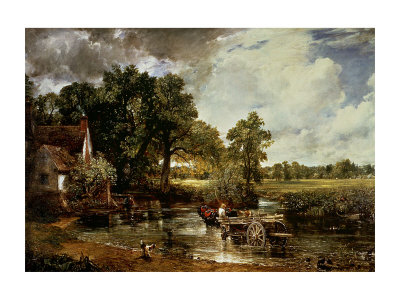
Because The Hay Wain became far more famous, it is tempting to treat Flatford Mill (Scene on a Navigable River) mainly as a precursor. That is only partly useful. Both pictures draw on the Flatford world, and both depend on Constable's knowledge of the Stour, but their emphases differ. The Hay Wain hides most of the mill complex, while Scene on a Navigable River brings the mill economy into clearer view.[4]
The comparison helps us see what is special about the earlier painting. The Hay Wain turns a passage of water near Willy Lott's house into a grander meditation on rural continuity and weather. Flatford Mill (Scene on a Navigable River) is more explicitly about navigation, transport and the working life of the river. Its beauty is inseparable from its practical subject.
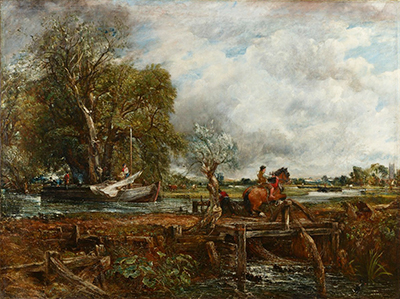
That difference is crucial for the Flatford group as a whole. Constable returned to nearby motifs again and again, but he did not merely repeat himself. A shift of viewpoint could alter the meaning of the scene. A lock, a footbridge, a towpath, a dry dock, a mill wall or a house could each organise a different idea of place. This painting is the one in which the navigable river itself becomes the theme.
The comparison also guards against a sentimental misunderstanding of Flatford. In The Hay Wain, the red-brick edge of the mill is barely present, while Willy Lott's house and the shallow crossing dominate the viewer's memory.[4] In Scene on a Navigable River, the business of the river is much harder to miss. Both works belong to Constable's home country, but they organise that country differently. The earlier picture is closer to the mechanics of river movement; the later one becomes a broader emblem of rural continuity.
Exhibition and significance
When Constable exhibited Scene on a Navigable River in 1817, he was still building the public identity that would later attach to the Stour paintings. The work shows him ready to make local Suffolk scenery carry serious exhibition weight.[4][6] He did not need classical ruins, mountain grandeur or invented pastoral drama. He had Flatford, the Stour, barges, trees and working water.
That confidence is one of the painting's major achievements. Constable's subject is humble only if judged by older hierarchies of art. In pictorial terms it is rich: a known place, a complex spatial arrangement, moving labour, family history, outdoor observation and carefully revised composition. The painting shows him converting intimate knowledge into public form.
It also marks a stage in the long development toward the Stour six-footers. The scale is smaller than the later great canvases, but the ambition is comparable. Constable is already asking whether English landscape, treated through truth of place and seriousness of structure, can stand in the exhibition room as major art. His answer is yes, though quietly.
The survival of the Flatford buildings adds another layer to the painting's afterlife. The National Trust history records the deep age of the mill, the eighteenth-century Constable family connection, the later end of Constable ownership and the twentieth-century acquisition of Flatford Mill with Willy Lott's House.[8] Modern visitors can therefore recognise part of the physical world from which Constable worked, even though the painting itself belongs to Tate. The relationship between object and place remains unusually vivid.
That afterlife should not make the painting feel like a heritage illustration. Constable was not preserving a tourist landmark. He was painting a living system before later restoration, memory and fame settled around it. The modern survival of Flatford helps viewers orient themselves, but the canvas should still be read as an active 1816-17 construction: a working landscape seen by an artist who knew its routines from youth.
How to read the painting
The best way into Flatford Mill (Scene on a Navigable River) is to begin with the foreground and then let the river carry the eye inward. The foreground is not an incidental edge. It is the place where the picture's practical subject becomes visible. The boy, horse and barges explain the relationship between animal power, human instruction and the controlled movement of goods. Once that action is understood, the rest of the landscape ceases to be merely scenic. It becomes the setting in which the work makes sense.
Next, look at the way Constable distributes attention. The right-hand trees have weight and darkness, but the open water prevents them from closing the scene. The river, the buildings and the distant lock relation create a slow pull into depth. This is where the Tate Papers discussion of visual dynamics becomes especially useful: the painting is not a flat inventory of correct outlines, even though Constable used careful means of drawing and transfer.[2] It is organised to make the viewer's eye move.
Finally, notice the balance between exact place and broader feeling. Flatford is specific, and the painting depends on its specificity. Yet the picture also speaks more widely about early nineteenth-century rural life, where agriculture, transport, family capital and seasonal labour were joined together. Constable's achievement is to make that broader meaning emerge from a precise scene. He does not generalise by smoothing away local facts. He generalises through them.
This is why the painting rewards slow looking. At first it may appear gentle and familiar; gradually it reveals itself as a dense account of work, memory, technique and ambition. The more clearly one sees the barges, the towpath, the lock system and the family mill, the more modern the picture feels. Constable is not simply remembering childhood. He is building a serious landscape art out of the material conditions of the place that formed him.
Why the painting matters
Flatford Mill (Scene on a Navigable River) matters because it holds together the two sides of Constable that are often separated: the affectionate painter of home ground and the rigorous maker of compositions. The painting is personal, but not merely private. It is factual, but not merely documentary. It is beautiful, but not detached from work.
The Tate picture also sharpens the meaning of Constable's attachment to the Stour. He was not painting an abstract countryside. He was painting a river he knew as transport, business, play, memory and artistic problem. That layered knowledge gives the picture its unusual steadiness. Nothing feels invented for effect, yet everything has been shaped.
Seen within the wider Constable cluster, the painting is a keystone. It prepares the way for later Flatford and Stour subjects while retaining its own identity as an image of navigation. It reminds us that Constable's realism was not passive copying. It was a demanding practice of attention, revision and feeling, rooted in a place where water moved, horses worked, flour travelled and art began.
Frequently Asked Questions
Discussion
What gives this Flatford scene its power: working-river detail, family memory, composition or the balance between accuracy and revision?
Reader Insights
Trace how horse, boys, barges, water and bridge turn a quiet landscape into a timed sequence of labour.
Consider how knowledge of the family mill deepens the picture without reducing it to autobiography.
Where does the composition feel carefully measured, and where does pictorial judgement take over?
Join the Conversation
Share your reading below.
References
- Tate Shop, Flatford Mill (Scene on a Navigable River), https://shop.tate.org.uk/john-constable-flatford-mill-scene-on-a-navigable-river/johcon004.html
- Iris Wien, “Constable and the Dynamics of Vision,” Tate Papers, no. 33, 2020, https://dig-305-artwork-alt-text-c8b04f.up.railway.app/research/tate-papers/33/constable-dynamics-vision
- Anne Lyles, Museum of Fine Arts, Houston, A View on the Banks of the River Stour at Flatford, https://emuseum.mfah.org/catalogues/the-stuart-collection/objects/127652/a-view-on-the-banks-of-the-river-stour-at-flatford
- National Gallery catalogue, The Hay Wain, https://www.nationalgallery.org.uk/paintings/catalogues/egerton-2000/the-hay-wain
- Flatford and Constable, “Flatford Mill under the Constables,” https://www.flatfordandconstable.org.uk/flatford-mill/flatford-mill-under-the-constables/
- East Bergholt Society, Flatford Mill Scene on a Navigational River, https://www.ebsoc.org.uk/constable-painting/flatford-mill-scene-on-a-navigational-river/
- National Trust, “John Constable at Flatford,” https://www.nationaltrust.org.uk/visit/suffolk/flatford/john-constable-at-flatford
- National Trust, “History of Flatford,” https://www.nationaltrust.org.uk/visit/suffolk/flatford/history-of-flatford
- Graham Reynolds, The Early Paintings and Drawings of John Constable, Paul Mellon Centre / Yale University Press, 1996, https://www.paul-mellon-centre.ac.uk/publications/browse/9780300063370