 by Tom Gurney
Tom Gurney BSc (Hons) is an art history expert with over 20 years experience
Published on August 27, 2026 / Updated on September 6, 2026
Email: tomgurney1@gmail.com / Phone: +44 7429 011000
The Corpus Christi Procession Leaving the Church of Santa Maria del Mar: Introduction
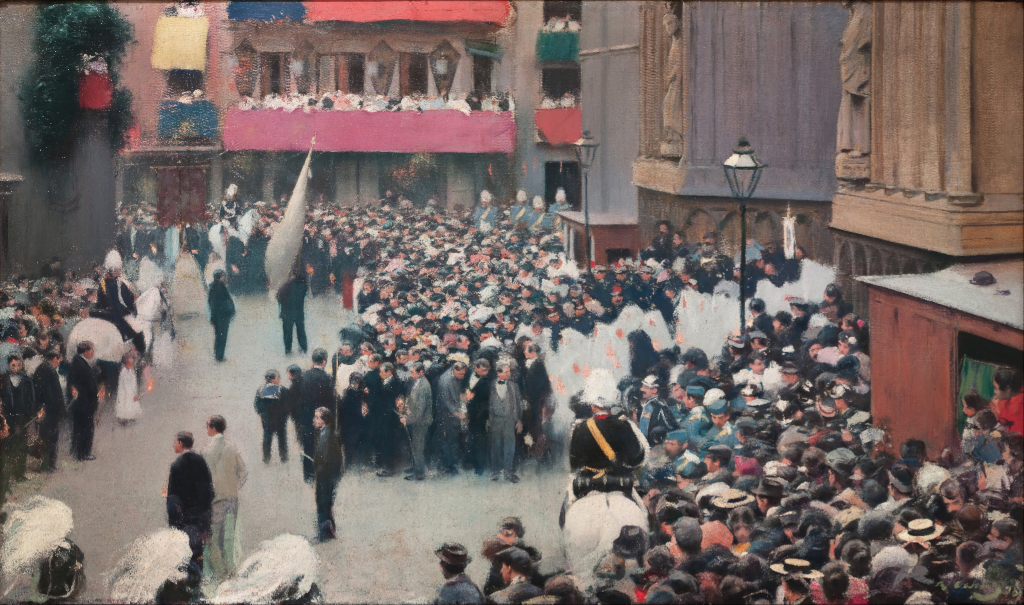
Ramon Casas' The Corpus Christi Procession Leaving the Church of Santa Maria del Mar is one of the most unsettling public scenes in Catalan modern painting.
MNAC records that the work was suggested to Casas by the bomb explosion at the Corpus procession of Santa Maria del Mar on 7 June 1896. Casas chose not to paint the instant of violence. He painted the procession before disaster. [11]
At a Glance
- ArtistRamon Casas
- Datec. 1896-1898 [11]
- MediumOil on canvas
- CollectionMuseu Nacional d'Art de Catalunya
Contents
- Why This Painting Matters
- The 1896 Procession and the Bombing
- Why Casas Paints the Moment Before
- Composition and Point of View
- Modern History Painting in Barcelona
- Relationship to Other Social Paintings
Why This Painting Matters
This painting gives the Casas cluster a different kind of modernity from the cafe, poster and portrait works. It is not about glamorous bohemia or witty friendship. It is about a city under pressure.
Casas takes a public ritual familiar to Barcelona viewers and turns it into a painting about suspense, memory and the fragility of civic order.
The 1896 Procession and the Bombing
The official MNAC catalogue gives the essential context: the bomb explosion at the exit of the Corpus procession in Santa Maria del Mar on 7 June 1896 suggested the painting to Casas. [11]
The attack took place during one of Barcelona's most visible religious and civic rituals. Documentary records preserved by Ajuntament de Barcelona provide contemporary context for the event and its public shock. [12]
Why Casas Paints the Moment Before
The most important interpretive point is Casas' refusal to paint the explosion. He chooses the procession leaving the church, before the known catastrophe.
That gives the painting a double time. Inside the picture, the ritual is still intact. Outside the picture, the viewer knows that the city's order is about to break.
Composition and Point of View
The painting is composed from a slightly elevated view, allowing Casas to organize a complicated public scene without losing the sense of a living street.
We are not standing inside the procession. We are looking across it, close enough to see ceremonial detail and far enough away to understand the crowd as a whole.
Modern History Painting in Barcelona
The work should be presented as modern history painting rather than simply genre painting. MNAC tags the subject as genre and society, but the scale, ambition and link to a specific violent event push it toward history painting. [11]
Its modernity lies in how quietly it handles that history. Casas paints ritual, civic decoration and collective motion, but the viewer's historical knowledge gives every attractive detail a second edge.
Relationship to Other Social Paintings
This article should connect the work to Casas' broader public paintings. In Garrote vil, he depicts a public execution from a distancing viewpoint; in La Carrega, he paints mounted police charging through a crowd. [2]
The Corpus painting is less visibly violent than either, but it belongs in the same family. It shows Casas thinking about crowds, ritual, vulnerability and public memory.
Frequently Asked Questions
Discussion
Is the power of this painting in what Casas shows, or in what he refuses to show?
Reader Insights
How does public ceremony become tense once you know the historical event?
What does this work add to Casas beyond portraits and cafe imagery?
Can a painting of the moment before feel more disturbing than the event itself?
Join the Conversation
Share your reading of this Ramon Casas page below.
References
- Museu Nacional d'Art de Catalunya, "The Corpus Christi Procession Leaving the Church of Santa Maria", accessed 25 July 2026.
- Ajuntament de Barcelona BCNROC, "Horroroso Atentado en Barcelona...", accessed 25 July 2026.
- Museo Nacional del Prado, "Casas y Carbo, Ramon", accessed 25 July 2026.
- Museu Nacional d'Art de Catalunya, Barcelona. Object record: Ramon Casas, The Corpus Christi Procession Leaving the Church of Santa Maria, c. 1896-1898, oil on canvas, inventory 010903-000. Image prepared from a high-resolution source supplied by TheHistoryOfArt.org. Accessed 25 July 2026.