 by Tom Gurney
Tom Gurney BSc (Hons) is an art history expert with over 20 years experience
Published on June 19, 2020 / Updated on October 14, 2023
Email: tomgurney1@gmail.com / Phone: +44 7429 011000
The Holy Family with Saint Anne and the Infant Saint John by El Greco: Introduction
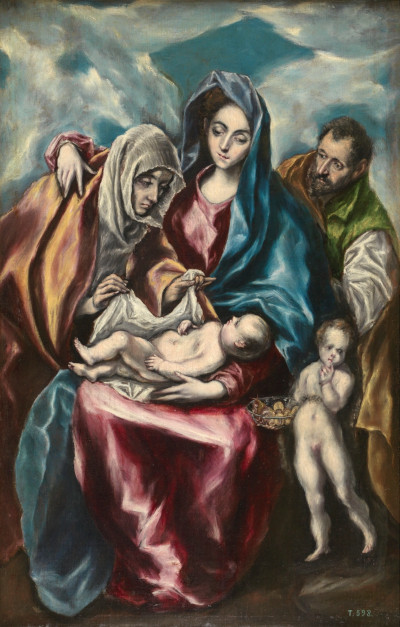
Saint Anne holds the corners of a white cloth above her grandson. The folds hang loosely between her hands, and the child looks up towards her from Mary's lap. Mary supports him with one arm and reaches round her mother's shoulder with the other. Behind her, Joseph bends in from the right. The four faces come close together, yet young John stands far enough to one side to put a finger near his lips and look out from the group. [1] [2]
El Greco painted this version of The Holy Family with Saint Anne and the Infant Saint John around 1600. The Museo Nacional del Prado owns the canvas, and it is on deposit at the Biblioteca Museu Víctor Balaguer in Vilanova i la Geltrú. The picture looks closely related to a smaller painting in Washington. An X-ray of the Prado canvas helps explain the resemblance and makes some of its small differences particularly interesting. One change concerns what the child does while Anne holds the cloth. [1] [2] [3]
At a Glance
- ArtistEl Greco (Doménikos Theotokópoulos) [1] [2]
- TitleThe Holy Family with Saint Anne and the Infant Saint John [1] [2]
- DateAround 1600 in the Prado catalogue. The Balaguer record gives 1595–1600. [1] [2]
- MediumOil on canvas [1] [2]
- Dimensions108.5 × 70 cm in the Prado's digital catalogue. Its 2007 printed catalogue gives 107 × 69 cm. [1] [4]
- CollectionPrado P000826, deposited at the Biblioteca Museu Víctor Balaguer, BMVB-8606 [1] [2]
This work across El Greco’s career
Martyrdom of Saint Maurice
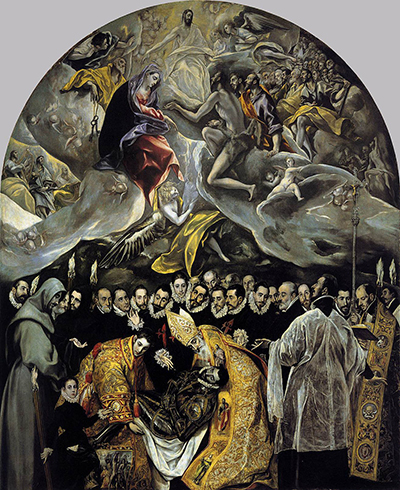
1580–82The Burial of the Count of Orgaz
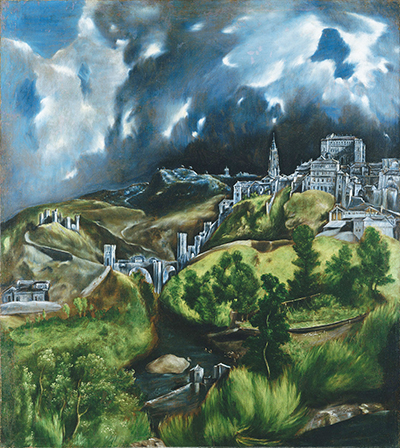
Commissioned 1586View of Toledo
c. 1599–1600The Holy Family with Saint Anne and the Infant Saint John (current article)
Around 1600 in the Prado catalogue. The Balaguer record gives 1595–1600. [1] [2]Opening of the Fifth Seal
c. 1608–14View and Plan of Toledo
1610–14Contents
- The cloth between Anne and the child
- Young John's gesture
- What the Washington version makes clearer
- Other arrangements of the family
- From the Museo de la Trinidad to Vilanova
The cloth between Anne and the child
Anne's white head covering falls close to the sides of her face. Her shoulders make a downward slant from the left edge to the hand nearer Mary. El Greco lights the cloth most strongly where her hands draw it up from the child's body. The upper edges of several folds catch the light, and the gaps between them remain grey. In that narrow area, the painter shows both the soft material and the different directions in which it is being held. The hand on the left is lower, but it holds up enough cloth for us to see the child's legs against it. The other hand gathers the corner just above his chest. [1] [2]
Christ lies across Mary's lap, head to the right and feet to the left. His face turns towards Anne. One of his knees bends above the folds of Mary's blue mantle and one arm rests close to his side. The pale body bridges several otherwise strong blocks of colour. Anne's warmer clothes lie beyond his feet, while Mary's lap is sharply lit in rose and red below him. Mary's supporting hand is visible where the white cloth and her red sleeve meet. It is easy to pass over that hand on the way to the brighter cloth. Look back and the way she holds the child becomes clearer. [1] [2]
Mary's right hand hangs down from her mother's far shoulder. A red cuff against the cloudy sky locates a gesture that would otherwise be hidden by Anne's body. The hand on Anne's shoulder and the hand immediately below the child appear at different levels, but both belong to the way Mary brings two generations together. Joseph leans forward over the other shoulder. His dark hair and beard, the green of his vest and a white sleeve read through gaps at the edge of Mary's mantle. The closeness of the figures makes the direction of each face and hand important. These are the small openings through which each person has room to respond. [1] [2]
Young John's gesture
John stands at the lower right, with one foot set farther back and his body turning slightly in the space between Mary and Joseph. His left hand rises under his chin. The finger is close to his mouth, and the light on his face draws attention to that very small gesture. He carries a bowl in his other hand. Highlights on its rim let it stand out against the red at the edge of Mary's lap. The bowl and the upper part of the cloth are close in height, but the gleam at the rim is sharp and brief, while the linen is described through flat and folded surfaces. [1] [2]
In the Prado catalogue, Leticia Ruiz Gómez refers to Enriqueta Harris's reading of the gesture as a request for silence. Harris compared it with a classical figure of Harpocrates in a print reproduced in Vincenzo Cartari's book on the ancient gods. There the finger near the lips accompanies a branch with fruit. Ruiz Gómez identifies a glass bowl with fruit in this painting. The resemblance makes a case for how a gesture could move from one subject to another. The paint gives the small fruits their shape and leaves their varieties open. The child's position already makes the movement easy to read, because he turns towards the space outside the picture as the others attend to Christ. [1]
Harris connected the gesture and cloth with an established interpretation of Holy Family pictures in which the infant is asleep and his sleep anticipates his death. Ruiz Gómez notes that Christ in the Prado version is awake. His open eye and Anne's downward glance make the encounter immediate. The white cloth can still suggest the shroud in Harris's reading. In front of the painting it is also the fabric an older woman holds ready to wrap a child. The head beneath Mary's blue mantle offers a point of comparison with the The Virgin Mary in the Prado collection. Both paintings frame Mary's face closely within the cloth. Here the long run of the mantle descends to the child's body and belongs to the wider exchange among the figures. [1]
What the Washington version makes clearer
The National Gallery of Art's Holy Family with Saint Anne and the Infant John the Baptist, 1959.9.4, is about half the height of the Prado canvas. John has fuller curls and more clearly modelled limbs. His finger comes directly to his lips, and the dark animal skin lies across his shoulder. The turns of his head and eyes make it easier to see that he is looking away from the child. In the Prado painting his look is more elusive. The gesture is still present, but lighter strokes blur the outline of his lower face and hand. The animal skin is suggested at his waist. In both versions the bowl puts his lowered hand close to Mary. [1] [2] [3]
The Prado X-ray also shows changes elsewhere in the group. An earlier state gave Joseph white hair and beard like the figure in Washington. El Greco darkened both in the finished Prado canvas. The catalogue also describes changes to the head and eyes of Christ and to Mary's line of sight. Her face in the Prado picture seems less directly turned towards the child. The resulting glances are close without all meeting at the same point. Ruiz Gómez allows for the possibility that more than one version drew on a common design and leaves open how the earliest layout on the Prado canvas was made. The X-ray shows what changed on this particular surface. It gives the differences in age, expression and attention a history within the making of the picture. [1] [3]
Other arrangements of the family
The four figures in El Greco's Holy Family with Saint Anne at the Hospital de Tavera gather around a different action. Mary nurses the infant. Anne and Joseph share the space around her, while the open sky comes close to their heads. The Vatican exhibition account dates that canvas to 1586–88 and discusses the significance of the nursing gesture. In the Prado picture the cloth, the returned glance towards Anne and the separate figure of John give the viewer several smaller actions to follow. El Greco could bring a family close together through a direct bodily contact or through gestures that cross the space between faces. [1] [5]
The Nativity made for the Hospital de la Caridad at Illescas centres the newborn differently again. Its institutional record describes the round format and the placement of the work in the sanctuary's decoration. The people gather close to an infant whose light draws their attention into the centre. The tall Prado canvas leaves a long passage below the family. Its red folds catch the light almost down to the ground, and young John's separate stance can be seen from head to foot. The scale and shape of that lower space give his appeal for quiet a place of its own. [1] [6]
From the Museo de la Trinidad to Vilanova
The Prado's published catalogue traces the picture through the Museo Nacional de la Trinidad and into the Prado in 1872. The blue number in the lower right corner is a Trinidad inventory mark. The same corner contains the rock on which the catalogue locates the Greek signature. The two marks are evidence from different stages in the canvas's history. The Trinidad number accompanied the painting as it moved between institutions. The artist's name belongs to the painted scene. Its earlier convent provenance is uncertain, and the Prado catalogue distinguishes a possible archival description from a secure match. [1]
The Prado records the deposit at the Biblioteca Museu Víctor Balaguer from 1986. The Balaguer museum lists it as BMVB-8606 and identifies the Prado as owner. An exhibition or catalogue may therefore refer to the Prado's painting even when the work is seen in Vilanova. The details that help identify it are visible in the museum's own reproduction. Look for Joseph's dark hair, the strong angles of Mary's light-struck skirt and the eye of the child turned up towards Anne. They are a way to carry the particular picture in mind when other versions answer to nearly the same title. [1] [2]
Browse the artworks
Browse the paintings covered in this collection and related works in museum catalogues. Some are by El Greco’s workshop or were formerly attributed to him.
| Name | Date | Medium |
|---|---|---|
| View of Toledo | Around 1599–1600 | Oil on canvas |
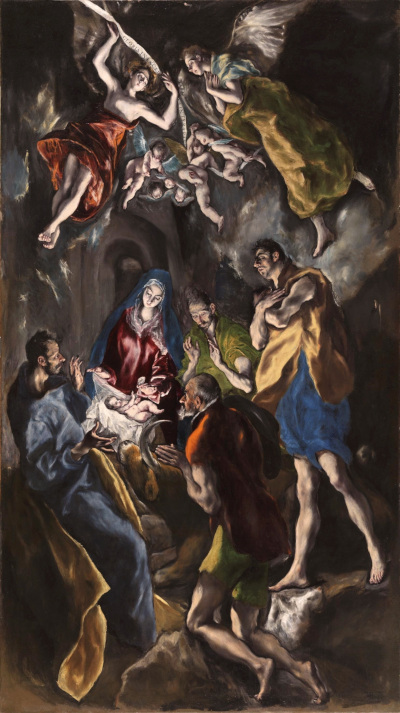
| Adoration of the Shepherds | 1612–14 | Oil on canvas |
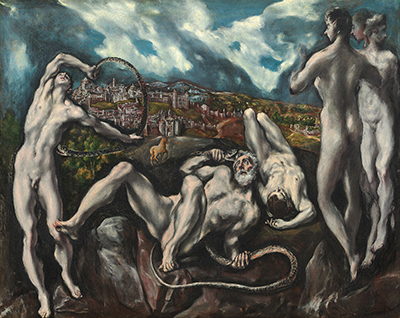
| Laocoön | About 1610–14 | Oil on canvas |
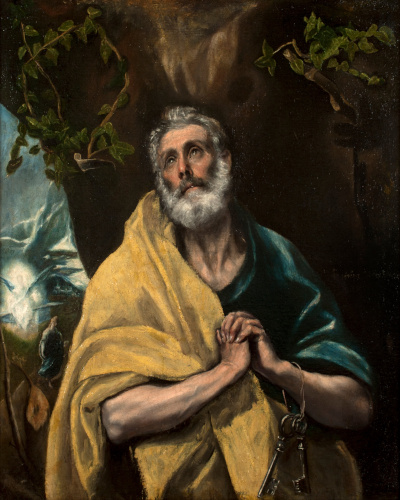
| The Tears of Saint Peter | 1587–96, Museo del Greco dating | Oil on canvas |
| The Holy Family with Saint Anne | About 1595 | Oil on canvas |
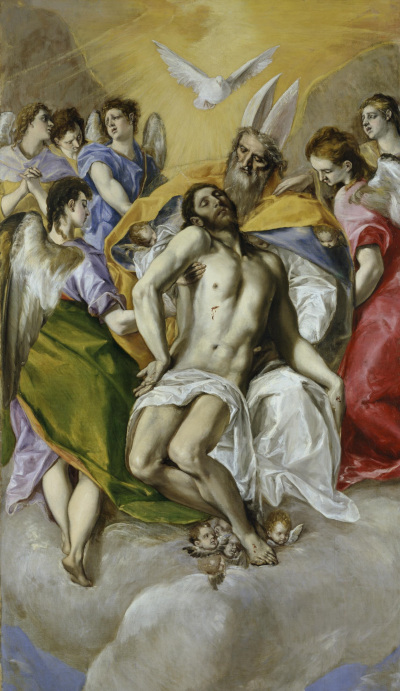
| The Holy Trinity | 1577–79 | Oil on canvas |
| The Burial of the Count of Orgaz | 1586–88, the conventional range | Oil on canvas |
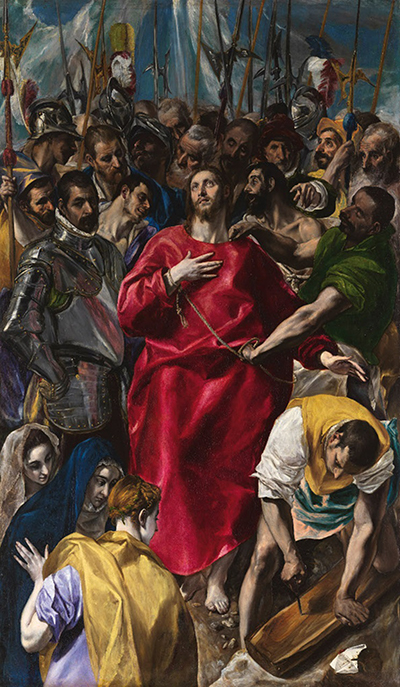
| Disrobing of Christ | 1577–79 | Oil on canvas |
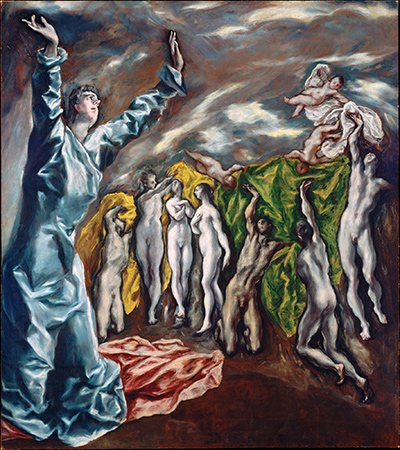
| Opening of the Fifth Seal | About 1608–14 | Oil on canvas |
| Saint Martin and the Beggar | 1597–99 | Oil on canvas |
| Martyrdom of Saint Maurice | 1580–82 | Oil on canvas |
| Adoration of the Name of Jesus | 1577–79 | Oil on canvas |
| Saint Peter in Penitence (Bowes Museum) | 1580s | Oil on canvas |
| Christ Carrying the Cross | Around 1577–87 | Oil on canvas |
| Crucifixion | 1597–1600 | Oil on canvas |
| Resurrection | 1597–1600 | Oil on canvas |
| Immaculate Conception | About 1608–13 | Oil on canvas |
| Annunciation | 1597–1600 | Oil on canvas |
| Coronation of the Virgin | 1591–92 | Oil on canvas |
| Lady in a Fur Wrap | About 1580–88 | Oil on canvas |
| Baptism of Christ | Around 1608–14, with further work in the early 1620s according to Walter Liedtke. The foundation dates the painting to around 1614. | Oil on canvas |
| Portrait of an Old Man (Possible Self-Portrait) | About 1595–1600 | Oil on canvas |
| Adoration of the Kings | 1565–67, Benaki Museum dating | Tempera on wood |
| Mary Magdalene in Penitence | About 1585–90, tentatively dated by the Museu del Cau Ferrat | Oil on canvas |
| Saint Sebastian | About 1577 in the cathedral centenary catalogue | Oil on canvas |
| Portrait of Cardinal Fernando Nino de Guevara | About 1600 | Oil on canvas |
| Penitent Magdalene | About 1576–77 | Oil on canvas |
| The Nobleman with his Hand on his Chest | About 1580 | Oil on canvas |
| Saint Peter and Saint Paul | 1590–1600 | Oil on canvas |
| Pentecost | Circa 1600 | Oil on canvas |
| The Fable | About 1580 | Oil on canvas |
| Pietà | 1580–90 | Oil on canvas |
| View and Plan of Toledo | 1610–1614, according to the Museo del Greco | Oil on canvas |
| Assumption of the Virgin | 1577–79, with 1577 in the Greek inscription | Oil on canvas |
| The Annunciation (1609) | Late Tavera period. The owner dates the canvas to 1614. Factum gives 1608–1613 in its initial recording account. | Oil on canvas |
| The Agony in the Garden of Gethsemane | 1590s | Oil on canvas |
| Portrait of Jorge Manuel Theotocópuli | Circa 1600–05 | Oil on canvas |
| Dormition of the Virgin | About 1565–66, according to the National Gallery of Greece | Tempera on wood |
| Saint Louis | 1585–90 | Oil on canvas |
| Ecstasy of St Francis of Assisi (1580) | About 1577–80 in the Vatican Museums’ account. The Diocesan Museum gives 1575–80. | Oil on canvas |
| Saint Francis of Assisi in Ecstasy, after El Greco | Seventeenth century | Oil on canvas |
| Christ Driving the Money Changers from the Temple | Probably before 1570 | Oil on wood |
| The Entombment of Christ | Circa 1568–70, Venice | Mixed technique on wood |
| Nativity | 1603–05 | Oil on canvas |
| Portrait of a Gentleman | About 1586 | Oil on canvas |
| Coronation of the Virgin (Illescas) | 1603–05 | Oil on canvas |
| A Boy Blowing on an Ember to Light a Candle (El Soplón) | About 1570–72 | Oil on canvas |
| The Feast in the House of Simon | About 1608–14 | Oil on canvas |
| Concert of Angels | About 1608–14 | Oil on canvas |
| Healing of the Man Born Blind | Around 1570 in Dresden’s printed collection guide | Mixed technique on wood |
| Fray Hortensio Félix Paravicino | 1609 | Oil on canvas |
| Purification of the Temple | Circa 1600 | Oil on canvas |
| Portrait of Vincenzo Anastagi | Circa 1575 | Oil on canvas |
| Saint Paul (Almadrones) | 1608–14 | Oil on canvas |
| Head of Christ | About 1579–86 | Oil on canvas |
| Last Supper | About 1567–68, Venice | Tempera on wood |
| Saint John the Evangelist (Prado Museum, Madrid) | About 1605 | Oil on canvas |
| Disrobing of Christ (Lyon, Half Painting Version) | About 1581–86 | Oil on canvas |
| The Dream of Philip II | 1577–79 | Oil on canvas |
| Portrait of a Sculptor | About 1577–80, 2019 exhibition dating | Oil on canvas |
| Saint Bernard | 1577–79 | Oil on canvas |
| Saint Benedict | 1577–79 | Oil on canvas |
| Portrait of Jerónimo de Cevallos | 1613, as catalogued by the Prado | Oil on canvas |
| The Flight into Egypt | About 1570 | Oil on wood |
| Saint Anthony of Padua | About 1580 | Oil on canvas |
| Portrait of a Doctor | 1582–85 | Oil on canvas |
| The Veil of Saint Veronica | 1586–95 | Oil on canvas |
| An Elderly Gentleman | About 1587–1600 | Oil on canvas |
| Saints Andrew and Francis | About 1595 | Oil on canvas |
| The Holy Family with Saint Anne and the Infant Saint John | Around 1600 in the Prado catalogue. The Balaguer record gives 1595–1600. | Oil on canvas |
| The Virgin Mary | 1595–1600 | Oil on canvas |
| Portrait of a Gentleman (1600-1605) | About 1600–05 | Oil on canvas |
| Portrait of a Young Gentleman | 1600–05 | Oil on canvas |
| John the Baptist and Saint John the Evangelist | 1600–10 | Oil on canvas |
| Portrait of a Friar | 1600–50 | Oil on canvas |
| Saint Thomas (Almadrones) | 1608–14 | Oil on canvas |
| Christ the Saviour (Almadrones) | 1608–14 | Oil on canvas |
| An Apostle (Prado P000814) | 1608–14 | Oil on canvas |
| Saint James (Almadrones) | 1608–14 | Oil on canvas |
| Julián Romero and his Patron Saint | 1612–18 | Oil on canvas |
| Allegory of the Camaldolese Order | Around 1600, Instituto Valencia de Don Juan dating | Oil on canvas |
| Saint Joseph and the Christ Child | 1597–99 | Oil on canvas |
| Saint Ildefonsus | Around 1600 according to the Prado's proposal, 1603–05 in Hadjinicolaou and Ficonofue | Oil on canvas |
| Saint Augustine | About 1585–1602, as listed in the 2014 exhibition study | Oil on canvas |
| Portrait of Diego de Covarrubias y Leyva | Circa 1600 | Oil on canvas |
| Saint Bernardino of Siena | 1603 in the Prado catalogue. The Museo del Greco object page lists 1602. | Oil on canvas |
| Portrait of Cardinal Tavera | About 1609 in the foundation's account, circa 1610 in its image heading | Oil on canvas |
| Visitation | About 1610–14 | Oil on canvas |
| Portrait of Francisco de Pisa | Circa 1610–14 | Oil on canvas |
| Saint Lawrence's Vision of the Madonna and Child (Apparition of the Virgin to St. Lawrence) | 1578–80 in the 2021 heritage decree | Oil on canvas |
| Christ on the Cross | Probably 1570s, assigned to El Greco’s Italian period in the sale literature | Oil on canvas |
| Portrait of Charles de Guise | 1572, as dated in the painted book | Oil on canvas |
| Portrait of Giulio Clovio | 1571–72, according to Capodimonte | Oil on canvas |
| Mount Sinai | About 1570–72 | Mixed technique on wood |
| Modena Triptych | 1567–1568, as dated by the Galleria Estense and the national catalogue | Tempera on wood |
| Saint Luke Painting the Virgin | 1560–67, Benaki Museum dating | Mixed technique on wood |
| Saint Ildefonso (Washington) | 1603–14 | Oil on canvas |
| Saint Martin and the Beggar (smaller Washington version) | 1600–14 | Oil on canvas |
| The Holy Family with Saint Anne and the Infant John the Baptist (Washington) | About 1595–1600 | Oil on canvas |
| The Adoration of the Name of Jesus (London panel) | Late 1570s | Oil on wood |
| Christ Driving the Traders from the Temple (London) | About 1600 | Oil on canvas |
| Saint Francis Receiving the Stigmata (Baltimore) | 1585–90 | Oil on canvas |
| Saint Luke (Almadrones, Indianapolis) | About 1610–14 | Oil on canvas |
| Saint Matthew (Almadrones, Indianapolis) | About 1610–14 | Oil on canvas |
| Saint Simon (Almadrones, Indianapolis) | About 1610–14 | Oil on canvas |
| The Tears of Saint Peter (Hospital de Tavera) | About 1605 | Oil on canvas Catalogue. |
Discussion
Look again at the images and ideas explored in The Holy Family with Saint Anne and the Infant Saint John by El Greco. These editorial prompts invite your observations.
Reader Insights
Look from Anne’s hands to the child’s face. Which edge of the white cloth leads most directly to his open eye?
Follow young John’s raised finger and then his line of sight. How does his position affect the attention you give the family?
Join the Conversation
Share a detail, comparison or question about The Holy Family with Saint Anne and the Infant Saint John by El Greco below.
References
- Leticia Ruiz Gómez, El Greco en el Museo Nacional del Prado. Catálogo razonado, Museo Nacional del Prado, 2007, cat. 15, pp. 115–119, and cat. 8, pp. 70–73 View source.
- Biblioteca Museu Víctor Balaguer, La Sagrada Familia con Santa Ana y San Juan, BMVB-8606 View source.
- National Gallery of Art, The Holy Family with Saint Anne and the Infant John the Baptist, 1959.9.4 View source.
- Museo Nacional del Prado, La Sagrada Familia, santa Ana y san Juanito, P000826 View source.
- Vatican exhibition I Cieli aperti. El Greco a Roma, La Sacra Famiglia con Sant'Anna View source.
- Fundación Hospital Nuestra Señora de la Caridad de Illescas, El Greco and the sanctuary paintings View source.