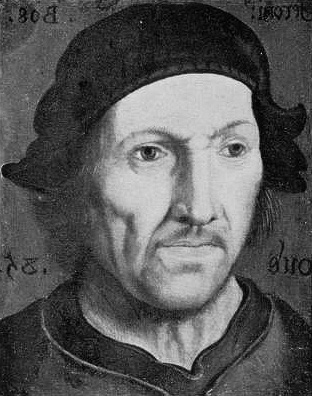
 by Tom Gurney
Tom Gurney BSc (Hons) is an art history expert with over 20 years experience
Published on June 19, 2020 / Updated on November 4, 2026
Email: tomgurney1@gmail.com / Phone: +44 7429 011000
Hieronymus Bosch: Introduction
Hieronymus Bosch is one of the most arresting artists of the Northern Renaissance: a painter of paradise, pilgrimage, folly, temptation and Hell whose images still feel almost impossibly alert. His monsters, hybrid bodies, burning cities, birds, fruits, musical instruments and strange machines can seem to belong to dreams, but Bosch was not an isolated fantasist painting outside his culture. He worked in and around the prosperous Brabant city of 's-Hertogenbosch, within a family of painters, in a devotional world shaped by churches, confraternities, public ritual, moral teaching and a demanding market for painted panels and altarpieces [4] [5].
The artist is usually known in English as Hieronymus Bosch, but the name itself tells part of the story. He was born Jheronimus van Aken, into a family whose name pointed back to Aachen. The name Bosch, or van den Bosch, linked him instead to his city, 's-Hertogenbosch, often shortened in English discussion to Den Bosch. Modern Dutch sources commonly use Jheronimus Bosch, while English-language museum records often use Hieronymus Bosch. Both names refer to the same painter, but the Dutch form is a useful reminder that Bosch's art grew from a particular city and social world rather than from a timeless realm of fantasy [5] [6].
Bosch's surviving works make unusual demands on viewers. They ask us to look slowly, because their meaning is distributed across small actions, edges, reverses, closed wings and recurring motifs. They also ask for caution. Some paintings long attached to Bosch are now attributed to his workshop, followers, later copyists or disputed hands. The Bosch Research and Conservation Project, presented through Closer to Bosch, has made this problem central by separating works associated with Bosch into categories such as Bosch, workshop, followers and workshop or follower [1] [2]. A responsible Bosch overview therefore has to do two things at once: introduce the famous artist behind The Garden of Earthly Delights and acknowledge that the Boschian world is larger than the autograph corpus.
At a Glance
- NameHieronymus Bosch / Jheronimus Bosch [5]
- Bornc. 1450, probably in 's-Hertogenbosch [5]
- Died1516, 's-Hertogenbosch [4]
- City's-Hertogenbosch, also known as Den Bosch [6]
- FieldEarly Netherlandish / Northern Renaissance painting [1]
- Known forTriptychs, moral satire, Hell imagery and devotional invention [13]
- Key cautionBosch, workshop, follower and disputed attributions must be separated carefully [1] [2]
Contents
- Artist Journey Map
- Connections
- At a Glance
- A Painter From 's-Hertogenbosch
- Bosch And The Northern Renaissance
- Why Bosch Still Looks So Strange
- The Triptych Imagination
- Major Paintings And Recurring Subjects
- Hell, Monsters And Moral Vision
- Symbolism Without A Cheat Sheet
A Painter From 's-Hertogenbosch
Bosch's biography is documented in fragments rather than in the rich self-explanatory trail left by later artists. He left no surviving diary or body of letters that can explain his images in his own words. The strongest biography begins instead with records: legal documents, civic references, confraternity material, later testimony and local heritage research brought together by BoschDoc and related institutions [4].
He was born in or shortly before 1450 as the fourth child in a family of five. The Van Aken family was deeply connected to painting. Bosch's great-grandfather, grandfather, father and several uncles were painters, and the evidence suggests that Jheronimus and his brothers learned the trade within this family setting [5]. In 1462 his father, Anthonis van Aken, bought the house known as De Kleine Winst on the market square in 's-Hertogenbosch. Local heritage research identifies it as a long-running family house and painters' workshop, and as the place where Jheronimus probably grew up and received his early training [6].
This matters because Bosch's art is sometimes treated as if it emerged from private eccentricity alone. The workshop setting points in a different direction. It places him inside a trade, a family economy and a city where painters supplied devotional panels, altarpieces, designs and objects for patrons who understood the moral and religious vocabulary of late medieval Brabant. For a fuller document-led account, continue to the Bosch Biography.
's-Hertogenbosch was not a decorative backdrop. Its churches, markets, guild networks and urban institutions helped form the world Bosch knew. He is documented in city records from 1474 to 1516, and by the early 1480s he had married Aleid van de Meervenne, who came from a well-to-do merchant family [4] [7]. The marriage seems to have improved his social standing. He later became a member of the Brotherhood of Our Lady, first as an ordinary member in 1486-87 and then as a sworn brother in 1487-88, placing him within an elite devotional confraternity connected with the city's religious life [7] [4].
The Brotherhood is not a magic key to every image. It does, however, remind us that Bosch's art belongs to a culture where moral reflection, public worship, sin, confession, death and salvation were everyday matters rather than merely artistic themes. Bosch's panels often turn those concerns into visual puzzles: roads that fork, tables that become theatres of sin, figures who ignore warning signs, saints under attack, crowds bent toward folly, and landscapes in which human action has cosmic consequences.
Bosch And The Northern Renaissance
Bosch belongs to the broad world of Early Netherlandish and Northern Renaissance painting, but he is not best understood as a simple member of a style school. In the Low Countries, fifteenth- and early sixteenth-century painters developed extraordinary skills in oil paint, surface description, devotional realism, donor portraiture, landscape distance and the fusion of sacred history with recognisable material life. Bosch inherited that world of precise looking, but he bent it toward unusually compressed moral invention [1] [17].
This is one reason his art differs so strongly from the familiar story of the Italian Renaissance. Bosch was not primarily concerned with antique bodies, classical balance or mathematical perspective as an intellectual display. His art is built instead from late medieval and Netherlandish habits of attention: the close surface, the crowded panel, the triptych wing, the domestic detail, the small moral incident, the devotional object that opens and closes, the sacred subject made present through everyday things. The result is Renaissance painting, but not Renaissance calm.
Bosch's originality lies in how he made that inherited visual language unstable. A landscape can begin as a credible world and become a theatre of temptation. A devotional panel can contain comedy without losing seriousness. A crowd can look both observed from life and morally distorted. A monster can be made from ordinary materials and still feel like a theological warning. Bosch's art therefore sits between the familiar and the impossible: it convinces the eye with precise detail, then uses that precision to show a world out of spiritual order.
That position also helps explain his later influence. Viewers who come to Bosch through Surrealism, fantasy or modern horror may recognise the shock first, but the paintings gain depth when seen beside Netherlandish devotion, urban craft, manuscript humour, moral satire and the object culture of altarpieces. Bosch's strangeness is not a rejection of his world. It is one of the most inventive forms that world produced.
Why Bosch Still Looks So Strange
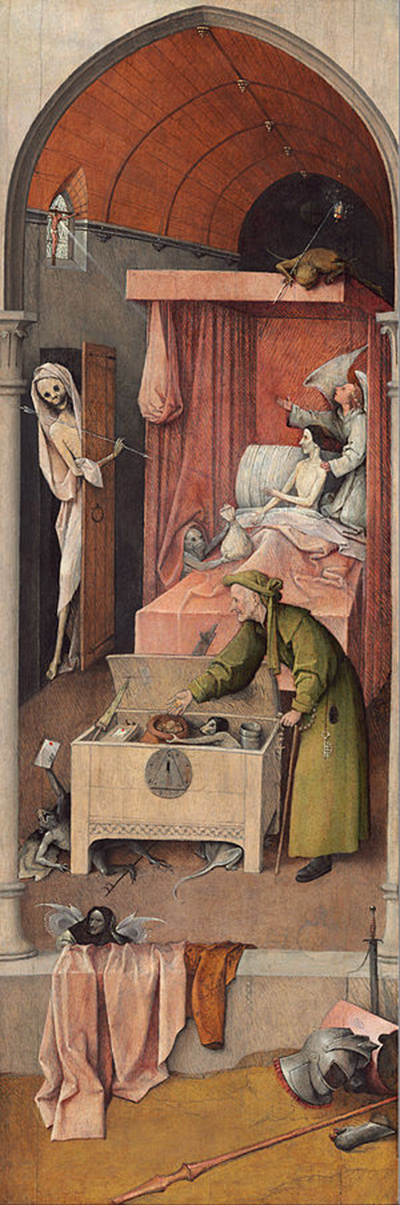
Bosch's fame rests partly on the shock of recognition. His pictures seem distant in costume, theology and technique, yet their world of distraction, appetite, vanity, spectacle and self-deception remains legible. He made moral images without making them simple. The viewer is rarely allowed to stand outside the scene as a comfortable judge. In The Haywain Triptych, humanity crowds around a wagon of hay as if chasing something irresistible and worthless; in Death and the Miser, the central drama is not grand battle but a last interior decision; in The Garden of Earthly Delights, the eye moves from creation to desire to punishment without being given a single modern caption that settles the matter [13] [18].
His strangeness also comes from scale. Bosch often hides the emotional force of a work inside tiny incidents. A monster may be comic and terrifying at once. A sinner may be absurdly busy. A demon may look cobbled together from a bird, a vessel, a tool, a musical instrument or a human limb. The images invite close looking, but they resist the kind of symbolic dictionary that treats every object as a code with one fixed answer. Museum and scholarly sources repeatedly show that Bosch's meanings arise from context, composition, devotional culture, satire, technical evidence and comparison with related works, not from isolated motifs alone [13] [1] [21].
That is why the safest way to read Bosch is to begin with the painting's structure. Is it a triptych with closed and opened states? Does it move from left to right? Does the exterior change the meaning of the interior? Is the work an accepted Bosch painting, a workshop production, a follower's image, a copy after a lost design or a disputed object? Those questions are more useful than asking, too quickly, what a single fruit, bird or instrument "means." For deeper thematic reading, see Bosch Symbolism and Bosch Hell.
The Triptych Imagination
Bosch's major reputation is inseparable from the triptych, the three-part format familiar from Netherlandish devotional painting. A triptych is not simply a wide image split into panels. It is an object with states: closed wings, outer imagery, inner wings, a central scene and a physical rhythm of concealment and revelation. Bosch used that structure to create moral and spiritual sequences that unfold in time as well as space [13] [15].
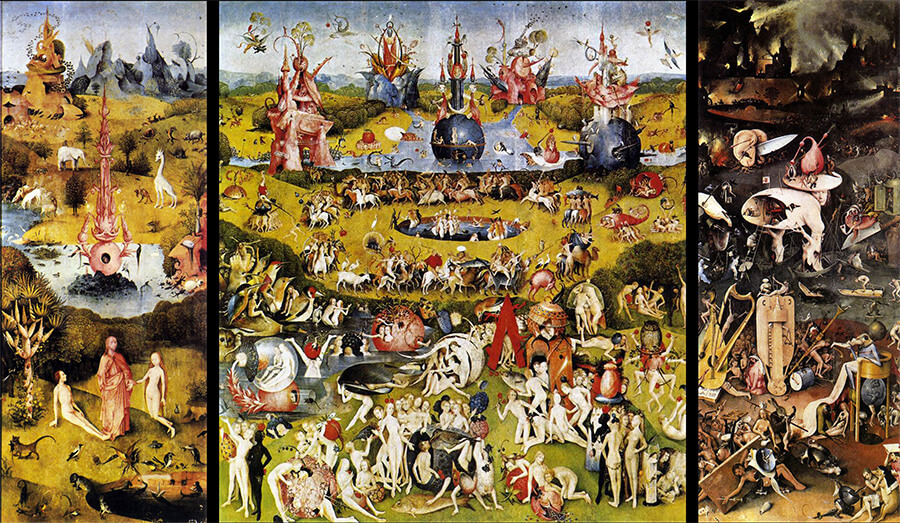
The Garden of Earthly Delights, now in the Prado, is the most famous example. The Prado dates it to 1490-1500 and presents it as oil on oak panel with a grisaille exterior. When closed, the wings show the world at an early stage of creation. When opened, the viewer moves from Eden through a vast central field of naked human activity into a Hell panel dense with punishments, inversions and memorable detail [13]. The work is often treated as Bosch's ultimate enigma, but its power depends on careful construction: closed and opened states, left-centre-right movement, recurring forms and a relationship between beauty and danger that never fully collapses into a simple warning label. Read more in The Garden of Earthly Delights.
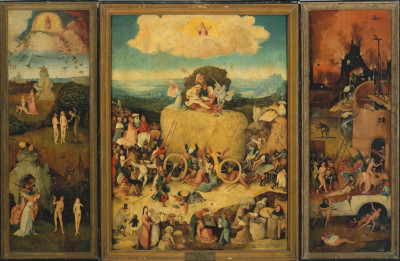
The Haywain Triptych, also in the Prado, offers a different moral architecture. The Prado dates it to 1512-1515. Its inner panels place humanity in pursuit of a hay wagon, a traditional image of worldly vanity, while the left panel traces the origin of sin and the right panel shows infernal consequence [13]. The work's outer wings, like the exterior of several Bosch triptychs, draw attention to the journeying figure and to the problem of human life as a path. The Haywain is often more immediately readable than the Garden, but it is no less subtle. Its crowd is comic, worldly and disturbing; its moral drama depends on motion, desire and distraction rather than a single villain. Explore the full work at The Haywain Triptych.
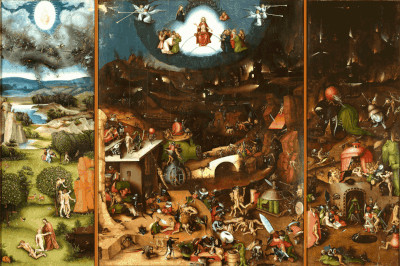
The Last Judgement Triptych in the Academy of Fine Arts Vienna gives the apocalyptic side of Bosch's art a monumental form. The Academy dates it to about 1490-1505 and presents it as one of Bosch's largest and densest works, with the Fall of Man, Last Judgment, torments and grisaille outer wings shaping the viewer's passage through the object [15]. It belongs with the Garden and Haywain as a central example of Bosch's ability to convert doctrine into overwhelming visual sequence. For the dedicated discussion, see The Last Judgement.
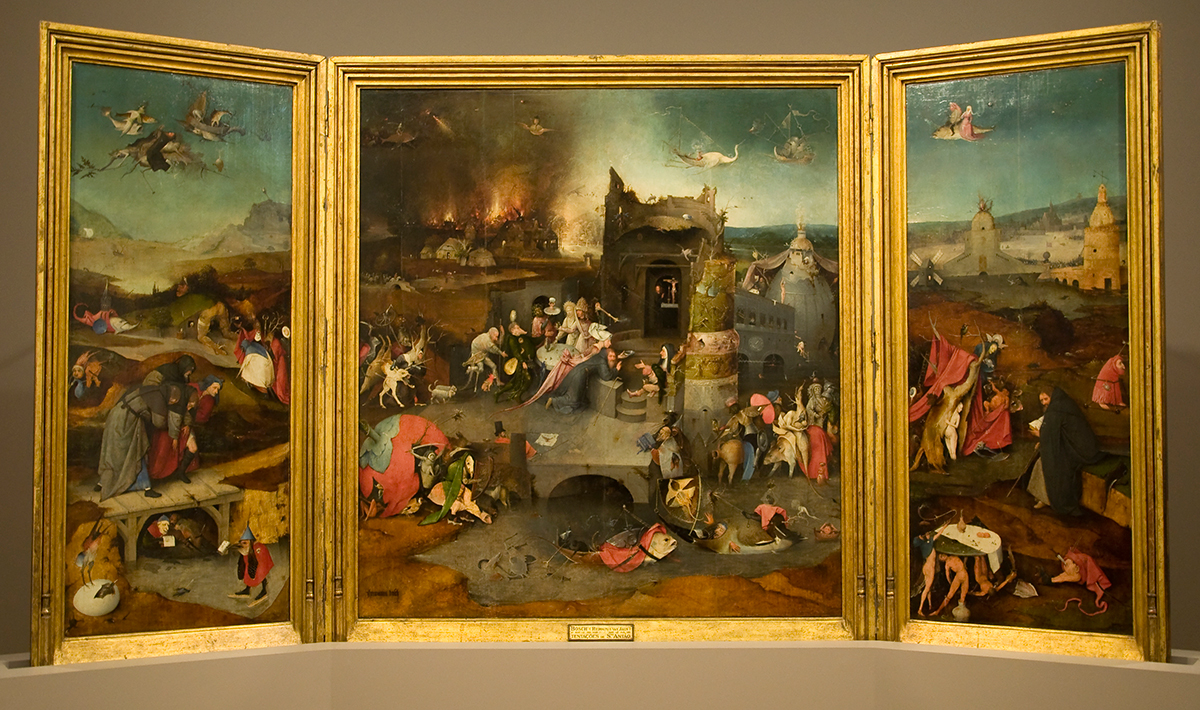
The Temptation of Saint Anthony, held in Lisbon's Museu Nacional de Arte Antiga, brings the triptych format into the world of the hermit saint. Saint Anthony's temptations allowed Bosch to stage assault, distraction, grotesque invention and spiritual endurance around a holy figure who remains under pressure but not overcome [14] [1]. Related panels, copies and prints after Bosch complicate the wider Anthony tradition, so this subject also shows why attribution and version history matter. Continue to The Temptation of Saint Anthony.
Major Paintings And Recurring Subjects
Bosch's best-known works do not form a neat sequence from youth to maturity, and dates often remain approximate. Still, the surviving corpus reveals persistent interests: human folly, moral choice, holy endurance, temptation, passion scenes, pilgrimage, sin, death and the afterlife. The Bosch Paintings hub brings these works together with careful attribution labels, because a Bosch painting list that ignores workshop, follower and copy problems gives readers a false sense of certainty.
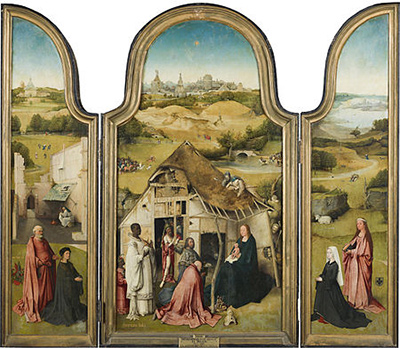
The Triptych of the Adoration of the Magi in the Prado shows Bosch working within a familiar devotional subject while making the details deeply unsettling. The Prado dates it around 1494 and identifies the donors as Peeter Scheyfve and Agneese de Gramme of Antwerp, accompanied by Saint Peter and Saint Agnes. Technical notes point to underdrawing and changes in the painted process, while the reverse and donor imagery help connect the triptych to patronage and private devotion [13]. It is a reminder that Bosch was not only a painter of monsters and Hell. He could handle established sacred subjects with originality, restraint and sharp observation.
Christ Mocked, also known as The Crowning with Thorns, in the National Gallery, London, offers another essential correction to the popular Bosch image. Dated about 1510 by the Gallery, it concentrates the violence around Christ in an unusually tight upright format. The National Gallery's catalogue material notes technical evidence beneath the visible surface, including changes from the underdrawing and an unfinished Saint Christopher beneath the painting [17]. Here Bosch's intensity is not panoramic but compressed. The faces close in; the cruelty is intimate.
Death and the Miser in the National Gallery of Art, Washington, shifts the drama into a chamber. The painting, dated by the NGA to about 1485/1490, presents death, temptation, decision and salvation in a scene that appears small but carries enormous moral pressure [18]. It is often linked with the wider Wayfarer or Pedlar network, including Ship of Fools and related fragments. That network remains important because Bosch's works did not all survive in their original form. Some panels are fragments of larger ensembles, and reconstructions must be explained as reconstructions rather than treated as visual fact.
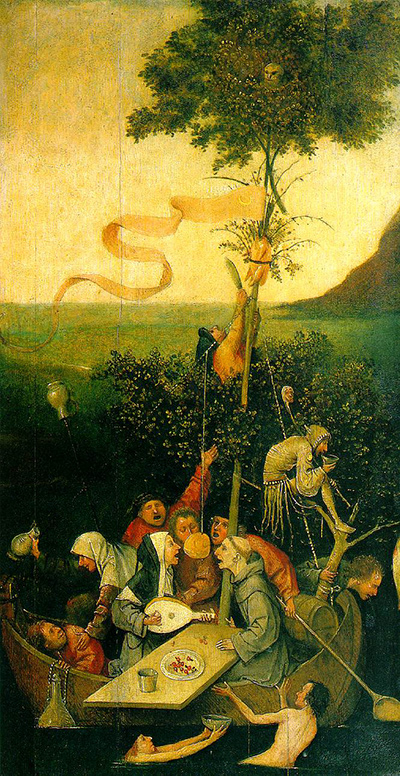
Ship of Fools in the Louvre is one of the most memorable Bosch images of worldly folly. The Louvre dates the work broadly to 1475/1500 and connects the title's modern history with the painting's rediscovery and later identification, while recent Louvre material relates it to Sebastian Brant's famous Ship of Fools tradition and to restoration research [19]. The painting's fragmentary context matters. It is not simply a free-floating satire of foolish people in a boat; it belongs to a broader set of moral images whose original arrangement and missing parts shape interpretation.
The Pedlar, also known as The Wayfarer, in Museum Boijmans Van Beuningen, offers a more solitary version of Bosch's moral journey. Boijmans identifies the work as an oil on panel from around 1500 and notes that it was assembled from the outside wings of a triptych. The museum connects it with surviving interior fragments including Ship of Fools, Allegory of Gluttony and Lust, and Death and the Miser, while also warning that symbolic readings require care [21]. For a viewer, that caution is important: the burdened traveller can suggest Everyman, pilgrimage, moral danger and worldly baggage, but those associations become strongest when grounded in the object's history and related panels.
Hell, Monsters And Moral Vision
Bosch's demons are famous enough to risk becoming detached from the paintings that contain them. They are reproduced as creatures, memes, details and curiosities, but in the paintings they usually function inside larger moral systems. Hell in Bosch is not just a place of horror; it is a world where human choices are inverted, magnified and made grotesquely visible. Musical pleasure becomes torture; appetite becomes exposure; luxury becomes entrapment; foolish movement ends in confinement [13] [15].
The right wing of The Garden of Earthly Delights is the best-known example, but Bosch's infernal imagery stretches across multiple works. The Last Judgement triptych turns the end of history into a dense field of punishments. The Haywain places Hell at the conclusion of worldly pursuit. The Visions of the Hereafter group, associated with Venice, develops another route into afterlife imagery, including ascent, fall and judgment [15] [1]. A focused look at these themes belongs in Bosch Hell, where the point is not to rank the strangest demons but to understand how Bosch visualised consequences.
The monsters themselves often seem assembled from ordinary things: animals, vessels, architecture, tools, food, armour, musical instruments and human fragments. That invented hybridity is part of Bosch's genius, but it should not be read as private hallucination. Late medieval devotional culture, moral satire, manuscript marginalia, carnival imagery, sermons, proverbs and visual humour all help explain why the grotesque could be both entertaining and serious. Bosch intensifies those traditions until the moral world looks physically unstable.
This is also where Bosch can feel modern without being modernist. Later viewers, especially in the nineteenth and twentieth centuries, found in him a precursor to dream imagery, fantasy and Surrealism. That reception is important, but it should not erase the original religious and moral matrix. Bosch did not need twentieth-century psychology to imagine a mind under siege. His world already had sin, temptation, demons, judgment, confession, spiritual trial and bodily folly as powerful visual languages.
Symbolism Without A Cheat Sheet
Few artists attract more confident explanations from weak evidence than Bosch. Birds, berries, eggs, fish, owls, knives, funnels, musical instruments and hollow bodies are often treated online as fixed symbols. Some motifs do have strong traditional associations, and some readings are supported by museum catalogues or scholarship. Others remain interpretive possibilities. Bosch rewards pattern recognition, but he punishes overconfidence.
A careful Bosch reading begins by asking where the motif appears, what the surrounding figures are doing, whether the painting is devotional, satirical, apocalyptic or fragmentary, and whether a museum or recognised scholar has connected that detail with a specific textual, theological or visual tradition. The same object may not carry the same weight in every composition. An instrument in a Garden Hell detail, a vessel in a Saint Anthony temptation and a bird in a moral satire do not automatically mean the same thing [13] [1].
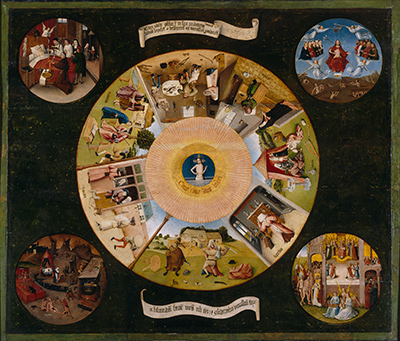
The Table of the Seven Deadly Sins and the Four Last Things shows why caution matters twice over. The Prado attributes the work to Bosch and dates it to 1505-1510, while the object has also been discussed in connection with attribution doubts and the wider Bosch/workshop debate [13] [1]. Its moral structure, with sins arranged around a central eye and the Four Last Things in corner roundels, is a strong subject for interpretation. But the question of authorship changes how the work should be presented. A symbol-led reading that forgets attribution becomes too neat.
Bosch's symbolism is best understood as a set of pressures rather than a set of passwords: sin and folly, sacred history and everyday behaviour, temptation and endurance, journey and judgment, vision and deception. The Bosch Symbolism guide develops those pressures work by work, with special attention to what can be responsibly said and what remains uncertain.
Style, Technique And The Evidence Beneath The Surface
Bosch's style combines precise drawing, sharp silhouettes, thin paint handling, unexpected scale shifts and extraordinary command of small incident. His surfaces can look clean and bright, but the technical evidence beneath them is often complex. Modern research has made Bosch a particularly good subject for close examination because infrared reflectography, X-radiography, dendrochronology, pigment study and conservation records can reveal changes, underdrawing, workshop practice and the relationship between versions [1] [13].
The Prado's technical work on the Garden, Haywain and other paintings helps show how Bosch's compositions developed, how exterior and interior wings were handled, and how technical evidence can clarify dating, sequence and attribution questions [13]. The National Gallery's study of Christ Mocked points to an underdrawing with more forceful brutality than the finished painting, and to the unfinished Saint Christopher beneath the visible image [17]. Boijmans restoration research around works such as Saint Christopher shows how ultraviolet, raking light, XRF, infrared and X-ray examination can deepen the understanding of both image and object [21].
This evidence does not make Bosch less mysterious. It makes the mystery more concrete. The paintings become worked objects: oak panels, underdrawings, revisions, surfaces, restorations, copies and workshop relationships. That matters because Bosch's fame has often been built from reproduced details without enough attention to material evidence. The Style and Technique guide follows that material side of Bosch's art, including how technical study intersects with attribution.
Workshop, Followers And Attribution
Bosch was famous in his own century and became even more famous through copies, variants, workshop images, followers and collectors who wanted Bosch-like invention. This is one reason the Bosch corpus is difficult. A painting may be by Bosch, from his workshop, by a follower, after a lost Bosch composition or wrongly attached to his name by later tradition. In Bosch's case, popularity created a visual language that outlived the hand of the artist.
The Bosch Research and Conservation Project has been especially influential because it treats attribution as a central research question rather than a footnote. Closer to Bosch presents works by Bosch alongside workshop and follower material, encouraging viewers to notice the distinctions rather than flattening everything into a single name [1] [2]. Museum records also vary in how they handle difficult objects. The Prado may retain a Bosch attribution for a work that other scholars question; another museum may present a work as after Bosch, workshop, follower or copy.
The Seven Deadly Sins, The Cure of Folly, Concert in the Egg, some Saint Anthony material, copies of the Adoration, and several drawings or prints require this kind of language. So do works whose original format has been altered or dismantled. When a panel is a fragment of a larger ensemble, or when a later copy preserves a lost design, the story becomes richer but less simple.
For readers, attribution caution is not a technical nuisance. It changes what the image can prove about Bosch. A follower's demon may tell us something about Bosch's reputation, but not necessarily about Bosch's own hand. A copy may preserve a composition, but it may also alter colour, detail and emphasis. A disputed painting may still be historically valuable, but the wording around it has to stay honest. See Workshop and Attribution for the cluster's full guide to Bosch, workshop, follower, copy and disputed works.
Drawings, Prints And Boschian Circulation
Bosch is primarily known as a painter, but drawings and prints are essential to the wider Boschian world. Drawings associated with Bosch and his circle raise complex attribution questions, and not every drawing historically placed under his name can be treated as autograph. Works such as the Tree Man drawing are important because they show how Boschian invention could exist outside large painted triptychs, but they need object-level evidence and careful labels [1] [23].
Prints require an even clearer distinction. Bosch himself is not securely known as a printmaker in the way Durer or Rembrandt is. The strong Bosch print story is a story of images after Bosch: engravings, copies, adaptations and print culture that helped his inventions circulate beyond the original paintings. The Metropolitan Museum of Art, National Gallery of Art, Rijksmuseum and British Museum all preserve after-Bosch or Bosch-related print material that can show how later artists, publishers and collectors transformed Bosch's visual language [24] [25].
That circulation shaped reception. Boschian monsters and moral satires moved into a broader visual culture, including prints associated with Hieronymus Cock and later artists such as Pieter Bruegel the Elder. The result is a tradition that is not simply "Bosch" but Boschian: indebted to Bosch's imagination, yet mediated by workshop practice, copying, publication, collecting and later taste. For more, see Bosch Drawings and Bosch Prints.
Reception, Quotes And The Problem Of Bosch's Voice
Bosch's reception begins early, but Bosch's own voice is hard to hear directly. No secure body of personal writings has emerged to let him explain his intentions. For that reason, a Bosch quotes collection has to be handled differently from a page of artist sayings. The most reliable "Bosch in words" material comes from documents, inventories, early witnesses, collectors, later writers, museum catalogues and scholars [4] [13].
Spanish collecting played a major role in Bosch's afterlife. Philip II valued Bosch's works and sent several to El Escorial, including the Adoration of the Magi and the Table of the Seven Deadly Sins, according to Prado provenance records [13]. The Garden of Earthly Delights also has an early reception trail through the Nassau palace context and Antonio de Beatis's 1517 account, with modern Prado scholarship treating the older simplified gift story carefully [13]. These records matter because they show Bosch's art being collected, interpreted and moved through elite settings within a century of his death.
Later writers made Bosch into many different things: moral satirist, religious visionary, inventor of demons, ancestor of fantasy, proto-Surrealist and master of grotesque imagination. Some of those labels reveal more about later viewers than about Bosch. A careful reception history uses those labels as evidence of changing taste, not as proof of Bosch's private psychology. For documented commentary and early testimony, see Bosch Quotes and, when available, reception-focused essays within the wider Bosch cluster.
How To Start With Bosch
For a first encounter, begin with the triptychs. The Garden of Earthly Delights shows Bosch at his most expansive and enigmatic. The Haywain Triptych offers a sharper moral satire on worldly pursuit. The Last Judgement gives the apocalyptic vision monumental force. The Temptation of Saint Anthony shows the holy figure under assault from a world of grotesque invention. Together, they introduce Bosch's range better than any isolated monster detail.
Then move to the smaller moral and devotional works. Death and the Miser, Ship of Fools, Christ Mocked, the Adoration of the Magi, Ecce Homo and The Pedlar show how Bosch could concentrate moral drama in interiors, fragments, devotional scenes and solitary figures. They also show why the Bosch corpus cannot be reduced to Hell. Bosch painted sacred history, donor devotion, Passion imagery, moral allegory, journeying figures and scenes of temptation as well as infernal punishment [18] [19] [17] [21].
Finally, read across the support topics. The biography gives the document-led life. The paintings hub explains the corpus. The symbolism guide slows down iconography. The technique guide follows materials and underdrawing. The workshop and attribution guide protects the difference between Bosch and Boschian. The hell, drawings, prints and quotes sections widen the field without losing the evidence. Bosch's world is strange enough without exaggeration; the sources make it stranger, sharper and more human.
Artworks and related attributions
Browse paintings, drawings and related attributions. Records group triptychs, fragments and two-sided sheets where appropriate. Dates follow the cited museum records or catalogue headings and are generally estimates. Rows marked “2016 catalogue” report that publication’s attribution and collection information; these are dated opinions, rather than a claim that every work is an accepted autograph Bosch.
| Name | Date | Medium, attribution and collection |
|---|---|---|
| A Crossbowman | Second half of the sixteenth century | Oil on oak panel · Copy after Hieronymus Bosch · Museo Nacional del Prado, Madrid · P002695 Source 1. Source 2. |
| A Woman Spinning and an Old Woman | Museum estimates: about 1480–1490 for the women and 1500–1505 for the reverse; the precise chronology is disputed | Pen and brown and grey ink on the front; pen and brown ink on the reverse · Hieronymus Bosch · Museum Boijmans Van Beuningen, Rotterdam · N 190 recto and verso (PK) Source 1. Source 2. |
| Adoration of the Child in Cologne | Second half of the sixteenth century | Oil on oak panel · Imitator of Hieronymus Bosch, in the city collection record · Wallraf-Richartz-Museum & Fondation Corboud, Cologne · WRM 0474 Source 1. Source 2. |
| Adoration of the Magi in Philadelphia | Early sixteenth century in the museum record; around 1495–1520 in the BRCP catalogue | Oil on oak panel · Hieronymus Bosch in the museum record; workshop of Bosch in the 2016 BRCP catalogue · Philadelphia Museum of Art, John G. Johnson Collection, 1917 · 1321; museum object 103592 Source 1. Source 2. |
| Adoration of the Magi — New York | c.1470–1480 | 2016 catalogue: Bosch; oil on oak · Metropolitan Museum 13.26 2016 catalogue. |
| Adoration of the Magi — Prado triptych | c.1494 | Oil on oak; grisaille exterior · Bosch · Prado P002048 Object source. |
| Adoration of the Magi — three associated fragments | c.1515–1535 | 2016 catalogue: Follower of Bosch · Two Shepherds / Retinue in Philadelphia; associated Adoration in private collection in 2016 2016 catalogue. |
| Ascent of the Blessed — Venice | c.1505–1515 | Oil on panel · Bosch · Gallerie dell’Accademia; Visions of the Hereafter Object source. |
| Battle of the Birds and Mammals | Not specified in catalogue heading | 2016 catalogue: Bosch; pen and brown ink · Berlin KdZ 14715 2016 catalogue. |
| Beggars and Musicians | Around 1530–1540 | Ink and wash on paper · Unknown follower of Hieronymus Bosch · Albertina, Vienna · 7798 Source 1. Source 2. |
| Christ Carrying the Cross Drawing | Around 1470 in the museum catalogue | Black chalk or charcoal, pen and brush in brown ink, white corrections · Anonymous, workshop of Rogier van der Weyden · Museum Boijmans Van Beuningen, Rotterdam · N 81 recto and verso (PK) Source 1. Source 2. |
| Christ Carrying the Cross in Vienna | Around 1490–1510 in the current KHM record and BRCP catalogue | Oil on oak, painted on both sides · Hieronymus Bosch; possible workshop involvement in the Passion side discussed by the BRCP · Kunsthistorisches Museum, Vienna · Gemäldegalerie, GG 6429 Source 1. Source 2. |
| Christ Carrying the Cross — El Escorial | c.1495–1505 | 2016 catalogue: Bosch; oil on oak · Patrimonio Nacional 10014739 2016 catalogue. |
| Christ Carrying the Cross — Ghent | c.1510–1516 (museum) | Oil on panel · Bosch in museum listing; authorship disputed · MSK Ghent 1902-H Object source. |
| Christ Mocked — London | c.1510 | Oil on wood · Bosch · National Gallery NG4744 Object source. |
| Concert in the Egg, After Hieronymus Bosch | Around 1561; third quarter of the sixteenth century | Oil on canvas · Anonymous, after Hieronymus Bosch · Palais des Beaux-Arts, Lille · P 816 Source 1. Source 2. |
| Conjurer / Comical Concert — Louvre drawing | Not specified in catalogue heading | 2016 catalogue: Bosch (recto), follower (concert verso) · Pen and brown ink · Louvre INV 19197 2016 catalogue. |
| Conjurer / Cross-bearing and beggars — Liège sheet | Not specified in catalogue heading | 2016 catalogue: Bosch (verso), follower (recto) · Pen and brown ink · Album d’Arenberg 534 2016 catalogue. |
| Crowning with Thorns — El Escorial | c.1530–1540 | 2016 catalogue: Follower of Bosch; oil on oak · Patrimonio Nacional 10014743 2016 catalogue. |
| Crucifixion with a Donor | Circa 1495–1505; Circa 1490–1500 | Oil on oak panel · Hieronymus Bosch · Royal Museums of Fine Arts of Belgium, Brussels · 6639 Source 1. Source 2. |
| Death and the Miser Drawing | Not securely established; probably made after the painting | Pen and brush, dark ink and white highlights on prepared paper · Workshop of Hieronymus Bosch in the BRCP catalogue; alternatives recorded by the Louvre · Musée du Louvre, Department of Prints and Drawings, Paris · RF 6947, Recto Source 1. Source 2. |
| Death and the Miser — Washington | c.1485/1490 (NGA) | Oil on panel · Bosch · National Gallery of Art 1952.5.33 Object source. |
| Ecce Homo Triptych — Boston | c.1495–1500; wings c.1500/1503 | 2016 catalogue: Workshop of Bosch; oil on oak · Museum of Fine Arts Boston; several production phases 2016 catalogue. |
| Ecce Homo — Frankfurt | c.1490 | Mixed technique on oak · Bosch · Städel 1577 Object source. |
| Fall of the Damned — Venice | c.1505–1515 | 2016 catalogue: Bosch; oil on panel · Visions of the Hereafter · Venice 2016 catalogue. |
| Garden of Earthly Delights | 1490–1500 (Prado) | Oil on oak; grisaille exterior · Bosch · Prado; triptych Object source. |
| Gluttony and Lust / Allegory of Intemperance — Yale fragment | c.1500–1510 (group dating) | 2016 catalogue: Bosch; oil on oak · Yale 1959.15.22; fragment associated with Ship of Fools 2016 catalogue. |
| Group of Ten Spectators, a Follower of Bosch | Around 1510–1540 in the current museum record | Pen and two brown inks on paper, with a brown framing line · Follower of Hieronymus Bosch in the Morgan record; Bosch in the BRCP catalogue · Morgan Library & Museum, New York · I, 112 Source 1. Source 2. |
| Head of an Old Woman | About 1500 | Oil on panel · Attributed to Jacob Cornelisz. van Oostsanen · Museum Boijmans Van Beuningen, Rotterdam · 2439 (OK) Source 1. Source 2. |
| Hell and the Flood — Rotterdam panels | Around 1515 in the museum records; around 1510–1520 in the BRCP catalogue | Oil on oak panels · Jheronimus Bosch in the museum records; workshop of Bosch in the BRCP catalogue · Museum Boijmans Van Beuningen, Rotterdam Source 1. Source 2. |
| Hermit Saints Triptych | Circa 1495–1505 | Oil on oak panels · Hieronymus Bosch · Gallerie dell’Accademia, Venice · 2044 Source 1. Source 2. |
| Infernal Landscape | Not specified in catalogue heading | 2016 catalogue: Bosch; pen and brown ink, red accent · Private collection in 2016 2016 catalogue. |
| Infernal Scene with Anvil / Monster Studies | Not specified in catalogue heading | 2016 catalogue: Bosch; attribution debated in entry · Pen and brown ink · Berlin KdZ 548 2016 catalogue. |
| Infernal Scene with Tree-Man / Standing Man | Not specified in catalogue heading | 2016 catalogue: Workshop of Bosch; pen and brown ink · Dresden C 1875; historical reverse title includes a proposed prophet 2016 catalogue. |
| Job Triptych — Bruges | c.1510–1520 | 2016 catalogue: Workshop of Bosch; oil on oak · Groeningemuseum / Hoeke loan in 2016 2016 catalogue. |
| Last Judgement — Bruges triptych | c.1495–1505 | 2016 catalogue: Bosch; oil on oak · Groeningemuseum 2016 catalogue. |
| Last Judgement — Munich fragment | c.1530–1540 | 2016 catalogue: Follower of Bosch; oil on oak · Alte Pinakothek 5752 2016 catalogue. |
| Last Judgement — Vienna triptych | c.1500–1505 (BRCP 2016) | Oil on oak · Bosch and workshop (BRCP 2016) · Academy of Fine Arts Vienna 2016 catalogue. |
| Man in a Basket and Comic Figures | Around 1500–1515 in the museum record | Pen and brown ink on paper; the reverse is catalogued as iron-gall ink · Hieronymus Bosch in the current Albertina record; attribution has been debated · Albertina, Vienna · 7797 recto and verso Source 1. Source 2. |
| Man Seen from Behind | About 1550–1569; About 1565–1570 | Traces of black chalk, pen and brush in light brown ink · Anonymous, circle of Pieter Bruegel the Elder · Museum Boijmans Van Beuningen, Rotterdam Source 1. Source 2. |
| Mary and John at the Foot of the Cross | About 1440 | Brush in grey and black · Unknown, possibly Netherlandish · Kupferstich-Kabinett, Staatliche Kunstsammlungen Dresden · C 815 Source 1. Source 2. |
| Model Sheet with ‘Witches’ | Disputed; proposals depend on the attribution | Pen and brown ink; the BRCP also records underlying black chalk · Hieronymus Bosch; follower attributions also recorded · Musée du Louvre, Département des Arts graphiques, Paris · INV 19721 recto Source 1. Source 2. |
| Peasant and Three Bust-Length Figures | 1401–1500 | Brown pen over a black preliminary drawing · Attributed to the Master of the Drapery Studies; Bosch circle also recorded · Kupferstichkabinett, Staatliche Museen zu Berlin · KdZ 777 Source 1. Source 2. |
| River to Hell — Venice | c.1505–1515 | 2016 catalogue: Bosch; oil on panel · Visions of the Hereafter · Venice 2016 catalogue. |
| Saint Anthony and a Concert in an Egg | Around 1510–1525 in the museum’s 2016–17 exhibition texts | Pen in light and dark brown inks · Workshop of Hieronymus Bosch; underlying monsters: Bosch (BRCP), possibly Bosch (exhibition text) · Kupferstichkabinett, Staatliche Museen zu Berlin · KdZ 711 recto and verso Source 1. Source 2. |
| Saint Christopher Carrying the Christ Child | c.1500; 1490–1505 in restoration material | Oil on panel · Bosch · Boijmans St 26 Object source. |
| Saint James and Hermogenes | About 1551–1575 in the KIK-IRPA catalogue | Oil on wood, painted on both sides · Anonymous follower of Hieronymus Bosch · Musée des Beaux-Arts, Valenciennes · P.46.1.44; older number 176 Source 1. Source 2. |
| Saint Jerome at Prayer | Circa 1485–1495 | Oil on oak panel · Hieronymus Bosch · Museum of Fine Arts, Ghent · 1908-H Source 1. Source 2. |
| Saint John on Patmos / Passion Scenes | c.1495–1505; estimates vary | Oil on oak · Bosch · Gemäldegalerie Berlin 1647A Object source. |
| Saint John the Baptist in Meditation | Late 15th century; c.1485–1510 (Prado exhibition) | Oil on panel · Bosch · Lázaro Galdiano 8155 Object source. |
| Saint Liberata Triptych | Circa 1495–1505 | Oil on oak panels · Hieronymus Bosch · Gallerie dell’Accademia, Venice · 2045 Source 1. Source 2. |
| Seven Deadly Sins and the Four Last Things | 1505–1510 (Prado) | Oil on poplar · Bosch (Prado); workshop/follower disputed · Prado Object source. |
| Ship of Fools — Louvre painting | 1475–1500 (record); c.1505–1515 (exhibition) | Oil on oak · Bosch · Louvre RF 2218; fragment Object source. |
| Ship of Fools — Louvre workshop drawing | Not specified in catalogue heading | 2016 catalogue: Workshop of Bosch · Pen, brush, grey-brown ink and white highlights on prepared paper · Louvre RF 3714 2016 catalogue. |
| Studies of Monsters | About 1530–1550, according to the current Ashmolean record | Pen and brown ink on laid paper, both faces · Anonymous follower of Hieronymus Bosch · Ashmolean Museum, University of Oxford · WA1863.155 Source 1. Source 2. |
| Studies of Saint Anthony and Monsters | No execution date specified in the current Louvre records | Pen and brown ink on paper · Bosch listed; reverse questioned by Louvre; BRCP accepts both faces · Musée du Louvre, Département des Arts graphiques, Paris · INV 20871 recto and verso Source 1. Source 2. |
| Temptation of Saint Anthony — Kansas City fragment | c.1500–1510 | 2016 catalogue: Bosch; oil on oak · Nelson-Atkins 35–22 2016 catalogue. |
| Temptation of Saint Anthony — Lisbon triptych | c.1500 | Oil on oak · Bosch · Museu Nacional de Arte Antiga 1498 Pint Museum. |
| Temptation of Saint Anthony — Prado panel | c.1530–1540 | 2016 catalogue: Follower of Bosch (2016 opinion); oil on oak · Prado P002049 2016 catalogue. |
| Terrestrial Paradise | Approximately 1505–1515 | Oil on oak panel · Hieronymus Bosch · Gallerie dell'Accademia, Venice Source 1. Source 2. |
| The Burning Ship Drawing | 1500–1520 | Pen and iron gall ink on paper · Attributed to Hieronymus Bosch · Academy of Fine Arts Vienna, Graphic Collection · HZ-2554; numbered 2554 in the BRCP catalogue Source 1. Source 2. |
| The Comical Barber Scene | About 1550–1580, according to the British Museum | Pen and brown ink, grey and brown wash, over black chalk · Anonymous follower, after Hieronymus Bosch · British Museum, Department of Prints and Drawings, London · 1854,0628.46 Source 1. Source 2. |
| The Conjuror, After Hieronymus Bosch | Probably after 1525; around 1530–1540 in the BRCP technical report | Oil on oak panel · Anonymous follower of Hieronymus Bosch · Musée Ducastel-Vera, Saint-Germain-en-Laye · 872.1.87 Source 1. Source 2. |
| The Cure of Folly / Extraction of the Stone of Madness | 1501–1505 (Prado) | Oil on oak · Bosch (Prado); workshop/follower disputed · Prado P002056 Object source. |
| The Entombment Drawing | About 1505–1515, current museum record | Brush and black and grey ink, with grey wash, over black chalk · Workshop of Hieronymus Bosch; drawn by the Master of the Prado Haywain Triptych; Hieronymus Bosch, argued by the BRCP in 2016 · British Museum, Department of Prints and Drawings, London · 1952,0405.9 Source 1. Source 2. |
| The Gathering of the Birds | Not specified in catalogue heading | 2016 catalogue: Bosch; pen and brown ink · Berlin KdZ 13136 2016 catalogue. |
| The Haywain — Prado triptych | 1510–1516 (BRCP 2016) | Oil on oak · Bosch (BRCP 2016) · Prado; separate Escorial version exists 2016 catalogue. |
| The Hearing Forest and the Seeing Field | Circa 1500–1505 | Pen and brown ink on paper · Hieronymus Bosch; reverse: Bosch and workshop · Kupferstichkabinett, Staatliche Museen zu Berlin · KdZ 549, front and reverse Source 1. Source 2. |
| The Owl’s Nest — Rotterdam | Not specified in catalogue heading | 2016 catalogue: Bosch; pen and brown ink · Boijmans N 175 2016 catalogue. |
| The Passion Triptych in Valencia | Workshop of Bosch, about 1510–1520; Follower of Bosch; centre about 1530–1540, wings about 1540–1550 | Oil and gold on oak panels · Workshop of Bosch, about 1510–1520; Follower of Bosch; centre about 1530–1540, wings about 1540–1550 · Museu de Belles Arts de València Source 1. Source 2. |
| The Pedlar / Wayfarer — Rotterdam | c.1500 (museum) | Oil on panel · Bosch · Boijmans 1079 (OK); rejoined exterior Object source. |
| The Tree-Man — Vienna drawing | c.1505 | Pen and brown ink · Bosch · Albertina, Vienna Object source. |
| The Wedding at Cana, After Hieronymus Bosch | Approximately 1560 in the current museum record | Oil on panel, 93 cm high × 72 cm wide · Anonymous, after Hieronymus Bosch · Museum Boijmans Van Beuningen, Rotterdam, St 25 Source 1. Source 2. |
| Two Fantastical Creatures — Berlin KdZ 550 | Around 1505–1515 in the museum’s 2016 exhibition text | Pen in brown ink on reddish prepared laid paper · Hieronymus Bosch · Kupferstichkabinett, Staatliche Museen zu Berlin · KdZ 550, recto and verso Source 1. Source 2. |
| Two Figures Wearing Mitres | About 1480 | Oil on panel · Anonymous (Boijmans); Bosch circle (RKD) · Museum Boijmans Van Beuningen, Rotterdam · 1177 (OK) Source 1. Source 2. |
| Two Men and the Temptation of Eve | About 1505–1515 in the Prado’s 2016 exhibition guide | Pen and grey-brown ink on paper · Hieronymus Bosch in the 2016 catalogues discussed here · Private collection, as recorded in 2016 Source 1. Source 2. |
| Two Men Fighting | Not specified in the current Louvre record | Pen and brown ink · In the manner of Hieronymus Bosch · Musée du Louvre, Département des Arts graphiques, Paris · INV 20660 recto; formerly NIII 8896 and MA 8400 Source 1. Source 2. |
| Two Men — Berlin KdZ 5210 | Not specified in catalogue heading | 2016 catalogue: Bosch questioned · Pen, brush, ink, chalk and white highlights · Berlin KdZ 5210; historical title Two Oriental Men 2016 catalogue. |
| Two Monsters — Berlin KdZ 547 | Approximately 1500–1510 in Berlin's 2016 exhibition catalogue; an estimated range | Pen and brown ink on paper · Hieronymus Bosch · Kupferstichkabinett, Staatliche Museen zu Berlin · KdZ 547, drawn on both sides Source 1. Source 2. |
Discussion
Look again at the images and ideas explored in Hieronymus Bosch. These editorial prompts invite your observations.
Reader Insights
Which detail or passage most changes how you understand this subject?
Which comparison with another work by Bosch helps you see it differently?
Which interpretation is best supported by the sources, and which remains uncertain?
Join the Conversation
Share a detail, comparison or question about Hieronymus Bosch below.
References
- Bosch Research and Conservation Project: View source
- Closer to Bosch, Bosch Research and Conservation Project: View source
- BoschDoc database, Huygens ING / KNAW: View source
- Huygens ING / KNAW BoschDoc resource page: View source
- Bosch500 biography and family-life materials: View source
- De Kleine Winst / Huis van Bosch: View source
- Rijksmuseum Bosch biography route: View source
- Museo Nacional del Prado, Bosch artist page: View source
- Museo Nacional del Prado, The Garden of Earthly Delights Triptych: View source
- Museo Nacional del Prado, The Haywain Triptych: View source
- Museo Nacional del Prado, Triptych of the Adoration of the Magi: View source
- Museo Nacional del Prado, Table of the Seven Deadly Sins: View source
- Museo Nacional del Prado, Bosch: The 5th Centenary Exhibition: View source
- Museu Nacional de Arte Antiga, The Temptations of Saint Anthony: View source
- Academy of Fine Arts Vienna, Bosch's Last Judgement Triptych: View source
- National Gallery, London, Christ Mocked (The Crowning with Thorns): View source
- National Gallery, London, Lorne Campbell catalogue entry for Christ Mocked: View source
- National Gallery of Art, Washington, Death and the Miser: View source
- Louvre Collections, La Nef des fous: View source
- Museum Boijmans Van Beuningen, The Pedlar: View source
- Museum Boijmans Van Beuningen, Jheronimus Bosch: the Devil Maker: View source
- Stadel Museum, Ecce Homo: View source
- Albertina, drawings and prints collection: View source
- Metropolitan Museum of Art, after-Bosch and related collection records: View source
- British Museum, Bosch-related print records: View source
- Yale University Press, Hieronymus Bosch, Painter and Draughtsman: Catalogue Raisonne: View source