


 by
Tom Gurney
Tom Gurney BSc (Hons) is an art history expert with over 20 years experience
Email:
tomgurney1@gmail.com
/ Phone:
+44 7429 011000
Henri Matisse: colour, line and the art of making space: Introduction
In Open Window, Collioure, colour almost spills through the window frame. In The Red Studio, a room becomes a single red field threaded with the outlines of furniture and pictures. Decades later, The Snail builds an image from cut pieces of painted paper. Each work asks us to recognise a subject while following what colour and shape do on their own. That question gives Henri Matisse's long career its continuity, even as his materials, scale and surroundings changed.[1][2][3]
Matisse (1869–1954) painted portraits, landscapes, still lifes and interiors; he also drew, sculpted, made prints and illustrated books. His vivid paintings helped define the brief Fauvist movement around 1905, but the label covers only a small part of his work. The measured construction of a studio picture, the spare line of a drawing, the weight of a sculpted back and the physical presence of a wall-sized cut-out each offered him a different way to organise what a viewer sees.[1]
The best way into Matisse is to look for decisions. Where does a patch of colour become a surface, a shadow or an object? Where does a line describe a body, and where does the empty space beside it complete the form? Why might an artist make a room red when the room itself was not red? These are questions you can carry from the paintings to the drawings, sculptures, prints and cut-outs.
At a Glance
- Born 1869, Le Cateau-Cambrésis, France; raised in Bohain.
- Died 1954, Nice, France.
- Known for Fauvist painting, expressive line, large decorative compositions and late gouache-painted paper cut-outs.
- Worked in Painting, drawing, sculpture, prints, illustrated books, stained-glass and chapel design.
- Key places Paris, Saint-Tropez, Collioure, Issy-les-Moulineaux, Nice and Vence.
- Start with Open Window , Woman with a Hat , Dance , The Red Studio and The Swimming Pool . [1] [4] [3]
Matisse’s artistic connections
Teachers, earlier models and working companions offer four documented ways into Matisse’s changing practice.
- Gustave Moreau: Moreau taught Matisse at the École des Beaux-Arts. Academic study was part of the formation behind his later experiments. [1]
- Paul Cézanne: Matisse bought Cézanne’s Three Bathers in 1899 and kept looking to its construction of figures and space. [4]
- Paul Signac: Time near Signac in 1904 brought Matisse into a direct exchange with Neo-Impressionist colour. [1]
- André Derain: Matisse and Derain painted together in summer 1905, developing the colour experiments associated with Fauvism. [1]
Henri Matisse in context
Dance (1910)
1910The Red Studio
1911The Piano Lesson
1916The Snail
1953Contents
- How did Matisse come to painting?
- What made the Collioure paintings new?
- Why did Matisse make such large paintings?
- Did his art become less colourful after Fauvism?
- What changed when Matisse moved to Nice?
- Was Matisse only a painter?
- Why did he return to the dance on a wall?
- What is a Matisse cut-out?
- How did late colour and line enter a room?
- What should you look at first?
How did Matisse come to painting?
Matisse did not begin with an established artistic path. He trained for legal work before turning to painting as a young adult, then went to Paris in 1891. His formal studies included the Académie Julian and the École des Beaux-Arts, where Gustave Moreau became an important teacher. Looking across his early work, it is easy to see why a single story of sudden artistic rebellion would be misleading: he learnt conventional drawing and composition before testing the possibilities of newer art.[1][4]
The painter he repeatedly looked back to was Paul Cézanne. Matisse acquired Cézanne's Three Bathers in 1899, a purchase the Centre Pompidou's chronology marks as a significant commitment. Cézanne's example offered more than permission to use unusual colour. A figure or still life could be held together by the relationships among patches, contours and intervals, rather than by a smooth imitation of surfaces. It would be too simple to call every later Matisse a direct answer to Cézanne; the point is that the young artist learnt to treat structure as something a painting makes visible.[4]
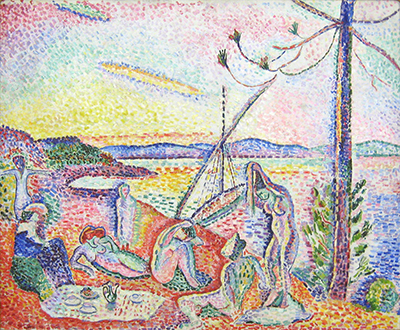
The southern light of France changed the terms of that search. During a 1904 stay at Saint-Tropez with Paul Signac nearby, Matisse explored the divided touches associated with Neo-Impressionism. In Luxe, calme et volupté, small marks of distinct colour work together across a scene of figures by the water. The painted surface asks for attention as much as the figures do. Yet Matisse did not keep applying one recipe of evenly distributed dots. The following year in Collioure, colour could be laid down more freely and unevenly, with open canvas, thick strokes and areas of flatter paint sharing the picture.[1][4]
That shift is worth noticing because it answers a common question about his development. Matisse was not trying to perfect a single technique and then repeat it. In one picture, separate touches could make light flicker; in another, a broad area of colour could state the presence of a wall, a face or a stretch of sea. His early experiments gave him choices. Their value lay in how differently they could make a scene feel and how clearly they could hold a composition together.
Watch: Matisse in sixty seconds
The Royal Academy introduces Matisse’s experiments with colour and cut paper.
Royal Academy of Arts. A short introduction to the artist and the changing forms of his work. Watch on YouTube.
Four stages of Henri Matisse’s career
These periods group related developments; painting, travel and local work overlap across their boundaries.
Learning what colour can do
Paris training, early still lifes and southern light gave Matisse several ways to build form. In 1904 he explored divided colour beside Signac. [1]
From Collioure to large interiors
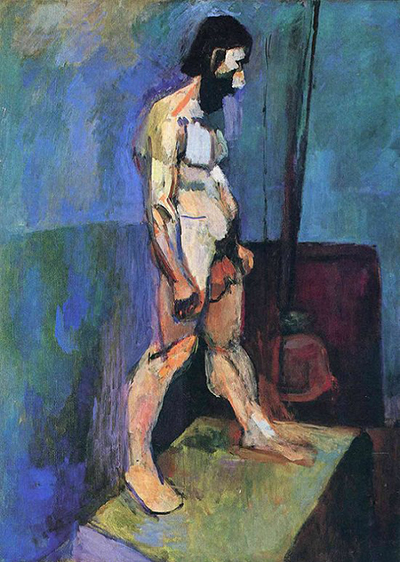
Fauvist portraits and landscapes led into major decorative commissions, studio paintings and a more austere period of revision. [1]


Rooms, figures and monumental design
Nice interiors, continued work in sculpture and drawing, and the Barnes dance commission made this a period of varied formats rather than one unchanging style. [1]
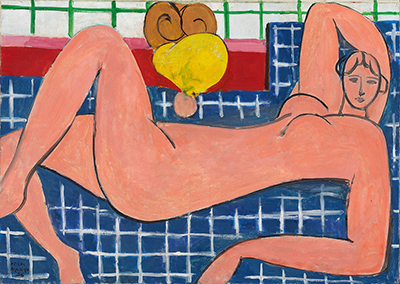
Cut colour moves into the room
Cut-paper designs grew through illustrated books, the Vence chapel and large autonomous compositions. Drawing and painting remained part of the practice. [1]
 Henri Matisse.jpg)

What made the Collioure paintings new?
In summer 1905 Matisse worked at the Mediterranean port of Collioure alongside André Derain. Open Window, Collioure keeps a subject that anyone can grasp: a room, a pair of open shutters, boats and water beyond. The familiar frame is useful because it gives the eye a stable threshold. Inside and outside do not sit in separate colour systems. Greens, pinks, blues and oranges move across the shutters, wall and harbour, so the view seems to belong as much to the painting's surface as to a space beyond it. The National Gallery of Art identifies the work as a 1905 painting and provides the object history; the visual movement from frame to sea can be followed in the image itself.[8]
That is a different experience from looking through a carefully disguised opening in the wall. The brushwork draws attention to itself. A patch beside the window may suggest both light on a surface and a colour chosen for its neighbouring patch. Matisse did not discard the room or the boats. Instead, he made their recognition depend on a more active arrangement of paint. The subject still matters, but it no longer has sole control over the painting.
The same year, Woman with a Hat brought this freedom into portraiture. The sitter is Matisse's wife, Amélie. Her hat expands above the face in energetic colour, and greens and other unexpected tones cross skin, clothing and background. San Francisco Museum of Modern Art records the portrait as a 1905 oil and describes the strong reaction it provoked when shown at the Salon d'Automne. It was unsettling to viewers partly because they expected a portrait to offer a plausible account of a person's complexion and dress. Matisse made colour do another job: hold the face, hat and whole surface in a living relationship.[9]
The Green Stripe pushes that experiment further by placing a green band down Amélie's face. The band can be seen as a dividing form, setting warm and cool passages against one another. It is a striking choice, but it does not erase the sitter. The head remains present through the balance of shape and colour. The Danish national gallery's object record confirms the 1905 painting and its identity; its exact placement in the career matters because it belongs to this concentrated period, not to all Matisse portraits.[10]
The term Fauvism grew from the reception of this circle of painters at the 1905 Salon d'Automne. Its association with startling colour and forceful brushwork is useful, but it can flatten differences among individual works. A Collioure window, a portrait of Amélie and the broad landscape and figures of Le bonheur de vivre do not solve the same pictorial problem. In the Barnes Foundation's account, Le bonheur de vivre was made between October 1905 and March 1906; its shifts of scale and emphatic colour challenged expectations of a harmonious Arcadian scene. That monumental painting already points toward the larger decorative ambitions that followed.[1][9][11]
Why did Matisse make such large paintings?
The question of scale became urgent when Matisse took on work for Sergei Shchukin, the Russian collector who supported him. In 1909 Shchukin commissioned two large decorative panels, Dance and Music, for his Moscow home. MoMA's Dance (I) is the early 1909 study; the later completed Dance and its companion Music are in the Hermitage. Those distinctions matter. The study and final mural are not interchangeable illustrations of one unchanging design, and the Barnes dance mural of the 1930s is another project again.[12][1]
Look at the dancers' joined bodies. Five figures turn around an open centre, their limbs carrying the eye from one form to the next. An arm reaches toward another; the ring has both movement and a moment of possible separation. A broad division of blue above and green below leaves little scenery to explain where they stand. What the picture offers instead is a rhythm of curves, intervals and colour that can register from across a room. In his account of the MoMA study, the museum describes Matisse's simplification of bodies and perspective as a deliberate search for direct expression. The figures' scale and arrangement are part of the work's meaning, not just an enlargement of a smaller picture.[12]
Shchukin's patronage also helps explain why Matisse's work of these years cannot be told only through individual framed pictures. A large painting makes demands on the wall around it and the person moving past it. The Dessert: Harmony in Red of 1908 spreads patterned red across a dining room, table and wall, weakening the boundary between furniture and setting. Its decorative unity is not the same solution as the dancers' open blue-and-green field. Both invite the viewer to experience colour over a broad area, but the eye moves through each composition in a different way. The paintings guide follows these distinctions across the wider collection.[1][4]
The 1911 Red Studio brings that ambition indoors. Matisse filled the room with a red colour that runs over floor and wall, leaving thin gaps to indicate edges of furniture and architectural boundaries. At the same time, paintings and sculptures inside the depicted studio keep their own detailed colour and form. It is a picture of where art is made and a way of asking how many different works can coexist in one visual space. MoMA notes that the actual studio was not red: the red belongs to the painting's construction. The work is therefore distinct from the earlier Shchukin red dining room, whose patterned interior and window pose another set of questions.[2]
This studio picture also shows Matisse looking at his own recent production. The canvases, sculpture and ceramics placed around the room are small but recognisable presences. MoMA's research for its 2022 exhibition reunited the painting with surviving works pictured in it, making the studio's painted inventory easier to explore. Yet the artwork's interest does not depend on recognising every miniature image. The contrast between the red field and those detailed works makes us aware of how differently a room and the objects in it can be represented. A grandfather clock without hands sits near the centre; it anchors the composition while its empty dial offers no ordinary measure of time.[2][13]
The years around the studio paintings also included two journeys to Morocco. The Met places a group of Moroccan pictures within Matisse's 1908–13 exploration of art and decoration. Their windows, figures and views are sometimes brought together under a broad travel label, but each painting still presents a particular framing problem. In Window at Tangier, the window is a way to divide interior from the view beyond; in Zorah on the Terrace, a seated figure and patterned setting require a different balance. These works should be read as constructed paintings, not transparent records of Moroccan life. They also complicate an account that jumps directly from the Shchukin panels to wartime austerity.[1][4]
Did his art become less colourful after Fauvism?
At some moments, yes; as a career-wide description, no. The years around the First World War brought more severe structures and quieter, sometimes darker colour. The Met describes Matisse's work of 1913–17 as a period of experiment and exchange with Cubism. Bathers by a River shows why a simple before-and-after story fails. Its broad vertical divisions and large, simplified bodies are very different from the flicker of the 1904 Saint-Tropez painting. Yet the Art Institute's scholarship follows a painting revised across several campaigns from 1909 to 1917. The final visible arrangement contains a history of changes; it is not just the product of one bleak wartime decision.[1][14]
The Piano Lesson, painted in 1916, offers another way to see the shift. Interior space, music and the human figure still matter, but large geometric divisions give the scene a tighter visual pressure. The painting may feel distant from a Collioure window, yet both ask how a room can be made from colour and shape rather than described through smooth illusion alone. Following those changes is more useful than deciding whether the artist was “still a Fauve.”
Matisse also continued to make portraits, landscapes and still lifes through these years. A single celebrated work can conceal the variety of his daily practice. The period's ambition lay partly in testing how far he could simplify a figure or a setting without losing the experience that drew him to it. Sometimes colour became more restrained; at other times it occupied a large area with new force. The balance was never fixed once and for all.
What changed when Matisse moved to Nice?
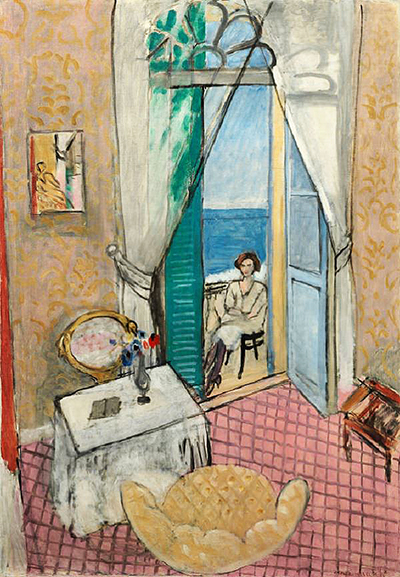
Matisse went to Nice in 1917 and made the south of France his main base thereafter. The shift brought a different light and a new set of interiors into his painting. Rooms could be staged with patterned textiles, screens, windows, plants and decorative objects; the person inside them might be seated, reclining or absorbed in a task. In these works, a textile can carry as much visual activity as the figure beside it. The surface becomes dense without always having the forceful opposition of the early Fauvist pictures.[1][4]
The word odalisque appears often in writing about the Nice period. It names a long European picture tradition of reclining women in imagined eastern settings, and it calls for care. Matisse arranged costumes and fabrics in his studio; these are constructed scenes, not neutral reports on a culture or the unmediated life of a sitter. Looking closely means asking what the pattern, pose and framing do, while keeping the people who modelled for the works in view. Their presence is part of the paintings' history, even when the images present them within an elaborate decorative setting.
The Interior at Nice and the Yellow Odalisque offer two ways into this chapter, but the titles are not labels for one generic “Nice style.” Matisse changed viewpoints, poses and the amount of space he allowed a window or wall to occupy. A viewer might begin at a figure, follow the edge of a cushion and find that the same curve returns in a patterned fabric. These repeated shapes make the room feel connected without dissolving every object into decoration.
The Nice years also show that a serene surface may be carefully constructed. Matisse's paintings can invite pleasure in light and colour while asking the eye to work across a complicated space. Their apparent ease should not erase the choices of cropping, pose and comparison that hold the scene together. The full biography places these pictures among the changes in his home, family and working life; here they show another stage in his exploration of how a figure and its surroundings can share a painted surface.
Was Matisse only a painter?
Painting is the easiest way to encounter his early innovations, but Matisse worked in several media throughout his life. His drawings could test a composition, study a person or find a line with the fewest useful marks. His sculptures asked different questions of volume and touch. According to the Met, more than half his sculptural work was completed between 1900 and 1910, while the serial development of the Back reliefs continued over a much longer span. A viewer can follow the body becoming more concentrated from one state to another, but the sculpture should not be treated merely as a rehearsal for a canvas.[1]
The relationship among these media is particularly clear when Matisse returns to a pose or an arrangement. A drawing can leave much of the paper unmarked yet give a figure remarkable presence; a sculpture occupies actual space and changes as one walks around it; a painting creates its own space within a frame. The same subject has different possibilities in each. That is why the artist's line cannot be understood only as the outline of a painted object. Sometimes it carries the main action of the work.
His prints and illustrated books opened another kind of encounter, one in which an image belongs to a sequence and a reader turns a page. The Met notes that he began major book illustration relatively late in life. A print may preserve a quick-looking line, but its making and distribution differ from a unique drawing. An image in an edition, a study for it and an autonomous composition should each be named for what they are. That distinction becomes especially important with Jazz, whose colourful images began as cut-paper maquettes before appearing as pochoir prints in the 1947 book.[1][15]
There is a useful thread from these different practices back to the painting. Matisse repeatedly explored what an edge can accomplish. A contour around a face, the outer shape of a sculpted torso, the margin of a print and the cut edge of a paper leaf can all direct the eye, but none is materially the same. Seeing the differences makes the late work feel less like an abrupt change of career. It also protects the individuality of each work instead of making every medium a footnote to colour.
The museum Matisse founded in his birthplace, Le Cateau-Cambrésis, gives a material reminder of that range. Its collection description identifies paintings, sculpture, drawings, prints, illustrated books and stained glass, as well as the original plaster states of the monumental Back reliefs. A drawing and a relief can be near each other in a collection without doing the same job. Looking between them can reveal how a contour changes when it is drawn, cut, modelled or cast.[16]
The same collection includes textiles and other objects from Matisse's own surroundings. They are a reminder that pattern entered his art through things he could handle, hang or place in a room. In a Nice interior, a patterned cloth is neither incidental background nor an abstract design pasted over a scene: it helps set the terms in which the figure and room meet. In a cut-out, the support, the painted sheet and the movement of a paper form again make a surface into something physical. These are different uses of material, but following them keeps “decoration” from becoming a vague compliment that explains nothing.[16][1]
Why did he return to the dance on a wall?
Around 1930, Matisse again faced an architectural commission, this time from the American collector Albert C. Barnes. His mural for the Barnes Foundation extended the dance theme across an unusual wall space. The figures had to work with the shape and proportions of the gallery, and the process pushed Matisse toward moving coloured paper pieces to plan a large arrangement. The Met records the commission and the mural's installation in 1933. The later work shares a subject with the Shchukin Dance, but its site, material planning and spatial problem are different.[1]
The recurrence of dance is revealing. A ring of bodies in the 1909 study creates movement within a rectangular field. A mural above a gallery requires movement to be felt along an architectural surface. The figure can be stretched or simplified to meet that setting. Matisse did not return because the earlier picture had left the subject “unfinished”; the new commission let him test it under new conditions. A visitor's own motion through the room becomes part of the encounter.
This search for an image that belongs to its setting helps connect the Barnes mural to the later chapel and cut-out interiors. It does not make them one continuous project. A commission, a domestic studio wall and a chapel each involve different audiences and purposes. What carries across them is Matisse's willingness to make a composition at the scale of the space around a person, while still asking what a line or coloured form can do by itself.
What is a Matisse cut-out?
Matisse's mature cut-outs were made from paper painted with gouache and cut into shapes. The cut form has a coloured face and a physical edge. Assistants helped prepare and place sheets, and shapes could be pinned to walls while arrangements were tested. The final mounted work may hold the composition still, but evidence from photographs and pinholes shows that many arrangements were provisional during their making. MoMA's account of the Paris, Vence and Nice studios describes walls that served as changing supports, not just backgrounds for finished work.[3]
It is tempting to call this “drawing with scissors,” but the phrase can hide the practical richness of the method. A cut can produce a curve that is both swift and exact. The piece removed from a sheet may become as interesting as the piece kept. Shapes can be shifted, turned and compared with neighbours; a leaf may appear to grow when another piece is placed beside it. Colour is no longer a layer of paint inside a drawn boundary. It arrives as a piece of material whose boundary is part of its identity.
Matisse had used cut paper in planning before the late independent works. The Barnes mural and designs for books and performance show that it could serve as a way of testing scale and relation. In the 1940s it also became a means of making works whose cut material remained central to their finished form. The Centre Pompidou's account of The Sorrows of the King explains this development, tracing a path through the Jazz maquettes and large decorations. That history is richer than the familiar claim that Matisse simply changed medium because he could no longer paint. His health mattered to his working conditions, but the cut-outs also extended questions he had pursued for decades.[17][1]
The history of Jazz makes the differences especially concrete. Matisse made cut-paper designs for a book whose printed plates were issued in 1947. A plate such as The Clown has an image conceived through cutting and colour, but the page a reader handles is a print. Its relation to writing, sequence, page size and turning time is part of the work. A later wall-sized cut-out has no such fixed reading order, even when its forms invite the eye to move. The two share a method of originating shapes; they do not give a viewer the same encounter.[15][17]
Zulma of 1950 offers a human figure made in this new way. Its silhouette and internal coloured pieces give a body presence without the modelling of oil paint. The Swimming Pool of 1952 does something else: blue forms travel around the walls of a room, so the viewer's turning body becomes part of the experience. MoMA identifies the work as a maquette for ceramic, later realised in that medium; the original paper composition deserves its own identity. The enormous Parakeet and the Mermaid grew across a corner of the Hôtel Régina studio in Nice. MoMA's photographs document substitutions among its forms before the final mermaid was chosen. The difference among figure, frieze and room-sized garden shows why “the cut-outs” cannot be treated as one repeated image.[3][18][19]
The Blue Nudes explore another relationship between figure and surrounding white ground. Their blue shapes can read as bodies and as areas of colour in tension with the gaps among them. They belong to Matisse's 1952 cut-paper practice, not to the painted Blue Nude: Souvenir of Biskra of 1907. The shared English phrase can obscure nearly half a century of difference in material and setting. The cut-outs guide follows the late works as works in their own right rather than as a single decorative afterword.[1][19]
How did late colour and line enter a room?
The Snail of 1953 presents a different problem from the Blue Nudes. Its broad coloured pieces form a loose spiral inside an almost square field. A title may help us find the animal, but the experience of the work does not require a diagram of its shell. Large areas meet, nearly meet or leave white intervals between them. The result depends on the pace at which the eye travels through those relationships. A reproduction may make it look like a small, immediately graspable emblem; the original work's scale asks a viewer to stand before it and register the pieces as an arrangement of substantial size.[19]
The Sorrows of the King is large too, yet its forms suggest a scene with figures, music and leaves. The Centre Pompidou records it as a 1952 composition of gouache-painted paper cut and mounted on canvas. Its account connects the work to Matisse's reading of Rembrandt's David Playing the Harp before Saul, while also making clear that the finished image is made through its own cut-paper language. The black figure, warm areas and scattered leaves allow narrative and surface pattern to coexist. Calling it merely abstract would lose the subject; treating its pieces as illustrations of a fixed story would lose the work they do as colour and shape.[17]
These large works could grow on a wall before they became fixed objects. In MoMA's photographs of the Nice studio, forms from The Parakeet and the Mermaid spread around a corner and stand above furniture. There is a difference between experiencing such an evolving wall and seeing a mounted work in a museum. The photographs help us understand the working process, while the final work asks us to look at the chosen relationships among its shapes. Neither view cancels the other. The wall was an active place where Matisse and his assistants could test what belonged next to what.[3]
MoMA's account of The Swimming Pool is unusually precise about that relationship to a room. Matisse had a band of white paper placed around his dining-room walls, interrupted by openings; he pinned blue swimmers and sea creatures onto it. The forms did not simply depict a pool within a frame. They surrounded the people who occupied the room. The later preservation and installation of its nine panels keep the original work accessible while making us aware that a museum gallery is a different space. The title identifies an imagined environment, but the work's material and original position are essential to how it produced that environment.[18]
The Chapel of the Rosary at Vence brought questions of colour, line and scale into an architectural setting with a defined purpose. Matisse worked on its decoration in the late 1940s and early 1950s. He designed stained-glass windows, ceramic panels, vestments and other elements for a place of worship, rather than making a set of independent pictures to hang there. Strong coloured light from the windows and sparer black lines on white ceramic surfaces play different roles as a visitor moves through the chapel. The commission cannot be reduced to a final triumph of cut paper: its materials and the chapel's liturgical use give it a character of its own.[1][4]
There are earlier clues to this interest in the room around the work. The Shchukin panels were commissioned for a staircase, the Barnes mural for a gallery wall and The Swimming Pool travelled around a dining room in Matisse's Nice apartment. Each setting had a particular function and set of limits. The recurrence of wall-scale composition across decades does not mean that Matisse had one finished theory of decoration. It shows him repeatedly adapting figure, colour and empty space to the conditions under which people would meet them.[1][3]
This is one reason Matisse's influence reaches beyond a taste for bright colours. The Met describes a career whose experiments affected later generations of painters. That influence is easiest to understand as a set of possibilities rather than a single look to copy: colour may organize a portrait without matching skin, a large field may hold several kinds of representation together, and the empty paper around a cut form may become part of the image. These choices need not lead every later artist to the same result. They opened questions about what a picture can make present, how it sits on a wall and how its materials remain visible. The questions are still useful for a reader meeting Matisse for the first time.[1]
What should you look at first?
For an early view of his colour, begin with Open Window. Notice how its recognizable harbour view shares the surface with vigorous marks of paint. Move to Woman with a Hat to see what happens when similarly independent colour enters a portrait. Le bonheur de vivre then expands the question across many figures and a larger, imagined landscape. The works belong near one another in time, but each gives colour a different task.[8][9][11]
To follow scale and space, place Dance beside The Red Studio. The first turns bodies into a rhythm across a broad field; the second turns an occupied room into a red field that still contains many separate works. Bathers by a River offers a third route, through revision and harder divisions of the surface. Their different dates, patrons and working histories matter more than a quick choice between “colourful” and “austere.”[12][2][14]
For the late period, compare the page and the wall. The Clown from Jazz lets you see how cut-paper designs entered a printed book, while The Swimming Pool and The Sorrows of the King ask you to imagine the bodily scale of a cut-paper work. The paintings, cut-outs, drawings, prints and sculptures guides let you continue by medium. The biography follows the life and working places behind these changes.[15][18][17]
The useful habit is to ask what a work makes possible in its own material. A broad painted red can hold a studio together; a pencil line can make a body present with very little else on the page; a cut edge can turn colour into a movable form. Matisse's career becomes more varied, and more connected, when those decisions remain visible.
Essential Henri Matisse works
Open Window, Collioure
1905 · Colour connects a room and harbour.

Woman with a Hat (Femme au chapeau)
1905 · A portrait of Amélie transformed through colour.

Le Bonheur de vivre
1905–06 · Figures and landscape meet at a monumental scale.

The Red Room (Harmony in Red)
1908 · Pattern joins table and wall.

Dance (1910)
1910 · Five bodies make a continuous, unstable ring.
The Red Studio
1911 · A studio becomes a red field around pictured artworks.
The Swimming Pool
1952 · Blue forms travel around the dining-room walls.
The Snail
1953 · Cut pieces suggest a shell through their turning arrangement.
Explore 113 Matisse artworks
This directory covers the 113 individual works explored in these articles, rather than a complete catalogue of Matisse’s output. Cut-paper designs and prints appear under Drawing in the medium filter; each row names its form. Dates retain the qualifications explained in the linked articles.
Frequently Asked Questions
No. He encountered the work of Impressionist and Post-Impressionist painters, and his own early experiments included a divided-touch approach associated with Neo-Impressionism. His 1905 paintings were central to Fauvism. None of these labels describes his whole career, which later included severe wartime compositions, Nice interiors and large cut-outs. [1] [4]
Illness changed how he could work, especially after surgery in 1941, but cutting and moving paper also developed from earlier design practices and long-standing interests in colour, contour and wall-scale composition. Assistants participated in preparing and arranging the late works. Each final piece still needs to be considered as a specific artistic decision rather than as a symptom or a substitute for painting. [1] [3]
No. MoMA's Dance (I) is a 1909 study associated with the commission for Sergei Shchukin; the later completed panel is in the Hermitage. The Barnes Foundation mural of the 1930s returns to the subject for a different wall and setting. The title alone is not enough to identify the object being discussed. [12] [1]
The published Jazz is an illustrated book of 1947. Its colour plates were made through a print process based on Matisse's cut-paper designs. The maquettes and the printed pages have related images but different materials and histories; a museum label or catalogue record should tell you which one you are seeing. [15] [17]
Discussion
Look again at the images and ideas explored in Henri Matisse: colour, line and the art of making space. These editorial prompts invite your observations.
Reader Insights
How did Matisse come to painting?
Which comparison discussed in the article helps you see the work differently?
How do the materials and historical setting affect your reading?
Join the Conversation
Share a detail, comparison or question about Henri Matisse: colour, line and the art of making space below.
References
- Magdalena Dabrowski , “Henri Matisse (1869–1954),” The Metropolitan Museum of Art, 2004. View source .
- Museum of Modern Art , “The Red Studio”. View source .
- Museum of Modern Art , “Matisse: The Cut-Outs — In the Studio”. View source .
- Centre Pompidou , “Henri Matisse: Chronologie” (PDF, in French). View source .
- Margaret Samu, The Metropolitan Museum of Art, Impressionism: Art and Modernity, 2004. View source.
- Sabine Rewald, The Metropolitan Museum of Art, Fauvism, 2004. View source.
- Museum of Modern Art, Cubism, collection glossary. View source.
- National Gallery of Art , “Open Window, Collioure”. View source .
- San Francisco Museum of Modern Art , “Woman with a Hat”. View source .
- Statens Museum for Kunst , “Portrait of Madame Matisse (The Green Stripe)”. View source .
- Barnes Foundation , “Collection Concentration: Searching for Paradise”. View source .
- Museum of Modern Art , “Dance (I)”. View source .
- Museum of Modern Art , “Matisse: The Red Studio”. View source .
- Art Institute of Chicago , “Bathers by a River,” Matisse Paintings, Works on Paper, Sculpture . View source .
- National Gallery of Art , “Jazz”. View source .
- Musée départemental Matisse , Le Cateau-Cambrésis, “Un musée, 3 collections” (in French). View source .
- Centre Pompidou , “La Tristesse du roi” (in French). View source .
- Museum of Modern Art , “The Swimming Pool, Maquette for ceramic”. View source .
- Museum of Modern Art , Henri Matisse: The Cut-Outs , exhibition checklist (PDF). View source .