



 by
Tom Gurney
Tom Gurney BSc (Hons) is an art history expert with over 20 years experience
Published on June 19, 2020 / Updated on October 22, 2026
Email:
tomgurney1@gmail.com
/ Phone:
+44 7429 011000
Paul Cézanne: a guide to the artist and his work: Introduction
A bowl of fruit, a mountain seen across fields, a person sitting still: Paul Cézanne returned to ordinary subjects until they became extraordinarily demanding pictures. In his paintings, the contour of an apple can shift as one colour presses against another. A road may lead into a landscape while the adjacent hillside rises almost parallel to the canvas. The scene remains recognizable, yet the viewer becomes newly aware of the work of looking. His achievement grew through repeated encounters with places, people and objects across decades of work. [1]
Cézanne was born in Aix-en-Provence in 1839 and died there in 1906. He painted in Paris, around Pontoise and Auvers, at L’Estaque, and above all in and around Aix. His career passed through dark, forceful early paintings, a consequential exchange with Camille Pissarro and the Impressionists, and decades of sustained experiments with still life, landscape and the figure. The changes are real, but no simple ladder from “early” to “late” explains the paintings. A late watercolour can be spare where an earlier oil is dense; two canvases of the same subject may ask different questions. [1] [2]
This guide introduces the main ways into his work. Follow the biography for the full life, paintings for a curated survey, and style and technique for a closer account of how he made an image. The subjects below open further paths through individual works and recurring motifs.
At a Glance
- Artist Paul Cézanne, French painter, draughtsman and printmaker. [1]
- Life Born 19 January 1839 in Aix-en-Provence; died there in October 1906. [2]
- Working places Aix and its surroundings, Paris, Pontoise and Auvers, L’Estaque and other sites in Provence. [2]
- Principal subjects Still lifes, landscapes, portraits, bathers and other figure compositions. [1]
- Key public milestones The independent exhibitions of 1874 and 1877, Vollard’s solo exhibition of 1895, and major posthumous Paris exhibitions in 1907. [3] [4] [1]
Cézanne’s artistic connections
Earlier examples, a working relationship and later responses are different kinds of connection.
- Eugène Delacroix: Delacroix offered an important example for Cézanne’s early expressive painting. [5]
- Camille Pissarro: Pissarro encouraged Cézanne’s work outdoors. [5]
- Henri Matisse: Matisse bought the small Petit Palais Three Bathers in 1899. Henri and Amélie Matisse gave it to the museum in 1936. [6]
- Pablo Picasso: Cézanne’s treatment of form and space became important to Picasso and the development of Cubism. [5]
- Georges Braque: Braque’s 1908 L’Estaque landscapes drew on Cézanne’s example. [7]
Paul Cézanne in context
Impressionist exhibitions
1874–1886: eight independent exhibitionsCubism
1907–1914: early developmentPaul Cézanne
1839–1906 (lifespan)Paul Gauguin
1848–1903 (lifespan)Georges Seurat
1859–1891 (lifespan)Vincent van Gogh
1853–1890 (lifespan)The Kiss of the Muse
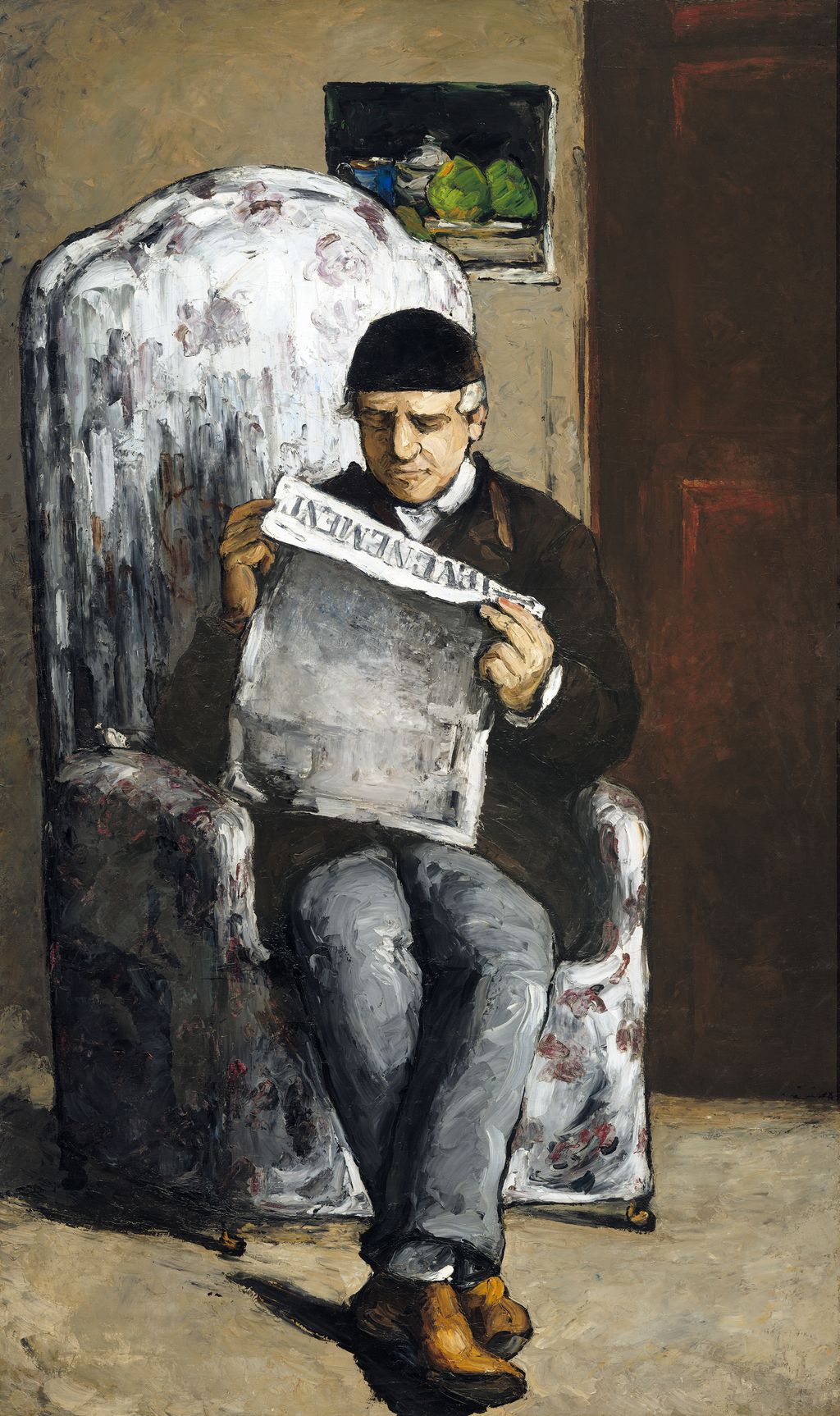
c.1860The Artist’s Father, Reading L’Événement
autumn 1866The Hanged Man’s House
c.1873A Modern Olympia
1873–74Maincy Bridge
1879–80The Blue Vase
1889–90The Basket of Apples
c.1893Apples and Oranges
c.1899The Large Bathers (Philadelphia)
1900–1906 (Philadelphia Museum dating)Château Noir (MoMA)
1903–04Four stages of Paul Cézanne’s career
These periods group related developments; painting, travel and local work overlap across their boundaries.
Training and early experiments
Drawing study in Aix and visits to Paris established a practice that included portraits, imagined scenes and landscape. [8]
Working with Pissarro and exhibiting independently
Work with Pissarro and participation in the exhibitions of 1874 and 1877 accompanied continuing movement between Paris and Provence. [8]

Landscape, portraiture and still life
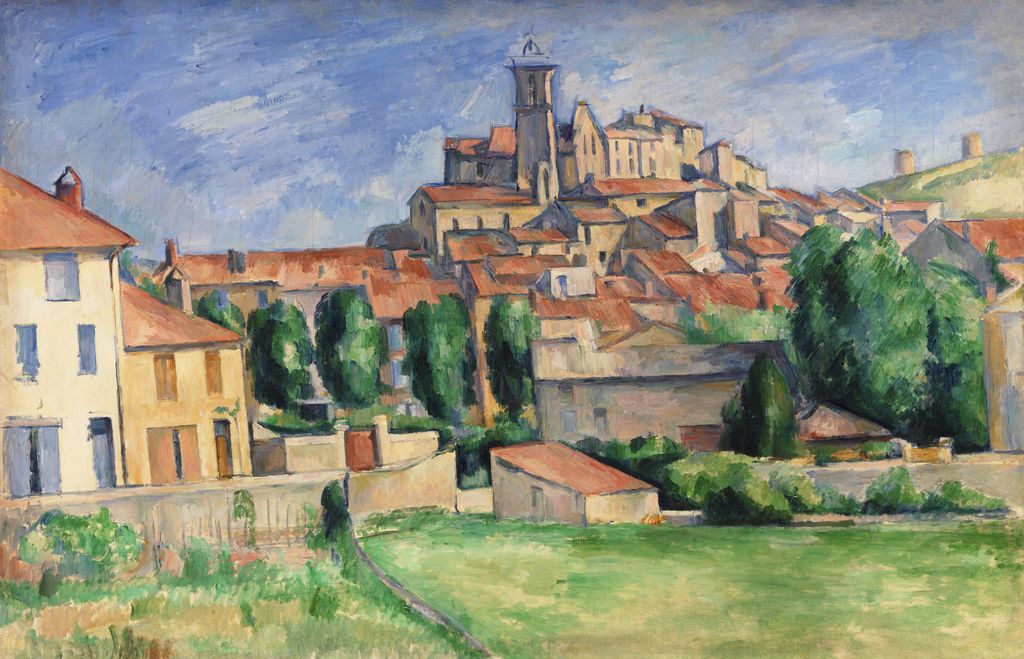
Gardanne, L’Estaque and Mont Sainte-Victoire joined portraits, card players and still lifes among recurring subjects. [8]
Exhibitions and work around Aix
Vollard’s 1895 exhibition increased visibility. Cézanne continued painting around Aix, where landscape, still life and bathers remained important. [8]

Essential Paul Cézanne works
The Artist’s Father, Reading L’Événement
autumn 1866 · An early, large portrait joining a family sitter, newspaper and painting within a painting.
The Hanged Man’s House
c.1873 · A landscape shown in the first independent exhibition in 1874.

A Modern Olympia
1873–74 · An early figure composition that reworks an established modern-art subject.
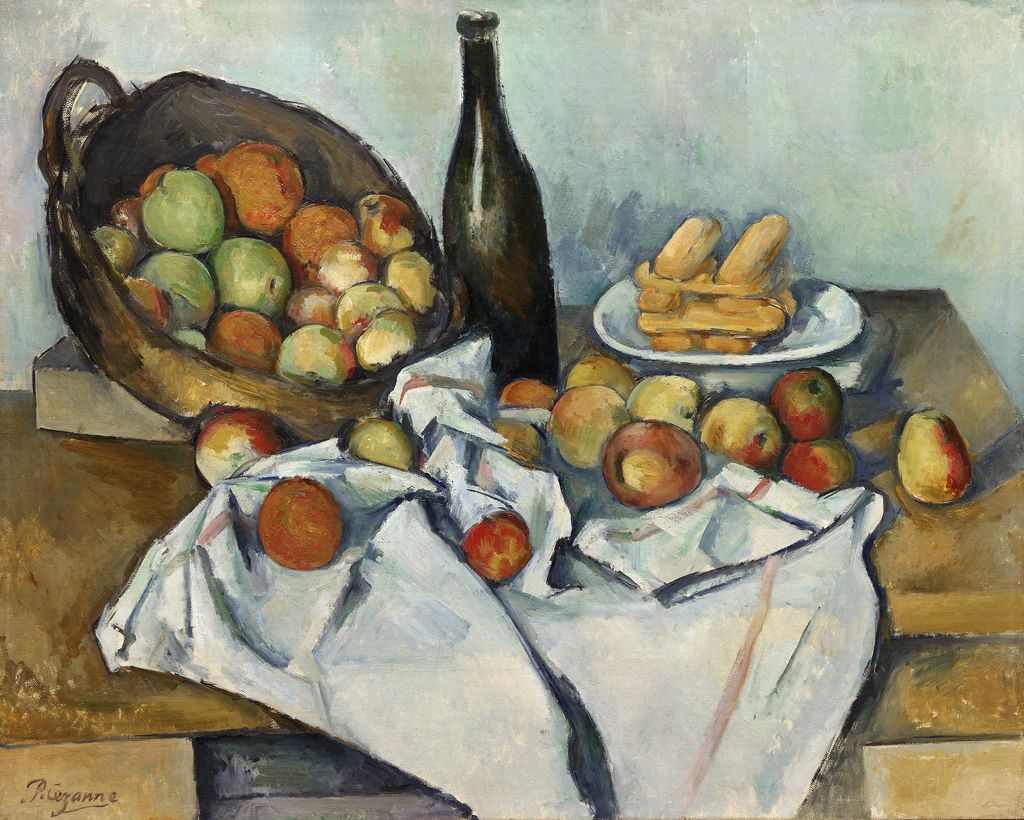
The Basket of Apples
c.1893 · A concentrated route into the construction of a still life.
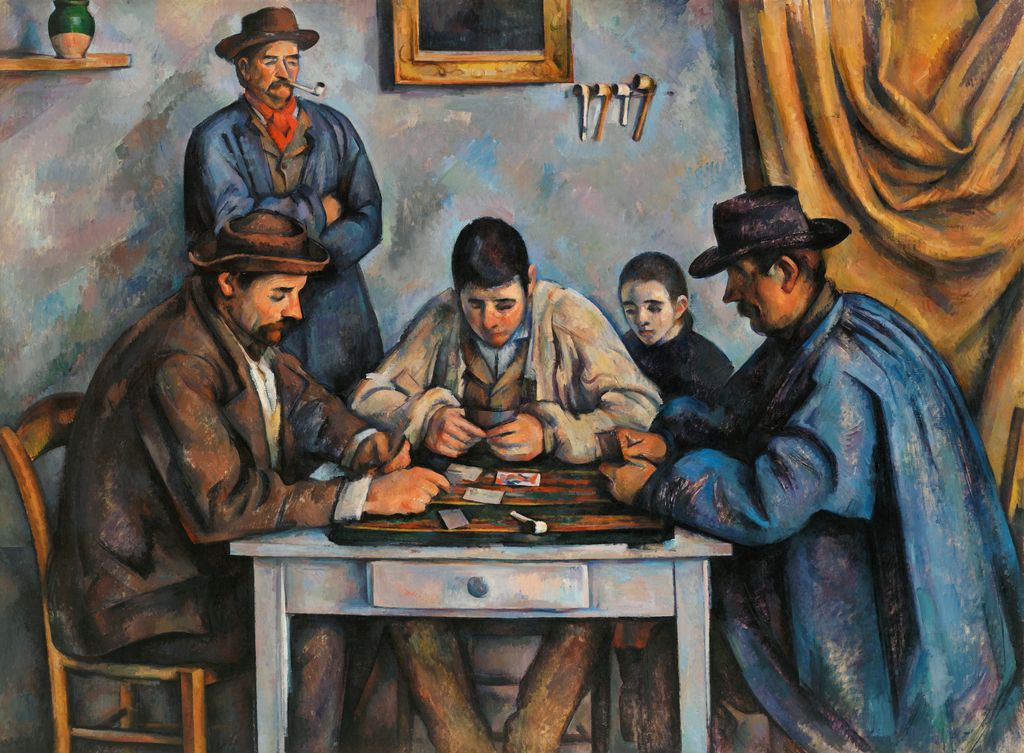
The Card Players (Barnes Foundation)
1890–92 · The five-figure Barnes canvas within the distinct Card Players paintings.
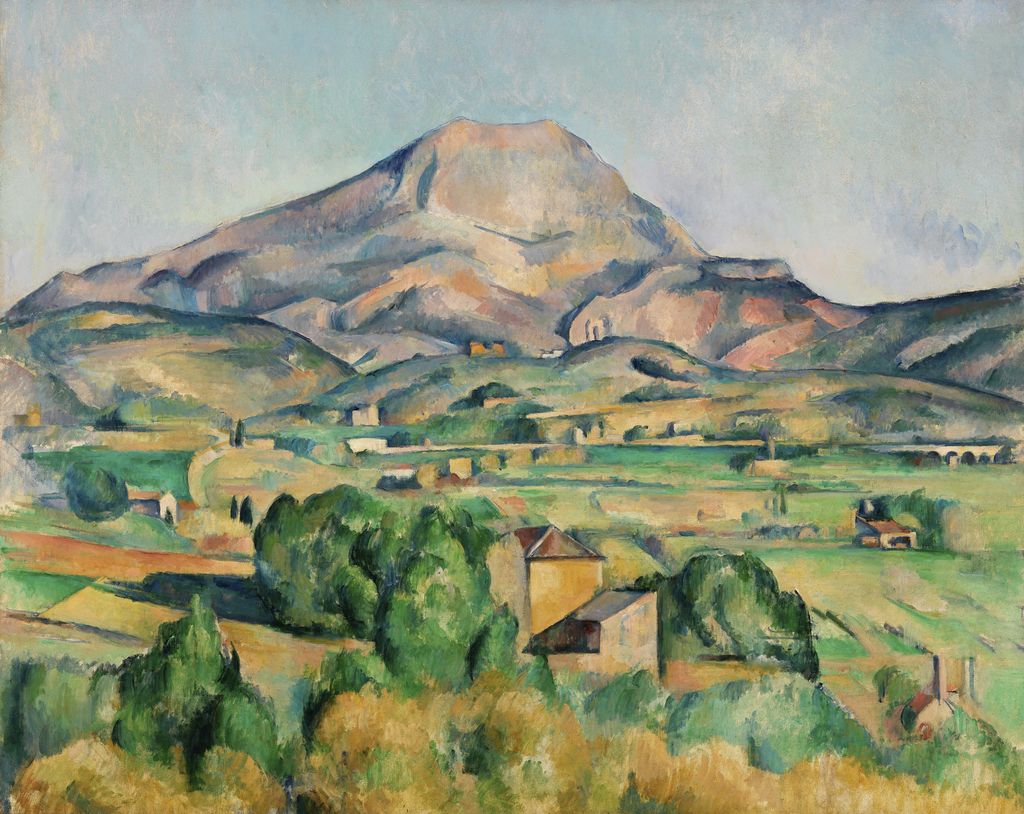
Mont Sainte-Victoire (Barnes Foundation, BF13)
1892–95 · One identified Barnes landscape within a much larger recurring mountain motif.
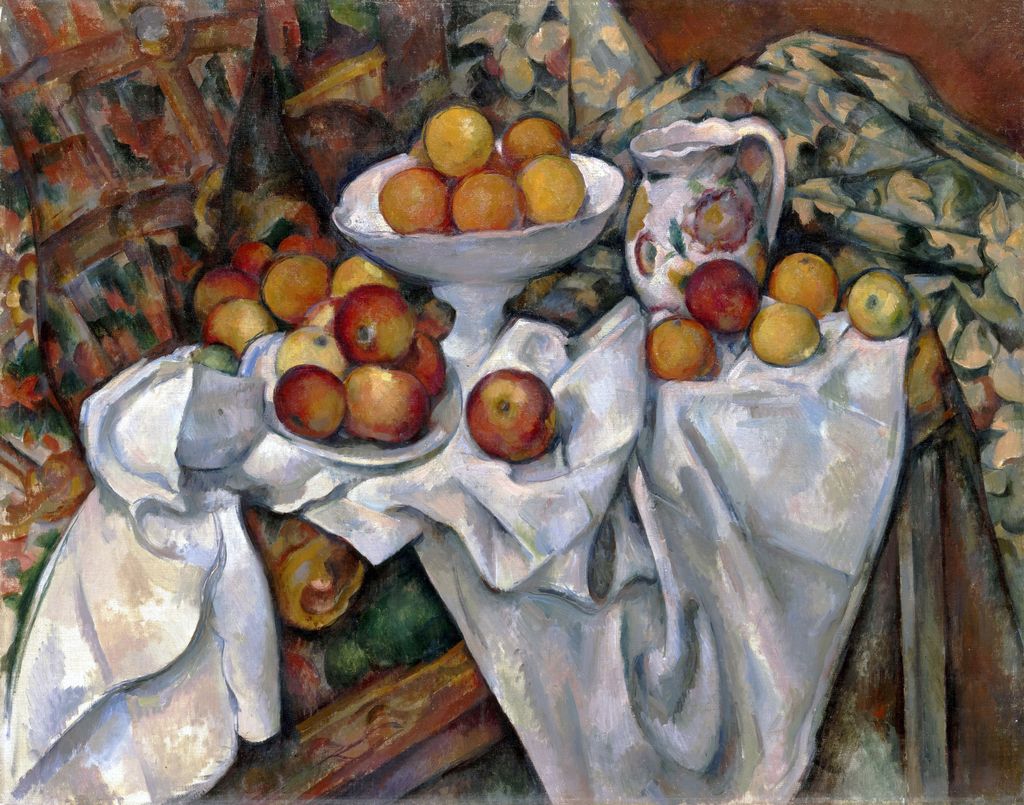
Apples and Oranges
c.1899 · A late still life with a broad arrangement of fruit, cloth and vessels.
The Large Bathers (Philadelphia)
1900–1906 (Philadelphia Museum dating) · The monumental Philadelphia canvas, distinct from the London and Barnes paintings.

Portrait of Ambroise Vollard
1899 · A sustained late portrait of the dealer associated with the 1895 exhibition.
Contents
- What makes a Cézanne painting distinctive?
- From Aix to the Impressionist circle
- Subjects that rewarded returning
- How Cézanne worked
- A reputation made during and after his lifetime
- Where to go next
What makes a Cézanne painting distinctive?
Start with relationships. In a still life, the fruit has volume because neighbouring patches of warm and cool colour persuade us that it turns. In a landscape, a stand of trees both occupies space and makes a pattern across the painted surface. Cézanne could make these two experiences—depth and the flat canvas—felt at once. That tension is why familiar things can look unexpectedly alert in his work. The Met’s account of his art emphasizes his building of form through colour and his willingness to let relationships among objects take precedence over a single, consistent perspective. [1]
Look, for example, at the cloth in The Basket of Apples . It is recognizably white, yet pale pinks, yellows, blues, greens and greys help it bend and swell. The basket pushes toward us, the bottle stands at an uneasy angle, and the tabletop does not join neatly across the composition. The Art Institute of Chicago’s study finds that some striking disjunctions were present in the early drawing, while contours and positions continued to change during painting. That combination matters: visible instability need not be a last-minute accident, but technical evidence does not tell us exactly why the artist wanted every departure from regular perspective. [9]
Other Cézannes are quieter. A modest cluster of fruit can be held in place by minute changes of edge and tone. A mountain view can make the distance feel both open and tightly constructed. A portrait may give its sitter a commanding presence without yielding a clear story about his or her thoughts. These effects depend on particular pictures. Cézanne did not apply one trademark stroke or one set of geometric rules to every subject; the surfaces and working sequences vary. Technical study of paintings in London finds drawing beneath some canvases, washes and reserves in others, and decisions revised across a whole surface. [10]
That variety makes slow comparison more rewarding than trying to spot a signature formula. A useful first exercise is to follow one edge—an apple against a cloth, a shoulder against a wall, a ridge against the sky. Ask where it becomes crisp, where colours meet without a hard line, and where the contour seems to move. Then step back. Local adjustments may form a coherent image without submitting to the geometry of a single camera view. Cézanne’s style and technique page pursues these questions in detail; the works linked here let you test them for yourself. [10]
From Aix to the Impressionist circle
Cézanne grew up in Aix, where he befriended Émile Zola and Baptistin Baille at school and attended the town’s drawing school. His father acquired the Jas de Bouffan estate in 1859. The house and grounds became an enduring workplace: Cézanne made large decorative paintings on its walls, portraits of family and acquaintances, and views of its trees, pool and buildings. The estate’s long use gives the lie to the idea that he found one finished style and thereafter merely repeated it. At Jas, different problems could be attempted within walking distance of one another. [2]
Paris offered other kinds of looking. Cézanne visited the Louvre and encountered contemporary artists, but his first stay in 1861 did not settle him permanently in the capital. He moved between Paris and Provence. Many paintings of the 1860s have dark colour, strong tonal contrasts and paint handled with conspicuous force, sometimes with a palette knife. The portraits of his uncle Dominique, shown in different roles and costumes, can feel theatrical. Their weight, pressure and invented situations show an artist testing what a painted figure can do. [1] [2]
Working beside Camille Pissarro around Pontoise and Auvers in the early 1870s changed his range. Outdoor painting, a lighter palette and attention to effects of daylight became more important. The two artists developed their outdoor practice through close exchange. Cézanne continued to pursue substantial, sometimes unsettling compositions even as he shared the independent exhibitors’ challenge to official art institutions. The National Gallery of Art’s record for House of Père Lacroix describes Cézanne painting beside Pissarro at Auvers in 1873–74 and points to the lighter colour and freer strokes in that landscape. The Met observes that his three works in the first independent exhibition did not all follow a standard Impressionist touch. [11] [1]
His entries in 1874 included A Modern Olympia and The House of the Hanged Man . The first reworks a charged subject from modern painting; the second anchors its clustered buildings in an Auvers landscape. Together they show the breadth of Cézanne’s practice within the independent exhibitions. Cézanne did not exhibit in the second independent show, but returned in 1877 with sixteen catalogued works and one unlisted painting. Contemporary responses ranged from ridicule to appreciation. [3] [12]
He remained mobile after these exhibitions, continuing to work between Provence and Paris. If you want the movement between cities, family obligations, friendships and exhibitions in sequence, begin with the biography and its account of Pissarro and the Impressionist years . Here the key point is pictorial: after working with Impressionist colour and daylight, Cézanne kept asking how a fleeting view might also acquire durable structure. [2] [1]
Subjects that rewarded returning
Fruit, vessels and the space of a table
Still life gave Cézanne a compact arena for sustained changes. An apple could be set beside a bottle, an edged plate, a patterned cloth or a flower vase; each addition altered the spatial question. These objects were available for long looking, and there was no need for a narrative climax. The pressure fell on how their masses touched, overlapped and held together. In the mid-1870s, as the Met observes, he began using closely related colour scales to create dimension in subjects such as Still Life with Jar, Cup, and Apples . The mature works carry that investigation into more complex arrangements. [1]
Begin with The Basket of Apples for a close study of a table that seems to refuse a single level. Then compare the lavish fabric and fruit of Apples and Oranges with the more concentrated Still Life with Apples . Recurring apples invite comparison of each arrangement’s distinct structure. Vase and flower arrangements, including The Blue Vase , ask what happens when fragile upright stems join the rounded weight of fruit. A still life with a skull changes the emotional register, but the exact combination of objects and the particular version matter before any symbolism is assigned. [9] [1]
The surface of a Cézanne still life can feel simultaneously settled and in motion. A plate’s ellipse may be adjusted by the neighbouring fruit. A cloth’s fold can change direction where its colour changes. The objects remain palpable while the picture’s construction stays visible. Looking closely at these arrangements is a direct way to understand why later artists found such scope in Cézanne’s handling of space. Yet “multiple viewpoints” is an interpretation, not a measured record of the painter walking round each tabletop and transcribing separate snapshots. Technical work on the Chicago basket shows deliberate early disjunctions and subsequent revisions, while leaving the painter’s full perceptual reasoning open. [9] [10]
Landscapes made through repeated visits
The geography of Provence was more than a backdrop. L’Estaque offered a bay, distant shore, roofs and trees; Gardanne offered a town whose houses could be gathered into strong rhythms; around Aix, roads, quarries, gardens and the profile of Mont Sainte-Victoire supplied recurring motifs. In the Met’s Mont Sainte-Victoire and the Viaduct of the Arc River Valley , dated 1882–85, a long horizontal bridge is set against fields, trees and distant rock. The viaduct offers a measure of human construction within the landscape, while the large central tree interrupts the panoramic view. Colour and overlapping planes carry the eye around its trunk toward the mountain. [1] [13]
Mont Sainte-Victoire names a subject that Cézanne revisited in different media, at different distances and from different viewpoints. Some versions show a broad valley; others bring the mountain into a tighter field of marks. The mountain motif guide compares the distinct works and what each return made possible. A repeated site could test how a stable landmark changes with a shift in weather, season, route or arrangement on the page. Monnier’s study of late watercolours likewise emphasizes experiments that alternate rather than march in one fixed progression. [14]
The Jas de Bouffan grounds and nearby Château Noir or Bibémus add another scale of inquiry. A wall, a path and a screen of branches can interrupt an easy view into depth. Cézanne’s answer is often a network of marks that gives the place weight while keeping the acts of painting and looking visible. Musée Granet presents Jas as a working ground over many years. The later Lauves studio, completed in 1902, gave him another base, but he continued to go out to motifs around Aix. The late years in Aix page follows those places more fully. [2]
Portraits and people at work or at rest
Cézanne’s portraits reward attention to the sitter’s posture and the painting’s arrangement. The repeat sittings of Hortense Fiquet, whom he married in 1886, produced a large, varied group of paintings and drawings. Met curator Dita Amory counts as many as twenty-nine painted portraits and stresses how little the evidence reveals about the couple’s private feelings. A still face can reflect the discipline of a long sitting and the painter’s formal choices. [15]
Other figures bring social and pictorial questions together. His father appears in a portrait reading a newspaper; friends and patrons sat for him; workers at Jas became subjects of paintings and studies. The Card Players is a series of five distinct canvases. Two versions now at the Met and Barnes Foundation have several figures; three other canvases show two players. Their exact order remains debated. Individual studies of the men informed the project, while the relationships among players, table, curtain and wall changed from canvas to canvas. Technical examination of the Met picture records numerous adjustments to its arrangement; those findings belong to that canvas. [16]
The card-playing men concentrate on a shared task, with little of the anecdote common in nineteenth-century genre painting. Their positions and colours make the space palpable, yet the action remains quiet. The Barnes version expands the gathering; the Met version compresses it. The Met currently dates its canvas 1890–92, a useful anchor when comparing it with the larger Barnes painting. Seeing both keeps scale and revision in view. It also guards against transferring evidence from one object to another just because both share a title. [16]
Bathers and the imagined figure
The bathers are among Cézanne’s most persistent figure subjects. They join landscape with bodies that he often developed from drawings, earlier art and imagination rather than from nude models posed directly before the final canvas. The Met describes this meeting of nature and memory in a bather painting of 1874–75. Across decades, Cézanne changed the size of groups, the relation of bodies to trees and water, and the degree to which figure and setting seem to lock together. The human body became another way to ask how a composition is built. [1]
The Philadelphia Large Bathers is a major destination in this path. The museum dates that large canvas 1900–06 and calls it unfinished. Its triangular gathering of figures and trees grows from a much longer investigation, but the Philadelphia picture must be distinguished from the monumental Bathers canvases now in London and at the Barnes Foundation. The open passages in its surface make the long process of searching and revision visible. [17] [10]
The title Large Bathers also occurs in printmaking. Douglas Druick’s study identifies a late-1890s lithograph with that title as an adaptation of an earlier four-male-figure composition, separate from the Philadelphia oil. The print carries the bather motif into another medium and gives readers a separate comparison with the oils. [18]
How Cézanne worked
Cézanne’s practice was deliberate without being uniform. He drew, washed in colour, repainted contours, left parts of a surface exposed and returned to relationships across a composition. A National Gallery study of selected London paintings found dry underdrawing in some, while other initial placements or later painted lines follow different paths. Visible open passages can be part of the image’s effect at different stages of making. A modern photograph can flatten these distinctions: translucent layers, exposed ground and dense paint may all appear simply as patches of colour on a screen. [10]
His own letters connect these visible choices with the problems he set himself. Writing to Émile Bernard on 15 April 1904, Cézanne famously discussed the cylinder, sphere and cone, but placed them in perspective and immediately addressed depth and the blue of the atmosphere. The letter considers how to perceive and organize depth in nature; its geometric words form one part of that larger argument. In a letter of 26 May 1904 he connected drawing and colour with the effort to give form to sensations. These dated letters show how closely he connected colour, drawing and observation. [19] [10]
Colour often does structural work. In The Basket of Apples , for example, cool and warm touches in the pale cloth create turns and weight with only limited dependence on an outline. In landscapes, a neighbouring blue or green may make a hill advance or recede. Their effect depends on relationships across the whole image. The National Gallery’s technical account finds that Cézanne revised and balanced colours over whole surfaces. [9] [10]
The awkwardnesses that viewers notice—an unstable rim, a doubled contour, the change in direction of a table edge—have prompted many explanations. Some may arise from reworking, some from close observation, and some from pictorial design. Technical examination can show that a line existed early or that a passage was changed. Close looking alongside material evidence helps test how each apparent irregularity functions in its picture. [10] [9]
Paper as a field of decisions
A transparent wash can leave earlier pencil marks and the white paper active. Monnier describes late watercolours in which colour begins without obvious preliminary pencilling, others in which pencil strengthens a wash, and others where the two form a dense network. In a landscape, reserved paper can read as light among leaves or air between nearer and farther forms. The drawings and watercolours guide follows these differences across particular sheets. [14]
The relationship between media is equally varied. Monnier argues that some experiments on paper informed late oil handling, while the precise sequence of any chosen oil and related sheet needs its own evidence. Druick’s account of the later lithographs adds a different form of collaboration: black impressions, hand-coloured models and printed colour states played separate roles within Vollard’s publishing project. Cézanne’s designs could circulate as prints while the bather motif retained a different life in oil. [14] [18]
A reputation made during and after his lifetime
Cézanne’s path to recognition was uneven. The independent exhibitions exposed his work to an audience willing to challenge official conventions, but they also brought mockery. He also had supporters and buyers, including the buyer of The House of the Hanged Man . The dealer Ambroise Vollard’s Paris solo exhibition of 1895 was a significant change in scale and visibility. Earlier patrons and buyers had already taken an interest, while critics and new collectors continued to differ in their responses. [3] [4]
In Provence he remained in contact with the wider art world. He corresponded with artists and critics, and younger painters visited him in Aix during the last years. He kept working through illness. After his death in 1906, Paris exhibitions in 1907 strengthened the reach of his work. Those events broadened attention already growing before he died. The contrast between modest subjects and broad influence is part of the story: artists encountering the pictures could see new ways to organize an apple, a house or a body on a flat support. [2] [1]
Later artists responded in different ways. Picasso and Braque studied Cézanne’s treatment of form and space while developing Cubism, yet their work took different risks and drew on other sources too. A Met account links Braque’s 1908 L’Estaque landscapes to his engagement with Cézanne. Surrealist responses could be far less admiring: Gavin Parkinson describes a history of hostility followed by André Breton’s brief, sympathetic rereading in 1936. Their readings reveal later artistic concerns as well as the works each chose to see. [20] [21]
His significance emerges most clearly from particular paintings. Cézanne showed that colour could build volume without conventional modelling; that a picture could sustain several spatial pressures while remaining a recognizable scene; and that repeated observation could be a source of fresh compositions rather than mere duplication. Later artists found different possibilities in those demonstrations. To understand his importance, it helps to look first at the choices in the works and then at the histories of their reception. [1] [20]
Where to go next
If you are new to Cézanne, take one subject at a time. The painting guide groups work by motif. Read an individual still life slowly, then compare it with another arrangement: The Basket of Apples and Apples and Oranges make a good pair. Notice first the edges of objects and their supporting surfaces; then consider how colour changes the depth of the scene. The comparison is more revealing than memorizing a list of supposed tricks.
For landscape, start with the Mont Sainte-Victoire guide and its distinct viaduct painting . Keep the mountain as a recurring subject rather than treating the title as one image. For figures, move from the Card Players series to the Philadelphia Large Bathers : the first organizes observed sitters around a concentrated activity, while the latter gathers imagined bodies into a much larger landscape structure. [16] [17]
If you want to follow Cézanne’s development through places and relationships, use the full biography , then the focused accounts of the early years , Impressionist years and late Aix years . If the paint itself has caught your attention, the style and technique and drawings guides follow the making of a picture. His letters and reported words are best read with dates and speakers attached. Any one route can bring you back to the same productive question: how did this particular arrangement come to hold together? [19]
Cézanne artworks directory
Browse 217 identified works in this researched selection, including paintings, drawings and watercolours. This is a bounded selection, not a complete catalogue of Cézanne’s surviving oeuvre. Unlinked titles have no confirmed article in this collection.
| Name | Date | Medium |
|---|---|---|
| A Head, a Cup, and a Bread Roll | 1891/1894 | Drawing |
| A Man seen from Behind | 1880/1883 | Drawing |
| A Modern Olympia | 1873–74 | Painting |
| A Nude and Foliage | 1879/1882 | Drawing |
| A Smoking Man | 1892–96 (catalogue); c.1890–92 (museum) | Drawing |
| Afternoon in Naples | 1876–77 | Painting |
| An Old Woman with a Rosary | about 1895–96 | Painting |
| Apples and Oranges | c.1899 | Painting |
| Auvers, Panoramic View | 1873–75 | Painting |
| Avenue at Chantilly | 1888 | Painting |
| Banks of the Marne | 1888–94 | Painting |
| Basket | 1877/1900 | Drawing |
| Bather with Outstretched Arms | 1877–78 | Painting |
| Bellows in Front of a Fireplace | 1887/1892 | Drawing |
| Bibémus Quarry | c.1895 | Painting |
| Boy in a Red Vest, Barnes Foundation | 1888–90 | Painting |
| Boy in a Red Vest, MoMA | 1888–90 | Painting |
| Boy in a Red Waistcoat, National Gallery of Art | 1888–90 | Painting |
| Branch in Flower | 1886/1889 | Drawing |
| Carnival Scene | 1885/1888 | Drawing |
| Chair and Dresser | 1880/1883 | Drawing |
| Chateau Noir | 1903–04 | Painting |
| Chestnut Trees and Farm at Jas de Bouffan | c.1885 | Painting |
| Chestnut Trees and Farm at Jas de Bouffan, Pushkin | c.1886 | Painting |
| Chestnut Trees at Jas de Bouffan in Winter | 1885–86 | Painting |
| Château Noir | 1900–04 | Painting |
| Cistern in the Park of Château Noir | c.1900 | Painting |
| Curtain, Jug and Fruit | 1893–94 | Painting |
| Cushion of an Armchair | 1886/1889 | Drawing |
| Draft Letter and Studies of Bathers | c.1878 | Drawing |
| Farmhouse and Chestnut Trees at Jas de Bouffan | 1884–85 | Painting |
| Figure Resting Head on Hand | c. 1889 | Drawing |
| Fireplace Tongs and Poker | 1887/1892 | Drawing |
| Forest Interior, San Francisco | c.1898–99 | Painting |
| Four Bathers | 1888–90 | Painting |
| Fruit and a Jug on a Table | 1893–94 | Painting |
| Gardanne | 1885–86 | Painting |
| Gardanne, Barnes Foundation | c.1885 | Painting |
| Hand and Shoulder of a Boy | c. 1885 | Drawing |
| Harlequin, National Gallery of Art | 1888–90 | Painting |
| Head of a Boy | 1887/1889 | Drawing |
| Head of a Boy Seen from Behind | c. 1885 | Drawing |
| Head of a Young Woman | c. 1880 | Drawing |
| Head of the Artist's Son | 1888/1889 | Drawing |
| Hillside in Provence | c.1890–92 | Painting |
| Horse Chestnut Trees at Jas de Bouffan | c.1885 | Painting |
| House and Farm at the Jas de Bouffan | c.1887 | Painting |
| House in a Park | 1883/1886 | Drawing |
| House in Provence | c.1885 | Painting |
| House of Père Lacroix | 1873 | Painting |
| House Surrounded by Vegetation | 1889/1892 | Drawing |
| Houses in Provence The Riaux Valley near L’Estaque | c.1883 | Painting |
| Jas de Bouffan, the Pool | c.1876 | Painting |
| Kerosene Lamp | 1878/1881 | Drawing |
| L'Estaque, Melting Snow | c.1870 | Painting |
| Lake Annecy | 1896 | Painting |
| Landscape in Provence, Pola Museum | 1879–82 | Painting |
| Landscape Near Aix-en-Provence | 1877/1880 | Drawing |
| Landscape Seen from the Inside of a Cave | 1889/1892 | Drawing |
| Landscape with Poplars | c.1885–87 | Painting |
| Landscape with Trees | 1895/1898 | Drawing |
| Leda and the Swan | c.1880 (possibly later) | Painting |
| Little Girl with a Doll | 1902–04 | Painting |
| Louis Guillaume | 1879–1890 | Painting |
| Madame Cezanne | 1888/1891 | Drawing |
| Madame Cezanne | 1886/1889 | Drawing |
| Madame Cezanne | 1882/1887 | Drawing |
| Madame Cezanne | 1897/1900 | Drawing |
| Madame Cezanne with her Head Lowered | 1893/1896 | Drawing |
| Madame Cézanne in a Red Armchair | c.1877 | Painting |
| Madame Cézanne in a Red Dress, Metropolitan Museum of Art | 1888–90 | Painting |
| Madame Cézanne in a Yellow Chair | 1888–90 | Painting |
| Madame Cézanne in a Yellow Chair, Fondation Beyeler | 1888–90 | Painting |
| Madame Cézanne in the Conservatory | 1891 | Painting |
| Maincy Bridge | 1879–80 | Painting |
| Maison Maria with a View of Château Noir | c.1895 | Painting |
| Man Bending Forward | 1883/1886 | Drawing |
| Man Smoking a Pipe, Pushkin | c.1891, possibly later | Painting |
| Man with a Pipe | 1891–96 | Painting |
| Man with a Pipe, Nelson-Atkins | 1890–92 | Painting |
| Man with a Straw Hat (Gustave Boyer) | c.1871 | Painting |
| Man with Crossed Arms | c.1899 | Painting |
| Man with Pipe, National Gallery of Art | 1892–96 | Painting |
| Mont Sainte-Victoire | c.1902–06 | Painting |
| Mont Sainte-Victoire | 1900–02 | Painting |
| Mont Sainte-Victoire (recto) | c.1895 | Watercolour |
| Mont Sainte-Victoire and the Viaduct of the Arc River Valley | 1882–85 | Painting |
| Mont Sainte-Victoire Seen beyond the Wall of the Jas de Bouffan | c.1885/1888 | Watercolour |
| Mont Sainte-Victoire Seen from Bibémus Quarry | c.1897 | Painting |
| Mont Sainte-Victoire, Barnes Foundation | 1892–95 | Painting |
| Near the Pool at Jas de Bouffan | 1883/1887 | Drawing |
| Pelicans | 1877/1880 | Drawing |
| Peonies | 1890/1893 | Drawing |
| Pierrot and Harlequin | 1888 | Painting |
| Pine Tree | 1882/1885 | Drawing |
| Pont des Trois Sautets | 1906 | Watercolour |
| Poplars | 1879–80 | Painting |
| Portrait of Ambroise Vollard | 1899 | Painting |
| Portrait of Gustave Geffroy | 1895–96 | Painting |
| Portrait of Madame Cezanne with Loosened Hair | 1885–86 | Painting |
| Portrait of the Artist Looking Over His Shoulder | 1883–84 | Painting |
| Portrait of the Gardener Vallier | 1906 | Painting |
| Portrait of Victor Chocquet | 1876–77 | Painting |
| Portrait Of Victor Chocquet Seated | 1877 | Painting |
| Provençal Manor | c.1885 | Painting |
| Pyramid of Skulls | 1898–1900 | Painting |
| Reclining Nude (Leda?) | c.1887 | Painting |
| Scipio | 1866–68 | Painting |
| Seated Man, Oslo | 1898–1900 | Painting |
| Seated Peasant | c.1892–96 | Painting |
| Seated Peasant, Hiroshima | c.1897 | Painting |
| Seated Peasant, Orsay | c.1900 | Painting |
| Self-Portrait | c. 1895 | Drawing |
| Self-Portrait in a Bowler Hat, Ny Carlsberg Glyptotek | 1885–86 | Painting |
| Self-Portrait in a Casquette | c.1875 | Painting |
| Self-Portrait with a Beret | 1898–1900 | Painting |
| Self-Portrait with a Hat, Artizon Museum | c.1890–94 | Painting |
| Self-Portrait with a Pink Background | c.1875 | Painting |
| Self-Portrait with Olive-Coloured Wallpaper | about 1880–81 | Painting |
| Self-Portrait with Palette | 1886–87 | Painting |
| Self-Portrait with White Turban | c.1878–80 | Painting |
| Self-Portrait, c.1895 | c.1895 | Painting |
| Self-Portrait, Pushkin Museum | c.1882 | Painting |
| Spanish Dancers | 1883/1886 | Drawing |
| Still Life with a Curtain | 1892–94 | Painting |
| Still Life with Apples | c.1890 | Painting |
| Still Life with Apples | 1893–94 | Painting |
| Still Life with Apples and a Pot of Primroses | about 1890 | Painting |
| Still Life with Milk Jug and Fruit | c.1900 | Painting |
| Still Life with Open Drawer | 1877–79 | Painting |
| Still Life with Plaster Cupid | about 1894 | Painting |
| Still Life with Skull | 1890–93 | Painting |
| Still Life with Soup Tureen | 1877 | Painting |
| Still Life, Pitcher and Fruit | 1893–94 | Painting |
| Studies Including a Straw Hat | 1895/1898 | Drawing |
| Studies Including Madame Cezanne | 1884/1887 | Drawing |
| Study for "The Judgement of Paris" or "The Amorous Shepherd" | 1883/1886 | Drawing |
| Study for Woman with a Coffee Pot | c.1895 | Painting |
| Study of "The Roman Orator (Germanicus)" | 1883/1886 | Drawing |
| Study of "Venus de Milo" | 1881/1884 | Drawing |
| Study of a Decorative Ornament | 1879/1882 | Drawing |
| Study of a Standing Male Figure after the Antique | c. 1895 | Drawing |
| Study of an Angel in Rubens' "The Prophet Elijah" | 1892/1895 | Drawing |
| Study of Desiderio da Settignano's "Bust of a Child" | c. 1895 | Drawing |
| Study of Houses | 1879/1882 | Drawing |
| Study of Puget's "Hercules Resting" | c. 1879 | Drawing |
| Study of Puget's "Milo of Crotona" | 1895/1898 | Drawing |
| Study of Puget's "Milo of Crotona" | 1880/1883 | Drawing |
| Study of the Allegorical Figure Bellona in Rubens' "The Apotheosis of Henri IV" | 1883/1886 | Drawing |
| Study of the Allegorical Figure Bellona in Rubens' "The Apotheosis of Henri IV" | 1879/1882 | Drawing |
| Study of the Allegorical Figure France in Rubens' "The Exchange of the Two Princesses" | 1882/1885 | Drawing |
| Study of the Allegorical Figure of Health in Rubens' "The Birth of Louis XIII" | 1880/1883 | Drawing |
| Study of the Allegorical Figure of the Genius of Health from Rubens' "The Birth of Louis XIII at Fontainbleau" | 1895/1898 | Drawing |
| Sugar Bowl, Pears and Blue Cup | 1865–66 | Painting |
| The Aqueduct, Pushkin Museum | Dating differs between museum records | Painting |
| The Artist's Father, Reading L'Evenement | autumn 1866 | Painting |
| The Artist's Son | c. 1887 | Drawing |
| The Artist's Son Leaning on his Elbow | c. 1887 | Drawing |
| The Artist's Son Reading | c. 1887 | Drawing |
| The Artist's Son Writing | c. 1887 | Drawing |
| The Artist’s Son, Paul | 1886–87 | Painting |
| The Avenue at Jas de Bouffan | 1868–70 (possibly later) | Painting |
| The Avenue at Jas de Bouffan, Geneva | c.1890 | Painting |
| The Basket of Apples | c.1893 | Painting |
| The Bather, Museum of Modern Art | c.1885 | Painting |
| The Bay of Marseille seen from L'Estaque | c.1885 | Painting |
| The Blue Vase | 1889–90 | Painting |
| The Boy in the Red Vest, Bührle | 1888–90 | Painting |
| The Buffet | 1877–79 | Painting |
| The Card Players, Barnes Foundation | 1890–92 | Painting |
| The Card Players, Courtauld Gallery | 1892–96 | Painting |
| The Card Players, Metropolitan Museum of Art | 1890–92 | Painting |
| The Card Players, Musée d’Orsay | 1893–96 | Painting |
| The Card Players, Qatar | 1892–96 | Painting |
| The Eternal Feminine | c.1877 | Painting |
| The Gardener Vallier | 1906 | Painting |
| The Gardener Vallier, Tate | 1905–06 | Painting |
| The Grounds of the Château Noir | c.1900–04 | Painting |
| The Gulf of Marseille Seen from L’Estaque | c.1885 | Painting |
| The Hanged Man's House in Auvers | c.1873 | Painting |
| The House of Doctor Gachet at Auvers | 1872–73 | Painting |
| The House with the Cracked Walls | 1892–94 | Painting |
| The Kiss of the Muse | c.1860 | Painting |
| The Large Bathers, Barnes Foundation | 1895–1906 | Painting |
| The Large Bathers, National Gallery | 1895–1905 | Painting |
| The Large Bathers, Philadelphia Museum of Art | 1900–06 | Painting |
| The Mill | 1889/1892 | Drawing |
| The Painter’s Father, Louis-Auguste Cézanne | c.1865 | Painting |
| The Peasant | 1890–92 | Painting |
| The Plaster Mill (La Moulin à plâtre) | 1889/1892 | Drawing |
| The Smoker, Hermitage | c.1891 | Painting |
| The Smoker, Mannheim | c.1891 | Painting |
| The Stove in the Studio | c.1865 | Painting |
| The Vase of Tulips | c.1890 | Painting |
| Thistle | 1893/1896 | Drawing |
| Three Heads, One of Madame Cezanne | 1882/1885 | Drawing |
| Three Skulls | c.1898 | Painting |
| Three Skulls on a Patterned Carpet | 1904 | Painting |
| Trees and Shrubs | 1883/1887 | Drawing |
| Turning Road at Montgeroult | 1898 | Painting |
| Two Bathers | 1884/1887 | Drawing |
| Two Heads | 1888 | Drawing |
| Two Heads | 1890/1896 | Drawing |
| Two Heads of Women | 1890/1894 | Drawing |
| Two Studies for "The Judgement of Paris" or "The Amorous Shepherd" | 1883/1886 | Drawing |
| Uncle Dominique in a Tasseled Cap | 1866 | Painting |
| Uncle Dominique in a Turban | 1866–67 | Painting |
| Victor Chocquet and an Angel for "The Apotheosis of Delacroix" | 1878/1880 | Drawing |
| Woman in Blue | c.1904 | Painting |
| Woman Leaning Forward | 1888/1891 | Drawing |
| Woman Leaning Forward | 1890/1894 | Drawing |
| Woman Leaning Forward | 1890/1894 | Drawing |
| Woman with a Coffee Pot | c.1895 | Painting |
| Women Bathers and a Roll of Paper | 1882/1885 | Drawing |
| Young Girl with a Doll | c.1895 | Painting |
| Young Italian Woman at a Table | c.1895–1900 | Painting |
| Young Man and Skull | 1896–98 | Painting |
Frequently Asked Questions
He exhibited with the Impressionists in 1874 and 1877 and worked closely with Pissarro; outdoor painting and a lighter palette changed his art. His exhibited works and later sustained pursuit of pictorial structure also resist a narrow account of Impressionist technique. “Post-Impressionist” is a useful historical label if it opens those differences rather than erasing the earlier exchange. [1] [3]
Apples and other still-life objects, Mont Sainte-Victoire and Provençal landscapes, portraits, card players and bathers are among his best-known subjects. He made multiple distinct works within each group, so a title such as The Card Players or Mont Sainte-Victoire needs an identified version. [1] [16]
The effect can involve early design, subsequent adjustment, colour relationships and a departure from conventional single-point perspective. Examination of Chicago’s Basket of Apples found key spatial disjunctions in its preliminary drawing. That does not establish one universal explanation for every tilted tabletop in his work. [9] [10]
No. Picasso and Braque developed Cubism in the early twentieth century, and Cézanne’s treatment of form and space was one important point of reference. His own paintings keep returning to observed places, objects and people; their historical influence should not be mistaken for his adoption of a later movement. [20]
Some works are described as unfinished, including Philadelphia’s Large Bathers . Elsewhere, visible ground, open paper or a sparse passage needs object-specific attention. An unpainted area can contribute to a picture’s effect without proving that Cézanne considered it finished; equally, openness alone cannot prove abandonment. [17] [10] [14]
Discussion
Look again at the images and ideas explored in Paul Cézanne: a guide to the artist and his work. These editorial prompts invite your observations.
Reader Insights
Choose two still lifes with similar objects. Where does the edge of an apple feel firm, and where does colour carry the shape without a continuous outline? How does the table make you aware of the picture’s space?
Compare an early and a late view of Mont Sainte-Victoire. What stays recognizable, and what changes in the placement of the ridge, the interval between foreground and distance, or the amount of exposed surface?
Look at a portrait without guessing the sitter’s feelings. What can posture, surrounding colour and the direction of painted marks tell you about the picture? Which questions remain outside the evidence of the image?
Join the Conversation
Share a detail, comparison or question about Paul Cézanne: a guide to the artist and his work below.
References
- The Metropolitan Museum of Art. James Voorhies, “Paul Cézanne (1839–1906),” Heilbrunn Timeline of Art History , October 2004. View source .
- Musée Granet. Cezanne au Jas de Bouffan , bilingual exhibition visitor booklet, 2025, especially pp. 7–13, 17–23. View source .
- Société Paul Cezanne. François Chédeville, chronology for 1874, including exhibition catalogue and contemporary press transcriptions, 2016 (in French). View source .
- Société Paul Cezanne. François Chédeville, chronology for 1895, including letters, press and dealer records, 2016 (in French). View source .
- James Voorhies, Paul Cézanne (1839–1906), Metropolitan Museum of Art, October 2004. View source.
- Petit Palais, Trois baigneuses, PPP2099, collection record. View source.
- Sabine Rewald, Cubism, Metropolitan Museum of Art, October 2004. View source.
- Musée Granet, Cézanne au Jas de Bouffan visitor guide, 2025, chronology pp. 17–23. View source.
- Art Institute of Chicago. Paul Smith, with technical report by Kim Muir and Giovanni Verri, “Cat. 10: The Basket of Apples , c. 1893,” Cézanne Paintings and Watercolors at the Art Institute of Chicago . View source .
- National Gallery, London. Elisabeth Reissner, “Ways of Making: Practice and Innovation in Cézanne’s Paintings in the National Gallery,” National Gallery Technical Bulletin 29, 2008. View source .
- National Gallery of Art, Washington. House of Père Lacroix , 1873, object record, accession 1963.10.102. View source .
- Société Paul Cezanne. François Chédeville, chronology for 1877, including exhibition catalogue and contemporary press transcriptions, 2016 (in French). View source .
- The Metropolitan Museum of Art. Mont Sainte-Victoire and the Viaduct of the Arc River Valley , object record, accession 29.100.64. View source .
- Museum of Modern Art. Geneviève Monnier, “The Late Watercolors,” translated by Frances Frenaye, in Cézanne: The Late Work , edited by William Rubin, 1977, pp. 113–18. View source .
- The Metropolitan Museum of Art. Rachel High, “Interview with Dita Amory, Curator and Co-author of Madame Cézanne ,” 1 December 2014. View source .
- The Metropolitan Museum of Art. Paintings Conservation, “Cezanne’s Card Players,” 1 August 2022. View source .
- Philadelphia Museum of Art. The Large Bathers , collection record, W1937-1-1. View source .
- Museum of Modern Art. Douglas Druick, “Cézanne’s Lithographs,” in Cézanne: The Late Work , edited by William Rubin, 1977, pp. 119–37. View source .
- Courtauld Gallery / Société Paul Cezanne. Paul Cézanne, letters to Émile Bernard of 15 April and 26 May 1904, in the Société’s 1904 documentary chronology (in French). View source .
- The Metropolitan Museum of Art. Sabine Rewald, “Cubism,” Heilbrunn Timeline of Art History , October 2004. View source .
- Courtauld Institute of Art. Gavin Parkinson, “Greengrocer, Bricklayer or Seer? Surrealist Cézanne,” in Modernist Games , 2013, pp. 69–99. View source .
- Margaret Samu, Impressionism: Art and Modernity, Metropolitan Museum of Art, October 2004. View source.
- James Voorhies, Post-Impressionism, Metropolitan Museum of Art, October 2004. View source.
- Le Baiser de la muse, d'après Frillié (FWN 572). View source.
- Louis-Auguste Cezanne, père de l'artiste, lisant L'Événement (FWN 402). View source.
- La Maison du pendu, Auvers-sur-Oise (FWN 81). View source.
- Une moderne Olympia (FWN 628). View source.
- Le Pont de Maincy (FWN 143). View source.
- La Montagne Sainte-Victoire vue de Montbriand (FWN 185). View source.
- Gardanne (vue horizontale) (FWN 224). View source.
- Le Vase bleu (FWN 823). View source.
- Les Joueurs de cartes (FWN 681). View source.
- La Montagne Sainte-Victoire (FWN 296). View source.
- La Corbeille de pommes (FWN 860). View source.
- Pommes et oranges (FWN 871). View source.
- Portrait d'Ambroise Vollard (FWN 531). View source.
- Château Noir (FWN 360). View source.
- Société Paul Cezanne,online catalogue structure and objectidentification. View source.
- National Gallery of Art,Cezanne Sketchbook,1992.51.9. View source.
- Splash image, Paul Cézanne.


