



 by
Tom Gurney
Tom Gurney BSc (Hons) is an art history expert with over 20 years experience
Published on June 19, 2020 / Updated on October 22, 2026
Email:
tomgurney1@gmail.com
/ Phone:
+44 7429 011000
Still Life with Apples by Paul Cézanne: Introduction
A white plate holds a small mound of red apples. Two greener fruits sit beside it, a lemon lies near the front edge, and a little metal container is pushed almost out of the picture. Behind them, a pale wall catches scattered strokes of blue and green. Nothing in Paul Cézanne's Still Life with Apples is spectacular as a possession. What holds the eye is the way these ordinary things lean towards one another, gather weight and occupy a surprisingly concentrated space.
This is the small oil painting dated about 1890 in the State Hermitage Museum, Saint Petersburg. It measures 35.2 × 46.2 cm, making its horizontal spread considerably smaller than many of Cézanne's better-known tabletop compositions. The museum records it under inventory number ЗКРсэ-558. Its intimate scale is part of its character: the plate and fruit form a compact encounter, with very little room left for a surrounding interior. [1]
At a Glance
- Artist Paul Cézanne (1839–1906). [1]
- Date about 1890. [1]
- Medium oil on canvas. [1]
- Dimensions 35.2 × 46.2 cm. [1]
- Collection State Hermitage Museum, Saint Petersburg; inventory ЗКРсэ-558. [1]
- Catalogue identity FWN 820; Rewald 674; Venturi 1518. [2]
This work across Paul Cézanne’s career
The Kiss of the Muse
c.1860The Artist’s Father, Reading L’Événement
autumn 1866The Hanged Man’s House
c.1873A Modern Olympia
1873–74Maincy Bridge
1879–80The Blue Vase
1889–90The Basket of Apples
c.1893Apples and Oranges
c.1899The Large Bathers (Philadelphia)
1900–1906 (Philadelphia Museum dating)Château Noir (MoMA)
1903–04Contents
- A plate that gathers the composition
- The quieter objects on the left
- Red and green across a pale wall
- How much space is there on the table?
- Brushwork and the experience of weight
- Dating and the painting's recorded history
- From this small arrangement to larger still lifes
- Annotated details
A plate that gathers the composition
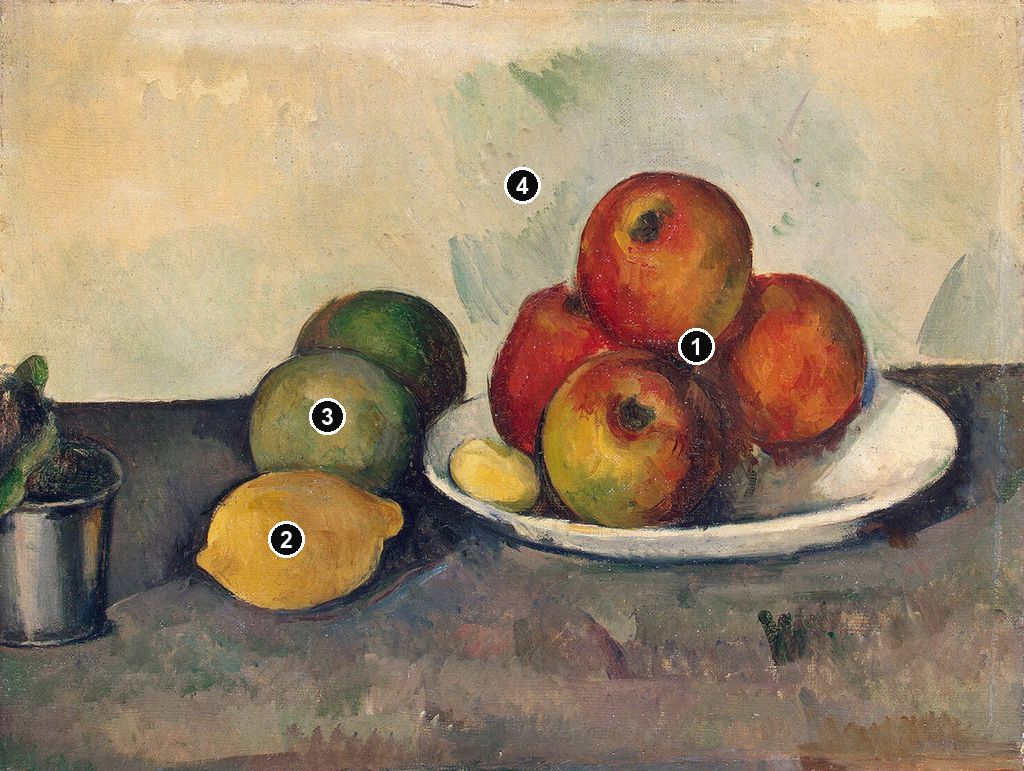
The apples on the right make a close group. One rises above the others, with its stalk cavity turned towards us. Beneath it, red fruit presses out on either side, while a larger green-yellow apple sits towards the front. Dark intervals between them let us distinguish their individual bodies without cutting each one into a separate, fully enclosed silhouette. The plate gives this uneven stack a common base.
Its pale rim is especially active. At the right it curves upwards around the red apple; across the front it becomes a broad, light crescent. That crescent makes the fruit look heavy because it seems to receive and contain the mound. The plate's ellipse also lets us look into it. We see enough of the inner surface to understand the fruit's placement, while the long lower edge stretches almost horizontally across the tabletop.
The green-yellow apple nearest us interrupts this long shape. Its rounded body crosses the plate's pale interior, placing a full, upright form against a flattened oval. Small changes of colour suggest the apple's sides: green around the lower turn, warmer yellow towards the light and red near the sunken top. The cavity is a dark, irregular mark that gives the surface an orientation. We recognise a fruit that can be turned in the hand, rather than an anonymous circle.
Look next at the apple above it. Its orange-red face is conspicuous against the light wall, but the contour is not an uninterrupted dark boundary. At some points the warm fruit meets cool background quite decisively; elsewhere adjoining strokes make the edge less certain. Our attention shifts between the solidity of the apple and the separate touches through which that solidity is built. The painting permits both kinds of looking at once.
The quieter objects on the left
The composition would feel quite different if the plate stood alone. To its left, two green fruits form a lower, more widely spaced group. The rear one is dark and shaded; the nearer one is broader and lighter. Their overlap offers a short step back into the picture. Their relatively subdued colour also gives the red apples room to become the chief concentration of warmth.
The lemon moves forward again. It is lower than either group of apples and closer to the bottom of the canvas. Its elongated yellow form provides a change of shape as well as colour. Against the rounder fruit it has a slightly pointed end and a broad side presented to the viewer. The dark stroke underneath makes it seem to rest on the surface, though the tabletop around it is built from broken marks rather than a polished, continuous plane.
At the extreme left, the little metal container introduces another contrast. Its sides descend in comparatively straight lines; its curved opening and base condense the ellipse that the plate spreads across the right. Light catches the front in a narrow pale band. Dark leaves and partly cropped flowers project above and across it, bringing the wall's cooler colours into contact with the container. This small planted group extends beyond the left edge, suggesting an arrangement continuing outside the frame.
A cut piece of lemon lies at the left side of the plate, behind the whole lemon in the foreground. Its pale interior is bordered by a stronger yellow edge. That small change of surface brings another distinction into the fruit: the outside skin of the whole lemon faces us, while the piece on the dish exposes its lighter flesh. Placed near the green apples, it also carries yellow towards the plate without joining the taller red mound.
These objects make the left side varied without making it crowded. Container, lemon and green apples occupy different heights. Each also offers a different relation between curve and straight edge. Their intervals matter: the exposed tabletop between them prevents the entire arrangement from becoming one continuous heap. On the right, touch and overlap dominate. On the left, separation gives us time to inspect each form.
Annotated Details from Still Life with Apples
The numbered points identify visible features discussed in this article. Return from each detail to the whole composition. Paul Cézanne, Still Life with Apples, about 1890, oil on canvas, 35.2 × 46.2 cm, State Hermitage Museum, Saint Petersburg (ЗКРсэ-558). Image source. Public domain.
Details from STILL LIFE WITH APPLES
Compare the cropped details with the complete images above. Notice how their colours, shapes and positions contribute to the larger compositions.
The plate and red apple group
The pale plate gathers the uneven mound of fruit. Compare its long ellipse with the upright rounded apples.
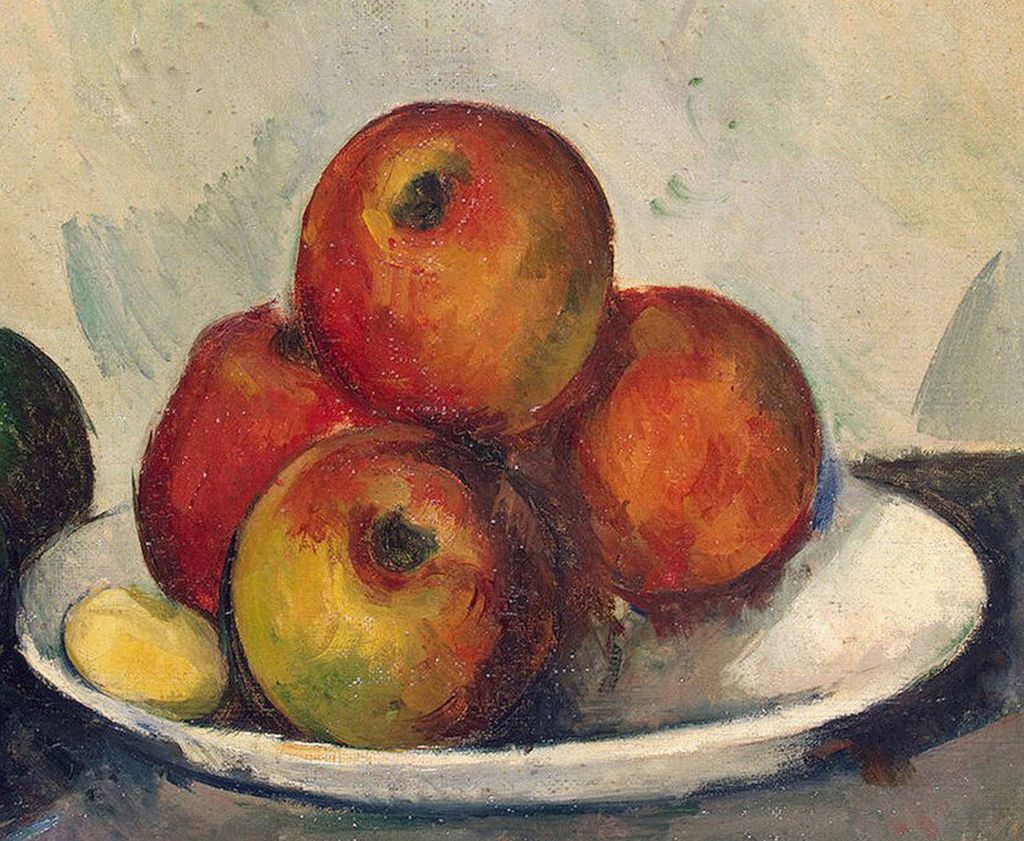
Whole and cut lemon
A cut piece rests beside the green fruit on the plate. Compare its pale interior with the outside of the whole lemon in front.
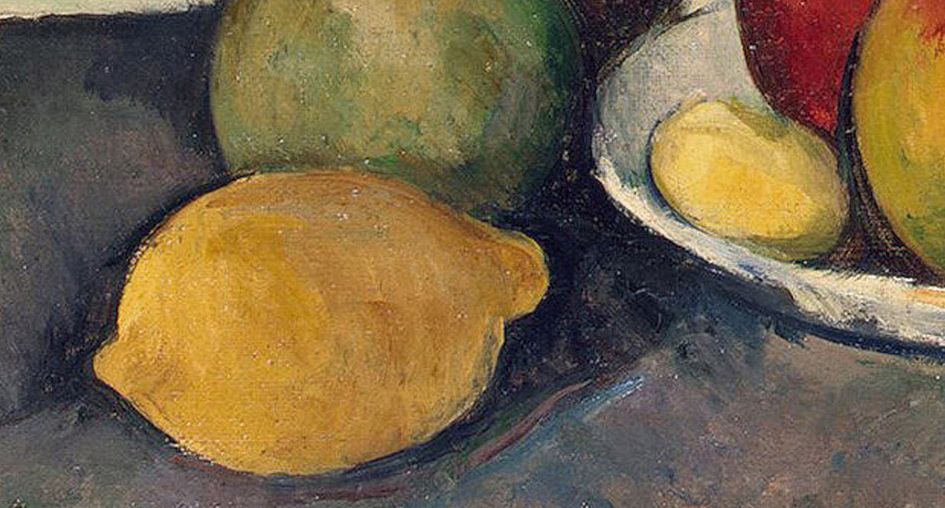
Green apples and the small container
The quieter green fruit overlaps near a metal container holding dark leaves and cropped flowers.
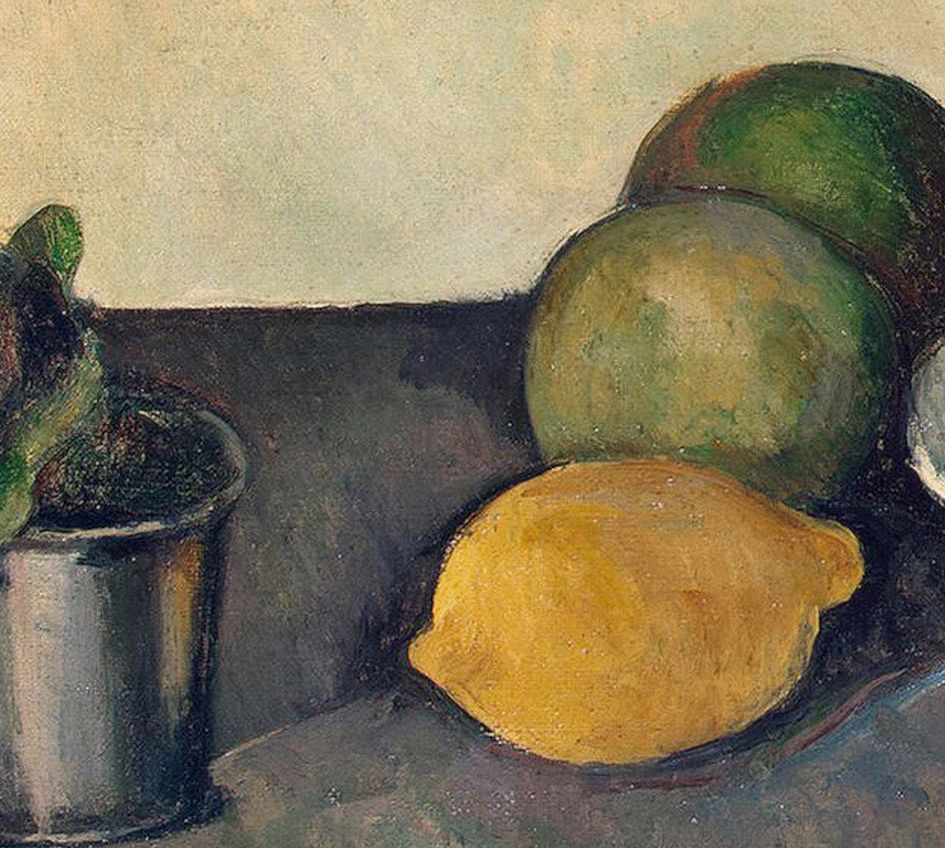
Colour across the pale wall
Cool green and blue strokes interrupt the pale wall beside the warm upper apple.
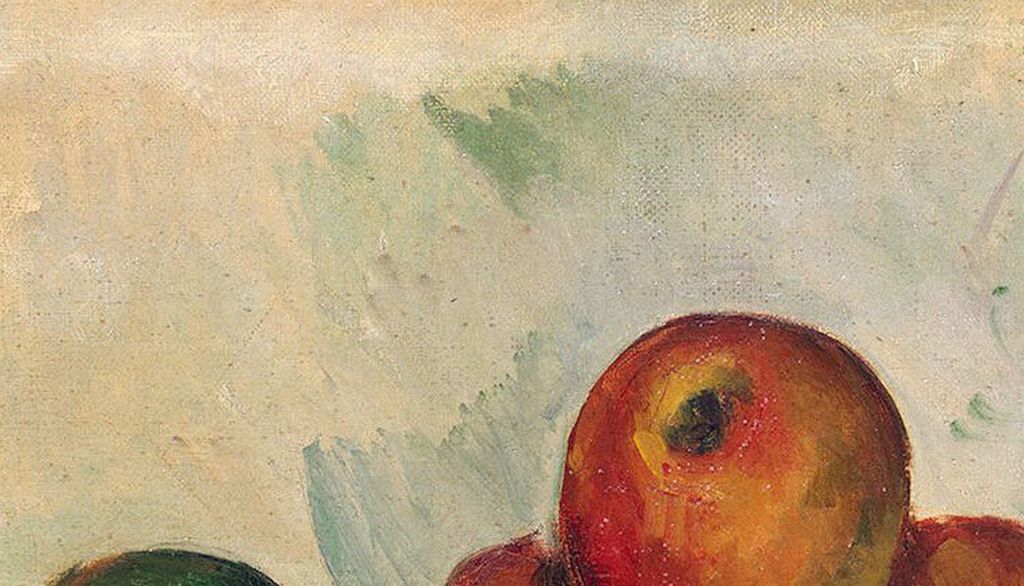
Red and green across a pale wall
Colour gives the picture a pattern that does not simply follow the objects' names. The apples include yellow, orange, red and green within single skins. The white plate contains cool blue-grey passages. The tabletop shifts between brown, green and muted violet, while the supposedly plain background is touched with warmer cream and cooler green. These variations connect one thing with another before we consciously trace their outlines.
The richest red is concentrated in the plate's fruit. Seen against the green apples, it makes the two groups immediately distinct. Yet green is also present in the front apple on the plate, and warm yellow links that apple to the lemon. The division between red fruit on one side and green fruit on the other therefore remains incomplete. Colour carries our eye across the gap that separates the two groups.
The wall offers a gentler version of this exchange. Broad, lightly differentiated patches keep it from becoming a blank backdrop. Near the upper fruit, cool strokes press close to the warm contour. Elsewhere the wall seems more open and softly lit. Its changes are slight enough to leave the fruit prominent, but visible enough to make the space around the still life feel painted and responsive.
This is a useful place to slow down. If we attend only to the red apples, the wall can seem merely pale. If we look at the wall first, the green and blue passages become more conspicuous, and the same colours begin to recur in fruit and table. The objects have not changed. Our sense of their relation has become more complex because the field around them now participates in the colour arrangement.
How much space is there on the table?
The horizontal division between wall and tabletop supplies the picture's clearest structural line. It is visible on both sides of the fruit but hidden behind the main group. Above it is a light, relatively open field; below it is a darker surface filled with objects and small strokes. The line gives the arrangement a setting without requiring a complete account of the room.
Several local clues suggest depth. The darker green apple disappears partly behind the lighter one. Fruit overlaps fruit within the plate. The plate in turn lies behind the foreground lemon. These small occlusions establish a sequence that we can read without difficulty. They make the tabletop sufficiently believable for the painting's more elusive passages to remain engaging rather than confusing.
At the same time, the broad visible surface of the plate asks us to look down, while the fruit presents much of its height. The wall rises close behind the upper apple. The resulting space feels shallow and densely used. It offers no spacious interior into which the eye can escape. Almost every turn of attention brings us back to a contact, an edge or a colour change among the objects.
The near edge of the table is less emphatic than the wall division. The lower area remains a spread of subdued brushwork, with no elaborately described legs or furniture front to anchor our position. That omission helps keep the fruit close to the picture surface. We are not invited to walk around a reconstructed room; we are held before a particular set of relationships within a small rectangle.
Brushwork and the experience of weight
The fruit feels substantial, but its painted surface does not imitate a photograph's continuous finish. Changes of direction and colour remain visible. The front apple, for example, brings a light yellow-green area into contact with a darker lower turn. The red apple at the top contains broad warm passages around the dark cavity. The marks give the eye enough information to make a rounded form while remaining legible as separate applications of colour.
Different parts of the picture ask for different levels of attention. The plate's light edge is comparatively insistent, whereas some background passages are loosely connected. The container has a sharp pale accent but a dark, less distinct upper area. These differences help direct looking. They do not, by themselves, tell us whether Cézanne regarded any particular passage as complete.
The painting also makes weight a relational effect. A fruit seems more securely placed when another overlaps it or when a dark contact appears below it. The stacked apples depend on the plate's curve; the plate's curve becomes more evident because of their pressure against it. Even the isolated lemon gains presence from its darker lower edge and the surrounding quieter tabletop. Solidity emerges through these meetings rather than through an evenly outlined inventory.
There is pleasure in returning from a detail to the whole. A patch that initially looks abrupt becomes part of a larger colour rhythm. A dark interval between apples becomes a sign of their closeness. A pale strip at the plate's edge becomes the support for an entire group. The small format allows such changes of attention to happen quickly, yet the relations are varied enough to reward repeated looking.
Dating and the painting's recorded history
The Hermitage and the current online catalogue raisonné place the painting around 1890. Earlier scholarship used an earlier range: the catalogue records Venturi's 1883–87 dating and a revised 1883–86 range, alongside Rewald's date of about 1890. These are differences in scholarly dating, rather than evidence for a precisely documented painting session. [2]
The ownership record also contains qualifications. The catalogue lists possible early connections with Vollard, Gustave Geffroy, the Prince de Wagram and Bernheim-Jeune, each marked uncertain. Later names include the dealers Alfred Daber, Tanner, Karl Haberstock, Georg Caspari and Hugo Perls, followed by the German collector Otto Krebs. Krebs's collection is the immediate historical context supplied for the work now at the Hermitage. [2]
The catalogue associates the painting with Vollard's 1895 Cézanne exhibition and records its appearance at Galerie Tanner in Zurich in 1919. Later exhibition entries include the Hermitage's Hidden Treasures Revealed in 1995–96 and Cézanne and the Russian Avant-Garde in 1998. This exhibition trail gives the small canvas a history beyond its quiet tabletop, while the questions attached to its early ownership should remain open. [2]
From this small arrangement to larger still lifes
Compare the Hermitage painting with The Basket of Apples . In the Chicago picture, dated about 1893, a tilted basket, bottle, piled biscuits and expansive striped cloth spread activity across a much larger arrangement. The Hermitage work concentrates its principal mass in a plate, leaving the smaller objects to counter it across exposed tabletop. The comparison reveals different distributions of weight; it does not establish that one was a preparatory step for the other. [3]
The later Apples and Oranges , dated about 1899 by the Musée d'Orsay, offers another productive comparison. Its white linen, floral jug, dishes and patterned drapery create a more abundant setting. Here, by contrast, the light wall and modest expanse of table leave fewer competing patterns around each fruit. Both arrangements encourage us to follow where one shape ends and another begins, but they give that attention very different surroundings. [4]
Return finally to the Hermitage plate. Its fruit is familiar, its scale approachable, its surrounding space almost bare. The sustained interest comes from distinctions that an everyday glance could overlook: two different greens, a curve flattened into an ellipse, a warm patch turned by a cool neighbour, the gap beneath an overlapping apple. The painting makes these small relationships sufficient to hold an entire composition together.
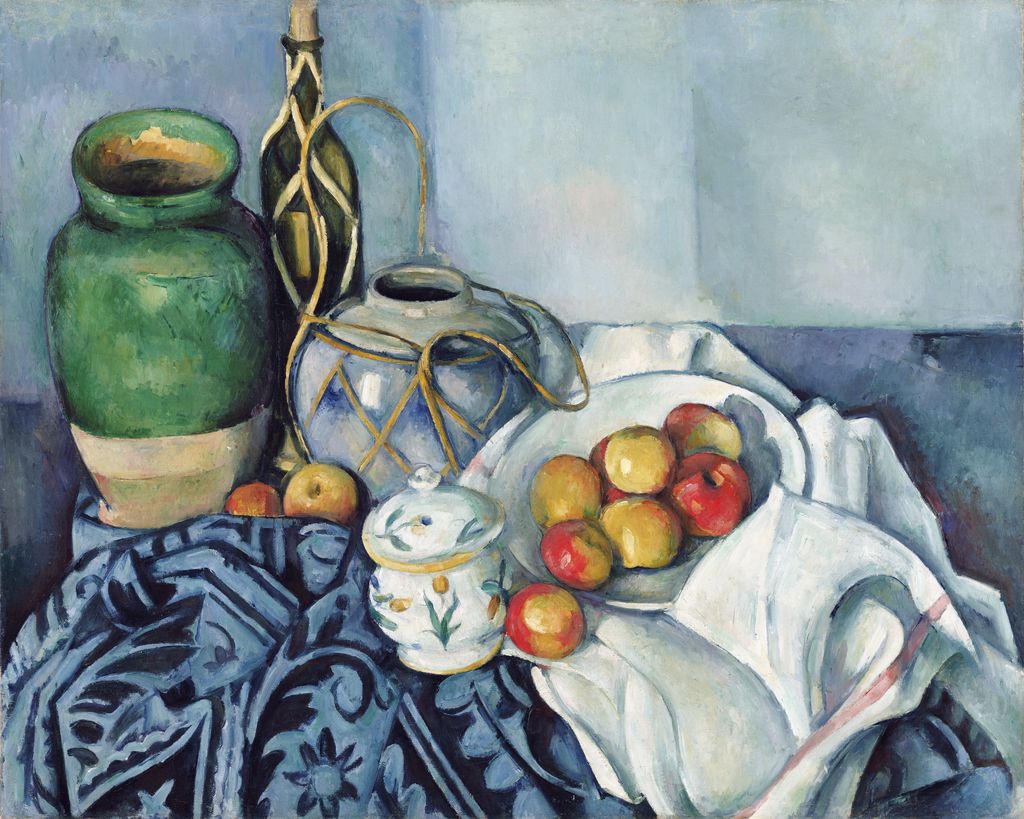
Paul Cézanne, Still Life with Apples, 1893–94, oil on canvas, J. Paul Getty Museum, Los Angeles (96.PA.8; FWN855).
Image source
.
CC0 / Public domain
. Proportional web export only; master unchanged.
Cézanne artworks directory
Browse 217 identified works in this researched selection, including paintings, drawings and watercolours. This is a bounded selection, not a complete catalogue of Cézanne’s surviving oeuvre. Unlinked titles have no confirmed article in this collection.
| Name | Date | Medium |
|---|---|---|
| A Head, a Cup, and a Bread Roll | 1891/1894 | Drawing |
| A Man seen from Behind | 1880/1883 | Drawing |
| A Modern Olympia | 1873–74 | Painting |
| A Nude and Foliage | 1879/1882 | Drawing |
| A Smoking Man | 1892–96 (catalogue); c.1890–92 (museum) | Drawing |
| Afternoon in Naples | 1876–77 | Painting |
| An Old Woman with a Rosary | about 1895–96 | Painting |
| Apples and Oranges | c.1899 | Painting |
| Auvers, Panoramic View | 1873–75 | Painting |
| Avenue at Chantilly | 1888 | Painting |
| Banks of the Marne | 1888–94 | Painting |
| Basket | 1877/1900 | Drawing |
| Bather with Outstretched Arms | 1877–78 | Painting |
| Bellows in Front of a Fireplace | 1887/1892 | Drawing |
| Bibémus Quarry | c.1895 | Painting |
| Boy in a Red Vest, Barnes Foundation | 1888–90 | Painting |
| Boy in a Red Vest, MoMA | 1888–90 | Painting |
| Boy in a Red Waistcoat, National Gallery of Art | 1888–90 | Painting |
| Branch in Flower | 1886/1889 | Drawing |
| Carnival Scene | 1885/1888 | Drawing |
| Chair and Dresser | 1880/1883 | Drawing |
| Chateau Noir | 1903–04 | Painting |
| Chestnut Trees and Farm at Jas de Bouffan | c.1885 | Painting |
| Chestnut Trees and Farm at Jas de Bouffan, Pushkin | c.1886 | Painting |
| Chestnut Trees at Jas de Bouffan in Winter | 1885–86 | Painting |
| Château Noir | 1900–04 | Painting |
| Cistern in the Park of Château Noir | c.1900 | Painting |
| Curtain, Jug and Fruit | 1893–94 | Painting |
| Cushion of an Armchair | 1886/1889 | Drawing |
| Draft Letter and Studies of Bathers | c.1878 | Drawing |
| Farmhouse and Chestnut Trees at Jas de Bouffan | 1884–85 | Painting |
| Figure Resting Head on Hand | c. 1889 | Drawing |
| Fireplace Tongs and Poker | 1887/1892 | Drawing |
| Forest Interior, San Francisco | c.1898–99 | Painting |
| Four Bathers | 1888–90 | Painting |
| Fruit and a Jug on a Table | 1893–94 | Painting |
| Gardanne | 1885–86 | Painting |
| Gardanne, Barnes Foundation | c.1885 | Painting |
| Hand and Shoulder of a Boy | c. 1885 | Drawing |
| Harlequin, National Gallery of Art | 1888–90 | Painting |
| Head of a Boy | 1887/1889 | Drawing |
| Head of a Boy Seen from Behind | c. 1885 | Drawing |
| Head of a Young Woman | c. 1880 | Drawing |
| Head of the Artist's Son | 1888/1889 | Drawing |
| Hillside in Provence | c.1890–92 | Painting |
| Horse Chestnut Trees at Jas de Bouffan | c.1885 | Painting |
| House and Farm at the Jas de Bouffan | c.1887 | Painting |
| House in a Park | 1883/1886 | Drawing |
| House in Provence | c.1885 | Painting |
| House of Père Lacroix | 1873 | Painting |
| House Surrounded by Vegetation | 1889/1892 | Drawing |
| Houses in Provence The Riaux Valley near L’Estaque | c.1883 | Painting |
| Jas de Bouffan, the Pool | c.1876 | Painting |
| Kerosene Lamp | 1878/1881 | Drawing |
| L'Estaque, Melting Snow | c.1870 | Painting |
| Lake Annecy | 1896 | Painting |
| Landscape in Provence, Pola Museum | 1879–82 | Painting |
| Landscape Near Aix-en-Provence | 1877/1880 | Drawing |
| Landscape Seen from the Inside of a Cave | 1889/1892 | Drawing |
| Landscape with Poplars | c.1885–87 | Painting |
| Landscape with Trees | 1895/1898 | Drawing |
| Leda and the Swan | c.1880 (possibly later) | Painting |
| Little Girl with a Doll | 1902–04 | Painting |
| Louis Guillaume | 1879–1890 | Painting |
| Madame Cezanne | 1888/1891 | Drawing |
| Madame Cezanne | 1886/1889 | Drawing |
| Madame Cezanne | 1882/1887 | Drawing |
| Madame Cezanne | 1897/1900 | Drawing |
| Madame Cezanne with her Head Lowered | 1893/1896 | Drawing |
| Madame Cézanne in a Red Armchair | c.1877 | Painting |
| Madame Cézanne in a Red Dress, Metropolitan Museum of Art | 1888–90 | Painting |
| Madame Cézanne in a Yellow Chair | 1888–90 | Painting |
| Madame Cézanne in a Yellow Chair, Fondation Beyeler | 1888–90 | Painting |
| Madame Cézanne in the Conservatory | 1891 | Painting |
| Maincy Bridge | 1879–80 | Painting |
| Maison Maria with a View of Château Noir | c.1895 | Painting |
| Man Bending Forward | 1883/1886 | Drawing |
| Man Smoking a Pipe, Pushkin | c.1891, possibly later | Painting |
| Man with a Pipe | 1891–96 | Painting |
| Man with a Pipe, Nelson-Atkins | 1890–92 | Painting |
| Man with a Straw Hat (Gustave Boyer) | c.1871 | Painting |
| Man with Crossed Arms | c.1899 | Painting |
| Man with Pipe, National Gallery of Art | 1892–96 | Painting |
| Mont Sainte-Victoire | c.1902–06 | Painting |
| Mont Sainte-Victoire | 1900–02 | Painting |
| Mont Sainte-Victoire (recto) | c.1895 | Watercolour |
| Mont Sainte-Victoire and the Viaduct of the Arc River Valley | 1882–85 | Painting |
| Mont Sainte-Victoire Seen beyond the Wall of the Jas de Bouffan | c.1885/1888 | Watercolour |
| Mont Sainte-Victoire Seen from Bibémus Quarry | c.1897 | Painting |
| Mont Sainte-Victoire, Barnes Foundation | 1892–95 | Painting |
| Near the Pool at Jas de Bouffan | 1883/1887 | Drawing |
| Pelicans | 1877/1880 | Drawing |
| Peonies | 1890/1893 | Drawing |
| Pierrot and Harlequin | 1888 | Painting |
| Pine Tree | 1882/1885 | Drawing |
| Pont des Trois Sautets | 1906 | Watercolour |
| Poplars | 1879–80 | Painting |
| Portrait of Ambroise Vollard | 1899 | Painting |
| Portrait of Gustave Geffroy | 1895–96 | Painting |
| Portrait of Madame Cezanne with Loosened Hair | 1885–86 | Painting |
| Portrait of the Artist Looking Over His Shoulder | 1883–84 | Painting |
| Portrait of the Gardener Vallier | 1906 | Painting |
| Portrait of Victor Chocquet | 1876–77 | Painting |
| Portrait Of Victor Chocquet Seated | 1877 | Painting |
| Provençal Manor | c.1885 | Painting |
| Pyramid of Skulls | 1898–1900 | Painting |
| Reclining Nude (Leda?) | c.1887 | Painting |
| Scipio | 1866–68 | Painting |
| Seated Man, Oslo | 1898–1900 | Painting |
| Seated Peasant | c.1892–96 | Painting |
| Seated Peasant, Hiroshima | c.1897 | Painting |
| Seated Peasant, Orsay | c.1900 | Painting |
| Self-Portrait | c. 1895 | Drawing |
| Self-Portrait in a Bowler Hat, Ny Carlsberg Glyptotek | 1885–86 | Painting |
| Self-Portrait in a Casquette | c.1875 | Painting |
| Self-Portrait with a Beret | 1898–1900 | Painting |
| Self-Portrait with a Hat, Artizon Museum | c.1890–94 | Painting |
| Self-Portrait with a Pink Background | c.1875 | Painting |
| Self-Portrait with Olive-Coloured Wallpaper | about 1880–81 | Painting |
| Self-Portrait with Palette | 1886–87 | Painting |
| Self-Portrait with White Turban | c.1878–80 | Painting |
| Self-Portrait, c.1895 | c.1895 | Painting |
| Self-Portrait, Pushkin Museum | c.1882 | Painting |
| Spanish Dancers | 1883/1886 | Drawing |
| Still Life with a Curtain | 1892–94 | Painting |
| Still Life with Apples | c.1890 | Painting |
| Still Life with Apples | 1893–94 | Painting |
| Still Life with Apples and a Pot of Primroses | about 1890 | Painting |
| Still Life with Milk Jug and Fruit | c.1900 | Painting |
| Still Life with Open Drawer | 1877–79 | Painting |
| Still Life with Plaster Cupid | about 1894 | Painting |
| Still Life with Skull | 1890–93 | Painting |
| Still Life with Soup Tureen | 1877 | Painting |
| Still Life, Pitcher and Fruit | 1893–94 | Painting |
| Studies Including a Straw Hat | 1895/1898 | Drawing |
| Studies Including Madame Cezanne | 1884/1887 | Drawing |
| Study for "The Judgement of Paris" or "The Amorous Shepherd" | 1883/1886 | Drawing |
| Study for Woman with a Coffee Pot | c.1895 | Painting |
| Study of "The Roman Orator (Germanicus)" | 1883/1886 | Drawing |
| Study of "Venus de Milo" | 1881/1884 | Drawing |
| Study of a Decorative Ornament | 1879/1882 | Drawing |
| Study of a Standing Male Figure after the Antique | c. 1895 | Drawing |
| Study of an Angel in Rubens' "The Prophet Elijah" | 1892/1895 | Drawing |
| Study of Desiderio da Settignano's "Bust of a Child" | c. 1895 | Drawing |
| Study of Houses | 1879/1882 | Drawing |
| Study of Puget's "Hercules Resting" | c. 1879 | Drawing |
| Study of Puget's "Milo of Crotona" | 1895/1898 | Drawing |
| Study of Puget's "Milo of Crotona" | 1880/1883 | Drawing |
| Study of the Allegorical Figure Bellona in Rubens' "The Apotheosis of Henri IV" | 1883/1886 | Drawing |
| Study of the Allegorical Figure Bellona in Rubens' "The Apotheosis of Henri IV" | 1879/1882 | Drawing |
| Study of the Allegorical Figure France in Rubens' "The Exchange of the Two Princesses" | 1882/1885 | Drawing |
| Study of the Allegorical Figure of Health in Rubens' "The Birth of Louis XIII" | 1880/1883 | Drawing |
| Study of the Allegorical Figure of the Genius of Health from Rubens' "The Birth of Louis XIII at Fontainbleau" | 1895/1898 | Drawing |
| Sugar Bowl, Pears and Blue Cup | 1865–66 | Painting |
| The Aqueduct, Pushkin Museum | Dating differs between museum records | Painting |
| The Artist's Father, Reading L'Evenement | autumn 1866 | Painting |
| The Artist's Son | c. 1887 | Drawing |
| The Artist's Son Leaning on his Elbow | c. 1887 | Drawing |
| The Artist's Son Reading | c. 1887 | Drawing |
| The Artist's Son Writing | c. 1887 | Drawing |
| The Artist’s Son, Paul | 1886–87 | Painting |
| The Avenue at Jas de Bouffan | 1868–70 (possibly later) | Painting |
| The Avenue at Jas de Bouffan, Geneva | c.1890 | Painting |
| The Basket of Apples | c.1893 | Painting |
| The Bather, Museum of Modern Art | c.1885 | Painting |
| The Bay of Marseille seen from L'Estaque | c.1885 | Painting |
| The Blue Vase | 1889–90 | Painting |
| The Boy in the Red Vest, Bührle | 1888–90 | Painting |
| The Buffet | 1877–79 | Painting |
| The Card Players, Barnes Foundation | 1890–92 | Painting |
| The Card Players, Courtauld Gallery | 1892–96 | Painting |
| The Card Players, Metropolitan Museum of Art | 1890–92 | Painting |
| The Card Players, Musée d’Orsay | 1893–96 | Painting |
| The Card Players, Qatar | 1892–96 | Painting |
| The Eternal Feminine | c.1877 | Painting |
| The Gardener Vallier | 1906 | Painting |
| The Gardener Vallier, Tate | 1905–06 | Painting |
| The Grounds of the Château Noir | c.1900–04 | Painting |
| The Gulf of Marseille Seen from L’Estaque | c.1885 | Painting |
| The Hanged Man's House in Auvers | c.1873 | Painting |
| The House of Doctor Gachet at Auvers | 1872–73 | Painting |
| The House with the Cracked Walls | 1892–94 | Painting |
| The Kiss of the Muse | c.1860 | Painting |
| The Large Bathers, Barnes Foundation | 1895–1906 | Painting |
| The Large Bathers, National Gallery | 1895–1905 | Painting |
| The Large Bathers, Philadelphia Museum of Art | 1900–06 | Painting |
| The Mill | 1889/1892 | Drawing |
| The Painter’s Father, Louis-Auguste Cézanne | c.1865 | Painting |
| The Peasant | 1890–92 | Painting |
| The Plaster Mill (La Moulin à plâtre) | 1889/1892 | Drawing |
| The Smoker, Hermitage | c.1891 | Painting |
| The Smoker, Mannheim | c.1891 | Painting |
| The Stove in the Studio | c.1865 | Painting |
| The Vase of Tulips | c.1890 | Painting |
| Thistle | 1893/1896 | Drawing |
| Three Heads, One of Madame Cezanne | 1882/1885 | Drawing |
| Three Skulls | c.1898 | Painting |
| Three Skulls on a Patterned Carpet | 1904 | Painting |
| Trees and Shrubs | 1883/1887 | Drawing |
| Turning Road at Montgeroult | 1898 | Painting |
| Two Bathers | 1884/1887 | Drawing |
| Two Heads | 1888 | Drawing |
| Two Heads | 1890/1896 | Drawing |
| Two Heads of Women | 1890/1894 | Drawing |
| Two Studies for "The Judgement of Paris" or "The Amorous Shepherd" | 1883/1886 | Drawing |
| Uncle Dominique in a Tasseled Cap | 1866 | Painting |
| Uncle Dominique in a Turban | 1866–67 | Painting |
| Victor Chocquet and an Angel for "The Apotheosis of Delacroix" | 1878/1880 | Drawing |
| Woman in Blue | c.1904 | Painting |
| Woman Leaning Forward | 1888/1891 | Drawing |
| Woman Leaning Forward | 1890/1894 | Drawing |
| Woman Leaning Forward | 1890/1894 | Drawing |
| Woman with a Coffee Pot | c.1895 | Painting |
| Women Bathers and a Roll of Paper | 1882/1885 | Drawing |
| Young Girl with a Doll | c.1895 | Painting |
| Young Italian Woman at a Table | c.1895–1900 | Painting |
| Young Man and Skull | 1896–98 | Painting |
Frequently Asked Questions
This version is in the State Hermitage Museum, Saint Petersburg, under inventory number ЗКРсэ-558. Cézanne painted other works with similar titles, so the collection and inventory identify the specific canvas. [1]
Discussion
Look again at the images and ideas explored in Still Life with Apples by Paul Cézanne. These editorial prompts invite your observations.
Reader Insights
Follow the white plate's rim from left to right. Where does it seem to contain the fruit, and where does an apple interrupt your sense of its shape?
Compare the two green fruits at the left with the green-yellow apple in the plate. Which differences of light, colour and overlap make them feel separate?
Look first at the wall, then at the fruit. Which colours become more noticeable in the apples after you have attended to the background?
Join the Conversation
Share a detail, comparison or question about Still Life with Apples by Paul Cézanne below.
References
- State Hermitage Museum , “Натюрморт с яблоками” ( Still Life with Apples ), inventory ЗКРсэ-558, collection record (in Russian). View source .
- Société Paul Cezanne , “Nature morte, c.1890,” FWN 820, The Paintings, Watercolors and Drawings of Paul Cezanne: An Online Catalogue Raisonné . View source .
- Art Institute of Chicago , Paul Smith, with technical report by Kim Muir and Giovanni Verri, “Cat. 10 The Basket of Apples, c. 1893.”. View source .
- Musée d'Orsay , “Pommes et oranges,” RF 1972, collection record (in French). View source .
- Le Baiser de la muse, d'après Frillié (FWN 572). View source.
- Louis-Auguste Cezanne, père de l'artiste, lisant L'Événement (FWN 402). View source.
- La Maison du pendu, Auvers-sur-Oise (FWN 81). View source.
- Une moderne Olympia (FWN 628). View source.
- Le Pont de Maincy (FWN 143). View source.
- La Montagne Sainte-Victoire vue de Montbriand (FWN 185). View source.
- Gardanne (vue horizontale) (FWN 224). View source.
- Le Vase bleu (FWN 823). View source.
- Les Joueurs de cartes (FWN 681). View source.
- La Montagne Sainte-Victoire (FWN 296). View source.
- La Corbeille de pommes (FWN 860). View source.
- Pommes et oranges (FWN 871). View source.
- Portrait d'Ambroise Vollard (FWN 531). View source.
- Philadelphia Museum of Art,The Large Bathers,W1937-1-1. View source.
- Château Noir (FWN 360). View source.
- Société Paul Cezanne,online catalogue structure and objectidentification. View source.
- National Gallery of Art,Cezanne Sketchbook,1992.51.9. View source.
- Splash image, Paul Cézanne, Still Life with Apples, about 1890, oil on canvas, 35.2 × 46.2 cm, State Hermitage Museum, Saint Petersburg (ЗКРсэ-558).


