 by
Tom Gurney
Tom Gurney BSc (Hons) is an art history expert with over 20 years experience
Published on June 19, 2020 / Updated on October 22, 2026
Email:
tomgurney1@gmail.com
/ Phone:
+44 7429 011000
Cézanne’s Original Prints: Etchings, Lithographs and Later Impressions: Introduction
A print of a Cézanne painting and a print made from a design Cézanne created for printing are different objects. The first transfers an existing image into a new product. In the second, the artist’s marks belong to a printing process from the outset, even when a specialist printer helps realise the edition. Cézanne’s original prints come chiefly from two brief episodes: etchings made in 1873 and lithographs associated with the Paris dealer Ambroise Vollard in the later 1890s. [1] [2]
The distinction becomes most interesting where a composition exists in several forms. Cézanne’s bathers appear in paintings, drawings, watercolours, black lithographs, hand-coloured working impressions and colour lithographs. A familiar subject does not make these interchangeable. The marks, colour and printing history of a particular sheet tell us what sort of work we are looking at. [2]
At a Glance
- Original-print media etching, sometimes combined with drypoint or aquatint, and lithography. [3] [4]
- Main working periods five etchings connected with 1873; three lithographic designs from the later 1890s in Druick’s catalogue. [1] [2]
- Key collaborators Dr Paul-Ferdinand Gachet in the etching period; publisher Ambroise Vollard and printer Auguste Clot in the lithographic period. [5] [2]
- Important distinction the date of a design can differ from the date when a particular impression was printed. [4]
Contents
- At Auvers: an artist learning the etched line
- The lithographs and Vollard’s print venture
- How a colour impression took shape
- The life of a plate or stone after Cézanne
At Auvers: an artist learning the etched line
Cézanne’s five etchings belong to the close working circle around Gachet, Pissarro and Armand Guillaumin. Gachet’s house at Auvers provided a setting where artists could try printmaking. Portraits and scenes of places both entered the experiment. Among the subjects are Guillaumin, a young woman’s head, a farm entrance, a garden and barges on the Seine after a composition by Guillaumin. The series is short, yet it moves between a fellow artist’s face, a familiar site and a borrowed image. [5] [4]
The medium offered a way to draw in lines and then print them in multiples. In etching, the artist opens marks through a protective ground on a metal plate; acid bites the exposed metal, and ink later lodges in those recesses for printing. The plate can be wiped and printed again, but each impression still depends on the condition of the plate and the printer’s handling of ink and paper. That process gives particular force to Cézanne’s rough edges and abrupt patches of dark: they are results on a pressed sheet, not brushstrokes on canvas. An etching can remain visibly tentative even after the plate has gone through acid and a press. [6]
In Portrait of Guillaumin with a Hanging Man , Guillaumin sits with his arms crossed, one knee raised and a broad-brimmed hat casting a dark patch over his eyes. A tiny hanging figure occupies the upper left corner, distant from the sitter yet impossible to overlook once seen. The portrait’s brisk, open line leaves much of the paper untouched. The Courtauld describes the hanging man as Cézanne’s emblem within this circle; it suggests, cautiously, that the portrait may have been drawn directly on the plate. [1] The Metropolitan Museum’s impression is catalogued as an etching with drypoint and as a restrike, a reminder that an original etched design can have a later printing history. [3]
In Entrée de ferme , the large near tree leans across a farm roof. Dense, slanting hatching gathers at the left, while the right side opens into shorter fence posts and lighter sky. The roof looks almost wedged between trunk and wall. Two reproduced impressions show how a single etched subject can change when the plate changes: an early state leaves the lower scene comparatively open; in another, dark tone covers much of the foreground and rises behind the roof. Smith identifies the second as a real alteration of the plate, not merely an ink variation. [4]
The earliest printing remains less certain. Gachet’s son said printing at Auvers had not yet begun in 1873. Smith instead points to rough paper and split plate marks on early impressions as evidence that Gachet may have printed some there. He leaves open the possibility that a later impression was given an earlier inscription date. The uncertainty matters because “made in 1873” describes Cézanne’s work on the plate more securely than it describes every sheet later pulled from it. [4]
The lithographs and Vollard’s print venture
Roughly two decades later, Vollard’s publishing plans brought Cézanne back to printmaking. The dealer had mounted Cézanne’s first solo exhibition in 1895 and was issuing portfolios of contemporary prints. The British Museum identifies his commission of Cézanne’s bathers lithograph within the wider nineteenth-century growth of prints for collectors. The change of setting matters: these were images meant to travel as printed sheets rather than remain a single canvas in a collection. [7] [8]
The three designs catalogued by Druick are The Bathers, large plate , The Bathers, small plate , and a self-portrait. The small-plate colour lithograph appeared in Vollard’s 1897 album. An album date need not be the date of the first drawing. The surviving images are plainly separate compositions. [9]
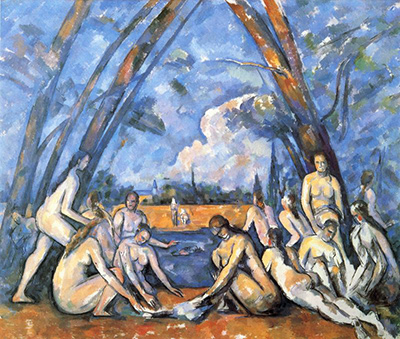
In the black large-plate image, four figures occupy a broad landscape. The standing man near the centre faces down toward a reclining figure; another turns away at right. Rock, water and trees are constructed from lines that alternately thicken and break apart, leaving broad areas of paper to supply the light. The raised mountain in the distance helps anchor the composition, while the low horizon keeps the bodies prominent. Cézanne reworked an earlier Bathers at Rest arrangement here. This is a separate composition from the monumental late Large Bathers canvas in Philadelphia, despite the near-identical English title. MoMA catalogues its impression as a trial proof of a lithograph published by Vollard and printed by Clot. [9] [2]
The small-plate bathers gather six figures more tightly around a patch of ground beneath trees. In the black impression, several heads are only lightly defined, and the central pair’s contours appear to share strokes. The clustered bodies make the group read first as a pattern of uprights and diagonals, then as individual poses. Comparing this image with the wider spacing of the large plate shows that “small” and “large” distinguish designs, not just sheet dimensions. The National Gallery of Art catalogues a small-plate impression as a colour lithograph and a large-plate impression as a lithograph; these are separate collection objects. [10] [11]
The third lithographic design shifts the subject from a group to Cézanne himself. In the reproduced self-portrait, a flat cap shades the forehead, but the eyes face the viewer. Close-set strokes make the jacket nearly black at its lower edge, while spare lines leave the cheeks and nose largely to the paper. The abrupt edge of a dark rectangular area beside the head contrasts with the softer marks of the face. The National Gallery of Art catalogues a Self-Portrait impression as an 1899 lithograph; Druick places the drawing earlier and records editions printed later. These dates can refer to different stages in a print’s life. [12] [9]
How a colour impression took shape
A useful way into the colour lithographs is to separate three objects that may look alike at a glance. One is the black printed design. Another is a black impression Cézanne coloured by hand as a guide. A third is a finished colour lithograph printed by the workshop. MoMA describes the hand-coloured proof used for the large-plate project and Clot’s part in recreating its effects. These are distinct physical sheets and processes: the watercolour on a working proof was applied to that sheet, whereas an edition’s colour was transferred through printing. [2]
Colour lithography can require a separate surface for each colour and careful registration when the sheet goes through the press again. The National Gallery of Art’s account of lithographic practice explains why the printer’s work matters even when the artist supplies the image. [13] Druick argues that Clot translated Cézanne’s painted guides into colour stones; he disputes a reported claim that Cézanne prepared every stone himself. [9]
The life of a plate or stone after Cézanne
Original design and lifetime printing should also be kept apart. The Met calls its impression of Guillaumin with a Hanging Man a restrike. Smith records later use of some etched plates in book editions, including the Guillaumin portrait issued with Théodore Duret’s history of Impressionist painters and the farm entrance issued in a 1914 Cézanne publication. An impression from the original plate preserves the artist’s etched design, while its date and any later change to the plate remain part of that sheet’s identity. [3] [4]
Druick distinguishes black and colour versions of the bather lithographs and later editions of the self-portrait, some dated only tentatively. A signature transferred from the stone is part of the printed image, not an individually handwritten signature. A useful label identifies the impression as well as the design. [9]
The best description of a Cézanne print names the composition, technique and, when known, the state or issue of the exact impression. A modern poster of an oil painting, a late impression from an etched plate, a black lithographic proof and a hand-coloured working impression may all circulate under the word “print.” Their relationships to Cézanne’s actions differ. A careful label helps the viewer follow those relationships, then return to what the marks on the actual sheet do. [3] [2]
Cézanne artworks directory
Browse 217 identified works in this researched selection, including paintings, drawings and watercolours. This is a bounded selection, not a complete catalogue of Cézanne’s surviving oeuvre. Unlinked titles have no confirmed article in this collection.
| Name | Date | Medium |
|---|---|---|
| A Head, a Cup, and a Bread Roll | 1891/1894 | Drawing |
| A Man seen from Behind | 1880/1883 | Drawing |
| A Modern Olympia | 1873–74 | Painting |
| A Nude and Foliage | 1879/1882 | Drawing |
| A Smoking Man | 1892–96 (catalogue); c.1890–92 (museum) | Drawing |
| Afternoon in Naples | 1876–77 | Painting |
| An Old Woman with a Rosary | about 1895–96 | Painting |
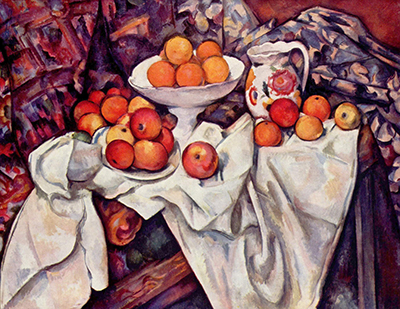
| Apples and Oranges | c.1899 | Painting |
| Auvers, Panoramic View | 1873–75 | Painting |
| Avenue at Chantilly | 1888 | Painting |
| Banks of the Marne | 1888–94 | Painting |
| Basket | 1877/1900 | Drawing |
| Bather with Outstretched Arms | 1877–78 | Painting |
| Bellows in Front of a Fireplace | 1887/1892 | Drawing |
| Bibémus Quarry | c.1895 | Painting |
| Boy in a Red Vest, Barnes Foundation | 1888–90 | Painting |
| Boy in a Red Vest, MoMA | 1888–90 | Painting |
| Boy in a Red Waistcoat, National Gallery of Art | 1888–90 | Painting |
| Branch in Flower | 1886/1889 | Drawing |
| Carnival Scene | 1885/1888 | Drawing |
| Chair and Dresser | 1880/1883 | Drawing |
| Chateau Noir | 1903–04 | Painting |
| Chestnut Trees and Farm at Jas de Bouffan | c.1885 | Painting |
| Chestnut Trees and Farm at Jas de Bouffan, Pushkin | c.1886 | Painting |
| Chestnut Trees at Jas de Bouffan in Winter | 1885–86 | Painting |
| Château Noir | 1900–04 | Painting |
| Cistern in the Park of Château Noir | c.1900 | Painting |
| Curtain, Jug and Fruit | 1893–94 | Painting |
| Cushion of an Armchair | 1886/1889 | Drawing |
| Draft Letter and Studies of Bathers | c.1878 | Drawing |
| Farmhouse and Chestnut Trees at Jas de Bouffan | 1884–85 | Painting |
| Figure Resting Head on Hand | c. 1889 | Drawing |
| Fireplace Tongs and Poker | 1887/1892 | Drawing |
| Forest Interior, San Francisco | c.1898–99 | Painting |
| Four Bathers | 1888–90 | Painting |
| Fruit and a Jug on a Table | 1893–94 | Painting |
| Gardanne | 1885–86 | Painting |
| Gardanne, Barnes Foundation | c.1885 | Painting |
| Hand and Shoulder of a Boy | c. 1885 | Drawing |
| Harlequin, National Gallery of Art | 1888–90 | Painting |
| Head of a Boy | 1887/1889 | Drawing |
| Head of a Boy Seen from Behind | c. 1885 | Drawing |
| Head of a Young Woman | c. 1880 | Drawing |
| Head of the Artist's Son | 1888/1889 | Drawing |
| Hillside in Provence | c.1890–92 | Painting |
| Horse Chestnut Trees at Jas de Bouffan | c.1885 | Painting |
| House and Farm at the Jas de Bouffan | c.1887 | Painting |
| House in a Park | 1883/1886 | Drawing |
| House in Provence | c.1885 | Painting |
| House of Père Lacroix | 1873 | Painting |
| House Surrounded by Vegetation | 1889/1892 | Drawing |
| Houses in Provence The Riaux Valley near L’Estaque | c.1883 | Painting |
| Jas de Bouffan, the Pool | c.1876 | Painting |
| Kerosene Lamp | 1878/1881 | Drawing |
| L'Estaque, Melting Snow | c.1870 | Painting |
| Lake Annecy | 1896 | Painting |
| Landscape in Provence, Pola Museum | 1879–82 | Painting |
| Landscape Near Aix-en-Provence | 1877/1880 | Drawing |
| Landscape Seen from the Inside of a Cave | 1889/1892 | Drawing |
| Landscape with Poplars | c.1885–87 | Painting |
| Landscape with Trees | 1895/1898 | Drawing |
| Leda and the Swan | c.1880 (possibly later) | Painting |
| Little Girl with a Doll | 1902–04 | Painting |
| Louis Guillaume | 1879–1890 | Painting |
| Madame Cezanne | 1888/1891 | Drawing |
| Madame Cezanne | 1886/1889 | Drawing |
| Madame Cezanne | 1882/1887 | Drawing |
| Madame Cezanne | 1897/1900 | Drawing |
| Madame Cezanne with her Head Lowered | 1893/1896 | Drawing |
| Madame Cézanne in a Red Armchair | c.1877 | Painting |
| Madame Cézanne in a Red Dress, Metropolitan Museum of Art | 1888–90 | Painting |
| Madame Cézanne in a Yellow Chair | 1888–90 | Painting |
| Madame Cézanne in a Yellow Chair, Fondation Beyeler | 1888–90 | Painting |
| Madame Cézanne in the Conservatory | 1891 | Painting |
| Maincy Bridge | 1879–80 | Painting |
| Maison Maria with a View of Château Noir | c.1895 | Painting |
| Man Bending Forward | 1883/1886 | Drawing |
| Man Smoking a Pipe, Pushkin | c.1891, possibly later | Painting |
| Man with a Pipe | 1891–96 | Painting |
| Man with a Pipe, Nelson-Atkins | 1890–92 | Painting |
| Man with a Straw Hat (Gustave Boyer) | c.1871 | Painting |
| Man with Crossed Arms | c.1899 | Painting |
| Man with Pipe, National Gallery of Art | 1892–96 | Painting |
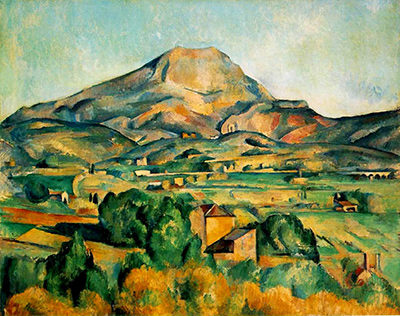
| Mont Sainte-Victoire | c.1902–06 | Painting |
| Mont Sainte-Victoire | 1900–02 | Painting |
| Mont Sainte-Victoire (recto) | c.1895 | Watercolour |
| Mont Sainte-Victoire and the Viaduct of the Arc River Valley | 1882–85 | Painting |
| Mont Sainte-Victoire Seen beyond the Wall of the Jas de Bouffan | c.1885/1888 | Watercolour |
| Mont Sainte-Victoire Seen from Bibémus Quarry | c.1897 | Painting |
| Mont Sainte-Victoire, Barnes Foundation | 1892–95 | Painting |
| Near the Pool at Jas de Bouffan | 1883/1887 | Drawing |
| Pelicans | 1877/1880 | Drawing |
| Peonies | 1890/1893 | Drawing |
| Pierrot and Harlequin | 1888 | Painting |
| Pine Tree | 1882/1885 | Drawing |
| Pont des Trois Sautets | 1906 | Watercolour |
| Poplars | 1879–80 | Painting |
| Portrait of Ambroise Vollard | 1899 | Painting |
| Portrait of Gustave Geffroy | 1895–96 | Painting |
| Portrait of Madame Cezanne with Loosened Hair | 1885–86 | Painting |
| Portrait of the Artist Looking Over His Shoulder | 1883–84 | Painting |
| Portrait of the Gardener Vallier | 1906 | Painting |
| Portrait of Victor Chocquet | 1876–77 | Painting |
| Portrait Of Victor Chocquet Seated | 1877 | Painting |
| Provençal Manor | c.1885 | Painting |
| Pyramid of Skulls | 1898–1900 | Painting |
| Reclining Nude (Leda?) | c.1887 | Painting |
| Scipio | 1866–68 | Painting |
| Seated Man, Oslo | 1898–1900 | Painting |
| Seated Peasant | c.1892–96 | Painting |
| Seated Peasant, Hiroshima | c.1897 | Painting |
| Seated Peasant, Orsay | c.1900 | Painting |
| Self-Portrait | c. 1895 | Drawing |
| Self-Portrait in a Bowler Hat, Ny Carlsberg Glyptotek | 1885–86 | Painting |
| Self-Portrait in a Casquette | c.1875 | Painting |
| Self-Portrait with a Beret | 1898–1900 | Painting |
| Self-Portrait with a Hat, Artizon Museum | c.1890–94 | Painting |
| Self-Portrait with a Pink Background | c.1875 | Painting |
| Self-Portrait with Olive-Coloured Wallpaper | about 1880–81 | Painting |
| Self-Portrait with Palette | 1886–87 | Painting |
| Self-Portrait with White Turban | c.1878–80 | Painting |
| Self-Portrait, c.1895 | c.1895 | Painting |
| Self-Portrait, Pushkin Museum | c.1882 | Painting |
| Spanish Dancers | 1883/1886 | Drawing |
| Still Life with a Curtain | 1892–94 | Painting |
| Still Life with Apples | c.1890 | Painting |
| Still Life with Apples | 1893–94 | Painting |
| Still Life with Apples and a Pot of Primroses | about 1890 | Painting |
| Still Life with Milk Jug and Fruit | c.1900 | Painting |
| Still Life with Open Drawer | 1877–79 | Painting |
| Still Life with Plaster Cupid | about 1894 | Painting |
| Still Life with Skull | 1890–93 | Painting |
| Still Life with Soup Tureen | 1877 | Painting |
| Still Life, Pitcher and Fruit | 1893–94 | Painting |
| Studies Including a Straw Hat | 1895/1898 | Drawing |
| Studies Including Madame Cezanne | 1884/1887 | Drawing |
| Study for "The Judgement of Paris" or "The Amorous Shepherd" | 1883/1886 | Drawing |
| Study for Woman with a Coffee Pot | c.1895 | Painting |
| Study of "The Roman Orator (Germanicus)" | 1883/1886 | Drawing |
| Study of "Venus de Milo" | 1881/1884 | Drawing |
| Study of a Decorative Ornament | 1879/1882 | Drawing |
| Study of a Standing Male Figure after the Antique | c. 1895 | Drawing |
| Study of an Angel in Rubens' "The Prophet Elijah" | 1892/1895 | Drawing |
| Study of Desiderio da Settignano's "Bust of a Child" | c. 1895 | Drawing |
| Study of Houses | 1879/1882 | Drawing |
| Study of Puget's "Hercules Resting" | c. 1879 | Drawing |
| Study of Puget's "Milo of Crotona" | 1895/1898 | Drawing |
| Study of Puget's "Milo of Crotona" | 1880/1883 | Drawing |
| Study of the Allegorical Figure Bellona in Rubens' "The Apotheosis of Henri IV" | 1883/1886 | Drawing |
| Study of the Allegorical Figure Bellona in Rubens' "The Apotheosis of Henri IV" | 1879/1882 | Drawing |
| Study of the Allegorical Figure France in Rubens' "The Exchange of the Two Princesses" | 1882/1885 | Drawing |
| Study of the Allegorical Figure of Health in Rubens' "The Birth of Louis XIII" | 1880/1883 | Drawing |
| Study of the Allegorical Figure of the Genius of Health from Rubens' "The Birth of Louis XIII at Fontainbleau" | 1895/1898 | Drawing |
| Sugar Bowl, Pears and Blue Cup | 1865–66 | Painting |
| The Aqueduct, Pushkin Museum | Dating differs between museum records | Painting |
| The Artist's Father, Reading L'Evenement | autumn 1866 | Painting |
| The Artist's Son | c. 1887 | Drawing |
| The Artist's Son Leaning on his Elbow | c. 1887 | Drawing |
| The Artist's Son Reading | c. 1887 | Drawing |
| The Artist's Son Writing | c. 1887 | Drawing |
| The Artist’s Son, Paul | 1886–87 | Painting |
| The Avenue at Jas de Bouffan | 1868–70 (possibly later) | Painting |
| The Avenue at Jas de Bouffan, Geneva | c.1890 | Painting |
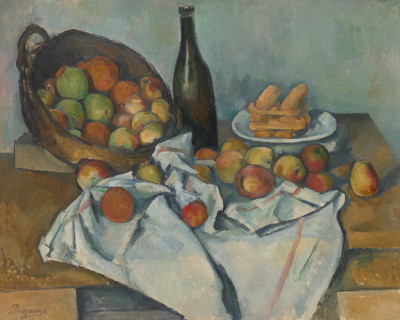
| The Basket of Apples | c.1893 | Painting |
| The Bather, Museum of Modern Art | c.1885 | Painting |
| The Bay of Marseille seen from L'Estaque | c.1885 | Painting |
| The Blue Vase | 1889–90 | Painting |
| The Boy in the Red Vest, Bührle | 1888–90 | Painting |
| The Buffet | 1877–79 | Painting |
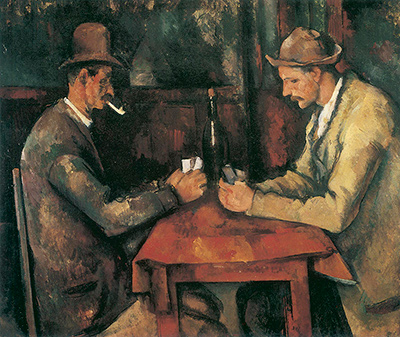
| The Card Players, Barnes Foundation | 1890–92 | Painting |
| The Card Players, Courtauld Gallery | 1892–96 | Painting |
| The Card Players, Metropolitan Museum of Art | 1890–92 | Painting |
| The Card Players, Musée d’Orsay | 1893–96 | Painting |
| The Card Players, Qatar | 1892–96 | Painting |
| The Eternal Feminine | c.1877 | Painting |
| The Gardener Vallier | 1906 | Painting |
| The Gardener Vallier, Tate | 1905–06 | Painting |
| The Grounds of the Château Noir | c.1900–04 | Painting |
| The Gulf of Marseille Seen from L’Estaque | c.1885 | Painting |
| The Hanged Man's House in Auvers | c.1873 | Painting |
| The House of Doctor Gachet at Auvers | 1872–73 | Painting |
| The House with the Cracked Walls | 1892–94 | Painting |
| The Kiss of the Muse | c.1860 | Painting |
| The Large Bathers, Barnes Foundation | 1895–1906 | Painting |
| The Large Bathers, National Gallery | 1895–1905 | Painting |
| The Large Bathers, Philadelphia Museum of Art | 1900–06 | Painting |
| The Mill | 1889/1892 | Drawing |
| The Painter’s Father, Louis-Auguste Cézanne | c.1865 | Painting |
| The Peasant | 1890–92 | Painting |
| The Plaster Mill (La Moulin à plâtre) | 1889/1892 | Drawing |
| The Smoker, Hermitage | c.1891 | Painting |
| The Smoker, Mannheim | c.1891 | Painting |
| The Stove in the Studio | c.1865 | Painting |
| The Vase of Tulips | c.1890 | Painting |
| Thistle | 1893/1896 | Drawing |
| Three Heads, One of Madame Cezanne | 1882/1885 | Drawing |
| Three Skulls | c.1898 | Painting |
| Three Skulls on a Patterned Carpet | 1904 | Painting |
| Trees and Shrubs | 1883/1887 | Drawing |
| Turning Road at Montgeroult | 1898 | Painting |
| Two Bathers | 1884/1887 | Drawing |
| Two Heads | 1888 | Drawing |
| Two Heads | 1890/1896 | Drawing |
| Two Heads of Women | 1890/1894 | Drawing |
| Two Studies for "The Judgement of Paris" or "The Amorous Shepherd" | 1883/1886 | Drawing |
| Uncle Dominique in a Tasseled Cap | 1866 | Painting |
| Uncle Dominique in a Turban | 1866–67 | Painting |
| Victor Chocquet and an Angel for "The Apotheosis of Delacroix" | 1878/1880 | Drawing |
| Woman in Blue | c.1904 | Painting |
| Woman Leaning Forward | 1888/1891 | Drawing |
| Woman Leaning Forward | 1890/1894 | Drawing |
| Woman Leaning Forward | 1890/1894 | Drawing |
| Woman with a Coffee Pot | c.1895 | Painting |
| Women Bathers and a Roll of Paper | 1882/1885 | Drawing |
| Young Girl with a Doll | c.1895 | Painting |
| Young Italian Woman at a Table | c.1895–1900 | Painting |
| Young Man and Skull | 1896–98 | Painting |
Frequently Asked Questions
Yes. Five etched designs are associated with 1873, and the lithographic group includes two bather compositions and a self-portrait. Druick and the Courtauld describe eight original print designs in all; MoMA’s online overview says nine works. The accounts use different totals; naming the designs makes their scope clearer. [9] [1] [2]
No. A hand-coloured proof has pigment applied to that particular sheet. In the colour lithograph, colour was printed from prepared surfaces using a model such as Cézanne’s painted proof. [2]
No. The print follows an earlier four-bather arrangement; the Philadelphia canvas is another, late composition. The similar English titles can obscure the different images. [9]
It signals that Cézanne supplied an earlier image or model, while someone else made the object being catalogued. For example, the National Gallery of Art lists makers of a 1914 illustrated Cézanne volume and identifies Cézanne as the artist “after” whom its images were produced. Check that maker line and the medium before treating an “after Cézanne” item as one of his original prints. [14]
Discussion
Look again at the images and ideas explored in Cézanne’s Original Prints: Etchings, Lithographs and Later Impressions. These editorial prompts invite your observations.
Reader Insights
Look at the black and colour versions of a bather lithograph. Which relationships among the figures become clearer when colour enters the scene?
In the Guillaumin portrait, how does the small hanging figure change the tone of an otherwise direct image of a fellow artist?
When an impression was printed decades after the design was made, which date would you want to see first on its museum label, and why?
Join the Conversation
Share a detail, comparison or question about Cézanne’s Original Prints: Etchings, Lithographs and Later Impressions below.
References
- The Courtauld Gallery , “Guillaumin au Pendu,” collection record. View source .
- The Museum of Modern Art , “The Bathers, large plate (Les baigneurs, grand planche),” collection record, object 4.1934, with Sarah Suzuki’s 2004 catalogue text. View source .
- The Metropolitan Museum of Art , “Portrait of Guillaumin with a Hanging Man,” collection record, object 60.563.46. View source .
- Nouvelles de l’estampe , Paul Smith, “Cezanne’s etchings: a catalogue of lifetime states (and principal posthumous editions),” no. 275, 2026. View source .
- The Metropolitan Museum of Art , “Cézanne to Van Gogh: The Collection of Doctor Gachet Opens at Metropolitan Museum May 25,” 1999. View source .
- The Metropolitan Museum of Art , Wendy Thompson, “The Printed Image in the West: Etching,” Heilbrunn Timeline of Art History , 2003. View source .
- The Metropolitan Museum of Art , James Voorhies, “Paul Cézanne (1839–1906),” Heilbrunn Timeline of Art History , 2004. View source .
- The British Museum , “French Impressions: Prints from Manet to Cézanne,” exhibition overview, 2020–2021. View source .
- The Museum of Modern Art , Douglas Druick, “Cézanne’s Lithographs,” in Cézanne: The Late Work , edited by William Rubin, 1977, pp. 119–137. View source .
- National Gallery of Art , “The Bathers (Small Plate),” collection record, 1897. View source .
- National Gallery of Art , “The Bathers (Large Plate),” collection record, 1896–1897. View source .
- National Gallery of Art , “Self-Portrait,” collection record, 1899, accession 1971.86.6. View source .
- National Gallery of Art , “Ruth Asawa’s Little-Known Experiment with Printmaking,” 2023, section on lithography and colour registration. View source .
- National Gallery of Art , “Cezanne,” illustrated volume, 1914, accession 2006.155.51. View source .
- Société Paul Cezanne,online catalogue structure and objectidentification. View source.
- National Gallery of Art,Cezanne Sketchbook,1992.51.9. View source.
- Splash image, Paul Cézanne, The Large Bathers, painting. Shown for comparison with his distinct bathers lithographs.