



 by Tom Gurney
Tom Gurney BSc (Hons) is an art history expert with over 20 years experience
Published on June 19, 2020 / Updated on November 2, 2026
Email: tomgurney1@gmail.com / Phone: +44 7429 011000
Prints and Reproductions: Introduction
A print of a Gustave Caillebotte painting and a print made by Caillebotte are different kinds of object. The distinction becomes particularly clear in his Portrait of Paul Hugot: Caillebotte made both a large oil portrait and a small printed version, now represented by an impression in the Petit Palais. The museum identifies its sheet as an original print, dated 1878, and records drypoint and etching as its techniques. [1]
His documented graphic experiments also include Canotiers (Oarsmen) and Madame Boissière Knitting. These works show him reconsidering familiar compositions through line, reduced scale and reversal. A modern reproduction can give us access to the appearance of his paintings; the original prints reveal another part of his practice, in which translating an image became an artistic problem in its own right. Galina Olmsted’s account of the prints is especially valuable for following that process. [2]
At a Glance
- Original print anchorPortrait of Paul Hugot, 1878, Petit Palais, Paris, inventory PPG2319. [1]
- Hugot materialsdrypoint and etching on laid paper; sheet 36.7 × 25.9 cm; plate mark 27.5 × 19.5 cm. [1]
- Other documented experimentsCanotiers, 1877, discussed in two states, and Madame Boissière Knitting, 1877. [2]
- Essential distinctionan original graphic work can revisit a painting; a modern reproduction reproduces an existing work’s appearance.
Contents
- What does a Caillebotte print mean?
- Paul Hugot: a figure rebuilt in lines
- Oarsmen, drawings and two printed states
- Madame Boissière and the status of a finished print
- Supporting a print publication
- What a reproduction preserves
- Annotated details
What does a Caillebotte print mean?
The word print describes both a means of making art and a means of circulating images. In Caillebotte’s case, that double meaning can obscure a small but rewarding area of his work. A colour reproduction of an oil painting may retain the figures, architecture and broad colour relationships of the original. Its printed surface, however, belongs to the reproduction. When Caillebotte worked on a drypoint, the choices involved in turning a composition into printed lines were part of his own making of the work. Olmsted argues that his prints should be understood as artistic explorations of existing compositions rather than mechanical copies of paintings. [2]
The fact that an original print has a related painting therefore does not make it a modern reproduction. Berhaut’s catalogue explicitly connects the Hugot drypoint, numbered 111A, with the preceding oil portrait, number 111. The relationship is part of the work’s history. It allows us to ask what Caillebotte retained, what he simplified and what changed when a painted figure became a figure built out of dark marks on paper. [3]
The separate category also prevents the abundance of images available today from being mistaken for evidence of a large historical print production. A retailer’s attribution of a reproduced image to Caillebotte does not establish that he made the printed object. Equally, a catalogue of paintings and pastels cannot be treated as a complete catalogue of his graphic work simply because it includes a drypoint. The useful starting point is an identified object, with a medium, dimensions and a documented relationship to other works.
An Original Print and Painted Comparisons

Paul Hugot: a figure rebuilt in lines
The Petit Palais impression offers unusually clear evidence. Its record distinguishes the dimensions of the paper from those of the plate mark and describes the object as an unmounted print. It also records a graphite inscription of Caillebotte’s name at the lower right. The museum acquired the impression through Raoul Leven’s donation in 1975. These details identify a particular sheet with a material history, rather than a free-floating image of a man in a top hat. [1]
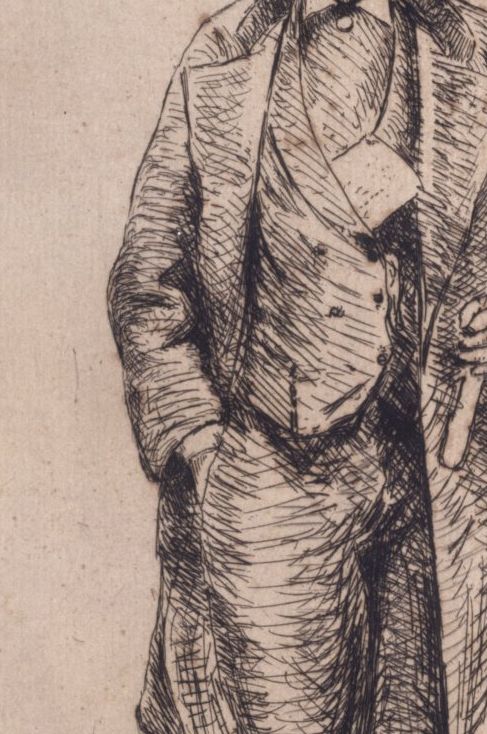
Look first at the contrast between the figure and the surrounding space. Hugot stands almost alone within a lightly bounded rectangle. His high hat, moustache, long coat and walking stick give him a sharply legible outline, but the interior of that silhouette is restless. Short strokes curve around the hat and cross through the coat. Denser passages gather beneath the arms and between the legs. The paper remains visible through the clothes, so that the figure’s apparent solidity depends on the spacing and direction of the lines. These are visible features of the Petit Palais impression. [1]
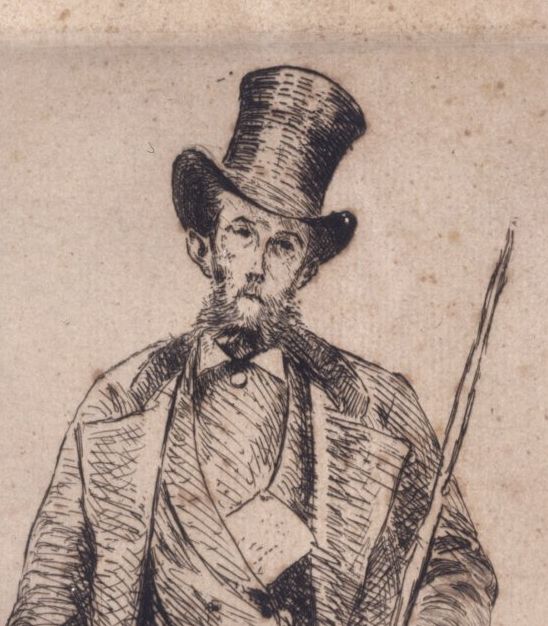
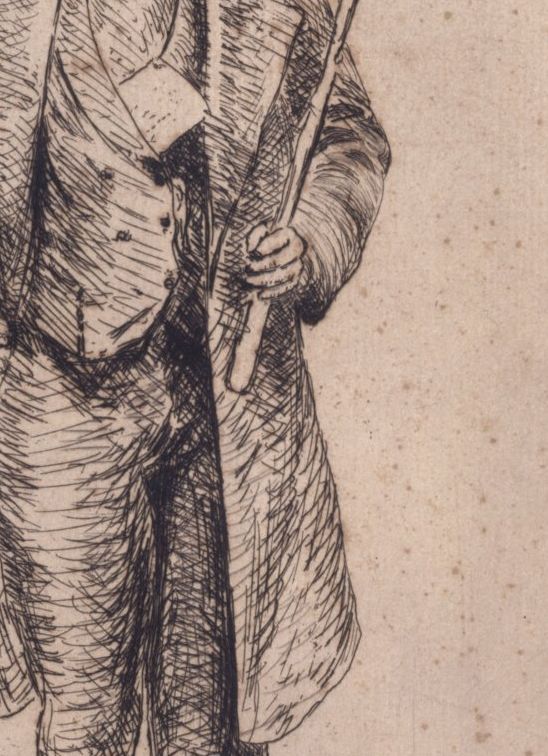
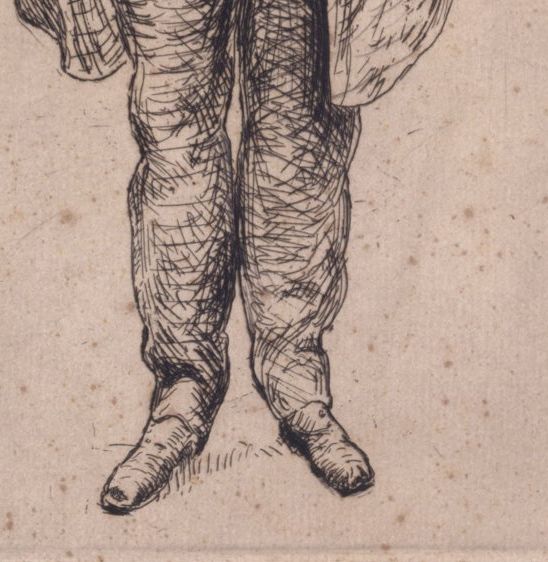
The walking stick is particularly useful for close looking. Its long, narrow diagonal cuts through the shorter marks of the clothing and leads the eye from the hand towards the head. Around it, the coat opens into folds, pockets and areas of overlapping hatching. At the bottom, the shoes establish the standing pose with very little suggestion of a surrounding floor. Much of the sheet remains relatively empty. The figure carries the portrait’s descriptive weight, while differences between dense and open passages give the clothing its volume. [1]
Scale sharpens the comparison with the oil portrait. Berhaut records a canvas 204 cm high and 92 cm wide; the Petit Palais gives a plate mark only 27.5 cm high for the print. The painting’s standing figure belongs to a format taller than a person, whereas the printed version invites inspection at close range. The reduction changes the encounter as much as the loss of painted colour does. A line that might appear incidental in an enlarged digital image has a different force when imagined within this modest rectangle. [3] [1]
Hansen’s published introduction to her 2009 article describes the drypoint as a mirror image of the painted portrait. That reversal is another reason to compare the two as related works rather than interchangeable versions. Familiar features occupy the opposite side of the composition, and the balance of hand, stick and coat has to be read afresh. The change makes the act of translation visible. [4]
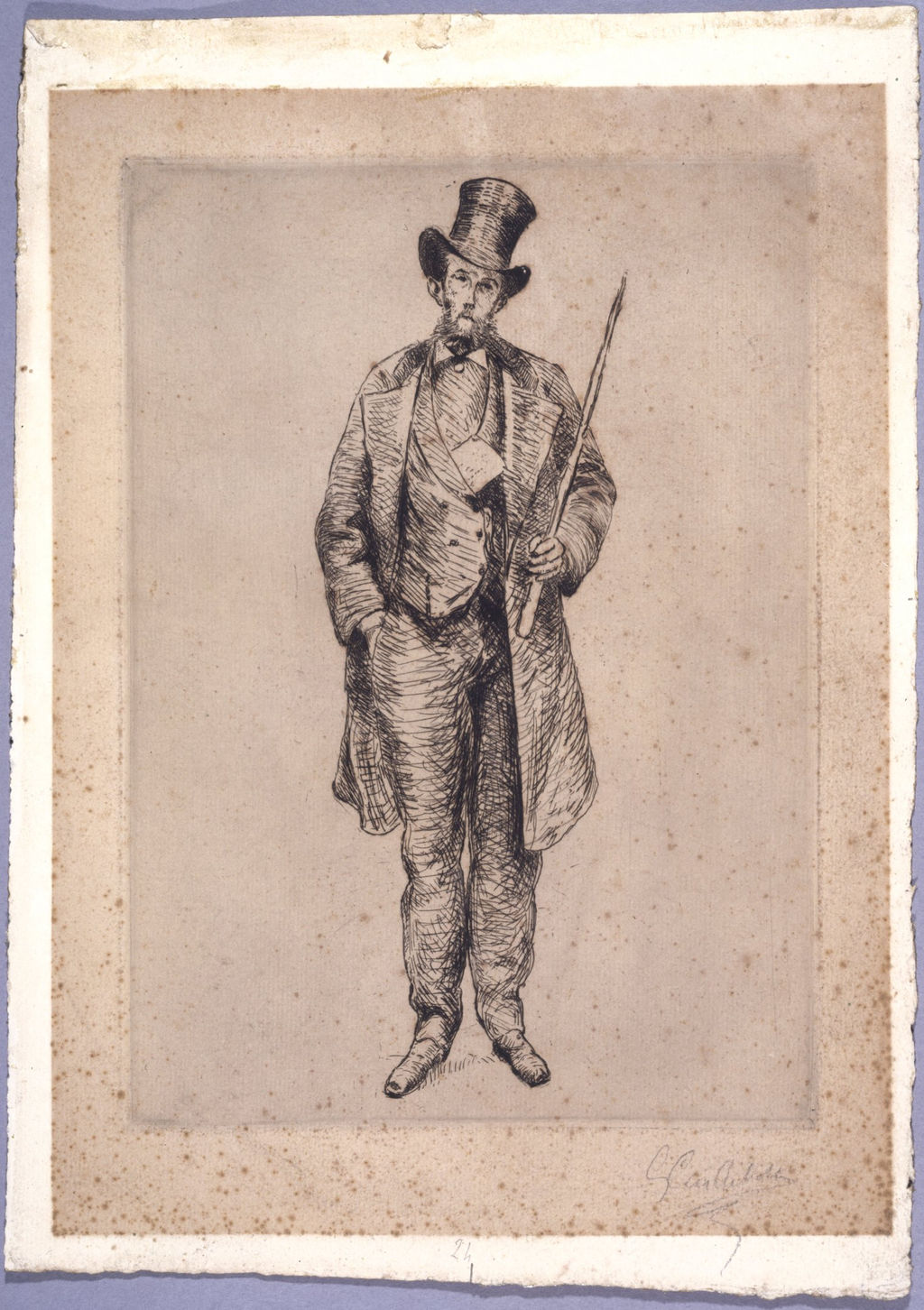
Portrait of Paul Hugot,1878; original drypoint and etching,Petit PalaisPPG2319. Complete sheet. Paris Musées / Petit Palais, musée des Beaux-Arts de la Ville de Paris. Image source. CC0 / Public domain. Resized only; complete sheet, toning and marks preserved.
Annotated Details from the original Paul Hugot print
The numbered points identify visible features discussed in this article. Return from each detail to the whole composition. Portrait of Paul Hugot,1878; original drypoint and etching,Petit PalaisPPG2319. Complete sheet. Paris Musées / Petit Palais, musée des Beaux-Arts de la Ville de Paris. Image source. CC0 / Public domain. Resized only; complete sheet, toning and marks preserved.
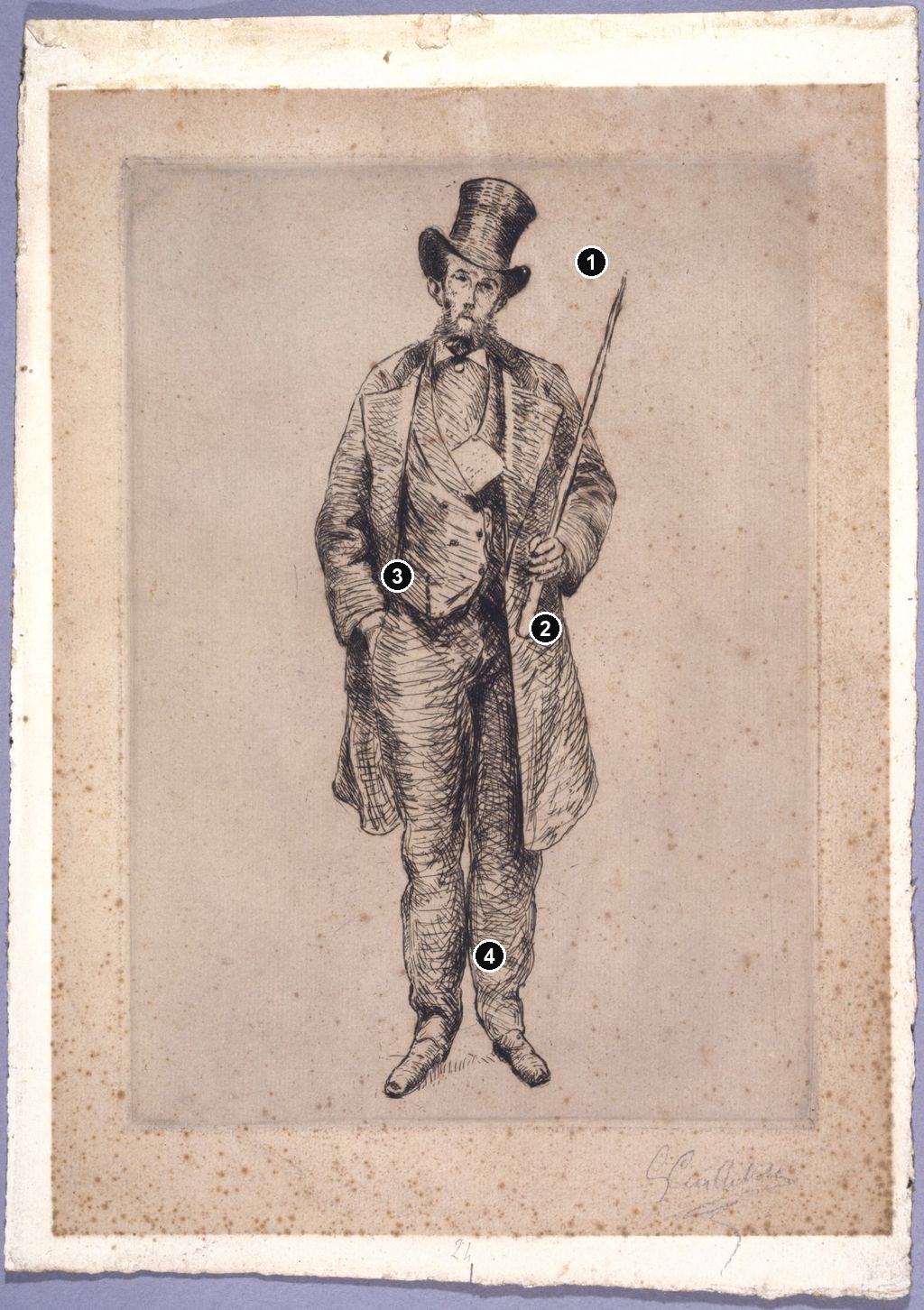
Details from THE ORIGINAL PAUL HUGOT PRINT
Compare the cropped details with the complete images above. Notice how their colours, shapes and positions contribute to the larger compositions.
The tall hat and small face
The tall dark hat gives the small face a conspicuous silhouette. Curving and crossing lines distinguish its brim from the lighter features below.
Hand and walking stick
A hand closes around the long walking stick. Its narrow diagonal passes beside the jacket and gives the standing figure a second upright support.
Lines across the jacket
Closely repeated lines describe the jacket’s folds and dark areas. Their directions change across sleeve, lapel and waist.
Trousers and turned feet
The trouser legs taper towards feet turned in different directions. Their outlines and repeated shading hold the figure within the pale surrounding field.
Oarsmen, drawings and two printed states
With Canotiers, the relationship between media becomes more intricate. Olmsted traces a composition through a large gridded chalk drawing, a painting, smaller drawings and two drypoint states. Her figure captions give the first printed image as 16 × 23.5 cm and the second as 16 × 23.7 cm. She identifies the second-state impression with the Kunsthalle Bremen. These are two documented states of a related print composition, not grounds for multiplying the subject into a series of unrelated artworks. [2]
The image’s orientation is central to her account. According to Olmsted, the first drypoint reverses the painting; the second returns the composition to the painting’s orientation. She describes the first impression’s handling as hesitant and uneven and suggests that a small gridded pencil drawing on tracing paper helped bridge the larger painted composition and the miniature printed image. The change of medium therefore involved practical decisions about reduction and transfer, as well as the ability to describe bodies and a boat in line. [2]
There is a genuine disagreement about where a smaller chalk drawing belongs in this sequence. Olmsted reports Dorothee Hansen’s proposal that it was made between the two print states. Olmsted instead places it before printing began, pointing to the signature included inside the drawing’s image. In her reading, Caillebotte was considering how a small finished graphic work might look, including the possibility of a signature on the plate. This is a reconstruction of the order of work, and the competing interpretations should remain visible. [2]
What matters for looking is the sustained attention to the image at different sizes. A composition that works across an oil canvas does not automatically remain clear when compressed into a rectangle roughly the size of a small book illustration. Lines must establish what broad painted areas can do elsewhere. The drawings and prints make that change of scale a concrete part of Caillebotte’s working process. They also complicate any easy division in which every drawing is merely preparation and every print merely dissemination. In Olmsted’s account, both media participate in the reconsideration of a composition. [2]
She connects Canotiers with Caillebotte’s developing view from within a boat: the artist or viewer shares the vessel’s position instead of observing it from the bank. That spatial problem also informs the later boating picture discussed on our Rower in a Top Hat page. The prints belong within this exploration of viewpoint. Their interest extends beyond the novelty of finding a less familiar medium in a painter’s work. [2]
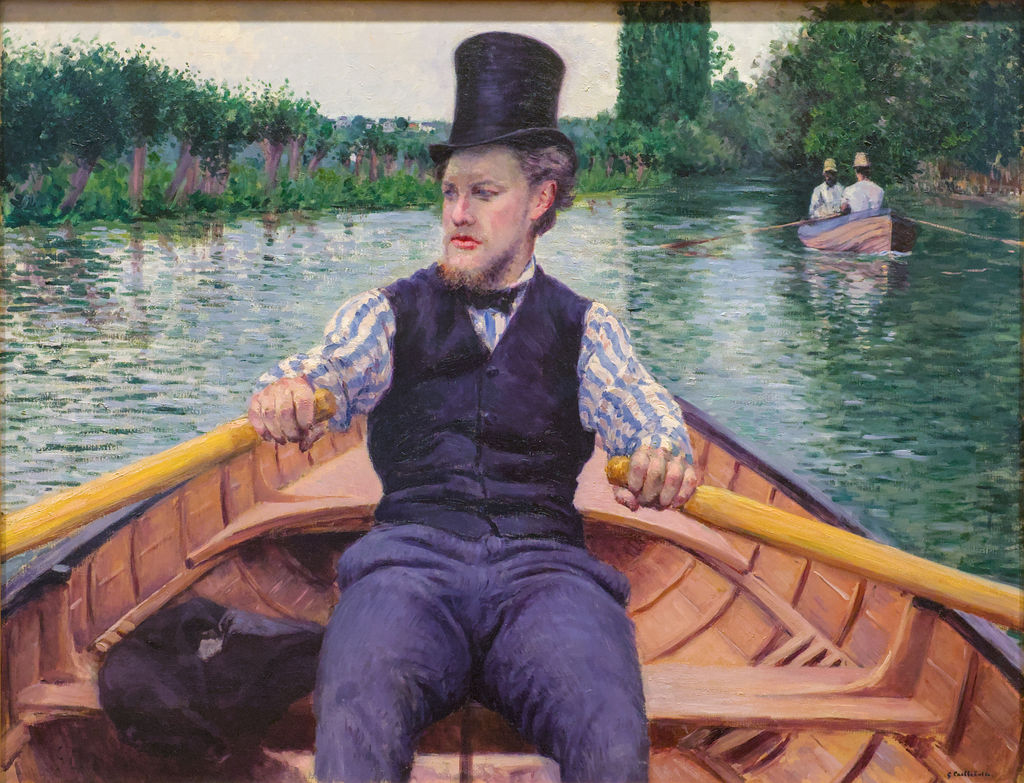
Rower in a Top Hat (Boating Party),about1877–78; separate oil painting in the boating-viewpoint comparison. Own work. Image source. Public domain. Resized only; source appearance preserved.
Watch: Gustave Caillebotte
Explore a museum overview and two discussions of Paris Street; Rainy Day. This shared selection offers wider context for the artist’s work.
"Who Is Gustave Caillebotte?" - HD version
An introduction to Caillebotte from the Kimbell Art Museum.
Watch on YouTubeMadame Boissière and the status of a finished print
Madame Boissière Knitting provides a quieter counterpart. Olmsted lists the drypoint image at 12 × 15.6 cm and associates the impression with the Kunsthalle Bremen. She draws attention to its sketchy handling and to Caillebotte’s pencil signature on the sheet. For her, these features support an understanding of the print as an independent artistic exploration of the painted subject. [2]
The signature is evidence worth weighing without turning it into proof of an exhibition plan. Olmsted suggests that Caillebotte may have considered exhibiting the print; she also states that he showed the paintings of Canotiers and Madame Boissière Knitting, rather than their printed counterparts, at the Impressionist exhibition of 1879. The distinction separates the artist’s experimentation in the studio from the work he ultimately placed before that exhibition’s public. [2]
It also gives the prints a useful place beside Caillebotte’s drawings. Comparing the related works brings changes of scale and orientation into focus. A smaller graphic work can preserve a composition while opening it to another rhythm of marks and another viewing distance. Its importance need not depend on whether Caillebotte exhibited it or developed the experiment into an extensive printed output.
Supporting a print publication
Caillebotte’s connection with printmaking also included financial support. Berhaut’s introductory account records that, when Degas planned a journal devoted to prints in 1879, Caillebotte agreed to provide part of the necessary backing alongside Ernest May. Berhaut cites Degas’s letter to Bracquemond as evidence of Caillebotte’s readiness to guarantee the venture. The planned publication did not come to fruition. [3]
This episode belongs beside the original prints because it shows two different forms of involvement: making graphic work and helping create a setting in which graphic work might circulate. It does not establish that Caillebotte’s surviving prints were prepared for the proposed journal. The evidence supports his willingness to back the project, while the precise place of his own experiments remains a separate question. His wider role as a supporter of other artists is explored in Collector and Bequest.
What a reproduction preserves
A reproduction is most useful when we are clear about what we want to see. It can preserve the organisation of an image: the placement of a figure, the direction of a street, the meeting of a riverbank and water. It can also make comparison possible between works that cannot be seen together. For the Hugot portrait, a reproduction of the whole sheet helps us distinguish the printed rectangle from the larger paper support. A crop showing only the figure serves a different purpose and hides that relationship.
Physical dimensions should therefore accompany the image in the reader’s imagination. The Hugot painting and drypoint can appear equally tall on a screen, despite the enormous difference between their actual formats. The screen makes comparison convenient while suppressing one of the most consequential differences between the works. Keeping the recorded dimensions in mind restores something of the original viewing distances: the large painted presence and the intimate printed figure. [3] [1]
For a reproduction of a painting, the complete composition is usually the best first reference. Cropping may alter the space around figures, remove an edge that gives a composition tension or turn a scene into a decorative detail. An enlarged detail can be revealing, but it should be understood as a detail. The same principle applies to a printed sheet: an image of the plate area and an image of the entire paper answer different questions.
Colour and surface require another kind of attention. A reproduction can suggest painted colour, but its paper or canvas does not become Caillebotte’s painted surface. Likewise, a reproduction of the Hugot drypoint lets us study hatching without becoming an original impression. The modern object has its own scale and surface, and can be judged as a useful image without being identified as a historical work made by the artist.
The practical starting points are simple: identify the depicted work, check whether the whole image is shown, distinguish image size from overall sheet or framed size, and read the description of the printing process. A modern edition number or a decorative signature reproduced within the image does not by itself answer the historical question of authorship. For Caillebotte’s original prints, the strongest guide remains the convergence of the object, its documented medium and specialist study. That approach keeps both kinds of encounter available: the pleasure of living with a reproduced painting and the closer investigation of the graphic works Caillebotte himself made.
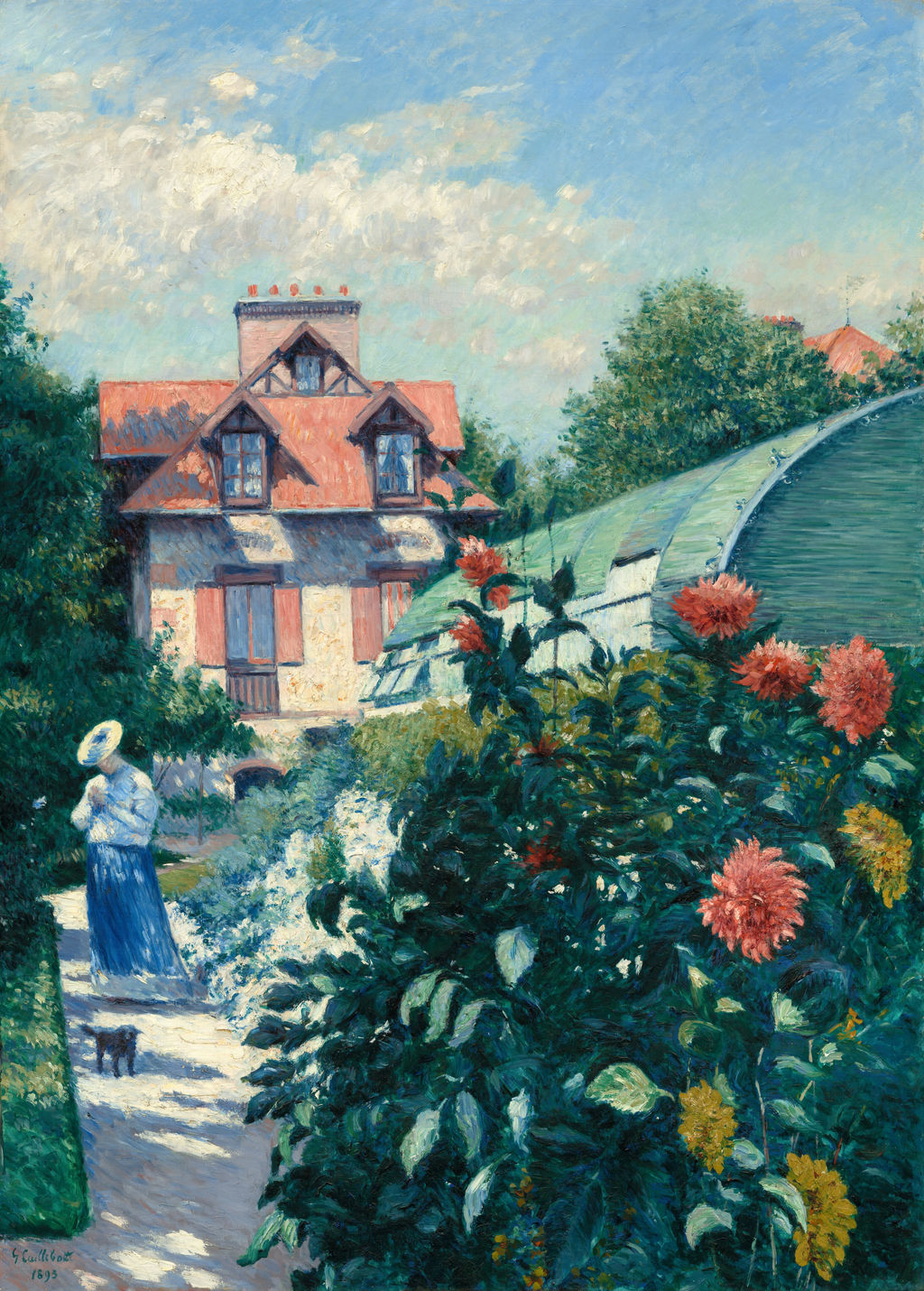
Dahlias, Garden at Petit Gennevilliers,1893; an oil painting reproduced as an image. Gift of the Scharffenberger Family. Image source. Public domain. Resized only; source appearance preserved.
Catalogue and documented works
This directory brings together 578 entries in the revised 1994 catalogue, 11 further documented records and three groups of study descriptions. It is a directory of records, not a total of authenticated individual works. Albums, print states and surviving decorative panels are grouped. English labels retain the French titles as searchable aliases; dates are supplied only where checked. Numbered entries link to the relevant article or the historical catalogue. Pastels appear under the Drawing filter; original prints remain searchable under All media.
Frequently Asked Questions
Olmsted describes Caillebotte making drypoints in front of the related paintings, with the printed result reversing their orientation. In her account of Canotiers, the second state returns the image to the painting’s orientation. [2]
The examples discussed here do not establish an exhaustive total. Two states of Canotiers should be understood together, while modern reproductions of paintings belong to a different category. Hansen’s 2009 article and Olmsted’s later discussion show why the graphic work requires its own specialist study. [4] [2]
Discussion
Look again at the images and ideas explored in Prints and Reproductions. These editorial prompts invite your observations.
Reader Insights
A printed line asks us to read light differently from a patch of oil colour.
The Paul Hugot image offers a close comparison between a face, its edges and the paper around it.
Which part of a painting would be hardest to translate into a print?
Join the Conversation
Share a detail, comparison or question about Prints and Reproductions below.
References
- Petit Palais / Paris Musées. Portrait de Paul Hugot, PPG2319 (current collection record). Object description, materials, sheet and plate-mark dimensions, inscription and 1975 acquisition; museum image consulted for close looking. View source. (in French).
- Galina Olmsted. Making and Exhibiting Modernism: Gustave Caillebotte in Paris, New York, and Brussels (2019), pp. 151–153 and figure-list captions 85–91. Drypoint states, related drawings, competing production sequences, Madame Boissière Knitting and the 1879 exhibition. View source.
- Marie Berhaut, with Sophie Pietri. Gustave Caillebotte: Catalogue raisonné des peintures et pastels (1994), introductory discussion pp. 10–11 and notes; catalogue nos. 111 and 111A, p. 115. Hugot painting and drypoint; Degas’s proposed print journal and Caillebotte’s backing. View source. (in French).
- Dorothee Hansen. “Newly discovered prints by Gustave Caillebotte,” The Burlington Magazine 151, no. 1272 (March 2009), pp. 160–162. Publicly accessible opening paragraph: earlier print references and the reversed Hugot drypoint. View source.
- Marie Berhaut with Sophie Pietri; Wildenstein Plattner Institute, Gustave Caillebotte Catalogue raisonné des peintures et pastels, 1994. View source. (in French).
- Art Institute of Chicago, Caillebotte Paintings and Drawings at the Art Institute of Chicago, 2015. View source.
- Petit Palais / Paris Musées, Portrait de Paul Hugot, original print, PPG2319, current. View source. (in French).
- Paul Perrin, Musée d’Orsay, Transcription de l’entretien commissaire Caillebotte, 2024. View source. (in French).
- Cleveland Museum of Art, Caillebotte collection records: 2020.260, 2009.157 and 2020.105, current. View source.
- Splash image, The Garden at Petit Gennevilliers; oil painting.


