by Tom Gurney
Tom Gurney BSc (Hons) is an art history expert with over 20 years experience
Published on June 19, 2020 / Updated on October 14, 2026
Email: tomgurney1@gmail.com / Phone: +44 7429 011000
Peter Paul Rubens at a glance
Peter Paul Rubens (1577–1640) was born in Siegen, trained as a painter in Antwerp, and spent the years 1600–08 in Italy. After returning to Antwerp, he worked for churches, courts and private patrons. His large studio could deliver ambitious commissions across Europe, while his own drawings and oil sketches record how ideas took shape. He also designed images that circulated in prints and tapestries. This site follows those different kinds of work through individual objects, their sources and their present collections.
The portrait alongside this page shows the older artist beneath a broad-brimmed hat, one hand near a sword and the other holding gloves. It is Rubens's late self-portrait in Vienna, not a generic picture of a Flemish painter. The Kunsthistorisches Museum identifies it as Self-Portrait, about 1638, oil on canvas, 110 × 85.5 centimetres, inventory GG 527. The courtly pose is a useful introduction to an artist whose career joined picture-making with the worlds of powerful patrons. It does not, by itself, tell the whole story: follow the works below to see what he made and how.
Explore Rubens
Biography
Follow the artist's life, patrons and travels.
Paintings
Explore altarpieces, portraits, myths and landscapes.
Drawings
See studies, preparatory sheets and designs.
Prints
Identify the engravers who carried designs into print.
Quotes
Read words tied to traceable letters and translations.
Italian years
Trace study and patronage from 1600 to 1608.
Workshop and collaborators
Understand shared production and attribution.
Oil sketches and technique
Follow small painted designs toward larger works.
Diplomacy and courts
Connect journeys, patrons and commissions.
Marie de' Medici cycle
Examine the Luxembourg Palace commission.
Begin with the life and the work
The biography follows Rubens from his family background and Antwerp training through Italy, the great altarpieces, diplomatic journeys, two marriages and his later landscapes. It explains why particular moments mattered to particular works. This homepage is a route into that fuller account, rather than a compressed substitute for it.
The paintings guide brings together altarpieces, portraits, mythologies, landscapes and court commissions. A painted surface might be a finished panel or canvas, a small oil sketch for a larger project, or work made with an assistant or another specialist. The guide uses object records to make those distinctions. A familiar title alone does not settle medium, date or authorship.
The drawings guide opens another side of Rubens's practice. He studied bodies, copied earlier art, developed compositions and prepared designs that another hand could translate into a print. Paper records decisions differently from a finished painting: revisions and searching lines can remain visible. The drawing pages identify the actual sheet, its technique and its present catalogue number whenever a source permits.
The prints guide concerns designs associated with Rubens and the engravers who carried them into reproducible images. A print after a Rubens painting is not automatically engraved by Rubens. Named makers, publishers and states matter. The quotes page approaches the artist's surviving words with similar care, identifying letters and translations rather than repeating detached sayings with uncertain origins.
Five focused guides provide context for the object pages. The Italian years examine study and patronage between 1600 and 1608. The workshop and collaborators explain shared production and attribution. Oil sketches and technique follow ideas from small painted studies toward larger works. Diplomacy and courts connect commissions to Rubens's journeys and patrons. The Marie de' Medici cycle brings together the Luxembourg Palace project and its surviving canvases. These guides are the natural next step when an individual painting raises a larger historical question.
Why Rubens's name covers different kinds of objects
Rubens was a painter, but a study of his work cannot stop at completed paintings. A drawing could test a figure's pose; a small oil sketch could offer a patron a proposed design; an engraved sheet could circulate a composition far from the original picture. Designs also moved toward tapestry and architecture. The relationships vary from one object to the next. Some works are by Rubens's hand, some were painted with collaborators, some belong to his studio, and some are later copies after his compositions.
The Corpus Rubenianum Ludwig Burchard, the long-running scholarly catalogue, is arranged across these kinds of work. Rubenshuis says its documentation covers more than 2,500 compositions and over 16,000 related works, including drawings, sketches, graphic works, tapestries and copies. These are catalogue and documentation figures. They must not be read as a claim that Rubens personally painted 16,000 pictures. The large numbers instead show how widely his designs travelled and how carefully each surviving object must be identified.
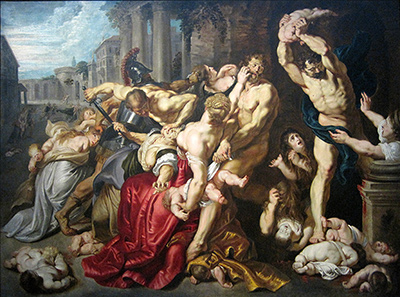
This distinction is especially important where a celebrated subject survives in several versions. There are two major paintings called The Massacre of the Innocents in this cluster, an early work in Toronto and a later one in Munich. Their dates, supports and locations differ. An oil sketch and a finished painting of the same event can also be separate objects. The pages retain established URLs, but the heading and caption identify the object actually shown. That lets a reader compare related compositions without merging their histories.
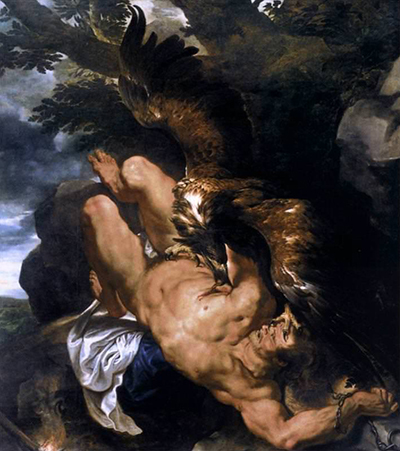
Even a single picture can have several participants. Rubens and Jan Brueghel the Elder collaborated on images in which figure painting and landscape or flowers meet. Rubens's Prometheus Bound involved Frans Snyders in the eagle. Those examples demonstrate a method of work; they do not prove that the same collaborators made every animal or flower in every Rubens picture. A catalogue's attribution and the evidence for it belong to the particular object.
Essential works: five ways into the collection
These five objects give a quick view of Rubens's range. Each link leads to a page about a checked, specific work, with its own collection and identification. They are starting points, not a ranking of his achievements.
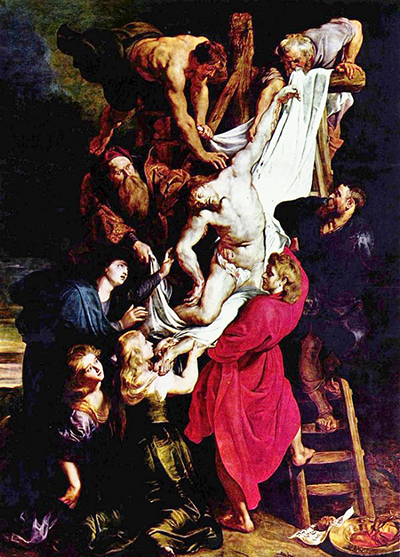
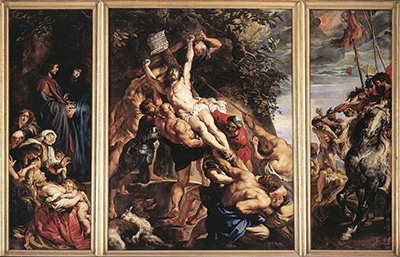
The Descent from the Cross at Antwerp Cathedral is a great altarpiece made in 1611–14. The local image shows the central panel, where figures lower Christ's body, while the full triptych has painted wings with related episodes. Its scale and setting make the work a strong entrance to Rubens's religious painting. The page distinguishes the centre from the entire altarpiece and from other paintings with similar titles.
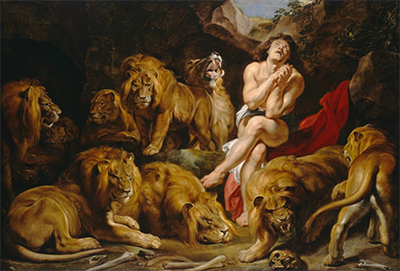
Daniel in the Lions' Den at the National Gallery of Art, Washington, shows a solitary biblical figure enclosed by animals. The cave, Daniel's raised face and the varying postures of the lions make a story of threat and trust visible without showing a battle. Its documented exchange with Sir Dudley Carleton in 1618 also opens a window onto the circulation of Rubens's work among collectors.
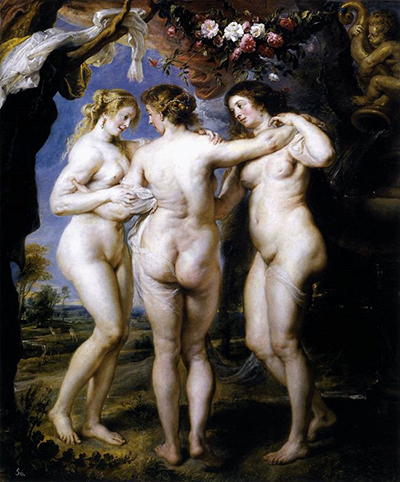
The Three Graces in the Museo del Prado shows three linked figures in a late mythological painting. The Prado catalogues it as oil on oak, a reminder that “painting” does not mean canvas by default. Its bodies, light and interlocking arms invite close looking; the object page also treats the late career, provenance and the limits of biographical readings of the figures.
The view of Het Steen in the early morning at the National Gallery, London, takes us into Rubens's later landscape work. It is associated with the estate he acquired in 1635, yet a painted view is not necessarily a literal survey of each field or building. The work rewards attention to changing light, movement through the countryside and the difference between a place owned by Rubens and a picture made from artistic choices.
Prometheus Bound at the Philadelphia Museum of Art turns a mythological punishment into a large, forceful scene. The eagle is associated with Frans Snyders, Rubens's specialist collaborator. The page looks at the painting and its documented partnership together. It is a useful fifth entry because it asks a question that a simple artist name cannot answer: who made which part of a shared work, and what evidence supports that division?
Find a subject that interests you
Rubens used religious stories, classical myth, portraits, animals and landscapes to answer very different commissions. The same subject can look different depending on its original setting. A church altarpiece needs to work at a distance and within a devotional programme. A smaller cabinet painting invites a more intimate encounter. A court cycle can make a political case through historical and allegorical figures. Look for the setting and intended audience on each page before reducing a work to its title.
For religious painting, begin with the Elevation of the Cross and Descent from the Cross in Antwerp, then compare smaller paintings and drawings of Christ's life. For myth, Prometheus Bound makes the role of a collaborator especially clear, while The Three Graces offers a late, very different treatment of classical figures.
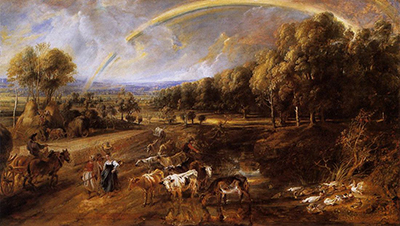
If landscape is your starting point, move from Het Steen to the Landscape with St George and the Dragon. The latter brings a legendary rescue into a broad scene of trees, distant buildings and spectators. Its Royal Collection date and a scholar's tighter proposed date are both identified on the object page, because they are not the same claim.
The drawings and prints guides are especially useful if you want to see how an image changed as it moved between media. A preparatory sheet may preserve a decision later revised in paint. An engraving can reverse, simplify or distribute a painted composition. These relationships need object-specific evidence; the mere fact that two images look alike is only the beginning of the comparison.
Place can be another way to browse. Antwerp holds major altarpieces made for local religious audiences, while collections in Madrid, London, Paris and Washington now keep works produced for quite different purposes. Present location and original destination should be kept distinct. A work in a museum today may have begun in a church, a court setting or a private collection. Its journey is part of its history, but the current museum label alone cannot always reconstruct every earlier stage.
How to read the artwork pages
Each page starts by naming the object that its image depicts. Collection records supply titles, dates, media, dimensions and inventory numbers wherever those details can be checked. The explanatory prose then separates what is visible from a museum's interpretation and from a later scholar's proposal. References at the end let readers follow the evidence. A date written as “about” remains approximate; a disputed attribution remains qualified.
Some of the URLs are inherited from earlier versions of the site. A route can survive even when research changes the best title, identifies a different version, or shows that the image is a drawing rather than a painting. The page heading, caption and source record carry the current identification. Where the local image could not be securely matched, the claim is held for more research. This is why the browsable directory below includes medium and date fields instead of presenting every route as an autograph oil painting.
The portrait at the top offers a final example. The image has long been stored locally as “Peter Paul Rubens.jpg,” but that filename is not its art-historical identity. The subject, pose and format match the Kunsthistorisches Museum's GG 527 self-portrait. The collection's inventory number, title and date provide a stable way to recognise it; the local image's original source remains unrecorded. The distinction between identifying a work and documenting the provenance of a digital file applies throughout this cluster.
Use the directory to browse a title, then open its page for the evidence behind it. If two pages seem to show the same subject, compare their collection and object numbers before treating them as one work. The object-level approach makes a large, varied body of material more navigable and more honest about what is known.
The Antwerp house as a place of work and exchange
Rubens's Antwerp house helps explain why the word “studio” can be too narrow for his working life. The Rubenshuis account of the Wapper property[16] dates its purchase to 1610. Rubens and Isabella Brant moved into the still-developing estate in 1615, according to the museum's garden history[3]. The property combined living rooms, a workshop, a garden, a place for receiving visitors and a setting for a collection. A painting could be made here, discussed with a patron here, studied beside older art or books, and eventually sent much farther away. That mixture matters when a page describes “the Rubens workshop”: it was a social and intellectual place as well as a production room.
The house drew on architectural impressions Rubens had gathered in Italy. The Rubenshuis account of the residence[2] identifies its portico and garden pavilion as surviving parts of his changes to the property. Its description of the portico's classical figures and symbols shows that architecture could itself make a statement about learning and the arts. The museum also notes that the garden served family life, reception and work; large painted surfaces could be placed there to dry. None of this means that every Rubens painting was made in the garden or that a depiction of an idealised garden is a literal view of the Wapper plot. It does show how closely his working spaces, collecting and self-presentation were connected.
There were many people behind the running of the estate. The Rubenshuis garden history[3] names gardeners Willem Donckers and Jaspar Verbrugghen and describes the movement of apprentices, household staff, family and visitors through the grounds. Their work is part of the setting in which the artist could sustain a large practice, even though it is not usually listed in an artwork's credit line. When an altarpiece or court commission appears under Rubens's name, its catalogue attribution addresses artistic responsibility for that object. It is not a complete roster of everyone whose labour made the household and studio function.
From an idea to a finished object
A commission might begin with a proposed subject, a patron's requirements and the building or room where the work would be seen. Rubens could test a pose in a drawing, arrange an entire scene in a small oil sketch, discuss the design, and then move toward a larger painted surface. Those stages should never be assumed for every surviving object. A drawing may be an independent study, a copy after another artist or a design for an entirely different project. A small oil painting may be a presentation sketch, a model for assistants or a finished cabinet picture. The oil-sketch guide and the individual object pages distinguish those uses where sources allow.
An instructive case outside this cluster is the Metropolitan Museum's Glorification of the Eucharist[6], a small oil sketch of about 1630–32. The Met identifies it as Rubens's design for an Antwerp Carmelite ensemble later executed by painter Gerard Seghers and sculptor Hans van Mildert. The sketch even proposes alternative architectural motifs in its corners. A viewer can see a design process and a division of responsibility in one documented object. It would be misleading to call the later ensemble simply an enlarged copy by Rubens or to treat Seghers and van Mildert as invisible. On this site, comparable distinctions are made whenever a design, a workshop execution and a finished work occupy different stages of one project.
Support and scale also change what a viewer can learn. The Prado's Three Graces is an imposing oil painting on joined oak boards; the Getty Last Supper study is a much smaller ink drawing that preserves separate groups of figures. Both can reveal Rubens's choices, but they are not evidence of the same phase or the same kind of audience. A work's material description should therefore appear before an interpretation of its effect. The word “Rubens” on a route is a starting point for identifying that work's date, support, maker and purpose, not a substitute for them.
Reading, copying and looking at nature
Rubens's interest in the ancient world was not limited to an occasional mythological subject. The Rubenshuis study of his books[4] describes a substantial private library that included Greek and Roman authors, history, architecture, natural history, politics and contemporary reports. Its account draws on letters and orders to booksellers and binders. Reading in original languages could help him test the meaning of a story before devising an image, while correspondence with learned friends could supply or challenge information. The museum's examples include Ovid and Virgil, an encyclopedia of natural history and travel writing. These sources explain a method of inquiry, but they do not prove that a particular passage directly generated a particular painting unless an object-specific record makes that connection.
Copying was another form of study. The Battle of Anghiari drawing follows Leonardo's lost painted battle through surviving copies and later scholarly attributions; the Ignudo Turning to the Right records Rubens studying a Michelangelo figure. A copied image can show what he valued in another artist's anatomy, rhythm or arrangement, even when the original was elsewhere or no longer survives. It need not be dismissed as uncreative, nor promoted into proof that he planned a particular finished painting. The proper question is what the specific sheet preserves, which earlier work it engages, and how securely that relationship is documented.
Books did not replace direct observation. The animal studies, portrait drawings and later landscape paintings in this cluster ask readers to compare selected details with the compositional work those details perform. The British Museum's cattle study is catalogued as office or studio of Rubens, for instance; its animal observation does not automatically make the sheet autograph. Conversely, the National Gallery's view of Het Steen combines a real estate association with constructed light and space. Looking at nature and inventing a picture were complementary activities, and attribution must still rest on evidence for the object at hand.
Designs that travelled beyond a painting
A painting fixed in a church or palace could be seen by a limited local audience, whereas a print after its design could circulate across borders. The Rubenshuis biography[16] describes the network of engravers through which Rubens's work reached wider audiences and the privileges sought to protect designs from unauthorised copying. These were collaborative images: the engraver's name, the painter whose design was followed, a publisher and sometimes a later state can all matter. The prints guide explains how to read those credits. A printed image should not be silently added to Rubens's personal tally of paintings, and a reverse image is not necessarily a new composition.
Tapestry extended designs in another direction. The Metropolitan Museum's history of Baroque tapestry[7] records designs for the Decius Mus series in the 1610s and the Triumph of the Eucharist scheme commissioned by Archduchess Isabella in 1626 for Madrid's Descalzas Reales. Oil sketches, cartoons and woven hangings are related, but they are physically and professionally distinct. A tapestry is made by weavers, often at monumental scale and for an architectural setting; the design painter does not become its sole material maker. Rubens also designed imagery for books and festive entries. These works help explain why a cluster of his art cannot be sorted only into “paintings” and “drawings.”
Patrons, settings and later journeys
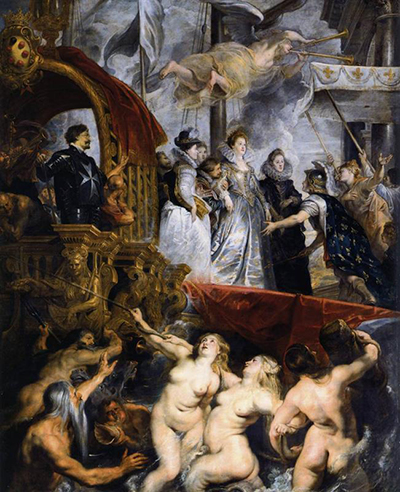
A work's present museum can be far from the audience for which it was first made. The Antwerp Descent from the Cross belongs to a cathedral setting and a triptych structure; the Louvre's Marie de' Medici cycle was designed for a queen's Luxembourg Palace in Paris. The Prado holds royal and private works now viewed in a public museum. Looking across these cases makes “where is it?” two questions: where can the work be seen today, and where did its first viewers encounter it? Distance, lighting, ritual, political use and the presence of companion works could all shape that first encounter.
The objects also travelled through collecting and inheritance. A picture retained in Rubens's own house could enter a royal collection after his death; another might be separated from the setting for which it was designed. Such histories are often incomplete. The provenance on an individual page records secure ownership steps and marks gaps rather than filling them with a continuous narrative. The Rubenshuis documentation service[5] describes how historical photographs, archival references and bibliography continue to inform the Corpus Rubenianum. It is a reminder that a present-day catalogue entry is the result of research, not a timeless label.
Using this cluster as a research map
Begin with a work that catches your attention, then follow one question across media and places. If the central issue is authorship, compare the workshop guide with the named specialists in Prometheus Bound and the qualified attributions of individual drawings. If the issue is how a composition grew, compare a drawing or oil sketch with a finished altarpiece where the relationship is documented. If you want to understand political storytelling, follow the Medici guide and its separate object pages, keeping the queen's historical events distinct from the date the paintings were produced.
The references at the foot of each page point to holding museums, conservation records, scholarly catalogues and other institutional sources. They may differ on dates or attributions. Such differences are not errors to be smoothed away automatically: one catalogue may give a broad range while another proposes a more precise date on stylistic grounds. A sheet may carry an old attribution that the current museum has revised. The pages present the reason for a choice and preserve meaningful uncertainty. This is especially important in a cluster where a common title can cover several versions, a print after a painting or a copy made centuries later.
Browse Rubens artworks
Frequently Asked Questions
Start with one of the five checked works above, then follow the subject or medium that interests you. The biography supplies the wider chronology; the paintings, drawings and prints guides explain how different kinds of object were made and used.
No. His designs could be carried out with a workshop or specialist collaborator, translated into prints, copied later, or known through preparatory drawings and oil sketches. Each object page gives the relevant attribution as supported by its collection record. The Corpus Rubenianum's large documentation figures include many categories beyond autograph paintings.
It is Peter Paul Rubens's late Self-Portrait, about 1638, held by the Kunsthistorisches Museum, Vienna, inventory GG 527. The museum's 2017 exhibition material gives the medium as oil on canvas and the size as 110 × 85.5 cm.
Discussion
Choose a painting, drawing or print and tell us what first caught your attention.
Add a collection record or reliable source if it changes an identification.
Reader Insights
Which of Rubens's subjects would you explore next?
How does knowing a work's medium affect the way you look at it?
What would you like to know about Rubens's studio or collaborators?
Join the Conversation
Share a specific observation or source below.
References
- Rubenshuis, Biography of Rubens. View source
- Rubenshuis, the Wapper house and artist's residence. View source
- Rubenshuis, the garden and household. View source
- Rubenshuis, Rubens's books and reading. View source
- Rubenshuis, Rubens documentation. View source
- The Metropolitan Museum of Art, The Glorification of the Eucharist. View source
- The Metropolitan Museum of Art, Baroque tapestry and Rubens's designs. View source
- Rubenshuis, Corpus Rubenianum Ludwig Burchard. View source
- Kunsthistorisches Museum, Rubens: The Power of Transformation press photographs, 2017, GG 527. View source
- Kunsthistorisches Museum, Selfportrait , GG 527, collection text via Google Arts & Culture. View source
- National Gallery of Art, Daniel in the Lions' Den. View source
- Cathedral of Our Lady, Antwerp, The Descent from the Cross. View source
- Museo del Prado, The Three Graces. View source
- National Gallery, A View of Het Steen in the Early Morning. View source
- Louvre Collections, The Disembarkation of the Queen at Marseille. View source
- Rubenshuis account of the Wapper property. View source