


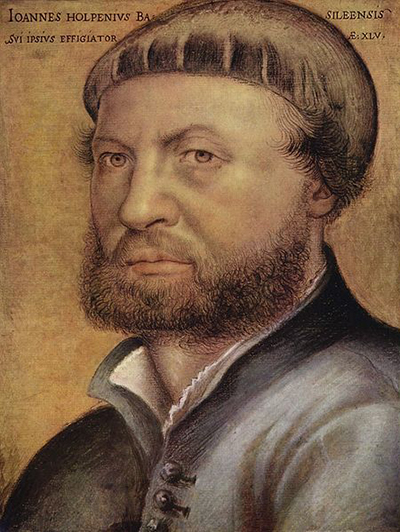
 by
Tom Gurney
Tom Gurney BSc (Hons) is an art history expert with over 20 years experience
Email:
tomgurney1@gmail.com
/ Phone:
+44 7429 011000
Hans Holbein the Younger: Introduction
Hans Holbein the Younger could give a fur collar the density of something held in the hand, then make a face above it seem almost within speaking distance. In his portraits, costly clothes and small bodily irregularities receive the same sustained attention. A crooked finger, the edge of an eyelid or the fold of a letter can become as memorable as a king's embroidered coat.
Henry VIII's commanding image is one entrance to this art. Others lead into very different worlds: a scholar resting his hands on a book, a family gathered beneath the Virgin's cloak, a dead body confined within a narrow tomb, or Death arriving at a royal dinner in a woodcut scarcely larger than a playing card. Holbein worked across painting, drawing, print design and ornamental design. Each practice changes what close description can do. [1] [2] [3]
Watch: Hans Holbein Paintings
Born in Augsburg around 1497–98 and dead in London in 1543, he spent much of his working life between Basel and England. His career joins the urban culture of printers and humanist scholars to the trade of London's German merchants and the display of the Tudor court. [1] [2] Following him across those settings reveals how many kinds of picture could emerge from the same attentive eye.
At a Glance
- Name Hans Holbein the Younger, distinguished from his father, Hans Holbein the Elder.
- Born Around 1497–98, Augsburg, in present-day Germany.
- Died 1543, London. [1]
- Principal working centres Basel and London.
- English periods 1526–28 and 1532–43. [2] [4]
- Practices Painting, portrait drawing, miniatures, designs for woodcuts, decorative objects and architectural decoration. [2] [3]
- Royal service Appointed King's Painter by 1536. [2]
- Useful starting points The Ambassadors , The Body of the Dead Christ in the Tomb , Sir Thomas More , the Henry VIII portrait family, Darmstadt Madonna , Jane Seymour , Christina of Denmark , Georg Giese , The Artist's Family and Dance of Death .
- Major concentrations Kunstmuseum Basel and the Royal Collection, alongside paintings and drawings in collections across Europe and North America. [2] [5]
Holbein’s artistic connections
Training, pictorial models and later adaptations connect these particular works.
- Hans Holbein the Elder : Holbein probably began his training with his father, the Augsburg painter Hans Holbein the Elder. [2]
- Leonardo da Vinci : Basel describes Laïs's face as Leonardesque and links the picture to Italian models of the courtesan portrait. [6]
- Wenceslaus Hollar : Hollar's 1648 Anne of Cleves translates Holbein's painted portrait into an etching, part of its later circulation. [7]
- Rowland Lockey : Lockey's 1593 More household and descendants adapts Holbein's lost family portrait by adding later generations. [8]
Hans Holbein the Younger in context
Albrecht Dürer
1471–1528 [12]Lucas Cranach the Elder
1472–1553 [13]Dead Christ in the Tomb
1521–22 [16]Sir Thomas More
1527 [17]Georg Giese
1532 [18]The Ambassadors
1533 [19]Contents
- A career between cities and kinds of work
- Looking at a portrait: face, hands and surrounding things
- Drawings bring the sitting closer
- Religious paintings and the problem of presence
- Small prints and elaborate designs
- Ten works with which to begin
- Artists, models and the afterlife of an image
- Collections, survival and returning to the pictures
A career between cities and kinds of work
The word “Younger” identifies a family relationship. Hans Holbein the Elder was an established Augsburg painter, and the son probably began his training with him. The Royal Collection retains that useful qualification: the family connection is certain, while the details of an apprenticeship are less fully documented. [2] Looking at the younger artist therefore begins within a workshop culture, where painting a face, drawing an ornament and preparing a design for someone else to execute could belong to related daily work.
By 1515 Holbein was in Basel. The city's place in his art extends well beyond a youthful prelude to London. Here he painted religious works and portraits and supplied designs for print. The Kunstmuseum Basel's account of its 2006 exhibition brings those activities together, presenting an artist whose surviving panels, drawings and graphic work belong to one broad field of invention. [3] His Basel years are especially rewarding for anyone who knows only the Tudor portraits: here the same concern with a credible human presence operates inside sacred narratives and images intended for very different kinds of use.
Four broad phases help keep the journeys clear. The Basel period up to 1526 established his range. A first English stay, from 1526 to 1528, brought commissions within Thomas More's circle. Holbein then returned to Basel before moving to England again in 1532. The last phase encompasses merchant portraits, diplomatic commissions and royal service. These divisions describe changing opportunities; they do not mark four abrupt reinventions of his style. The detailed biography follows the documentary record and its remaining uncertainties. [2] [4]
The movements also carry a warning against reading an entire life through one portrait. A cloth merchant, a mayor and a royal diplomat needed different forms of representation. A work made for private remembrance had a different task from a dynastic image in a palace. Holbein's versatility becomes clearer when we ask what each picture was required to make visible: learning, relationship, authority, devotion or the particular appearance of someone absent.
The surviving career is also uneven. Monumental projects have disappeared, while small sheets and printed impressions remain. A modern encounter with Holbein consequently moves between complete objects and fragments of larger undertakings. The Whitehall cartoon preserves part of a lost mural; portraits drawn from life survive without their corresponding paintings; later copies keep compositions available in altered form. That mixture is central to the art we can see today. [2] [21]
Four stages of Hans Holbein the Younger’s career
These periods group related developments; painting, travel and local work overlap across their boundaries.
A broad practice established in Basel
Religious panels, portraits and print designs establish a wide practice. [2]


Portraits within More’s English circle
More and his circle introduce new English portrait commissions. [2]

Family, civic work and a changing city
Family portraiture and continued religious work bridge the two English stays. [2]

Merchant portraits, diplomacy and royal service
Merchant, diplomatic and royal portraits coexist with court designs. [2]


Looking at a portrait: face, hands and surrounding things
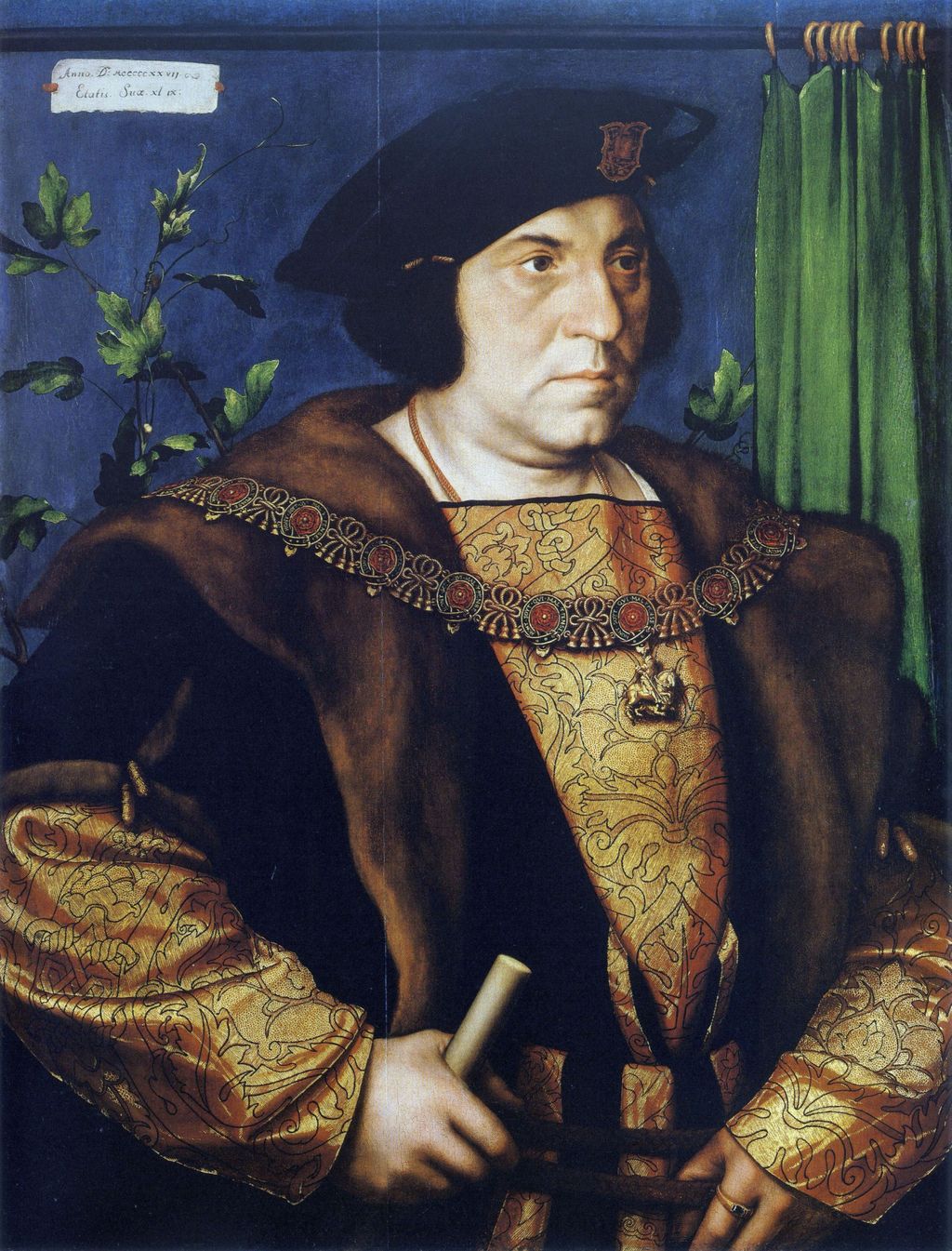
A useful first step is to let the face wait. In Sir Thomas More , painted in 1527 and now in the Frick Collection, follow the broad turn of the shoulders, the spreading sleeves and the joined hands. More looks away from us. His body is close, but his attention belongs somewhere beyond the frame. The red velvet and brown fur give the figure weight before we begin to interpret the mouth or eyes. [22]
Then return to the face. Its small changes of light differ from the much sharper sparkle of the chain. Stubble is neither a continuous shadow nor a decorative pattern: its individual marks sit on the turning surface of the chin. The softness of the fur makes the exposed skin feel more vulnerable. Holbein's precision is relational. A surface becomes convincing partly because it behaves differently from the material next to it.
Hands often make that relation practical. They hold books, gloves or folded papers, resting on objects that connect the sitter to the picture's lower edge. In the Longford Castle Erasmus , on loan to the National Gallery, the scholar's hands lie on a substantial red book. The painting dates to 1523; Erasmus sent it to Archbishop William Warham the following year. A likeness could travel where its sitter could not. The book's inscription compares Erasmus's literary labour to the feats of Hercules, placing his work beneath his hands. [23]
The contrast with More is instructive. More's paper remains folded and unreadable; Erasmus's book carries a claim about his achievement. Both pictures are remarkably still, but their objects introduce different kinds of public identity. The presence of a book does not automatically make every sitter a scholar, any more than an unread letter tells us its contents. Its particular treatment matters: open or closed, held or displayed, legible or withheld.
Georg Giese's portrait gives such things a far larger role. Painted in 1532, it presents a merchant from Danzig associated with London's Steelyard trading community. Berlin's curator Stephan Kemperdick describes major changes during its making, including the relocation of shelving and a change in the direction of the head. This dense room was carefully constructed and revised. It should not be treated as a simple record of a space Holbein found ready-made. [18]
Look at the sleeves before trying to name everything on the table. Their pink folds run towards hands occupied with a letter. Around them, hanging papers, metal implements, books and a transparent flower vase invite the eye to stop repeatedly. The vase is especially delicate against the patterned carpet: the stems remain visible through its body, while small lights define the glass. Giese's face has to hold its place amid all this competing information. The darkness of his coat and cap helps it do so.
Finally, distinguish persuasive presence from access to a person's mind. Jeanne Nuechterlein argues that Holbein's portraits encourage us to accept carefully shaped appearances as faithful records. Her introduction to Translating Nature into Art asks how this seeming objectivity differs from the more conspicuously invented forms of his other work. It is a productive question to carry from picture to picture. [24] A quiet expression may feel extraordinarily revealing; the precise thought behind it still belongs to the sitter.
Hans Holbein the Younger, Portrait of Georg Giese (Der Kaufmann Georg Gisze), 1532, oak panel, 97.5 × 86.2 cm. Gemäldegalerie, Staatliche Museen zu Berlin, inventory 586. Gemäldegalerie, Staatliche Museen zu Berlin; Google Arts & Culture/Wikimedia Commons.
Image source
.
Public domain
.
Drawings bring the sitting closer
The portrait drawings often make the encounter seem less formal. A head emerges with extraordinary completeness while a shoulder remains a handful of lines. In some sheets, a pale pink preparation already supplies the middle tone of flesh. White highlights and darker marks can then model the face economically. Royal Collection conservators Rachael Smith and Victoria Button explain that Holbein varied his use of chalk, watercolour and prepared paper in response to the individual drawing. There was no single rigid recipe behind every likeness. [25]
That variation is worth looking for before deciding that a less finished passage represents neglect. The face, a particular jewel and a patterned sleeve may each require different kinds of information. A small repeated section can establish a textile design; written notes can preserve colour; a carefully observed contour can record the exact relation of nose to mouth. What a painter needs later is not necessarily what a viewer expects from a finished portrait.
Compare the drawing of Thomas More with the Frick painting. The drawing lets the head occupy a comparatively open field; the painted version binds it into fur, velvet, chain and curtain. In the sheet, the surrounding paper gives the marks an exposed delicacy. In the painting, the body and its materials create a fuller public presentation. The difference is useful even before we ask which outlines were transferred or which details changed.
Drawing also linked a brief sitting to work completed elsewhere. The evidence for Christina of Denmark makes this unusually concrete. In Brussels in 1538 Holbein had three hours with the sitter. Susan Foister's National Gallery catalogue explains why the familiar claim that he painted the entire surviving full-length portrait in that time is implausible: he probably made one or more drawings to carry back to England. John Hutton's report praised the likeness as “very perffight”. The recorded sitting and the finished painting are different stages. [20]
A large drawing can have another function again. The National Portrait Gallery's Henry VIII and Henry VII is a cartoon, a preparatory design at monumental scale. More than two and a half metres high, it places the broad, forward Henry VIII before his narrower, receding father. The younger king's stance already has force without the finished mural's colour. Paper here organises an image that would share a room with standing spectators. [21]
Seen together, the small head studies and this giant sheet broaden what “drawing” means. Some marks capture fleeting access to a person; others establish the architecture of a whole composition. Both can be exact, but exactness serves different purposes. Their survival allows us to see choices that a completed painted surface may conceal.
Religious paintings and the problem of presence
The Body of the Dead Christ in the Tomb changes the conditions of looking. The long, low panel gives a body almost no surrounding space. The head lies at one end; the feet approach the other. Above and below, the tomb's boundaries remain uncomfortably close. The eye travels along the extended form instead of settling into the usual upright relationship with a portrait.
The Kunstmuseum Basel dates the work to 1521–22. Its account of examination describes a change from a curved niche to the rectangular space we see. It also presents Christian Müller's proposed setting in an Amerbach family memorial as a hypothesis, rather than a recovered certainty. [16] The painting's severity does not require a confident reconstruction of its first display. Its restricted field, open eye and mouth, extended hand and altered colour of flesh are already powerful things to encounter.
There are no mourners within the scene to demonstrate a response for us. That absence makes viewing unusually exposed. In a crowded Passion narrative, grief can pass between gestures and faces. Here the corpse occupies the image without that company. Describing its material finality does not settle what Holbein believed about resurrection, nor does a later viewer's shock become a statement of the artist's intention.
The Solothurn Madonna , dated 1522 by its owning museum, offers a different relationship between body and sacred presence. [26] The Virgin and Child sit between standing saints. Large areas of clothing, the throne and the patterned floor make a stable upright arrangement. Yet the small child introduces an ordinary physical dependence within it: the sacred figure must be held. Holbein can give a devotional subject bodily credibility without turning it into an everyday domestic event.
In the Darmstadt Madonna , the kneeling family of Jacob Meyer shares the Virgin's enclosure. Würth dates the work to 1525/26 and 1528 and identifies the spreading mantle as protective. The original is now in its collection at the Johanniterkirche in Schwäbisch Hall. [27] Mary rises beneath a great shell; below her, prayer, embroidered clothes and the richly worked carpet gather around the edge of her dark cloak.
Here portraiture belongs inside religious painting. Meyer's face retains its particular weight and structure while his joined hands establish an act of prayer. The women opposite make a sequence of differently shaped white head coverings; the smaller figures in front bring the scene towards our own space. Recognisable individuals and sacred protection coexist within a constructed gathering. This is one reason Holbein's art resists division into an early religious painter followed by a wholly separate portraitist.
Hans Holbein the Younger, The Body of the Dead Christ in the Tomb, 1521–22. Oil on limewood, 32.4 × 202.1 cm. Kunstmuseum Basel, Amerbach-Kabinett, inv.318.
Image source
.
Public domain
.
Small prints and elaborate designs
The Dance of Death puts carefully observed interiors to another use. A king dines beneath a canopy while Death pours a drink; a judge's authority meets a skeletal intruder. Clothing and furniture establish the roles quickly, leaving room for the disruptive action. The tiny scale makes every bent limb and interval of white paper count.
The Metropolitan Museum names Holbein alongside the blockcutter Hans Lützelburger and dates the designs to about 1526, with publication in 1538. Its approximate image size is only 6.5 by 5 centimetres. [28] Those facts change the way enlarged reproductions should be read. What fills a screen was once a scene held close to the eyes, its fine lines dependent on another artist's translation into wood.
In The King , the canopy makes the seated ruler the centre of the room. Death's forward lean breaks into that arrangement without overturning the table. The skeleton performs a familiar service, but its exposed body belongs to a different order of existence from the thickly clothed diners. The scene works through the unsettling fitness of the action: Death has found a role inside the ceremony.
The series joins social observation to Christian reflection on mortality. It also demonstrates how much Holbein could communicate through action, where many portraits give us stillness. Following the prints and woodcuts opens a different rhythm of looking: one encounter follows another, and the reader compares what happens to different occupations and ranks. The designer, cutter, publisher and date of an individual impression all belong to that history. [28]
His designs for objects and decoration require another adjustment. A drawing may propose an object without documenting that it was made. Basel's Table ornament with caryatids , dated 1533–36, is conventionally associated with a fountain and Anne Boleyn. Its current neutral title is a useful starting point. [29] Supporting figures, projecting bowls and curling ornament form a structure whose parts can be followed up the sheet, even while the eventual material object remains uncertain.
The connection with portraiture is visible in the attention given to crafted surfaces. A pendant painted on a chest, a vessel placed on a table and an ornament conceived on paper all ask how light will make an intricate form legible. Holbein's command of small distinctions could serve representation and invention alike. An elaborate design does not establish that Holbein also executed the metalwork. Collaboration belongs here as it does in the woodcuts.
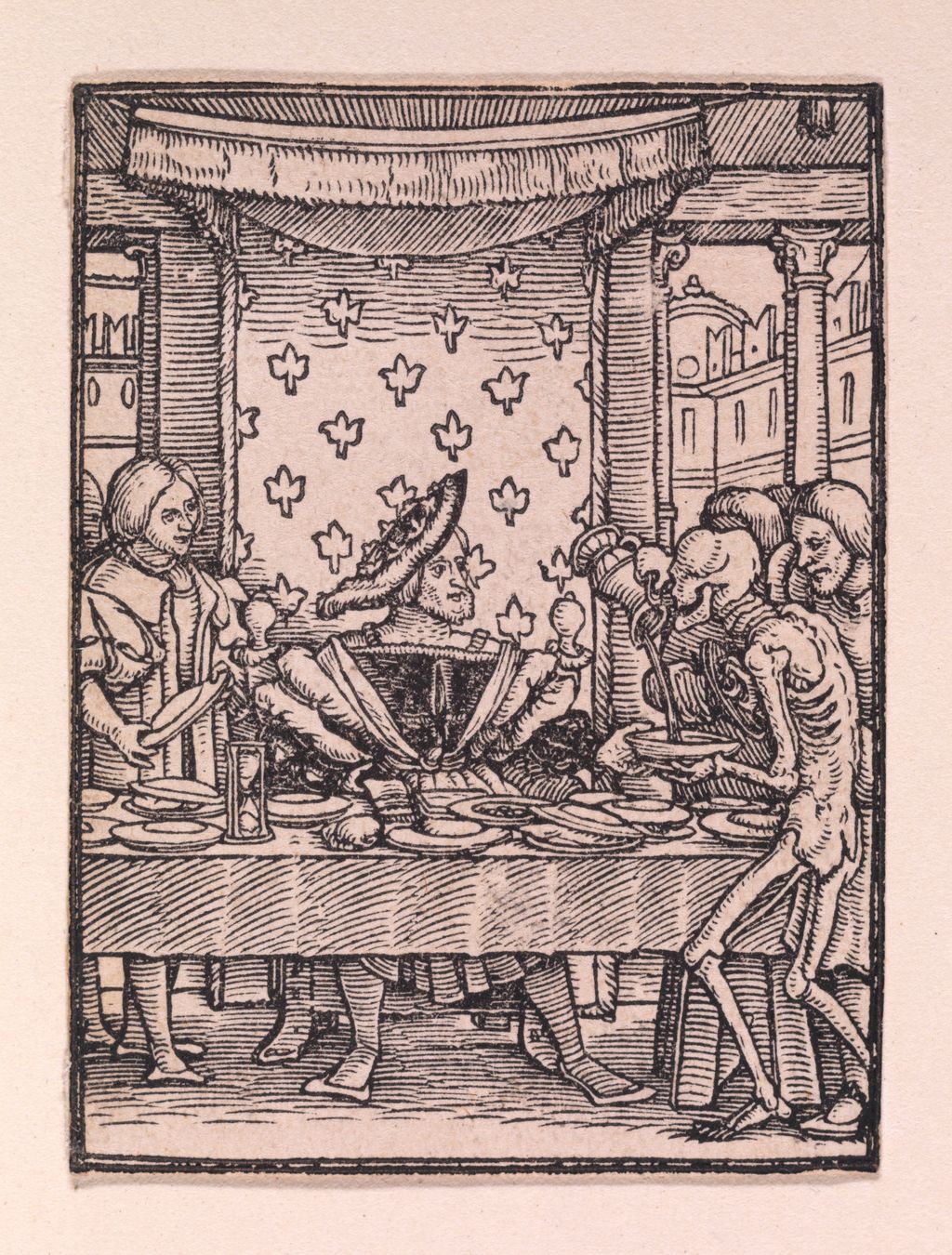
The King, from the Dance of Death. Design by Hans Holbein the Younger; block cut by Hans Lützelburger, about 1526. The series was first published as a book in 1538. The Metropolitan Museum of Art, Rogers Fund, 1919, 19.57.8.
Image source
.
Public domain
.
Ten works with which to begin
These ten starting points offer different experiences of Holbein. They can be visited in any order, though comparing two at a time often reveals more than moving rapidly through all ten.
- The Ambassadors , 1533 . Two full-length men stand beside shelves of objects, while a distorted skull crosses the foreground. Change your position and the apparently unreadable shape becomes legible. The picture makes looking a bodily action as well as an intellectual task. [19]
- The Body of the Dead Christ in the Tomb , 1521–22 . Begin with the distance between the body and its stone enclosure. The narrow format controls the encounter before a single symbolic detail is considered. [16]
- Sir Thomas More , 1527 . Follow the turns from shoulders to hands to head. Its bodily nearness and averted gaze make a useful comparison with Giese's outward attention. [22]
- The Henry VIII portrait family . Distinguish the lost Whitehall mural, Holbein's surviving small portrait in Madrid, the large cartoon and workshop versions. The familiar Walker Art Gallery full-length painting is attributed to Holbein's workshop. Compare how the king's breadth survives changes of scale and setting. [21] [30] [31]
- Darmstadt Madonna , 1525/26 and 1528 . Observe how Mary's mantle gathers the kneeling figures while their faces and clothes keep them distinct. Portrait likeness has become part of a devotional relationship. [27]
- Jane Seymour , about 1536–37 . The Vienna painting binds headdress, shoulders, sleeves and clasped hands into a firm outline. Begin with that silhouette, then move inward to the tiny variations of ornament and flesh. [32]
- Christina of Denmark , 1538 . A long black gown, a pale face and held gloves make a remarkably spare full-length encounter. Set it beside Jane's more densely ornamented portrait and compare how each figure occupies the surrounding field. [20]
- Georg Giese , 1532 . Let the letter lead towards the hands, the sleeves and finally the face. Then follow the shelves and table edges: individually persuasive objects inhabit a room that becomes less straightforward the longer you examine it. [18]
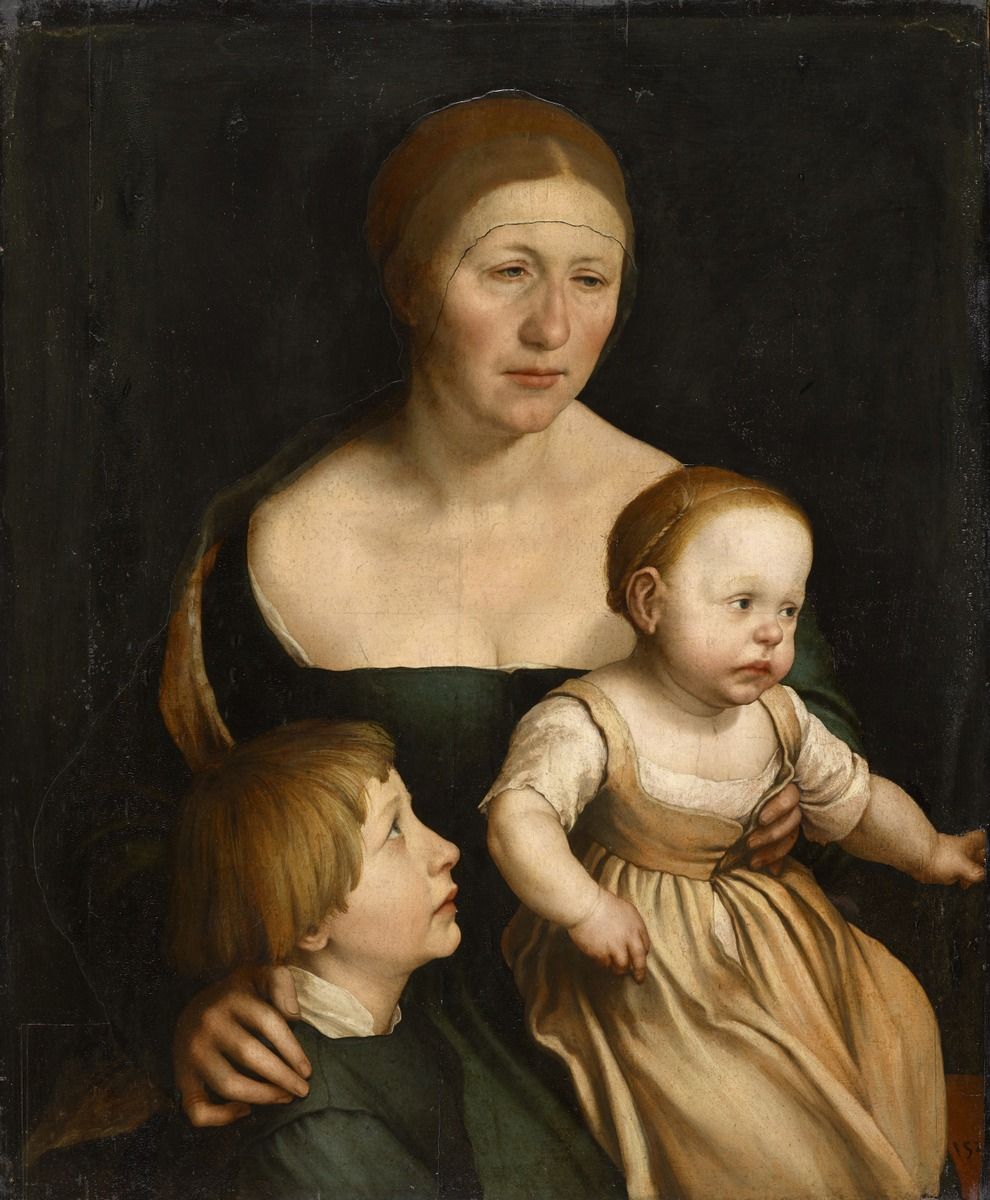
- The Artist's Family , about 1528–29 . Elsbeth and the two elder children form a close group, but their attention moves outwards. The painting is on paper, cut around the figures and mounted on wood. Its altered condition complicates any story built from their expressions. [33]
- Dance of Death , designs about 1526, published 1538 . Compare one sheltered interior with another. A canopy, bed or professional chair identifies the place from which Death removes its occupant. The series rewards attention to very small differences of action. [28]
Artists, models and the afterlife of an image
Connections between artists are most useful when they name a particular exchange. The Elder offers a probable training relationship. Leonardo da Vinci offers a more specific point of comparison in Holbein's idealised figures. Basel describes the face in Laïs Corinthiaca as Leonardesque and connects it with Italian models of the courtesan portrait. [6] That concerns a pictorial language of beauty: the softened modelling, inclined head and composed expression. It does not establish a meeting between the two artists or prove an Italian journey.
The distinction between individual likeness and an ideal type is especially productive beside Holbein's portraits. Laïs has a classical name, an offered palm and coins on the ledge. Her face participates in that invented role. Giese's hands instead hold a letter within a named merchant's setting. Both can look tangible, but the relationship between model, subject and identity differs.
A closely related Basel panel, Venus with Cupid , adds another kind of connection. The museum now assigns it to an unnamed assistant, the Venus-Maler, in Holbein's workshop. It interprets the picture as a free variation after Laïs . Similarity between the faces therefore leads into collaboration and reuse rather than proving that both paintings are autograph works. [34]
Later artists carried Holbein's images into new media and new historical moments. Wenceslaus Hollar's etching of Anne of Cleves , dated 1648, is explicitly a work after Holbein. The National Portrait Gallery connects it with the Earl of Arundel's commissioning of reproductions of his collection. [7] A painted arrangement of richly coloured clothes became a network of printed lines, capable of circulating in many impressions. Hollar belongs to the history of Holbein's reception, not to his sixteenth-century workshop.
Rowland Lockey's Sir Thomas More, his father, his household and his descendants , painted in 1593, does something more transformative. The National Portrait Gallery identifies it as based on Holbein's lost family portrait, with later generations added. The resulting gathering spans people who could never have shared the room. [8] An inherited composition becomes a statement about family descent and continuing Catholic belief. Calling it simply “Holbein's More family” loses both its later purpose and Lockey's contribution.
Such examples explain why copies deserve attention alongside firm attribution labels. They can preserve evidence for something lost and simultaneously change it. A copying artist may retain poses while adding sitters, translate colour into line or adapt a palace figure to a smaller panel. The important questions are concrete: what was retained, what changed, who made this object and when?
Collections, survival and returning to the pictures
Basel and the Royal Collection offer complementary encounters. Basel preserves much of the early range: religious painting, portraits, drawings and designs. Its collection history is bound to the Amerbach family. The city and university acquired the Amerbach Cabinet in 1661, keeping together a collection that included numerous Holbein paintings and a large body of works on paper. [5] That history helps explain why a modern visit can bring unlike kinds of object into unusually close company.
The Royal Collection's central group comprises eighty drawings, most probably acquired by Henry VIII after Holbein's death. It also preserves cases where a portrait study and finished painting survive together. [2] A visitor can compare how a face is established across sheets, where clothing receives colour notes, or how a few precise marks stand beside broader modelling. The drawings repeatedly bring the working encounter back into view.
Individual paintings create other points of entry: The Ambassadors and Christina in the National Gallery, More and Cromwell at the Frick, Giese in Berlin, Jane in Vienna, and the small Henry VIII in Madrid. [22] [18] [20] [19] [30] [32] These are collection homes, not promises that a particular work will always be on display. What matters for understanding Holbein is the opportunity to compare different formats and functions, whether through originals or careful reproductions.
Survival can also mislead. Whitehall's mural was destroyed in 1698; its complete composition is known through later records, including Remigius van Leemput's painted copy. [21] A familiar reproduction may conceal that distance. Equally, a yellowed varnish or old photograph may shape a work's reputation. The Louvre's account of the restoration of Anne of Cleves describes the recovery of colour and previously obscured costume details, and reopens questions about where the painting was completed. [35] Familiarity is a reason to look again.
For a first exploration, choose a route through the materials: paintings , drawings , prints or designs . For a closer account of how appearances were made, follow style and technique . Then return to a single detail: More's stubble, Giese's glass vase, Christina's gloves or the king's drink in Dance of Death . Holbein's range becomes easier to understand when large questions about identity, belief and power remain attached to these small, exact things.
Essential Hans Holbein the Younger works
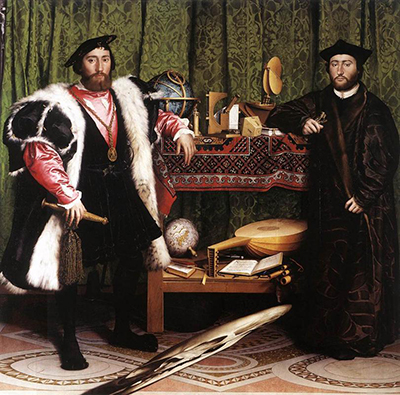
The Ambassadors
1533 · Two figures, shelves of objects and an oblique skull make the viewer’s position matter.
The Body of the Dead Christ in the Tomb
1521–22 · A long, low enclosure holds the body almost without surrounding space.
Sir Thomas More
1527 · Turned shoulders, joined hands and averted eyes shape a close encounter.

Henry VIII: the Portrait Family
Workshop portrait, 1537–47; wider portrait family · A durable royal image survives through workshop paintings and later versions.
Darmstadt Madonna
1525/26 and 1528 · The Virgin’s protective mantle gathers the kneeling donor family.

Jane Seymour
about 1536–37 · Headdress, shoulders, sleeves and hands establish a firm silhouette.
Christina of Denmark
1538 · A pale face and held gloves punctuate a long black gown.
Georg Giese
1532 · Letters, sleeves and glass create several routes towards the merchant’s face.
The Artist's Family
about 1528–29 · Supporting hands and outward attention connect mother and children.
Dance of Death
designs about 1526; published 1538 · Small scenes place a skeletal visitor within recognisable occupations.
Artworks directory
Explore paintings, drawings, prints and designs, including works without a separate article. Related studies and versions have their own entries; workshop works and copies are labelled. Print designs and series are grouped rather than repeated for every impression.
Frequently Asked Questions
Many portrait sheets recorded a sitter for a possible painting or miniature. Their degree of finish and materials vary. A drawing could preserve a likeness and details needed later without reproducing the eventual painting's full arrangement. [25]
Discussion
Look again at the images and ideas explored in Hans Holbein the Younger. These editorial prompts invite your observations.
Reader Insights
Choose a sleeve, hand or held object before looking at the sitter's expression. How does that first detail alter the person you subsequently seem to meet?
Compare a portrait drawing with a painting, or a painted portrait with Hollar's etching after Holbein. Which parts of the likeness travel most effectively between materials?
A complete painting, a fragmentary design and a later copy offer different kinds of evidence. Which changes most strongly when you learn its history?
Join the Conversation
Which Holbein work first drew you beyond the familiar image of Henry VIII? Share a detail that held your attention and a second work that helped you see it differently.
References
- National Galleries of Scotland , Hans Holbein the Younger , artist record and biography. View source .
- Royal Collection Trust , Holbein in the Royal Collection , artist overview, royal service and collection history. View source .
- Kunstmuseum Basel , Hans Holbein d.J.: Die Basler Jahre 1515 bis 1532 , 2006 exhibition account (in German). View source .
- Städel Museum , Holbein and the Renaissance in the North , 2023–24 Digitorial, sections on Hans Holbein the Younger. View source .
- Kunstmuseum Basel , Geschichte der Sammlung , Amerbach Cabinet and civic acquisition (in German). View source .
- Kunstmuseum Basel , Laïs Corinthiaca , 1526, inventory 322, collection commentary (in German). View source .
- National Portrait Gallery , Anne of Cleves by Wenceslaus Hollar based on a work by Hans Holbein the Younger , 1648, NPG D11254. View source .
- National Portrait Gallery , Rowland Lockey after Hans Holbein the Younger, Sir Thomas More, his father, his household and his descendants , 1593, NPG 2765, collection account. View source .
- National Gallery, Early Renaissance, glossary. View source.
- National Gallery of Art, Northern Renaissance. View source.
- National Galleries of Scotland, Mannerism, glossary. View source.
- National Gallery of Art, Albrecht Dürer, artist record. View source.
- National Gallery of Art, Lucas Cranach the Elder, artist record. View source.
- National Gallery, Hans Holbein the Younger, artist record. View source.
- Kunstmuseum Basel, Bildnis des Bonifacius Amerbach, 1519, inventory 314 (in German) . View source .
- Kunstmuseum Basel , Der tote Christus im Grab , 1521–22, inventory 318, collection record and commentary (in German). View source .
- The Frick Collection, Sir Thomas More, 1527, accession 1912.1.77, collection record . View source .
- Staatliche Museen zu Berlin / Stephan Kemperdick , Der Kaufmann Georg Gisze , 1532, inventory 586; collection record and commentary from 200 Meisterwerke der europäischen Malerei – Gemäldegalerie Berlin , 2019 (in German). View source .
- Susan Foister / National Gallery , The Ambassadors , in The German Paintings before 1800 , 2024, especially “Interpretation of the Composition” and “Meanings of the Objects”. View source .
- Susan Foister / National Gallery , Christina of Denmark, Duchess of Milan , in The German Paintings before 1800 , 2024, especially “The Commission”. View source .
- National Portrait Gallery , King Henry VIII; King Henry VII , about 1536–37, NPG 4027, collection account and current display labels. View source .
- The Frick Collection , Frick Madison: A Guide to Works of Art on Exhibition , 2021, entries for Sir Thomas More and Thomas Cromwell , p. 39. View source .
- National Gallery , Erasmus , 1523, L658, on loan from the Longford Castle collection, collection record. View source .
- Jeanne Nuechterlein , Translating Nature into Art: Holbein, the Reformation, and Renaissance Rhetoric , Pennsylvania State University Press, 2011, “Introduction: Holbein's Reformation of Art”, supplied on the publisher's page. View source .
- Rachael Smith and Victoria Button / Royal Collection Trust , Holbein's portrait drawings , conservation account. View source .
- Kunstmuseum Solothurn , Solothurner Madonna , 1522, A I 134, collection record (in German). View source .
- Würth Collection , Hans Holbeins Schutzmantelmadonna , Madonna des Bürgermeisters Jacob Meyer zum Hasen , 1525/26 and 1528, inventory 14910 (in German). View source .
- Metropolitan Museum of Art , The Dance of Death , Hans Holbein the Younger and Hans Lützelburger, about 1526, published 1538, 19.57.1–.42, collection record. View source .
- Kunstmuseum Basel , Tafelaufsatz mit Karyatiden , 1533–36, inventory 1662.165.89, collection record (in German). View source .
- Mar Borobia / Museo Nacional Thyssen-Bornemisza , Retrato de Enrique VIII de Inglaterra , about 1537, inventory 191 (1934.39), collection account (in Spanish). View source .
- National Museums Liverpool / Walker Art Gallery , workshop of Hans Holbein the Younger, Portrait of Henry VIII , institutional collection record on Google Arts & Culture. View source .
- Kunsthistorisches Museum Wien , Next Generation , Jane Seymour , about 1536–37, inventory 881 (in German). View source .
- Kunstmuseum Basel , Bildnis der Frau des Künstlers mit den beiden ältesten Kindern , about 1528–29, inventory 325, collection record and commentary (in German). View source .
- Kunstmuseum Basel , Venus mit dem Amorknaben , Venus-Maler, workshop assistant, about 1526–28, inventory 323 (in German). View source .
- Musée du Louvre , Le portrait d'Anne de Clèves par Hans Holbein le Jeune , restoration and interpretation feature (in French). View source .
- Royal Collection Trust, Holbein at the Tudor Court, Nash Gallery large-print exhibition labels, 2023 . View source .
