by
Tom Gurney
Tom Gurney BSc (Hons) is an art history expert with over 20 years experience
Email:
tomgurney1@gmail.com
/ Phone:
+44 7429 011000
Henry VIII: Holbein’s Portraits and Their Copies: Introduction
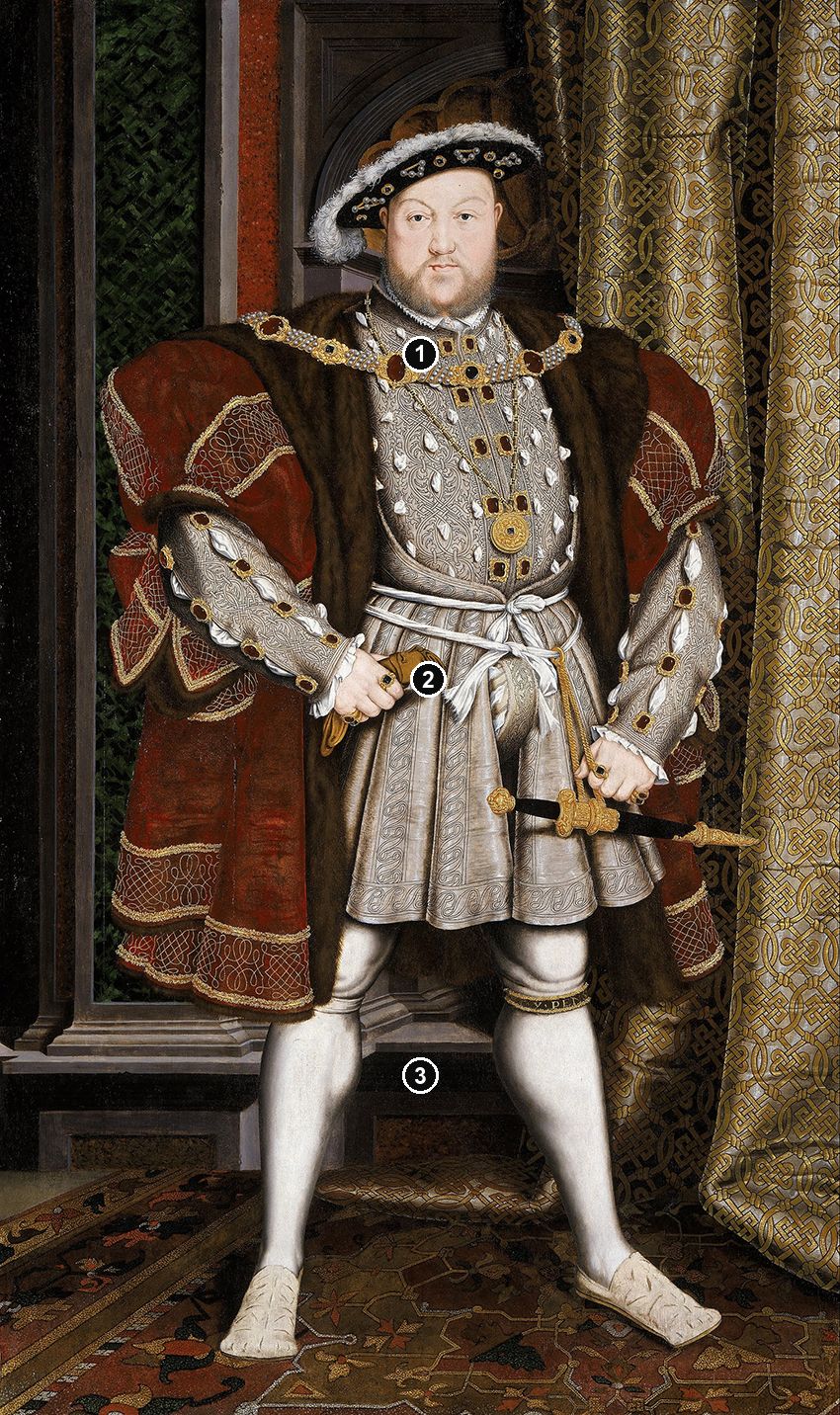
Henry VIII stands with his feet planted far apart, his elbows projecting beyond his waist and his clothes spreading into an almost square silhouette. The white stockings draw the eye down to the broad shoes, then the red robe carries it back towards the face. It is an extraordinarily familiar figure. Yet the full-length painting in the Walker Art Gallery, reproduced here, is attributed to the workshop of Hans Holbein the Younger , rather than to Holbein himself. Its distinction matters: the composition belongs to a family of images whose most important original no longer survives. [1] [2]
Holbein’s great wall painting at Whitehall Palace was completed in 1537 and destroyed by fire in 1698. A large preparatory drawing, a small painted portrait in Madrid and a seventeenth-century copy of the whole mural preserve different parts of its history. Together they reveal a royal image being designed, adapted and carried from one setting into another. [2] [3] [4]
At a Glance
- Subject Henry VIII, King of England, who reigned from 1509 to 1547. [2]
- Full-length portrait illustrated here Portrait of Henry VIII , workshop of Hans Holbein the Younger, Walker Art Gallery, Liverpool; the museum’s institutional partner record dates it 1537–47. [1]
- Surviving painted portrait by Holbein Portrait of Henry VIII of England , c.1537, oil on panel, 28 × 20 cm, Museo Nacional Thyssen-Bornemisza, Madrid, inventory 191 (1934.39). [3]
- Surviving Whitehall cartoon King Henry VIII; King Henry VII , c.1536–37, ink and watercolour, 257.8 × 137.2 cm, National Portrait Gallery, London, NPG 4027. [2]
- Lost original Holbein’s dynastic mural at Whitehall Palace, completed in 1537, destroyed in 1698. [2]
- Complete painted record Remigius van Leemput, Henry VII, Elizabeth of York, Henry VIII and Jane Seymour , 1667, oil on canvas, 88.9 × 99.2 cm, Royal Collection, RCIN 405750. [4]
This work across Hans Holbein the Younger’s career
Dead Christ in the Tomb
1521–22 [6]Sir Thomas More
1527 [7]Georg Giese
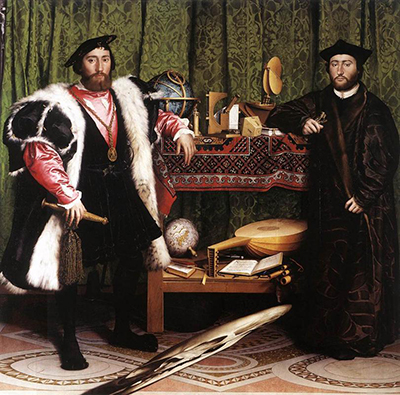
1532 [8]The Ambassadors
1533 [9]Contents
- Looking at the Walker Portrait
- A Monumental King on a Small Panel
- The Cartoon: Designing a Figure at Full Size
- The Whitehall Mural: Four Figures and a Dynasty
- A Royal Presence in a Palace Room
- Copies, Adaptations and the Work of Other Painters
- How the Image Outlived Henry
- Reading Henry Without Inventing Him
- Annotated details
Looking at the Walker Portrait
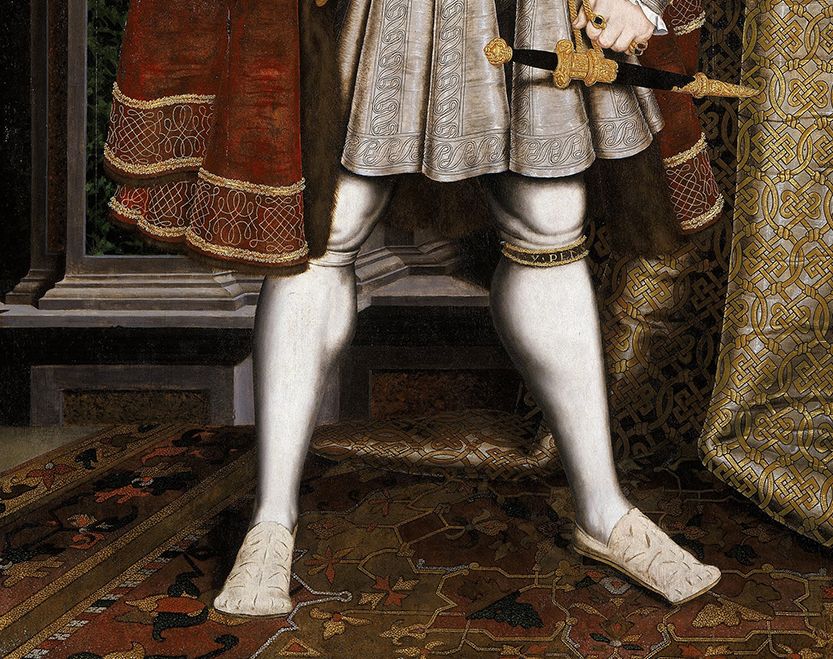
Begin with the space between Henry’s feet. It is unusually large, a wedge of patterned carpet that makes the body seem securely braced. Both shoes rest visibly on the floor; neither foot suggests that a step is about to follow. Above them the white stockings form two clear, tapering shapes. The robe falls outside this pale framework, so that its darker colour enlarges the figure without obscuring the legs. The king occupies the centre from top to bottom, but his reach across the picture is equally important.
The sleeves are crucial to that breadth. Their rounded red upper sections extend beyond the fur edging of the robe. Lower down, the pale sleeves narrow towards the wrists, with repeated openings and jewels marking their length. The hands therefore emerge from a carefully graduated sequence of large and small forms. They look quite modest beside the shoulders, though their placement gives the pose much of its structure.
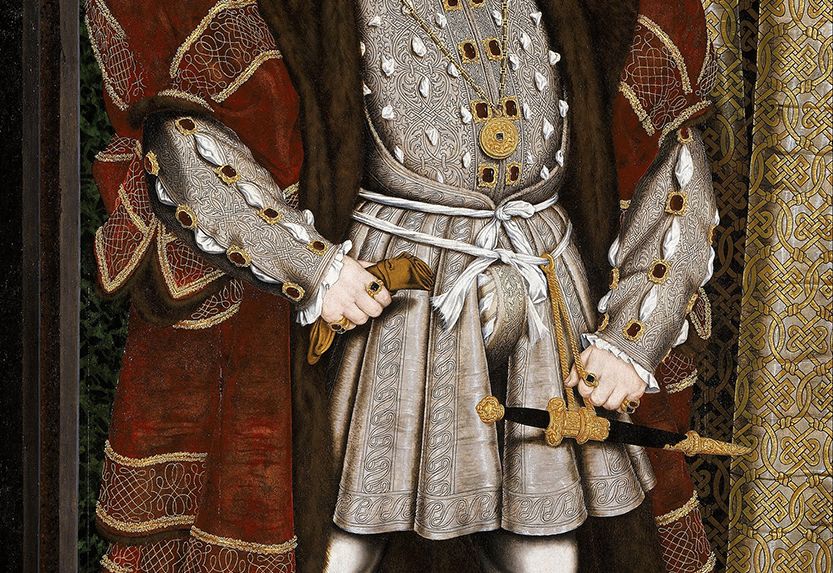
Henry’s right hand, on our left, gathers the gloves near his waist. His left is lower, beside the cord and hilt of the dagger. The weapon lies almost horizontally, making a short, firm line across the lower torso. Its dark sheath contrasts with the bright tunic. The equipment of rank and force is present within a stationary pose, with neither a raised arm nor a drawn blade.
The tunic brings a different kind of activity. Its pale surface is broken by dark embroidery, gold settings and white fabric pulled through openings. Across the chest, chains and a pendant create another rhythm. These small, repeated accents keep the broad expanse from becoming empty. Seen from farther away, the costume reads as a glittering mass; closer looking separates it into many differently shaped components.
Notice, too, how the setting answers the clothes. Straight architectural edges rise on the left, while a gold-patterned curtain hangs on the right. The carpet fills the foreground with angled borders and ornamental shapes. Henry’s body is surrounded by worked surfaces. The folds of the curtain give one area a particularly dense texture, against which the clearer outline of the stocking remains easy to follow.
The face occupies surprisingly little of this display. The black cap, edged with pale feathers, helps isolate it from the dark background. A reddish beard defines the jaw; the mouth is small and closed. Looking at this face after the costume can be revealing. The apparent force of the portrait depends on the whole arrangement of shoulders, hands, legs and surrounding space. It cannot be located in the eyes alone.
Liverpool’s account describes the picture as an adaptation of the figure in the Whitehall mural, with a simplified architectural setting and an added curtain. The workshop attribution allows us to appreciate that adaptation as a painting with its own choices. It also prevents a common confusion between this surviving full-length portrait and the lost wall painting. [1]
A Monumental King on a Small Panel
The Thyssen portrait changes the encounter immediately. At only 28 centimetres high, it asks for close attention. Henry’s shoulders press towards the sides, and his hands enter along the bottom edge. A deep blue background replaces the column, curtain and carpet. The compactness makes the head and decorated chest feel all the more substantial. This is a surviving painting accepted as Holbein’s own work, dated by the museum to about 1537. [3]
The face turns slightly, allowing the far cheek to recede and the nearer ear to remain visible. It has a more distinctly angled structure than the front-facing head in the Walker portrait. The cap also slopes across the composition. Its pale feather follows an irregular curve, opening out against the blue, while gold ornaments punctuate the black brim. The combination creates a lively upper boundary to an otherwise firmly contained figure.
At the throat, a gold collar makes a narrow band between skin and clothing. Below it, the embroidered garment is divided into vertical strips. Lines of ornament travel down the torso, interrupted by white openings and jewel settings. A long chain crosses these vertical rhythms and ends in a large circular pendant. It is easy to move from the eyes to the pendant and back again, noticing how the two occupy a common central area without falling into rigid alignment.
The body is so closely cropped that each surviving fragment of a gesture matters. One hand holds brown gloves, their folded fingers making a little bundle at the lower edge. A dark stone in a ring stands out against the skin. On the other side, another hand and ring enter the frame. They do not provide the expansive armature of the full-length pose, but they keep this small portrait from becoming a detached head above a diagram of expensive clothes.
The contrast between face and textiles deserves patient looking. The embroidery remains insistently patterned, while the face depends on small transitions around the eyelids, nose and mouth. The beard moves between those two kinds of description: its outline defines a broad shape, but individual hairs soften the edge. Without a palace interior, the portrait still gives an impression of considerable physical weight.
Its original destination is uncertain. Mar Borobia’s collection essay notes that it has not been identified in the royal inventories; possible ownership by Henry remains a possibility. The painting entered the Thyssen collection in 1934. Those facts leave room for a distinction between what the object shows and what its history can establish. A small format may invite intimate viewing, but it does not by itself identify the first owner or the room in which the portrait hung. [3]
Annotated Details from Henry VIII: Holbein’s Portraits and Their Copies
The numbered points identify visible features discussed in this article. Return from each detail to the whole composition. Workshop of Hans Holbein the Younger, Portrait of Henry VIII, 1537–47, Walker Art Gallery, Liverpool. An adaptation of Holbein’s Whitehall figure; this surviving painting is attributed to his workshop.
Details from HENRY VIII: HOLBEIN’S PORTRAITS AND THEIR COPIES
Compare the cropped details with the complete images above. Notice how their colours, shapes and positions contribute to the larger compositions.
The head within the wide costume
The pale face sits above a broad arrangement of fur, red sleeves and patterned white cloth. Follow how the cap and collar frame this much smaller area of skin.
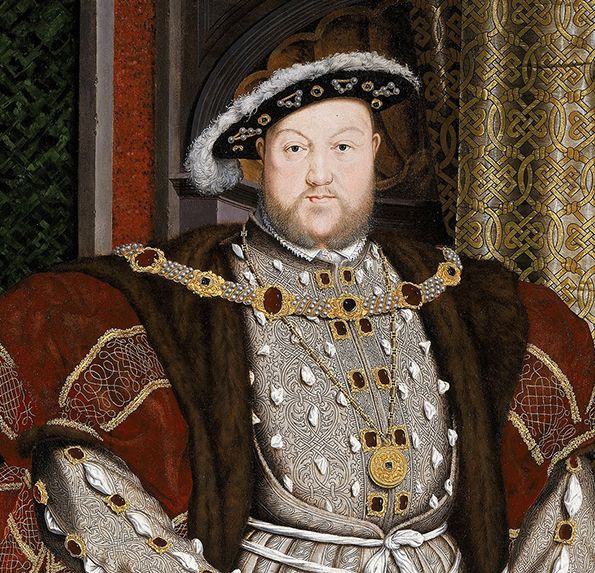
Hands and the ornamented garment
The hands occupy opposite sides of the waist. Repeated gold-coloured ornaments cross fabric that bunches into larger folds around the sash.
The spread stance and patterned floor
The feet turn outwards across the patterned floor. Compare the light stockings with the heavy dark borders of the outer garment.
The Cartoon: Designing a Figure at Full Size
The National Portrait Gallery’s great sheet gives scale back to the king. Measuring more than two and a half metres in height, it preserves the left side of the Whitehall composition: Henry VIII stands in front, while Henry VII rises behind him. The drawing dates to about 1536–37. Its joined sheets and separately attached figures show a composition assembled from parts. [2]
Here, the word cartoon means a large preparatory drawing. The sheer size is part of its function. A design made at the scale of the intended painting could carry the main outlines from the artist’s paper to the wall. The familiar studio image of a small sketch enlarged by eye is insufficient for understanding this object. The drawing had to organise bodies, architectural divisions and ornament across a surface large enough to confront a standing spectator.
Look first at the two kings together. The younger Henry is wide and low in the foreground, his bent arms enclosing the waist. Behind him, his father’s long robe creates a much narrower vertical movement. One figure spreads; the other rises. Their different positions allow both to remain legible in a fairly narrow surviving section. Henry VIII’s shoulders almost bridge the architecture around him, while his father appears within its upper space.
The legs carry much of the design even in this subdued, worn image. The gap between them is clear, and their changing angles can be followed beneath the tunic. The familiar pose was therefore established before the colour of the finished mural. Red velvet and gold ornaments would enrich it, but the underlying distribution of weight already worked through outline and proportion.
The head is especially instructive. Henry looks to one side in the cartoon. In Leemput’s record of the completed mural, the face has turned towards the spectator. This visible change is small in relation to the whole body, but substantial in its effect: it brings the direction of the face into closer agreement with the outward-facing torso. We do not need to invent a conversation between painter and king to recognise the difference. [2] [4]
The transfer procedure also needs a little care. The Gallery’s current explanation suggests that the surviving drawing was retained as a record, with another cartoon used for the actual wall transfer. In pouncing, powder passed through small holes to mark the design on the new surface. The familiar statement that this very sheet was necessarily pressed against the Whitehall wall goes beyond that account. [2]
Such distinctions make Holbein’s drawings rewarding objects in their own right. Here, construction remains visible: the joining of paper, the positioning of figures and the relationship between a design and its eventual use. The cartoon brings us unusually close to the practical work behind an image that can otherwise seem to have appeared fully formed.
Watch: Holbein’s portraits and working methods
Explore museum films on Holbein’s drawings, painted portraits and close-looking details.
Hans Holbein at the court of Henry VIII
A Royal Collection Trust film exploring Holbein’s work at Henry VIII’s court.
Watch on YouTubeThe Whitehall Mural: Four Figures and a Dynasty
Leemput’s 1667 copy restores the missing half. Opposite the two kings stand Elizabeth of York, Henry VIII’s mother, and Jane Seymour , his third wife. The women occupy corresponding levels: Elizabeth stands farther back, Jane in the foreground. A tall inscribed structure separates the two groups. Above them, elaborate painted architecture joins the sides into one interior. [4]
The result changes our understanding of Henry’s stance. Seen alone, he appears self-sufficient. In the group, he is part of a deliberate arrangement across generations. His father stands above and behind him, while Jane occupies the foreground opposite. The painting brings together four people who could never have stood for this group at the same moment: Henry VII and Elizabeth of York had died before Holbein’s English career. The family relationship is constructed pictorially across time. [2]
The central block gives that relationship a verbal form. The Royal Collection translates the opening of the Latin verses as a competition over whether the father or the son should be considered the greater ruler. Its appeal is directed to a spectator looking at the figures. Praise is built into the composition, taking the form of an apparently open question whose two possible answers both honour a Tudor king. [4]
There is also a strong visual balance between the sexes, despite the unequal expansiveness of the poses. Jane’s gown spreads towards the carpet, answering Henry’s broad upper body with a differently shaped mass of fabric. Her clasped hands remain close to the centre of her body. Elizabeth’s quieter stance behind her corresponds to the older king across the picture. Each figure has an individual outline, yet their placement makes the pairs easy to compare.
The architecture supplies a further frame of continuity. Repeated niches, panels and projecting supports establish a shared order around the family. The painted lion and dragon above add heraldic presences; the Royal Collection’s exhibition labels identify them as Henry’s animals. The same labels explain that the verses celebrate his supremacy over the English Church alongside the dynasty’s might. The mural thus attached its family statement to the authority Henry claimed in his own reign. [11]
The date, 1537, has encouraged a connection with the birth or anticipated birth of Edward, Henry and Jane’s son, in October that year. The National Portrait Gallery presents this as a possible impetus for the commission. Edward is not one of the four figures in Leemput’s complete record. The distinction is useful: a proposed occasion for a work is not necessarily an event literally illustrated within it. [2]
A Royal Presence in a Palace Room
Holbein was recorded as King’s Painter by September 1536. The Royal Collection’s exhibition account places portraiture beside his designs for jewellery, weapons, metalwork and other court objects. In that setting, a painted image formed part of a much broader environment of crafted display. The decorated clothes in the Henry portraits belong visually to that world, even when the paintings themselves give no account of who made each accessory. [11]
Whitehall adds an architectural dimension to this environment. The mural was associated with the Privy Chamber, an inner palace room. The National Portrait Gallery cautions that its first audience would have been selective. The Royal Collection describes Henry receiving important guests before it. We should therefore imagine a relationship between painted and living presence in a particular room, rather than assume that the original was a public spectacle available to everyone. [2] [11]
That setting makes the life-size scale especially consequential. A spectator entering the chamber would share real space with a painted figure approximately the size of a person. In a small reproduction, the king’s broad stance is a shape enclosed by a rectangle. At full size, it can be understood in relation to our own shoulders, feet and bodily reach. The design offers the viewer a human measure, then fills that measure with costly clothing and an insistently frontal arrangement.
The mural’s architecture would have supplied another exchange between the real room and its painted extension. The surviving records show people placed before niches and ornamental supports. These do not simply provide a neutral backdrop. They give the figures an ordered place to stand, making royal genealogy look as settled and substantial as the surrounding building.
Calling the image propaganda can identify its celebration of power, but the word is most useful when we also ask about setting and audience. A restricted court encounter, a portrait in a subject’s house and a later historical reproduction involve different viewers. The design’s political force travels through those situations, changing as it goes. Its later circulation should not be projected backwards into an unsupported account of how every Tudor subject saw the original.
Copies, Adaptations and the Work of Other Painters
The full-length Henry could survive removal from the group because the stance already made a complete composition. The legs establish the base, the arms define the sides, and the cap closes the upper contour. A copyist could change the background or reduce the length while retaining enough of that structure to make the king recognisable. The Walker painting demonstrates the first possibility; a three-quarter-length Royal Collection version, dated c.1538–47, demonstrates the second. [1] [11]
Petworth House preserves another full-length repetition, catalogued by the National Trust as studio of Holbein, c.1543–47. At 237.5 centimetres high, it preserves the imposing physical scale of this portrait family. The Trust explicitly distinguishes it from an autograph painting. Its record draws attention to a carpet bunched over a step, a detail it considers evidence of a close connection with the lost mural. [12]
The carpet detail is a useful invitation to look beyond the face. Small features in a setting may help establish relationships between versions, while a repeated facial pattern can occur in paintings of very different quality. A portrait’s resemblance to a famous design answers one question about its ancestry. The handling of its paint, the construction of its support and its recorded history answer other questions about the object that survives.
Tarnya Cooper’s research on Tudor portrait production explains why repeated images deserve such attention. Workshops could use patterns and divide different parts of a painting’s manufacture among several craftspeople. Her 2009 lecture also cautions against confidently attaching individual names to works made within that system. A recognisable composition need not imply that the best-known artist personally painted every example. [13]
Copying could also alter the experience of dress. In the Walker picture, the large gold-patterned curtain creates a dense vertical field beside the king. Leemput’s complete group has a different balance between bodies, carpet and architecture. Even without knowing the reasons for each alteration, we can see that repetition offered opportunities for adjustment. Preserving the king’s pose did not require preserving every surrounding element.
This is why a copy should be identified positively. “Workshop of Holbein” tells us how a collection currently locates a painting in relation to the artist. “After Holbein” identifies dependence on his invention without making the same claim of workshop production. Neither description supplies an exact account of every hand involved. The terms help keep the origin of a design distinct from the making of a particular painted surface.
The survival of several objects also changes the story of loss. Without the mural, a single copy might tempt us to reconstruct everything from it. With the cartoon, the small panel and different painted repetitions, comparison becomes possible. Agreement can make the basic pose secure; variation alerts us to details that were revised, adapted or transmitted differently.
How the Image Outlived Henry
Holbein’s image was not the only Henry available to sixteenth-century viewers. The Society of Antiquaries preserves a more restrained portrait type, with a pale green background, which it associates with an earlier, non-Holbein pattern. Its collection account describes production from a cartoon rather than repeated sittings from life. Seeing another type helps release us from the assumption that every likeness of the king must descend from Whitehall. [14]
Holbein’s isolated stance is easy to retain in memory. A viewer can recognise it from the disposition of legs and elbows before seeing the face clearly. The dense costume remains readable at a distance because its ornaments sit within a strong overall shape. That combination helps the design persist through changes of scale and quality.
Its force was discussed while the original still existed. In his Schilder-boeck , published in 1604, Karel van Mander described Henry’s life-size portrait at Whitehall as so lifelike that the spectator was startled. He explained this through the apparent animation of the head and limbs. His passage is valuable evidence for the portrait’s early reputation; it should not be turned into a documented description of each visitor’s emotional response. [15]
The distinction matters because surprise at convincing art and fear of a ruler are related but different ideas. Van Mander’s words praise the vividness of the representation. Modern viewers, bringing knowledge of Henry’s reign, may read menace in the same face and stance. That response belongs to the encounter between image and historical knowledge. It is not a transparent record of the sitter’s private character.
Other documentary traces record concern for the mural’s survival. Arthur B. Chamberlain’s 1913 study quotes John Evelyn’s diary entry of 11 February 1656, expressing relief that the painting had suffered little defacement. It also cites Charles Patin’s seventeenth-century explanation of Charles II’s decision to commission a copy as a way of preserving the work for posterity. These are accounts transmitted through an older study, but they reveal a history of attention before the final loss. [16]
Leemput’s painting acquired a new importance when Whitehall burned. It had been made in 1667 for Charles II, thirty-one years before the fire of 4 January 1698. The Royal Collection identifies it as the surviving complete record of the mural. Its value includes what the celebrated isolated figure leaves out: the two queens, the older king, the central inscription and the architecture enclosing them. [4]
Reading Henry Without Inventing Him
The four principal witnesses allow four different kinds of looking. The Walker portrait offers a full-length adaptation with a particular setting and a workshop attribution. The Thyssen panel offers the concentrated handling of a small painting by Holbein. The cartoon preserves design at monumental scale. Leemput’s copy restores the family arrangement while remaining a work painted more than a century later.
Try comparing one feature across them. The head changes its angle; the hands survive or disappear according to the crop; the surrounding ornament expands and contracts. Then look at the feet. Their placement is central to the full-length image, yet the small panel produces a substantial royal presence without showing them at all. Each object solves a distinct problem of presentation.
This comparison also sets limits on what a portrait can tell us. We can describe the narrow eyes, the closed mouth, the jewels and the weapon. We can document the dynastic setting and the reproduction of the design. Those observations do not establish what Henry thought during a sitting, whether he personally ordered a particular adjustment, or how closely the painted body corresponded to his body on a given day.
The pleasure of looking need not diminish under those limits. On the contrary, the paintings become more varied. The white folds emerging through a sleeve, the angle of a glove and the vertical fall of a curtain become choices to inspect, rather than clues forced into a fixed verdict on Henry. Holbein’s invention is powerful enough to support that slower attention, and its many surviving descendants reward the effort of telling them apart.
Artworks directory
Explore paintings, drawings, prints and designs, including works without a separate article. Related studies and versions have their own entries; workshop works and copies are labelled. Print designs and series are grouped rather than repeated for every impression.
Frequently Asked Questions
The museum attributes it to Holbein’s workshop. It repeats and adapts the figure developed for his Whitehall mural. It should be credited as a workshop portrait, even though the underlying design is associated with Holbein. [1]
Remigius van Leemput painted the Royal Collection’s reduced copy in 1667 for Charles II. It records the group before the original was lost, but it is a seventeenth-century painting rather than a surviving fragment by Holbein. [4]
Discussion
Look again at the images and ideas explored in Henry VIII: Holbein’s Portraits and Their Copies. These editorial prompts invite your observations.
Reader Insights
Follow the gloves, rings and dagger cord. How much of the king’s apparent authority comes from the hands, and how much from the larger shape of the sleeves?
Compare Henry standing alone with the four-figure composition. Does the presence of his parents and Jane Seymour change the story the portrait seems to tell?
Imagine the small Thyssen panel held nearby, then the cartoon seen at its actual height. Which details would become more noticeable in each encounter?
Join the Conversation
Which version of Henry holds your attention longest: the full-length figure, the small painted panel or the family group? Share a detail that changes when you compare them.
References
- National Museums Liverpool / Walker Art Gallery , Portrait of Henry VIII , workshop of Hans Holbein the Younger, institutional collection record on Google Arts & Culture; attribution also given in National Museums Liverpool’s Henry VIII print description. View source 1 . View source 2 .
- National Portrait Gallery , King Henry VIII; King Henry VII , Hans Holbein the Younger, c.1536–37, NPG 4027; collection description and display labels. View source .
- Museo Nacional Thyssen-Bornemisza / Mar Borobia , Retrato de Enrique VIII de Inglaterra , c.1537, inventory 191 (1934.39), collection record and essay (in Spanish). View source .
- Royal Collection Trust , Remigius van Leemput, Henry VII, Elizabeth of York, Henry VIII and Jane Seymour , 1667, RCIN 405750; collection description, dimensions and provenance. View source .
- Kunstmuseum Basel, Bildnis des Bonifacius Amerbach, 1519, inventory 314 (in German) . View source .
- Kunstmuseum Basel, Der tote Christus im Grab, 1521–22, inventory 318 (in German) . View source .
- The Frick Collection, Sir Thomas More, 1527, accession 1912.1.77, collection record . View source .
- Gemäldegalerie Berlin, Georg Gisze . View source .
- Susan Foister, The Ambassadors, The German Paintings before 1800 (2024) . View source .
- Susan Foister, Christina of Denmark, Duchess of Milan (2024) . View source .
- Royal Collection Trust , Holbein at the Tudor Court , large-text exhibition labels, Nash Gallery, sections “Artists at Court”, “Painting the King”, RCIN 405750 and RCIN 404438, PDF pp.2–3, 24–27 and 41. View source .
- National Trust , Henry VIII (1491–1547) , studio of Hans Holbein the Younger, c.1543–47, Petworth House, NT 486186; collection record. View source .
- Tarnya Cooper / Gresham College , The Faces of a King: New research on portraits of Henry VIII , lecture transcript, 1 October 2009, workshop production and contexts of royal portrait ownership. View source .
- Society of Antiquaries of London , Henry VIII (pale green background) , LDSAL333, exhibition collection entry, Henry VIII: Defender of the Faith? . View source .
- Karel van Mander , “Het leven van Hans Holbeen, uytnemende Schilder”, Het schilder-boeck , first published 1604, fol.222r, original Dutch text reproduced by DBNL (in Dutch). View source .
- Arthur B. Chamberlain , Hans Holbein the Younger , vol.II, 1913, pp.94–95, citing Charles Patin’s Relations historiques (1673) and John Evelyn’s diary entry of 11 February 1656; digitised public-domain text. View source .
- Würth Collection, Holbeins Schutzmantelmadonna, inventory 14910, current owner account (in German) . View source .
- Metropolitan Museum, Dance of Death series . View source .
- Kunstmuseum Basel, Bildnis der Frau des Künstlers mit den beiden ältesten Kindern, about 1528–29, inventory 325 (in German) . View source .
- Kunsthistorisches Museum Wien, Next Generation, Jane Seymour, about 1536–37, inventory 881 (in German) . View source .