by
Tom Gurney
Tom Gurney BSc (Hons) is an art history expert with over 20 years experience
Email:
tomgurney1@gmail.com
/ Phone:
+44 7429 011000
Portrait of Sir Thomas More: Introduction
Thomas More sits close to the front of the picture, wrapped in brown fur, black cloth and red velvet. His hands meet at the lower edge, holding a folded paper. Above them, a gold chain makes a bright curve across his chest. The face turns to the right, following a direction that the hands and shoulders quietly reinforce. Behind this compact figure, a green curtain sweeps into deep folds.
Holbein painted the portrait in 1527, during his first stay in England. More was already a scholar, lawyer and royal servant; his appointment as Lord Chancellor lay two years ahead. The painting now belongs to the Frick Collection in New York. Its apparent immediacy rewards slow looking: the tiny distinctions between skin, hair, fur and metal make the sitter extraordinarily tangible, while his averted gaze keeps something of the encounter beyond our reach. [1]
At a Glance
- Artist Hans Holbein the Younger.
- Title Sir Thomas More .
- Date 1527.
- Medium Oil on oak panel.
- Dimensions 74.9 × 60.3 cm.
- Collection The Frick Collection, New York.
- Accession number 1912.1.77.
- Credit Henry Clay Frick Bequest. [1]
- Related works Two portrait drawings in the Royal Collection, RCIN 912268 and RCIN 912225, and the lost More family portrait. [2] [3]
This work across Hans Holbein the Younger’s career
Dead Christ in the Tomb
1521–22 [5]Georg Giese
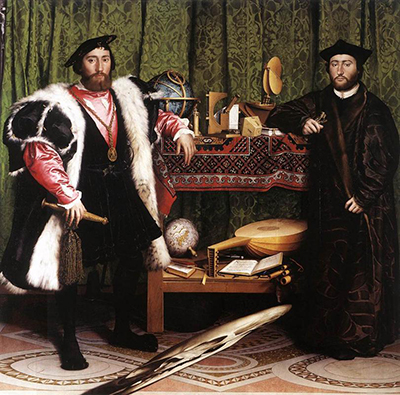
1532 [6]The Ambassadors
1533 [7]Contents
- A presence built from turns and diagonals
- Skin, fur and the red velvet sleeves
- The chain and the sitter's public position
- How Holbein entered More's circle
- More described in words
- Two drawings and a complicated working process
- A paper held between the hands
- From Tudor England to the Frick Collection
- Looking beyond the later story
A presence built from turns and diagonals
The first impression is of a firmly gathered body. More occupies most of the panel's width, his sleeves spreading to either side before returning towards the joined hands. The broad shoulders, enveloping collar and substantial forearms give the figure weight. Yet the pose has a direction: the nearer shoulder projects towards us while the face turns away, and the eyes carry that movement beyond the right-hand border.
Follow the line from his cap to his hands. The dark hat spreads sideways above the forehead, then the face narrows towards the chin. Fur opens around the neck and drops into a long point at the front of the gown. Beneath it, the arms form another, wider enclosure. These nested shapes gather our attention around the head without isolating it from the body. More's expression belongs to a whole arrangement of clothing, shoulders and hands.
The curtain provides a different rhythm. Long folds run obliquely behind the sitter, with light catching their raised surfaces and shadow deepening the hollows. At the upper right, a cord changes direction and descends beside a narrow, lighter strip of background. This small upright passage checks the sweep of the fabric. It also prevents the green from becoming an indefinite field: the hanging has an edge and belongs to a constructed setting.
More's body remains comparatively still within all this movement. The folds of his clothes bend and bunch, but the shoulders hold their position. His head does not tip dramatically, and neither hand makes a gesture towards the viewer. The interest lies in how little action is needed. The turning face and concentrated eyes establish attention without supplying a conversation or an event.
That restraint leaves room for several responses. He may look alert, guarded or absorbed, depending on where we begin. The strong line of the mouth can seem severe until the small irregularities of the lips become visible; the face then feels less like an emblem of resolution and more like a particular person's face. Holbein gives the features a persuasive relationship to one another without disclosing the thought behind them.
The low ledge helps bring the portrait into our space. It passes under the forearm near the bottom of the panel, close enough to establish a boundary we almost share. Above it, the bright hands appear accessible; higher up, the eyes remain directed elsewhere. That difference between physical nearness and diverted attention is one reason the portrait holds us. We can inspect More closely, yet we cannot obtain his answering look.
Skin, fur and the red velvet sleeves
The face contains some of the painting's quietest transitions. Light spreads over the forehead and cheek, catches the projecting nose, then changes in strength around the mouth and chin. The shadow beneath the cap is relatively narrow. It sets the forehead back under the brim without swallowing the eyes, which remain sharply available to view.
Look at the space between the lower lip and the chin. A scattering of short dark marks suggests stubble over the gently turning flesh. The marks are much smaller and less insistent than the hairs at the edge of the fur collar. Holbein distinguishes two kinds of hair at two scales, allowing both to register as texture without making them compete. The face feels especially exposed beside the thick protection of the collar.
The fur's colour varies from warm, light brown to almost black. Its outer edge is broken into projecting wisps; farther in, softer passages suggest the depth of the pile. The point descending over the chest creates a dark central channel, while the broader part catches the light near the shoulder. The impression of thickness comes from these changes across the whole collar as much as from individual hairs.
Below it, the black gown remains legible through very limited shifts of tone. Narrow lights indicate folds that would disappear if the garment were painted as a flat silhouette. The green behind the shoulders sharpens its boundary, while the brown fur softens the transition towards the head. Black therefore performs several jobs: it gives the figure breadth, supports the brighter materials and frames the flesh.
The velvet sleeves are more active. Their red is interrupted by deep creases, almost black where the fabric folds inward. Thin, brighter edges trace the places where it turns towards the light. Near the elbows, compressed folds suggest the cloth's response to bent arms; nearer the wrists, the shapes gather tightly before meeting the white cuffs. The sleeves have volume because their light and dark passages describe the position of the limbs inside them.
Colour moves between these areas. The warmth of the fur leads towards the skin, and the red sleeves repeat that warmth at greater intensity below. The green hanging gives the upper body a cool surround. Gold crosses between face and arms, adding a much harder kind of brightness. Each surface has its own behaviour, but none sits apart as a display sample. The chain bends with the chest, the fur wraps around the neck, and the velvet creases around the elbows. The materials keep reminding us of the body that carries them.
The chain and the sitter's public position
More's gold chain is particularly easy to misread through hindsight. The Frick identifies it as a sign of service to the king, rather than the badge of a particular office. It cannot, in this portrait of 1527, announce an appointment as Lord Chancellor that came only in 1529. More had already served as a diplomatic envoy and Privy Councillor and had been elected Speaker of the House of Commons in 1523. [1]
The chain consists of repeated S-shaped links, interrupted near the centre by more intricate pieces and a hanging rose. Its broad curve lies over the softer curve of the fur. Small areas of light turn each link into a solid object, while the gaps keep the ornament from becoming an unbroken band. The pendant falls slightly below the collar's widest section, where its detailed outline can be read against darker clothing.
On a first viewing, this is one of the strongest assertions of importance in the picture. More's name and career are invisible to anyone who does not already know them; expensive clothing and conspicuous metalwork communicate social standing immediately. Even a viewer unable to identify a single link can understand the weight of the ornament and the care given to its display.
The presentation is contained. The hands remain low, their activity limited to holding the paper. Rank is worn on the body, keeping public distinction close to the ordinary proportions of head, shoulders and arms.
The white cuffs matter here too. Their narrow edges separate red cloth from flesh, making the transition unusually crisp. One hand bears a dark ring whose setting catches a small light. These compact details balance the larger ornament above: chain, ring, cuffs and paper draw us down through the figure in successive changes of texture. Holbein's description of status never entirely displaces the physical details of wearing and handling things.
How Holbein entered More's circle
Holbein came to England from Basel in 1526. Erasmus provided the connection with More; the Royal Collection's exhibition account cautiously describes the painter as probably carrying a letter of recommendation. More became an early English patron. The relationship belonged to an international community sustained by books, correspondence and personal introductions, whose members included Erasmus and Archbishop William Warham. [9] [2]
The practical value of such a connection is clear in More's surviving letter to Erasmus, dated at Greenwich on 18 December 1526. Near its end, More calls Erasmus's painter a mirus artifex , a remarkable artist. He fears that England may offer less opportunity than the newcomer expects, but promises to help prevent the country proving entirely unproductive for him. The passage combines admiration with the practical business of finding work. [10]
More had someone to recommend the painter, and Holbein had a patron willing to assist him. The letter establishes personal acquaintance, high regard for the artist's ability and an undertaking to help; it gives no details of commissioning the portrait or arranging its sittings.
The surrounding letter also reminds us that humanist friendship did not exist apart from religious argument. More devotes substantial attention to Erasmus's controversy with Luther, urging him to continue his response. His brief notice of the painter occurs within that much larger exchange. Painting was one of several concerns moving through the correspondence, alongside publication, belief and obligations between friends. [10]
It is tempting to search the Frick portrait for an illustration of this conversation. There is, however, no visible title of a book or legible passage that tells us which dispute occupies More. What the painting provides is the person whose letters circulated: the face, the clothing, the hands and the bodily presence. Knowing something of the exchange enriches the encounter without turning every feature into a coded reference to a text.
Watch: Holbein’s portraits and working methods
Explore museum films on Holbein’s drawings, painted portraits and close-looking details.
Hans Holbein at the court of Henry VIII
A Royal Collection Trust film exploring Holbein’s work at Henry VIII’s court.
Watch on YouTubeMore described in words
Eight years before Holbein's panel, Erasmus attempted a portrait of More in a letter to Ulrich von Hutten, dated 23 July 1519. He made the analogy with painting explicit, modestly presenting his account as an incomplete likeness of a friend. His description moves between outward appearance and habits of mind, clothing and conversation. [11]
Erasmus recalls dark auburn hair, a sparse beard and an expression animated by humour. He also says that More preferred simple clothes and avoided silk and gold chains except when circumstances required them. These are the observations of an admiring friend, offered in a letter written considerably earlier than the Frick portrait. They need not match the public presentation chosen for a later sitting. [11]
The difference is illuminating. Holbein's More wears precisely the kind of conspicuous ornament Erasmus treats as an obligation of position. A painted portrait records an occasion of self-presentation, with dress and pose selected for it. It need not provide the average appearance of the sitter at home. Nor does the serious face cancel Erasmus's account of a humorous companion. A single still image has much less scope than a long letter to register changes in company, mood and behaviour.
More offers another kind of self-portrait in the prefatory letter to Peter Giles accompanying Utopia . He explains that legal work and public business consume his days, while evenings require conversation with his wife, children and servants. Writing must take what time remains. The account belongs to the literary framing of Utopia , where More carefully fashions his role as author and reporter; it is not an unmediated diary entry. [12]
Read beside the painting, it adds activity to the seated figure. The hands held together at rest belong to someone who describes a life of pleading, hearing, judging and speaking. The smooth arrangement of the portrait gives no measure of the pressure of those tasks. That gap between a composed likeness and an account of daily business is productive: each medium supplies something the other cannot.
Neither document explains what More felt while sitting for Holbein. They do, however, prevent the portrait becoming a personality test. The mouth and eyes can suggest seriousness; the letters introduce humour, friendship, argument and competing responsibilities. A historical person could encompass all these things, while a painter had to build one sustained image from a particular pose.
Two drawings and a complicated working process
The survival of two portrait drawings of More brings us unusually close to the making and reuse of his likeness. Both are in the Royal Collection. RCIN 912268, dated 1527, is executed in black and coloured chalks and has outlines pricked for transfer. The separate RCIN 912225, dated about 1526–27, includes brown wash, and its contours have been followed with a stylus. [2] [3]
Their connection with the Frick portrait is immediately recognisable in the cap, turned face and fur collar. But a resemblance is not a complete account of their function. A likeness could be recorded, traced, transferred and adapted, leaving more than one surviving sheet. The more lightly worked drawing need not be the first version simply because it looks less finished.
Technical research makes the sequence harder to reduce to a single straightforward operation. Victoria Button reports evidence of pouncing in the Frick painting's underdrawing: a design was transferred using a dotted pattern. Yet her comparisons found that the pricked Royal drawing does not align with the entire painted face, even though individual features correspond closely. The traced drawing proved a closer fit. Button therefore considers an intermediate pattern, or the possibility that the traced sheet was taken from the painting itself. These are hypotheses about use and sequence, not a settled chain of production. [13]
The distinction changes how we look at the finished face. Its precision may feel almost automatic, as if Holbein simply carried an intact likeness from paper to panel. The surviving evidence points instead towards several possible acts of translation and adjustment. Small differences of position can matter without destroying recognition. A painted eye, a chalk eye and the outline beneath the paint belong to related but distinct stages of work.
There is also a connection with the More family portrait , whose original painting is lost. The Royal Collection associates the traced sheet with that commission; its account of the pricked drawing suggests that both larger More studies may initially have served the individual portrait. The exact relationship remains open. [2] [3] The Frick panel survives as a complete painted encounter with More alone, while the drawings preserve evidence of a likeness available for other uses.

Hans Holbein the Younger, Sir Thomas More, 1527. Black and coloured chalks, with outlines pricked for transfer; 39.8 × 29.9 cm. Royal Collection, RCIN 912268.
A paper held between the hands
The small white paper is easy to overlook beside the sleeves. Its upper point rises between the hands, and its pale surface picks up the light of the nearby cuffs. Because it is partly concealed, we cannot read it as a document with an identifiable subject. It introduces the activity of handling a written object without giving us access to its words.
In his Frick audio commentary, Xavier F. Salomon suggests that the paper and the portrait's character could be consistent with a work intended for a friend. That remains a proposal about its original purpose. The surviving record does not identify a recipient for this panel. [1]
A striking comparison survives in More's own response to another portrait. In 1517, he wrote verses concerning Quinten Massys's paired likeness of Erasmus and Peter Giles. One poem gives the picture a voice: correspondence conveys the mind of the absent friends, while the painted image supplies their bodily appearance. More was thus already thinking about the different ways words and pictures could overcome separation. [14]
This earlier response helps us understand why a likeness mattered within a network of correspondents. Letters could bring a friend's conversation across a distance; a portrait preserved a recognisable presence. It does not prove that Holbein's painting was sent to Erasmus, and it cannot tell us who first possessed it. It supplies a contemporary way of thinking about the experience of looking at a person who is elsewhere.
The paper also has a simple compositional role. It makes a small, angular interruption among the rounded forms of hands and sleeves. One hand closes towards it while the other supports the group from below. Their contact suggests care and restraint without a dramatic action. The portrait contains a written object, but More himself remains its principal subject; our attention returns from the unreadable paper to the visible face.
From Tudor England to the Frick Collection
The portrait's early history contains a large gap. The Frick's provenance account begins with its making in 1527 and resumes with a documented reference in Rome in 1631. In that year, the English diplomat Arthur Hopton reported the picture in Cardinal Pier Paolo Crescenzi's collection. How it travelled from England to Italy, and who owned it along the way, remain uncertain. [15]
One possible connection leads through the French cardinal Matthieu Cointerel, who possessed a painting of More at his death in 1585. The Frick presents this as a possible part of the panel's history, rather than a secure identification of every link. By the nineteenth century the portrait had returned to London, passing through the dealer Farrer and the Huth family. Henry Clay Frick bought it from Edward Huth in 1912 for £55,000. [15]
The gaps are especially noticeable because the sitter's likeness has become so familiar. We can feel that we know the picture while knowing little about its first rooms, viewers or journeys. Its composition cannot fill that documentary absence. The close format might suit a private setting, but it does not name a household; the paper might invite a reading about friendship, but it does not supply an address.
Its later collection changes the company in which we meet it. In the Frick, More has long been associated with Holbein's portrait of Thomas Cromwell , acquired by Frick in 1915. The two were installed on opposite sides of the Living Hall fireplace. [15] Such an arrangement encourages a comparison across careers and reputations, even though the pictures were made at different times.
Seen within that later pairing, More's face easily becomes one half of a historical confrontation. Seen on its own, the panel has another pace. We can attend to the fall of the fur, the bright chain and the small passage of exposed shirt beneath the chin before naming any political opposition. The painting's collecting history is part of its meaning for later viewers, while its individual arrangement continues to invite a more patient encounter.
Looking beyond the later story
The Frick dates its Cromwell portrait to 1532–33, several years after the More. [16] They should therefore be compared as separate solutions to portraiture, with attention to their different settings and dates. A later display can bring two people into dialogue without making their pictures an original pair.
More's subsequent fate inevitably affects modern responses. He was executed in 1535 and was canonised in 1935. [1] Those events belong to the history of the sitter and to the reception of his image. The portrait, painted in 1527, presents an established servant of Henry VIII before that final conflict. Its clothes announce position, and its composure gives the figure stability; neither constitutes evidence that Holbein intended an image of future martyrdom.
The eyes look beyond the frame towards something we cannot see. Their direction creates a sense of attention without identifying its object. That unresolved quality allows us to return to the face and find it compelling even when we set aside the events that followed.
Below, the fingers bend around their modest piece of paper and the red sleeves bunch against the wrists. The slight pressure of hand against hand gives this dignified public figure an ordinary physical action. It holds our attention alongside the bright chain and the concentrated gaze.
Artworks directory
Explore paintings, drawings, prints and designs, including works without a separate article. Related studies and versions have their own entries; workshop works and copies are labelled. Print designs and series are grouped rather than repeated for every impression.
Frequently Asked Questions
The Frick portrait dates from 1527, during Holbein's first period in England. It precedes More's appointment as Lord Chancellor in 1529. [1]
The Frick identifies the chain as an emblem of service to the king. It does not mark one specific office, so it should not be described as proof that More was already Lord Chancellor. [1]
Discussion
Look again at the images and ideas explored in Portrait of Sir Thomas More. These editorial prompts invite your observations.
Reader Insights
Follow the bright folds of red velvet towards the hands. Which changes of light make the fabric seem thickest?
Look from the face to the curtain and back. How does More's attention beyond the frame affect your sense of his presence?
Erasmus described a humorous friend; Holbein preserved this composed pose. What can each kind of portrait communicate most readily?
Join the Conversation
Which detail makes More feel most physically present to you: the stubble, the fur collar, the gold links or the folded paper? Describe how it changes your experience of the whole portrait.
References
- The Frick Collection , Sir Thomas More , 1527, accession 1912.1.77; collection record, commentary and audio transcript by Xavier F. Salomon. View source .
- Royal Collection Trust , Sir Thomas More (1478–1535) , 1527, RCIN 912268, collection record, including text adapted from Holbein to Hockney: Drawings from the Royal Collection . View source .
- Royal Collection Trust , Sir Thomas More (1478–1535) , c.1526–27, RCIN 912225, collection record. View source .
- Kunstmuseum Basel, Bildnis des Bonifacius Amerbach, 1519, inventory 314 (in German) . View source .
- Kunstmuseum Basel, Der tote Christus im Grab, 1521–22, inventory 318 (in German) . View source .
- Gemäldegalerie Berlin, Georg Gisze . View source .
- Susan Foister, The Ambassadors, The German Paintings before 1800 (2024) . View source .
- Susan Foister, Christina of Denmark, Duchess of Milan (2024) . View source .
- Royal Collection Trust , Holbein at the Tudor Court , Chambers Gallery large-print exhibition labels, “Basel to London, 1526”, PDF pages 27–28. View source .
- Thomas More , letter to Erasmus, Greenwich, 18 December 1526, Erasmi epistolae , edited by P. S. Allen and others, letter 1770, especially lines 71–74; scan supplied by the Center for Thomas More Studies (in Latin). View source .
- Desiderius Erasmus , letter to Ulrich von Hutten, Antwerp, 23 July 1519, letter 999; English translation from Francis M. Nichols, The Epistles of Erasmus , volume 3, 1918, pp.387–401, reproduced by the Center for Thomas More Studies; especially PDF pages 1–2. View source .
- Thomas More , prefatory letter to Peter Giles, Utopia , Center for Thomas More Studies edition, 2023, printed pp.13–14. View source .
- Victoria Button , The portrait drawings of Hans Holbein the Younger: function and use explored through materials and techniques , PhD thesis, Royal College of Art, 2013, pp.208–210. View source .
- Thomas More , letter and verses to Peter Giles, 7 October 1517, Erasmi epistolae , edited by P. S. Allen and others, letter 684, especially the poem beginning Tabella loquitur ; scan supplied by the Center for Thomas More Studies (in Latin). View source .
- Christopher Snow Hopkins, The Frick Collection , “Mapping Provenance: Holbein's ‘Sir Thomas More’”, 15 October 2021. View source .
- The Frick Collection , Thomas Cromwell , 1532–33, accession 1915.1.76, collection record. View source .
- Würth Collection, Holbeins Schutzmantelmadonna, inventory 14910, current owner account (in German) . View source .
- Metropolitan Museum, Dance of Death series . View source .
- Kunstmuseum Basel, Bildnis der Frau des Künstlers mit den beiden ältesten Kindern, about 1528–29, inventory 325 (in German) . View source .
- Kunsthistorisches Museum Wien, Next Generation, Jane Seymour, about 1536–37, inventory 881 (in German) . View source .