by
Tom Gurney
Tom Gurney BSc (Hons) is an art history expert with over 20 years experience
Email:
tomgurney1@gmail.com
/ Phone:
+44 7429 011000
Portrait of Thomas Cromwell: Introduction
Thomas Cromwell sits beside a green-covered table, his head turned towards the left edge of the picture. A broad black cap and a heavy fur collar enclose the pale face. One hand holds a small white paper low against his dark gown. On the table, more papers lie beside a richly bound book, whose golden edges catch the light. His eyes look past these objects, towards someone or something outside the frame.
Holbein's portrait makes public business look remarkably still. The materials of work are close to hand, yet nothing is being written, opened or passed across the table. The figure holds his position while the little differences between paper, fur, wood and metal make the room tangible. Painted in 1532–33, the surviving panel belongs to the Frick Collection in New York. [1]
At a Glance
- Artist Hans Holbein the Younger.
- Collection title Thomas Cromwell .
- Date 1532–33.
- Medium Oil on oak panel.
- Dimensions 78.1 × 64.1 × 0.7 cm.
- Collection The Frick Collection, New York.
- Accession number 1915.1.76.
- Credit Henry Clay Frick Bequest. [1]
- Important distinction The National Portrait Gallery's NPG 1727 is an early seventeenth-century version after Holbein's composition. [2]
- Recent research A jewelled Book of Hours at Trinity College, Cambridge, has been identified by researchers with the book on Cromwell's table. [3] [4]
This work across Hans Holbein the Younger’s career
Dead Christ in the Tomb
1521–22 [6]Sir Thomas More
1527 [7]Georg Giese
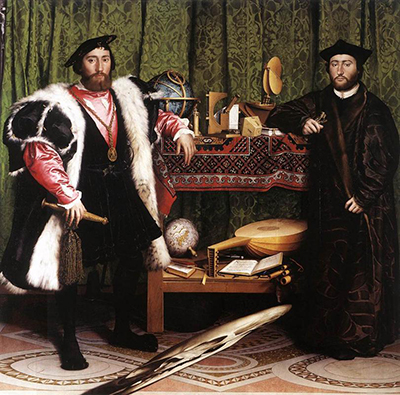
1532 [8]The Ambassadors
1533 [9]Contents
- A portrait at a particular point in Cromwell's career
- The seated figure and the shape of the room
- Papers, hands and the small still life
- What the painted surfaces can tell us
- The jewelled book and the Cambridge discovery
- Copies and the changing identity of the likeness
- From an English collection to the Frick
- Facing Thomas More
A portrait at a particular point in Cromwell's career
The date matters because Cromwell's later titles and fate can so easily take over the picture. Holbein shows him during the artist's second English period. The folded letter on the table identifies his position as Master of the Jewel House; the painting is thought to commemorate that appointment. [1] [3] Its setting therefore belongs to a specific stage in his advancement. The familiar name “Earl of Essex”, attached to later images, should not be read backwards into every feature of this earlier portrait.
There is an understated fitness between the office and the arrangement. A man associated with the custody of valuable objects appears beside an exceptionally elaborate binding. The book introduces precious metal into a room otherwise dominated by cloth, wood and paper. Yet that relationship does not tell us exactly who devised the display, where the portrait was first hung or what instructions Cromwell gave Holbein. The suggestion of a commemorative purpose remains more secure than an invented account of the commission.
The painting itself offers a carefully limited kind of access. Cromwell is seated in a furnished interior, close enough for us to notice the pressure of his fingers and the rim of his ring. He does not acknowledge the viewer. We occupy a position from which his working surroundings are available to inspection, while his attention remains elsewhere. This combination gives the portrait its unusual reserve: the objects are exposed more readily than the sitter's thoughts.
Even the room is only partly supplied. We see wall covering, panelling, the edge of another textile and the table. There is no doorway, distant window or view that would let us reconstruct the whole interior. The setting gives Cromwell a physical place without turning his likeness into an illustration of an identifiable day's business.
The seated figure and the shape of the room
Begin with the broadest divisions. Dark blue fills the upper background; warm wooden panelling crosses the middle; green cloth spreads across the foreground. Cromwell's black gown binds these areas together. The figure rises from the table's level into the blue field, while the pale face stands out near the junction of cap and collar.
The panelling is especially effective. Its upper horizontal edge passes behind the sitter's shoulders, giving us a stable measure against which to read the body. Upright divisions carry the eye down through the exposed wood at the left. The room feels constructed from straight pieces, in contrast to the rounded cheek, bent fingers and soft fur. These differences help the seated figure feel substantial without requiring a dramatic pose.
The cap is almost as broad as the collar below it. Between these two spreading shapes, the face projects to the left. Nose, lips and chin make a sequence of small changes along the lit contour. The nearer eye remains visible under the brim, but the head is turned sufficiently far that the far side of the face becomes narrow. Holbein lets the turn register clearly while retaining enough of the face for a sustained encounter.
Cromwell's shoulder makes a large descending curve on the right. Much of the gown is very dark, although faint changes of tone still describe its folds and volume. Against that broad area, the hand holding the paper becomes a concentrated point of activity. The little white shape is bright enough to stop the eye but small enough to leave the figure's mass intact.
At the far left, a different textile interrupts the room's straight lines. Its red and dark pattern descends over a rounded form and disappears beyond the border. We cannot inspect the whole object it covers. That cut-off passage gives the room a sense of continuation beyond the picture, while its intricate pattern counterbalances the comparatively quiet green tablecloth.
The portrait has very little empty space. Even the blue behind the head carries a pattern, difficult to read in the darker areas. The density does not feel crowded because the strongest edges remain simple: the cap's brim, the line of the face, the panelling and the table. Small detail settles within an arrangement that can be understood from across a room.
Papers, hands and the small still life
The white papers on the table provide another route into the painting. Their irregular outlines overlap one another, breaking the long green surface into smaller, oblique shapes. Some edges lift slightly; other parts lie flat. Light and shadow make them look thin enough to handle, a very different kind of weight from the nearby book.
The folded letter also carries information. In his Frick commentary, Xavier F. Salomon explains that it supplies Cromwell's office. [1] Such lettering joins the practical appearance of a document to the identifying function of an inscription. It can tell a historically informed viewer something precise without moving the words onto a conspicuous title panel above the sitter.
The paper in Cromwell's hand works differently. Its bright folds are visible, but the viewer is not given a readable message. The fingers gather around it, with a pale cuff emerging from the dark sleeve. A coloured stone in the ring adds a small glint beside the white paper. Flesh, cloth, jewellery and the folded sheet meet within a passage much smaller than the head.
These two groups of papers connect the body to the table. The hand seems withdrawn towards Cromwell's lap, while the papers on the cloth lie nearer to us. That separation creates depth and suggests the ordinary possibility of movement between the two places. Nothing moves in the picture, but the distances are small enough for us to imagine a hand reaching down, setting something aside or picking it up.
The book anchors the opposite end of the still life. Its rectangular outline and decorated edge make it firmer and more self-contained than the loose papers. A projecting clasp interrupts its border. The contrast is one of use as well as appearance: a bound volume gathers leaves within a durable cover, while loose documents can be rearranged. Holbein makes these differences visible without telling us the contents of every object.
The table is also a boundary. Its near edge runs across the lower picture, keeping the viewer outside Cromwell's immediate space. Beyond it, the objects remain close enough to examine. This is part of the portrait's quiet tension: access to the man's surroundings does not produce an answering look from the man himself.
Watch: Holbein’s portraits and working methods
Explore museum films on Holbein’s drawings, painted portraits and close-looking details.
Hans Holbein at the court of Henry VIII
A Royal Collection Trust film exploring Holbein’s work at Henry VIII’s court.
Watch on YouTubeWhat the painted surfaces can tell us
The Frick describes the painting as oil on oak panel. The Getty's 2021 exhibition checklist independently records this same Cromwell portrait, with the Frick as lender and the same measurements. [1] [11] It is a surviving painting attributed to Holbein, distinct from the later versions that preserve its arrangement.
At the visible surface, the treatment of materials rewards comparison. The fur's edge softens as small hairs project into neighbouring areas. The book's metal fittings remain sharply bounded. The papers catch broad, pale lights, whereas the ring concentrates its light within a tiny setting. Panelling gives a relatively smooth, warm background to the softer outline of the gown.
The effects describe things with different thicknesses and surfaces occupying the same room. A small hard glint makes metal feel unlike velvet; an interrupted outline makes fur feel unlike wood. The portrait's persuasive presence grows from relationships between neighbouring materials.
Technical evidence requires more care. The detailed National Portrait Gallery study frequently associated with this composition examines NPG 1727, its later copy. Tree-ring analysis places the earliest possible felling of the tested board in 1595. Infrared examination revealed fine drawing, ruled edges and adjustments; the researchers considered possible metalpoint. Those findings belong to that panel. [2]
A test of one version cannot automatically explain the making of another. The copy's underdrawing is valuable evidence of how this likeness was reproduced, but it does not give us Holbein's original sequence of work. Looking at the Frick painting and reading a technical examination of NPG 1727 are complementary activities only when the two objects remain distinct.
The jewelled book and the Cambridge discovery
For many viewers, the object on the table has become the portrait's most intriguing detail. In 2023, researchers announced that it could be identified with a Book of Hours preserved at Trinity College, Cambridge. Alison Palmer, curator at Hever Castle, recognised the binding; Kate McCaffrey and Owen Emmerson helped investigate its history. Cambridge's announcement presents the identification as the result of comparison and provenance research. [4]
The proposal gives the painted book a life beyond its small rectangle on the table. A Book of Hours contained devotional prayers. This example was printed in Paris by Germain Hardouyn in 1527 or 1528, and Anne Sadleir gave it to Trinity in 1660. The suggested connection runs through the family of Cromwell's secretary Ralph Sadleir. [3]
The binding provides particularly specific evidence. Cambridge reports that specialist examination identified its silver-gilt borders as the work of Pierre Mangot and dated the metalwork to 1529–30. Analysis by Joanna Symonowicz using Raman spectroscopy identified the stones as grossular garnets. [4] These are findings about the surviving book. They give substance to the proposed comparison without turning a painted highlight into a chemical analysis.
Trinity also records that the original velvet has worn down, exposing black silk, and that some gilding has been lost. [3] The present object and its painted appearance therefore need to be compared with their different histories in mind. Paint can preserve an earlier impression of a surface that has since changed. Equally, a small depiction can simplify an object that becomes much more complicated when handled and examined.
On the table, the binding's gold-coloured edge is conspicuous against the green. The dark cover gives it a solid central mass, while the fittings divide the bright border into sections. The decorative detail continues around the side facing us. Holbein has positioned the volume so that the viewer can appreciate the binding even though its pages remain closed.
The discovery opens questions about Cromwell's reading and possessions without answering them all. Trinity notes the absence of annotations demonstrating his use of the book in prayer. [3] Ownership, devotional practice and the choice of an object for a portrait are related questions, but they require different kinds of evidence. The book may have been valued for its workmanship, its contents or several reasons together; the portrait does not rank those possibilities for us.
Copies and the changing identity of the likeness
The National Portrait Gallery's version is dated to the early seventeenth century and classified as the product of an English workshop. Its conservation account identifies the Frick painting as Holbein's original. The London version also carries a scroll naming the Earl of Essex, which the researchers found was not original to that copy. [2]
That distinction has consequences for anyone comparing reproductions. The same seated pose can circulate with different backgrounds, added lettering and altered colour. Familiarity with the face may make two pictures feel interchangeable, but the physical evidence can separate them by decades. A later title may tell us how a sitter was remembered rather than how he presented himself at the first sitting.
Copying also changes the scale at which details matter. In the Frick picture, the face, hand and book belong to one carefully balanced arrangement. When a later painter repeats the composition, each has to be remade in paint. The outline of a sleeve, the angle of a table edge or the crispness of a clasp can change even when the overall likeness remains recognisable. Technical study helps historians locate those acts of translation.
A copy records the continued usefulness of an image and its survival in another setting. The NPG study documents an extended family of versions. [2] Their existence helps explain why a single composition has become the habitual visual companion to Cromwell's name.
From an English collection to the Frick
The Frick's collection history begins tentatively with Sir Thomas Pope at Tittenhanger House. It then follows descendants and the Earls of Caledon, followed by Sir Hugh Lane and Frick's acquisition in 1915. [1] The qualification at the beginning matters: a plausible early owner is not the same as a fully documented commission history.
The making of the likeness and the panel's later ownership remain distinct histories. A family connection can help trace its movements without establishing who first commissioned it. The surviving painting carries more history than the moment represented on its surface.
Its New York setting is unusually well documented early in its life with Frick. Julie Ludwig's study of the collection's first handbook explains that the 1916 volume placed Cromwell on the north wall of the Living Hall. The handbook offers a record of the arrangement while the building was still a private residence. [12]
A room can become part of a painting's later identity. Visitors remember the route towards it, the scale of the surrounding furnishings and the other faces nearby. Reproductions remove that company and make the panel seem self-sufficient. Both experiences can be useful: the room reveals a history of collecting, while the isolated image makes it easier to follow the small relations within Holbein's composition.
Facing Thomas More
At the Frick, Cromwell has long been encountered in relation to Holbein's portrait of Sir Thomas More . Salomon's audio commentary presents the two as an opposed pair, their display drawing attention to their political conflict and deaths. [1] The arrangement creates a powerful encounter, although the paintings were made several years apart. Their present pairing does not establish a shared original commission.
The visual comparison is rewarding even before we interpret the men's careers. More's green curtain moves in broad folds behind his shoulders. Cromwell's room is more tightly organised by the horizontal panelling and the spread of the table. In each, the face turns away from a direct exchange with the viewer; in each, a small paper is held close to the body. Similar ingredients produce different kinds of space.
Cromwell's conspicuous book also changes the balance. The table becomes an independent area of interest, allowing our attention to settle away from his face. Papers, binding and pen help furnish a world of things to which the sitter has access. The dark breadth of the gown remains remarkably uninterrupted above them.
It is tempting to make those differences settle a moral judgement. A firm mouth, a heavy collar or a pale cheek cannot establish honesty, cruelty or religious conviction. Nor does a cooler range of colour prove that Holbein disliked his sitter. Modern novels and performances can make the image feel newly familiar, but they supply interpretations of Cromwell rather than evidence about the portrait's original making.
The Frick's account places Cromwell's rise and his execution in 1540 within the history surrounding the painting. [1] That later knowledge inevitably colours the encounter. Looking closely brings us back to the earlier, unfinished moment of a life: a seated official, a paper held in reserve and a closed book whose binding continues to invite examination.
Artworks directory
Explore paintings, drawings, prints and designs, including works without a separate article. Related studies and versions have their own entries; workshop works and copies are labelled. Print designs and series are grouped rather than repeated for every impression.
Frequently Asked Questions
The original panel is in the Frick Collection, New York, accession 1915.1.76. Its collection date is 1532–33. [1]
NPG 1727 is an early seventeenth-century workshop version after the earlier composition. Its technical examination concerns that copy. [2]
They were painted at different dates. Their familiar confrontation at the Frick belongs to their later display together. [1]
Discussion
Look again at the images and ideas explored in Portrait of Thomas Cromwell. These editorial prompts invite your observations.
Reader Insights
Compare the sheet held close to the body with the documents spread on the table. How do their different positions guide your attention?
The pages are closed, but the fittings are prominently displayed. What can you learn about a book before reading it?
Trace the panelling and table before looking back at the face. Which straight line does most to stabilise the seated figure?
Join the Conversation
Does your eye return first to Cromwell's face, his hand or the jewelled book? Describe which visible detail gives the portrait its strongest sense of presence.
References
- The Frick Collection , Thomas Cromwell , 1532–33, accession 1915.1.76; collection record, commentary, collection history and audio transcript by Xavier F. Salomon. View source .
- National Portrait Gallery , Thomas Cromwell, Earl of Essex , NPG 1727, early seventeenth century, based on a work of 1532–33; conservation research in the Tudor and Jacobean Portraits Database. View source .
- Trinity College Library, Cambridge , “Thomas Cromwell's Book of Hours”, 19 January 2024, subsequently updated; research account including binding and gemstone analysis. View source .
- University of Cambridge , “Trinity College prayer book belonged to Thomas Cromwell, new research suggests”, 9 June 2023. View source .
- Kunstmuseum Basel, Bildnis des Bonifacius Amerbach, 1519, inventory 314 (in German) . View source .
- Kunstmuseum Basel, Der tote Christus im Grab, 1521–22, inventory 318 (in German) . View source .
- The Frick Collection, Sir Thomas More, 1527, accession 1912.1.77, collection record . View source .
- Gemäldegalerie Berlin, Georg Gisze . View source .
- Susan Foister, The Ambassadors, The German Paintings before 1800 (2024) . View source .
- Susan Foister, Christina of Denmark, Duchess of Milan (2024) . View source .
- J. Paul Getty Museum , Holbein: Capturing Character in the Renaissance , exhibition checklist, 19 October 2021–9 January 2022, no.46, PDF page 9. View source .
- Julie Ludwig, The Frick Collection , “The First Handbook: ‘Paintings in the Collection of Henry Clay Frick’”, 30 November 2022. View source .
- Würth Collection, Holbeins Schutzmantelmadonna, inventory 14910, current owner account (in German) . View source .
- Metropolitan Museum, Dance of Death series . View source .
- Kunstmuseum Basel, Bildnis der Frau des Künstlers mit den beiden ältesten Kindern, about 1528–29, inventory 325 (in German) . View source .
- Kunsthistorisches Museum Wien, Next Generation, Jane Seymour, about 1536–37, inventory 881 (in German) . View source .