


 by
Tom Gurney
Tom Gurney BSc (Hons) is an art history expert with over 20 years experience
Email:
tomgurney1@gmail.com
/ Phone:
+44 7429 011000
Holbein in Words: Quotations, Letters and Painted Inscriptions: Introduction
Hans Holbein’s portraits make people look so present that it is easy to imagine hearing them speak. Their actual words bring a different pleasure: the small shock of a person addressing an immediate need. Thomas More worries about finding the painter work. An ambassador reports the success of a hurried sitting. Bonifacius Amerbach labours over the poem that will accompany his own face. These voices bring us close to Holbein, provided we keep their speakers distinct. [1] [2] [3]
Holbein’s own will offers a quieter encounter. Its instructions concern debts, possessions and children, rather than a philosophy of art. Read beside the letters and inscriptions, it gives the painter a place among the people whose likenesses and interests occupied his working life. The most revealing words are often practical ones. [4]
At a Glance
- Holbein’s surviving personal testimony his will, dated 7 October 1543, includes instructions about debts and two children at nurse. [4]
- A contemporary admirer Thomas More called him mirus … artifex in a letter to Erasmus of 18 December 1526. [1]
- A sitter’s words Bonifacius Amerbach composed the epigram on his 1519 portrait. [3]
- A report of Holbein at work John Hutton’s letter to Thomas Cromwell of 14 March 1538 describes the Christina of Denmark sitting. [2]
- An inscription about likeness the Derich Born portrait imagines a painted person acquiring a voice. [5]
Contents
- Erasmus: an introduction with a joke about money
- Thomas More: praise followed by a promise
- Amerbach: the sitter writes the portrait’s poem
- Derich Born: a face awaiting a voice
- Hutton: three hours with Christina of Denmark
- Holbein’s will: responsibilities in his own name
- Later voices around The Ambassadors
Erasmus: an introduction with a joke about money
“The arts are freezing in this part of the world.” Erasmus wrote this in a letter to the Antwerp town clerk Pieter Gillis, also known as Peter Aegidius, on 29 August 1526. In Arthur B. Chamberlain’s published English translation, the remark introduces Holbein’s journey to England in search of earnings. Erasmus adds a pun linking England with angels, the English gold coins. The humour makes a practical recommendation memorable. [6]
The bearer is identified as the man who painted Erasmus’s portrait. Gillis is asked to help him visit the painter Quinten Massys. We glimpse how an artist could travel through a network of personal introductions: one man recognises a likeness, writes to a friend and helps open another door. The Royal Collection’s account places this journey against declining demand for devotional imagery in Basel as religious reform spread. [6] [7]
The freezing arts are Erasmus’s phrase, not Holbein’s complaint. Nor does the joke tell us everything the painter felt about leaving Basel. Its immediate purpose was to help someone on his way. That combination of admiration, wit and useful assistance makes it more vivid than a general declaration about artistic genius.
Thomas More: praise followed by a promise
More’s letter to Erasmus from Greenwich, dated 18 December 1526, contains the words “mirus est artifex”: he is a wonderful craftsman or artist. More addresses Erasmus’s painter, then worries that England may prove less fruitful than Holbein had hoped. He promises to do what he can to prevent it being wholly barren. [1]
This little passage places praise beside the question of earning a living. More recognises skill, yet recognition alone will not supply commissions. His promise has the warmth of personal help and the caution of someone unable to guarantee every opportunity. It gives an unusually direct glimpse of the circumstances surrounding Holbein’s first English stay. [1]
Much of More’s letter concerns Erasmus’s religious writings and controversies. Holbein enters briefly among larger anxieties and obligations. The painter’s arrival mattered enough to mention, without turning the whole exchange into an account of art. [1]
The portrait of Sir Thomas More can therefore be approached with a useful distinction in mind. We have More’s admiration for Holbein in his own words. We do not have a transcript of their conversations during a sitting.
Amerbach: the sitter writes the portrait’s poem
On the portrait of Bonifacius Amerbach , a painted tablet carries a Latin poem praising the likeness. Its author was Amerbach himself. The Kunstmuseum Basel records more than twenty drafts on a surviving sheet in Basel University Library. Even after Holbein transferred the text to the panel, a phrase was changed. [3]
The earlier wording, “SCRIPTA COLORIBVS”, stressed colour; its replacement, “NOBILE LINEOLIS”, shifted the emphasis towards line. This is a fascinating meeting of verbal and visual judgement. The sitter was choosing how his appearance, and the painter’s achievement, would be presented together. The museum also explains that the precisely inscribed date refers to Amerbach’s birthday, rather than establishing the day Holbein completed the work. [3]
An inscription can look authoritative simply because it appears inside a painting. Here its history is more engaging than that apparent finality. The compact finished text grew out of repeated attempts to find the right formulation. Amerbach’s words praise Holbein, but also display Amerbach’s own literary care. The portrait joins two kinds of making: the painted likeness and the sitter’s account of what that likeness accomplishes.
Watch: Holbein’s portraits and working methods
Explore museum films on Holbein’s drawings, painted portraits and close-looking details.
Hans Holbein at the court of Henry VIII
A Royal Collection Trust film exploring Holbein’s work at Henry VIII’s court.
Watch on YouTubeDerich Born: a face awaiting a voice
“If you added a voice this would be Derich his very self.” This is the Royal Collection’s translation of the opening line of the Latin inscription beneath Derich Born . It is one of the most attractive comments attached to a Holbein portrait because it expresses something viewers can recognise: a convincing face seems almost ready to answer us. [5]
The words belong to the painting’s presentation of likeness. They are not a recorded remark by Born during the sitting, and painting the letters does not, by itself, establish who composed the verse. We can enjoy the boast without converting it into a conversational quotation by Holbein.
Nicola Christie’s conservation account describes how the supposedly carved inscription was made. Fine scored guidelines organise the lettering, which Holbein painted freehand using two colours. The words praise an illusion of life while taking the form of another illusion, letters cut into stone. Their visual setting contributes to their meaning. [5]
Read the line while looking at the sitter’s face, then look down at the lettering. The imagined voice and the carefully fashioned surface work together. Speech is the one thing the portrait promises in words and leaves to the viewer’s imagination.
Hutton: three hours with Christina of Denmark
John Hutton’s report to Thomas Cromwell of 14 March 1538 brings us close to an actual working appointment. Holbein had travelled to Brussels with Philip Hoby to portray Christina of Denmark as a possible wife for Henry VIII. Hutton describes the sitting on 12 March and praises the painter:
“who having but thre owers space hathe shoid hym self to be master of that siens”. [2]
The unfamiliar spelling does not conceal the excitement: in three hours Holbein had demonstrated mastery of his craft. Hutton was reporting the progress of a diplomatic undertaking, where an effective likeness had an immediate use. His admiration belongs to that occasion. Philip Hoby participated in the mission; Hutton wrote this letter. [2]
Three hours describes the opportunity with the sitter. It does not establish that the large Christina of Denmark portrait was finished in that time. Susan Foister’s National Gallery catalogue distinguishes the documented encounter from the unresolved details of Holbein’s procedure. No preparatory drawing survives. [2]
The report preserves the impact of Holbein’s work on a contemporary observer. It gives us the observer’s judgement, while leaving the painter’s own explanation of his decisions unheard.
Holbein’s will: responsibilities in his own name
The will dated 7 October 1543 identifies Holbein as “servaunte to the Kynges Magestye”. In the transcription published by Chamberlain, he directs that his goods and horse be sold and his debts paid. He names sums owed to Mr Anthony, a royal servant at Greenwich, and John of Antwerp, a goldsmith. He also provides a monthly payment for two children at nurse. They are not named in the document. [4]
These instructions give us words issued in Holbein’s name, preserved through a legal record. Their purpose shapes their contents: obligations must be settled and money assigned. The children’s provision is particularly affecting because it is specific in financial terms while leaving so much about the people unstated.
The administrative entries dated 29 November describe Holbein as already dead. Together with the will, they bound the final weeks of his life; they do not supply an exact death day. [4]
A legal document offers a different intimacy from an artist’s memoir. We hear what Holbein wanted done with particular responsibilities. His silence here about painting follows the business of the document and cannot tell us how he would have described his art.
Later voices around The Ambassadors
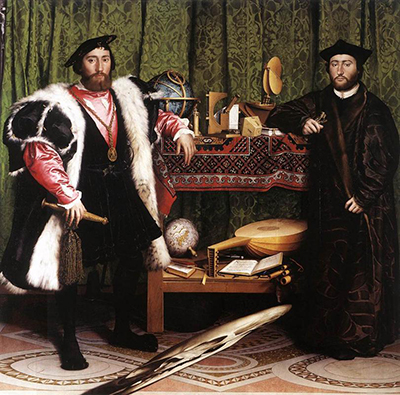
Words continued to gather around Holbein’s pictures after the original participants died. The National Gallery’s catalogue follows several early descriptions of The Ambassadors . An inventory of 1589 appears to identify the second sitter as a different member of the Dinteville family. Seventeenth-century documents instead name Georges de Selve. A copy dated 1654 of a memorandum by the historian Nicolas Camusat records exceptionally high praise for the painting’s richness and workmanship. [8]
These accounts tell us about people trying to understand what they had inherited. A name could become confused while admiration remained strong. Later testimony has its own setting, just as More’s recommendation and Hutton’s report have theirs.
Looking at the two figures, the books and the crowded shelves, we may want a single sentence from Holbein explaining the whole design. The surviving voices considered here offer something more various: friendship, persuasion, literary ambition, professional admiration and practical care. Keeping those voices audible as separate people enriches the encounter with the paintings.
Artworks directory
Explore paintings, drawings, prints and designs, including works without a separate article. Related studies and versions have their own entries; workshop works and copies are labelled. Print designs and series are grouped rather than repeated for every impression.
Frequently Asked Questions
The phrase belongs to Erasmus’s letter to Pieter Gillis of 29 August 1526. Erasmus was introducing Holbein as he travelled towards England. [6]
More wrote “mirus est artifex” to Erasmus on 18 December 1526. The words praise Holbein as a wonderful artist or craftsman; More then promises practical assistance. [1]
Amerbach composed it. The Kunstmuseum Basel records numerous surviving drafts and a change to the text after Holbein painted it on the panel. [3]
His will provides documented instructions in his name, including directions about debts and two children at nurse. It is a legal document, rather than a statement of artistic principles. [4]
Discussion
Look again at the images and ideas explored in Holbein in Words: Quotations, Letters and Painted Inscriptions. These editorial prompts invite your observations.
Reader Insights
More admired Holbein’s skill and worried about his earnings. How does reading those thoughts together change your understanding of patronage?
The Derich Born inscription imagines adding a voice. Which visible detail makes a painted face seem closest to speaking?
Amerbach drafted his own epigram repeatedly. What might a sitter want words to express that a face alone could not?
Join the Conversation
Which voice brings Holbein closest to you: Erasmus’s humour, More’s promise, Hutton’s admiration or the practical instructions of the will? Explain what the passage adds to your experience of a particular portrait.
References
- Thomas More , letter to Erasmus, Greenwich, 18 December 1526, letter 1770 in P. S. Allen’s Opus epistolarum Des. Erasmi Roterodami , printed p. 443, lines 71–74; scanned edition supplied by the Center for Thomas More Studies (in Latin). View source .
- Susan Foister / National Gallery , “Christina of Denmark, Duchess of Milan”, The German Paintings before 1800 , 2024, “The Commission”; includes Hutton’s letter to Cromwell, 14 March 1538. View source .
- Kunstmuseum Basel , Bildnis des Bonifacius Amerbach , 1519, inventory 314; catalogue description and inscription (in German, with Latin inscription). View source .
- Arthur B. Chamberlain , Hans Holbein the Younger , volume II, 1913, chapter XXVIII, pp. 294–296: transcription of Holbein’s will, 7 October 1543, and administrative entries, 29 November 1543. View source .
- Nicola Christie / Royal Collection Trust , “Derich Born”, inscription translation and conservation account, RCIN 405681. View source .
- Erasmus, translated in Arthur B. Chamberlain , Hans Holbein the Younger , volume I, 1913, chapter XI, p. 255: letter to Peter Aegidius, 29 August 1526. View source .
- Royal Collection Trust , Holbein at the Tudor Court , Chambers Gallery large-print labels, 2023, “Basel to London, 1526”, PDF pp. 27–28. View source .
- Susan Foister / National Gallery , “The Ambassadors”, The German Paintings before 1800 , 2024, “Inscriptions” and “Provenance”. View source .
- Splash image , Hans Holbein the Younger, The Ambassadors, 1533. National Gallery, London, NG1314. Image: National Gallery, London; Google Arts & Culture/Wikimedia Commons. Image source . Public domain .


