


 Buy Art Prints Now
from Amazon
* As an Amazon Associate, and partner with Google Adsense and Ezoic, I earn from qualifying purchases.
 by Tom Gurney
Tom Gurney BSc (Hons) is an art history expert with over 20 years experience
Page Created on June 19, 2020 / Page Updated on November 1, 2026
Email: tomgurney1@gmail.com / Phone: +44 7429 011000
Jan van Eyck’s life and art
A reflection in armour, a bead catching a window's light, a distant street painted on a panel small enough to carry: Jan van Eyck made the act of looking unusually demanding and rewarding. His pictures persuade us that different materials have their own weight, texture and response to light. They also ask us to read. Names, dates, mottos and biblical words appear on frames, clothing and architecture, bringing the painter's craft into contact with a patron's identity or a sacred event.[1][2]
Van Eyck worked in the Burgundian Netherlands in the early fifteenth century. His surviving paintings include the great Ghent Altarpiece, portraits of merchants and members of his own circle, and devotional images designed for very different scales of attention. Only a small body of work survives securely from his hand. Its influence has nevertheless been immense, and conservation continues to change what scholars and viewers can see. The most useful introduction follows that variety: the court painter and the urban professional, the maker of likenesses and religious visions, and the artist whose physical objects sometimes preserve as much evidence on their edges and backs as in their central images.[1][3]
At a Glance
Jan van Eyck’s artistic connections
Explore family collaboration, court employment and two named devotional commissions.
- Hubert van Eyck: The Ghent frame credits Hubert with beginning the altarpiece and Jan with completing it. Their division of work remains a subject of research. [4] [18]
- Philip the Good: Ducal service from 1425 brought income, rank and assignments that included travel to Portugal. [1] [3]
- Nicolas Rolin: The Burgundian chancellor kneels opposite Mary and Christ in a painting that joins prayer with an expansive landscape. [6]
- Joris van der Paele: The canon’s named commission, original frame and chaplaincies connect his painted likeness with continuing worship. [2]
Jan van Eyck in context
Service at The Hague
Documented in 1422 [1]Philip the Good’s court
From 1425 [3]Embassy to Portugal
1428–29 [3]Established in Bruges
By 1431; died there in 1441 [1]Hubert van Eyck
The Ghent frame names the brother who began the work [4]Philip the Good
Ducal employment and diplomatic service [3]Joos Vijd and Elisabeth Borluut
Commissioners of the Ghent Altarpiece [4]Nicolas Rolin
The Burgundian chancellor kneels opposite Mary and Christ [6]Joris van der Paele
His frame records the patron and his chaplaincies [2]The Madonna of Chancellor Rolin
About 1430–35 [6]Ghent Altarpiece
1432 [4]The Annunciation in Washington
About 1434–36 [12]The Lucca Madonna
About 1437 [7]Saint Barbara
1437 [15]A career between court and city
The first surviving records place Van Eyck in The Hague in 1422, working for John of Bavaria, ruler of Holland. From 1425 he served Philip the Good, Duke of Burgundy, with connections to both Lille and Bruges. In 1428–29 he travelled to Portugal and painted Isabella of Portugal, Philip's prospective bride. By 1431 he was established in Bruges, where he died in 1441. His birthplace is usually associated with Maaseik, but his birth date and artistic education remain uncertain. An exact childhood or a securely traced apprenticeship cannot be reconstructed from the surviving documents.[1][3]
Court employment gave him an income, rank and assignments beyond painting for display. Philip valued his services enough to increase his remuneration substantially. Yet the surviving pictures show that a ducal appointment did not confine his clientele to a palace. Clergy, foreign merchants and fellow professionals all appear in the record. Campbell's catalogue also documents assistants working with him, so the achievement belongs within an active workshop as well as an exceptional individual's career. The detailed biography follows those documents; the paintings themselves reveal how differently that professional standing could be put to use.[3]
The Madonna with Canon Joris van der Paele gives a particularly clear example. Musea Brugge identifies Saint Donatian as the patron of the church for which it was made, while Saint George attends the kneeling canon. Its original frame records the patron's name, his two chaplaincies and completion in 1436. The canon's prayer is therefore joined to a named institution and provision for continuing worship. Van Eyck's ability to make armour and brocade shine serves that encounter: material splendour gives the assembled sacred figures a presence beside the ageing donor.[2]
The range of patrons also cautions against explaining every painting through one social story. A court commission, a cleric's memorial and an image used for personal devotion could all require closely observed surfaces. The effect of that observation changes with the object. A viewer standing before a chapel altarpiece encounters a different relationship of size, gesture and public worship from someone holding a small portrait. Van Eyck's versatility lies partly in adapting his powers of description to these different circumstances, rather than repeating the same kind of realism at different dimensions.[2][3][8]
Four stages of Jan van Eyck’s career
Ghent: a painting that changes when opened
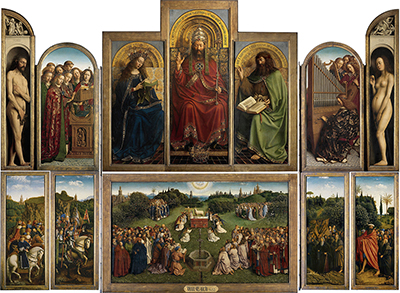
The Ghent Altarpiece was made for the chapel of Joos Vijd and Elisabeth Borluut in the church now called Saint Bavo's Cathedral. Its frame inscription names Hubert van Eyck as the artist who began the work and Jan as the brother who completed it; the work was presented in 1432. Its doors make it an object with two principal appearances. Closed, it presents the Annunciation, the kneeling donors and figures that imitate sculpture. Open, it reveals a far more extensive gathering centred on the Lamb and a heavenly upper register.[4][5]
Opening changes more than the number of figures visible. The exterior's restrained colours and fictive stone give way to brilliant garments, a broad green landscape, music-making angels and the naked figures of Adam and Eve. Frames divide the panels, yet the picture repeatedly suggests continuity across those divisions. The Met notes how painted light and shadow on the exterior respond to the original chapel setting. Van Eyck's realism can thus involve the actual place of worship as well as the things represented within the image. The work asks the viewer to negotiate a boundary between painted architecture and the church around it.[5]
In the lower central panel, blood flows from the standing Lamb into a chalice. The scene refers to Christ's sacrifice and the Eucharist, not to an ordinary gathering around an animal. Different communities approach through the landscape, while a fountain sends water toward the foreground. The upper figures, singing angels and outer humans place that act of adoration within a larger account of redemption. No single biblical passage explains every part of the programme. Its richness comes from relationships among scripture, liturgy, observation and the repeated physical experience of the opened and closed object.[5]
Devotion at close quarters
A smaller devotional panel can create an equally absorbing space. In the Louvre's Virgin of Chancellor Rolin, Nicolas Rolin kneels opposite Mary and the Christ Child. Columns and arches open onto a garden, a river city, cultivated land and distant mountains. The Louvre identifies Rolin's office under Philip the Good, but has not identified the background as a particular real city. The tiny buildings and inhabitants are extraordinarily specific without turning the scene into a dependable topographical record. Close observation and invention work together.[6]
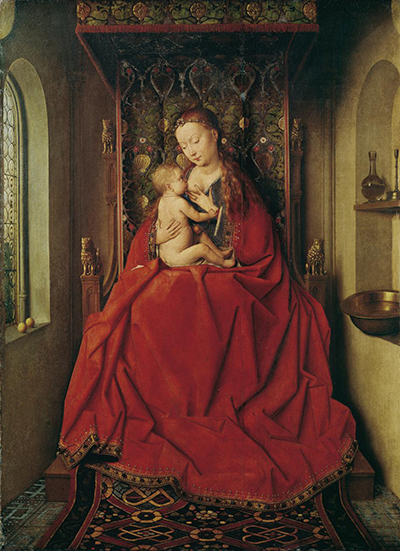
The Lucca Madonna in Frankfurt offers another solution. The Städel describes how its floor, walls and vaulted ceiling appear to continue into the viewer's space. A window is reflected in a glass vessel; light and shade help make the mother and child seem immediately near. The setting gives an intimate relationship a convincing physical enclosure. Comparing it with the Rolin panel is useful because the two pictures organise sacred access differently: one opens outward across a landscape, while the other draws the viewer into a narrow interior. Similar attentiveness to materials produces different kinds of encounter.[7]
Antwerp's Madonna at the Fountain measures only nineteen by twelve centimetres. Mary holds the child before a cloth supported by angels, with flowers behind and a metal fountain in front. KMSKA connects the fountain to Marian imagery and considers private devotion a likely use for the little object. Its frame, painted to resemble marble, retains the date 1439, a signature and Van Eyck's motto. Those edges participate in the image's meaning: even on a small work, simulated stone, personal words and delicate painted surfaces remain part of the viewer's experience.[8]
Such pictures cannot all be explained by assigning a symbol to every object. A fountain may have an established devotional association, while a distant city may remain invented or unidentified. It helps to begin with a painting's scale, materials and arrangement, then follow the evidence for its function. A patron's prayer, a biblical event and the pleasure of looking closely can occupy the same panel. None requires us to invent an original owner, a specific room or a literal location where the sources leave those things unknown.[6][7][8]
Watch: Jan van Eyck in context
Choose a Smarthistory close reading of the Arnolfini Portrait or the closed and opened Ghent Altarpiece.
Jan van Eyck, The Arnolfini Portrait
Look closely at the room, mirror and gestures in the London double portrait.
Watch on YouTubePortraits, names and the artist's own voice
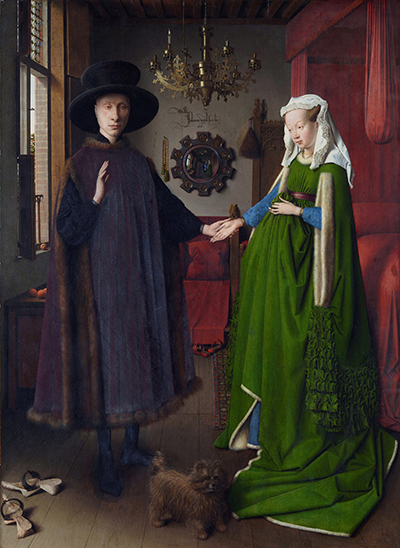
The Arnolfini Portrait shows a man and woman in a furnished interior, with a convex mirror giving another view behind them. The National Gallery identifies the couple only provisionally and rejects the once familiar claim that the scene securely records a wedding ceremony. Her gathered gown does not establish pregnancy. Costly clothing, oranges, furnishings and the signature above the mirror help shape the couple's presentation, but do not supply a complete biography. Even the believable room contains spatial inconsistencies. The painting's persuasive realism is an artistic construction, not a substitute for documentary evidence.[9]
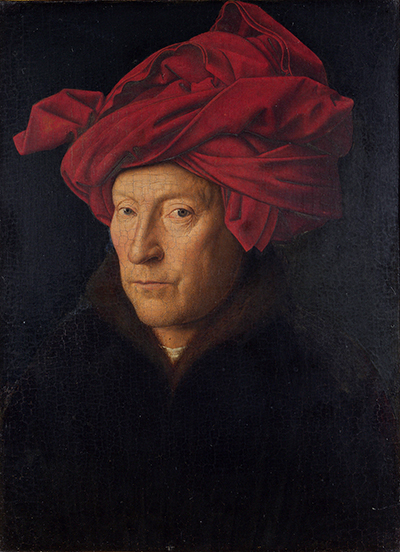
A portrait can feel personal even when the sitter's identity remains open. The National Gallery's Portrait of a Man in a Red Chaperon is widely considered a self-portrait, although no independently certain likeness settles the question. Its original frame bears Van Eyck's motto and the date 21 October 1433. The strong light on the face, dark background and complicated folds of the red headwear focus attention on an intense gaze. The wording on the frame draws attention to the maker's abilities, allowing a declaration of craft to stand beside the possible image of its author.[10]
With Margareta van Eyck, the surviving words provide firmer identification. Musea Brugge transcribes an inscription that speaks in the sitter's voice: her husband completed the portrait in June 1439, when she was thirty-three. The frame and reverse imitate marble. Both the speaking inscription and the treatment of the back matter, because the picture is more than a face isolated from its support. The museum's display allows the reverse to be seen. Its presentation reminds modern visitors to ask what earlier viewers might have encountered when an object was turned or handled.[11]
These examples show different relationships between likeness and knowledge. An uncertain name need not make a portrait uninformative: clothes, pose, light and the manner of address still deserve examination. Conversely, a firmly named sitter does not make every question about a commission answerable. Van Eyck's frames can preserve a date, a voice or a claim about making, while leaving other circumstances unrecorded. The portraits and paintings guide keeps those degrees of certainty visible across the surviving works.[9][10][11]
Painting with words and oil
Written language is often part of the encounter rather than a caption added outside it. In the Washington Annunciation, gold letters carry Gabriel's greeting through the church interior. Mary's response is reversed and upside down, addressed toward heaven rather than arranged for our ordinary reading. The architecture, light and dialogue make a theological event visible through spatial relationships. The NGA also records the work as oil on canvas transferred from panel, a reminder that the support now beneath an image may differ from the one its painter used.[12]
Looking at the words alongside the frame inscriptions in the portraits makes Van Eyck's range apparent. A painter can let a person appear to speak, record the completion of an object, or turn a biblical response toward its divine recipient. Text has a location and direction in these pictures. Removing a frame or cropping a reproduction may therefore remove evidence rather than simply improve the view. The quotes and inscriptions guide follows the traceable wording and the objects that preserve it.[8][10][11][12]
Van Eyck did not invent oil painting. As the Met's technical overview explains, the medium was used in northern Europe centuries before his career. His achievement lay in its handling: translucent layers could intensify colour, slower drying allowed soft transitions, and sharply placed touches could imitate a gleam on hard metal or light caught by glass. Oil also allowed thick accents and fine descriptive strokes. The apparent richness of a garment and the softness of a face could therefore arise from different applications of the same medium. Its flexibility helped make close observation persuasive across a remarkable variety of subjects.[13]
Technical examination also reveals decisions that the finished surface conceals. Campbell's catalogue of the Arnolfini painting describes revisions to heads and gestures, and details added without appearing in the initial underdrawing. The candle, dog and other objects were not all fixed at the start. Such discoveries challenge the assumption that microscopic finish required an entirely predetermined design. Van Eyck could adjust an image as it developed, controlling its effect through revision as well as through exact execution. The mirror, furniture and people feel coordinated because of choices made during painting, not because the painter passively copied a complete scene before him.[14]
Antwerp's Saint Barbara tests another assumption about finish. Its dated original frame survives, but much of the figure and building site remains almost monochrome. KMSKA sets out the disagreement: was it abandoned before its expected layers of colour, or conceived as a finished monochrome work? Even the frame's painted marbling is incomplete in one area. The uncertainty makes the small panel valuable for considering drawing, preparation and the different appearances a work could have during making. Its delicacy cannot be measured simply against the saturated colour of a completed Madonna.[15]
Surfaces, reverses and conservation
A picture's present appearance carries the history of what happened after the painter stopped. The French conservation centre C2RMF documents this particularly well for the Rolin panel. Its recent treatment addressed discoloured varnish, later paint and weaknesses in the support, while cleaning revealed the quality of the reverse's imitation stone. Conservators treated both faces, and the decision to display the reverse changed the intervention's course. The object emerged as something to examine around its edges, rather than only as an image looking out from a wall. This has consequences for questions about how it was originally used.[16]
The Louvre's 2024 exhibition placed that conservation work within a wider reassessment of the painting. Its published account connects laboratory study, restoration and questions of function, rather than treating cleaning as a purely cosmetic improvement. New clarity can reveal space, colour and small details; a better-understood back can raise a different question about handling and display. Conservation can both resolve a problem and make a familiar object less simple. This is why a current colour photograph, an older reproduction and an image taken during treatment should not be treated as interchangeable evidence.[17]
At Ghent, KIK-IRPA's study of the lower register identifies an elaborate early painted composition attributed to Hubert. Jan reworked substantial parts, including the landscape and the replacement of a natural spring with the monumental fountain. The institute also proposes a third phase of additions before the extensive sixteenth-century overpainting. This account is more complex than dividing design and execution neatly between the brothers. It shows that a large painting could develop through several interventions, and that the surviving image preserves more than one moment of invention. It does not authorise assigning every unstudied passage elsewhere to a particular hand.[18]
The current upper-register project continues that investigation. KIK-IRPA describes different panel histories and materials, including relief brocades made with tin foil, gilding and paint. The angel panels travelled to Berlin and were sawn through their thickness in the nineteenth century; Adam and Eve followed a different path. The project schedule extends from 2023 into spring 2027. Such differences matter because an altarpiece assembled into one visual whole is still made of distinct supports and surfaces. Understanding their condition requires panel-specific evidence as well as a theory of the overall composition.[19]
Essential Jan van Eyck works
Ghent Altarpiece
1432 · A hinged ensemble whose opened and closed states change the encounter. [4]
The Arnolfini Portrait
1434 · A double portrait whose room, mirror and gestures invite close looking. [9]
 Jan van Eyck.jpg)
The Annunciation in Washington
About 1434–36 · Gabriel and Mary exchange words and gestures within a densely furnished church. [12]
 Jan van Eyck.jpg)
The Madonna of Chancellor Rolin
About 1430–35 · The chancellor faces Mary and Christ before a garden and distant river city. [6]
The Lucca Madonna
About 1437 · An intimate devotional image connects the nursing mother and child with a furnished room. [7]
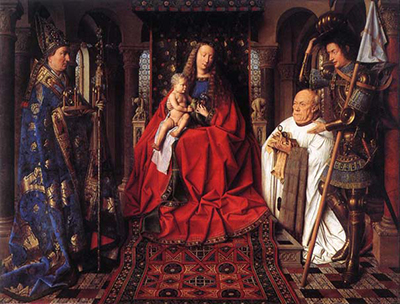
Madonna with Canon Joris van der Paele
1436 · A named canon joins the Virgin and Child, Saint George and Saint Donatian. [2]
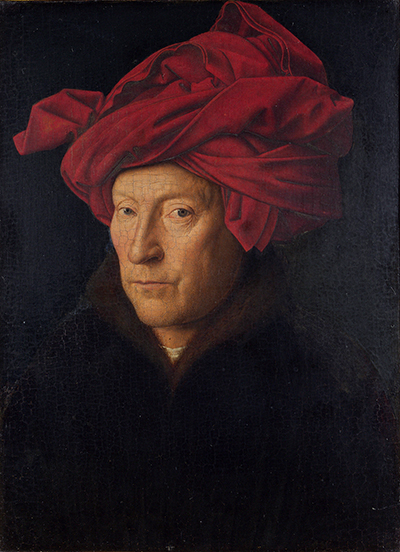
Portrait of a Man (Self Portrait?)
1433 · A direct gaze, red chaperon and inscribed frame leave the sitter’s identity open. [10]
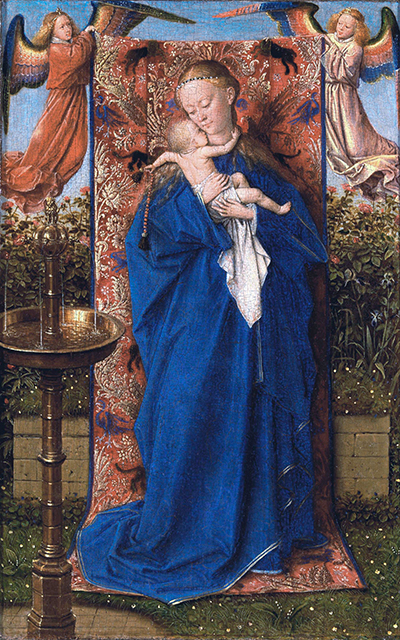
Madonna at the Fountain
1439 · An intimate embrace and reflected light fill a panel smaller than many book pages. [8]
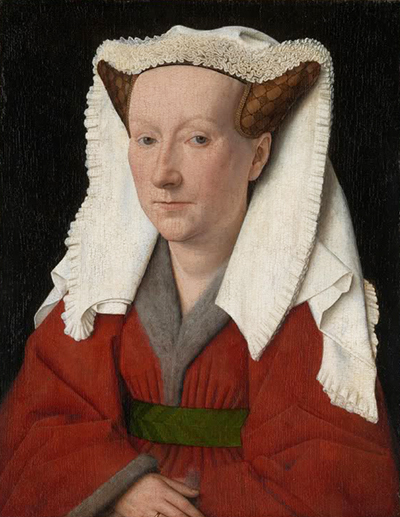
Portrait of Margaret van Eyck
1439 · The original frame speaks in the sitter’s voice and records her age. [11]
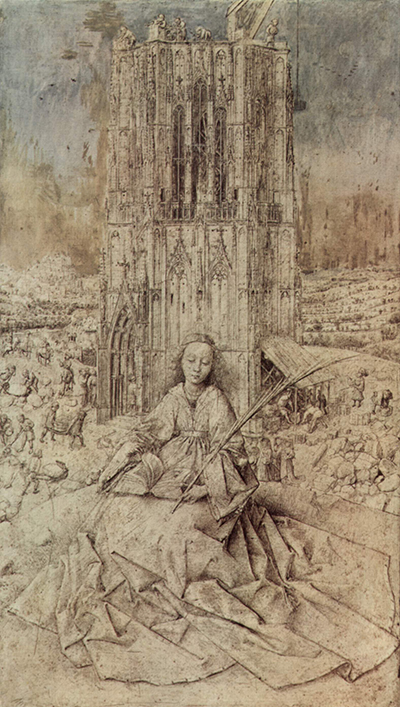
Saint Barbara
1437 · A reading saint and a tower under construction make the question of finish unusually vivid. [15]
A small surviving body of work, a wide afterlife
Not every Eyckian image is a surviving painting by Jan. Museum Boijmans Van Beuningen in Rotterdam catalogues its Crucifixion drawing with qualified attribution to Van Eyck and/or his workshop, using a broad date around 1440–50. Recognised during preparations for the 2012 exhibition, it prompted technical investigation and a dedicated scholarly publication. The museum lists metalpoint and ink on prepared paper. Its significance lies partly in the questions it raises about models, drawings and workshop transmission. Calling it simply an undisputed new Van Eyck would erase the qualification that makes the object worth studying.[20]
The same care is needed with later copies and records of lost works. A surviving witness may preserve a composition or reveal what later artists valued, while offering no access to the original painter's brushwork. A workshop label, a follower attribution and a secure autograph work answer different historical questions. Because the surviving corpus is small, that distinction becomes more useful, not less: it allows related material to enlarge our understanding without making the number of originals appear greater than the evidence supports. The drawings and prints guides follow those relationships across different media.[3][20]
His reputation already reached beyond the Low Countries during the fifteenth century. Campbell records the Italian humanist Fazio's high praise in 1456, and the Met traces the spread of northern oil methods through imported pictures, travel and exchanges among artists and patrons. The history has several routes rather than a single moment when one painter exported a secret. Van Eyck's importance rests on the compelling things his pictures made possible: intimate sacred spaces, forceful likenesses, complex landscapes and material effects that invited artists elsewhere to reconsider how paint could describe the world.[3][13]
Today the best starting points retain that variety. Ghent offers a monumental changing ensemble; Bruges preserves the Van der Paele Madonna and Margareta's portrait; Antwerp holds Saint Barbara and the little Madonna at the Fountain. London, Paris, Frankfurt and Washington provide different encounters with his portraits and devotional scenes. Their research records also make comparisons possible across distances. Begin with a picture's complete object and scale, then look for what its light, words, materials and history add to the experience. Van Eyck's detail repays attention because it belongs to those larger relationships.[2][6][7][8][11][12][15]
Explore museum research
Continue with institutional catalogues, conservation research and exhibition resources.
Jan van Eyck. Lorne Campbell, National Gallery collection catalogue.
A foundation for the documented career, workshop and surviving paintings. Read the catalogue.
Revoir Van Eyck. Musée du Louvre, 2024 exhibition.
Explore the reassessment of the Rolin Madonna following research and conservation. Explore the exhibition.
Researching the Ghent Altarpiece. KIK-IRPA, research on Hubert and Jan’s contributions.
Follow the evidence behind changing accounts of how the lower register was made. Read the research.
Jan van Eyck artwork directory
These 55 records link to the cluster’s artwork articles. They include individual Ghent panels, lost designs, later copies and disputed attributions; they are not a count of independent autograph paintings.
| Name | Date | Object and attribution |
|---|---|---|
| The Arnolfini Portrait | 1434, signed and dated | Painting Catalogue. |
| The Annunciation in Washington | About 1434–36 | Painting Catalogue. |
| The Madrid Annunciation Diptych | About 1433–35 | Painting Catalogue. |
| The Crucifixion and the Last Judgment | About 1436–38 in the current Met catalogue | Painting Catalogue. |
| The Crucifixion Drawing Associated with Jan van Eyck | About 1440–50 | Drawing · Van Eyck and/or his studio; authorship disputed Catalogue. |
| The Madonna of Chancellor Rolin | About 1430–35 | Painting Catalogue. |
| The Lucca Madonna | About 1437 | Painting Catalogue. |
| Madonna with Canon Joris van der Paele | 1436 | Painting Catalogue. |
| Madonna at the Fountain | 1439, signed and dated | Painting Catalogue. |
| Madonna in the Church | About 1437–40 | Painting Catalogue. |
| The lost Madonna of Nicolas van Maelbeke | Original lost | Painting · Lost painting formerly in Ypres Catalogue. |
| The Ince Hall Madonna | Middle or later fifteenth century in the NGV catalogue | Painting · Flanders; interpreted as a later follower of Jan van Eyck Catalogue. |
| Saint Barbara | 1437, recorded on the original frame | Painting Catalogue. |
| Saint Francis Receiving the Stigmata in Turin | See article | Painting · Presented as Jan van Eyck by the owning museum Catalogue. |
| Saint Francis Receiving the Stigmata | 1430–32 in the museum’s scholarly catalogue | Painting Catalogue. |
| Virgin and Child with Saints and Donor | About 1441–43 | Painting · Jan van Eyck and workshop Catalogue. |
| Virgin and Child with Saints Michael and Catherine | 1437 | Painting Catalogue. |
| Woman Bathing | Original lost; later witnesses | Painting · Lost composition associated with Jan van Eyck Catalogue. |
| The Three Marys at the Tomb | 1425–35 in the owning museum’s catalogue | Painting · Attributed to Jan van Eyck Catalogue. |
| Saint Jerome in His Study in Detroit | About 1435; date and authorship remain disputed | Painting Catalogue. |
| Vera Icon | About 1601–25 in Musea Brugge’s catalogue | Painting Catalogue. |
| Saint Christopher | About 1460–70 | Painting · Follower of Jan van Eyck Catalogue. |
| The Birth of Saint John the Baptist in the Turin–Milan Hours | See article | Manuscript illumination · Hand G; identification with Jan van Eyck is disputed Catalogue. |
| Jan van Eyck’s Dresden portrait study, traditionally called Cardinal Albergati | About 1435–40 in the Morgan–Dresden exhibition | Drawing Catalogue. |
| Portrait of a Man in a Red Chaperon | 21 October 1433 | Painting Catalogue. |
| Léal Souvenir | 1432 | Painting Catalogue. |
| Portrait of an Older Man, traditionally called Cardinal Albergati | Mid-to-late 1430s; published datings differ | Painting Catalogue. |
| The Berlin Portrait of a Man with a Red Chaperon, traditionally called Giovanni Arnolfini | Around 1435–38 | Painting Catalogue. |
| Portrait of Margaret van Eyck | 1439 | Painting Catalogue. |
| Portrait of the Goldsmith Jan de Leeuw | 1436 | Painting Catalogue. |
| Portrait of Baudouin de Lannoy | 1430–40 in the catalogue; conservation study favours about 1438–40 | Painting Catalogue. |
| The lost portrait of Isabella of Portugal | Painted in Portugal in 1429 | Painting · Lost; later visual witnesses survive Catalogue. |
| Portrait of a Man with a Blue Chaperon | Around 1430 in the owning museum’s catalogue | Painting Catalogue. |
| The Man with the Pinks | About 1520 | Painting · Unknown artist copying Jan van Eyck Catalogue. |
| The Crucifixion panel | About 1436–38 | Painting Catalogue. |
| The Last Judgment panel | About 1436–38 | Painting Catalogue. |
| Adam on the Ghent Altarpiece | 1432 ensemble | Painting · Ghent component Catalogue. |
| Eve on the Ghent Altarpiece | 1432 ensemble | Painting · Ghent component Catalogue. |
| The central Deity of the Ghent Altarpiece | 1432 ensemble | Painting · Ghent component Catalogue. |
| Adoration of the Mystic Lamb — Jan and Hubert van Eyck | 1432 ensemble | Painting · Ghent component Catalogue. |
| The Virgin Mary in the Ghent Altarpiece | 1432 ensemble | Painting · Ghent component Catalogue. |
| The Singing Angels of the Ghent Altarpiece | 1432 ensemble | Painting · Ghent component Catalogue. |
| The Music-making Angels of the Ghent Altarpiece | 1432 ensemble | Painting · Ghent component Catalogue. |
| The Soldiers of Christ in the Ghent Altarpiece | 1432 ensemble | Painting · Ghent component Catalogue. |
| The Just Judges | 1432 original; later replacement | Painting · Ghent component; later replacement Catalogue. |
| Joos Vijd and John the Baptist | 1432 ensemble | Painting · Ghent component Catalogue. |
| Elisabeth Borluut | 1432 ensemble | Painting · Ghent component Catalogue. |
| The Offerings of Cain and Abel in the Ghent Altarpiece | 1432 ensemble | Painting · Ghent component Catalogue. |
| Interior View | 1432 ensemble | Painting · Ghent component Catalogue. |
| Gabriel | 1432 ensemble | Painting · Ghent component Catalogue. |
| Virgin Annunciate | 1432 ensemble | Painting · Ghent component Catalogue. |
| The Cumaean Sibyl | 1432 ensemble | Painting · Ghent component Catalogue. |
| The Erythraean Sibyl | 1432 ensemble | Painting · Ghent component Catalogue. |
| Prophet Zechariah and the Angel Gabriel | 1432 ensemble | Painting · Ghent component Catalogue. |
| Ghent Altarpiece | 1432; presentation associated with 6 May | Painting Catalogue. |
Related reading
Discussion
What do you notice in Jan van Eyck? Share a close observation or a source that adds useful context.
Join the Conversation
Keep observations specific and evidence clear.
References
- National Gallery, London, “Jan van Eyck”: documented career, origins and range of patrons. View Source
- Musea Brugge, “Madonna with Canon Joris van der Paele,” 0000.GRO0161.I: original frame, patronage, church and material effects. View Source
- Lorne Campbell, “Jan van Eyck,” National Gallery catalogue, 1998, online version 2025: career, workshop, surviving corpus and early reputation. View Source
- Saint Bavo's Cathedral, “The Ghent Altarpiece”: commission, presentation and original chapel. View Source
- Susan Jones, “The Ghent Altarpiece,” Metropolitan Museum of Art, 2002: arrangement, chapel light, liturgy and programme; attribution discussion supplemented here by later KIK-IRPA research. View Source
- Musée du Louvre, “La Vierge du chancelier Rolin,” INV 1271: subject, architecture, imagined city, materials and reverse. View Source
- Städel Museum, “Lucca Madonna”: scale, spatial construction and reflected window. View Source
- KMSKA, “Madonna at the Fountain,” 411: scale, imagery, frame, inscription and likely use. View Source
- National Gallery, London, “The Arnolfini Portrait,” NG186: probable sitters, room, dress and disputed wedding interpretation. View Source
- National Gallery, London, “Portrait of a Man (Self Portrait?),” NG222: qualified identity, chaperon, original frame and date. View Source
- Musea Brugge, “Portrait of Margareta van Eyck,” 0000.GRO0162.I: speaking inscription, date, age, marbled frame and reverse. View Source
- National Gallery of Art, Washington, “The Annunciation,” 1937.1.39: dialogue, its orientation and transferred support. View Source
- Susan Jones, “Painting in Oil in the Low Countries and Its Spread to Southern Europe,” Metropolitan Museum of Art, 2002: the medium's earlier history, properties and international transmission. View Source
- Lorne Campbell, “The Arnolfini Portrait,” National Gallery catalogue, 1998, updated 2021, online version 2025: working revisions and underdrawing. View Source
- KMSKA, “Saint Barbara,” 410: signed frame, condition and disputed degree of completion. View Source
- C2RMF, “La Vierge du chancelier Rolin — Restauration,” 20 March 2024: treatment of the panel, paint and imitation-stone reverse. View Source
- Musée du Louvre, “Revoir Van Eyck,” 2024 exhibition: the research and restoration reassessment. View Source
- KIK-IRPA, “The mystery of Hubert van Eyck and the Ghent Altarpiece solved”: lower-register phases and division of work. View Source
- KIK-IRPA, “Restoration and research of the upper register”: materials, differing panel histories, research and current schedule. View Source
- Museum Boijmans Van Beuningen, “Kruisiging van Christus,” MB 2014/T 1 (PK): qualified attribution, date, media and research history. View Source