by Tom Gurney
Tom Gurney BSc (Hons) is an art history expert with over 20 years experience
Published on June 19, 2020 / Updated on October 14, 2023
Email: tomgurney1@gmail.com / Phone: +44 7429 011000
Introduction
Masaccio’s career lasted barely more than a decade, yet his effect on European painting was immense. Born Tommaso di Ser Giovanni di Mone Cassai in 1401, he died in Rome in 1428 or possibly early 1429, leaving behind a body of work so small that almost every surviving painting has become a major document in the history of the Early Renaissance. His importance lies not in the number of pictures he produced but in the decisiveness with which he changed how painted figures occupy space.
Masaccio gave bodies unprecedented weight, organised architecture through a convincing perspectival system, used light to model form coherently and treated biblical narratives as events inhabited by recognisably human beings rather than as decorative arrangements floating against gold. The change can be seen with extraordinary clarity when his paintings are compared with those of the generation immediately before him. Late-Gothic elegance, brilliant surface and linear grace still dominated much Florentine painting when Masaccio began, but within a few years he had made figures appear solid enough to stand, move, suffer and breathe inside unified space.
That achievement does not mean that Masaccio “invented the Renaissance” on his own. Brunelleschi, Donatello, Ghiberti, Masolino, Fra Angelico and others were transforming architecture, sculpture and painting at the same time, and Masaccio’s revolution developed inside that highly interconnected Florentine environment rather than outside it. What distinguishes him is the extraordinary compression of innovation into a very short life.
The San Giovenale Triptych of 1422 already shows him thinking seriously about centrally organised space; the Brancacci Chapel turns that interest into monumental fresco narrative; the Pisa Polyptych proves that he could translate bodily mass and foreshortening into complex panel painting; and the Holy Trinity at Santa Maria Novella makes perspective itself part of a theological and architectural illusion. Masaccio therefore stands at one of the great turning points in Western art. His paintings made the new Renaissance concern with measured space, physical presence and human emotion visible with a directness that later artists could study, imitate and extend for generations.
At a Glance
- Birth nameTommaso di Ser Giovanni di Mone Cassai
- Known asMasaccio
- Born21 December 1401
- BirthplaceCastel San Giovanni, now San Giovanni Valdarno
- DiedRome, 1428 or possibly early 1429
- Age at deathabout 26–27
- Earliest known workSan Giovenale Triptych, dated 23 April 1422
- Major collaborative partnerMasolino da Panicale
- Principal fresco projectBrancacci Chapel, Santa Maria del Carmine, Florence
- Major panel commissionPisa Polyptych, 1426
- Major independent frescoHoly Trinity, Santa Maria Novella, Florence
- Key innovationsmonumental bodies, coherent light, single-point perspective, emotionally direct narrative
- Major artistic relationshipsGiotto, Brunelleschi, Donatello, Masolino, Fra Angelico
- Later influenceFilippo Lippi, Filippino Lippi, Leonardo, Michelangelo and generations of Florentine painters
Contents
- Early Life in the Valdarno
- Joining the Florentine Painters’ Guild
- The San Giovenale Triptych
- Masolino da Panicale
- Masaccio and Donatello
- A Chapel of Three Generations
- The Apostles
- Distribution of Alms and Death of Ananias
- The Lost Upper Register
- Virgin and Child
- The Holy Trinity
- Vasari and Rediscovery
- Style: Light
- Masaccio and Giotto
- Leonardo and Michelangelo
- A Career of Only a Few Years
- Why Masaccio Matters
- Frequently Asked Questions
- References and Research Sources
Early Life in the Valdarno
Masaccio was born in 1401 in Castel San Giovanni, the Tuscan town now known as San Giovanni Valdarno. His father, Ser Giovanni di Mone Cassai, was a notary, while the family name Cassai is connected with craftsmen who made wooden chests and related furnishings. The painter’s familiar nickname, Masaccio, is derived from Maso, the common short form of Tommaso.
Later writers interpreted the enlarged form as something like “clumsy Tom”, “hulking Tom” or “slovenly Tom”, but those character descriptions belong largely to later biographical tradition and should not be treated as secure evidence about his personality. Masaccio’s father died while he was still young, and the surviving documentary record of his childhood is thin. There is no securely documented apprenticeship that explains precisely how he learned painting, which makes the maturity of the San Giovenale Triptych at only twenty particularly remarkable.
Florence and the Artistic World of the 1420s. By the early 1420s, Florence had become one of the most experimental artistic centres in Europe. Brunelleschi was developing a new architecture based on measured proportions and revived classical forms, Donatello was giving sculpture unprecedented bodily immediacy, and Ghiberti was combining elegance with increasingly convincing spatial and narrative systems. Painting could not remain untouched by these developments.
Artists faced a new problem: if architecture and sculpture were becoming more physical, rational and humanly present, painted figures also needed to inhabit space in a more convincing way. Masaccio responded with extraordinary speed. Rather than treating innovation as a decorative layer added to older forms, he reorganised the fundamental relationship between body, light and setting.
Joining the Florentine Painters’ Guild
Masaccio was admitted to the Arte dei Medici e Speziali, the Florentine guild that included painters, in January 1422. This documentary milestone confirms that he was already operating professionally in Florence at the beginning of the decade. Guild membership mattered because painters worked inside regulated professional systems rather than as isolated geniuses. Contracts, materials, assistants, payments and workshop relationships all shaped production, and Masaccio’s surviving commissions make more sense when seen within this institutional world.
The San Giovenale Triptych
The earliest known work securely associated with Masaccio is the San Giovenale Triptych, dated exactly 23 April 1422. Its unusually precise date makes it one of the most important chronological anchors in the study of his short career. The triptych retains several inherited conventions, including gold and a multi-panel devotional structure, but its central throne and figures already show a new concern with coherent space. Mary and Christ possess a sculptural solidity that separates them decisively from the more weightless elegance of much contemporary late-Gothic painting. The work is also remarkable for the perspective of the throne.
Rather than treating architectural furniture as symbolic decoration, Masaccio organises it around a central spatial logic that draws the eye into the painting. The grapes held by the Christ Child create an additional Eucharistic meaning. Their presence connects the naturalistic body of the child with the sacramental body of Christ, demonstrating how Masaccio’s new physical realism could intensify rather than diminish theological content.
Rediscovery and Attribution. The San Giovenale Triptych remained in its local setting for centuries and was not fully recognised as a foundational Masaccio until the twentieth century. Luciano Berti’s 1961 attribution transformed the painting into a key starting point for the artist’s catalogue. One unusual detail strengthens the connection. Writing in Saint Juvenal’s book has been compared with Masaccio’s only surviving autograph, offering a rare material bridge between painting and documentary hand.
The Lost Sagra Fresco. Soon after the San Giovenale Triptych, Masaccio painted a now-lost fresco representing the consecration of Santa Maria del Carmine in Florence. The work, traditionally called the Sagra, was painted in green earth and commemorated the 1422 consecration of the Carmelite church. The fresco was later destroyed, but early descriptions and drawings preserve some sense of its importance.
Vasari claimed that Masaccio included portrait-like figures of contemporary Florentines such as Brunelleschi, Donatello and Masolino, though these identifications belong to a later account and should be treated cautiously. Even in loss, the Sagra matters because it appears to have shown Masaccio experimenting with groups of contemporary figures in coherent space. It suggests that his interest in physical presence and observational realism was already extending beyond conventional sacred iconography.
Masolino da Panicale
Masaccio’s relationship with Masolino was one of the defining collaborations of his career. Masolino was older and more closely connected with the elegant late-Gothic tradition, while Masaccio developed the heavier, more volumetric language that came to define the Early Renaissance. It is tempting to turn them into opposites, but surviving evidence suggests a more productive relationship.
They collaborated repeatedly, learned within the same professional environment and produced works in which contrasting styles coexist inside one object. Their partnership demonstrates that artistic change is rarely a clean generational replacement. New painting emerged through collaboration between artists with different strengths and visual habits.
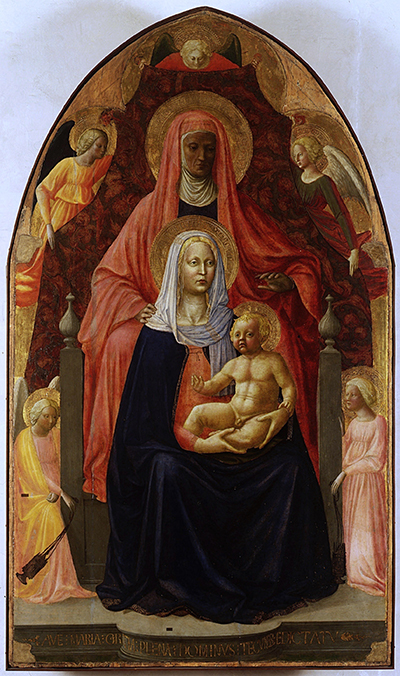
Sant’Anna Metterza. The Sant’Anna Metterza, now in the Uffizi, is one of the clearest surviving documents of Masaccio and Masolino working together. The painting was made around 1424–25 for Sant’Ambrogio in Florence and was commissioned by Nofri Del Brutto Buonamici. Modern attribution generally associates Saint Anne primarily with Masolino while giving the Virgin and Child to Masaccio.
The contrast is immediately instructive because Masaccio’s figures possess unusual bodily mass, and the child seems fleshy and physically present rather than merely symbolic. This difference does not reduce the work to a competition between the two painters. The panel succeeds because two visual languages inhabit one sacred hierarchy, creating a transitional object that makes artistic change visible within the same composition.
The Virgin and Child in Sant’Anna Metterza. Masaccio’s Virgin is monumental. Her body occupies real volume, the knees project beneath the fabric, and the Christ Child sits with a convincing physical relation to her lap. The effect is closely connected with contemporary sculptural thinking. Masaccio appears to treat painted figures almost as if they could be modelled in clay or carved in stone, which helps explain why Donatello became such an important point of comparison.
Masaccio and Donatello
Donatello’s sculpture provided one of the strongest contemporary models for bodily presence in Florence. His saints, prophets and reliefs show figures with weight, psychological force and convincing relation to architectural settings, qualities that Masaccio translated into painting with remarkable sensitivity. The influence may not have been entirely one-way. Scholars have long discussed the closeness of their artistic worlds, and both men were experimenting with how human figures could become physically and emotionally credible without losing monumental dignity. The Pisa Polyptych later provides particularly useful evidence. Technical studies have connected Masaccio’s foreshortened saints with sculptural solutions developed by Donatello for figures intended to be viewed from below.
Masaccio and Brunelleschi. Brunelleschi’s role in the development of mathematical perspective forms another essential part of Masaccio’s story. The architect’s experiments demonstrated how a single viewpoint could organise receding space geometrically, giving painters a new means of constructing believable architectural worlds. Masaccio became one of the most revolutionary users of that system in painting. The relationship is clearest in the Holy Trinity, where the illusionistic chapel is so geometrically persuasive that generations of scholars have proposed Brunelleschi’s direct assistance. No document proves that collaboration, so the claim should remain hypothetical. What is secure is that Masaccio understood and applied the perspectival culture Brunelleschi helped create.
The Brancacci Chapel. The Brancacci Chapel in Santa Maria del Carmine became the defining fresco project of Masaccio’s career. Felice Brancacci commissioned the decoration after returning from Egypt in 1423, and Masolino appears to have begun portions of the upper programme by 1424 before Masaccio became deeply involved. The chapel was dedicated to Saint Peter, whose life provided the principal narrative framework.
This was especially appropriate to the Carmelite environment, where Peter could embody the active charity and apostolic authority of the early Church. The cycle was never completed during Masaccio’s lifetime. Both he and Masolino had left the project by the later 1420s, and Filippino Lippi finished remaining sections decades later in the 1480s.
A Chapel of Three Generations
This long interruption makes the Brancacci Chapel unique. Masolino, Masaccio and Filippino Lippi worked across different moments and styles, yet the resulting ensemble became one of the most influential training grounds in Florentine art. Later artists studied there intensely. Florence’s institutional history of the chapel names Leonardo da Vinci and Michelangelo among the generations who treated the frescoes as models. The chapel therefore became not simply one Renaissance masterpiece but a school of looking. Masaccio’s bodies, perspective, gesture and emotional economy remained active long after his death because painters could encounter them directly on the wall.
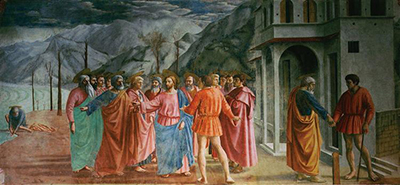
The Tribute Money. The Tribute Money is one of Masaccio’s most celebrated frescoes and one of the clearest demonstrations of his mature narrative method. Several moments from the Gospel story appear within one unified landscape and architectural setting, but the scene remains coherent because gesture, gaze and light guide the viewer through time. Christ stands at the centre surrounded by apostles.
The tax collector demands payment, Peter is sent to find the coin in the fish, and the payment appears at the right, all within the same pictorial world. The remarkable achievement lies in the figures. They are not decorative actors arranged in a pattern; they form a psychologically connected group whose bodies occupy a shared atmosphere.
Unified Light. Masaccio uses a consistent light source across the group, modelling faces and drapery with directional shadow. This was a major development because it makes the figures feel governed by the same natural conditions. The light does not simply make the painting more realistic. It creates social unity, binding separate bodies into one event.
The Apostles
The apostles possess individual physiognomies and varied responses, but Masaccio avoids portrait-like distraction. Their different faces enrich the scene while the group remains structurally coherent around Christ. This balance between individuality and monumentality would become one of the most influential aspects of Renaissance figure painting. Later artists could study how to make a crowd feel human without allowing it to collapse into anecdote.
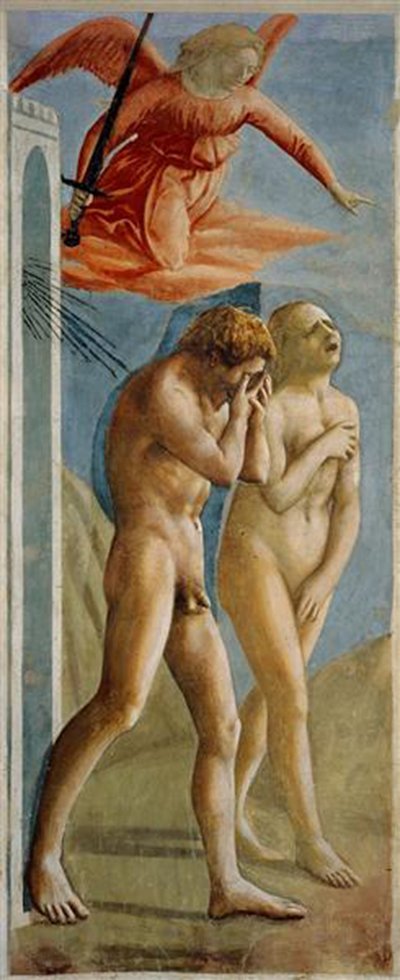
Expulsion from the Garden of Eden. The Expulsion from the Garden of Eden is among the most emotionally direct images of the Early Renaissance. Adam and Eve leave Paradise under the force of divine judgement, their bodies expressing shame and grief with a degree of psychological intensity that contrasts sharply with more decorative treatments of the subject. Adam covers his face.
Eve cries out and attempts to cover her body, turning theological loss into bodily experience. The fresco became famous partly because Masaccio allows physical vulnerability to carry the narrative. The human body is no longer simply an ideal form but an instrument of emotion.
Nudity and Restoration. Later centuries altered the fresco when leaves were added to cover the naked figures. Modern restoration removed those additions, allowing Masaccio’s original conception to be seen again. This restoration history is important because the painting’s reputation depends strongly on the expressive nakedness of Adam and Eve. Their vulnerability is theological, emotional and physical at once.
Saint Peter Healing the Sick with His Shadow. This fresco translates miracle into urban life. Peter walks through a street while the sick are healed by the passing of his shadow, and Masaccio gives the setting a strikingly contemporary physical presence. The architecture feels like a real city rather than an abstract biblical backdrop. The poor and sick occupy the foreground with the same bodily seriousness as apostles. This social realism aligns closely with the Carmelite emphasis on charity and the early Church. Holiness appears through action among ordinary people.
Distribution of Alms and Death of Ananias
The Distribution of Alms and Death of Ananias develops the same social theme more directly. Peter distributes resources to the poor while Ananias lies dead after withholding part of the proceeds from the sale of property. The scene links charity with moral responsibility. Wealth is not condemned simply for existing, but it is judged according to how it is used within the Christian community. This theme would have had particular resonance in a densely populated Florentine district where poverty was a visible reality. Masaccio gives religious narrative civic weight.
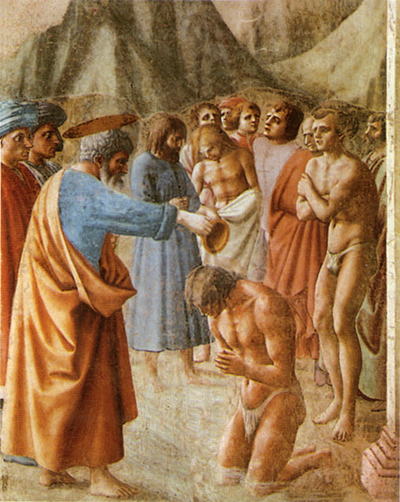
Baptism of the Neophytes. The Baptism of the Neophytes is another landmark in Masaccio’s treatment of the body. One newly baptised man shivers visibly from cold while another kneels to receive the sacrament, and these observed physical responses make the scene feel immediate without undermining its religious seriousness. The detail of the shivering figure is especially revealing because it is not necessary to identify the biblical subject. Masaccio includes it because bodies react to the world they inhabit, and that small naturalistic observation turns sacred history into something lived rather than merely illustrated.
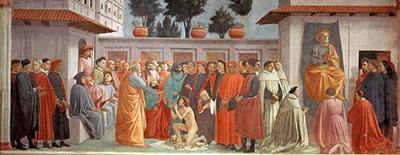
Raising of the Son of Theophilus and Saint Peter Enthroned. The large fresco later completed by Filippino Lippi embodies the chapel’s interrupted history particularly clearly. Masaccio began the composition, which combines the miraculous raising of Theophilus’s son with Peter enthroned as a figure of ecclesiastical authority, while Filippino completed unfinished areas decades later. The result allows viewers to see different Renaissance generations literally sharing one wall. This makes the fresco invaluable for understanding continuity, restoration and artistic inheritance within the chapel, while also showing how carefully Filippino had to adapt his own style to an already canonical environment.
The Lost Upper Register
The Brancacci Chapel originally contained more frescoes than survive today. The vault and upper lunettes included additional scenes and Evangelists, but eighteenth-century remodelling destroyed much of this material, leaving the surviving cycle only a fragment of the original programme. Surviving sinopie provide traces of those lost compositions and help confirm Masolino’s early role in the decoration. They also remind us that the chapel’s current appearance is the result of historical loss as much as preservation.
Fire and Later Damage. A major fire in 1771 damaged Santa Maria del Carmine and affected the chapel, although the principal frescoes survived. Subsequent restoration campaigns altered surfaces repeatedly, making the modern condition the result of both extraordinary survival and significant intervention. The comprehensive restoration of 1981–90 transformed understanding of the paintings by removing later dirt, overpainting and protective layers. A further diagnostic and conservation campaign from 2022 to 2024 continued this work, demonstrating that the chapel remains an active field of technical research rather than a static historical monument.
The Pisa Polyptych. In 1426 Masaccio received one of the best-documented commissions of his career: a large polyptych for the chapel of Giuliano degli Scarsi in Santa Maria del Carmine at Pisa. Payment records show that he began work in February 1426 and completed the project within the year, providing an unusually precise framework for one of his mature achievements. The same records also document assistants, including his younger brother Giovanni, later known as Lo Scheggia.
The Pisa project therefore provides rare concrete evidence of Masaccio working through a workshop system rather than producing every component entirely alone. The original polyptych was later dismantled, and surviving panels are now scattered across several museums. Reconstruction has consequently become a major part of understanding the commission, turning the work into both a masterpiece and an art-historical puzzle.
Virgin and Child
The central Virgin and Child, now in the National Gallery, is one of Masaccio’s most monumental panel paintings. Mary sits with extraordinary physical weight while Christ eats grapes, linking ordinary bodily action with Eucharistic symbolism and making sacred meaning depend upon the believable physicality of mother and child. The throne is organised through perspective, and the child’s body is convincingly three-dimensional. Masaccio’s interest in physical presence is therefore fully compatible with traditional gold and sacred symbolism rather than representing a rejection of them.
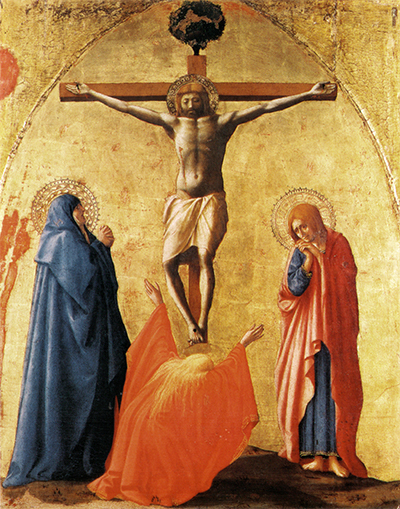
Crucifixion. The Crucifixion from the Pisa Polyptych, now in Naples, was intended for an elevated position and therefore required a special solution to the problem of viewing from below. Masaccio shortens and foreshortens Christ’s body so that it would appear convincing to a spectator standing beneath the panel. This is where comparison with Donatello becomes particularly strong. Sculptors had long faced the problem of designing figures for architectural heights, and Masaccio translates similar thinking into painted form with a confidence that makes the body appear adjusted to real viewing conditions.
The Predella. The surviving predella sections, now in Berlin, demonstrate another side of his skill. The Adoration of the Magi and martyrdom narratives are smaller and more densely populated than the central panels, yet the same concern with mass, space and light remains. Predella painting required narrative compression, because many figures and actions had to be made legible within shallow horizontal fields. Masaccio proves capable of moving between monumental stillness and compact storytelling without losing structural clarity.
The Holy Trinity
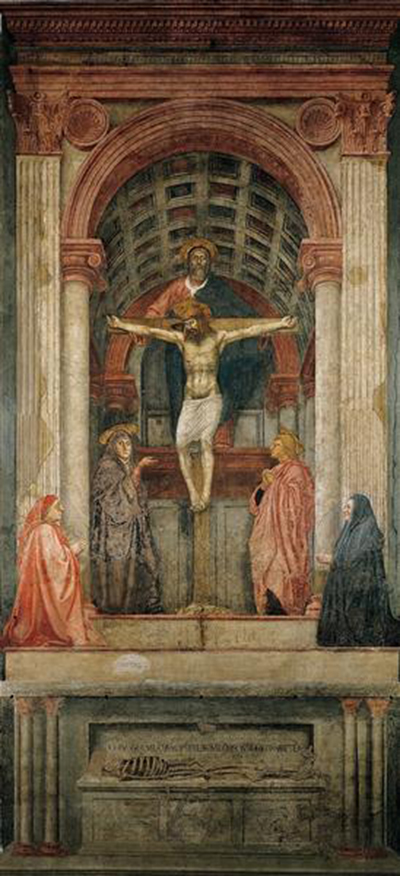
The Holy Trinity in Santa Maria Novella is perhaps Masaccio’s most famous demonstration of perspective. Painted around 1425–26, though technical scholarship has proposed a slightly earlier date around 1424–25, it creates the illusion of a deep barrel-vaulted chapel opening inside a flat wall. God the Father supports the Cross, Christ hangs below, the Holy Spirit occupies the central theological relationship, and Mary and Saint John stand within the fictive architecture.
Two kneeling donors occupy the threshold between sacred vision and real church space, helping the fresco link the represented chapel with the viewer’s own position in the nave. The remarkable effect depends upon a carefully constructed vanishing point related to the spectator’s physical location. Perspective is therefore not merely demonstrated mathematically; it controls how the worshipper encounters theology.
The Memento Mori. Below the main sacred group lies a painted skeleton accompanied by the famous reminder that what the viewer is now, the dead figure once was, and what the dead figure is, the viewer will become. This lower register changes the entire fresco because it confronts the spectator with mortality before directing attention upward towards the possibility of salvation. The relationship creates a complete devotional structure: death, sacrifice, intercession and eternal hope all occupy one architectural illusion. Masaccio’s perspective is therefore inseparable from the theological journey of the viewer.
The Donors. The kneeling husband and wife have often been identified with the Lenzi family, partly because of documentary and burial evidence connected with Santa Maria Novella. Their precise identities remain uncertain, so the painting should not be presented as a securely documented Lenzi commission. This uncertainty is valuable rather than inconvenient. It reminds us that even one of the most famous frescoes in Western art does not yield every historical fact equally clearly, and that careful qualification is part of serious art history rather than a weakness.
Vasari and Rediscovery
Vasari covered the Trinity in 1570 when a new altar was installed, causing the fresco to disappear from ordinary view for centuries. It was later rediscovered, detached and moved, while the lower skeleton section remained hidden until the twentieth century. In 1952 the lower section was recovered and reunited with the principal fresco, allowing the full theological structure to be understood again. This history demonstrates how later architectural changes can fundamentally reshape not only an artwork’s condition but the very way its meaning is perceived.
Madonna Casini. The small Madonna Casini, often called the “Tickling Madonna”, reveals a very different Masaccio. Instead of monumental public theology, the painting presents intimate physical play between Mary and Christ, using touch and bodily reaction to make private devotion emotionally immediate. The child responds to his mother’s touch with an informality almost unprecedented in devotional painting of the period.
The sacred relationship becomes tender, domestic and bodily without losing religious meaning, showing that Masaccio’s revolution in physical realism could operate at miniature scale as effectively as on a monumental wall. The reverse carries the arms associated with Cardinal Antonio Casini, providing important patronal evidence. The painting broadens Masaccio’s surviving corpus by showing that his interest in embodied humanity was not limited to fresco cycles or large altarpieces.
Style: Weight. The most consistent feature of Masaccio’s mature style is physical weight. Figures do not seem placed upon surfaces; they appear to occupy them through a combination of stance, drapery, anatomy and light. This effect comes from several interacting devices rather than one trick. Masaccio’s figures feel substantial because the structure of the entire image supports their bodies, creating a pictorial world in which mass and gravity operate consistently.
Style: Light
Masaccio’s light is unusually coherent for his period. Figures within the same scene appear illuminated from the same direction, allowing shadows to describe volume consistently and making separate bodies feel governed by the same natural conditions. The light does not simply make the painting more realistic. It creates social and spatial unity, binding figures into one environment and allowing the viewer to understand their physical relationship more immediately.
Style: Perspective. Perspective gives Masaccio’s scenes architectural credibility. In the Brancacci Chapel it organises streets, buildings and groups, while in the Holy Trinity it becomes the very foundation of the image. Masaccio’s importance does not lie in inventing mathematical perspective. Brunelleschi’s experiments were decisive, but Masaccio demonstrated how radically painters could use the system to make sacred history inhabit real space and to coordinate the viewer’s physical position with the meaning of an image.
Style: Emotion. Masaccio’s emotional directness is equally important. Adam and Eve grieve physically, apostles respond to Christ as individuals, the poor wait for aid, and baptised converts shiver from cold, so theological narratives are repeatedly expressed through ordinary bodily experience. These observations make sacred history human without reducing it to everyday anecdote. Masaccio treats emotion as embodied truth, allowing physical response to become one of the principal carriers of religious meaning.
Style: Economy. Masaccio also avoids unnecessary decorative distraction. Architecture, bodies and gesture are usually subordinated to the central action, which gives the paintings their remarkable clarity even when several narrative moments occupy one surface. This economy makes the images feel powerful because nothing essential is diluted. Where many figures appear, the viewer can still identify the emotional and theological centre quickly.
Masaccio and Giotto
Giotto provided the most important earlier Italian precedent for monumental figures and emotionally intelligible sacred narrative. Masaccio’s achievement can be understood partly as a revival and radical extension of that older Florentine tradition rather than as a complete rejection of everything before him. The connection is not simple imitation. Masaccio inherits Giotto’s seriousness of body and narrative but adds the new spatial and lighting systems of the fifteenth century, becoming both an heir to Florentine tradition and one of its most decisive innovators.
Influence on Fra Angelico. Fra Angelico’s work in the mid-1420s shows clear awareness of Masaccio’s bodily and spatial innovations. Prado scholarship connects the Virgin with the Pomegranate and the Prado Annunciation with the new visual language associated with Masaccio and Masolino. Angelico did not become Masaccian in style. Instead, he absorbed physical mass and perspective into a more luminous, contemplative Dominican language, demonstrating how Masaccio’s influence could operate through transformation rather than imitation.
Influence on Filippo Lippi. Fra Filippo Lippi likewise emerged within the Florentine environment shaped by the Brancacci Chapel. His later painting develops another balance between Masaccian bodily presence and more lyrical line, colour and emotional intimacy. The relationship demonstrates how rapidly Masaccio’s innovations became a shared Florentine vocabulary. Painters no longer needed to resemble him closely in order to use what he had made possible.
Filippino Lippi and the Completion of Brancacci. Filippino Lippi’s role is even more direct. Decades after Masaccio’s death, he was commissioned to complete the unfinished Brancacci Chapel and therefore had to work beside frescoes that had already become authoritative models. The project became an act of historical dialogue. Filippino had to preserve continuity without suppressing his own generation entirely, and his success helped turn the chapel into a coherent monument spanning several decades of Florentine painting.
Leonardo and Michelangelo
Later Florentine artists studied the Brancacci Chapel intensely. Institutional histories name Leonardo da Vinci and Michelangelo among those who treated the frescoes as a school of drawing, bodies and narrative, reinforcing the idea that Masaccio’s influence operated through direct visual study as much as through written reputation. Michelangelo’s own monumental figures are almost unimaginable without the earlier example of Masaccio’s physical gravity. The influence passes through generations rather than through personal contact, which makes the chapel itself an active transmitter of style.
Rome. Masaccio eventually travelled to Rome, where he again worked in relation to Masolino. Their late collaborative environment included the Santa Maria Maggiore altarpiece, reconstructed today from surviving dispersed panels. The Roman phase is difficult because Masaccio died before his work there could develop fully. Some surviving panels belong to Masolino, others to Masaccio, and the precise sequence of production remains debated, making the final period one of the most cautious areas of his biography.
Santa Maria Maggiore. The Santa Maria Maggiore altarpiece appears to have been double-sided and collaborative. Modern reconstruction has identified surviving panels in several collections, allowing scholars to piece together a project that Masolino completed after Masaccio’s death. The commission demonstrates that the partnership between the two painters continued until the end of Masaccio’s life. Their relationship therefore cannot be reduced to one early Florentine episode or to a simplistic contrast between conservative and revolutionary styles.
Death. Masaccio died in Rome in 1428 or possibly early 1429, still only in his twenties. The exact cause remains uncertain, and while later theories exist, including disease, none is documented securely enough to present as fact. What is certain is that his death abruptly ended one of the most rapidly developing careers in European art. The surviving works leave the impression of an artist still expanding his range rather than one who had reached a settled late style.
A Career of Only a Few Years
The extraordinary thing about Masaccio is how little time he had. From the securely dated San Giovenale Triptych of 1422 to his death around 1428, only about six years separate the first known masterpiece from the end of his career. Within that period he moved from an early triptych to some of the most sophisticated fresco and perspectival painting in Europe. Few artists have compressed such fundamental change into so short a period, and that compression is central to the intensity of his historical reputation.
The Problem of the Surviving Corpus. Masaccio’s surviving oeuvre is fragmented. Frescoes have been destroyed, altarpieces dismantled, collaborative works divided between hands and major projects lost, so the history of his art is inseparable from reconstruction. This makes every surviving fragment unusually important. Scholars must repeatedly infer complete objects from panels scattered across London, Berlin, Naples, Pisa and Los Angeles, while lost frescoes such as the Sagra remain accessible only through later descriptions and copies.
Restoration and Modern Understanding. Modern conservation has fundamentally shaped Masaccio’s reputation. The Brancacci restoration recovered colour and modelling concealed by grime and later additions, while the Holy Trinity was physically reconstructed through the rediscovery of its lower section. These interventions demonstrate that art history depends upon material condition. A dirty, altered or fragmented work can produce a distorted understanding of style, and modern conservation has repeatedly made Masaccio’s innovations clearer rather than merely more attractive.
Why Masaccio Matters
Masaccio matters because he changed the physical credibility of painting. Before him, Florentine artists had already experimented with volume, narrative and architecture, but after him the combination of body, light and measurable space became almost impossible for ambitious painters to ignore. His figures occupy space with the authority of sculpture, while his architecture obeys a coherent visual logic and his light binds figures into one environment. Emotion emerges through bodies rather than decorative gesture, which gives even familiar Christian stories a new psychological force.
Most importantly, these innovations serve meaning. Perspective turns the Holy Trinity into an architectural experience of salvation, weight makes the Virgin of the Pisa Polyptych physically maternal, cold makes a baptised convert human, grief makes Adam and Eve’s loss unforgettable, and charity becomes social action in the Brancacci Chapel. Masaccio’s revolution was therefore not technical display for its own sake.
He made sacred painting more convincing because he made the human world inside it more believable. His short life ensured that later artists had to continue the experiment for him. Fra Angelico, Filippo Lippi, Filippino Lippi, Leonardo, Michelangelo and countless others inherited a visual world that Masaccio had helped reorganise with astonishing speed.
Frequently Asked Questions
Discussion
Use this space to discuss Masaccio: Early Renaissance Paintings, Biography and Frescoes, its source evidence and how it fits into Masaccio's wider cluster.
Keep comments focused on close looking, attribution language, object evidence and page-specific caveats.
Reader Insights
Which detail on this page most changes how you read the work?
How does this page connect to Masaccio's paintings, fresco technique or Florentine setting?
Where should the wording stay cautious because the source evidence is qualified?
Join the Conversation
Share your reading of Masaccio: Early Renaissance Paintings, Biography and Frescoes below.
References and Research Sources
- National Gallery, London, Masaccio artist biography and Pisa Polyptych research. View Source
- Museo Masaccio, San Giovanni Valdarno, San Giovenale Triptych. View Source
- Museo Nacional del Prado, Fra Angelico and the Rise of the Florentine Renaissance, for Masaccio’s wider Florentine context.
- Uffizi Galleries, Masaccio and Masolino, Sant’Anna Metterza. View Source
- Comune di Firenze / Musei Civici Fiorentini, Brancacci Chapel history and restoration. View Source
- MUS.E Firenze, Brancacci Chapel historical and iconographic resources. View Source
- National Gallery, London, catalogue reconstruction of the Pisa Polyptych. View Source
- J. Paul Getty Museum, technical research on Masaccio and Donatello in the Pisa Polyptych. View Source
- Santa Maria Novella, Florence, institutional history and interpretation of Masaccio’s Holy Trinity. View Source
- Opificio delle Pietre Dure, technical and conservation research on the Holy Trinity. View Source
- National Gallery, London, reconstruction of the Santa Maria Maggiore altarpiece. View Source
- Uffizi Galleries, research on the Madonna Casini / “Tickling Madonna”. View Source