 by Tom Gurney
Tom Gurney BSc (Hons) is an art history expert with over 20 years experience
Published on June 19, 2020 / Updated on October 14, 2023
Email: tomgurney1@gmail.com / Phone: +44 7429 011000
Introduction
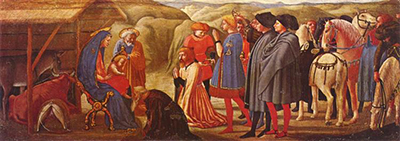
The predella of Masaccio’s Pisa Polyptych is one of the most important surviving demonstrations of his ability to work at small scale without losing bodily weight, spatial clarity or narrative discipline. The best-known surviving section, the Adoration of the Magi now in Berlin, compresses a complex procession, architecture, landscape, animals and kneeling figures into a shallow horizontal field while preserving the same structural seriousness found in Masaccio’s monumental frescoes.
The predella originally ran beneath the principal tier of the 1426 altarpiece commissioned by Giuliano degli Scarsi for Santa Maria del Carmine in Pisa. Above it stood the Virgin and Child and the now-lost flanking saints, while the lower strip unfolded narrative episodes connected with Christ and the saints represented above. This relationship between iconic presence and narrative action was fundamental to late medieval and Renaissance altarpieces.
The upper register presented sacred figures as timeless intercessors, while the predella showed stories from their lives, allowing viewers to move between devotion, biography and theology within one architectural object. Masaccio’s achievement is therefore not simply that he painted a beautiful Adoration. He understood how a low, narrow narrative strip could support the whole altarpiece intellectually and visually, translating the same concern with bodies, space and light into a very different scale.
At a Glance
- ArtistMasaccio, with possible workshop participation in some predella scenes
- AltarpiecePisa Polyptych
- Date1426
- Original locationSanta Maria del Carmine, Pisa
- Current location of major predella fragmentsGemäldegalerie, Berlin
- Best-known surviving predella sceneAdoration of the Magi
- Other surviving narrativesmartyrdom and saintly-life episodes associated with the polyptych
- Function of predellanarrative strip beneath the principal sacred figures
- Key formal challengecompressing many figures and actions into a low horizontal space
- Key Masaccian qualitiesbodily mass, clear grouping, perspective and controlled light
- Workshop issuesome lower-quality predella passages have been linked with Andrea di Giusto
- Historical significancereveals Masaccio’s narrative skill at miniature scale and helps reconstruct the lost altarpiece’s iconographic programme
Contents
- What Is a Predella?
- The Biblical Subject
- Horizontal Rhythm
- Architecture
- Gentile da Fabriano as Comparison
- The Magi and the Central Madonna
- Saints Julian and Nicholas
- Why the Adoration Is Higher Quality
- Architecture of Attention
- The Pisa Baptistery Pulpit
- The Child as Centre
- Relation to The Tribute Money
- Lost Context
- Why the Pisa Predella Matters
- Frequently Asked Questions
- References and Research Sources
What Is a Predella?
A predella is the low horizontal section beneath the principal part of an altarpiece. It often contains smaller narrative scenes connected with the central subject or the saints represented above. This structure allows two different kinds of sacred image to coexist. Large saints provide stable devotional presence, while smaller scenes below narrate events through time.
The Predella within the Pisa Polyptych. The Pisa Polyptych was a multi-tiered architectural ensemble. The central Virgin and Child dominated the main register, saints flanked her, upper panels rose above and the predella formed the narrative foundation below. The lower strip therefore anchored the whole altarpiece historically. Sacred figures who appear timeless above acquire biographies and actions below.
Narrative beneath Icon. This relationship is especially important because it creates a vertical logic. A saint can stand eternally before the viewer in the main tier while the predella explains martyrdom, miracles or episodes from that saint’s life. The viewer therefore moves between timeless presence and historical narrative. The altarpiece becomes both icon and story.
The Adoration of the Magi. The Adoration of the Magi is one of the finest surviving predella scenes and is frequently singled out in scholarship as among the strongest components of the Pisa Polyptych. Masaccio condenses an elaborate Epiphany procession into a low horizontal format without allowing the scene to become visually confused. The Magi approach the Virgin and Child, attendants and animals gather around them, and architecture and landscape provide enough spatial structure to keep the crowd coherent.
The Biblical Subject
The Adoration comes from Matthew 2, where wise men travel to honour the Christ Child with gifts. Renaissance tradition elaborated the story into a rich procession of kings, attendants and exotic animals. The subject was especially suited to predella format because processions move naturally across a horizontal field. Masaccio uses that movement while maintaining a clear devotional focus.
The Virgin and Child. The Virgin and Child form the sacred destination of the procession. Even at reduced scale, Masaccio gives them enough bodily gravity to remain visually authoritative. This demonstrates that monumentality for Masaccio is not simply a function of size. It is a way of constructing bodies and relationships.
The Kneeling Magus. The kneeling king creates a strong transition between procession and sacred group. His lowered body establishes reverence while also opening space visually around the Virgin and Child. Masaccio uses posture to organise hierarchy. Devotion becomes legible through the body.
The Procession. Behind the principal Magi, attendants and animals extend the narrative laterally. The scene therefore contains more figures than many of Masaccio’s major panel paintings, yet the procession remains controlled. This demonstrates exceptional narrative economy. Masaccio knows how to imply abundance without sacrificing clarity.
Horizontal Rhythm
The predella’s low shape naturally encourages movement from side to side. Masaccio uses repeated bodies, horses and architectural cues to create a visual rhythm across the panel. The procession therefore feels continuous rather than crowded. Horizontal format becomes an advantage.
Scale. Predella figures are much smaller than the Virgin and saints above. Masaccio nevertheless gives them volume through light, stance and overlap. This is one of the most impressive aspects of the scene. The bodies do not collapse into decorative miniatures.
Monumentality at Small Scale. Masaccio’s figures remain structurally serious even when tiny. Knees bend, horses occupy depth and garments describe bodies with surprising clarity. This proves that his monumentality is conceptual. A figure can feel weighty without being physically large.
Perspective. Architecture and ground plane help organise the procession. Masaccio does not construct an elaborate perspectival box, but the spatial relationships remain clear enough that figures occupy different depths convincingly. Perspective therefore adapts to narrative density. It becomes flexible rather than demonstrative.
Architecture
The architectural elements provide both spatial structure and social context. They help frame the sacred encounter without overwhelming the scene. As elsewhere in Masaccio’s work, architecture serves people. It provides order rather than spectacle.
Landscape. Landscape elements extend the world beyond the immediate foreground. Distant forms help prevent the horizontal field from feeling shallow or cramped. This expansion is especially valuable in a predella. A physically narrow panel can suggest a much larger journey.
Animals. Horses and other animals contribute to the sense of procession and worldly splendour. Their presence also creates another opportunity for Masaccio to demonstrate observational naturalism. The animals are not merely decorative motifs. They participate in the movement and depth of the scene.
Courtly Splendour. The Adoration traditionally allowed painters to represent luxury, textiles, gifts and exotic retinues. Masaccio includes enough splendour to make the Magi recognisably royal without allowing ornament to dominate. This restraint distinguishes him from more courtly painters such as Gentile da Fabriano. Wealth remains present, but bodily and spatial clarity take priority.
Gentile da Fabriano as Comparison
Gentile’s famous Adoration of the Magi of 1423 represents one of the great International Gothic approaches to the subject, filled with luxurious surface, elaborate costume and dense decorative detail. Masaccio’s predella treatment is far more austere. The comparison reveals different artistic priorities within the same decade.
Masaccio versus Courtly Ornament. Masaccio does not reject splendour entirely. He simply subordinates it to structure. The Magi remain kings, but their significance comes through action, posture and spatial relationship rather than through decorative excess alone.
The Gift-Bearing Kings. The Magi’s gifts reinforce Christ’s royal and sacred identity. Gold, frankincense and myrrh traditionally signify kingship, divinity and future death. In the context of the Pisa Polyptych, these themes connect naturally with the Crucifixion above. Even the Epiphany anticipates the Passion.
Christological Structure. The predella therefore participates in the altarpiece’s larger Christological sequence. Adoration, Eucharistic grapes and Crucifixion all point towards the identity and destiny of Christ. The polyptych becomes a theological architecture. Each panel contributes to a wider narrative system.
The Magi and the Central Madonna
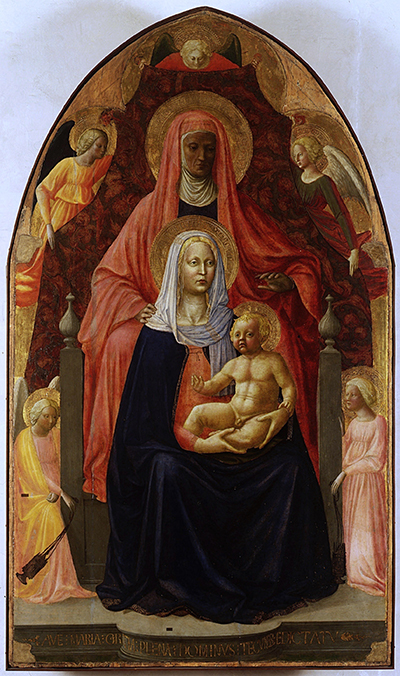
The predella’s Virgin and Child echo the larger central image above. This repetition operates across scale: Mary and Christ appear both as monumental sacred presence and as participants in biblical narrative. The viewer therefore encounters the same holy figures in different temporal modes. Above they are timeless; below they inhabit history.
Narrative Time. Predella scenes are fundamentally temporal. They show actions, journeys, martyrdoms and miracles rather than static sacred presence. Masaccio handles this temporal dimension with exceptional clarity. The Adoration feels like one moment within a larger journey.
The Martyrdom Scenes. Other surviving predella panels represent martyrdom episodes connected with saints from the main tier. These narratives helped explain the identities and sanctity of the standing figures above. The relationship between saint and story is therefore architectural. Biography literally supports icon.
Saint Peter and Saint John the Baptist. Scenes connected with Peter and John the Baptist would have reinforced the identities of the lost flanking saints. Their narratives gave viewers access to the lives behind the iconic bodies. This is especially important because the principal saint panels no longer survive. The predella helps preserve traces of the lost programme.
Saints Julian and Nicholas
Other scenes relate to Saints Julian and Nicholas, also identified by Vasari among the lost flanking saints. Their presence demonstrates how specifically the altarpiece was tailored to patronal and devotional needs. The predella therefore preserves information that the missing upper panels can no longer provide fully.
Workshop Participation. National Gallery scholarship notes variation in quality across the predella and has associated some scenes from the lives of Julian and Nicholas with Masaccio’s assistant Andrea di Giusto. This evidence is important because it reveals differentiated workshop labour within one commission. The master controlled the design, but assistants could execute subsidiary passages.
Andrea di Giusto. Andrea appears in the payment records as Masaccio’s garzone. His documented role gives attributional proposals stronger historical context than stylistic speculation alone. The Pisa Polyptych therefore offers a rare convergence of documentary and visual workshop evidence.
Masaccio’s Design. Even where execution varies, the overall structure is attributed to Masaccio’s planning. The iconographic sequence, spatial relationships and hierarchy required one coherent design intelligence. This distinction between invention and execution is central to Renaissance authorship. A master could be responsible for the whole without painting every detail personally.
Why the Adoration Is Higher Quality
Scholars generally treat the Adoration of the Magi as one of the finest predella scenes and strongly associate it with Masaccio’s own hand. Its figures, space and light show the same confidence as his major panels. This makes it an essential benchmark for comparing other predella fragments. Quality itself becomes part of attribution.
Light. Masaccio uses light to give small figures volume. Even within miniature scale, shadows establish bodies and separate overlapping forms. This coherence connects the predella with the central Madonna and Crucifixion. The altarpiece appears designed to share one broad luminous logic.
Colour. Colour helps distinguish figures within the dense procession. Robes, animals and architecture remain legible because tonal relationships are carefully controlled. At the original viewing distance, these chromatic groupings would have been essential. Fine detail alone could not carry the composition.
The Original Viewing Height. The predella occupied a low zone compared with the upper panels. It was therefore relatively accessible to viewers, who could inspect its narrative detail more closely. This difference in viewing distance shaped Masaccio’s strategy. Upper panels use broad monumental forms, while the predella can sustain denser storytelling.
Architecture of Attention
The polyptych distributed different kinds of looking vertically. Viewers could contemplate large sacred figures from farther away and then read smaller narrative scenes closer to eye level. The altarpiece therefore choreographed attention. Scale and height determined how different images were consumed.
Predella and Liturgy. Because the predella sat close to the altar, its narratives occupied a zone near actual liturgical action. The relationship between painted history and sacramental practice would have been immediate. This proximity deepened theological meaning. Christ’s story and saints’ lives unfolded directly beside the rituals that continued their sacred significance.
Predella and Burial. The funerary chapel context also matters. Martyrdom, sacrifice and adoration would have been encountered alongside prayers for the dead. The lower narratives therefore participated in a devotional environment concerned with memory and salvation. Story became part of commemoration.
Nicola Pisano. National Gallery scholarship has suggested that Masaccio may have responded to Nicola Pisano’s famous sculptural reliefs in Pisa, particularly in crowded narrative scenes. This local influence is especially relevant to the predella because Nicola’s relief sculpture offered sophisticated models for compressing many figures into shallow spaces.
The Pisa Baptistery Pulpit
Nicola Pisano’s pulpit in the Pisa Baptistery was one of the city’s great artistic monuments. Its reliefs combine classical bodily forms, dense narrative and architectural compression. Masaccio’s encounter with such work would have provided an important Pisan counterpart to the Florentine lessons of Donatello and Brunelleschi.
Sculpture and Predella Space. Relief sculpture and predella painting face similar problems. Both must suggest deep narrative space within physically shallow fields. Masaccio’s ability to compress bodies while preserving volume therefore belongs to a cross-media Renaissance culture. Painting and sculpture solve related spatial problems.
The Adoration and Humanism. The scene also participates in Renaissance humanism through its attention to varied bodies, social ranks and observable behaviour. Kings kneel, attendants wait and animals move within one shared world. Sacred hierarchy remains intact, but humanity becomes more diverse. The biblical event gains social texture.
Royalty and Humility. The kneeling Magus embodies one of the subject’s central paradoxes: worldly power submits before a child. Masaccio makes that hierarchy visible through posture rather than symbolic scale. The king remains recognisably dignified while physically lowering himself. Humility becomes bodily action.
The Child as Centre
Christ is small within the crowded scene but remains the true centre because every important movement converges towards him. Masaccio therefore demonstrates another form of compositional hierarchy. Physical size does not determine spiritual importance.
Mary’s Stability. Mary provides the stable anchor around which the procession moves. Her stillness contrasts with the lateral motion of the Magi and attendants. This balance between stability and movement gives the scene clarity. Sacred presence receives worldly motion.
The Horsemen. Mounted figures extend the procession and increase spatial complexity. Horses overlap, turn and occupy depth, giving Masaccio opportunities to demonstrate naturalistic observation beyond the human body. Their inclusion also reinforces the social status of the visitors. The Adoration becomes a royal arrival.
Economy. Despite the complexity, the scene is remarkably economical. Masaccio does not overload every surface with ornament. The resulting clarity makes the narrative feel monumental despite the scale. Restraint becomes a form of power.
Relation to The Tribute Money
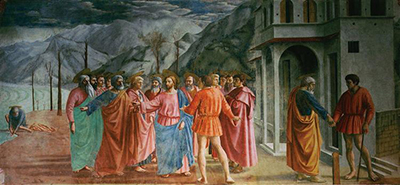
The Adoration and Tribute Money differ greatly in size and medium, but both organise multiple figures within coherent space. Gesture, grouping and architecture guide the viewer through dense narrative. This continuity demonstrates Masaccio’s adaptability. The same compositional intelligence works on wall and panel.
Relation to the Brancacci Chapel. The predella likely benefited from Masaccio’s fresco experience. Broad grouping, bodily mass and spatial clarity had already become central to his mature language. Panel painting therefore absorbs lessons from mural scale. The miniature does not become fussy.
Relation to the Central Virgin and Child. The central Madonna is iconic and monumental; the predella Madonna participates in story. Together they reveal two complementary modes of sacred representation. Masaccio can make Mary timeless above and historical below without contradiction. The altarpiece depends on that duality.
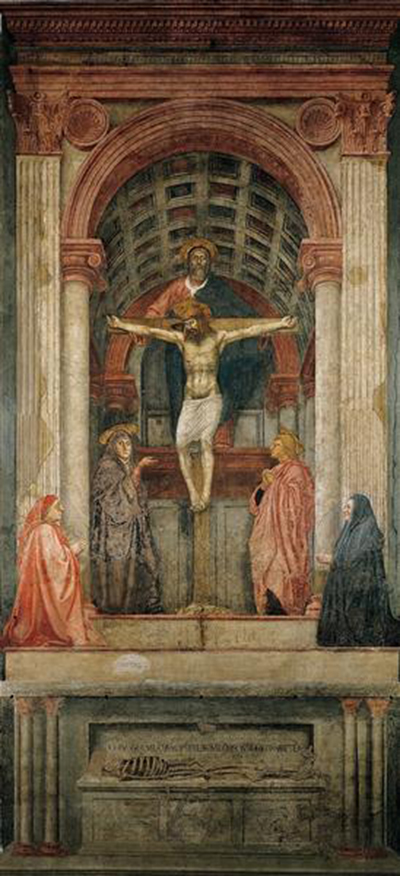
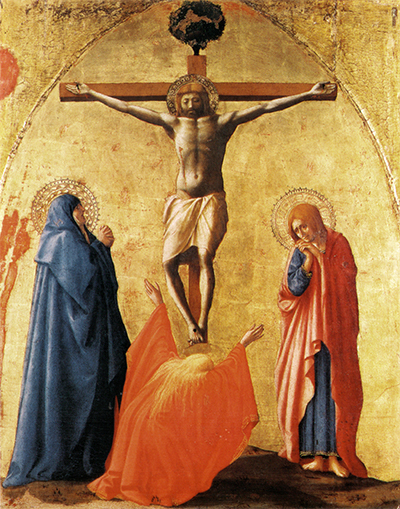
Relation to the Crucifixion. The Crucifixion above provides the ultimate Passion image, while the Adoration below celebrates Christ’s recognition by the Magi. The altarpiece therefore spans beginning and end. Birth, recognition and sacrifice belong to one theological structure.
Lost Context
Modern Berlin display necessarily isolates the predella panels from their original upper figures. Their narratives can still be understood individually, but many vertical relationships are lost. This is why reconstruction matters so strongly for the Pisa Polyptych. The predella was designed to explain what stood above it.
Fragment and Whole. A surviving predella panel is both complete and incomplete. It may contain a fully legible narrative, yet it originally functioned as one sentence within a larger visual argument. The modern viewer therefore has to read at two scales. One scene matters in itself and as part of the lost ensemble.
Why the Predella Matters for Masaccio. The predella proves that Masaccio’s reputation should not rest only on monumental fresco. He could compress narrative, manage small figures and adapt perspective to narrow spaces without losing gravity. This versatility is especially impressive given how short his career was. By 1426 he had already mastered radically different formats.
Why the Adoration Matters. The Adoration of the Magi matters because it demonstrates Masaccio’s ability to control luxury without being controlled by it. Kings, horses and attendants create splendour, but the composition remains structurally clear and centred on Christ. Its restraint distinguishes Masaccio from more courtly contemporaries. Narrative seriousness outweighs decorative abundance.
Why the Pisa Predella Matters
The broader predella matters because it helps reconstruct the intellectual architecture of the lost altarpiece. Saints above gain stories below, while Christ’s life and sacrifice are extended through narrative episodes. Workshop variation also makes the predella one of the best places to study Masaccio’s professional practice. Andrea di Giusto and possibly other assistants contributed within a design controlled by the master.
Most importantly, the lower strip demonstrates that Masaccio’s Renaissance revolution was scalable. The same concern with bodies, space and clear human action that transformed the Brancacci Chapel could operate within a panel only a fraction of the size. The Pisa predella therefore deserves to be understood not as secondary decoration but as one of the keys to how the entire polyptych worked.
Frequently Asked Questions
Discussion
Use this space to discuss Adoration of the Kings by Masaccio, its source evidence and how it fits into Masaccio's wider cluster.
Keep comments focused on close looking, attribution language, object evidence and page-specific caveats.
Reader Insights
Which detail on this page most changes how you read the work?
How does this page connect to Masaccio's paintings, fresco technique or Florentine setting?
Where should the wording stay cautious because the source evidence is qualified?
Join the Conversation
Share your reading of Adoration of the Kings by Masaccio below.
References and Research Sources
- National Gallery, London, scholarly catalogue for the Pisa Polyptych, for the predella reconstruction, quality distinctions, Andrea di Giusto attribution and Nicola Pisano comparisons. View Source
- Gemäldegalerie, Berlin, collection records for surviving Pisa Polyptych predella panels.
- National Gallery, London, Masaccio: The Virgin and Child, for the broader altarpiece structure and relationship between central image, predella and Crucifixion. View Source
- J. Paul Getty Museum, Masaccio: Saint Andrew and the Pisa Altarpiece, for the polyptych’s programme, patronage and reconstruction. View Source
- Matthew 2, biblical source for the Adoration of the Magi.