 by Tom Gurney
Tom Gurney BSc (Hons) is an art history expert with over 20 years experience
Published on June 19, 2020 / Updated on July 5, 2026
Email: tomgurney1@gmail.com / Phone: +44 7429 011000
Edvard Munch: Anxiety, Love and the Modern Soul
Edvard Munch was the Norwegian artist who made anxiety, desire, illness, loneliness and death into some of the defining images of modern art. He is known above all for The Scream, but that single image only opens the door. Across more than sixty years, Munch developed a language of paintings and prints in which private feeling becomes public form. [1]
MUNCH, the museum devoted to his work in Oslo, presents him as one of Modernism's major artists and stresses the range of his experimentation across painting, graphic art, drawing, sculpture, photography and film. The same museum places him in the Symbolist movement of the 1890s and as a pioneer of Expressionist art from the early twentieth century onward. [1]
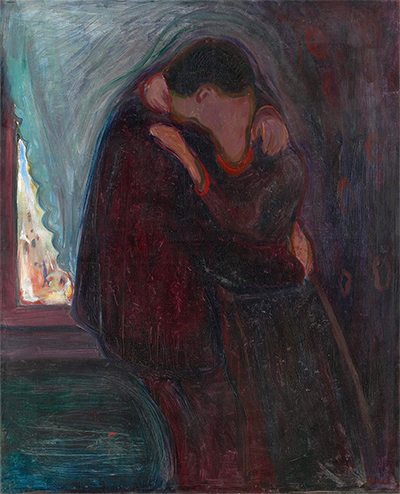
The best way to begin with Munch is to avoid making biography do all the work. His childhood illness, family bereavements, difficult love affairs, nervous crises and late solitude matter, but they do not explain the art by themselves. Munch's achievement was to turn personal experience into repeatable modern motifs: the isolated figure on a bridge, the shoreline couple, the deathbed room, the kiss that becomes a single shape and the face opening into a scream. [2]
At a Glance
- Full name: Edvard Munch
- Born: 12 December 1863
- Died: 23 January 1944
- Nationality: Norwegian
- Movements: Symbolism, Expressionism, Modernism
- Known for: Psychological painting, printmaking and The Scream
Contents
- Why Munch Matters
- Biography and Chronology
- Timeline
- Style
- Themes and Motifs
- Museum Perspective
- Major Works
- Technique and Printmaking
- Reception and Legacy
- Where to Start
Why Munch Matters
Munch matters because he helped shift modern art away from outward description and toward inner states. His paintings and prints do not simply show people in rooms, streets or landscapes. They make fear, desire, jealousy, grief and solitude visible through colour, line, repetition and setting. [7]
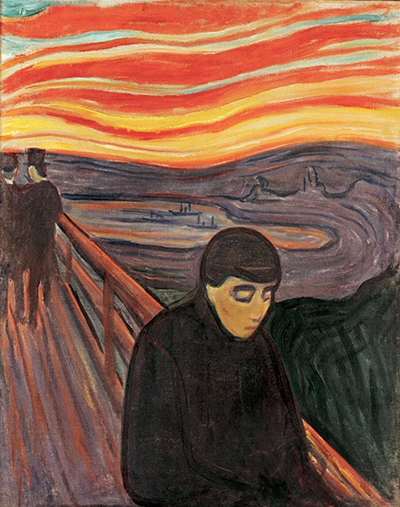
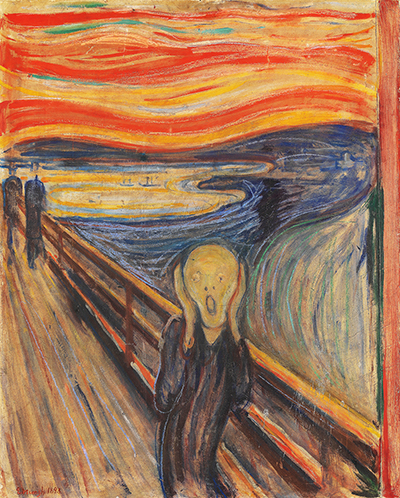
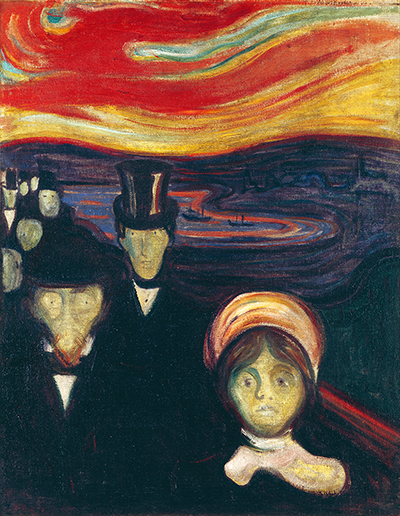
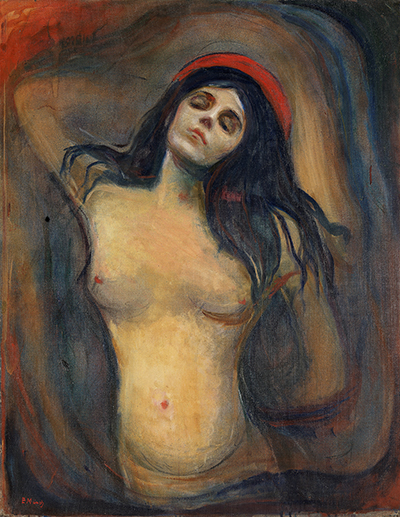
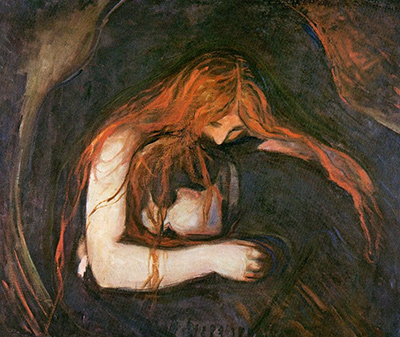
In The Scream, a figure on a bridge becomes an image of psychic pressure. In Despair and Anxiety, landscape and human presence are fused into an atmosphere of unease. In Separation, The Kiss, Vampire and Madonna, love is never simple reassurance; it is bound to distance, possession, sexuality and mortality. [9]
His importance also lies in repetition. Munch returned to motifs across paintings, pastels, lithographs, woodcuts and other graphic media. A work such as The Scream is not only one image in one material. It is a motif that changes as it moves between versions, techniques and audiences. [4]
This is why Munch is a crucial bridge between nineteenth-century Symbolism and twentieth-century Expressionism. He used visible form to carry emotional intensity, but he did so with recurring subjects and carefully worked variations rather than one-off confessions. [1]
Biography and Chronology
Edvard Munch was born on 12 December 1863, the son of Christian Munch, a military doctor, and Laura Munch. MUNCH's timeline records that he spent his childhood in Kristiania, now Oslo, and that his mother died from tuberculosis when he was five. His aunt Karen then moved into the household and became an important stabilising presence. [2]
Munch was often ill as a child and spent long periods away from school. That limitation also gave him time to draw. MUNCH records that at seventeen he wrote, "It is my decision now to become a painter." In 1880, he enrolled at the Royal School of Art and Design in Kristiania. [2]
The 1880s brought mentors, experiments and early controversy. Munch met Christian Krohg, encountered the radical Kristiania Bohemians, and began working toward an art of emotional and psychological directness. In 1886 he exhibited The Sick Child, a work rooted in the death of his sister Sophie from tuberculosis. MUNCH describes the painting as both praised and fiercely criticised, and as a small breakthrough. [2]
The 1890s were decisive. After his father's death in 1889, Munch's art turned more sharply toward memory, grief and states of the soul. In 1892, an exhibition in Berlin was closed after one week. The scandal helped build his reputation, and MUNCH records his response to Aunt Karen: "I could not have a better form of publicity." [2]
During the same decade, Munch created or developed many of his most famous motifs, including The Scream, Vampire, Puberty and Madonna. He also took up printmaking, a crucial step because it let him experiment with images and circulate them in greater numbers. [2]
In 1902, Munch presented a group of images under the title The Frieze of Life. The project organised his art around love, anxiety, jealousy, illness and death. His health deteriorated during the following years, and in 1908 he entered Dr Daniel Jacobson's clinic in Copenhagen. After treatment, he returned to Norway and worked on the University of Oslo Aula decorations between 1909 and 1916. [2]
In 1916, Munch bought Ekely on the outskirts of Oslo and lived there for the rest of his life. The late work includes self-portraits, landscapes, garden scenes and monumental images. In 1940, after German troops invaded Norway, Munch changed his will and left nearly all of his works to the municipality of Oslo. He died on 23 January 1944. [2]
Timeline
- 1863 - Edvard Munch is born on 12 December. [2]
- 1880 - Munch enrols at the Royal School of Art and Design in Kristiania. [2]
- 1886 - The Sick Child brings praise, criticism and an early breakthrough. [2]
- 1892 - His Berlin exhibition closes after one week, increasing his notoriety. [2]
- 1890s - Munch develops major motifs including The Scream, Vampire, Puberty and Madonna. [2]
- 1902 - Munch presents The Frieze of Life. [2]
- 1908 - He enters Dr Daniel Jacobson's clinic in Copenhagen. [2]
- 1916 - Munch buys Ekely outside Oslo. [2]
- 1944 - He dies on 23 January. [2]
Style
Munch's style changed across his long career, but several habits recur. He simplifies bodies, bends landscape around feeling, uses colour emotionally and repeats motifs across different media. His figures often appear isolated even when surrounded by other people. His landscapes are not neutral backgrounds; they carry psychological pressure. [7]
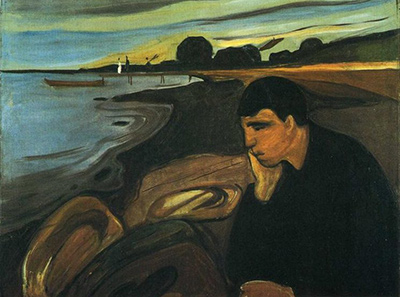
This is visible in Evening on Karl Johan Street, where the modern city becomes a scene of collective unease. It is also visible in Melancholy and Sick Mood at Sunset: Despair, where shoreline, colour and figure become inseparable from mood. [8]
Munch's forms often seem direct, but they are rarely careless. The simplified face, the repeated shoreline, the sloping bridge, the dark interior and the flat field of colour are all ways of intensifying experience. The image may look emotionally raw, but the motif is usually carefully structured. [9]
Themes and Motifs
Munch's most important themes form a network rather than a list. Anxiety connects The Scream, Despair and Anxiety. Love and separation connect The Kiss, Vampire, Separation, Madonna and Dance of Life. Illness and death connect The Sick Child, Death in the Sickroom and related deathbed images. [4]
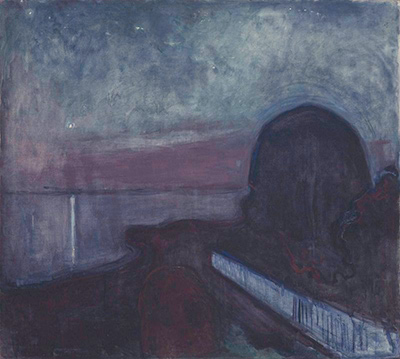
The motif of the isolated figure is especially important. Munch repeatedly places a person at an edge: a bridge, a shoreline, a room, a bed, a street or a window. That edge can be physical, emotional or existential. The figure is not simply alone; the whole setting seems to participate in the condition. [7]
Self-portraiture provides another route through the cluster. Early self-images explore identity and modern artistic persona, while Self-Portrait Between the Clock and the Bed turns the late artist's body into a stark confrontation with time, work and mortality. [9]
Museum Perspective
MUNCH's collection gives the strongest institutional perspective on the artist. The museum records almost 28,000 artworks and more than 42,000 unique museum objects, built around Munch's bequest to Oslo. It describes that bequest as one of the world's largest collections of works by a single artist. [3]
That scale matters editorially. Munch is not only the painter of a handful of famous images. His work survives as a large, self-revising archive of paintings, prints, drawings, photographs, writings, correspondence and objects. MUNCH also provides a digital catalogue raisonne and a digital archive of Munch's texts and correspondence. [3] [6]
MoMA's artist record confirms Munch's international museum importance. It identifies him as Norwegian, 1863-1944, associates him with Expressionism, painting and print, lists 73 works online, and records major exhibitions including Edvard Munch: The Modern Life of the Soul. [4]
The National Museum of Norway anchors the most famous object in the cluster. Its record for The Scream gives the 1893 work as tempera and crayon on cardboard, 73.5 x 91 cm, inventory number NG.M.00939, acquired as a gift from Olaf Schou in 1910. The museum also records that technical and graphological study supports the conclusion that the famous pencil inscription was added by Munch himself. [5]
Major Works
| Work | Cluster Role | Why It Matters |
|---|---|---|
| The Scream | Flagship | The best-known Munch image and the central anxiety motif. [5] |
| Despair | Flagship | A crucial bridge between shoreline landscape and psychological crisis. [9] |
| Separation | Flagship | A major image of love, loss and emotional distance. [9] |
| The Kiss | Flagship | Turns intimacy into a near-fusion of bodies and faces. [7] |
| Vampire | Flagship | A central love/death motif with important painted and printed versions. [2] |
| Madonna | Flagship | A key image of sexuality, death, framing and print variation. [2] |
| Dance of Life | Flagship | A major Frieze of Life image connecting love, age, desire and symbolic landscape. [2] |
| The Sick Child | Flagship | An early breakthrough rooted in illness, loss and Munch's challenge to finish and polish. [2] |
| Eye in Eye | Priority Refresh | A current search winner and useful page for the love/encounter route. [4] |
Technique and Printmaking
Munch was a painter, but printmaking is essential to his reputation. MUNCH's timeline states that printmaking gave him freedom to experiment and allowed him to reproduce his artworks in greater quantities. That point is vital for any Munch cluster because several major motifs exist in painted, pastel and printed versions. [2]
MoMA's artist record also places print alongside painting in Munch's institutional identity, and many of the works it lists are prints. Pages on The Scream, Madonna, Vampire, Anxiety and the future prints hub should therefore explain versions and techniques carefully rather than treating each motif as a single object. [4]
This also affects interpretation. Printmaking let Munch repeat, revise and intensify images. A motif could become darker, flatter, more graphic or more widely circulated depending on the medium. That makes repetition part of the meaning, not merely a practical method. [8]
Reception and Legacy
Munch's legacy is often summarised through Expressionism, but that label should not flatten him. His work grew from Symbolism, naturalism, bohemian modernity, print culture, personal memory and a long process of repetition. He did not simply paint emotion; he built images in which emotion became structure. [7]
The scandal of the closed 1892 Berlin exhibition shows how disruptive his work seemed in its own time. Later museum histories tell a different story: the artist once treated as shocking became central to accounts of modern art, with major holdings and exhibitions at institutions including MUNCH, the National Museum of Norway and MoMA. [2] [4]
His images remain powerful because they are specific enough to feel personal and open enough to feel shared. A bridge, a sickroom, a shoreline, a kiss, a moonlit dance or an old man standing between a clock and a bed can hold more than one life story. That is the core of Munch's modernity. [10]
Where to Start
Start with The Scream, but do not stop there. Read it beside Despair, Anxiety and Sick Mood at Sunset: Despair to see how Munch develops the anxiety landscape. [9]
For love and separation, follow Separation, The Kiss, Vampire, Madonna and Dance of Life. For illness and death, begin with The Sick Child and Death in the Sickroom. [4]
For data-led current reader demand, the cluster also needs strong pages on Eye in Eye, Weeping Nude and Sick Mood at Sunset: Despair. These may not all be canonical flagship pages, but they are valuable because real readers are already finding them. [10]
FAQs
Edvard Munch was a Norwegian artist, born in 1863 and active until his death in 1944. MUNCH describes him as a major modern artist who worked across painting, graphic art, drawing, sculpture, photography and film. [1]
The Scream is Munch's most famous image. The National Museum of Norway records its 1893 version as tempera and crayon on cardboard, measuring 73.5 x 91 cm. [5]
Yes, Munch is closely associated with Expressionism, but he also belongs to Symbolism and broader Modernism. MUNCH places him in Symbolism in the 1890s and as a pioneer of Expressionist art from the early twentieth century onward. [1]
The Frieze of Life was Munch's grouping of images about central human experiences such as love, anxiety, jealousy, illness and death. MUNCH records that he presented the group in 1902. [2]
MUNCH in Oslo holds the central Munch collection, built around the artist's bequest to the municipality. The museum records almost 28,000 artworks and more than 42,000 unique museum objects. [3]
Begin with The Scream, then read Despair, Anxiety, Separation, The Kiss, Vampire, Madonna, The Sick Child and Dance of Life to understand the main routes through the cluster. [9]
References
- MUNCH, "Edvard Munch 1863-1944," accessed July 4, 2026, https://www.munch.no/en/edvard-munch/.
- MUNCH, "Edvard Munch's life 1863-1944," accessed July 4, 2026, https://www.munch.no/en/edvard-munch/edvard-munch-timeline/.
- MUNCH, "About the collection," accessed July 4, 2026, https://www.munch.no/en/our-collection/.
- Museum of Modern Art, "Edvard Munch," artist record, accessed July 4, 2026, https://www.moma.org/artists/4164-edvard-munch.
- National Museum of Norway, "Edvard Munch, The Scream," object record, accessed July 4, 2026, https://www.nasjonalmuseet.no/en/collection/object/NG.M.00939.
- eMunch.no, "Edvard Munch's Writings: The English edition," accessed July 4, 2026, https://emunch.no/english.xhtml.
- Sue Prideaux, Edvard Munch: Behind the Scream, New Haven: Yale University Press, 2005.
- Patricia G. Berman, ed., Edvard Munch: The Modern Life of the Soul, New York: Museum of Modern Art, 2006.
- Gerd Woll, Edvard Munch: Complete Paintings, London: Thames & Hudson, 2009.
- Reinhold Heller, Edvard Munch: The Scream, London: Allen Lane, 1973.