 by Tom Gurney
Tom Gurney BSc (Hons) is an art history expert with over 20 years experience
Published on June 19, 2020 / Updated on October 17, 2026
Email: tomgurney1@gmail.com / Phone: +44 7429 011000
Meet Franz Marc
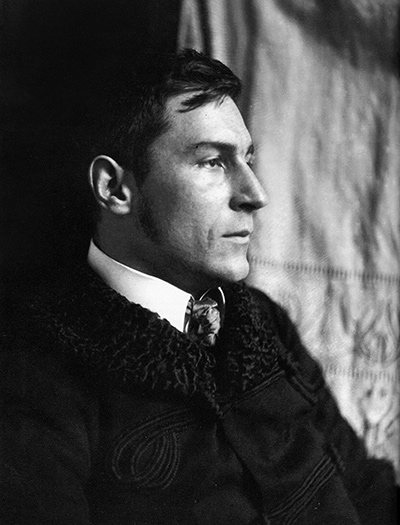
Franz Marc's horses are blue, his cows yellow, and his forests sometimes seem to have been built from panes of coloured glass. Yet the animals are recognisably alive. A horse lowers its head; a cow gathers itself into an improbable leap; two foxes seem to disappear into the red and orange shapes around them. Marc used these familiar creatures to ask how a painting might show more than a human observer's passing view of nature. Across a remarkably short mature career, he changed the answer again and again.
Marc was born in Munich in 1880 and died near Verdun in 1916. His most familiar paintings belong chiefly to the years between 1910 and the outbreak of the First World War in 1914. During that span, he moved from close study of animals in the Bavarian countryside towards radiant, increasingly fractured compositions. He also helped shape Der Blaue Reiter (The Blue Rider), the exhibition and publication project that brought a striking range of modern art before German audiences. The energy of his paintings can make their compressed history easy to miss: Blue Horse I, Yellow Cow, Tiger and The Fate of the Animals appeared within about three years of one another. [1] [2]
At a Glance
- Born8 February 1880, Munich [1]
- Died4 March 1916, near Verdun [3]
- Known forAnimal paintings and expressive colour [1]
- Artistic circleDer Blaue Reiter, 1911–12 [4]
- PlacesMunich, Lenggries, Sindelsdorf and Kochel [1]
Franz Marc in context
Die Brücke
German Expressionist group, 1905–13Cubism
Paris movement, 1907–14Der Blaue Reiter
exhibitions, almanac and circle, 1911–14Maria Franck-Marc
shared Bavarian working life, 1909–16August Macke
friendship and exchange, 1910–14Wassily Kandinsky
Blue Rider collaboration, 1911–12Robert Delaunay
Paris encounter, 1912Contents
- Looking at an animal painting
- From Munich to the Bavarian countryside
- What colour could do
- Der Blaue Reiter and the wider art world
- Eight works that open the story
- Drawings, prints and works on paper
- The last years and the paintings' later lives
- Article Author
- Four career stages
- Essential works
Follow Franz Marc's career through four stages
Learning to look beyond the academy
Marc studied in Munich and travelled to Paris in 1903 and 1907, testing French painting against his own close study of animals. [1].
Colour, friendship and an international almanac
Marc worked with Kandinsky and Macke around the Blue Rider exhibitions and the 1912 almanac. Paintings of horses, cows, forests and deer pushed colour and form in different directions. [4].
Essential works
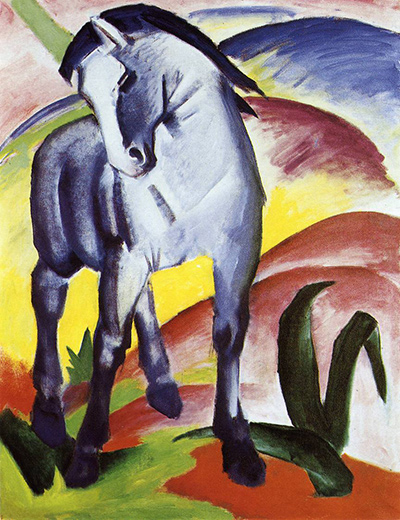
Blue Horse I
1911 · A solitary foal joins animal form to radiant colour.

Large Red Horses
1911 · Three grazing horses make one rhythmic group.
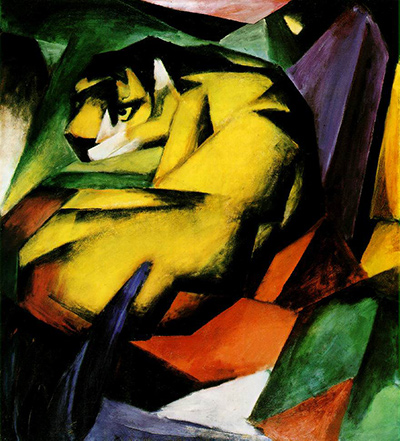
Tiger
1912 · A crouching body fits into a tense field of facets.
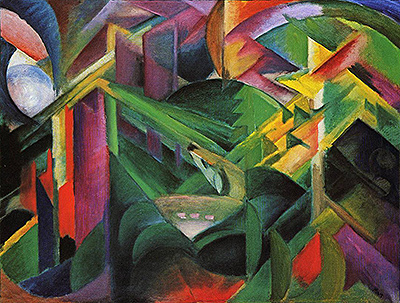
Deer in a Monastery Garden
1912 · A deer enters a moonlit network of colour.
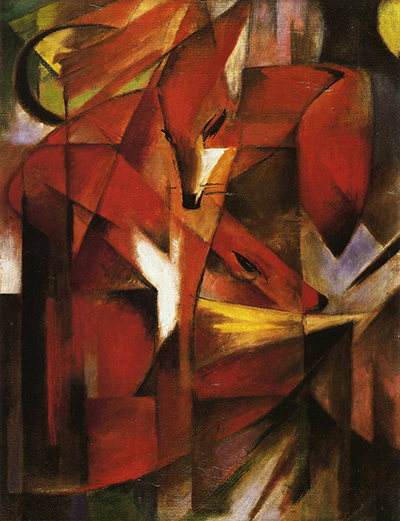
The Foxes
1913 · Animal bodies merge with a fractured red forest.
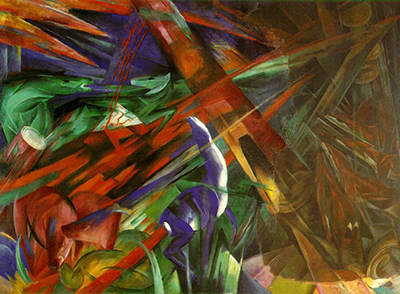
The Fate of the Animals
1913 · Creatures and trees meet in a forceful crossing.
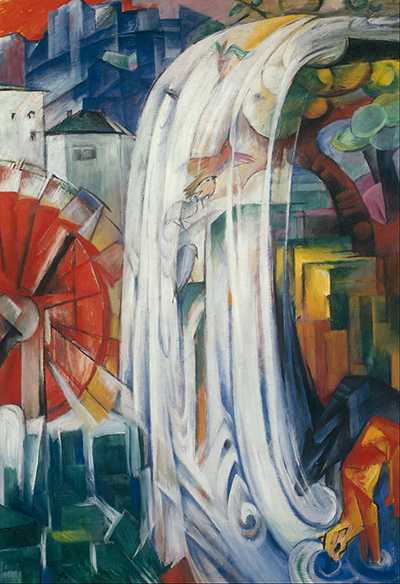
The Bewitched Mill
1913 · Buildings, water and plants interlock after a Tyrol journey.
Watch: Franz Marc
Explore Marc’s blue horses, the Blue Rider circle and the move towards abstraction in English-language videos.
Franz Marc, Blue Horses and Der Blaue Reiter
An English-language introduction to Marc’s blue horses, animals, spirituality and the Blue Rider.
Watch on YouTubeLooking at an animal painting
Start with the animal's posture. In Blue Horse I, the foal's head bends inward while its body rises almost the full height of the canvas. Its blue is concentrated and weighty; the hills and plants around it answer with reds, yellows, greens and violets. The horse occupies an imagined space made for the encounter of those forms and colours. Marc had watched and drawn horses for years, and the painting still depends on a felt knowledge of how one stands. What changed was his willingness to make its colour and setting serve the image's inner rhythm. The Lenbachhaus, which holds the painting, relates its inward-looking pose to an older tradition of contemplative figures in landscape. That is one art-historical reading of an image whose first invitation is simply to stop and follow the horse's curved neck and folded attention. [6]
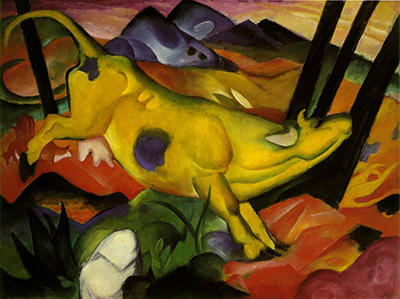
In Yellow Cow, made in the same year, the animal seems to burst across the canvas. Its back makes a long yellow arc, and its dark hooves flick outward against a landscape of blue hills and other bright zones. The Guggenheim's account of the painting connects its exuberance to Marc's developing ideas about colour. A visitor need not translate yellow into a single fixed meaning to see how the cow's leap, the sweep of its body and the surrounding colour shapes carry the sense of motion. The two 1911 paintings show how much variety Marc could find within his chosen subject: a poised solitary horse and an animal that appears to set the whole field in motion. [7] [8]
Marc's animals were never a simple category of charming subjects. He believed they could offer a way of imagining life beyond the human habits he found limiting. That belief is visible in the dignity and concentration he gave them, but the paintings do not all promise peace. The compressed body of Tiger feels ready to spring. In The Fate of the Animals, trees, creatures and shards of colour are caught in a violent crossing of lines. Its alternate English title, Animal Destinies, preserves the broad scope of the German Tierschicksale: the work is about a whole living world under strain. Marc painted it in 1913, before the war. Its later history and reception brought new meanings to the image without making it a deliberate prophecy. [9] [10]
In a note published among his writings and tentatively dated to 1911–12, Marc asked how a horse, eagle, deer or dog might see the world. He questioned the painter's habit of placing an animal inside a landscape made for human eyes. This was an artistic challenge rather than a claim that he could recover an animal's literal vision. It urged him to think about the surroundings as part of that creature's existence. The question helps explain why the relation between bodies and landscape grows so important in his work. In an early pasture painting, it can be a shared curve; in the later forest pictures, animal and setting can appear to be made of the same shifting planes. [11]
From Munich to the Bavarian countryside
Marc grew up in Munich, where his father Wilhelm was a painter. He studied at the city's art academy from 1900 to 1902 and travelled to Paris in 1903 and 1907. French painting offered possibilities beyond the academic training he had received, but the decisive setting for much of his own work was closer to home: the hills, fields and villages south of Munich. He spent time on the Staffelalm near Kochel and worked at Lenggries. By 1909 he was often painting in Sindelsdorf, and in 1910 he and the artist Maria Franck gave up their Munich studio base and settled there fully. These places mattered because they gave him sustained contact with animals and room to test how they could become the centre of a painting. [1] [5]
The earlier horse groups show a painter working through observation and arrangement. In the grazing horses of 1910, backs, necks and the lines of the land begin to form one continuous pattern. The animals are still embedded in pasture rather than set apart as icons of colour. In the 1911 Large Red Horses, the three horses have become a tightly joined rhythm of rounded bodies. Their red coats carry across the group as a deliberate pictorial force. The painting is also known as Grazing Horses IV, a title that places it within the series and helps distinguish it from the separate 1910 Grazing Horses III. [12] [13]
The choice of animals also grew from the company Marc kept. Maria Franck-Marc was a practising artist with her own work and place in the Munich avant-garde; she was present in the shared life from which many of these images emerged. In January 1910, August Macke visited Marc's studio. Their friendship became an exchange of paintings, ideas and searching letters. Macke connected Marc with the collector Bernhard Koehler, whose support gave the painter a more secure foundation. Marc's encounter with Wassily Kandinsky at the start of 1911 opened another close artistic partnership. The story of the blue horses is therefore also a story of conversations, disagreement, patronage and collaboration, not of an isolated painter discovering colour in the countryside. [1] [14] [5]
What colour could do
Marc's use of blue, yellow and red was deliberate, but it was also experimental. In a letter to Macke dated 12 December 1910, he set out personal associations: blue with a severe, spiritual masculine principle, yellow with a gentle and sensuous feminine one, and red with heavy matter. The letter goes on to consider what happens when colours meet and mix. Marc was thinking about relationships on a canvas as much as attaching labels to isolated colours. His terms reflect the gendered language and intellectual climate of his time; they do not supply an automatic translation for every blue animal or yellow field. [15]
He wanted colours to work together with force and clarity. The Franz Marc Museum describes his experiments with complementary contrasts and his use of a prism to test their optical effect. A patch of blue could intensify an orange beside it; violet and yellow might steady or disturb one another. Marc was absorbing ideas from contemporary colour study while judging them against what happened as he painted. In the snow pictures of 1910–11, white ground becomes a testing place for these relationships. By the time of Blue Horse I, colour helps hold the whole image together, from the animal to the hills around it. [16]
This is one reason his paintings reward slow looking. The first surprise of a blue horse soon gives way to smaller discoveries: how a flank echoes a hill, how the curve of a neck leads into another colour, or how several animals make one larger shape. The colour is expressive because it is organised. On the Style and Colour page, those experiments can be followed in greater detail, including the distance between what Marc wrote about colour and what individual paintings actually do.
Der Blaue Reiter and the wider art world
Marc and Kandinsky's partnership took public form in Der Blaue Reiter. Their first exhibition under that name opened in Munich in December 1911. A second exhibition, focused on graphic work, followed in 1912. They also edited an almanac published that May. Its pages brought together art from different times and cultures alongside essays, music and images by contemporary artists. Marc contributed writing and helped choose and present work; the project made visible an expansive idea of what modern art could learn from. The Blue Rider is best understood through these exhibitions, the almanac and the network around them, rather than as a club with a settled roster. [2] [4]
The exchange extended beyond Munich. Marc and Macke visited Robert Delaunay in Paris in 1912. Delaunay's colour and the possibilities opened by Cubism and Futurism added to Marc's growing interest in breaking a form into moving planes. In 1913, Marc and Macke advised the dealer Herwarth Walden on the selection and display of the First German Autumn Salon in Berlin. In these years Marc was making a deeply individual art while taking an active part in the exhibitions and arguments that shaped modernism around him. [1] [17]
His own work shows why those exchanges mattered. In Deer in a Monastery Garden, animals inhabit a setting of interlocking light and shade. In The Foxes, orange and red animals are harder to separate from the facets of the forest. The Bewitched Mill turns buildings, water and vegetation into a dense, animated field. The animals do not simply vanish as his art develops; their contours and the places they occupy become more closely woven together. His later compositions could approach abstraction without losing their roots in what he had seen and drawn. [18] [19] [20]
Eight works that open the story
These paintings make a useful path through Marc's changing art. Each has its own page, because the colour, structure and physical history of one work rarely explain the next.
- Blue Horse I (1911) — a solitary blue foal whose lowered head and upright body make a concentrated image of presence. The Lenbachhaus holds the painting, Blaues Pferd I, under accession G 13324. [6]
- Yellow Cow (1911) — a yellow animal leaps across a landscape whose blue and red zones seem to move with it. It belongs to the Guggenheim Museum's Founding Collection. [7]
- The Large Blue Horses (1911) — three horses form a sweeping group of blue bodies and curved lines. The painting is at the Walker Art Center in Minneapolis. [21]
- Tiger (1912) — the animal's compact body is fitted into a framework of yellow, black and green facets. This is the Lenbachhaus painting, distinct from Marc's woodcut also titled Tiger. [9] [22]
- The Fate of the Animals (1913) — creatures and trees meet in a forceful crossing of coloured forms. A 1917 fire and Paul Klee's 1919 repair are still part of the painting we see at Kunstmuseum Basel. [10]
- The Foxes (1913) — two foxes emerge from a red and orange forest of fractured planes. Its later provenance includes Nazi-era loss, restitution and a 2022 sale; the work has a story beyond its former Düsseldorf home. [19] [23]
- The Tower of Blue Horses (1913) — the great stacked-horse canvas is missing. Preparatory images and records preserve knowledge of its composition, while its fate after the Second World War remains uncertain. [24]
- Fighting Forms (1914) — large red and blue forms confront one another in a painting close to abstraction. It is held by the Bavarian State Painting Collections in Munich. The work's title invites interpretation; its colours do not establish that Marc painted a conscious prediction of war. [25]
The list shows both the familiarity and the range of Marc's work. It begins with the particular weight of a foal's body and ends with forms that can be read without identifying a particular animal. The progression is real, but it was never a straight line. Animal pictures, drawings and abstract experiments overlapped. The paintings catalogue lets a visitor follow the wider sequence and compare works of similar subject or title.
Drawings, prints and works on paper
Painting is only part of the story. Marc drew animals repeatedly, sometimes to study a pose and sometimes to test how a body might become an arrangement of lines. Sketchbooks, postcards and watercolours show ideas moving between small sheets and large canvases. A painted postcard of blue horses, for example, has its own history and must be distinguished from the missing Tower of Blue Horses painting. The drawings guide follows such works on paper and the questions they raise about preparation, experiment and finished images. [26] [27]
Printmaking gave Marc another kind of line. A woodcut is made by cutting away parts of a block, inking the remaining raised surface and pressing it onto paper. The medium's strong contrasts and repeated impressions could make an animal's outline both economical and forceful. The Franz Marc Museum's collection includes prints and blocks, while the Lenbachhaus records individual sheets such as The Birth of the Horses. A print with the same title as a painting is a distinct object, often with its own date, state and collection history. The prints page introduces the techniques and a route through the surviving work. [26] [28]
The last years and the paintings' later lives
By 1914 Marc was making compositions in which large colour forms seemed to contend across the whole surface. He bought a house in Kochel, but the war interrupted the life and work he had built. Marc served at the front; in 1915 he made thirty-six drawings in a field sketchbook. He died on 4 March 1916 during a reconnaissance ride near Verdun. His early belief that war might bring a renewal of culture is a difficult part of the historical record. The losses of the war, including Marc's own death, give that belief its full and painful context. [1] [17]
The paintings have continued to change in meaning and, at times, in physical appearance. Fire damaged The Fate of the Animals in 1917; Klee's repair remains visibly darker than Marc's surviving paint. The Tower of Blue Horses passed through Nationalgalerie ownership, Nazi confiscation and wartime control before disappearing from view. The Foxes was returned after a long provenance investigation and sold in 2022. These histories should not be folded into Marc's intentions, yet they affect what visitors can see, where a painting is held and how its story is told. [10] [24] [23]
Marc's career remains compelling because each of its bold changes began with the same demanding question: how could an animal and its world be made present in paint? His answer might be a quiet blue horse, a leaping cow, a forest of broken colour or a canvas that seems almost to have shed its visible subject. The biography follows the life behind those choices. The Blue Rider guide opens the circle of artists, exhibitions and ideas around him. Together with the artwork pages, they make room for the distinct stories carried by these unforgettable paintings.
Artwork Directory
This source-checked selection contains 192 identified works and print designs from the current Franz Marc research set. It is a curated selection, not a complete catalogue raisonné. Some works link to their article here; others link to a collection record. Unresolved identifications are omitted.
Discussion
Marc’s animal paintings change markedly in mood, scale and construction across his short career.
Reader Insights
Observation
Which posture stays with you most: the blue horse’s stillness, the cow’s leap or the tiger’s tension?
Comparison
How does a grouped horse painting organise movement differently from a single animal?
Interpretation
Where does colour feel most closely tied to the animal’s body rather than a fixed symbol?
Join the Conversation
Which detail changed the way you saw this work? Share a close observation or a comparison with another Marc picture.
References
- Lenbachhaus, Franz Marc biography. View source.
- Berlin State Museums, Blue Rider chronology. View source.
- German National Library, Franz Marc. View source.
- Lenbachhaus, Blue Rider collaboration. View source.
- Franz Marc Museum. View source.
- Lenbachhaus, Blaues Pferd I. View source.
- Solomon R. Guggenheim Museum, Yellow Cow. View source.
- Guggenheim teaching materials. View source.
- Lenbachhaus, Tiger. View source.
- Kunstmuseum Basel, Tierschicksale dossier. View source.
- Franz Marc, Briefe, Aufzeichnungen und Aphorismen, vol. 1, notes tentatively dated 1911–12. View source.
- Harvard Art Museums, Grazing Horses IV. View source.
- Sotheby's, Weidende Pferde III. View source.
- Lenbachhaus, Macke and Marc exhibition. View source.
- Marc to August Macke, 12 December 1910, German correspondence transcription. View source.
- Franz Marc Museum, colour-theory research. View source.
- Museo Nacional Thyssen-Bornemisza, Franz Marc. View source.
- Lenbachhaus, Deer in a Monastery Garden. View source.
- Christie's, The Foxes. View source.
- Art Institute of Chicago, The Bewitched Mill. View source.
- Walker Art Center. View source.
- Lenbachhaus woodcut. View source.
- German Lost Art Foundation. View source.
- Berlin State Museums dossier. View source.
- Pinakothek, Kämpfende Formen. View source.
- Franz Marc Museum, collection. View source.
- Franz Marc Museum, tower sketch. View source.
- Lenbachhaus, Geburt der Pferde. View source.
- Related artwork image, Yellow Cow: Photograph by Dr. Alexey Yakovlev; resized without crop or colour change, CC BY-SA 2.0.