by Tom Gurney
Tom Gurney BSc (Hons) is an art history expert with over 20 years experience
Published on June 19, 2020 / Updated on October 17, 2026
Email: tomgurney1@gmail.com / Phone: +44 7429 011000
Looking at Large Red Horses
Three horses fill Franz Marc’s Large Red Horses. The animal on the left turns its pale face towards us while lifting a foreleg. A second rises behind it, chest and neck extending upwards. The horse at the right lowers its head to the ground. Their red and orange bodies overlap in a triangular arrangement, with blue and violet manes set against green hills, yellow light and blue foreground shadows. Marc completed the painting in 1911. It is also known as The Red Horses and, in its series, as Grazing Horses IV—three names for one large canvas now held by Harvard Art Museums. [1] [2]
The German title is Weidende Pferde IV. The oil painting measures 121 × 183 cm and belongs to Harvard’s Busch-Reisinger Museum. Its width gives Marc room to join the three animals to a rolling landscape. The horse at the right grazes; the left one shifts its feet and turns; the central one looks outward and up. There is no brook and no uniform row of grazing heads. Their different gestures make the group active while the shared colour and repeated curves hold it together. [2] [3]
Three bodies, one rhythm
Begin with the left horse. Its reddish body bends in a broad arc from back to chest, while its head turns towards the viewer and its front leg rises above the warm ground. The blue-violet mane makes a sharp accent against its pale face. Behind it, the central horse extends upwards, breaking the low line of the distant hills. At right, the third horse bends so that its neck and mane lead the eye down into the blue foreground. Together their positions form a loose triangle, from the lifted central head to the two lower figures. The arrangement brings both steadiness and movement to the scene. [1] [2]
The hills repeat the animals’ curves. A green ridge rises behind the left horse; another carries the eye across the right. Dark green patches interrupt the slopes. In the foreground, bands of yellow, orange and blue seem to echo the horses’ changing colours. The picture does not isolate three animals on a neutral background. It makes their bodies and the land participate in one flowing design. Marc’s desire to understand animals within nature, rather than simply set them before a human-viewed landscape, is especially tangible here. That connection is an interpretation of what we can see, supported by his own questions about animal perception. [3] [4]
The painting’s red is more varied than its popular title suggests. Harvard’s conservation team found a fiery red on the left horse, a somewhat more orange red on the right, and a crimson to wine-red middle body with yellowish-brown hues. Blue, violet and very dark purple appear in the manes. These distinctions matter when looking at the group: the horses are related, but Marc did not colour them identically. The hues shift the visual weight of each animal and help separate overlapping forms. [2]

Franz Marc, Grazing Horses IV. Three red horses bend into a compact, repeated rhythm.
Watch: Franz Marc
Explore Marc’s blue horses, the Blue Rider circle and the move towards abstraction in English-language videos.
Franz Marc, Blue Horses and Der Blaue Reiter
An English-language introduction to Marc’s blue horses, animals, spirituality and the Blue Rider.
Watch on YouTubeFrom an idea to the painted canvas
This work is unusually well documented by a letter Marc sent Maria Franck on 2 February 1911. He described a large painting of three horses in a colourful landscape and included a sketch of the composition. The colours he envisaged were not exactly those that appear in the finished picture. He mentioned horses ranging from yellowish brown to violet, while the visible canvas gives its two outer horses much more forceful reds. The letter is valuable evidence of Marc’s thinking in progress, not a substitute for looking at the decisions he made with paint. [2]
Preparatory tempera studies also show fine pencil lines establishing a triangular design. The Harvard team used infrared imaging, x-radiography and close surface examination to see how that design reached the large canvas. A short underlying diagonal echoes the sketches. Two tiny holes pricked into fresh paint near the centre may relate to scaling and measuring the composition, perhaps using a pin and string. They suggest that Marc planned the placement carefully even as he left himself room to alter it. These are material traces, not marks a visitor is meant to see from across a gallery. [2]
The right horse changed during painting. Infrared and x-ray study found that one rear leg began in a straighter position and was later bent and moved to the right. Changes around its abdomen and other leg can also be seen. That adjustment affects how the grazing animal stands within the group and how its body balances the left-hand horse. Marc’s strong final arrangement was worked out through revision, not transferred perfectly from a completed diagram. [2]
The conservators found thicker paint on the two outer horses and traces of crimson at their contours. They consider it likely that all three were first painted closer to the violet-brown range Marc had described, before he strengthened the two outer animals into brighter red and orange-red. This is a well-supported technical interpretation, not a claim that every buried brushstroke has been mapped. It shows why the picture is a turning point: the famous red horses emerged through choices Marc made on the canvas itself. [2]
What the pigments reveal
Harvard’s analysis identified several colours Marc mentioned in his correspondence, including vermilion, cadmium yellow and cobalt blue in the foreground. The blue bush at left contains synthetic ultramarine with some cobalt blue, while deep green includes viridian. The outer horses owe much of their bright colour to vermilion mixed with yellow and likely orange pigments. These findings make the visual contrast between animal and landscape more concrete. Marc was not merely writing about pure colour as an idea; he selected and layered actual materials to give the landscape and bodies their force. [2]
Even the darkest passages are complicated. The conservators report that Marc did not use pure black for the painting’s dark areas; the horses’ eyes and deep contours are made with mixtures of coloured pigments. They also found different red lake pigments and investigated the way the paint layers interact. This does not mean every dark patch should be decoded pigment by pigment in ordinary viewing. It tells us that Marc’s colour relations continue within passages that may appear almost black in a small image. [2]
The study records selective varnishing too. Some parts of the landscape and the horses’ manes appear to have received natural resin varnish from Marc, while other regions were left duller. A later, overall synthetic varnish has made the present surface more uniformly glossy, reducing that original difference. The painting’s colour today is therefore the result of both Marc’s work and its material history. Conservation is not a footnote to interpretation: it helps us understand what can be seen now and where that appearance may differ from Marc’s intended contrasts. [2]
A fourth grazing-horse painting
The Roman numeral places the work in a series. Harvard’s conservators describe three earlier grazing-horse canvases from 1910. The first two use more naturalistic colour, while the third intensifies the landscape with brighter accents. Studies on paper trace Marc’s developing arrangement and palette. The fourth and largest canvas pushes that development into a full field of vivid colour and emphatic shapes. Its title “Red Horses” describes the result more immediately, but Grazing Horses IV preserves the relationship to the preceding experiments. [2]
Those earlier images should not be treated as copies with different paint. Marc was testing how horses could form a group and how the curves of their backs might relate to a hillside. In this 1911 work, the three bodies build one large shape across the canvas while remaining individually legible. The series offers a rare view of a subject changing as his artistic questions changed. That is why the technical evidence of sketch, pinholes, altered legs and changed colours matters: it turns a familiar picture into a record of decisions. [2] [5]
From Folkwang to Harvard
The painting was acquired by the Folkwang Museum in 1911. Nazi authorities removed it from that museum in 1937 as part of their campaign against modern art. It was offered through the 1939 Lucerne sale and passed to Paul E. Geier. After his death it went to Gabriele Geier. The work was on loan to Harvard’s Busch-Reisinger Museum from 1991 and entered its collection as a bequest in memory of Paul and Gabriele Geier in 2014, numbered 2014.301. This history explains both its current museum home and the long interval in which it could be seen there before formal accession. [1] [3]
The 1937 removal belongs to the painting’s history, but it does not replace its first, artistic story. Marc made a large, deliberate arrangement of three horses and a landscape, revised it as he worked, and chose colours stronger than those in his initial letter. Following the left horse’s turning head to the central raised neck and down the grazing animal at right reveals the rhythm he built. Following the reds into blue, green and yellow reveals how the animals belong to the whole field. Those two paths—through the bodies and through the colours—keep Large Red Horses lively far beyond its familiar title. [2] [1]
Artwork Directory
This source-checked selection contains 192 identified works and print designs from the current Franz Marc research set. It is a curated selection, not a complete catalogue raisonné. Some works link to their article here; others link to a collection record. Unresolved identifications are omitted.
Discussion
Three horses form a broad rhythm that Marc revised as he painted.
Reader Insights
Observation
How do the backs and lowered head carry your eye across the canvas?
Comparison
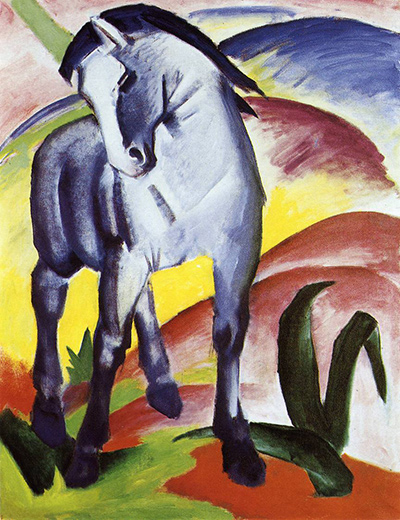
What changes when this group is set beside the single Blue Horse I?
Interpretation
How do the conservation findings complicate the idea of one fixed colour plan?
Join the Conversation
Which detail changed the way you saw this work? Share a close observation or a comparison with another Marc picture.
References
- Harvard Art Museums, Grazing Horses IV, 2014.301. View source.
- Harvard conservators, technical study, 2017. View source.
- Harvard, artwork image and credit. View source.
- Franz Marc, notes on how an animal sees the world. View source.
- Lenbachhaus, Marc biography. View source.
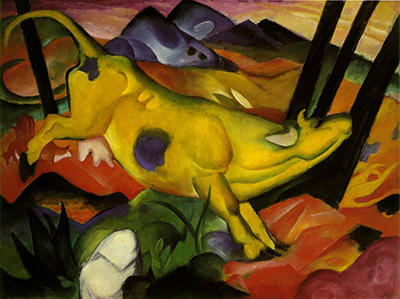
- Related artwork image, Yellow Cow: Photograph by Dr. Alexey Yakovlev; resized without crop or colour change, CC BY-SA 2.0.
- Splash image: Franz Marc, Grazing Horses IV (Large Red Horses), 1911. Harvard Art Museums, 2014.301. Public-domain Harvard-sourced image.