 by Tom Gurney
Tom Gurney BSc (Hons) is an art history expert with over 20 years experience
Published on June 19, 2020 / Updated on November 6, 2025
Email: tomgurney1@gmail.com / Phone: +44 7429 011000
Michelangelo: Sculpture, Painting, Architecture, Drawings and Poetry
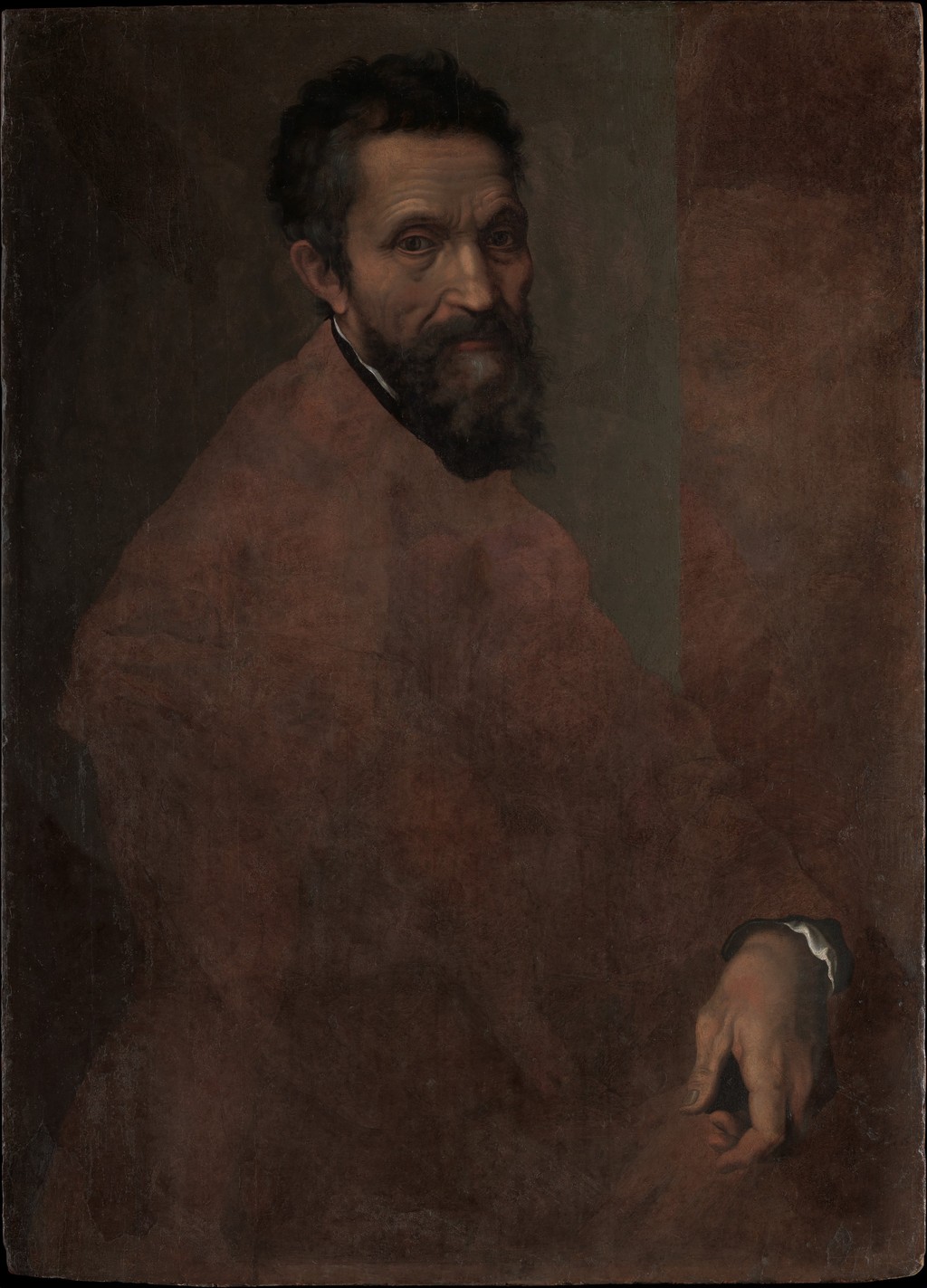
Michelangelo’s career cannot be contained by a single masterpiece or even a single art. The sculptor of David painted the Sistine ceiling, designed the Laurentian Library, reshaped St Peter’s Basilica, produced hundreds of drawings and wrote more than 300 poems. These achievements did not unfold as parallel displays of effortless genius. They competed for time, changed with patrons and sites, and often survived through assistants, builders, editors and conservators.
Born in 1475 and active until his death in 1564, Michelangelo moved between Florence and Rome across almost seven decades.[1][2] His world changed from Medici Florence to republican government, from Julius II’s confident papacy to Reformation conflict and Catholic reform. Marble remained central to his identity, but drawing—disegno as both mark and conception—linked figures, buildings and compositions across media.[1] The links matter. So do the differences.
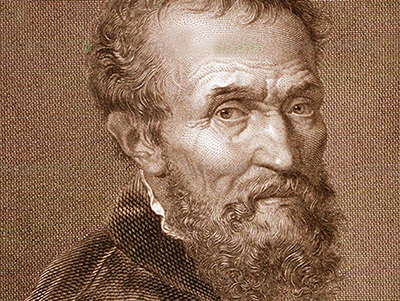
...of a nature rather divine than human.
At a Glance
- Full nameMichelangelo di Lodovico Buonarroti Simoni
- Born6 March 1475 in Caprese, within Florentine territory[2]
- Died18 February 1564 in Rome, shortly before his eighty-ninth birthday[2]
- Principal centresFlorence and Rome
- PracticesSculpture, painting, architecture, drawing and poetry
- TrainingDomenico Ghirlandaio’s workshop and the Medici garden environment associated with Bertoldo di Giovanni[2]
- Major patronsThe Florentine Republic, Medici rulers and popes including Julius II, Clement VII and Paul III
- Signature early worksMadonna of the Stairs, Battle of the Centaurs, Bacchus, Vatican Pietà and David
- Major painted worksDoni Tondo, Sistine ceiling, Last Judgement and Pauline Chapel frescoes
- Major architectural worksNew Sacristy, Laurentian Library, Capitoline Hill, Porta Pia and St Peter’s Basilica
- Central long projectThe repeatedly redesigned Tomb of Pope Julius II, 1505–45[12]
- Literary corpusMore than 300 poems in Italian, including drafts and fragments[17]
- Contemporary epithetIl divino, “the divine,” reflecting fame achieved during his lifetime[2]
- Working principleCross-media conception joined the arts, but material, site and authorship must be established work by work
Contents
- Why One Label Is Not Enough
- Disegno: Drawing and Conception
- A Career Already Famous in Its Own Time
- Childhood, Ghirlandaio and the Medici Garden
- Bacchus
- The Vatican Pietà
- David and the Reworked Block
- The Sistine Ceiling
- Creation of Adam
- Medici Florence and an Unbuilt Façade
- The Last Judgement
- Poetry
- Sculpture as Chosen Identity
- Architecture and Succession
- Eight Works with Which to Begin
Watch: Michelangelo in Context
This short TheHistoryOfArt video gives a compact visual introduction to Michelangelo across sculpture, painting and architecture, including David, the Sistine Chapel and the Vatican Pietà.[27]
Why One Label Is Not Enough
Michelangelo often identified with sculpture, and contemporaries recognised its centrality to him. Yet calling him simply a sculptor makes the Sistine Chapel an inexplicable interruption and treats three decades of architecture as secondary. His later architectural work at St Peter’s Basilica shows why the full career cannot be confined to one medium.
Calling him a universal artist can produce the opposite error. It may flatten all practices into one idea of genius, as though carving marble, painting wet plaster and directing a building were equivalent acts.
They are not. Marble is removed irreversibly. Fresco pigment bonds with drying plaster under daily time pressure. Architecture passes through drawings, models, masons and successors. Poems survive in drafts, copies and translations.
Michelangelo’s range becomes more impressive when these differences remain intact.
Disegno: Drawing and Conception
Renaissance disegno could signify physical drawing and the mental design underlying a work. The Metropolitan Museum uses this double meaning to explain Michelangelo’s movement among sculpture, painting and architecture.[1]
On paper he could test a torso, revise a tomb, calculate a building or prepare a gift drawing. A red-chalk body might contribute to a fresco; a ruled ink sheet could persuade a patron of an architectural scheme.
Drawing unifies the career procedurally, not stylistically. A rapid study and a finished presentation gift answer different needs.
It also reveals that monumentality was prepared through intimate labour. Colossal figures began as small adjustments of shoulder, hand and balance.
A Career Already Famous in Its Own Time
Michelangelo became the subject of biographies before his death. Giorgio Vasari published a life in 1550 and expanded it in 1568; Ascanio Condivi issued a separate account in 1553.
Such attention was extraordinary for a living artist. Praise as divino elevated him into a model of creative power.[2]
Lifetime fame is evidence, but it is not neutral fact about character. Biographers shaped events into stories of vocation, rivalry, difficulty and miraculous ability.
Modern understanding must use their testimony while testing it against contracts, letters, objects and sites. Legend began close to the man, not centuries later.
Documents Against the Solitary-Genius Myth
Casa Buonarroti joins works of art to the family archive. The archive contains 169 volumes of letters, contracts, accounts and domestic papers gathered by Michelangelo and his descendants.[3][4]
These records show marble being ordered and transported, payments negotiated, relatives supported, assistants managed and obligations disputed.
Administration does not explain artistic form by itself. It reveals the conditions under which form became possible.
The isolated genius of popular anecdote was also a correspondent, contractor, employer, debtor, creditor, family member and papal servant.
Childhood, Ghirlandaio and the Medici Garden
Michelangelo was born in Caprese, where his father held a temporary Florentine office. The family soon returned towards Florence.[2]
As a teenager he entered Domenico Ghirlandaio’s workshop. There he encountered large collaborative painting, drawing, tempera and fresco technique.[2]
Around 1490–91 he also studied in the Medici garden environment supervised by Bertoldo di Giovanni, where antique sculpture and recent Florentine art offered another education.[2]
Workshop and garden should not be made into rival origin myths. One gave technical and organisational formation; the other intensified sculptural and humanist study.
Michelangelo’s early practice grew from both living craft and celebrated precedent.
Madonna of the Stairs
Casa Buonarroti preserves the low-relief Madonna of the Stairs, made while Michelangelo was still very young.[3]
The Virgin sits in profile as the Child nurses or sleeps against her. Shallow carving compresses architecture and bodies into planes, revealing close engagement with Donatello.
Its quietness is structural rather than sentimental. Mary’s broad body contains the intimate act while steps and attendants open a distant spatial world.
The work shows Michelangelo learning through imitation that becomes transformation. Donatellesque relief supplies a language, not a formula.
Battle of the Centaurs
The Battle of the Centaurs, also at Casa Buonarroti, presents a dense knot of nude bodies in higher relief.[3]
Heads, backs and limbs overlap so tightly that individual combat is difficult to follow. The subject becomes an argument about bodily compression and violence.
Some surfaces remain rough or unresolved. It is tempting to see a fully formed philosophy of the unfinished in them.
The caution needed throughout Michelangelo begins here: an incomplete area can arise from interruption, changing intention, damage or deliberate retention. Surface alone does not always choose among them.
Bologna and the First Roman Breakthrough
Political upheaval drove Michelangelo from Florence in 1494. In Bologna he added figures to the shrine of Saint Dominic before reaching Rome.
His first Roman period produced Bacchus and the Vatican Pietà, two marbles whose differences resist a single youthful style.
One engages a pagan god through bodily instability and intoxication; the other transforms dead weight and maternal grief into polished devotional form.[5][6]
Rome offered antique sculpture, private patrons and papal ambition. Michelangelo responded without abandoning Florentine formation.
Bacchus
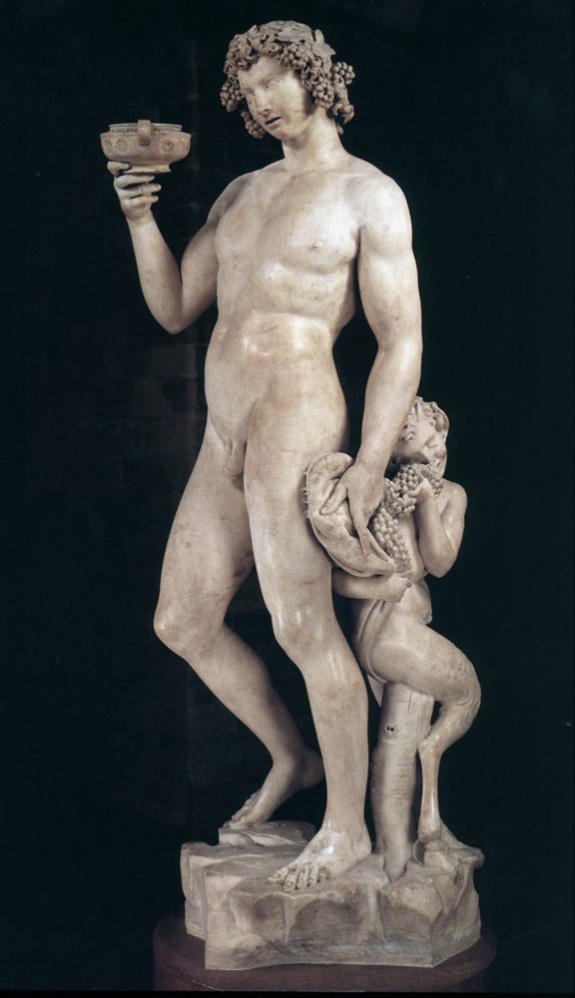
The Bargello’s Bacchus shows the wine god raising a cup while grapes and a small satyr animate the lower group.[5]
His abdomen softens, balance wavers and attention seems altered. Michelangelo’s answer to antiquity is not a sober reconstruction of ideal virtue.
The raised hand and cup are now missing, and other damage affects the pose.[5] Present condition must shape description.
The sculpture’s history also includes rejection or displacement from its first intended setting before entry into Medici possession.
Classical subject, modern invention and altered object coexist.
The Vatican Pietà
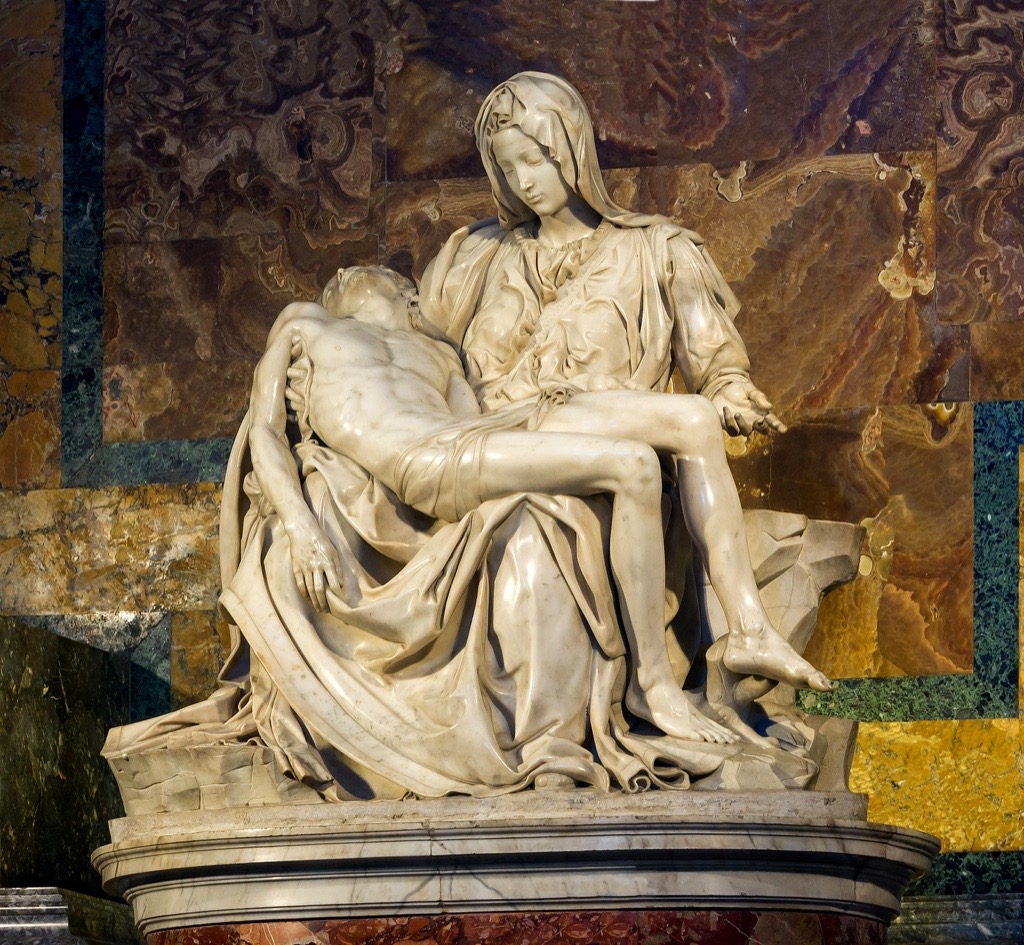
Commissioned for Cardinal Jean Bilhères de Lagraulas in the late 1490s, the Vatican Pietà places the dead Christ across Mary’s lap.[6]
Its pyramidal order, high polish and restrained grief made Michelangelo famous. The signature cut across the Virgin’s sash is unique among his surviving sculptures.
Mary’s youth and the relative scale of the bodies have inspired many explanations. The work’s devotional and funerary setting should precede claims about Michelangelo’s personal psychology.
It is also distinct from the later Bandini and Rondanini Pietàs. Shared subject does not make three marbles stages of one object.
David and the Reworked Block
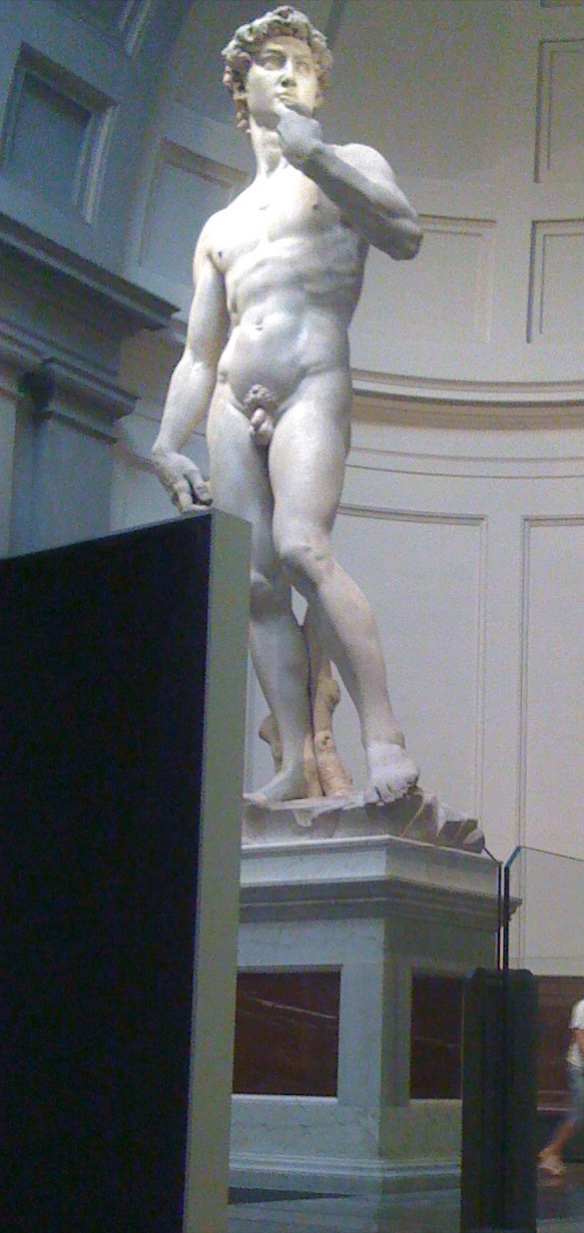
The marble assigned to Michelangelo in 1501 had already been attacked by earlier sculptors. The Accademia records this difficult material history.[7]
Michelangelo completed David in 1504. A committee decided that the more-than-five-metre figure should stand before the Palazzo della Signoria rather than high on Florence Cathedral as originally intended.[7]
Changing site changed meaning. The biblical youth became a civic emblem within republican space.
The giant Goliath is absent. Tension concentrates before action: turned head, held sling, enlarged hand and unequal distribution of weight.
The original now stands indoors at the Accademia, while replicas occupy later sites. Each viewing context is historically different.
The Battle of Cascina
For the Great Council Hall, Florence gave Michelangelo the Battle of Cascina commission while Leonardo was preparing the Battle of Anghiari.
Neither mural was completed, and Michelangelo’s full cartoon is lost.[1][2]
Surviving drawings and copies preserve groups of soldiers surprised while bathing and rushing to arms. They are evidence for the design, not fragments of the vanished painting.
The project became a school for younger artists who studied its male nudes. Its influence survived more securely than its intended public object.
Loss therefore changes the medium of reception: a mural known through paper and memory.
The Doni Tondo
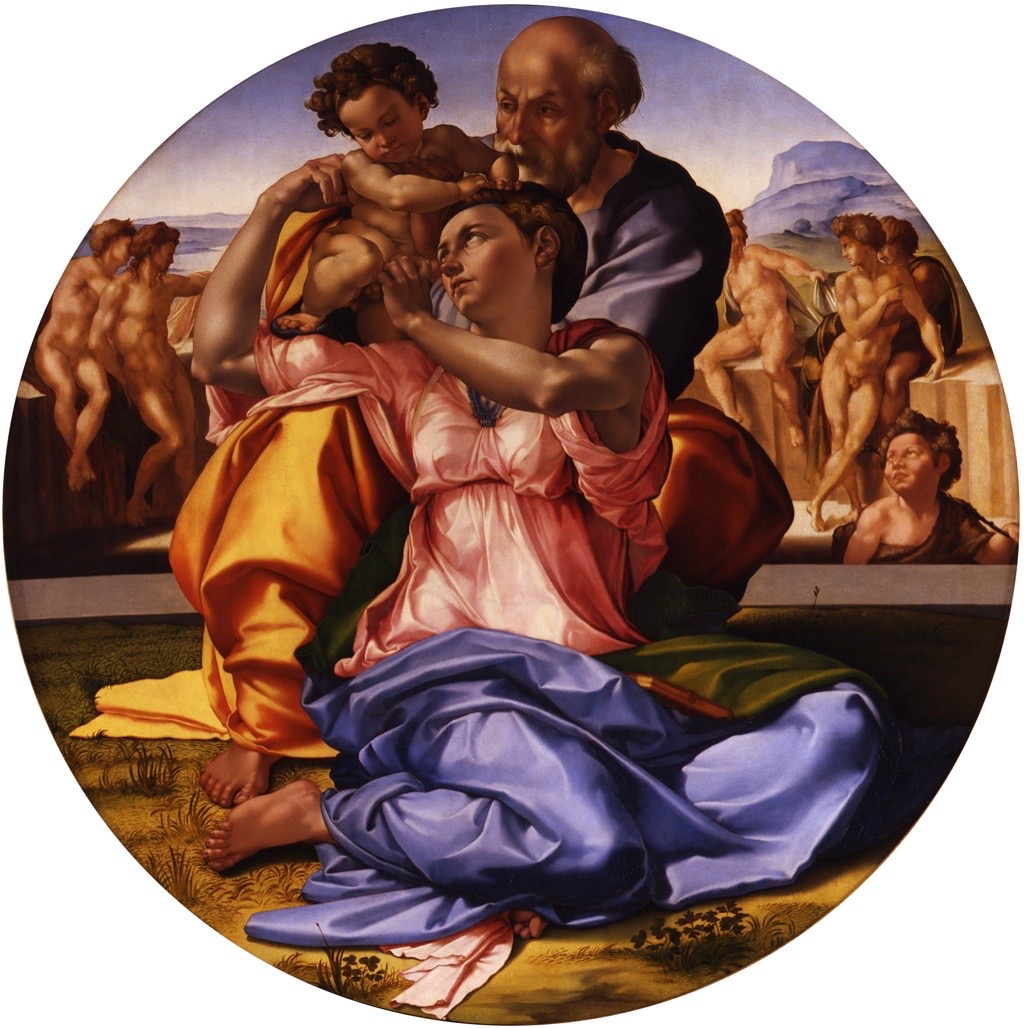
The Uffizi’s circular Holy Family, generally dated around 1505–06, is Michelangelo’s only surviving finished panel painting.[8]
Mary makes a forceful turn towards the Christ Child as Joseph completes the interlocked group. Nude youths occupy the background beyond a low barrier.
The painting uses tempera grassa, a rich tempera medium, and retains its elaborate carved frame.[8]
Its private domestic context, circular shape and panel technique separate it from the Sistine frescoes.
Competing explanations for the background nudes remain interpretations. The work is strongest when material and compositional facts precede a total symbolic code.
Julius II and the Tomb That Would Not End
Pope Julius II called Michelangelo to Rome in 1505 to design an immense funerary monument. Successive contracts reduced and altered it until a wall tomb was installed in San Pietro in Vincoli in 1545.[12]
The forty-year history involved changing sites, heirs, interruptions and dispersed sculptures. Michelangelo’s biographical tradition called it the tragedy of the tomb.
The first designs, later Slaves, Moses and final monument do not belong to one unchanging arrangement.
Each phase must be reconstructed on its own evidence. A sculpture associated with the project cannot be inserted automatically into every design.
The tomb exemplifies the career’s central friction between conception and obligation.
Patron network
Patrons, Institutions and Power Around Michelangelo
Michelangelo’s career moved through families, republics, popes, cardinals, institutions and friendships. This network keeps commission power separate from friendship, devotional exchange and later execution, so the homepage does not turn every relationship into a simple patronage story.
Medici family and San Lorenzo
Lorenzo’s circle shaped early formation; later Medici popes and institutions drew Michelangelo into San Lorenzo, the New Sacristy, the Laurentian Library and the unrealised façade.[2][14][15][21]
Florentine civic patrons
David became a public Florentine object through civic decision-making, placement and republican meaning, not merely through private artistic ambition.[7]
Julius II
Julius II anchors two enormous but different demands: the changing tomb project and the Sistine ceiling commission, whose routes must not be collapsed into one story.[9][12][13]
Leo X
Leo X’s San Lorenzo façade project shows patronage as competition, design, contract and material supply, with marble logistics becoming part of the work’s history.[21]
Clement VII and Paul III
The Last Judgement belongs to a later papal moment than the ceiling: Clement VII initiated the altar-wall project, and Paul III carried it forward.[11]
Papal Rome and St Peter’s
St Peter’s is an institutional project across many hands. Michelangelo’s role was decisive, but the dome and basilica must preserve later architectural authorship.[18][19]
Moses
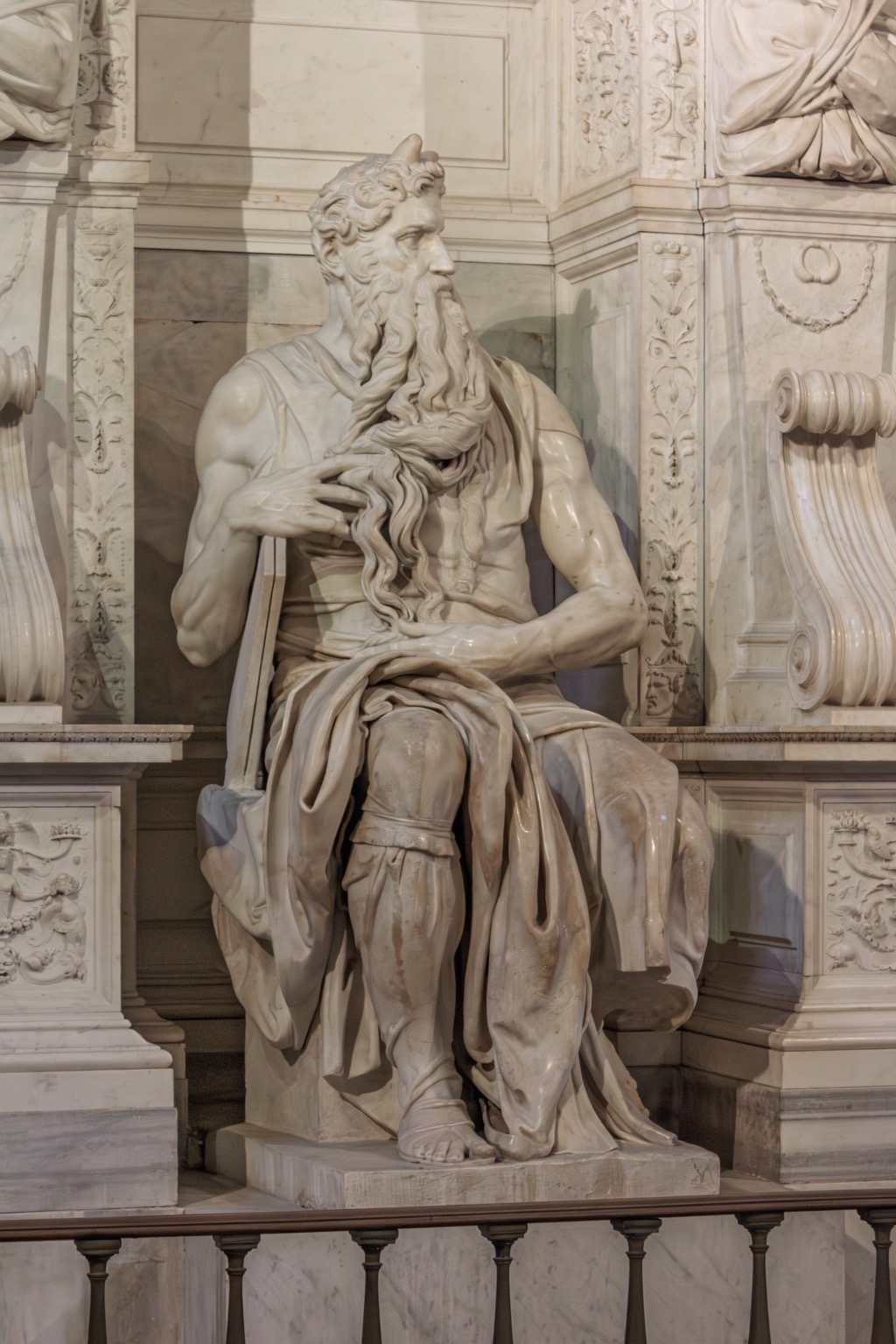
The seated Moses dominates the lower level of the final monument. Tablets rest under one arm; beard and drapery descend in powerful streams; the head turns as though attention has been suddenly seized.
Horns emerge from the brow. They belong to a long Latin translation and visual tradition around the radiance of Moses’s face after receiving the law, not to confusion over his identity.[13]
Later modification may have intensified the turn. The sculpture’s physical history belongs beside its iconography.
Moses is monumental enough to eclipse the tomb, but it should be seen as one part of a changing commemorative project.
The Slaves and the Attraction of the Unfinished
Two highly finished Slaves are in the Louvre; four rougher prisoners stand at the Accademia.
Their traditional names—Dying, Rebellious, Young, Bearded, Atlas and Awakening Slave—do not all come from Michelangelo.
The Florentine figures make carving stages visible: drill channels, point marks, rough masses and emerging bodies.
They have encouraged the seductive idea that Michelangelo simply liberated figures already present in stone. That metaphor illuminates experience but cannot replace contracts, dates and workshop procedure.
Not every rough surface was intended as a philosophical end.
The Sistine Chapel Before Michelangelo
The chapel was built and decorated under Sixtus IV. Perugino, Botticelli, Ghirlandaio, Cosimo Rosselli and collaborators painted the fifteenth-century wall cycles.[10]
Julius II commissioned Michelangelo to repaint the damaged or unsatisfactory vault. The 1508 undertaking expanded beyond an initial apostolic proposal.[9]
Recognising the earlier building prevents a common falsehood: Michelangelo did not create the entire Sistine Chapel.
His intervention entered an existing liturgical and artistic environment, then the later Last Judgement transformed the altar wall again.[10][11]
The monument is layered authorship across time.
The Sistine Ceiling
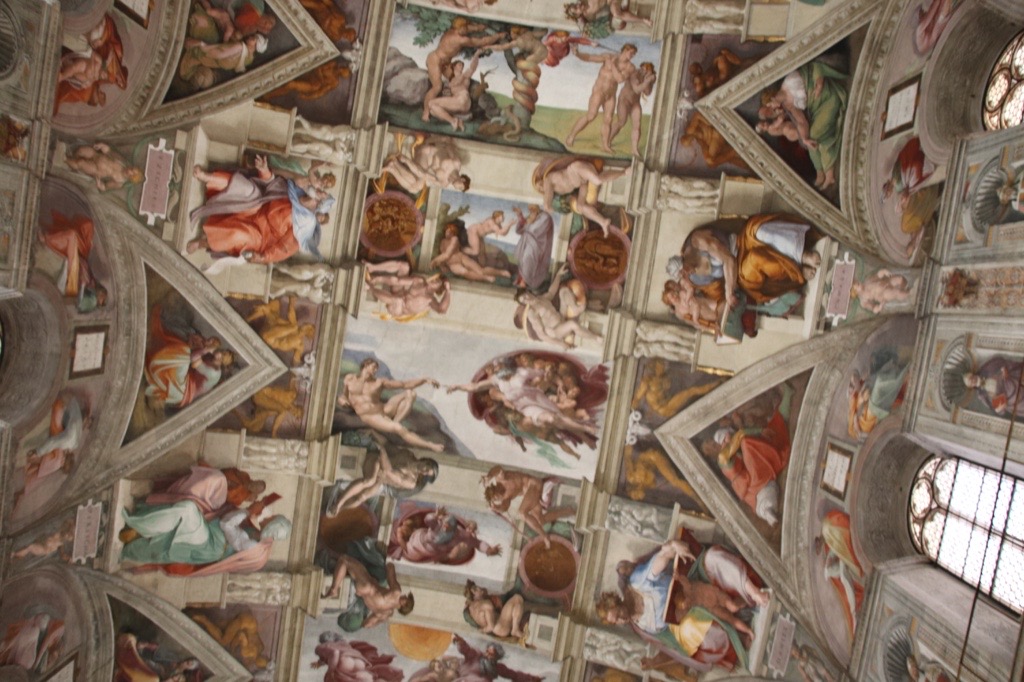
Michelangelo painted the ceiling between 1508 and 1512 in two broad campaigns.[9]
Nine Genesis histories occupy the central spine, moving among Noah, Adam and Eve, and Creation. Prophets and Sibyls sit around them; the Ancestors of Christ fill lower lunettes and spandrels; ignudi, medallions and corner narratives complete the structure.[9]
Painted architecture unifies this immense variety. Figure scale and colour change with hierarchy and viewpoint.
Preparatory drawings expose sustained study. The ceiling did not arrive as an untouched vision translated directly overhead.
Fresco demanded daily plaster sections and decisive execution, but decisiveness rested on preparation.
Creation of Adam
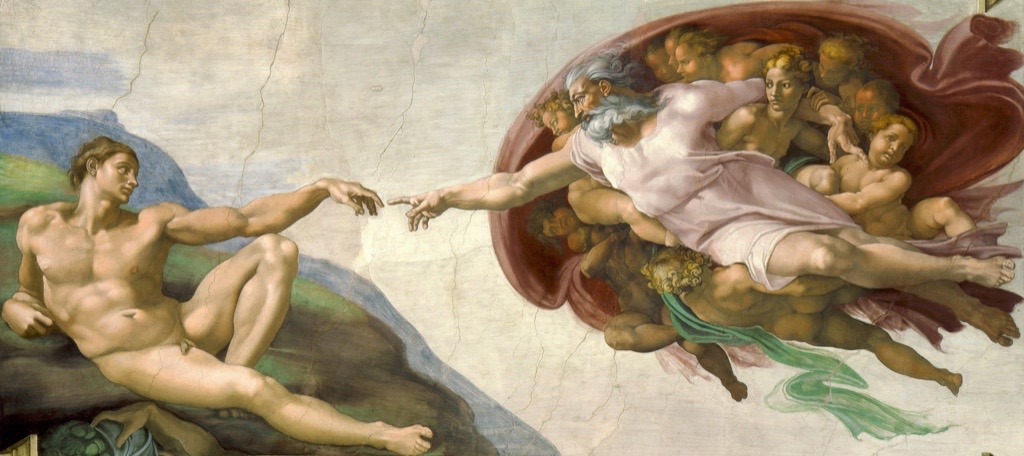
Creation of Adam is only one field within the ceiling, though it has become its most reproduced image.
Adam reclines on earth while God advances through a mantle crowded with figures. Their fingers approach without touching.
The charged interval conveys animation before contact. Space itself becomes the bearer of divine intention.
Isolating the hands can obscure the whole bodily relation: Adam’s languor, God’s rushing energy and the companions gathered around him.
Fame has turned a narrative moment into a universal emblem. Returning it to the vault restores sequence, scale and theology.
Prophets, Sibyls and Ancestors
Seven Hebrew prophets and five classical Sibyls sit in monumental alternation, joining scriptural revelation to Christian interpretations of pagan prophecy.[9]
Below them, the Ancestors of Christ inhabit family time. Name tablets identify genealogical fields without securely naming every adjacent person.
This difference matters. The seers are individualised sacred types; the families often remain anonymous in their fatigue, pregnancy, nursing and waiting.
Michelangelo’s ceiling can accommodate heroic revelation and ordinary continuation without reducing one to the other.
Medici Florence and an Unbuilt Façade
Under the Medici pope Leo X, Michelangelo returned to projects at San Lorenzo. A vast façade was planned and contracted but never built.
The surviving designs show architecture as sculpture-bearing public surface. Cancellation consumed years without leaving a monument on the church.
Failure to build should not erase the project’s importance. Drawings, models, quarrying and organisational labour shaped Michelangelo’s architectural development.
The façade also demonstrates that patronage by a powerful family could be unstable rather than easy.
The New Sacristy
The New Sacristy at San Lorenzo combines architecture and sculpture around Medici commemoration.[14]
Tombs for Giuliano, Duke of Nemours, and Lorenzo, Duke of Urbino, are paired with Night and Day, Dawn and Dusk. A Madonna and Child occupies the chapel, while Saints Cosmas and Damian were carved by collaborators.[14]
The younger dukes must not be confused with their more famous namesakes Lorenzo the Magnificent and Giuliano murdered in 1478.
Michelangelo left Florence in 1534 before installation was complete. Later hands helped form the ensemble now seen.
Authorship belongs to design, carving, collaboration and afterlife in unequal proportions.
The Laurentian Library
The library at San Lorenzo joins a long reading room to a dramatically compressed vestibule.[15]
In the vestibule, paired columns appear embedded in walls while brackets, blind openings and layered architectural members create pressure. The staircase flows into the centre as both passage and object.
The reading room is calmer and more horizontal, organised for books, desks and light.
Michelangelo designed and directed parts of the complex, but later builders interpreted and completed work after his departure.[15]
Architecture makes authorship temporal. A building can remain Michelangelesque while containing decisions made by others.
Florence, Exile and Permanent Rome
Political crisis defined Michelangelo’s final Florentine years. During the siege of 1529–30 he worked on defensive fortifications for the republic, then negotiated survival after Medici restoration.
He left Florence permanently in 1534. Rome became his home for the final three decades.[2][16]
The move did not end Florentine obligations or family ties. Nor did it begin religious concern from nothing.
It did concentrate late painting, architecture, drawing and poetry within a changing papal city.
The Last Judgement
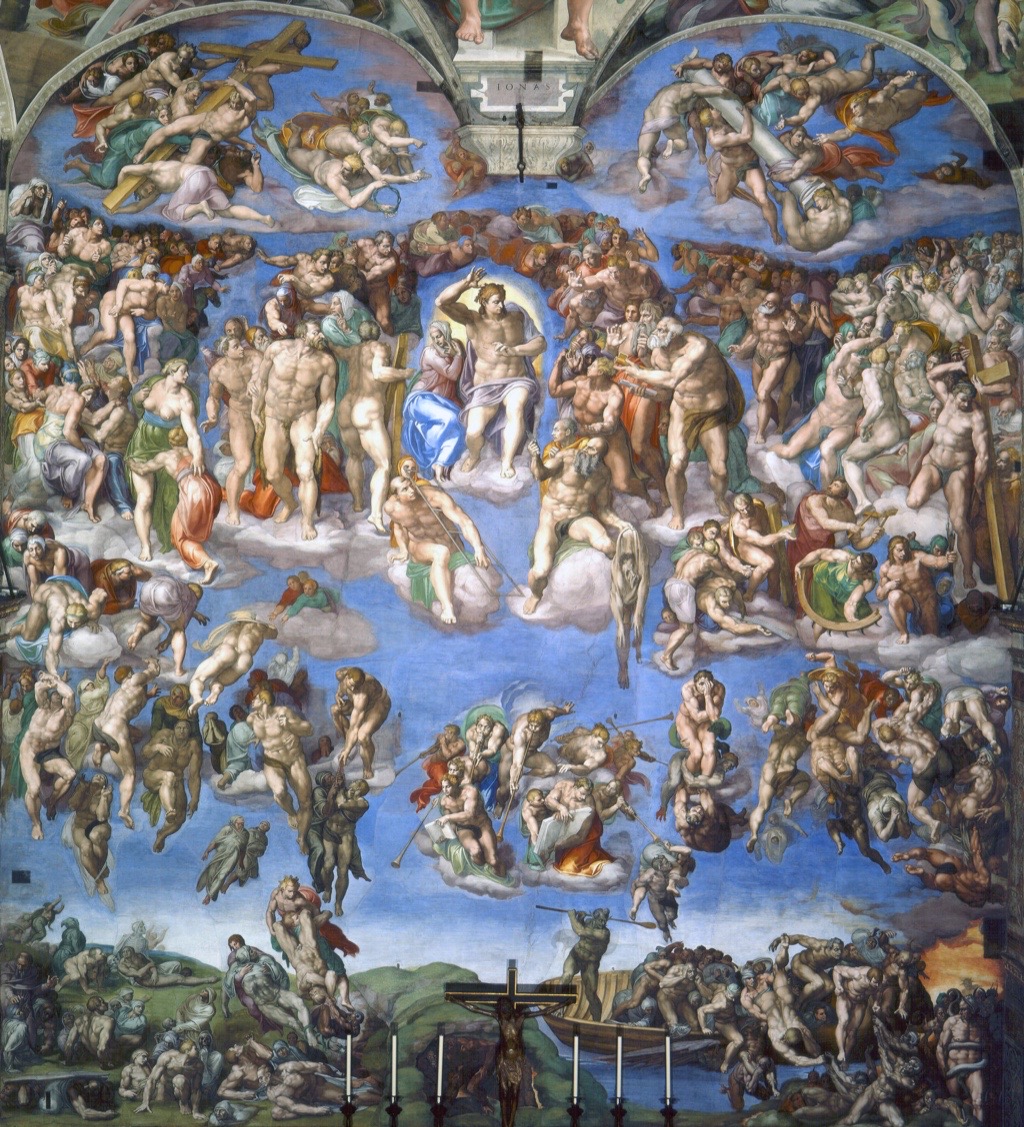
Commissioned initially under Clement VII and carried out under Paul III, the Last Judgement covers the Sistine altar wall. Michelangelo painted it between 1536 and 1541.[11]
Christ occupies the centre within a vast circulation of saints, risen bodies, angels and damned souls. The ceiling’s clear compartments have disappeared.
The fresco altered earlier chapel decoration and later underwent censorship through painted coverings, especially after Michelangelo’s death.[11]
Restoration has changed what modern viewers see again.
The work’s history therefore includes original fresco, institutional controversy, intervention and conservation.
The Pauline Chapel
Michelangelo’s final frescoes face one another in the Pauline Chapel: The Conversion of Saul and The Crucifixion of Saint Peter.
Painted during the 1540s, they replace the ceiling’s youthful clarity with crowded, unstable movement. An older Saul collapses beneath descending Christ; Peter turns outward as his inverted cross is raised.
The narrow private chapel requires oblique and moving viewpoints. Flat reproduction can make the compositions appear more disordered than they are in place.
These works are not weakened repetitions of the Sistine. They pursue calling, martyrdom and late bodily strain in another space.
Vittoria Colonna and Tommaso de’ Cavalieri
Michelangelo’s late decades were shaped by different intimate friendships. Cavalieri received passionate poems and elaborate presentation drawings. Colonna, already an accomplished poet, exchanged religious verse, letters and devotional ideas with him.[16]
Their roles should not be collapsed. Cavalieri belongs centrally to male-directed desire, classical myth and lasting friendship. Colonna belongs to poetic equality, reform spirituality and religious image exchange.
Neither relationship permits unsupported claims about private conduct.
Together they show that Michelangelo’s creativity operated through conversation and gifts as well as commissions.
Poetry
More than 300 poems survive in Italian, including sonnets, madrigals, epitaphs, drafts and fragments.[17]
They address love, male beauty, artistic making, faith, civic life, age and death. Sculptural metaphors allow mind, hand and stone to become emotional agents.
The poems are not transparent diary entries. Literary form and revision shape the first-person voice.
Early publication also changed them: Michelangelo’s grandnephew altered male pronouns and other wording in 1623. Modern English versions depend on named translators.
Poetry belongs to the career’s centre because it reveals another sustained practice of making.
Presentation Drawings
In the 1530s Michelangelo created highly finished chalk drawings as gifts. Mythological works for Cavalieri and religious compositions associated with Colonna were complete objects, not merely workshop preparation.[16]
Their intimacy encouraged close, repeated contemplation. Copies soon circulated some designs beyond the original recipient.
Other presentation works include ideal heads and the Cleopatra later surrendered by Cavalieri to the Medici.
These sheets complicate the division between public monument and private study. A drawing small enough to hold could carry ambition equal to a sculpture.
Drawings Beyond Preparation
Michelangelo’s drawings include rapid pen notations, black- and red-chalk figure studies, architectural plans, full-scale cartoons and sheets refined for presentation. Treating all of them as preliminary stages misses differences of purpose and finish.[1]
A study for a Sibyl may isolate a shoulder or twist so that the body can be understood before fresco painting. An architectural sketch may place several alternatives on one sheet, preserving decisions that a completed wall conceals. A presentation drawing, by contrast, may be the intended gift and finished work.
Survival is uneven. Early biographers associated Michelangelo with the destruction of drawings, and the surviving record suggests strong control over what left his possession. That history has encouraged romantic claims that every lost sheet was deliberately burned to hide effort. The evidence supports caution: some works were destroyed, while accident, workshop use, dispersal and time also reduced the corpus.[1][2]
The remaining sheets are precious because they resist the legend of instant creation. Repeated contours, altered limbs, pasted corrections and reused paper show thought proceeding through trial. Even a confident line belongs to a sequence of choices.
Drawings also carry afterlives. Pupils, collectors and engravers copied prized inventions. A copied composition may preserve a lost idea without preserving Michelangelo’s hand. Attribution therefore depends on material, technique, provenance and comparison rather than fame of design alone.
Painting Beyond the Sistine Chapel
The Sistine works are so dominant that Michelangelo’s smaller painted corpus can appear to consist only of a youthful panel and disputed remnants. Its scarcity deserves explanation rather than neglect.
The Doni Tondo demonstrates complete command of panel painting at a moment when Florence was intensely competitive.[8] Its dense interlocking bodies and saturated colour anticipate no single later work, but they establish that Michelangelo’s painting was not born suddenly on the Sistine scaffold.
The unfinished Manchester Madonna and Entombment in the National Gallery have long occupied complex debates over authorship and workshop participation. They are useful precisely because they reveal how difficult it is to separate a young master’s invention from execution by other hands when the surface remains incomplete.
The lost Battle of Cascina cartoon belongs to painting even though the mural was never realised. Copies and prints spread its wrestling nude soldiers through sixteenth-century art. An absent wall could exert influence through a paper design.
At the opposite end of the career, the Pauline Chapel frescoes are often viewed after the ceiling and Last Judgement, as though late style were merely decline. Their restricted site, oblique sightlines and themes of conversion and martyrdom produce a harsher visual language adapted to a private papal chapel.[16]
The painted career is therefore not a straight ascent to one ceiling. It includes portable object, unrealised civic project, vast public fresco and difficult late devotion, each governed by another material and audience.
Sculpture as Chosen Identity
Michelangelo’s identification with sculpture was both personal conviction and public construction. The chisel offered a language of force, resistance and release that entered his poems and the accounts of his life. Yet “sculptor” did not mean that every marble followed one technique or ideal.
Relief allowed him to work through different depths. The youthful Madonna of the Stairs uses extraordinarily shallow carving, whereas the Battle of the Centaurs turns a block into a compact field of projecting bodies.[5] Free-standing works such as Bacchus and David pose different problems of balance, viewing and public presence.
The Vatican Pietà converts a monumental subject into highly finished surfaces and a stable pyramidal group.[6] Decades later, the Bandini and Rondanini groups expose recutting, damage and radical reconsideration. Their roughness does not represent an unchanging preference finally revealed in old age; it belongs to distinct histories of making and abandonment.
Marble itself was never passive. Block dimensions, flaws, transport and previous cutting limited invention. Michelangelo could exploit an already worked block for David, reject material he considered unsuitable, or alter a figure after substantial carving.
Assistants complicate the identity further. Quarry workers, transporters, roughing-out specialists and studio hands made monumental sculpture possible. Michelangelo guarded conception and often asserted direct control, but the social labour surrounding stone remained essential.
To call him a sculptor, then, is meaningful when it names an enduring artistic commitment. It becomes misleading when used to diminish the scale of his painting, architecture, drawing or poetry.
Marble to masterpiece
How Michelangelo Turned Marble into Sculpture
Michelangelo’s marble sculpture was not magic performed after inspiration. It moved through design, block choice, contracts, transport, roughing out, finishing and sometimes interruption. This process feature keeps the romance of the chisel tied to source-backed object histories.
Design before stone
Drawings and models could organise figures before carving, but each surviving sculpture still has to be read as an object with its own evidence and later history.[1][12]
Choose and move marble
Quarries, contracts and transport mattered. The San Lorenzo façade project shows how Carrara and Pietrasanta marble logistics could shape, delay or derail ambition.[21]
Find the figure in the block
David began with a difficult Cathedral block already worked by earlier sculptors; Michelangelo’s solution turned constraint into civic monument.[7]
Architecture and Succession
Michelangelo entered architecture through an artist’s command of drawing, model-making and sculptural form, then became responsible for projects that could not be completed by one lifetime.
The New Sacristy and Laurentian Library join architectural enclosure to furniture, sculpture and movement. Their long execution already required others to interpret plans and settle details after Michelangelo left Florence.[14][15]
In Rome, succession became unavoidable. The Capitoline ensemble developed across centuries. Porta Pia was altered. At St Peter’s, Michelangelo inherited competing schemes, reorganised the central body and advanced the drum, while Giacomo della Porta and Domenico Fontana completed a modified dome after his death.[18]
This does not dissolve individual authorship. A changed building can still preserve a decisive spatial conception, structural choice or profile. But naming Michelangelo as architect should begin rather than end the inquiry: which stage, which drawing, which built fabric and which successor are involved?
Architecture also changes the scale of patronage. A statue may be moved, but a basilica or civic piazza is bound to institutions, ritual, traffic, finance and generations of builders. Design becomes an argument carried forward by people who may never have met its originator.
Michelangelo’s late buildings reveal a creator increasingly powerful yet dependent on continuity. Their survival rests on the capacity of others to translate incomplete instructions into stone, brick and urban space.
Across media
Michelangelo Across Sculpture, Painting, Architecture, Drawing and Poetry
Michelangelo is easiest to flatten into one label: sculptor, ceiling painter, architect, genius. The source record is more useful than that. He worked across materials and forms, but each medium demanded different evidence, constraints and kinds of authorship.
Sculpture
Marble gave Michelangelo fame from early Rome to late Milan, but polished, damaged, unfinished and recut surfaces require different readings.[3][6][23]
Painting
The Sistine ceiling and Last Judgement belong to Vatican fresco campaigns, while the Doni Tondo is a rare finished panel painting with its own domestic format.[8][9][11]
Architecture
Architecture depended on drawings, models, builders and successors. St Peter’s and the Laurentian Library need Michelangelo’s design separated from later execution.[15][18]
Architect of St Peter’s
Paul III appointed Michelangelo to lead work at St Peter’s in 1546. He inherited a building shaped by Bramante, Raphael, Antonio da Sangallo the Younger and others.
Michelangelo simplified and strengthened the centralised design, brought construction of the eastern arm and drum forward, and prepared the dome’s essential conception.[18]
He did not complete the basilica alone. Giacomo della Porta and Domenico Fontana built the dome after his death, modifying aspects while preserving the fundamental double-shell scheme.[18]
St Peter’s is exemplary multi-generational authorship. Michelangelo’s intervention was decisive within a history larger than any one architect.
The Capitoline Hill and Rome as Design
Michelangelo reorganised the Capitoline ensemble through the placement of the ancient equestrian Marcus Aurelius, a trapezoidal piazza, building façades and a broad approach.
Much was executed over long periods by others. The famous pavement was completed centuries later.
The project shows architecture expanding into urban choreography. Buildings, statue, ground pattern and movement belong to one design.
Late Michelangelo did not abandon bodies for abstract structure. He began directing the body of the visitor through civic space.
Porta Pia and Late Invention
Porta Pia, begun for Pius IV, converts a city gate into an architectural mask of extraordinary compression.
Broken conventions, layered openings and unexpected details make the wall seem active. Later rebuilding and additions changed the structure.
As with the Laurentian vestibule, architectural members act less like a calm grammar than forces pressing against one another.
Late invention is not exhausted or purely solemn. It can be witty, excessive and experimental.
The Bandini Pietà
The four-figure Florentine or Bandini Pietà brings the dead Christ together with Nicodemus, the Virgin and Mary Magdalene.
Michelangelo worked on it for himself rather than under an ordinary public commission, then attacked and abandoned parts of the marble. Tiberio Calcagni later intervened.
Nicodemus’s face is often associated with Michelangelo’s own features, but self-portrait language should remain qualified.
The sculpture’s breakage, repair and multiple hands are not distractions from meaning. They are the conditions of the object now seen.
The Rondanini Pietà
Michelangelo continued revising the Rondanini Pietà near the end of his life. Earlier forms were cut down as he transformed the relation between Mary and Christ.
The figures fuse into a narrow, elongated group far removed from the polish of the Vatican Pietà.
Its unfinished state invites spiritual interpretation, especially surrender of physical perfection. Yet death interrupted work, and earlier stages remain physically embedded.
The marble is both last meditation and active recarving. It cannot be made to prove one final intention Michelangelo never declared complete.
Collaboration and Unequal Authorship
Michelangelo designed works executed partly by Sebastiano del Piombo, Marcello Venusti, assistants, stonecutters and architects. He also inherited buildings and left designs for successors.
Association must be stated precisely. “By Michelangelo” can mean carved by him, drawn by him, designed under his direction or transformed from his concept. These are not equivalent.
The New Sacristy saints, Minerva Christ, St Peter’s dome and many architectural details require named collaborators.
Precision does not diminish Michelangelo. It reveals how authority operated across workshops and time.
Unfinished Does Not Mean One Thing
The visible roughness of Michelangelo’s sculptures has become a major part of modern admiration.
Different works, however, stopped for different reasons: faulty marble, changed contracts, political interruption, dissatisfaction, deliberate revision, transfer to another hand or death.
The Italian term non-finito describes an aesthetic of incompletion but can conceal those histories when applied universally.
Close looking should ask what tools and stages remain, then turn to documentation.
The emerging figure is a powerful metaphor. It is not a substitute for evidence.
Works Altered After Michelangelo
Damage, censorship, restoration and relocation have changed many works.
The Vatican Pietà was attacked in 1972 and restored. David moved indoors in the nineteenth century. The Last Judgement received painted coverings. Bacchus lost limbs. The Julius tomb was repeatedly redesigned before later conservation.
A work’s present appearance is historical, not timeless.
Restoration may reveal colour or reintegrate losses, but it also introduces decisions about what to remove, retain and reconstruct.
The object encountered now carries both Michelangelo and its survival.
Florence
Florence preserves the greatest concentration of Michelangelo’s early and middle career.
Casa Buonarroti holds the early reliefs and major drawings. The Accademia holds David, Saint Matthew and four Slaves. The Bargello preserves Bacchus, Brutus, David-Apollo and other sculptures. The Uffizi holds the Doni Tondo.
San Lorenzo brings together the New Sacristy and Laurentian Library, while Santa Croce contains Michelangelo’s tomb.
These sites are not interchangeable museum containers. Civic square, family chapel, library and domestic collection give works different social lives.
Rome and Vatican City
The Sistine Chapel holds the ceiling and Last Judgement; the Pauline Chapel preserves the final frescoes. San Pietro in Vincoli contains the reduced Julius monument and Moses.
St Peter’s joins the youthful Vatican Pietà to the architectural impact of Michelangelo’s last decades.[6][19]
The Capitoline Hill and Porta Pia extend his presence into civic and defensive Rome.
No itinerary should treat these as one chronological corridor. They range from the 1490s to projects realised after his death.
Beyond Florence and Rome
Milan’s Castello Sforzesco holds the Rondanini Pietà. Bruges preserves the Madonna and Child. Paris holds the Louvre Slaves. London, Windsor, Oxford, New York, Haarlem, Vienna and Berlin contain major drawings.
Movement occurred for many reasons: gift, inheritance, sale, political transfer, collecting and protection.
A drawing’s current museum may be far from the project it prepared. A sculpture may have remained in its intended church or travelled across Europe.
Geography is part of object history, not merely visitor information.
Historical map annotation
Michelangelo’s Italy: Places Across a Lifetime
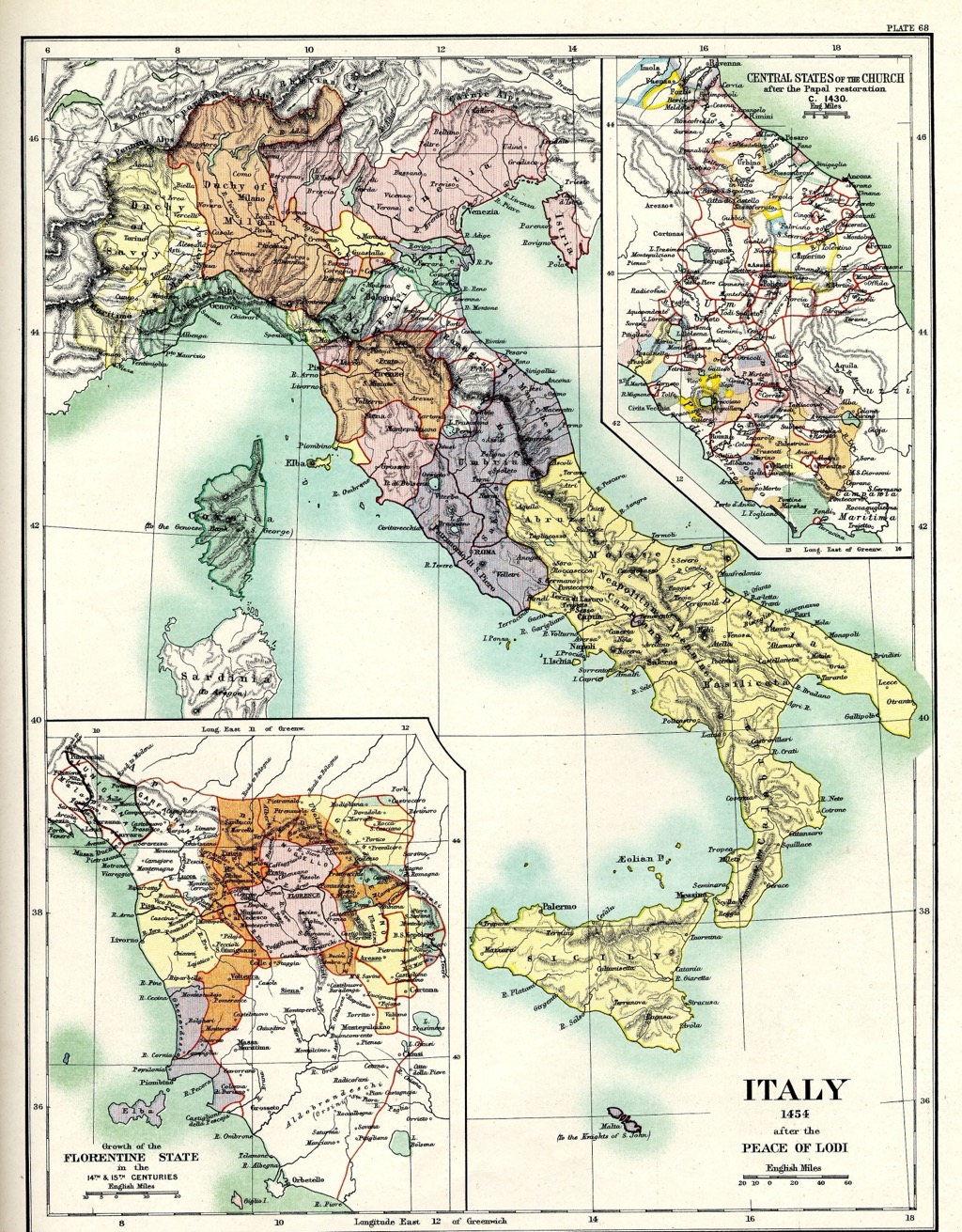
This annotated map uses Reginald Lane Poole’s 1902 atlas plate of Italy in 1454, after the Peace of Lodi, as historical background for the political geography Michelangelo inherited. The map predates Michelangelo’s birth in 1475, so the pins trace career places across his later life rather than claiming that 1454 borders stayed fixed for the whole period.[29]
 1
2
3
4
5
6
1
2
3
4
5
6
The map shows Italy shortly before Michelangelo’s lifetime. The city cards below follow his later travels and commissions across Florence, Bologna, Rome, Carrara and Siena.
Eight Works with Which to Begin
How to Approach Any Michelangelo Work
Start with six questions:
1. What physical object or building is this? 2. What material and technique does it use? 3. Who commissioned it, and did that commission change? 4. Which parts did Michelangelo make, design or supervise? 5. What later intervention or relocation affects it? 6. Which meanings are documented, traditional, proposed or disputed?
Only then ask how the work connects to the larger career.
This order prevents fame from becoming evidence and analogy from becoming attribution.
Three Great Masters
Leonardo, Michelangelo and Raphael Compared
The three names are often grouped as if they made the same kind of art. A useful comparison does the opposite: it shows where their careers overlap in Florence, Rome and High Renaissance culture, while keeping their media, patrons and surviving evidence distinct.
Leonardo da Vinci
1452–1519 · Vinci, Florence, Milan, France- Principal identity
- Painter, draughtsman, designer and engineer whose work ranged from workshop painting to court service and scientific inquiry.[24]
- Signature route
- Mona Lisa and The Last Supper anchor the public route into his art.
- Role in comparison
- Leonardo tests knowledge through observation, drawing, invention and painting, often leaving projects unfinished or dispersed.
Michelangelo
1475–1564 · Florence, Rome, Vatican City- Principal identity
- Sculptor, painter, architect, draughtsman and poet, with marble and disegno running through many different commissions.[1][17]
- Signature route
- David, the Sistine Chapel and St Peter’s Basilica show the range.
- Role in comparison
- Michelangelo makes the body monumental across stone, fresco, architecture and poetry, but each medium keeps its own constraints.
Raphael
1483–1520 · Urbino, Florence, Rome- Principal identity
- High Renaissance painter and designer whose short career moved from Urbino and Florence to papal Rome.[25]
- Signature route
- School of Athens is the key Vatican route; Sistine Madonna anchors later fame.
- Role in comparison
- Raphael clarifies harmony, intellectual order and workshop fluency, especially in the papal rooms where he responds to the same Roman world.[26]
Artist Up Close
The most enduring Michelangelo is neither the effortless divine genius nor the permanently tormented solitary. He is a maker who revised relentlessly across conditions he could not control.
He inherited damaged marble, abandoned designs, recut finished passages and wrote poems that corrected themselves on paper. He quarrelled over contracts while depending on collaborators. He achieved exceptional authority without escaping patrons, politics or mortality.
Across media, one quality recurs: bodies and structures appear under pressure. Adam reaches, David waits, the Laurentian walls compress their columns, a sonnet strains against its rhyme.
Pressure is not one symbolic code. It is Michelangelo’s way of making form feel consequential.
Frequently Asked Questions
Discussion
How does disegno connect Michelangelo’s practices without erasing the differences among marble, fresco, paper and building?
Reader Insights
How does disegno connect Michelangelo’s practices without erasing the differences among marble, fresco, paper and building?
What changes when a work moves from a proposed or original site into a museum?
How should an overview balance Michelangelo’s design with assistants, collaborators and successors?
Join the Conversation
How should an overview balance Michelangelo’s individual design with the work of assistants, collaborators and successors?
References
- The Metropolitan Museum of Art, Michelangelo: Divine Draftsman and Designer,, View source.
- The Metropolitan Museum of Art, Michelangelo: Divine Draftsman and Designer—Exhibition Galleries,, View source.
- Fondazione Casa Buonarroti, Casa Buonarroti, Florence,, View source.
- Fondazione Casa Buonarroti, Buonarroti Archive,, View source.
- Musei del Bargello, Michelangelo: The Bloom of Renaissance Art,, View source.
- Papal Basilicas / Holy See, Michelangelo’s Pietà,, View source.
- Galleria dell’Accademia di Firenze, Michelangelo’s David,, View source.
- Uffizi Galleries, Holy Family, Known as the Doni Tondo,, View source.
- Vatican Museums, Sistine Chapel Ceiling,, View source.
- Vatican Museums, Sistine Chapel History,, View source.
- Vatican Museums, The Last Judgement,, View source.
- Rijksmuseum Research Library, Michelangelo’s Tomb for Julius II: Genesis and Genius,, View source.
- Museo Tattile Statale Omero, Moses,, View source.
- Musei del Bargello, Cappelle Medicee,, View source.
- Biblioteca Medicea Laurenziana, Visita in breve,, View source.
- British Museum, Michelangelo: The Last Decades,, View source.
- University of Toronto Press, The Complete Poems of Michelangelo: Joseph Tusiani’s Classic Translation,, View source.
- Holy See, Dome and Lantern,, View source.
- Papal Basilicas / Holy See, Papal Basilicas: From Tourist to Pilgrim,, View source.
- Fondazione Casa Buonarroti, Model for the Facade of San Lorenzo, View source.
- Musée du Louvre, Imprisoned in Stone — The Louvre's Slaves, View source.
- Castello Sforzesco / Comune di Milano, La Pietà Rondanini, View source.
- National Gallery of Art, Leonardo da Vinci, View source.
- The National Gallery, London, Raphael, View source.
- Vatican Museums, School of Athens, View source.
- Art Explora Academy, Michelangelo | Sculpting the Divine | David, Sistine Chapel & Pieta, content produced by TheHistoryOfArt, View source.
- Giorgio Vasari, “Michelagnolo Buonarroti,” in Lives of the Most Excellent Painters, Sculptors, and Architects, Wikisource, Contemporary biography, View source.
- Reginald Lane Poole, Historical Atlas of Modern Europe, Oxford: Clarendon Press, 1902, plate 68, Italy 1454 after the Peace of Lodi, via Wikimedia Commons, Public-domain file page, View source.