


 by Tom Gurney
Tom Gurney BSc (Hons) is an art history expert with over 20 years experience
Published on June 19, 2020 / Updated on August 8, 2026
Email: tomgurney1@gmail.com / Phone: +44 7429 011000
Brutus by Michelangelo
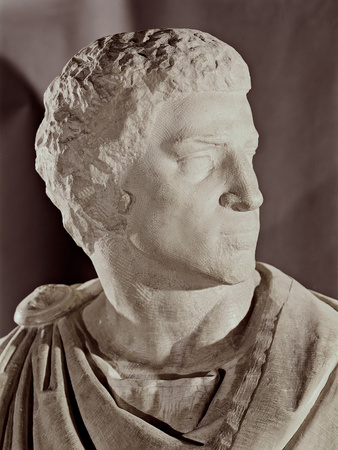
The head turns sharply, as if a voice or danger has entered from beyond the marble. Beneath it, an armoured chest and gathered drapery make the bust feel less like a fragment than a compressed body. Michelangelo’s Brutus contains no dagger, falling dictator or Roman Senate. Its politics reside in a name, a gaze and the unstable moral memory of a man who killed Julius Caesar in the name of republican liberty.
Made in the later 1530s or around 1540 and now in Florence’s Museo Nazionale del Bargello, the marble bust is one of Michelangelo’s rare engagements with the portrait form.[1] It is generally connected with Florentine republican exiles and the political crisis following the murder of Duke Alessandro de’ Medici. Those circumstances make an anti-tyrannical reading compelling. They do not turn every chisel mark into a decoded declaration of Michelangelo’s private beliefs. Brutus deserves to remain both a charged historical object and a face whose silence prevents certainty.
At a Glance
- ArtistMichelangelo Buonarroti
- TitleBrutus
- DateAbout 1539–1540
- MediumMarble
- FormBust with head, shoulders, armour and drapery
- SubjectTraditionally identified as Marcus Junius Brutus, one of Julius Caesar’s assassins
- Present locationMuseo Nazionale del Bargello, Florence
- Commission circleAssociated with the Florentine republican exile Donato Giannotti and Cardinal Niccolò Ridolfi
- Political backgroundThe Medici restoration in Florence and the 1537 assassination of Duke Alessandro de’ Medici
- StateUnfinished or partly completed, with later workshop intervention traditionally associated with Tiberio Calcagni
- Classical frameAn ancient Roman republican subject translated into the visual language of a Renaissance bust
- Central cautionIts subject and context support political interpretation; they do not prove one exhaustive message or a verbatim confession by Michelangelo
Contents
- Who Was Brutus?
- A Roman Form for a Florentine Crisis
- Giannotti, Ridolfi and Exile
- The Head in Motion
- Face, Hair and Controlled Severity
- Armour, Drapery and the Missing Whole
- Unfinished Marble and Later Hands
- Brutus, Tyrannicide and Moral Ambiguity
- Brutus and David
- Brutus in the Bargello
- Classical Portrait and Renaissance Invention
- How to Look at Brutus
- Why Brutus Matters
- Artist Up Close
Who Was Brutus?
Marcus Junius Brutus was a Roman senator and one of the leaders of the conspiracy that killed Julius Caesar in 44 BCE. For some ancient and Renaissance writers, he represented the defence of republican liberty against tyranny. For others, he embodied betrayal—an assassin who turned against a benefactor and helped plunge Rome into further civil war.
That division is not noise around the sculpture; it is part of the subject. “Brutus” never named a morally neutral ancient worthy. The viewer arrives with a question: liberator or traitor? Michelangelo does not settle it through a narrative attribute. He gives Brutus the concentrated seriousness of a person whose action and judgment remain disputed.
The bust also resonates with an earlier Brutus in Roman memory, Lucius Junius Brutus, legendary founder of the Republic and expeller of kings. Renaissance political thought could allow the two figures and their associations to overlap. The name therefore gathered stories of founding, assassination, liberty, ingratitude and civic violence.
A Roman Form for a Florentine Crisis
The bust format invokes antiquity. Head and upper torso offer the kind of concentrated presence associated with Roman portraiture and the Renaissance collecting of ancient marbles. Michelangelo did not reconstruct an archaeological likeness of the historical Brutus. He created a modern moral presence through a classical form.
This mattered in sixteenth-century Florence, where ancient history supplied a language for current power. After the Medici returned and republican government collapsed, political opponents could understand Roman defenders of liberty as mirrors for their own condition. The assassination of Duke Alessandro de’ Medici by his cousin Lorenzino in 1537 made the analogy especially volatile.
Yet an analogy is not an identity. Lorenzino could be compared with Brutus, but Michelangelo’s bust is not a documentary portrait of him. The Roman name allowed contemporary events to be discussed at a distance. That distance could protect, ennoble or complicate the comparison.
Giannotti, Ridolfi and Exile
The work is associated with Donato Giannotti, a Florentine republican intellectual living in exile, and with Cardinal Niccolò Ridolfi, whose position connected Medici family ties with opposition to Medici rule. This circle gives the sculpture a historically plausible political audience. It was not carved in an ideological vacuum.
Commission history matters because meaning arises between maker, patron and intended beholder. A Brutus made for republican-minded Florentines after a duke’s assassination carries a different charge from a generic antique exercise. MUS.E’s exhibition framing of “Michelangelo and Power” supports placing the bust within this field of Florentine imagery, authority and resistance.[3]
Still, patronage does not produce a transcript of agreement. Michelangelo’s relations with Medici patrons, republican institutions and political upheavals stretched across decades. A single label such as “anti-Medici” cannot capture every loyalty, fear or compromise. The bust enables political speech while withholding the artist’s final sentence.
The Head in Motion
The sculpture’s dominant event is directional. Brutus turns his head to one side, creating the impression of sudden attention held under control. The neck transfers that motion into the shoulders, so the bust does not feel like a static support for a face.
The gaze does not meet the spectator squarely. This refusal of frontal engagement can feel guarded, alert or disdainful. Those are legitimate responses, but not documented diagnoses. The safest account begins with what the form does: it directs attention beyond the sculpture and gives the unseen space beside it dramatic importance.
The turned head also makes time perceptible. A frontal portrait can seem eternally composed. Brutus appears to have just looked, or to be about to act upon what he sees. Michelangelo transforms a memorial type into a moment without specifying the event.
Face, Hair and Controlled Severity
The face is built from strong transitions rather than soft charm. Brow, eyes, nose, cheek and compressed mouth make character through structure. The hair and beard frame the head while reinforcing its ancient identity. Idealisation does not erase individuality, yet the result should not be mistaken for a likeness taken from life.
Severity is the bust’s most defensible emotional term because it describes the viewer’s experience of its restraint. Rage, hatred or remorse would assign a particular inner story that marble cannot confirm. Brutus’s concentration is powerful precisely because its object is absent.
Light changes that expression. Shadows beneath the brow can deepen vigilance; illumination across the cheek can make reserve seem calm. A bust so dependent on the turn of the head will never have one fixed psychological image.
Armour, Drapery and the Missing Whole
The torso combines armour and cloth, giving the head a public and historical body. Armour links Brutus with martial and civic authority, while drapery mediates between rigid protection and the living figure beneath. The bust does not require arms and legs to establish status.
Michelangelo uses the lower field to manage the force of the head. Broad planes stabilise the turn; folded cloth redirects it; the truncation of the torso makes the composition feel intentionally concentrated even where finish remains uneven. This is not a detached portrait head placed on an indifferent base.
The unseen full body is nevertheless implied. The shoulders suggest a stance, and the head’s rotation proposes that the torso might have turned differently had it continued. Bust portraiture relies on that imaginative completion: enough body to make consciousness embodied, not enough to narrate an action.
Unfinished Marble and Later Hands
The bust is not uniform in finish. Some passages carry Michelangelo’s strong definition, while the lower portions and details have been associated with later completion by Tiberio Calcagni. The distinction should be kept visible rather than absorbed into a blanket claim that every surface is solely autograph.
Workshop intervention does not make the object inauthentic. Renaissance sculpture could pass between master and assistant, especially when projects remained unfinished. Calcagni’s activity belongs to the bust’s material history, while Michelangelo’s invention governs its character.
Nor should incompletion automatically be treated as political refusal. It may reflect competing work, age, altered circumstances or dissatisfaction. The present contrast between resolved head and less settled lower field intensifies attention, but its expressive consequence is not proof of an original programme to leave the bust rough.
Brutus, Tyrannicide and Moral Ambiguity
The political idea at the centre of the sculpture is tyrannicide: can killing a ruler be justified as defence of liberty? Brutus made that question unavoidable in Renaissance thought. The title positions the bust within debate rather than supplying an answer.
If the face appeared jubilant, the work might read as simple celebration. If it displayed obvious torment, it might become a tragedy of guilt. Michelangelo gives neither. Brutus is contained. His apparent resolve can attract republican admiration, while the refusal of emotional explanation leaves room for doubt about violence.
This moral ambiguity protects the sculpture from propaganda’s short life. Political circumstances gave it urgency, but unresolved character lets later viewers confront the recurring tension between resistance and assassination.
Brutus and David
Michelangelo’s David provides the most revealing Florentine comparison. Both figures became associated with the defence of liberty against superior power. Both draw on ancient bodily ideals. Yet their narrative moments and public histories differ profoundly.
David stands before combat, sling nearly concealed, the giant absent. Its placement before Palazzo Vecchio turned biblical readiness into a republican civic emblem. The Accademia’s institutional account preserves that history.[4] Brutus appears after the deed for which history remembers him, even though the bust shows no narrative action. The political burden lies in retrospection.
The David was publicly appropriated by the republic; Brutus emerged within a smaller, politically connected commission circle during Medici rule. One became civic monument, the other concentrated counter-memory. Comparing them shows how Michelangelo could make political presence through radically different formats without proving identical personal intentions.
Brutus in the Bargello
The Bargello places the bust within a remarkable group of Michelangelo sculptures, including the youthful Bacchus, the Pitti Tondo and the uncertain David–Apollo.[1] Collection context changes the work. Instead of addressing a narrow circle of politically informed patrons, Brutus now joins a public history of Renaissance sculpture.
The neighbouring works reveal Michelangelo moving among mythological, devotional, biblical and classical-political subjects. They also share problems of title, finish and later reception. The museum does not neutralise politics, but it expands the bust beyond them.
In this company, the rarity of the portrait-bust form becomes clearer. Michelangelo usually made full bodies, architectural ensembles or sacred groups. Here, a head and chest carry a weight comparable to a monument.
Classical Portrait and Renaissance Invention
Michelangelo’s knowledge of antiquity did not lead to passive imitation. Ancient busts supplied a format, types of drapery and ways of making character monumental. His Brutus uses that inheritance to address a crisis unknown to Roman sculptors: the return and consolidation of Medici power in Florence.
A broad Metropolitan Museum study of Michelangelo’s designs and working practice situates such translation within a career that continually reworked ancient forms rather than merely copying them.[2] The classical past became a repertoire for new bodies and new arguments.
The bust’s success therefore depends on historical doubleness. It must feel Roman enough for the name Brutus to carry authority and modern enough for sixteenth-century viewers to recognise their own political danger.
How to Look at Brutus
Start with the angle of the head. Follow the line through neck and shoulders and identify where the body supports or resists the turn. Then notice where Brutus looks. The object of attention is absent, so the surrounding space becomes part of the composition.
Move next to the boundary between face and beard, flesh and hair, neck and armour. Differences in texture organise identity. Finally compare the level of resolution across the bust. Rather than treating roughness as a single symbol, ask what each passage contributes to the hierarchy of attention.
The slowest looking should be reserved for moral response. Do you read control as virtue, secrecy, defiance or threat? The sculpture does not prevent those interpretations. It makes viewers responsible for recognising where perception becomes political judgment.
Why Brutus Matters
Brutus matters because Michelangelo compresses historical conflict into the smallest major sculptural format of his career. The turn of a head can imply danger, resolve and an unseen world. Armour can transform a portrait into a public type. A disputed ancient name can reactivate Florence’s struggle over liberty.
It matters equally because it refuses to behave like a slogan. The bust’s political associations are strong, but its emotion is controlled and its intended message is not documented in one definitive statement. That gap is not a weakness. It preserves the ethical difficulty of its subject.
Finally, the sculpture teaches that political art need not depict an event. Memory can reside in a name and a body at attention. Michelangelo’s Brutus neither raises a weapon nor claims innocence. He turns—and leaves history to complete the motion.
The absence of an inscription within the sculptural image sharpens that effect. Identification depends on the title and historical tradition carried alongside the marble. If that name were lost, viewers could still recognise authority, guarded attention and classical character, but the specific argument about tyrannicide would weaken. Brutus demonstrates how words and objects cooperate: the name activates Roman and Florentine memory, while the body keeps that memory morally unresolved.
Artist Up Close
Michelangelo made the bust after his permanent move away from Florence, when relations between Medici power and republican exile remained personally and politically charged. He had worked for the Medici, served the Florentine Republic on its fortifications and survived the family’s return. The subject of Brutus therefore entered a life shaped by opposed obligations. But biography does not unlock the face completely. Michelangelo’s achievement was to convert that field of conflict into a disciplined form capable of sustaining several judgments at once.
Frequently Asked Questions
Discussion
Does the ancient name Brutus make the bust feel public before anything else?
How much of the sculpture's force comes from the turn of the head and compressed torso?
Where should a careful reader stop when connecting Brutus to Florentine politics?
Join the Conversation
Compare the classical subject, the bust's formal tension and the limits of political interpretation.
References
- Musei del Bargello, Michelangelo: The Bloom of Renaissance Art”:, View source.
- The Metropolitan Museum of Art, Michelangelo: Divine Draftsman and Designer”:, View source.
- MUS.E Firenze, Michelangelo and Power”:, View source.
- Galleria dell’Accademia di Firenze, Michelangelo’s David”:, View source.