 by Tom Gurney
Tom Gurney BSc (Hons) is an art history expert with over 20 years experience
Published on June 19, 2020 / Updated on November 6, 2025
Email: tomgurney1@gmail.com / Phone: +44 7429 011000
Michelangelo's Drawings
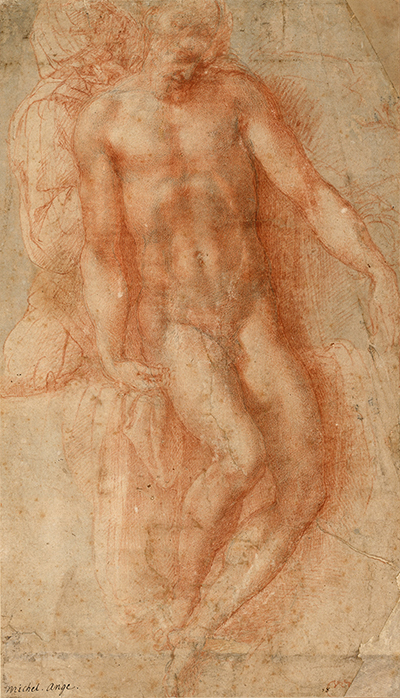
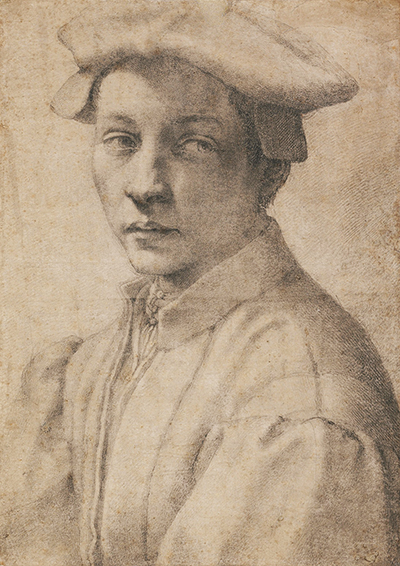
A Michelangelo drawing may contain a body that strains toward a fresco, an unfinished church assembled under compass lines, or Cleopatra's head presented so beautifully that the sheet became a treasured gift. Turn the paper over and another history can appear: a discarded pose, accounts written decades later, or a second Cleopatra concealed beneath an old backing until conservation exposed her.
Drawings were where Michelangelo could move fastest and revise most visibly. Chalk gathers around a knee; an ink line changes the angle of a fortification; a hand is tried beside a torso; sheets are joined until a figure grows larger than a person. Yet immediacy should not be confused with simplicity. Paper was folded, trimmed, pricked, backed, repaired, copied and reattributed. Some sheets served walls or sculptures; others were finished gifts; many functions remain uncertain.
The breadth of the corpus makes drawing the clearest link among Michelangelo's sculpture, painting and architecture. The Renaissance word disegno carried both the act of drawing and the intellectual conception behind a work. His sheets preserve that double meaning: physical marks and ideas changing form.[1][2][3]
At a Glance
- Principal functionsExploration, life study, compositional planning, transfer, patron presentation, collaboration, architecture and independent gift
- Common materialsRed and black chalk, pen and ink, wash, stylus or leadpoint, white heightening and mixed media
- Important collectionCasa Buonarroti holds a family corpus of more than 200 sheets, only a small selection shown at once
- Ceiling studiesStudy for Adam, Erythraean and Libyan Sibyl sheets
- Lost-design evidenceNude from the Back for the Battle of Cascina; studies for Leda
- Large cartoonEpifania, 1550–1553, assembled from 26 sheets
- Presentation drawingsMythological sheets for Tommaso de' Cavalieri; Cleopatra
- Architectural and military examplesPorta al Prato fortification; San Giovanni dei Fiorentini plan
- Authorship terms“Drawn by,” “attributed to,” “after” and “formerly attributed to” are not interchangeable
- Conservation principlePaper and drawing media are sensitive to light, temperature, humidity, old mounts and handling[1–20]
Contents
- What Counts as a Michelangelo Drawing?
- Disegno: Mark and Conception
- Drawing the Living Body into Another Body
- Anatomy Without a Medical Diagram
- The Lost Battle of Cascina on Paper
- From Study to Cartoon
- Drawings for Sculpture and Tombs
- Fortifications Drawn Under Pressure
- Building a Church Through Revisions
- Presentation Drawings: Art Made to Be Given
- Copies, Former Attributions and Honest Labels
- Paper Has a Body
- How the Casa Buonarroti Corpus Survived
- Digital Access and the Difference from the Sheet
- Artist Up Close
- The Most Vulnerable Part of a Monumental Career
- Browse Michelangelo’s Drawings
What Counts as a Michelangelo Drawing?
No honest overview begins with a single total. Casa Buonarroti alone preserves more than 200 sheets connected with the family collection, while major groups are dispersed through the British Museum, Metropolitan Museum, Royal Collection, Louvre, Uffizi and other institutions.[1][4] Some sheets are drawn on both sides, some assemble multiple pieces, and some contain marks made at very different dates.
Authorship adds another boundary. A museum may catalogue an object as drawn by Michelangelo, attributed to him, after him, formerly attributed to him, or by another artist in his circle. These phrases describe evidence. “After Michelangelo” normally means another maker copied or adapted his work; it does not mean a late drawing by Michelangelo himself.[4][17][18]
Function is equally varied. A rapid sketch may test the position of five bodies. A life study may isolate a back or leg. A modello may present a clear proposal to a patron. A cartoon brings a design toward full size for transfer. A highly finished presentation drawing may be conceived as an autonomous gift. Finish can suggest function but does not decide it alone.[2][3][13]
Michelangelo also destroyed drawings, according to accounts transmitted by Vasari and others, perhaps to conceal labour or control his legacy. The story must remain attributed, but the fragmentary survival is undeniable. What remains is not a complete paper diary. It is a selected and often accidental residue shaped by Michelangelo, recipients, heirs, collectors and museums.[1]
Disegno: Mark and Conception
In sixteenth-century Florence, disegno meant more than competent draughtsmanship. It joined the visible line to the mental ordering of a work. The concept helped unite painting, sculpture and architecture as arts founded in design.[2][3]
Michelangelo's practice gives that claim physical evidence. A body drawn from life could be altered for a sibyl on a ceiling. A tomb proposal could coordinate architecture and figures before marble was assigned. A plan could turn repeated geometric revisions into a possible church. The same intelligence moved across supports without making every medium identical.
Drawing was not always the first step in a tidy sequence. Michelangelo used clay or wax models for some sculptural and painted problems; he redrew after decisions changed; a sheet could preserve a figure later deleted. Paper interacted with memory, model, building and block.
Nor did every line seek a finished object. Some sheets test thought for its own momentum. Others gather unrelated studies because unused space invited another problem. The paper is less a window onto one instant than a field where several times can coexist.
The physical variety of marks follows these needs. Chalk can model a shoulder through soft tone or cut a contour with a sharpened edge. Pen makes rapid decisions difficult to erase. Wash gives weight and depth to drapery or architecture. White heightening lifts a form from tinted paper. Stylus lines may establish a position barely visible beneath the final drawing.[2]
Drawing the Living Body into Another Body
Michelangelo's figure studies begin with observation and end in transformation. A model supplies weight, tension, proportion and the way a joint bends. The represented subject may be a biblical ancestor, female prophet, pagan youth or resurrected soul. Life study is evidence, not identity.
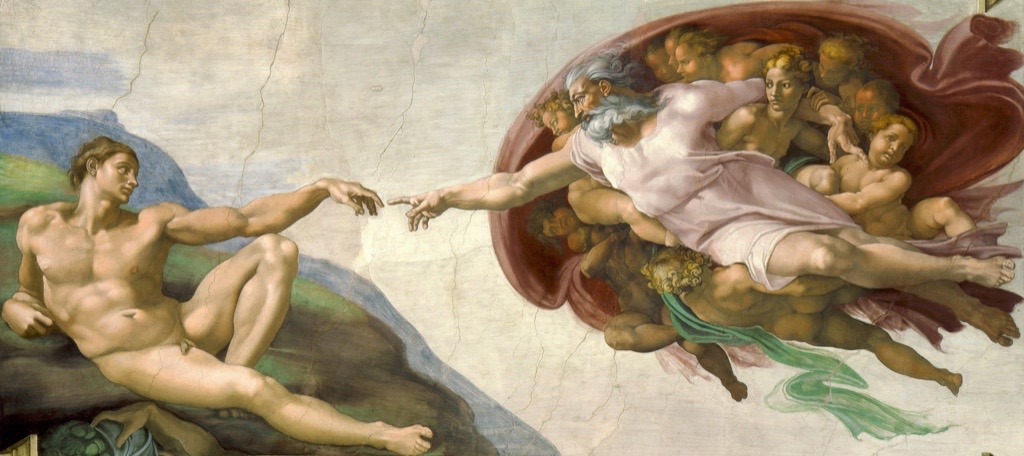
The British Museum's Study for Adam, made about 1511 in dark red chalk and stylus, concentrates on the reclining torso and legs used for the Sistine ceiling. Michelangelo reinforces and adjusts contours; a hand is studied separately. The head is missing from the surviving sheet, whose trimming, wear and historic varnishing affect how the chalk appears.[5]
The fresco retains the body's broad relation to the ground while altering detail and placing it opposite the advancing God. A larger black-chalk arm study and lost full cartoon belonged to further stages. The red-chalk sheet is therefore one moment between a living model and an invented first man.
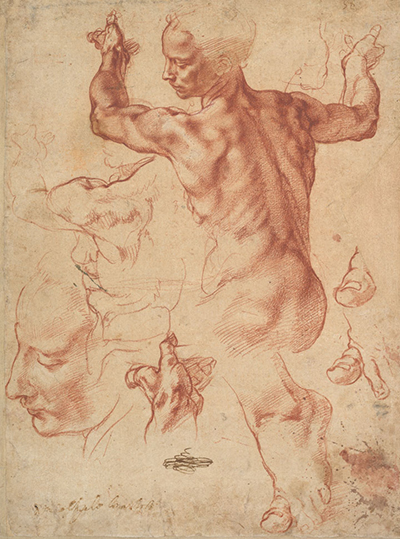
The Metropolitan Museum's Studies for the Libyan Sibyl, around 1510–1511, gathers a twisting back, shoulder, hand and foot. A male model supplied the principal anatomy for a female prophetic figure. Red chalk creates dense tone and fine hatching, with white accents catching the shoulder; another medium appears on the reverse.[7]
The transformation is deliberate. Michelangelo changes model into subject through pose, clothing, scale and context. Calling the final Sibyl male mistakes workshop means for represented identity; pretending no male model was involved erases the drawing's evidence.
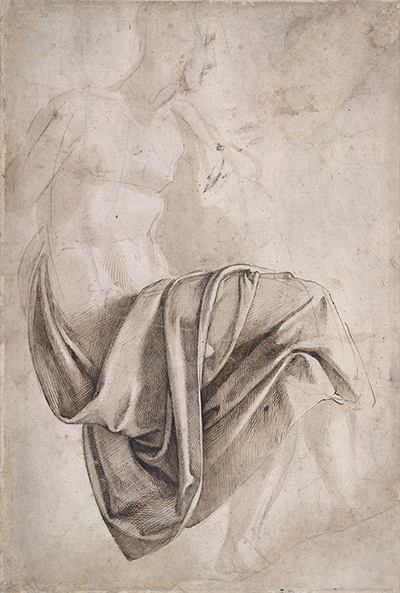
The British Museum's Erythraean Sibyl sheet studies another problem: how cloth carries weight. Pen, ink and wash develop drapery over a black-chalk underdrawing. On the reverse, separate studies in other media include a seated figure, a hand and a small ceiling scheme.[6] Recto and verso function almost like two worktables sharing one paper.
Browse Michelangelo’s Drawings
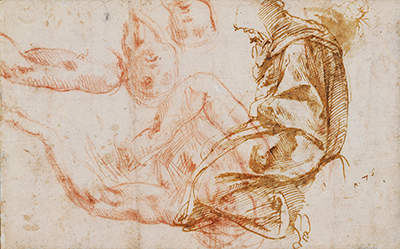
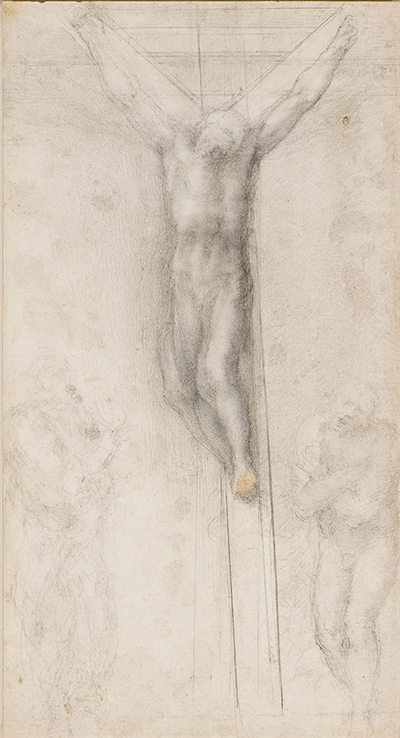
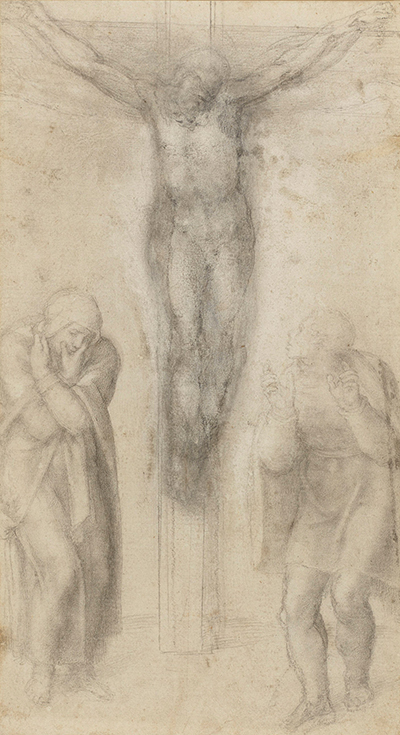
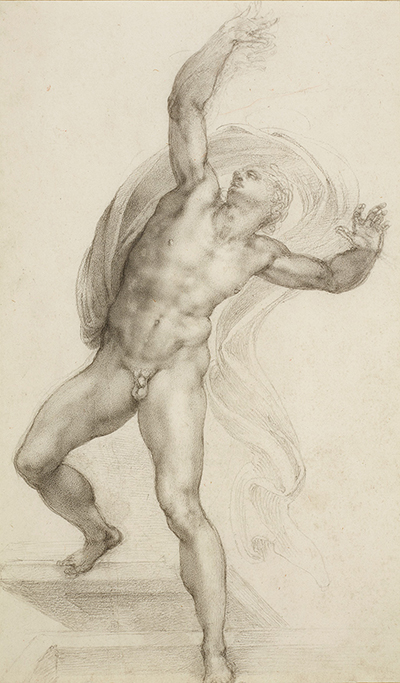
Use this section to move from the drawings overview into individual sheets, design studies, presentation drawings and copy-related routes.
 for Tomb of Pope Julius II Michelangelo.jpg)
Anatomy Without a Medical Diagram
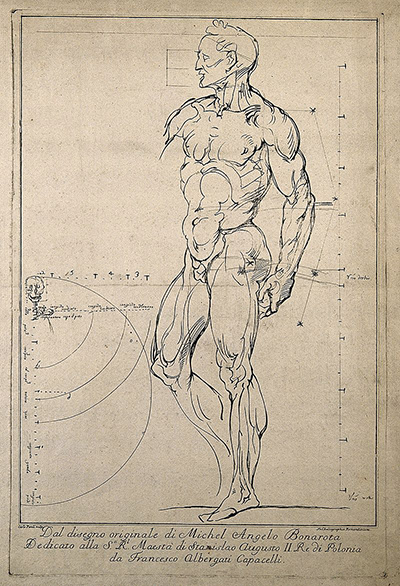
Michelangelo studied bodies with unusual intensity, including through dissection, but his surviving drawings do not all behave like labelled anatomical plates. Their anatomy serves movement, weight and invention.
A British Museum Study of a Right Leg from about 1524–1525 uses pen and brown ink over leadpoint. Hatching clarifies the knee, tibia and surrounding structures as though skin has become thin enough for the working mechanics to show. A black-chalk torso occupies the reverse.[9]
The museum compares its structural exposure to an écorché, a flayed figure. That description applies to the catalogued sheet; it does not turn every muscular nude associated with Michelangelo into a documented anatomical study.
The distinction matters because modern viewers often seek secret organs in completed paintings. Michelangelo's demonstrable anatomical knowledge makes hidden-image theories feel plausible, but it does not prove them. A drawing of a leg provides evidence of studied structure. An alleged brain or kidney embedded in a fresco remains an interpretation unless supported separately.
Michelangelo's greatest anatomical invention lies in transition. A relaxed limb prepares to bear weight; a back twists beyond a stable front; skin stretches over joints. The sheet teaches him how a body can do something, not merely what its parts are called.
The Lost Battle of Cascina on Paper
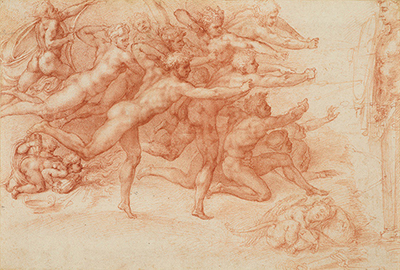
Florence gave Michelangelo the Battle of Cascina commission in 1504 for Palazzo Vecchio's council hall. The intended mural was never painted. A large cartoon depicting soldiers surprised while bathing became famous and was later lost, leaving studies and copies as evidence.[8]
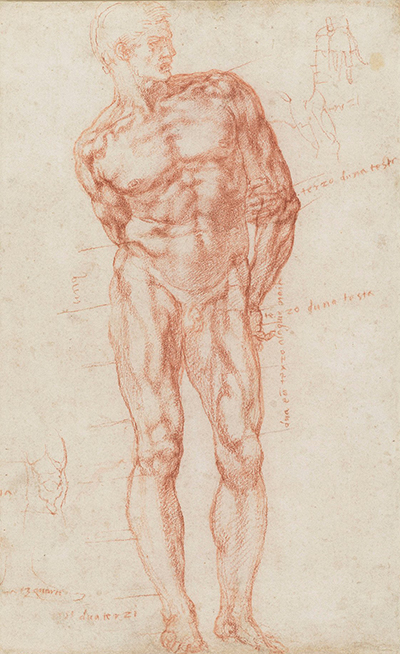
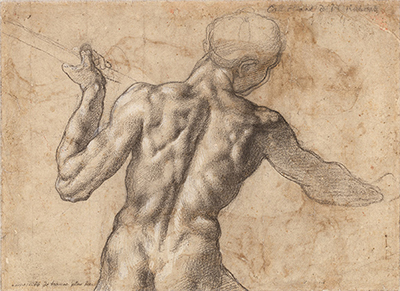
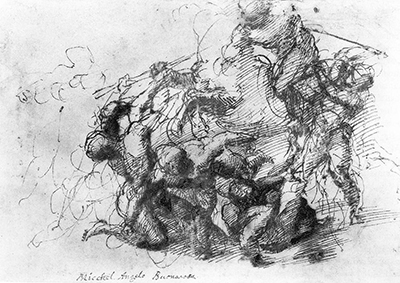
Casa Buonarroti's Nude from the Back dates to about 1504–1505. Pen and ink drive around a twisting figure, with traces of black chalk beneath. The pose belonged to one stage of the battle design but was removed from a later version known through another artist's copy.[8]
That elimination is important. A powerful autograph sheet does not guarantee a place in the final conception. Drawing allowed Michelangelo to reject as well as preserve.
The paper accumulated another life. In 1528 Michelangelo folded and reused it for family and expense notes. A celebrated figure study became a practical writing surface more than twenty years later.[8] Modern reverence should not be projected backward as though every working sheet was always treated like a museum treasure.
Later artists studied and copied the lost cartoon, transmitting bodies even after the original disappeared. These copies have documentary and artistic value, but their maker must remain distinct. The lost fresco, lost cartoon, autograph study and later copy are four different objects.
From Study to Cartoon
For a painting, drawings might proceed from small compositional trials to life studies, enlarged details and full-scale cartoons. The sequence varied, and most stages have not survived. A cartoon is not an animated image; in Renaissance practice it is a large working design used to develop or transfer a composition.
The Epifania at the British Museum makes the scale tangible. Drawn in black chalk around 1550–1553, it stands more than two metres high and is assembled from 26 sheets. Michelangelo made it for his biographer and associate Ascanio Condivi, who used the design for a panel painting.[15]
The title is traditional and the precise iconography has been debated. What the object securely demonstrates is collaborative transfer. Pricked contours indicate that parts were copied through an intermediate sheet, rather than the entire giant cartoon being pressed directly against the final panel.[15]
Its 26 sheets are not invisible supports. Joins, different paper responses and later repairs make the cartoon a composite object. Full scale demanded construction as well as drawing.
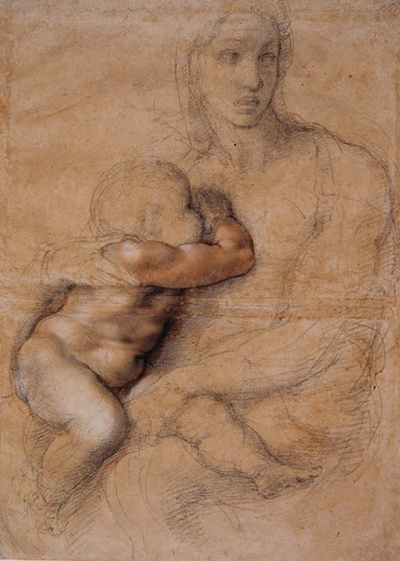
The Madonna and Child cartoon at Casa Buonarroti presents another uncertainty. Made around 1525 on two joined sheets with mixed chalk, ink and white lead, it contains corrections but has no securely identified final painting or sculpture.[10] The traditional label “cartoon” describes its scale and working character without solving its ultimate destination.
These examples prevent a functional hierarchy in which working drawings are merely inferior preliminaries. The Epifania made another artist's picture possible; the Madonna sheet may preserve a project that went no further. Both are substantial works on paper with lives of their own.
Drawings for Sculpture and Tombs
Sculptural drawing could organise an entire monument, test one figure or resolve a hand. For the tomb of Julius II, Michelangelo used quick sketches, life studies and more finished demonstration drawings. Their differences reflect audience as well as stage.[3]
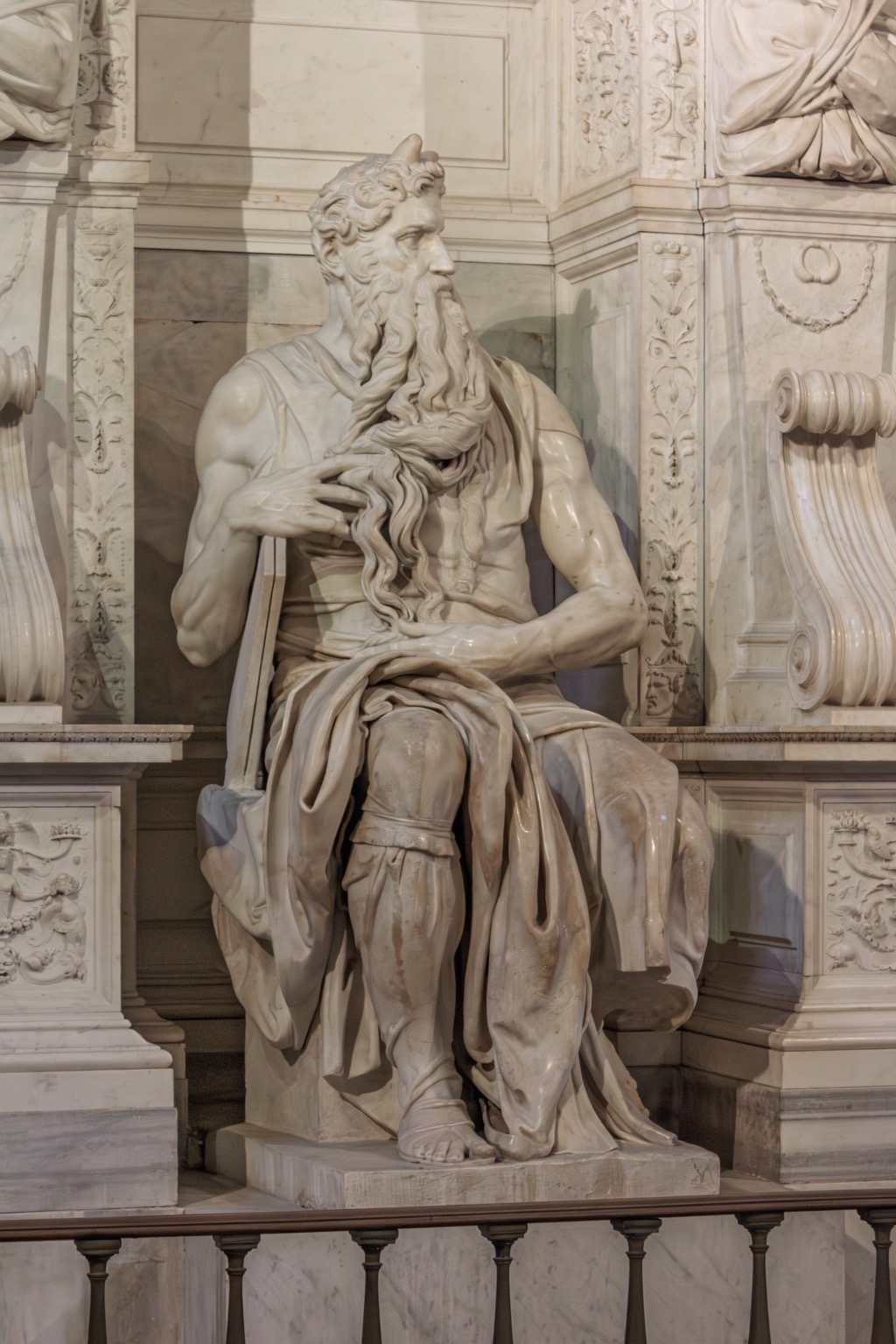
A patron-facing tomb proposal needed sufficient clarity to communicate architecture, tiers and sculpture. A private sheet could explore alternatives without pretending they were settled. Because the Julius tomb changed repeatedly after its 1505 commission, no drawing should be treated automatically as a picture of the final monument at San Pietro in Vincoli.
Paper also works differently from marble. A line can shift a limb cheaply; a wash can add shadow; a discarded version remains visible under the chosen one. Stone imposes weight, flaw and irreversible removal. Drawing prepares for carving without containing a finished statue waiting to be enlarged.
Three-dimensional models could stand between sheet and block. The Met's account places clay and wax modelling beside life study in Michelangelo's practice.[2][3] A difficult pose might be tested in several forms, each answering questions the others could not.
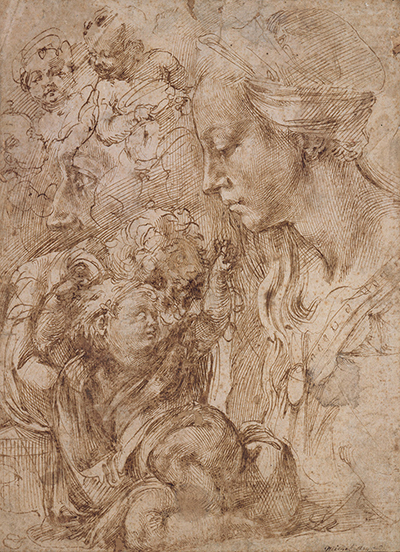
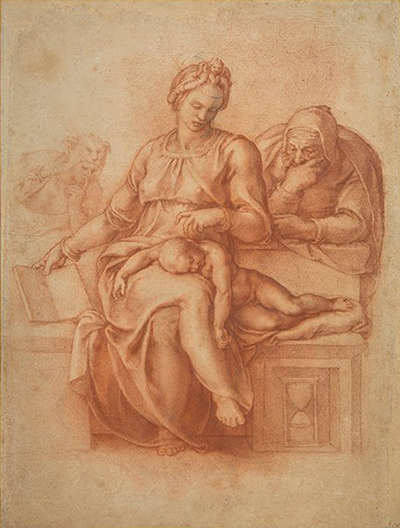
Highly finished devotional sheets complicate the boundary with sculpture. A Virgin and Child may have been a design for relief, an independent image or both at different moments. Unless documents or a final object establish the relation, resemblance cannot decide function.
Fortifications Drawn Under Pressure
In 1529 the Florentine Republic appointed Michelangelo governor and procurator general of fortifications as imperial forces threatened the city. Casa Buonarroti preserves sixteen drawings connected with defences, many unbuilt or later destroyed.[11]
The study for the Porta al Prato of Ognissanti combines pen, ink, watercolour and red chalk. Angular projections push outward toward possible lines of attack. Wash differentiates masses and hollows; repeated contours retain changing tactical ideas.[11]
The design is both military and intensely visual. Its lobed shapes have encouraged comparison with organic forms, but aesthetic fascination should not erase civic emergency. These were proposals for resisting siege.
Drawing could respond more quickly than construction. A sheet could test paths of fire, wall thickness and approach while political conditions changed. Many designs remained paper possibilities, making survival on the sheet especially important.
Michelangelo's military office also challenges the idea that his architecture emerged only from contemplative monument building. Defensive drawing required calculation of movement, force and vulnerability—the same spatial intelligence redirected toward survival.
Building a Church Through Revisions
Around 1559 Michelangelo developed plans for San Giovanni dei Fiorentini in Rome. A Casa Buonarroti sheet shows a centralised church organised around altar, columns and corner chapels. Compass traces establish geometry while black chalk, ink, watercolour and white lead record repeated change.[12]
Some areas darken because Michelangelo worked into wet white lead and revised them several times. The drawing's density is therefore temporal: decisions accumulate rather than merely shade the plan.
Tiberio Calcagni made a copy for Cosimo I in 1560. Michelangelo's scheme remained unbuilt, and the present church follows a later plan.[12] Confusing the drawing with the executed building would erase precisely what makes it valuable—an unrealised late experiment.
Architectural plans are often treated as impersonal diagrams beside expressive figure drawings. This sheet resists that division. Its compass geometry is rigorous, but the repeated dark alterations feel urgent. Buildings, like bodies, developed through pressure and revision.
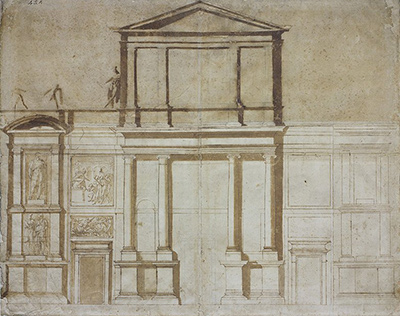
Other projects generated elevations, profiles, moulding details and patron demonstrations. At San Lorenzo, drawings connected façade, New Sacristy and Laurentian Library. Paper helped secure approval, instruct collaborators and test how a visitor would move through built form.[3]
Presentation Drawings: Art Made to Be Given
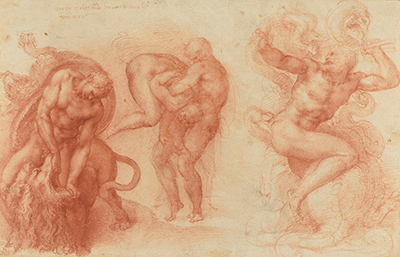
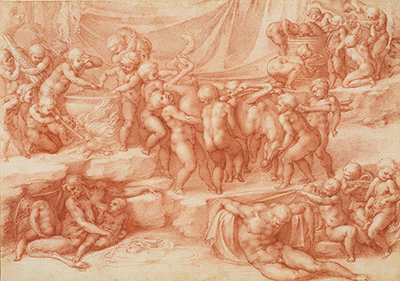
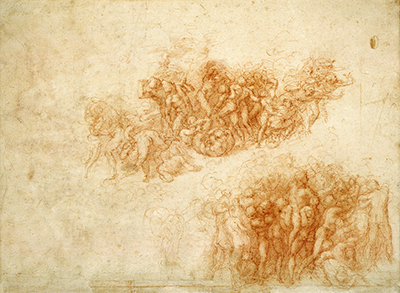
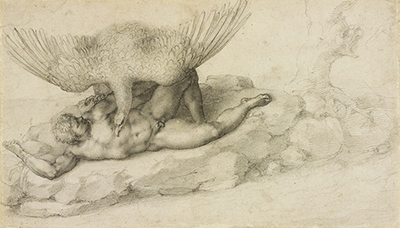
In the early 1530s Michelangelo made a group of highly finished drawings for Tommaso de' Cavalieri. The Royal Collection associates the group with The Punishment of Tityus, Ganymede, The Fall of Phaethon and a children's bacchanal. They were not disposable studies on the way to fresco or sculpture. Drawing itself was the gift.[13]
The mythological subjects explore desire, punishment, ascent and fall through exquisitely controlled bodies. Their meanings have been read spiritually, erotically and personally. Institutional interpretations can guide attention, but no single secret code exhausts the relation between maker, recipient and myth.
The sheets circulated. Cavalieri permitted copying, and engravings spread the inventions. The original Ganymede was lost, but related copies preserve its design. A copy can transmit composition and reception without acquiring Michelangelo's hand.[13]
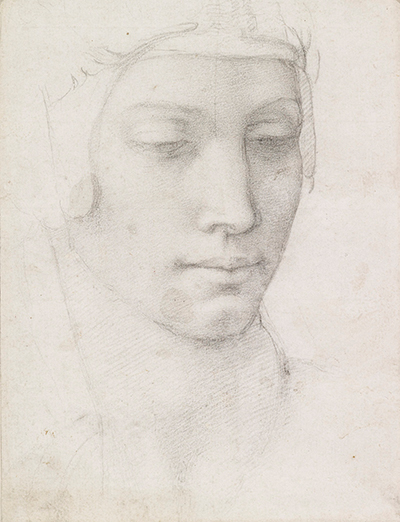
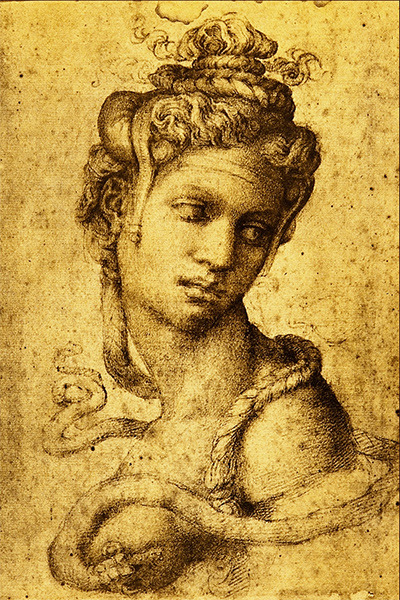
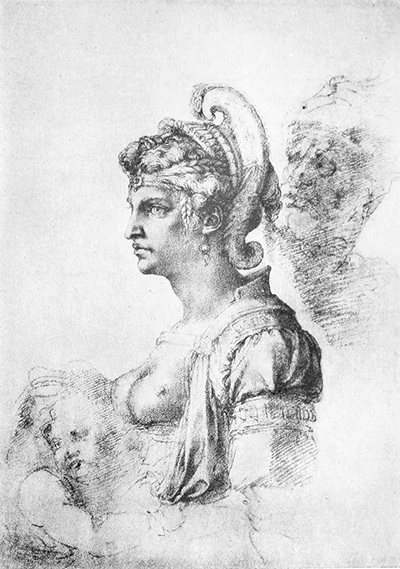
Cleopatra, made about 1535, was another Cavalieri gift. Her profile, elaborate hair and coiling serpent are drawn with finished concentration. In 1562 Cavalieri transferred the sheet to Duke Cosimo I after arranging to retain a copy.[14]
During restoration in 1988, removal of an old backing revealed a second autograph Cleopatra on the reverse. This hidden version is more agitated: the face appears strained and the forms less ceremonially resolved.[14]
The discovery transformed interpretation. Recto and verso preserve two emotional and formal possibilities within one object. The public-facing finished drawing had literally concealed a searching counterpart.
Copies, Former Attributions and Honest Labels
Michelangelo's drawings were copied during his life and after it. Some copies trained artists; some recorded lost originals; others translated figures from paintings back onto paper. Visual closeness can be historically important without proving authorship.
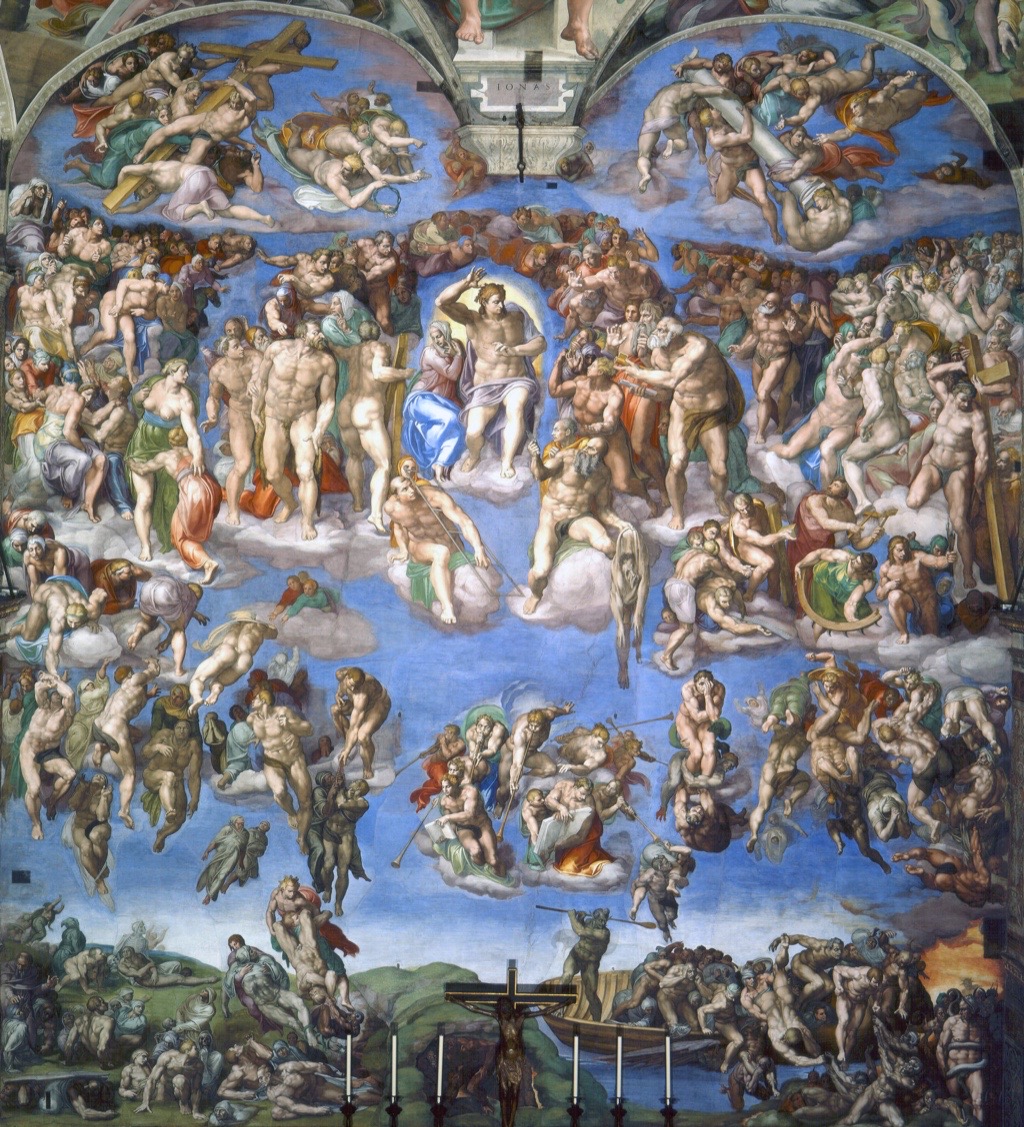
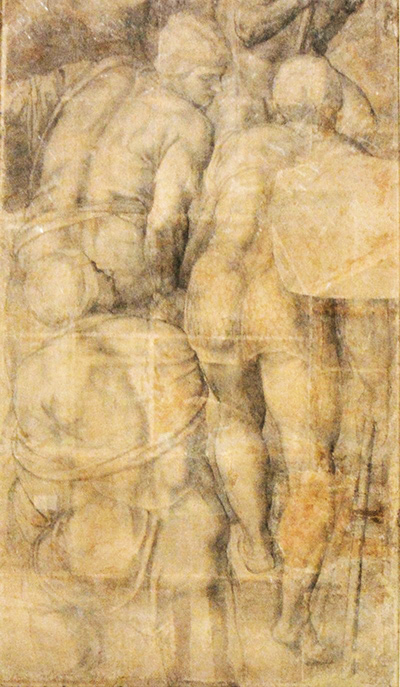
The Metropolitan Museum catalogues a red-chalk Study of Figures from Michelangelo's Last Judgment as by an unidentified artist after Michelangelo, dated about 1540–1550.[17] It records the fresco's forms at close range, but “after” keeps the copying hand visible.
Attributions can move in the other direction. A reclining nude at the British Museum entered collections as Michelangelo and was once linked to Adam. It is now catalogued as a work by Baccio Bandinelli from about 1514.[18] Old inscriptions and respected ownership form part of provenance; they do not override current scholarship.
The Studies for the Head of Leda demonstrate a third relation. Casa Buonarroti accepts the red-chalk sheet as autograph and connects it with Michelangelo's lost Leda and the Swan. Later copies of the painting are not thereby autograph, and the surviving study is not a fragment of the lost panel.[19]
These distinctions are not bureaucratic caution imposed upon looking. They change what marks mean. A Michelangelo revision, a pupil's close imitation and a later artist's recollection can resemble one another while bearing different intentions and dates.
Paper Has a Body
Drawings are often reproduced as pure images with every stain and edge cropped away. The objects themselves have thickness, fibre, joins, folds, tears, inscriptions, watermarks and backs. Their condition governs what can be seen.
The Study for Adam is worn, trimmed and historically varnished. The red chalk visible now is mediated by that treatment history.[5] The Nude from the Back bears later notes and folds.[8] Cleopatra changed identity when its backing was removed.[14]
The Epifania presents conservation at monumental scale. Old linings, adhesives and backing darkened the 26-sheet assembly and contributed to distortion, tears and loss. British Museum conservators had to treat the accumulated structure rather than approach it as one untouched sheet.[15][16]
Casa Buonarroti's collection records the damage caused by prolonged display. Drawings remained framed or in showcases until 1960, then underwent treatment at the Uffizi before returning in 1975. The museum now rotates small selections because light and environmental exposure are cumulative.[1]
Limited display is therefore care, not neglect. Chalk particles sit loosely on fibres; iron-based inks may corrode paper; temperature and humidity change supports and old adhesives. A drawing can fade precisely because audiences value seeing it.
How the Casa Buonarroti Corpus Survived
The largest family-held concentration of Michelangelo drawings did not arrive intact through a single act of preservation. Casa Buonarroti traces it through inheritance, gift, recovery, sale and eventual public ownership.[1]
After Michelangelo's death, his nephew Leonardo had to buy back sheets that had reached the Roman market. Around 1566 he gave a group to Cosimo I de' Medici together with the Madonna of the Stairs. In the early seventeenth century, when Michelangelo Buonarroti the Younger created memorial rooms in the family house, Cosimo II returned the relief and part of the drawings.[1]
The most admired sheets were framed and displayed as family monuments: Cleopatra in the study, a San Lorenzo façade design in the Room of Night and Day, and the small Madonna and Child cartoon in the Room of the Angels. Other sheets were gathered into volumes. These choices preserved works while also exposing selected ones to prolonged light and mounting.[1]
The collection suffered important losses. At the end of the eighteenth century, Filippo Buonarroti sold drawings to the painter and collector Jean-Baptiste Wicar. In 1859, another Michelangelo Buonarroti sold further sheets to the British Museum. The dispersal helps explain why related rectos, versos and project groups now occupy museums in different countries.[1]
Cosimo Buonarroti, the last direct family heir, died in 1858 after leaving the house and much of its contents for public benefit. The drawings remained in frames and showcases until 1960, by which time sustained display had caused substantial damage. They were taken to the Uffizi's drawings and prints department for restoration and returned in 1975.[1]
The present rotating display is the outcome of that history. It reverses the older assumption that permanent visibility honours an artist best. For light-sensitive paper, temporary darkness preserves future access. The more-than-200-sheet corpus remains extraordinary not because it escaped change, but because enough survived generations of reverence, use, sale and repair.
Digital Access and the Difference from the Sheet
High-resolution imaging can reveal faint stylus lines, compare recto and verso, and give global access to fragile works rarely displayed. Casa Buonarroti's online catalogue began with twenty sheets supported by updated bibliography, restoration evidence and scientific examination.[20]
Digital enlargement is especially powerful for drawings. It can distinguish hatching direction, paper joins and small changes invisible through a display case. It also risks detaching marks from physical scale. A thumb-sized correction may fill a screen; a two-metre cartoon may shrink to the dimensions of a sketch.
Colour calibration and lighting affect chalk and paper tone. A digital file records an imaging event, not unmediated presence. It does not expose the sheet to light, but neither does it reproduce texture, translucency or the act of moving around a large composite object.
The best use of digital access is complementary. It supports comparison and preservation while object records retain dimensions, medium, condition and authorship. The image becomes most informative when reattached to those facts.
Artist Up Close
Michelangelo's drawings make revision intimate. A finished marble can conceal how many arms were imagined before one remained. On paper, the abandoned contour still runs beside the chosen edge. Thought appears as coexistence rather than a polished sequence.
Yet the sheets are not transparent access to personality. Each had a function and audience. A patron modello suppresses uncertainty; a life study concentrates on usable anatomy; a presentation drawing converts private relation into exquisite finish; a fortification plan responds to civic danger.
The reuse of paper is particularly revealing. Michelangelo turned old work over, filled gaps, joined sheets and wrote accounts across studies. Scarcity and practicality counter the modern fantasy of every touch being preserved reverently from the instant it was made.
His dependence on other people is also visible. Models posed. Assistants and collaborators received designs. Cavalieri preserved and copied gifts. Calcagni copied an architectural plan. Condivi used the Epifania. Collectors, descendants and conservators determined survival.
Drawing remained the medium in which these relations could travel. A line moved from body to sheet, sheet to cartoon, cartoon to wall, or gift to engraving. Michelangelo's authorship did not end at the edge of the paper, but neither did it absorb every hand that followed.
The Most Vulnerable Part of a Monumental Career
Michelangelo's greatest frescoes and marbles can seem physically indestructible even when their conservation histories prove otherwise. His drawings announce vulnerability immediately. A damp room, bright display or adhesive backing can transform them.
That fragility is one reason they feel close. Chalk sits on the surface with little barrier between action and viewer. A hesitation need not be translated into marble or plaster. The distance from hand to mark is short.
But closeness is earned through care. Rotating displays, condition reports, revised attributions and digital catalogues are the systems that let the sheets remain available. Scholarship and conservation do not stand outside the art; they explain why an old backing matters, why “after” matters and why a drawing sometimes stays in darkness.
Michelangelo's drawings hold possible bodies, possible buildings and possible paintings. Some possibilities became among the world's most famous works. Others remained only lines. Their power lies in refusing to make realised and unrealised thought entirely separate.
Frequently Asked Questions
Discussion
Michelangelo’s drawings can look immediate, but many contain accumulated decisions, transfer evidence and later object history. Does a working study bring a viewer closer to the artist than a presentation drawing, or do the two reveal different kinds of intention?
Reader Insights
Look for reinforced contours, erased positions, pentimenti or studies turned in different directions. Which decision becomes visible only because the sheet remains unfinished?
Set a Sibyl study beside Cleopatra or The Punishment of Tityus. How do scale, finish and subject change when a drawing is made for a wall, a private gift or an uncertain purpose?
Compare “drawn by Michelangelo” with “after” or “formerly attributed.” How does that maker field change what the image can responsibly show?
Join the Conversation
Which kind of drawing would you most like to study at close range—a rapid compositional sketch, an anatomical study, an architectural plan, a full-scale cartoon or a presentation drawing—and what physical evidence would you examine first?
References
- Fondazione Casa Buonarroti, Michelangelo's Drawings, View source.
- Metropolitan Museum of Art, Michelangelo: Divine Draftsman and Designer, View source.
- Metropolitan Museum of Art, Michelangelo: Divine Draftsman and Designer—Exhibition Galleries, View source.
- British Museum, Michelangelo Collection/Person Record, View source.
- British Museum, Study for Adam, View source.
- British Museum, Study for the Drapery of the Erythraean Sibyl, View source.
- Metropolitan Museum of Art, Studies for the Libyan Sibyl, View source.
- Fondazione Casa Buonarroti, Nude from the Back, View source.
- British Museum, Study of a Right Leg, View source.
- Fondazione Casa Buonarroti, Madonna and Child, View source.
- Fondazione Casa Buonarroti, Study of Fortification for the Porta al Prato of Ognissanti, View source.
- Fondazione Casa Buonarroti, Plan for the Church of San Giovanni dei Fiorentini, View source.
- Royal Collection Trust, Michelangelo's Presentation Drawings, View source.
- Fondazione Casa Buonarroti, Cleopatra, View source.
- British Museum, Epifania Cartoon, View source.
- British Museum, The Biggest Challenge: Conserving Michelangelo's Epifania, View source.
- Metropolitan Museum of Art, Study of Figures from Michelangelo's Last Judgment, Sistine Chapel, View source.
- British Museum, A Nude Man Reclining, Formerly Attributed to Michelangelo, View source.
- Fondazione Casa Buonarroti, Studies for the Head of Leda, View source.
- Fondazione Casa Buonarroti, Online Catalogue of Michelangelo's Drawings, View source.