


 by Tom Gurney
Tom Gurney BSc (Hons) is an art history expert with over 20 years experience
Published on June 19, 2020 / Updated on November 6, 2025
Email: tomgurney1@gmail.com / Phone: +44 7429 011000
The Punishment of Tityus
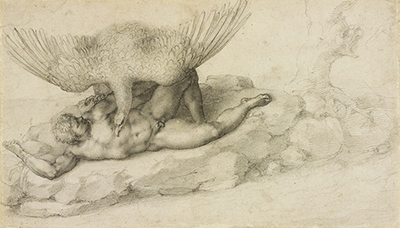
A vulture spreads its wings above the exposed body of Tityus. The giant lies bound across a rock, one arm pulled over his head and the other lost against the body. His torso twists, but Michelangelo gives him the physique of a hero rather than the ruined flesh of a victim. Punishment has not yet broken the body's beauty.
Michelangelo made this black-chalk drawing in 1532 as a gift for the young Roman nobleman Tommaso de' Cavalieri. It is one of the earliest and finest of the highly finished sheets now called presentation or gift drawings. The Royal Collection preserves it at Windsor, RCIN 912771.[1]
On the reverse, the outlines of Tityus were traced and transformed into studies for the risen Christ. One piece of paper therefore carries a condemned pagan body and a Christian body overcoming death. The change is not a hidden correction. It shows how Michelangelo could make posture think across opposed meanings.
At a Glance
- ArtistMichelangelo Buonarroti
- TitleThe Punishment of Tityus; the name is also spelled Tityos
- Date1532
- MediumBlack chalk on paper; charcoal studies on the verso
- DimensionsApproximately 19 × 33 centimetres
- Current collectionRoyal Collection, Windsor
- Royal Collection numberRCIN 912771
- RecipientTommaso de' Cavalieri
- SubjectTityus eternally punished for assaulting Latona/Leto
- VersoTwo studies for the risen Christ, developed by tracing/turning the recto pose
- Object typeFinished presentation or gift drawing, not a preparatory study for a documented painting
- CompanionA lost Ganymede composition known through copies
Contents
- Who Was Tityus?
- The Body on the Rock
- A Heroic Body for a Guilty Giant
- A Gift to Tommaso de' Cavalieri
- Tityus and Ganymede
- The Risen Christ on the Verso
- Drawing as Sculpture in Chalk
- Copies and Prints
- Punishment, Desire and Interpretation
- Reading the Myth in Michelangelo's Rome
- Provenance and Royal Collection Identity
- How to Look at The Punishment of Tityus
- Why The Punishment of Tityus Matters
Who Was Tityus?
In Greek and Roman mythology, Tityus was a giant who attempted to rape Leto—Latona in Latin—the mother of Apollo and Artemis. For this violence he was cast into the underworld, stretched over a vast space and subjected to a bird that consumed his liver.[1][2]
The organ renewed, making torment perpetual. The punishment resembles that of Prometheus, but their offences and moral traditions differ. Prometheus suffers for defying Zeus and aiding humanity; Tityus is punished for sexual aggression.
Ancient authors varied details, including whether one or two birds attacked and how the body was fixed. Renaissance artists therefore inherited a recognisable story without one controlling visual formula.
The liver was historically associated with appetite and passion. Its repeated consumption turns ungoverned desire back upon the desiring body. Michelangelo shows the moment before the beak enters flesh, allowing anticipation to carry violence.
The Body on the Rock
Tityus lies diagonally across the sheet. His right arm extends above the head and is restrained; the left arm disappears near the hip. One leg lengthens while the other bends sharply. The torso rotates between them.
The rock supplies the principal setting. Michelangelo leaves much of the paper open, so the body and bird form a self-contained sculptural group. A horizon line does little to soften the isolation.
Black chalk permits dense modelling and fine transitions. Michelangelo builds the giant through repeated strokes rather than enclosing an empty contour. The chest, abdomen and thighs take shape as volumes responding to pressure.
The bird's wings create a second architecture above him. Their spread counters the body's diagonal and compresses the space. Yet the vulture does not fully merge with the man; a terrible interval remains before contact.
The face expresses fortitude more than screaming agony, as the Royal Collection notes.[1] This restraint preserves the body's dignity while sharpening moral ambiguity. The viewer may admire the very figure being condemned.
A Heroic Body for a Guilty Giant
Michelangelo drew Tityus with proportions and musculature associated with heroic nudes. That choice is not moral approval. Renaissance art regularly used ideal bodies to make downfall intelligible: the greater the physical power, the more consequential its defeat.
The giant's beauty also implicates desire. Cavalieri received an image in which an admired male body is displayed under punishment for lust. The subject cannot be separated entirely from Michelangelo's intense emotional attachment to the recipient, although it should not be converted into a simple confession.
The body's twisting exposure recalls antique sculpture. Scholars have compared it with the Laocoön and a falling Gaul, among other models.[2] Michelangelo used antiquity as a repertoire of bodily intelligence, not as a template to copy whole.
Tityus's heroism makes the punishment psychologically complex. His body seems capable of resistance, but eternity has already defeated it. The bird need not tear flesh in order for the sentence to be absolute.
A Gift to Tommaso de' Cavalieri
Michelangelo met Cavalieri in Rome in 1532. The artist was fifty-seven; Cavalieri was a young nobleman celebrated for intelligence and beauty. Their relationship generated letters, poems and drawings and lasted until Michelangelo's death.[1]
The first two elaborate drawings given to Cavalieri presented Tityus and Ganymede. Cavalieri wrote on 1 January 1533 that he spent two hours each day contemplating the drawings.[1] This is unusually direct evidence of sustained private viewing.
Calling the sheet a presentation drawing distinguishes it from rapid workshop study. Michelangelo brought the surface to a high finish so it could be received as a complete work. “Gift drawing” can be even more exact: the object created a bond through exchange rather than presenting a design to a patron for approval.
The gift was not merely decorative. It demanded interpretation. Myth, physical beauty, moral danger and astonishing technique gave Cavalieri material to revisit, just as his letter records.
The intimacy of the exchange does not make the drawing private in the modern sense. It soon entered networks of copying and print, and Cavalieri himself allowed access to some compositions.
Tityus and Ganymede
The lost companion drawing showed Ganymede carried upward by Jupiter in the form of an eagle. Early copies preserve the composition. Both sheets featured a male nude dominated by a huge bird.[1]
Their movements oppose one another. Ganymede ascends; Tityus is pressed down. One body is lifted toward the divine; the other is bound in the underworld.
Renaissance interpretations could make Ganymede's ascent an allegory of spiritual love, while Tityus embodied carnal appetite and punishment. The pair then becomes a meditation on desire's possible directions.
This reading suits Michelangelo's Neoplatonic vocabulary, in which earthly beauty could awaken the soul toward a higher source. Yet myth resists a perfectly clean diagram. Ganymede's abduction and Tityus's assault carry coercion that modern viewers cannot dissolve into abstract love.
The lost original also reminds us that the pair survives unevenly. Tityus is an autograph sheet; the Ganymede known today comes through copies. Reproductions preserve design while changing authorship and touch.
The Risen Christ on the Verso
On the back of the sheet Michelangelo reused Tityus's outline for two studies of the risen Christ.[3] The paper was turned, and the recumbent diagonal became an upright or ascending body with arms raised.
Tracing allowed the main proportions to pass through the sheet. Michelangelo then altered gesture and meaning. A body punished without end becomes one that has conquered death.
This transformation demonstrates the neutrality and flexibility of pose. Anatomy alone does not determine subject. Orientation, attributes, accompanying figures and the body's relation to gravity can reverse an image's theology.
The process was economical—paper was valuable—but it was more than thrift. Michelangelo discovered a new figure through the old one. A condemned pagan giant supplied the physical armature for Christian salvation.
The verso also prevents viewers from treating the recto as a transparent confession about desire. The artist's mind did not stop at Tityus. He tested the same form against its spiritual opposite.
Museum display often privileges the finished recto, leaving the verso known through reproduction. The full object is double-sided, and any complete account must hold both images together.
Drawing as Sculpture in Chalk
The sheet is often praised for sculptural modelling. That phrase should describe a method rather than imply Michelangelo merely imagined marble. Chalk allows him to build mass through pressure, direction and density.
Highlights are the untouched paper. Dark passages recede; layered strokes round limbs; contours vary instead of operating like an even wire. The body seems to occupy space because transitions are organised across its surface.
Michelangelo's experience as a sculptor sharpened his understanding of torsion, but drawing creates effects stone cannot. The enormous bird can hover without support. The background can disappear. A traced body can migrate instantly to the reverse and change identity.
Presentation finish also controls time. Rapid sketches expose searching; Tityus conceals much of its construction beneath resolution. The recipient encounters an inevitable body even though the verso reveals how readily it could be transformed.
Copies and Prints
Michelangelo's Cavalieri drawings became some of the most copied inventions of the sixteenth century. Tityus was engraved by the 1540s, and later impressions circulated the composition beyond the original relationship.[4]
Print reverses or standardises details depending on transfer method. It can add setting, inscriptions or harder outlines. The National Galleries of Scotland holds an engraving after Michelangelo in which background ruins were added from the Forum of Nerva.[4]
Such changes reveal reception. A private chalk gift became a public mythological exemplar. Artists learned the recumbent body; collectors acquired the name; publishers supplied context the original had withheld.
Titian's painted Tityus for the Spanish Habsburg court belongs to the wider afterlife of the subject. The Prado notes Michelangelo's prestigious precedent while keeping the Venetian painting's own invention distinct.[2]
Copies should not be presented as substitutes for the Royal Collection sheet. They preserve composition but not the exact pressure and revisions of Michelangelo's chalk. Their historical value lies in transmission.
Punishment, Desire and Interpretation
Tityus has encouraged biographical readings because Michelangelo gave it to a man he loved and praised in intense language. The opposed Ganymede makes erotic and spiritual interpretation unavoidable.
It remains risky to assign one stable message. The drawing could warn against uncontrolled appetite, elevate love through contrast, display artistic mastery, invite learned conversation and express personal feeling simultaneously.
Michelangelo's poems often move between bodily beauty and divine ascent without resolving their tension. Tityus gives that tension a terrible physical form: desire produces exposure, binding and repetition.
Modern viewers should also name the initiating violence. Tityus is not punished simply for being passionate; the myth condemns attempted rape. Turning him into a romantic emblem of Michelangelo's suffering would displace Leto and soften the story's moral structure.
The drawing's power lies partly in making sympathy uncomfortable. We confront a beautiful body and must remember why it suffers.
Reading the Myth in Michelangelo's Rome
Michelangelo and Cavalieri belonged to a culture in which knowledge of classical myth marked education. Tityus could be approached through Virgil, Ovid and other ancient authors as well as through images. The drawing did not need an inscription to explain every event to its first recipient.
Ancient moralisation offered Michelangelo a way to connect the myth with the governance of passion. Lucretius had treated the eternally consumed Tityus as an image of a person torn by the anxieties of love rather than locating the torment only in an underworld.[6] Renaissance readers could carry this psychological Tityus alongside the literal punished giant.
The blank setting strengthens that interior possibility. Michelangelo omits crowds, judges and elaborate Tartarus. Rock, bond, bird and body are enough. Punishment seems to occur within the structure of desire itself.
Yet the myth remains anchored in an offence against another person. Psychological allegory must not erase Leto or convert attempted sexual violence into a neutral sadness about love. The drawing's learned openness asks the viewer to hold moral cause and subjective torment together.
Provenance and Royal Collection Identity
The sheet is now in the Royal Collection at Windsor, numbered RCIN 912771.[1] Its path from Cavalieri into later collections is part of the broader history of Michelangelo's drawings, many of which were copied, dispersed and reattributed.
Royal Collection cataloguing preserves both sides and the relationship to the gift drawings. The object is not a loose “Michelangelo sketch” or an illustration for Titian. Its controlled identity joins recto, verso, recipient and medium.
Spelling varies between Tityus and the Greek-form Tityos. The variation does not indicate two drawings. It is a linguistic alias for the same mythological figure and sheet.
The accession number matters because titles can multiply. It keeps the object distinct from prints after Michelangelo and from other artists' Tityus paintings.
How to Look at The Punishment of Tityus
Begin with the diagonal joining raised wrist, chest and extended leg. Then notice how the bent leg interrupts it.
Compare the bird's wings with the man's arms. Both spread, but one controls the space and the other is restrained.
Look for the moment of contact. Michelangelo withholds gore; anticipation concentrates attention on intact flesh.
Study the chalk transitions across the torso. The body is modelled by changes of tone, not only outline.
Then view the verso in reproduction. Rotate the sheet mentally and watch condemnation become resurrection.
Finally compare an engraving. Identify what print culture adds or hardens. The differences reveal how a gift became a canonical design.
Why The Punishment of Tityus Matters
The drawing matters because it is complete without being closed. As a gift, it stages a learned and intimate exchange; as myth, it warns about violent appetite; as a body, it invites admiration that complicates judgment.
Its verso makes the sheet still richer. Michelangelo did not treat pose as a prison. By tracing, turning and revising, he made the same anatomy carry opposite destinies.
Tityus also demonstrates the social power of drawing. Chalk on a modest sheet moved from the hands of two friends into copies, engravings, royal collection and the visual memory of later artists. Its fame was not a secondary accident. Circulation became another life of the gift.
Frequently Asked Questions
Discussion
What details, sources or comparisons stand out to you in Punishment of Tityus?
Reader Insights
Which formal detail changes how the work reads?
Which documented source or collection history feels most useful?
Which related Michelangelo work should readers compare next?
Join the Conversation
Add a source-led observation, comparison or question for other readers.
References
- Royal Collection Trust, Michelangelo's Presentation Drawings,” including The Punishment of Tityus, RCIN 912771:, View source.
- Museo Nacional del Prado, Tityus”:, View source.
- Museum Boijmans Van Beuningen, The Resurrection of Christ,” discussion of the traced Royal Collection Tityus:, View source.
- National Galleries of Scotland, Tityus,” engraving after Michelangelo:, View source.
- Metropolitan Museum of Art, Michelangelo exhibition object highlights, Punishment of Tityos:, View source.
- Perseus Digital Library, Lucretius, De Rerum Natura, Book III, Tityus passage:, View source.