


 by Tom Gurney
Tom Gurney BSc (Hons) is an art history expert with over 20 years experience
Published on June 19, 2020 / Updated on August 8, 2026
Email: tomgurney1@gmail.com / Phone: +44 7429 011000
David–Apollo by Michelangelo
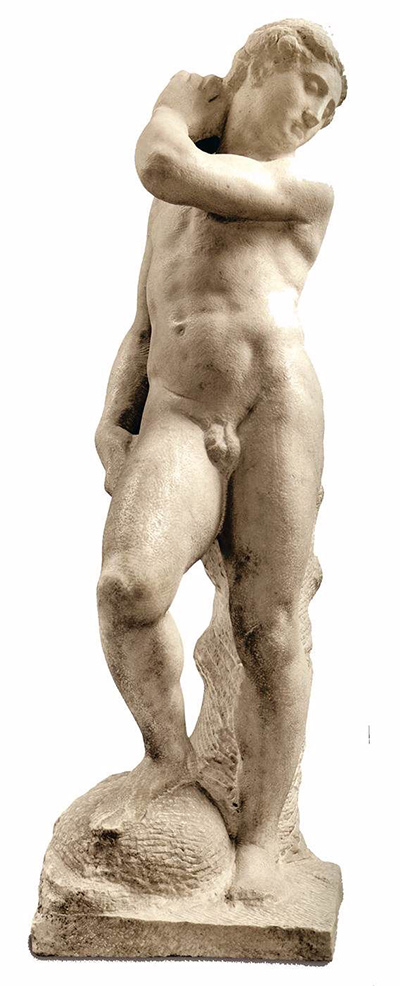
The young man turns toward something that is no longer there—or was never completed. One arm reaches across his chest, a long form runs behind his back, and a rough mass rises beneath one foot. If he is Apollo, the missing object may have belonged to the god’s bow or quiver. If he is David, the unfinished mound may have become Goliath’s head and the gesture may relate to a sling. Michelangelo’s marble refuses to choose for us.
Now in Florence’s Museo Nazionale del Bargello, the sculpture is known variously as Apollo, David, and most responsibly David–Apollo.[1] Its double title does not advertise indecision by modern cataloguers who have failed to look closely enough. It preserves conflicting historical evidence and an object whose incomplete attributes cannot settle the subject. The ambiguity is the work’s central fact, not an inconvenience to remove.
At a Glance
- ArtistMichelangelo Buonarroti
- Preferred titleDavid–Apollo, while Apollo and David remain historically important alternatives
- DateAbout 1530
- MediumMarble
- FormUnfinished standing youth
- Present locationMuseo Nazionale del Bargello, Florence
- Patronage contextAssociated with Baccio Valori, Medici governor of Florence after the republic’s defeat
- Possible subject oneApollo, classical god of music, poetry, prophecy and archery
- Possible subject twoDavid, biblical victor over Goliath and a powerful Florentine civic emblem
- Key evidence problemAttributes and supporting forms remain too incomplete to decide the identity conclusively
- Formal signatureA compact turn through shoulders, torso, hips and supporting leg
- Political cautionA work for Valori in post-siege Florence invites political interpretation, but uncertain subject and unfinished state prevent a single secure message
Contents
- Why Two Names Survive
- The Case for Apollo
- The Case for David
- Baccio Valori and Post-Republican Florence
- A Body Organised by Turning
- The Arm and the Missing Action
- The Rough Mass Beneath the Foot
- What the Unfinished Surface Reveals
- David–Apollo in the Bargello
- Comparing Michelangelo’s Two Davids
- David–Apollo and Victory
- How Titles Direct Vision
- Attributes, Loss and the Fragility of Identity
- What Completion Might Have Changed
- Why David–Apollo Matters
- Artist Up Close
Why Two Names Survive
Titles often feel like labels attached after interpretation has finished. Here the title is itself evidence. Historical records have supported both David and Apollo, and later scholars have tried to reconcile words with the marble’s incomplete forms. The hyphenated name preserves that unresolved encounter.
Apollo would be recognisable through attributes such as a bow, quiver or perhaps another object associated with the god’s arts. David would be identified through a sling, sword or the severed head of Goliath. Michelangelo completed none of these possible signs sufficiently to silence alternatives. A long form behind the figure and a mound beneath the foot can be recruited into either account, but recruitment is not proof.
The double title also reminds us that identification is historical. Inventories, descriptions and display traditions shape what later viewers expect to see. Once a sculpture is called Apollo, graceful turn and youthful nudity appear classical; once it is called David, tension and the rough lower mass begin to look biblical. The same marble changes under the pressure of a noun.
The Case for Apollo
Apollo offers a plausible reading of the idealised young body and the long element associated with the back. As a divine archer, the god could be represented with bow and quiver; as patron of poetry and music, he embodied cultivated beauty especially suitable to elite Renaissance ownership.
The figure’s movement can also feel Apollonian in the later sense of poised grace. He is not shown in violent combat. His turn is contained, and his body retains a languor uncommon in images of a hero confronting a giant. A patron could have valued such a classical subject as both learned reference and demonstration of Michelangelo’s mastery of the male nude.
Yet these associations cannot complete the missing attribute. Ideal youth belongs equally to David traditions, and a bow or quiver needs firmer material confirmation than an suggestive shape. Apollo remains a strong historical title, not a verdict.
The Case for David
David was never a neutral subject in Michelangelo’s Florence. His colossal earlier statue had become an emblem of the republic outside Palazzo Vecchio, and the Accademia’s object history preserves its civic relocation and fame.[3] To make another David around 1530, after the republic’s defeat and Medici return, would place biblical heroism inside a transformed political world.
The rough form under the youth’s foot has been read as an undeveloped head of Goliath. The hand’s relation to the upper body may suggest the action of drawing or reaching toward a sling. If those interpretations are correct, the statue would represent David after or around the moment of victory in a pose unlike the tense readiness of the earlier colossus.
But a mass that might have become a head is not yet a head. The pose does not offer an unmistakable sling, sword or stone. The David reading gains power from Florence’s history and from documentary naming, while the visible object continues to withhold closure.
Baccio Valori and Post-Republican Florence
The work is commonly associated with Baccio Valori, installed as Medici governor after imperial and papal forces ended Florence’s last republic. Michelangelo had served that republic by designing fortifications during the siege. A commission for Valori therefore emerged from political danger, accommodation and survival.
This context makes either title provocative. A David for a Medici official might domesticate or appropriate the republic’s former emblem. An Apollo might replace civic resistance with courtly classical culture. Those are illuminating possibilities, but the sculpture does not document which strategy a patron or artist intended.
Michelangelo’s acceptance of work under restored Medici power should not be simplified as enthusiasm or secret sabotage. Artists depended on patrons, and political defeat could make negotiation necessary. The unfinished statue records that difficult proximity without revealing the private terms on which Michelangelo experienced it.
A Body Organised by Turning
Whatever his name, the figure is not a rigid upright. One leg bears weight while the other engages the rough support; hips and shoulders shift in different directions; an arm crosses or approaches the chest; the head answers the movement with its own inclination. The body is constructed through counteraction.
This turn does not yet reach the aggressive spiral of Victory. It is more compact and inward. The figure seems occupied by an action close to his own body rather than expanding toward an opponent. That concentration supports both identities: Apollo handling an attribute or David managing a sling.
Moving around the statue exposes how incompletion affects the pose. Some contours gather into convincing anatomy, while others merge with blocks left for attributes or support. The body’s turn is legible before its action is.
The Arm and the Missing Action
The raised or crossing arm is the compositional hinge. It draws attention across the torso and directs the spectator toward the area behind the shoulder. Because the related object remains unclear, gesture becomes suspended between several actions.
If the youth reached for an arrow, the movement would activate Apollo’s identity. If he handled a sling, David’s narrative would come forward. If later finishing would have altered the arm’s relationship to the support, both modern reconstructions may be too narrow.
This uncertainty makes the gesture unusually vivid. A fully named action can be recognised and mentally completed at once. The David–Apollo holds attention because intention remains on the verge of legibility. Michelangelo had established the body’s need to move before leaving us enough information to say exactly why.
The Rough Mass Beneath the Foot
The form below the raised foot is often made to bear too much argument. Under a David reading, it promises Goliath’s severed head; under an Apollo reading, it may be a support or another attribute. In its present state, it is visibly a mass reserved within the block.
Structurally, that mass matters regardless of iconography. It supports the lifted leg and gives the pose unequal levels. The body gains ease or dominance from resting one foot above the ground plane. Michelangelo regularly made necessary supports participate in meaning, but an unfinished support can retain more than one possible future.
The responsible viewer therefore looks twice: first at what the form presently does, then at what it might have represented. Function is secure; identity remains provisional.
What the Unfinished Surface Reveals
The statue preserves different stages of carving. The principal body is clear enough to establish youth, stance and turn, while attributes, support and some surfaces remain less resolved. Such unequal work makes the sequence of sculptural priority visible. Michelangelo secured the living figure before every narrative identifier was complete.
That sequence helps explain why subject uncertainty persists. In many Renaissance statues, an attribute is a small addition that carries a large share of identity. If work stops before it is clarified, anatomy survives while iconography loosens. The marble remains compelling as a body and unstable as a story.
Unfinished does not mean deliberately ambiguous. Michelangelo may have intended one subject and expected the final attribute to make it obvious. Later circumstances prevented that completion. The double title belongs to the surviving condition, not necessarily to an original plan for indeterminacy.
David–Apollo in the Bargello
The Bargello’s Michelangelo collection places the statue near objects that sharpen its problems: Bacchus, a securely mythological youthful nude; Brutus, a politically charged classical bust; and the Pitti Tondo, an unfinished sacred relief.[1] Together they show how one sculptor’s work can cross subject, format and condition.
Beside Bacchus, the Apollo possibility gains classical company, but the differences are substantial. Bacchus carries grapes and cup with enough clarity for his intoxicated identity to dominate. David–Apollo lacks decisive attributes and draws its energy inward.
Beside Brutus, political context becomes more audible. Both sculptures have been read against Medici power, yet one has a secure Roman name and the other a divided title. The museum setting encourages comparison without solving either work through its neighbour.
Comparing Michelangelo’s Two Davids
If the Bargello youth is David, comparison with the earlier colossal statue is unavoidable. The Accademia David enlarges the hero before combat, every bodily decision contributing to alert preparation.[3] The later youth is smaller, more relaxed or inward, and materially incomplete.
Their political contexts would also invert. The first David became a republican guardian. A later David associated with Valori would belong to a Medici-dominated order that had defeated the republic Michelangelo served. Repetition of the subject could therefore register appropriation, survival, transformation—or simply a patron’s desire for a celebrated theme.
Because the title is uncertain, this comparison must remain conditional. It demonstrates what is at stake in calling the statue David; it does not make the name true by narrative attraction.
David–Apollo and Victory
The Genius of Victory develops a more explicit two-body hierarchy and a stronger spiralling motion. The David–Apollo is a single youth whose opponent or attribute remains only potential. Placing them together reveals Michelangelo moving from inward torsion to a group organised by physical dominance.
Both are tied to unstable histories. Victory has a probable but unsettled relation to the Julius tomb and a later Medici civic placement. David–Apollo carries a divided subject identity and Valori context. Their uncertainties are not identical, but both warn against treating a modern title as a complete original programme.
The younger figure in each work also shows that beauty can complicate power. Grace does not explain whether the subject is god, biblical victor or personification. The body persuades before the label decides.
How Titles Direct Vision
Try looking at the statue under one name at a time. As Apollo, notice the elegance of the turn, the long form near the back and the absence of strain. As David, notice the raised foot, the possibility of a defeated head and the hand’s relation to an imagined sling. Each title organises evidence selectively.
Then let both names fall away. Attend to weight, balance, toolwork and the intervals between arm and torso. This does not produce a subject-free truth, because Renaissance sculpture was made to represent something. It does reveal how much of the object’s achievement survives the identification problem.
Finally restore the double title. The exercise shows that uncertainty is not ignorance alone. It is knowledge of how interpretations are constructed and where the evidence stops.
Attributes, Loss and the Fragility of Identity
Renaissance viewers learned to identify sacred, biblical and mythological figures through attributes. Keys announce Peter, a wheel Catherine, a club Hercules. Those objects may occupy little space, yet they carry an enormous interpretive burden. The David–Apollo exposes what happens when carving ceases before such a sign becomes unequivocal.
An attribute does more than attach a label. It organises action. A bow requires the hand to reach or draw; a sling changes the tension of an arm; a severed head converts a raised foot into the gesture of a victor. Without the completed object, the anatomy can support several stories because the body's basic mechanics have not changed.
This fragility extends beyond unfinished sculpture. Attributes can be broken, restored incorrectly or separated from an object over centuries. A title may then survive even when the visible evidence that established it does not. Conversely, a later title can train spectators to see a damaged form as the attribute they expect.
The Bargello marble gives unusually direct access to that process because its undecided forms remain attached. We can watch identity gathering around a support and a gesture without reaching completion. The work therefore belongs to the history of classification as much as to the history of Michelangelo’s style.
What Completion Might Have Changed
Imagining a finished statue is unavoidable but hazardous. A few decisive cuts could have transformed the lower mass into a recognisable head, sharpened the long form into archery equipment or clarified the hand’s action. Surface polish would have made the body more continuous, but iconographic completion would have altered meaning more profoundly.
It is also possible that later revisions would have changed relationships now taken for granted. Michelangelo worked responsively, and stone preserved for one object could be redirected as a composition developed. The present marble should not be treated as a perfectly transparent underdrawing of a lost final state.
What can be recovered is a hierarchy of decisions. The youth’s stance and rotation were important enough to establish early. The attributes that would have fixed narrative identity came later or remained less developed. Michelangelo made bodily presence the stable core around which subject could still change.
Why David–Apollo Matters
The statue matters because it makes attribution of subject visible as a process. Museum labels usually present identity after debates have been compressed into a few words. David–Apollo keeps the debate in the name and invites viewers to test both possibilities against the stone.
It also matters as a record of Michelangelo’s political circumstances around 1530. A sculptor who had defended the republic could find himself working within the restored Medici order for a powerful governor. The marble’s ambiguity should not be turned into coded resistance, but its context prevents classical or biblical youth from remaining innocent of power.
Most of all, the sculpture demonstrates that formal completion and narrative completion are different. Michelangelo carved enough body for movement, balance and presence to command attention. He did not finish enough attribute for the subject to become secure. The result is not half an artwork. It is a compelling sculpture with an incomplete sentence.
Artist Up Close
Michelangelo made the David–Apollo during one of the most perilous turns in his Florentine life. After working on republican defences, he had to negotiate the Medici return and eventually left Florence permanently. A broad study of his design practice helps place the statue’s bodily torsion within a career of cross-media invention.[2] But the work’s special value lies in what career synthesis cannot settle: whether this particular youth was intended as Apollo or David. Michelangelo’s hand is recognisable; his subject remains divided.
Frequently Asked Questions
Discussion
What changes when the work is called Apollo rather than David-Apollo?
How much should unfinished carving shape interpretation?
Which comparison clarifies the sculpture most: Brutus, Bacchus, David or Victory?
Join the Conversation
Compare the Apollo and David-Apollo names, the unfinished form and the Bargello context.
References
- Musei del Bargello, Michelangelo: The Bloom of Renaissance Art”:, View source.
- The Metropolitan Museum of Art, Michelangelo: Divine Draftsman and Designer”:, View source.
- Galleria dell’Accademia di Firenze, Michelangelo’s David”:, View source.