


 by Tom Gurney
Tom Gurney BSc (Hons) is an art history expert with over 20 years experience
Published on June 19, 2020 / Updated on November 6, 2025
Email: tomgurney1@gmail.com / Phone: +44 7429 011000
The Flood by Michelangelo
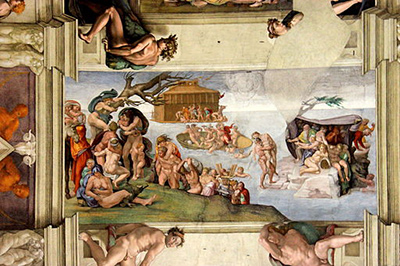
Michelangelo’s Flood has no single hero large enough to control it. Across a wide Sistine ceiling field, families drag possessions onto shrinking islands, parents clutch children, men struggle into a small boat, bodies cling to a blasted tree and a crowded shelter offers only temporary refuge. In the distance, Noah’s ark floats with a chosen remnant aboard. Nearer figures are larger and emotionally immediate, but most are doomed.
The fresco is also known as The Deluge, and the Vatican Museums identify it as the eighth of the nine central Genesis stories when the ceiling is ordered from altar toward entrance.[1][2] Its catastrophe follows Sacrifice of Noah in that physical sequence even though Genesis places the sacrifice after the waters recede. The panel’s power depends on accepting several forms of disorder at once: rising water, scattered action, reversed chronology and the painful distance between human sympathy and divine judgment.
At a Glance
- Institutional titleThe Flood[2]
- Alternative titleThe Deluge
- Artist and methodMichelangelo Buonarroti, fresco
- LocationOne of the nine central Genesis pictures on the Sistine Chapel vault
- PatronagePope Julius II; ceiling work ran from 1508 to 1512[3]
- Biblical sourceThe Flood narrative in Genesis 6–8[6][7]
- Physical sequence positionEighth from the altar, between Sacrifice of Noah and Drunkenness of Noah[1]
- Chronological cautionNoah’s sacrifice occurs after the Flood in scripture despite preceding it overhead
- Principal zonesLeft foreground refuge, central water and boat, right-hand rocky shelter, and the ark in the distance
- Key visual conditionNumerous small figures compete for unstable ground
- Moral tensionIndividual acts of care occur inside a scene of collective destruction
- Viewing cautionThe dense action is difficult to resolve from the chapel floor and changes sharply with cropping
Contents
- Genesis and Universal Catastrophe
- A Composition Without a Stable Centre
- The Left-Hand Refuge
- The Central Boat
- The Ark in the Distance
- The Rocky Shelter
- Water as the Destruction of Boundaries
- Bodies Carrying Bodies
- Failed Technologies of Rescue
- Children and the Cost of Judgment
- Nude Bodies in Mortal Weather
- Physical Order and Biblical Order
- Early Work and the Problem of Scale
- Fresco Labour and Reported Damage
- Seeing the Deluge from Below
- Restoration, Colour and Surface
- The Flood as a Test of Attention
- The Ethics of Watching Disaster
- Why The Flood Matters
- Artist Up Close
Genesis and Universal Catastrophe
Genesis describes a world corrupted by violence and a divine decision to destroy living creatures through a flood. Noah, judged righteous in his generation, is instructed to build an ark and preserve his family and animal life.[6] Rain and waters overwhelm even the high mountains; life outside the ark dies.[7]
The story combines judgment and preservation. It is not simply an ancient account of bad weather, nor is the ark a generic rescue vessel available to every figure Michelangelo paints. The vessel represents the divinely ordered survival of Noah’s household and living kinds.
Michelangelo concentrates on those outside it. The biblical text states their fate collectively; the fresco imagines it through individuals. A mother holds a child, a man supports another body, families gather under cloth and swimmers reach for a boat.
This shift does not cancel the scriptural judgment. It makes its human cost present. Anonymous figures acquire enough specificity to provoke pity even though the narrative offers no rescue for them.
A Composition Without a Stable Centre
The field is organised into clusters rather than one dominant action. At the left, figures climb and gather on higher earth beneath a tree. Across the middle, water carries a small boat full of struggling bodies. At the right, people crowd onto pale rock under an improvised covering. Farther back, the ark remains comparatively self-contained.
No central figure unifies these zones through gesture. Instead, the eye moves restlessly from crisis to crisis, replicating the scene’s failure of common order.
The broad format encourages scanning. Each group initially seems to offer a possible refuge, then reveals insufficiency: earth is shrinking, branches bend, the boat is overloaded, cloth cannot stop water and the ark is remote.
Michelangelo thereby turns composition into catastrophe. The absence of a single focal solution is not confusion accidentally produced by too many bodies; it is the visual condition of a world in which people cannot coordinate an escape.
The Left-Hand Refuge
The largest foreground group occupies dark, rising land. Adults and children crowd together with bundles, garments and household objects. A seated woman spreads across the lower edge, while other figures support or carry vulnerable companions.
The group contains remarkable tenderness. Bodies overlap in embraces and acts of assistance. One adult shelters a smaller figure; another bears weight that is not his or her own. Michelangelo makes care visible even when it cannot change the outcome.
Above them, a man climbs toward a tree whose trunk and branches bend across the sky. Other figures cling to the higher ground or lift possessions. The tree promises elevation but not true safety.
This cluster is closest to the observer and therefore hardest to dismiss as an anonymous multitude. Their enlarged anatomy produces identification before the distant ark can supply theological explanation.
The Central Boat
A small craft pitches in the middle distance, dangerously crowded. Some figures sit within it; others cling to the edge or struggle in the water. An oar or pole suggests attempted control, but the boat lacks the stability of the ark behind it.
Its shape is crucial because it can be mistaken for Noah’s vessel in an isolated crop. The ark is the large rectangular construction farther back. The open boat belongs to those trying to survive by human means.
Bodies in and around the craft form a compressed knot of limbs. Individual poses become difficult to disentangle, intensifying the sense of panic. The water erases firm footing and makes every handhold temporary.
The contrast between vessels is theological and visual. One is overloaded and exposed; the other is enclosed and preserved. Distance makes the secure vessel smaller to the eye, as if salvation were present yet inaccessible to those whose suffering dominates the foreground.
The Ark in the Distance
Michelangelo represents the ark as a box-like wooden structure rather than a sweeping ship. Figures crowd near its opening or platform, but its geometry remains stable amid the surrounding flood.
Genesis describes the ark through dimensions, decks, opening and covering.[6] The fresco does not attempt a technical reconstruction of every measurement. Rectilinear mass is enough to signal an ordered enclosure.
Its background position has major emotional consequences. The object central to the biblical survival story is not the largest form in the image. Viewers confront doomed humanity before locating Noah’s refuge.
This reversal of expected hierarchy may be one reason the scene feels so disturbing. The ark provides narrative certainty without offering compositional relief. It cannot absorb the grief distributed across the foreground.
The ark’s enclosure also reverses the foreground search for height. People outside climb rocks and trees because elevation seems to promise safety. The saved occupy not the highest visible point but a structure made in obedience to divine instruction.[6] Vertical effort and covenantal refuge are not the same.
Michelangelo makes that difference spatially understated. The distant building could almost escape notice, and no radiant sign isolates it. Recognition depends on knowing the narrative and reading past the emotionally dominant crowds. The composition tests whether the observer will mistake immediate scale for ultimate significance.
This is not an invitation to feel less for the foreground. On the contrary, the visual delay lets pity form before the ark supplies the story’s severe division between those inside and everyone else.
The Rocky Shelter
At the right, another group occupies pale stone beneath a stretched cloth. The covering resembles a hurried tent or canopy, held and gathered by figures at its edges.
The arrangement evokes domestic protection—family, fabric, a temporary roof—yet it is absurdly inadequate against a universal flood. Human beings reproduce the forms of household security on ground that is about to vanish.
Several figures look outward or upward, while children and adults press into the confined space. The white rock and fabric distinguish the group from the darker left refuge, giving the panel two competing islands of attention.
Their isolation is compositional as well as narrative. Water separates them from the left cluster and central boat. The many groups share danger but cannot join forces.
Water as the Destruction of Boundaries
Michelangelo does not make the water spectacular through towering waves. Much of it appears as a broad, pale expanse occupying the intervals between refuges. Its relative visual quiet is ominous: the flood wins by removing distinctions between path, shore and depth.
Land normally organises human movement. People can stand, carry, build and gather because surfaces remain stable. Here every cluster is an exception surrounded by a medium that offers no foothold. Water converts distance into isolation.
The pale field also allows darker bodies, boats and structures to register from below. Destruction and pictorial clarity cooperate. Michelangelo makes a relatively featureless element the space through which every desperate gesture becomes visible.
Because the water is not assigned one dramatic crest, its scale is difficult to measure. It seems to continue beyond the picture, fulfilling the biblical claim of a catastrophe without safe exterior.[6][7]
Bodies Carrying Bodies
Across the fresco, Michelangelo repeats acts of carrying and support. Adults lift children, companions bear the exhausted and people pull one another across unstable terrain.
These gestures introduce ethical complexity. The Flood is a divine punishment for collective corruption, yet many individuals within it act compassionately. The image does not make them into named righteous exceptions, but neither does it depict humanity as a uniform mass of vice.
The bodies are muscular even under desperation. Strength is real but insufficient. A powerful back can carry another person for a few steps; it cannot outlast water covering the mountains.
Michelangelo’s anatomy therefore avoids easy heroism. Physical capacity becomes the means through which helpless care is expressed.
Failed Technologies of Rescue
The groups depend on objects humans ordinarily trust: bundles preserve possessions, cloth creates shelter, a small boat crosses water and a tree offers height. Each device is sensible under limited danger and futile against the event Genesis describes.
Michelangelo does not ridicule these attempts. The boat still floats, the canopy still covers and the tree still supports. Their failure comes from scale rather than stupidity. Local solutions confront universal conditions.
The ark is the exception, not because it is inherently more graceful, but because the narrative defines it as built under divine instruction.[6] This distinction is uncomfortable. From a purely visual standpoint, the open boat’s struggle may seem more heroic than the distant box’s security.
The fresco asks the observer to hold practical admiration and theological outcome apart. Ingenuity has value, but it does not determine survival in this story.
Children and the Cost of Judgment
Children appear throughout the refuge groups, held, carried or kept close. Their presence heightens the emotional cost of the biblical catastrophe.
Genesis describes the destruction collectively rather than pausing over individual families.[7] Painting can force a slower encounter. A small body beside an adult changes an abstract population into dependent life.
This does not amount to a theological answer about innocence and punishment. Michelangelo offers no explanatory inscription. The figures make the question harder, not simpler.
Their scale also tests visibility. At ceiling height, children can merge into larger clusters. Close reproductions reveal how insistently the composition embeds vulnerability within muscular crowds.
Nude Bodies in Mortal Weather
Many figures are naked or lightly draped. Nudity links them to the ceiling’s creation narratives while transforming its meaning. Adam’s first body belongs to possibility; these bodies belong to exposure.
Without substantial clothing, shelter or architecture, anatomy meets the elements directly. Skin defines the boundary that water threatens. Twisting torsos and raised limbs no longer celebrate potential alone; they register cold, fear, weight and exhaustion.
The display of the nude has sometimes encouraged attention to formal invention at the expense of subject. Yet form and catastrophe are inseparable. Michelangelo’s study of bodies allows him to vary panic across age, sex, burden and direction.
The beauty of individual figures does not redeem the scene. It makes destruction more difficult to accept as distant abstraction.
Physical Order and Biblical Order
Read from the altar, the Noah group appears as Sacrifice, Flood and Drunkenness.[1] Genesis narrates the Flood before Noah’s offering.[7] The first two therefore exchange positions.
This fact establishes that the ceiling is not a simple illustrated strip mechanically following verse order. Monumental programmes respond to theological association, architectural compartments, visual scale and patterns across an entire room.
Why the sacrifice precedes the catastrophe has prompted interpretation, but no single official source resolves the design decision. It is responsible to describe the effect: an image of ordered worship is encountered before mass disorder, and hope precedes the disaster that historically occasioned it.
The reversal also warns against assuming that physical placement determines working chronology. The Noah scenes lie in the entrance-side half Michelangelo completed first, while the cosmic beginnings near the altar were executed later.[3]
Early Work and the Problem of Scale
The Vatican dates completion of the first ceiling half to August 1510 and the full vault to October 1512.[3] The Flood belongs to that earlier entrance-end phase.
Its numerous relatively small figures are often contrasted with the larger, simpler bodies Michelangelo used as the campaign progressed. The comparison is visibly persuasive at broad level: the Flood’s density differs sharply from the solitary God in Separation of Light from Darkness.
Still, stylistic development should not become a precise calendar. Compartment size and subject also matter. A universal catastrophe involving crowds naturally demands different resources from a cosmic act embodied in one figure.
The most balanced conclusion is that experience, viewing distance, architecture and narrative all contributed to Michelangelo’s changing scale.
Fresco Labour and Reported Damage
Fresco is made by applying pigment to fresh plaster in sections. A crowded composition requires extensive planning, transferred contours and coordination of adjacent passages.
Early accounts of the ceiling campaign have been associated with technical setbacks and surface problems in the Flood area. Such stories should be handled carefully unless tied to conservation evidence or reliable documentation. The present institutional sources establish the work’s place and material context without supporting every anecdote.[2][3][4]
What the surface visibly shows is complexity: many bodies, overlapping contours and changing tonal fields painted at architectural scale. Cracks and restoration history are part of the fresco’s later material life.
Technical difficulty should deepen respect for the work without becoming a myth in which Michelangelo alone performs every preparatory and practical act without assistance.
Seeing the Deluge from Below
From the chapel floor, the panel’s multitude is hard to parse. Larger masses—dark land, pale rock, central water and distant ark—organise perception before individual stories emerge.
This creates a gap between immediate experience and photographic study. A high-resolution detail can isolate a parent or swimmer, but it may erase the group’s relation to other failures of refuge.
The most revealing method is incremental. Locate the ark, then the small boat; compare the two land masses; finally follow the chains of bodies within each. The chaos becomes structured without becoming calm.
A complete ceiling view adds another scale. The crowded human disaster occupies one rectangle among prophets, sibyls, ignudi, medallions and painted architecture.[3] Catastrophe is both immense and contained.
Restoration, Colour and Surface
The Vatican’s histories distinguish the chapel’s long conservation record from the modern campaign that transformed public visibility of the ceiling.[4][5] Cleaning altered the balance familiar from older dark reproductions and renewed debate over Michelangelo’s colour and finishing methods.
In The Flood, colour helps separate clusters: flesh against dark ground, pale figures against water, cloth against exposed rock, warm wood against grey-blue distance. Digital reproductions vary dramatically in how these differences register.
Surface cracks can attract the eye in enlarged images, while ceiling distance subordinates them to composition. Neither condition is false. They answer different questions about material state and visual experience.
Claims about an exact “original colour” should therefore remain cautious. The fresco is a conserved historical surface, and every photograph adds its own conditions.
The Flood as a Test of Attention
The image initially overwhelms because it distributes narrative. Unlike Creation of Adam, it offers no single gap or gesture easily detached as an icon.
Patient attention changes that. The clusters reveal different responses: self-preservation, care, exhaustion, cooperation, panic and resignation. The catastrophe becomes a study of behaviour under impossible pressure.
This variety also resists moral sorting by appearance. Viewers cannot identify a visible catalogue of guilt corresponding to each doomed person. The biblical judgment and painted sympathy remain in tension.
Michelangelo does not resolve that discomfort. He gives it bodies.
The Ethics of Watching Disaster
An image of catastrophe can turn suffering into spectacle, especially when its bodies are formally beautiful. Michelangelo’s design cannot remove that risk; it can make the observer conscious of it.
No foreground figure looks out to request admiration. Attention circulates within crises: toward a child, an exhausted companion, a branch or the unstable craft. Viewers remain outside those networks, able to see more than any painted person and unable to help.
The distant ark adds a second kind of knowledge. The observer knows the biblical outcome while the struggling groups behave as if rescue might still be possible. That temporal advantage can produce judgment or pity.
The most humane looking resists treating anatomy as an inventory of poses. Formal invention matters because it differentiates fear and care, not because disaster is merely an excuse for virtuosity.
Why The Flood Matters
The fresco matters because it makes universal destruction intimate without losing scale. A distant ark carries the saved remnant while foreground families turn judgment into human grief.
It matters as evidence of Michelangelo’s early ceiling strategy: dense groups, multiple incidents and relatively small figures organised across an architectural field. Later simplification becomes more intelligible when set against this abundance.
Most importantly, The Flood refuses a comfortable division between righteous story and anonymous victims. Preservation is visible, but so is love among the condemned. The image’s moral force lies in holding both.
Artist Up Close
Michelangelo’s command of anatomy does not guarantee his figures control. In The Flood, strength is everywhere and mastery nowhere. Muscular adults carry children, haul bundles and grasp branches, yet the water dissolves the value of every effort. By multiplying capable bodies and denying them sufficient ground, the artist turns physical power into pathos. The tragedy is not that humanity does nothing; it is that people act intensely and still cannot save one another.
Frequently Asked Questions
Discussion
What do you notice first in Michelangelo's The Flood: the people seeking refuge, the distant ark, or the way the scene sits within the Noah sequence?
Reader Insights
How does the crowded composition change the emotional force of the Genesis sequence?
What changes when The Flood is read between sacrifice and family aftermath?
How do title variants shape the way readers find and understand the scene?
Join the Conversation
Compare this scene with Sacrifice of Noah and Drunkenness of Noah, and ask how Michelangelo shifts from survival to crisis and aftermath.
References
- Vatican Museums, Central Stories”:, View source.
- Vatican Museums, The Flood”:, View source.
- Vatican Museums, Sistine Chapel Ceiling”:, View source.
- Vatican Museums, Sistine Chapel History”:, View source.
- Vatican Museums, The Sistine Chapel Twenty Years Later: New Breath, New Light”:, View source.
- United States Conference of Catholic Bishops, Genesis, Chapter 6”:, View source.
- United States Conference of Catholic Bishops, Genesis, Chapter 8”:, View source.