


 by Tom Gurney
Tom Gurney BSc (Hons) is an art history expert with over 20 years experience
Published on June 19, 2020 / Updated on August 8, 2026
Email: tomgurney1@gmail.com / Phone: +44 7429 011000
The Conversion of Saul by Michelangelo
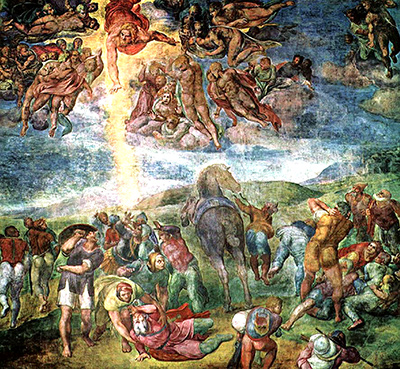
Heaven does not open gently. Christ plunges downward through a crush of angels, one hand directing a shaft of light towards the blinded man below. Soldiers scatter, a grey horse turns away and Saul lies on the earth, his face and raised hand caught between defence and recognition. Conversion arrives as an interruption powerful enough to disorganise an army.
Michelangelo painted The Conversion of Saul between late 1542 and July 1545 on a side wall of the Pauline Chapel in the Vatican Palace.[1] It faces his later Crucifixion of Saint Peter. Together, the frescoes present the call of Paul and the death of Peter within a private papal sanctuary dedicated to the Church’s two principal apostles.[1]
How should this page handle the Saul/Paul title and Pauline Chapel setting? The inherited route uses Conversion of Saul, while the Holy See source uses Conversion of Saint Paul. This page preserves both names, keeps the fresco in the Pauline Chapel, and separates it from the Sistine ceiling and Last Judgement.
At a Glance
- WorkThe Conversion of Saul, also titled The Conversion of Saint Paul
- Artist and techniqueMichelangelo Buonarroti; fresco
- DateFrom the end of 1542 to July 1545[1]
- LocationPauline Chapel, Apostolic Palace, Vatican City
- PatronPope Paul III Farnese, for the chapel bearing his papal name[1]
- Scriptural basisActs 9, with Paul’s later retellings in Acts 22 and 26[2][3][4]
- MomentThe persecutor Saul is struck by heavenly light and addressed by the risen Christ near Damascus
- Main zonesChrist and angels above; Saul, horse, soldiers and companions below
- Non-scriptural conventionActs mentions no horse, although equestrian conversion scenes were established in art
- Age paradoxMichelangelo shows Saul as an older bearded man rather than a youthful persecutor
- Paired frescoThe Crucifixion of Saint Peter, begun after the conversion and finished in 1550[1]
- Viewing conditionThe long, narrow chapel makes oblique and moving viewpoints more important than a flat frontal view[5]
Contents
- Saul Before Paul
- Conversion or Calling?
- Saul and Paul: Why Two Titles?
- Christ Descending Through Heaven
- The Shaft of Light
- An Older Saul
- Falling Without Gracefulness
- The Horse That Acts Does Not Mention
- Soldiers and Companions
- Shields, Spears and a Defeated Mission
- Landscape and the Road to Damascus
- A Composition for a Narrow Chapel
- The Conversion Facing Peter’s Death
- Two Walls Seen in Succession
- Beyond the Familiar Road-to-Damascus Formula
- A Programme That May Have Changed
- Paul III and the Apostle Paul
- Michelangelo’s Last Painted Cycle
- Colour After Restoration
- Conversion as Seeing Differently
- Why The Conversion of Saul Matters
- Artist Up Close
Saul Before Paul
Acts first presents Saul as an opponent of the earliest Christians. He approves Stephen’s killing, enters houses and drags believers away. He then obtains authority to arrest followers of “the Way” in Damascus.[2]
Near the city, a light from heaven suddenly surrounds him. He falls and hears a voice: “Saul, Saul, why are you persecuting me?” The speaker identifies himself as Jesus.[2]
Saul rises unable to see. His companions lead him by the hand into Damascus, where he remains without sight for three days before Ananias is sent to him.[2]
The encounter reverses direction at every level. A man travelling to seize Christians becomes dependent upon others; the persecutor is chosen as witness; physical blindness begins spiritual recognition.
Michelangelo condenses that reversal into the instant between falling and understanding.
Conversion or Calling?
“Conversion” is the standard title, but the event is also a calling. Saul does not merely adopt a new opinion; he receives a commission.
In Paul’s later account before Agrippa, Christ appoints him as servant and witness and sends him to open eyes, turn people from darkness to light and extend forgiveness.[4]
Those words make the fresco’s light more than spectacle. Saul is blinded by the radiance through which he will become an agent of spiritual sight.
The episode therefore contains future mission inside present collapse.
The Pauline Chapel’s purpose deepens that connection. The Holy See describes the sanctuary as evoking the mission and destiny of the universal Church, with Peter grounding papal legitimacy and Paul sustaining doctrine and outward mission.[1]
Saul’s fall is the beginning of an ecclesial future, not a private epiphany isolated on a road.
Saul and Paul: Why Two Titles?
The fresco is called both Conversion of Saul and Conversion of Saint Paul. These names identify the same person at different narrative and devotional moments.
Acts calls him Saul during the Damascus encounter. Later it notes “Saul, who is also called Paul,” after which Paul becomes the usual name in the narrative.
Conversion of Saul preserves the dramatic before-state: the persecutor at the moment his direction changes. Conversion of Saint Paul names the apostle known retrospectively to Christian tradition.
Neither title indicates a different work.
Michelangelo himself exploits this doubleness. The fallen figure is Saul in action but Paul in sacred memory—already honoured in the chapel that bears the name of both apostle and patron.
Christ Descending Through Heaven
Christ appears high on the wall but does not remain enthroned. His body leans sharply downwards, surrounded by angels and cloud.
The extended arm directs divine force towards Saul. Light becomes a vector joining separated realms.
Michelangelo crowds the celestial zone. Angels press around Christ rather than forming calm, symmetrical ranks.
Their movement makes heaven feel active, almost physically breaking into the journey below.
Christ’s foreshortened body also answers the chapel’s oblique sightlines. From a position along the central axis, the descent acquires direction unavailable in a squared photograph.[5]
This is revelation conceived as movement towards a particular person.
The Shaft of Light
A bright vertical passage connects Christ with Saul’s head. It cuts through landscape and crowd more decisively than any road.
Acts repeatedly makes light central. In chapter 9 it flashes from heaven; in chapter 22 Paul calls it a great light; before Agrippa he remembers a radiance brighter than the sun.[2][3][4]
Michelangelo gives that brightness compositional authority. It separates groups while linking above and below.
The beam is not painted like an ordinary sunbeam originating outside the scene. Its source is Christ’s intervention.
Saul’s raised hand acknowledges both physical pain and directed encounter. He cannot yet see, but the light has found him.
This inversion—illumination producing blindness—lies at the heart of the fresco.
An older interpretation describes the highlights on Saul and the horse as the first dim apprehension of grace.[8] The metaphor is persuasive so long as it remains grounded in Acts: the horse has no conversion of its own, while Saul will convert perception into mission.
An Older Saul
Michelangelo depicts Saul with an ageing, bearded face. The choice conflicts with the common expectation of a younger man at the beginning of his Christian vocation.
The discrepancy is deliberate enough to demand attention, but its final meaning cannot be proven. Some interpretations see autobiographical identification between the elderly artist and the apostle undergoing radical reorientation.
That possibility is strengthened by Michelangelo’s own late religious concerns, yet resemblance is not documentary proof of self-portraiture.
An older Saul also collapses time. The future apostle seems already present within the fallen persecutor.
The image becomes less a reconstruction of a young traveller and more a meditation on conversion as a necessity at any age.
Michelangelo, himself in his late sixties when the work began, makes spiritual beginning inhabit an old body.
Falling Without Gracefulness
Saul’s body does not perform an elegant descent. He lies heavily on the ground, limbs awkwardly gathered and face exposed upward.
His companions reach towards him, but their movements do not form a serene rescue.
The collapse has removed command. Saul had travelled with authority and purpose; now he cannot stand or see.
Michelangelo builds this loss of control into the pose. The torso turns while the legs remain caught among other bodies and objects.
Unlike the falling damned in the Last Judgement, Saul is not being expelled from salvation. His helplessness is the condition through which a new vocation begins.
The same physical grammar—fall, exposure, disorientation—can therefore carry opposite theological outcomes.
The Horse That Acts Does Not Mention
A horse occupies the earthly crowd, its hindquarters prominent as it turns away. Acts never says Saul travelled on horseback.[2][3][4]
By Michelangelo’s time, however, the fallen rider had become a useful visual convention. A horse clarifies interrupted journey, former status and sudden loss of mastery.
The animal also enlarges the disturbance. Divine light affects not only Saul but the entire travelling formation.
Its turned body creates a massive central barrier, partially hiding figures and complicating spatial continuity.
The horse should therefore be understood as pictorial tradition rather than biblical evidence.
Michelangelo does not use it merely for grandeur. Its retreating weight contrasts with the exposed man who can no longer direct it.
The Vatican patrons’ conservation account observes that the principal action lies towards one side while the horse and terrified observers restore balance elsewhere.[6] “Balance” here does not mean repose. The animal prevents the lower half from collapsing entirely around Saul and gives the scattered company a second centre of mass.
Soldiers and Companions
Saul’s party includes armed men, attendants and terrified figures reacting in different directions. Shields, spears, garments and bodies break any simple line of march.
Acts 9 says the companions hear the voice but see no one; Acts 22 says they see the light but do not understand the voice; Acts 26 emphasises that all fall to the ground.[2][3][4]
The differing accounts encourage a range of reactions rather than one uniform response.
Michelangelo paints collective bewilderment. Some protect themselves, some run, some look upward and some attend to Saul.
No secondary figure fully comprehends the event. The revelation is public in its disruption but particular in its address.
The crowd makes that difference visible: many are struck by circumstances, one receives the vocation.
Shields, Spears and a Defeated Mission
Military equipment identifies coercive purpose. Saul has not approached Damascus as a humble pilgrim.
Spears rise into the landscape; circular shields offer physical defence. Neither has relevance against the light.
Michelangelo turns the armed expedition into a formation defeated without combat. Christ carries no earthly weapon.
The shields cannot block revelation, and the spears point nowhere useful.
This impotence gives conversion a political dimension. Authority granted for persecution collapses before a higher claim.
The former instruments of control become debris within Saul’s dependence.
Landscape and the Road to Damascus
The distant landscape opens behind the crowd with hills, trees and an approach towards a settlement.
It is not a precise topographical portrait of Damascus. Its function is directional: the mission has a destination, and that destination remains beyond the interruption.
Saul will still enter the city, but led rather than leading.[2]
The light occupies the vertical axis while the journey would have followed a horizontal course. Divine action crosses human intention.
Michelangelo keeps enough distance visible to remind us that conversion is not the end of the story.
Ananias, baptism, preaching and conflict lie beyond the pictured instant.
A Composition for a Narrow Chapel
Flat reproductions often make the fresco appear dispersed, with inconsistent scale and uncertain focus.
William Wallace’s study argues that such criticism privileges the least important viewpoint: a frontal position difficult to sustain inside the long, narrow Pauline Chapel.[5]
As a person moves along the central aisle, different groups align, separate and direct attention towards Saul. Proportions adjusted for oblique sight become more coherent.
The history therefore unfolds partly through bodily movement by the observer.
This is not a defect excused by location. It is a composition made through location.
Michelangelo treats the wall as one side of an inhabited corridor rather than an autonomous rectangular picture.
The Conversion Facing Peter’s Death
On the opposite wall, the cross of Peter is being hauled into position. Michelangelo worked on that fresco after completing the conversion, finishing it in March 1550.[1]
The pair joins vocational beginning to faithful ending.
Saul falls down and will rise with a new mission. Peter is raised on an inverted cross and approaches death.
One history is invaded by heaven; the other appears almost abandoned to a bleak earthly labour.
Yet both concern apostolic identity made through surrender. Saul loses the old direction of his will; Peter gives his body to martyrdom.
Their facing positions allow the chapel to hold calling and witness together.
Two Walls Seen in Succession
The paired frescoes cannot be experienced exactly as two illustrations printed side by side. They occupy opposite walls, and their scale exceeds a single comfortable field of vision.
Movement along the chapel turns attention from one to the other. Saul’s beam descends; Peter’s cross rises. One composition disperses from a flash, while the other gathers around a laborious execution.
This bodily alternation creates meanings unavailable to either wall alone. The observer must turn, repeating in modest physical form the conversion’s change of direction.
The narrowness also produces partial views. Christ may come into alignment before every soldier is visible; Saul may be understood before the distant road opens.
Michelangelo composes for discovery over time. The frescoes’ apparent crowding becomes a device that prevents immediate possession.
Beyond the Familiar Road-to-Damascus Formula
Later paintings often isolate Saul, horse and light into a stark triangle. Michelangelo keeps a far larger company and a populated heaven.
The difference changes the event’s social scale. This is not a private mystical experience that happens to interrupt one traveller. Armed institutional purpose has accompanied Saul, and an angelic host attends Christ.
Earthly and celestial communities meet without merging. The companions cannot enter Saul’s exchange, while the angels do not descend to organise the fallen party.
Michelangelo gives the central relation—Christ addressing Saul—an immense environment but no visual quiet.
That refusal of isolation suits the apostle’s future. Paul’s calling will lead outward into communities, conflicts, journeys and letters. The crowded beginning anticipates a public vocation.
A Programme That May Have Changed
The Holy See notes an intriguing uncertainty. Vasari’s first edition mentioned a Consignment of the Keys rather than Peter’s crucifixion, suggesting that the intended scheme may originally have paired the calls of the two apostles.[1]
If so, the final choice altered the relation from two beginnings to beginning and end.
The evidence does not establish exactly when or why a change occurred. Vasari may also have been mistaken.
What survives is the authoritative fact: Michelangelo’s conversion faces his crucifixion of Peter.
The possibility of an earlier plan nevertheless reminds us that iconographic programmes can evolve during construction.
The present theological relation should not be projected backwards as an unchanging first idea.
Paul III and the Apostle Paul
The chapel was constructed under Pope Paul III Farnese and named for him. Its dedication to Saints Peter and Paul joined papal name, institutional history and apostolic mission.[1]
Beginning with the conversion honoured the apostle whose name the patron bore.
The decision is devotional and political without needing to be reduced to flattery. Paul’s transformation from persecutor to missionary offered a profound model of grace acting through historical power.
The pope who commissioned the Last Judgement now asked Michelangelo to address the beginnings of apostolic authority in a more intimate sanctuary.
Personal patronage and universal Church history meet on the same wall.
Michelangelo’s Last Painted Cycle
The Pauline pair followed the Last Judgement and became Michelangelo’s final frescoes.[1]
They were made while he also carried major architectural responsibilities, including work connected with St Peter’s. Illness interrupted the chapel undertaking in 1544 and 1546.[1]
Late date should not be used as a shorthand for diminished ability. The crowded compositions and extreme poses pursue problems different from the lucid central scenes of the Sistine ceiling.
Treccani notes the fresco base, transfer procedures and indications of complex execution, while the Metropolitan Museum places the late works within Michelangelo’s continuing culture of disegno—drawing as both physical preparation and design.[7][9]
The result is less classically stable but not less intentional.
Colour After Restoration
For centuries the Pauline frescoes were associated with darkness. Conservation completed in 2009 removed layers of dust, oil and previous intervention while seeking to preserve Michelangelo’s surviving work.[1]
The cleaning revealed vivid, urgent colour closer in chromatic character to the Last Judgement than older photographs suggested.[1]
In the conversion, blue-green landscape, red garments, pale light and variegated flesh prevent the crowd from becoming one brown mass.
Colour separates simultaneous reactions and reinforces the rupture between celestial brightness and earthly confusion.
Restoration does not return an untouched original state. It creates a better conserved historical surface after centuries of change.
Comparisons must therefore identify whether an image predates or follows the cleaning.
Conversion as Seeing Differently
The story’s deepest paradox is visual. Saul’s eyes are opened spiritually when his bodily sight fails.
Michelangelo distributes that paradox through the whole composition. Companions who can see the event do not understand it; Saul, blinded, is the one addressed.
The observer stands in a comparable uncertainty. The fresco offers abundant visible action, yet its meaning emerges only by following Christ’s gesture and the beam to the fallen man.
Sight alone is insufficient. Direction and interpretation matter.
The work thus transforms a problem of faith into a problem of looking at a crowded wall.
Conversion is not merely what happens to Saul. It is the reorganisation of attention.
Why The Conversion of Saul Matters
The fresco matters because Michelangelo refuses to make inward change invisible. Revelation overturns bodies, animals, weapons and landscape.
It matters because the aged Saul turns conversion into a late-life question rather than a youthful adventure.
Above all, its apparent compositional disorder resolves through the chapel. The spectator’s movement, Christ’s descent and Saul’s fall intersect. A history about changed direction is itself understood by changing position.
Artist Up Close
Michelangelo paints grace as catastrophic precision. Heaven descends upon one persecutor, yet an entire company is thrown off balance. The old face on the ground gives the scene its severity: transformation is not easy, flattering or reserved for the young. It begins where command fails. Light takes away sight, collapse opens vocation, and the road continues under a new authority.
Frequently Asked Questions
Discussion
What details, sources or comparisons stand out to you in Conversion of Saul by Michelangelo?
Reader Insights
Which formal detail changes how the work reads?
Which documented source or collection history feels most useful?
Which related Michelangelo work should readers compare next?
Join the Conversation
Add a source-led observation, comparison or question for other readers.
References
- Holy See, Office for the Liturgical Celebrations of the Supreme Pontiff, “The Pauline Chapel”:, View source.
- United States Conference of Catholic Bishops, Acts, Chapter 9”:, View source.
- United States Conference of Catholic Bishops, Acts, Chapter 22”:, View source.
- United States Conference of Catholic Bishops, Acts, Chapter 26”:, View source.
- William E. Wallace, Narrative and Religious Expression in Michelangelo’s Pauline Chapel,” Artibus et Historiae 10, no. 19 (1989):, View source.
- Patrons of the Arts in the Vatican Museums, Pauline Chapel”:, View source.
- Treccani, Michelangelo pittore”:, View source.
- Web Gallery of Art, The Conversion of Saul”:, View source.
- Metropolitan Museum of Art, Michelangelo: Divine Draftsman and Designer:, View source.