


 by Tom Gurney
Tom Gurney BSc (Hons) is an art history expert with over 20 years experience
Published on June 19, 2020 / Updated on October 11, 2026
Email: tomgurney1@gmail.com / Phone: +44 7429 011000
Mark Rothko: Introduction
Mark Rothko (1903–1970) built a body of work that changed repeatedly before reaching the large fields of colour for which he is most widely known. The painter born Marcus Rothkowitz in Dvinsk, now Daugavpils, Latvia, immigrated to the United States as a child, trained and taught in New York, and spent decades testing how a painting could engage a viewer.[1] His art brings colour and form into a sustained encounter with the viewer, while his teaching, writings and ambitious commissions reveal the intellectual work behind the paintings. This guide follows the career through individual works, published research and the rooms created for his art.
At a Glance
- Lived1903–1970 [1]
- Born / workedDvinsk (now Daugavpils) / New York [1]
- MovementAbstract Expressionism and colour-field painting [1]
- Known forLarge colour fields and paintings conceived for rooms [1]
Explore Rothko’s career
Figurative and urban
1930sMyth and Surrealism
1940–46Colour fields
1947–61Murals and late paper
1958–70Adolph Gottlieb: joint 1943 statement
1943Clyfford Still: California teaching context
1947–49No. 3/No. 13
1949White Center
1950Black on Maroon
1958Rothko Chapel
1964–67Four stages of Rothko’s work
People within built space
Early portraits, city scenes and subway paintings explore the relation between figures and New York architecture.
Forms that resist one fixed story
Works such as Hierarchical Birds use mythic and organic imagery. Rothko and Gottlieb debated serious subject matter in their jointly signed 1943 statement.
Large, soft-edged areas
The 1949 transition leads to White Center and a varied mature format. Scale, edge and surrounding ground make each painting distinct.
Architecture, acrylic and paper
The Seagram project and Rothko Chapel ask how paintings occupy rooms, while late work continues on canvas and paper.
Rothko’s documented connections
Milton Avery
Avery was an early mentor and friend. They spent time in Gloucester in 1934, when Rothko made beach scenes that the National Gallery relates to Avery’s example. [9].
Adolph Gottlieb
The painters jointly signed their 1943 response to critic Edward Alden Jewell. [2].
Henri Matisse
Matisse is part of Rothko’s documented artistic dialogue; the connection is a historical conversation, not a claim that one canvas copies another. [30].
Rembrandt
Rothko admired Rembrandt’s contrasts of light and dark. The National Gallery compares their self-portraits while keeping the two works’ differences visible. [9].
Laurentian Library
Rothko’s interest in Michelangelo’s Florence architecture informs discussion of the Seagram paintings. Explore the commission.
John and Dominique de Menil
The patrons commissioned a fourteen-painting environment for Houston. [5].
Eight works to start with
Contents
- Four overlapping stages
- Where to begin with the paintings
- Artists and places in the story
- Abstract Expressionism and Rothko’s individual practice
- Colour, form and the time spent looking
- Paintings on paper, drawings and prints
- Rooms, architecture and the viewer
- Biography and words
- The questions that scholarship keeps open
- Collections, archives and the changing picture of the artist
- Rothko across institutions and languages
- A route through the larger questions
- Collection records and further reading
Four overlapping stages
The first stage is figurative and urban. Rothko's 1930s city scenes and subway paintings still show people and architecture. Entrance to Subway of 1938 places figures within a built environment; it asks how bodies occupy public space before the artist's later canvases removed depicted bodies altogether. The National Gallery of Art records that he painted subway subjects while working in New York and that his early exhibitions included portraits, landscapes, nudes and city scenes.[1]
The second stage, running through much of the 1940s, brought mythic and Surrealist imagery. Hierarchical Birds and Slow Swirl at the Edge of the Sea are different 1944 ways of making organic forms difficult to name. Rothko and Adolph Gottlieb's joint 1943 letter argued for serious subject matter, risk and large shapes; its principles belong to both painters.[2] Tentacles of Memory shows the related importance of ink, watercolour and paper.
The third stage is the move toward broad, softly bounded fields of colour. MoMA's No. 3/No. 13 and the Guggenheim's Untitled of 1949 are separate canvases at the threshold. White Center and MoMA's No. 10 show how varied the format could already be in 1950. David Anfam's accessible 2007 essay on White Center treats changes within the ground and edge as essential to seeing a painting that first looks simple.[3]
The fourth stage involves mature canvases, experiments on paper and the increasingly architectural scale of commissions. Rothko's 1958–59 Seagram paintings were planned for a restaurant but withdrawn; fourteen later works were completed for the Houston Chapel, which opened in 1971 after his death.[4][5] Late works include both an NGA acrylic paper Untitled (brown and gray) and MOCA's different acrylic canvas Untitled (Black and Gray). The stages overlap and should not be treated as rigid dates on a stylistic ladder.
The stages overlap in ways that matter. In the middle 1940s, a mythic subject, an ink drawing and a more open abstraction could coexist. In the late 1960s, paintings on paper continued alongside monumental canvas commissions. A four-stage map helps a reader orient themselves, but it cannot substitute for the date, support and specific history of an individual work. The object pages let those exceptions complicate the broad timeline.
Where to begin with the paintings
The paintings guide introduces canvas and paper works across the career. For a first set of object studies, begin with Entrance to Subway, Slow Swirl, No. 3/No. 13, White Center, No. 61 (Rust and Blue), Orange and Yellow, Four Darks in Red and No. 14, 1960. The works span more than twenty years and several collections. Their changing scale and palette are easier to see when compared as individual objects rather than as generic “Rothkos.”
Number 61 and No. 61 (Rust and Blue) identify the same MOCA painting. The colour phrase “Magenta, Black, Green on Orange” refers to MoMA’s No. 3/No. 13. Titles and numbers recur across the oeuvre, so the individual guides keep each painting attached to its date and collection.
Two comparisons are especially useful. First, set the 1944 Hierarchical Birds beside the 1949 No. 3/No. 13: the former still depends on ambiguous figures and an implied mythic world, while the latter asks broad colour areas to carry the encounter. Second, compare the 1956 Orange and Yellow with 1958 Four Darks in Red. That short interval contains a shift of palette and weight; the dark work belongs to the Whitney, however, and should not be mislabelled as a Seagram mural just because it was made in the commission year. Neither comparison proves a simple march from bright optimism to dark despair. It shows Rothko testing different degrees of light, density and enclosure within a recognisable format.
Artists and places in the story
Rothko's work was formed through friendships, looking and disagreement as well as solitary practice. Milton Avery was an important early mentor, according to the National Gallery of Art. The two artists were friends and spent time in Gloucester in the summer of 1934. The Gallery compares the high horizons and still figures of Rothko's beach scenes with Avery's simplified bathers. That connection helps explain the early paintings as considered experiments with placement and colour, rather than an unrelated prelude to abstraction.[9] It does not mean that Avery supplied Rothko's later format fully formed.
Adolph Gottlieb was both a friend and a partner in artistic argument. Their jointly signed 1943 reply to Edward Alden Jewell defended the seriousness of mythic subject matter and the risks they took with unfamiliar forms.[2] The collaboration matters because a quotation taken from that letter cannot be credited to Rothko alone. The two painters also made different works; shared language about myth is evidence of a conversation, not a recipe that produced identical pictures. The quotes guide returns each short passage to its document and date.
Older art remained part of Rothko's thinking. The National Gallery describes his admiration for Rembrandt's capacity to use light and dark to convey feeling and compares their self-portraits.[9] It also places Matisse within Rothko's artistic dialogue.[30] Matisse's Le Luxe II (1907–08), shown here, is one of the paintings depicted within The Red Studio, the interior Rothko repeatedly studied at MoMA.[9][31] These comparisons should be made through particular works, not through the loose claim that every dark Rothko is “like Rembrandt” or every bright one “like Matisse.” The visual question is how a painting organises attention, not whether two artists used the same colour.
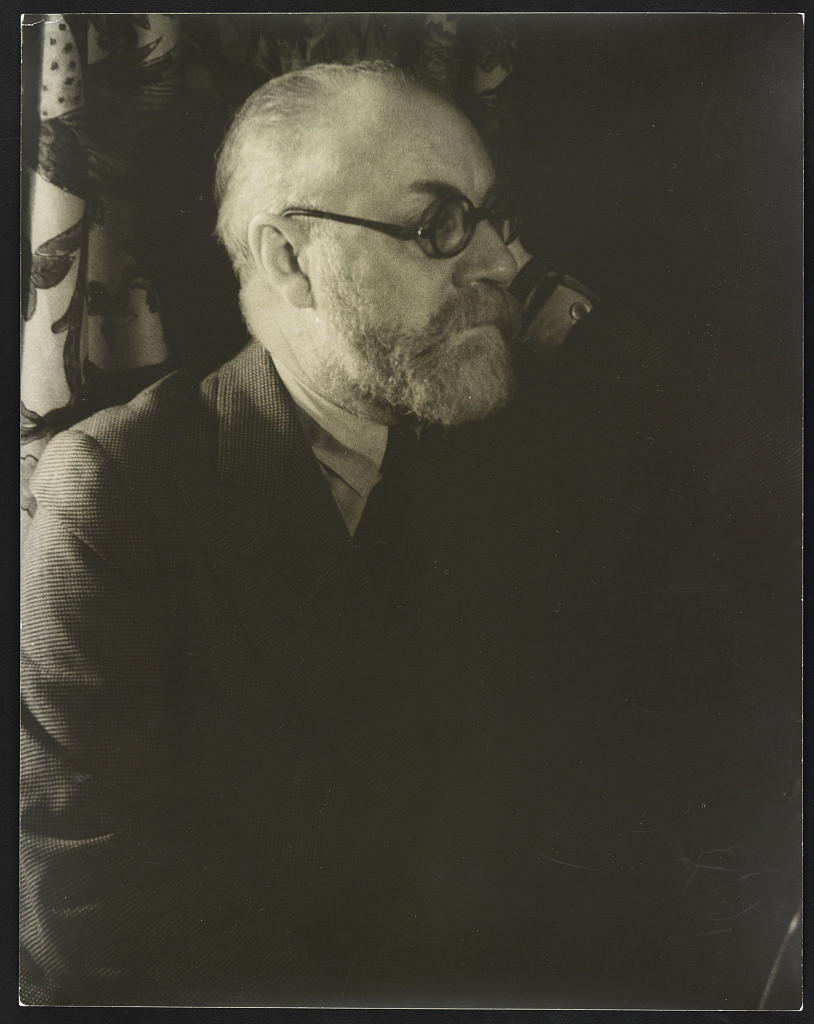
Henri Matisse, photographed on 20 May 1933. The National Gallery of Art places Matisse within Rothko’s artistic dialogue.
Carl Van Vechten. Library of Congress, Prints & Photographs Division, Carl Van Vechten Collection, LC-DIG-ds-07636. [33]
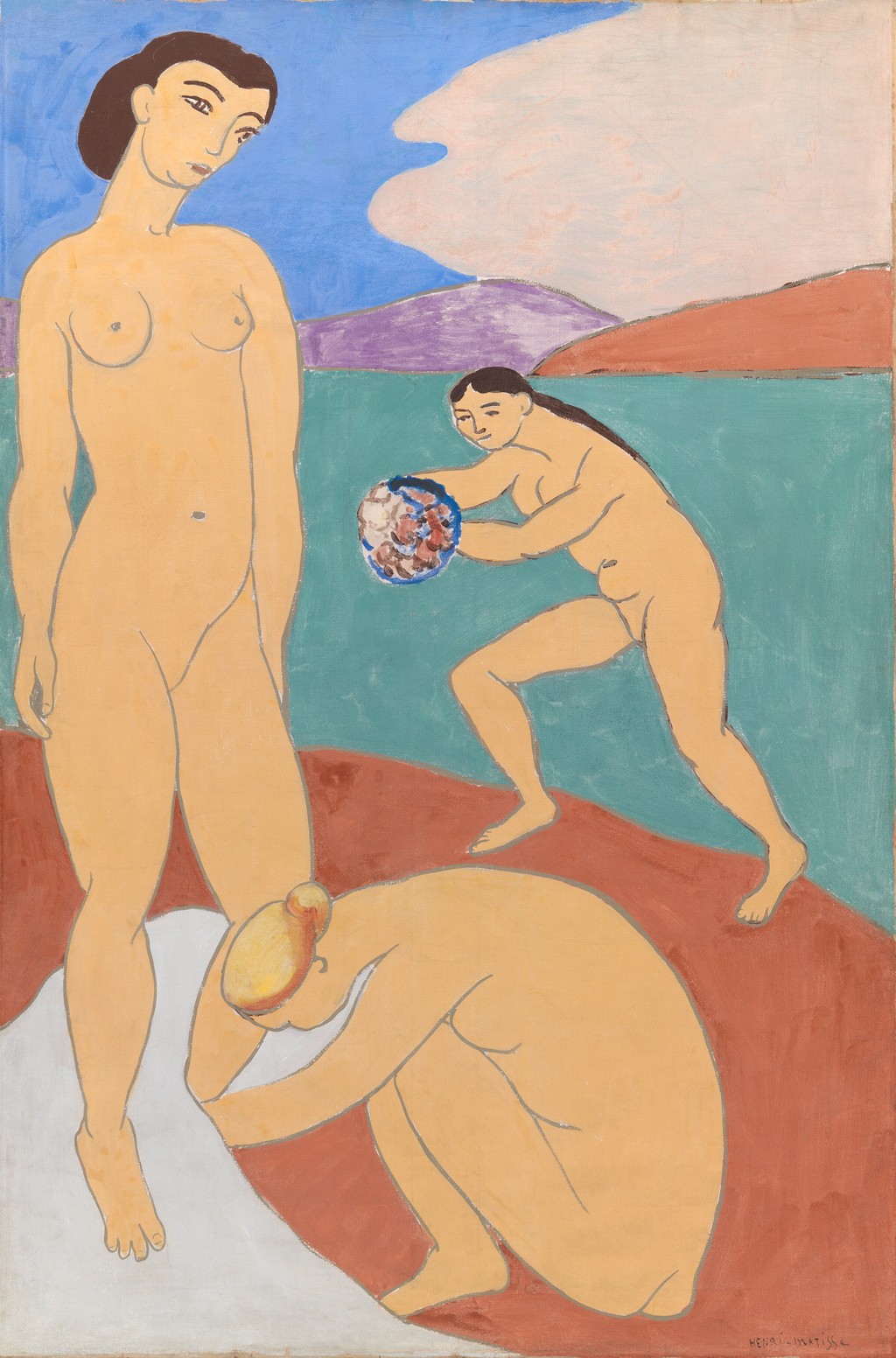
Henri Matisse, Le Luxe II, 1907–08, glue distemper on canvas; SMK, KMSr76. This is one of the paintings depicted within The Red Studio, the Matisse work Rothko studied at MoMA.
Henri Matisse, Le Luxe II; SMK – National Gallery of Denmark; KMSr76. Resized without cropping. [34]
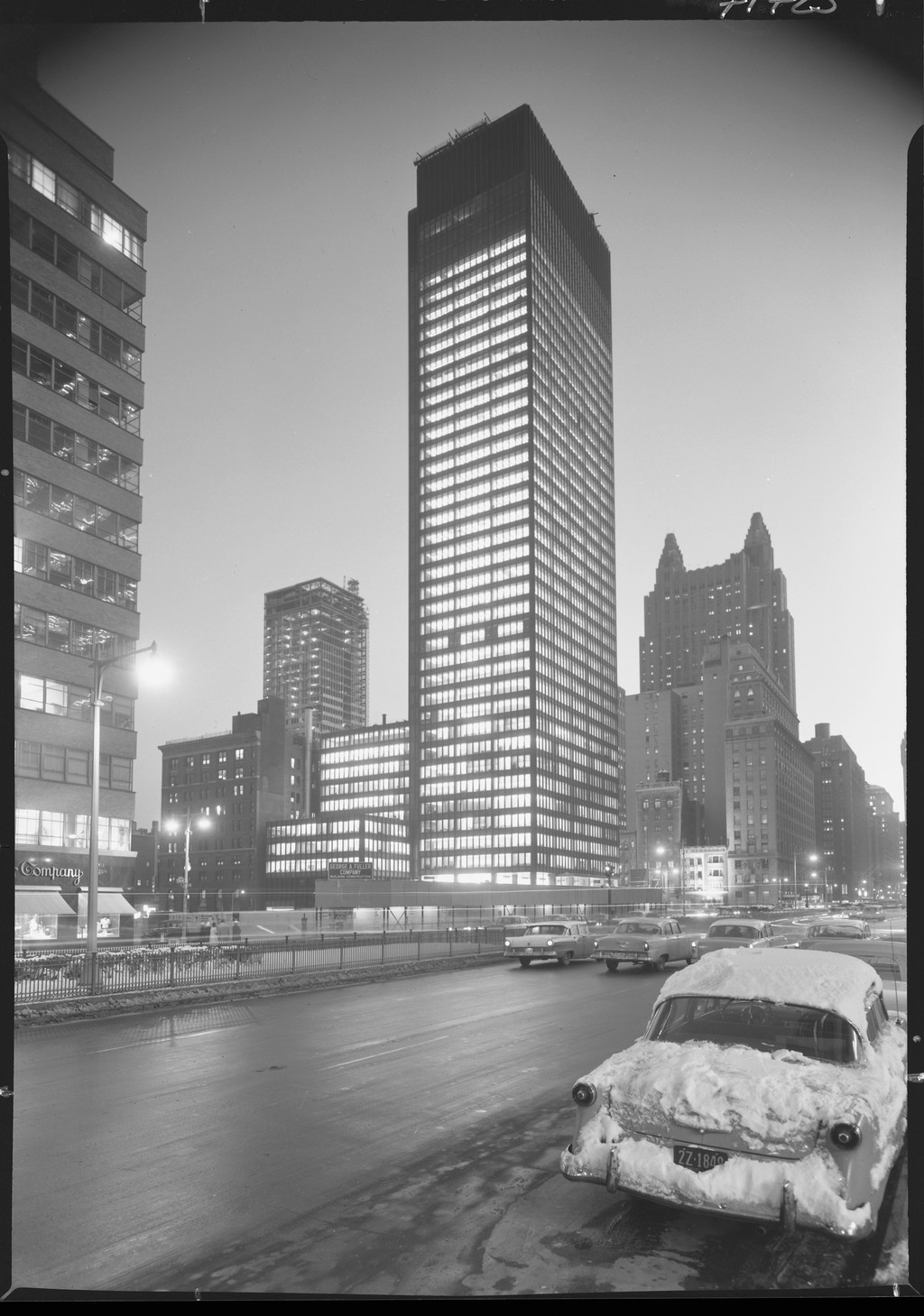
Architecture became a direct problem in the Seagram commission. During a 1959 visit to Florence, Rothko studied the vestibule of Michelangelo's Laurentian Library. The National Gallery connects its blocked openings and sense of enclosure with the mural project.[9] This is a documented relationship to a specific place. The 1958 Seagram Building photograph used in this guide shows the proposed restaurant's architectural setting, while the Seagram essay explains why those paintings did not remain there. Houston's Chapel later posed a different relationship between image, light and room.[5]
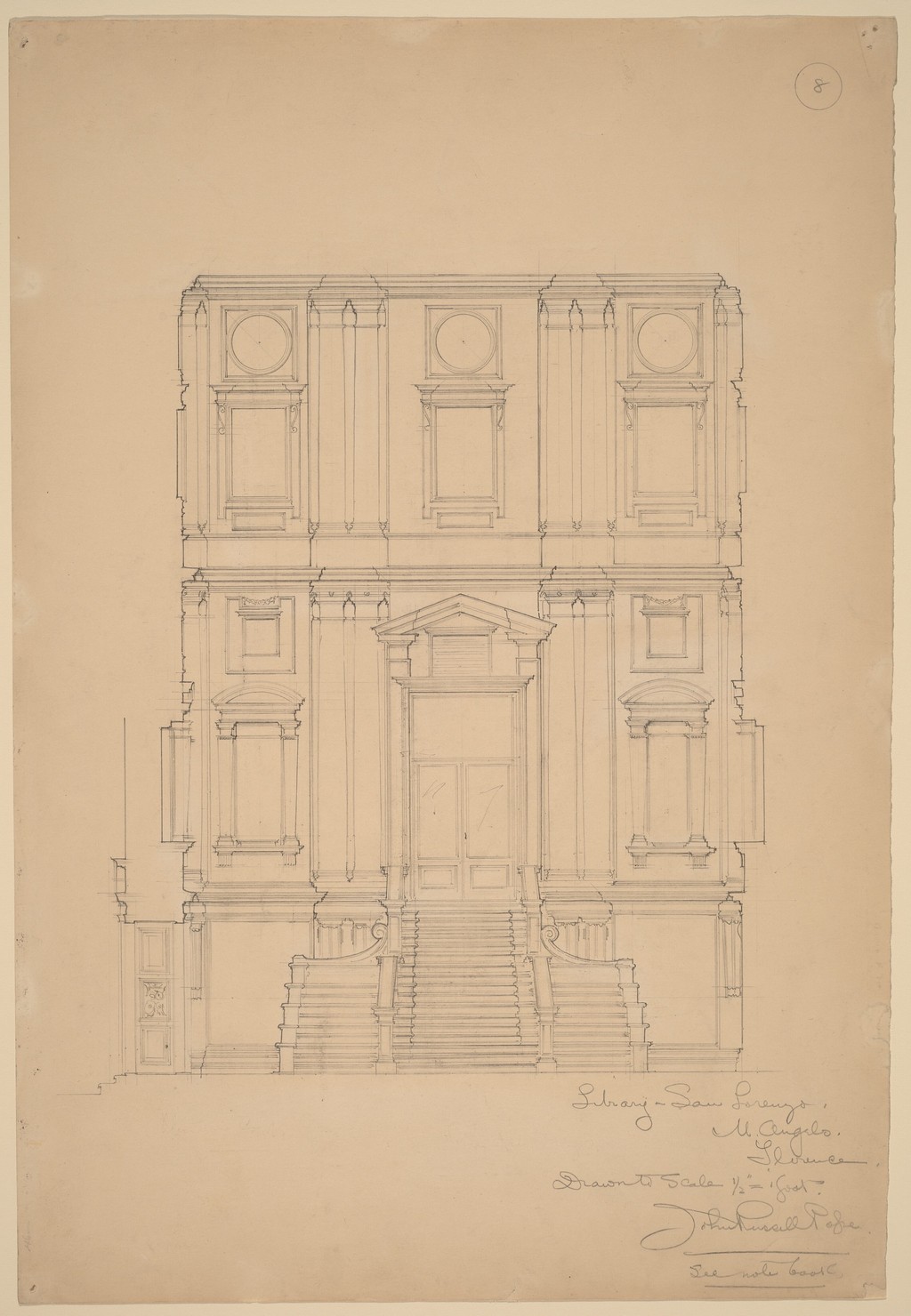
John Russell Pope, Library, San Lorenzo, circa 1896; graphite. This historical measured drawing shows the wall and stair arrangement of Michelangelo’s Laurentian Library vestibule, the Florentine space later linked to Rothko’s Seagram murals.
Courtesy National Gallery of Art, Washington; Gift of Mrs. John Russell Pope; 1939.2.8. Resized without cropping. [35]
Abstract Expressionism and Rothko’s individual practice
Rothko’s mature work belongs to the history of Abstract Expressionism, the group of artists associated with the emergence of a major centre of modern painting in postwar New York. The category is useful for locating his exhibitions and artistic relationships. His particular choices of form, surface and scale still need to be examined within it.
Dorothy C. Miller’s foreword to MoMA’s 15 Americans in 1952 makes this problem visible at the moment of growing recognition. The exhibition gave substantial space to individual artists, sometimes a whole gallery, and brought different aims together. Miller cautioned that classification could mislead the public and frustrate painters. The catalogue therefore used artists’ statements beside their works, allowing individual positions to remain audible.[17]
This context helps a viewer compare Rothko with Pollock, Still or other contemporaries without expecting all their paintings to do the same thing. The place of a mark, the distribution of attention and the relation to the viewer can differ sharply. Shared exhibitions make those differences part of the history. The broad movement name offers an entry point; the paintings supply the specific encounters.
The National Gallery’s Bodies in Space presentation offers a further approach. It brings early figures in interiors and mythic works into relation with the classic rectangles, asking how Rothko engaged both painted bodies and the real bodies of viewers.[18] The question can connect distant periods without requiring them to look alike. In an early subway scene a person occupies painted architectural space. In a large abstraction, the visitor occupies actual space in front of the canvas.
Colour, form and the time spent looking
A description of a Rothko can begin with colour, then widen to how colour is organised. The extent of one field, the gap before the next, the visibility of a ground and the treatment of an edge all matter. Two paintings with related palettes can create different relations of weight and openness. A change of proportion can make the same colour seem to occupy a new role.
Consider three kinds of boundary. The physical edge of the canvas separates the object from its wall. The boundary of a painted field separates one passage from another. The interval between fields may expose a ground that joins the whole composition. A viewer moving attention among these boundaries can find that the apparent simplicity of a few rectangles becomes a succession of different relationships.
The process takes time because looking can change its object of attention. An initial impression of luminous red may give way to a darker passage, then to a narrow band, then to the relation between the painting and its room. Returning to the whole composition allows those observations to affect the first impression. This is a way to describe sustained attention without prescribing a particular emotion.
The paintings essay develops these questions through early works, the multiforms, the mature canvases and late paper paintings. Its material evidence gives broad fields a history of layers, supports and revisions. The individual guides let the reader pursue one work’s particular palette, scale and exhibition history.
Paintings on paper, drawings and prints
Rothko did not work only on canvas. The National Gallery reports more than 1,000 paintings on paper and is compiling a catalogue expected to document roughly 2,600 paper works across categories.[6][7] The drawings guide discusses paper works classified as drawings, including SFMOMA's Tentacles of Memory. The prints guide separates original paintings and drawings from shop reproductions. A paper work mounted on canvas, such as Untitled (Red on Red) of 1969, remains an original painting on paper. It is neither a commercial print nor simply an oil canvas.
That distinction also affects scholarship. Anfam's 1998 catalogue raisonné covers works on canvas. Some auction records quote precise Anfam numbers for individual canvases, and this cluster reports those citations with their sources. A paper work requires paper-specific cataloguing. The NGA project is still developing, so its holdings and records should be checked again as they are updated.
The National Gallery's conservation research reveals why the support is more than a catalogue technicality.[6] On some paper works Rothko taped the sheet to a board or large easel, painted beyond its edges, then removed or retained traces of the tape. A late Brown and Gray experiment involved a hard border made with masking tape; later examples kept a white paper border. Those decisions shape how a field ends and how it relates to its surroundings. Paper could also be mounted for display without a conventional glazed frame. A buyer encountering the word “print” in a shop listing should therefore ask whether the item is an original paper work, an authorised reproduction or a modern decorative copy. The term alone does not answer that question.
Rooms, architecture and the viewer
Rothko cared about the conditions in which a painting was seen. The Seagram Murals guide explains the 1958 Four Seasons commission and why the paintings were never installed at their intended venue. Tate's 1958 Black on Maroon belongs to that project. The Rothko Chapel guide follows a later commission that became a room of fourteen installed canvases. The Chapel's natural light, architectural partners and continuing public mission affect the way those paintings are experienced.[5]
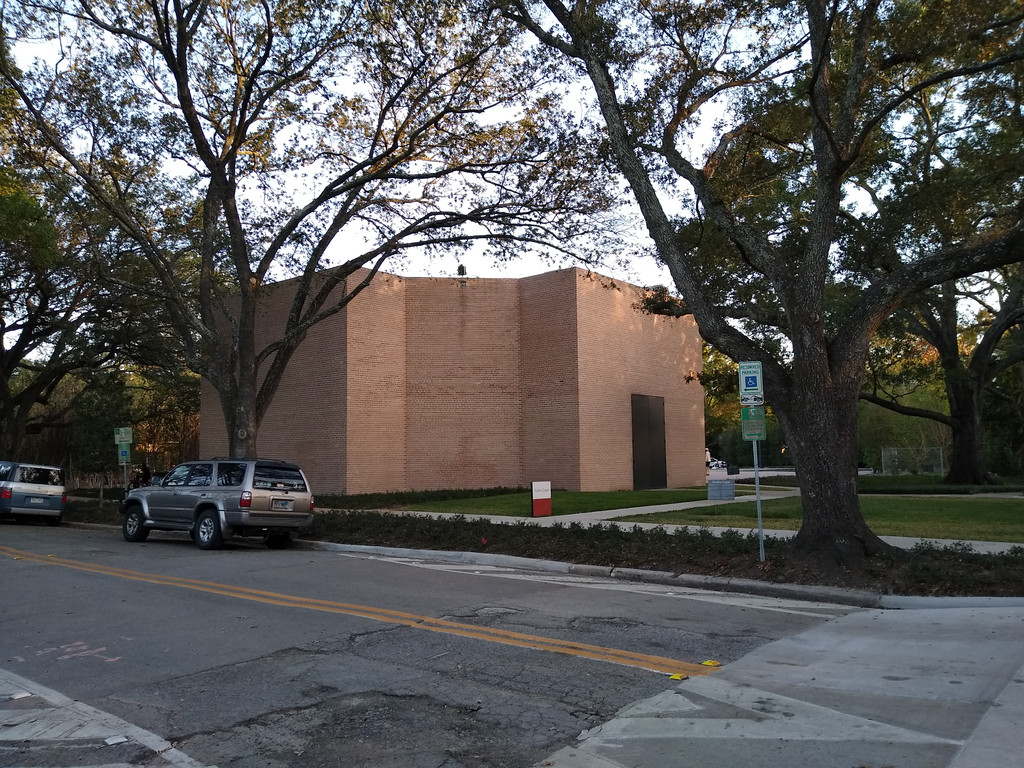
The Rothko Chapel seen across a public street on 21 November 2020. The exterior gives architectural context for the dedicated Houston room.
Photograph: WhisperToMe. [36]
The Phillips Collection's Rothko Room offers another model: four paintings encountered in an intimate space.[8] These contexts make clear why a reproduced image, especially a small thumbnail, cannot deliver the scale or changing light of a Rothko canvas. They also show that an “artwork” can be a single physical object and part of a spatial relationship. A guide needs both levels: exact accession numbers for individual paintings and careful histories of the rooms in which they were meant to work.
The rooms differed sharply. Seagram offered seven places for works in a luxury restaurant; Rothko produced more than thirty canvases and withdrew the commission.[4] The Chapel was conceived for fourteen paintings in a dedicated spiritual environment, while the Phillips room brings four works into a smaller museum setting.[5][8] The Chapel's East Triptych is currently off-site for restoration after 2024 storm damage, so the historic count should not be read as a live display count.[13] It would be misleading to speak of a single “Rothko room” model that developed unchanged across these sites. Patronage, available wall space, natural light and the purpose of the building altered the problem each time.
Biography and words
The biography follows Rothko from Dvinsk and Portland to his New York career, commissions and final years. The shorter about page gives a quick orientation. His quotes page explores letters, radio discussion, exhibition statements and published books. Dates and authorship give the words their setting, including the shared 1943 statements with Gottlieb.[2][6]
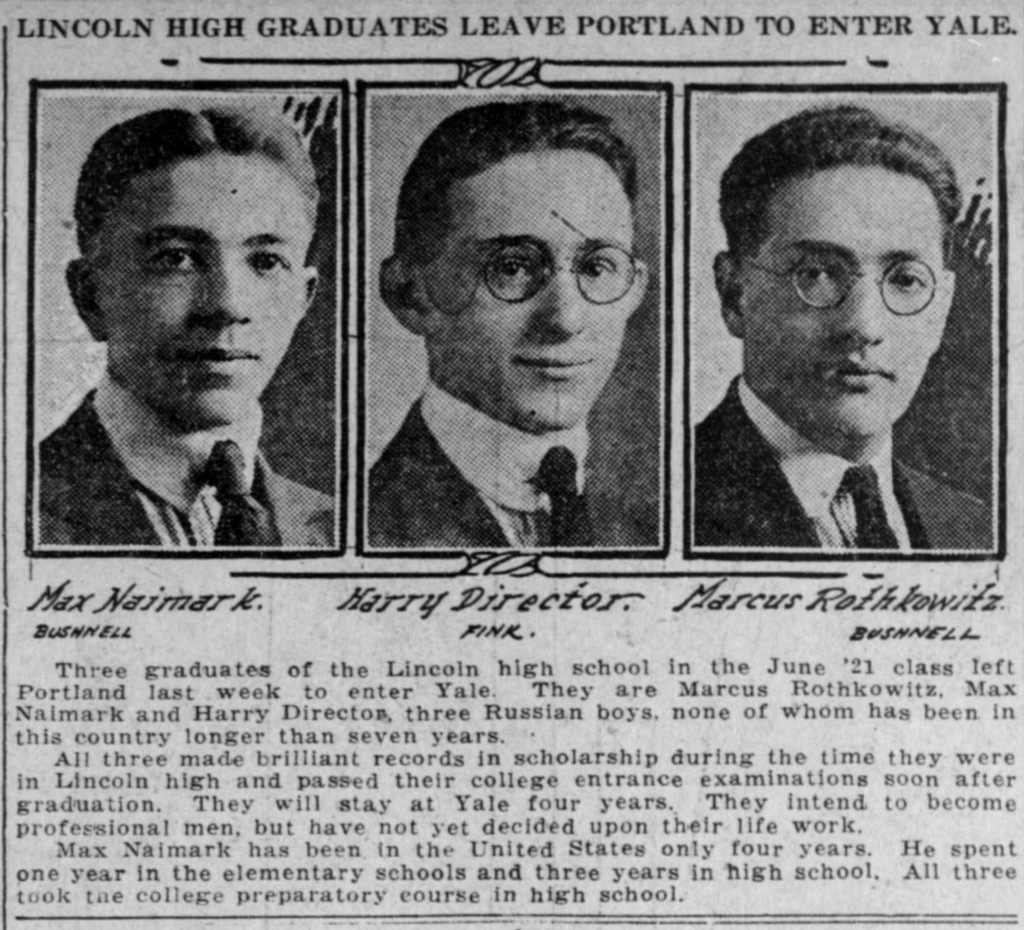
Marcus Rothkowitz, later known as Mark Rothko, at right, with Max Naimark at left and Harry Director at centre, as named in a Yale-bound students item. The Sunday Oregonian, 18 September 1921, section three, page 6. Detail preserves the complete item; the date is its publication date.
Portrait credits printed in the item: Bushnell and Fink. Historic Oregon Newspapers, University of Oregon Libraries. [37]
Rothko's death by suicide in 1970 belongs in an accurate biography, but the date cannot be used as a shortcut to interpret every late dark painting. Works from 1969 include a vibrant red paper painting as well as brown-and-gray compositions. Museums record their different supports, mediums and histories. The material evidence is a better starting point than a fixed psychological story.
It is also worth separating Rothko's recorded words from later descriptions of his aims. The 1943 statement was jointly authored with Gottlieb and defended mythic themes; a line detached from it can easily imply solo authorship.[2] The National Gallery's technical discussion transcribes Rothko's claim that a painting is an experience, but that statement does not make every viewer's response identical.[6] The quotes guide gives the statements their documentary setting. The paintings guide asks what a support, surface and room actually show before attaching an artist's sentence to them.
The questions that scholarship keeps open
Rothko’s painting has supported accounts of human drama, spiritual experience, bodily presence, visual structure and material process. These approaches can overlap. A discussion of a room may ask both how light falls and how the visitor experiences it. A study of an edge may concern both the physical layer of paint and the apparent movement of a form.
The Getty Research Institute’s 2002 Seeing Rothko symposium makes the variety explicit. Its programme included detailed looking, early critical reception, the Chapel, inverted canvases and late work, followed by discussion with artists. Thomas Crow situated the event within research on the spectator’s contribution to the experience and meaning of visual art.[19] The programme is evidence of the questions being asked; a lecture title alone does not establish the lecturer’s complete argument.
The published debate was sometimes sharp. In his 2006 review of the resulting Seeing Rothko anthology, David Anfam challenged particular accounts of inverted canvases and the treatment of early sketchbooks. He emphasised connections to the bodily symmetry and reflections of the mid-1940s, and to ordinary objects and architecture transformed into mythic forms.[20] These are Anfam’s arguments in a directly accessible essay, distinct from his catalogue entries.
Such disagreement is useful when it returns a general interpretation to specific evidence. Does the proposed connection explain a particular painting? Does a sketchbook support it? Does the account fit the date? The questions allow biography, visual analysis and conservation to correct one another. They also explain why a celebrated painter can remain an active subject of research even after extensive cataloguing.
The 1998 National Gallery retrospective, organised by Jeffrey Weiss, presented ninety-seven paintings and seventeen graphic works, with David Anfam and Mark Rosenthal serving as consultants. Its accompanying scholarship and selection joined the artist’s development to a major public reassessment.[21] An exhibition gathers works into an argument; a catalogue raisonné documents the wider body of objects. Both kinds of publication contribute to understanding, with different scope and purposes.
Collections, archives and the changing picture of the artist
Much of the research is possible because works and records entered institutions together. The National Gallery’s account of its Rothko holdings describes a Foundation distribution to thirty-five museums and identifies Washington as the principal recipient. Alongside artworks came research material, including conservation records and exhibition reviews. The Gallery’s later lending programme sent works to institutions around the world.[22]
The gift helped widen the public picture of Rothko. A collection containing early pictures and works on paper can show developments concealed by an emphasis on a few celebrated mature canvases. Loans can take those less familiar stages to other audiences. Archival records can clarify how a painting moved, was presented or was understood at the time.
The manuscript of The Artist’s Reality adds another part of that history. The National Gallery’s 2007 annual report records its gift by Kate Rothko Prizel and Christopher Rothko.[29] An artist known for reticence in front of the paintings also left a sustained written inquiry. The quotes essay explains the difference between that book, the collected shorter writings and statements originally published in exhibition catalogues.
Paper is especially important to the changing account. The 2023–24 exhibition project and Adam Greenhalgh’s accompanying book considered works made across the career, including paintings on paper reaching monumental dimensions.[22] This alters the familiar separation of small preparatory drawing from large finished painting. The size and ambition of a work cannot be inferred from the support alone.
Rothko across institutions and languages
The painter's history is now studied through collections and exhibitions that ask different questions. In Daugavpils, the Rothko Museum opened in 2013 and rotates works lent from the family collection. Its current presentation says twenty-four different family works have appeared there since opening.[10] That is a changing selection, not a permanent set of twenty-four paintings on the walls at once. It puts the birthplace in dialogue with work made in America without claiming that every abstract form can be traced to a childhood memory.
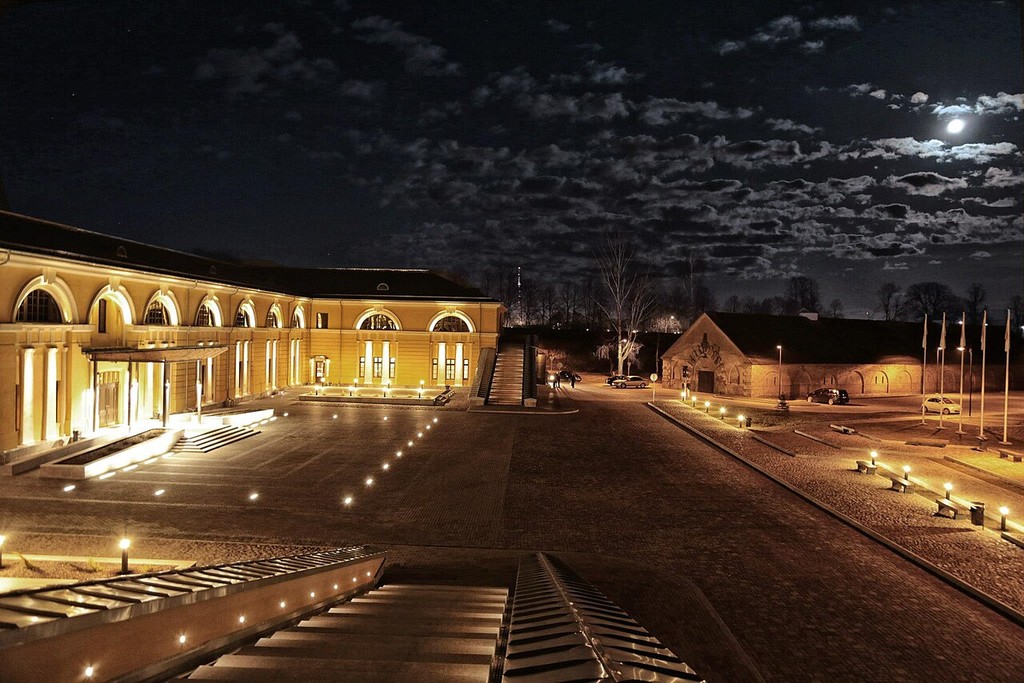
Night view of the Daugavpils Rothko Art Centre in 2013, now the Rothko Museum, in the city where the artist was born.
Photograph: Karlis.Rasis. Photograph remains CC BY-SA 3.0. Resized without cropping. [38]
The Fondation Louis Vuitton's 2023–24 Paris retrospective brought together roughly 115 works from major museums, private lenders and the family collection.[11] Its French curatorial account moves from 1930s subway scenes through mythic imagery and multiforms to the classic format, Seagram paintings and late work. It stresses that bright colour still appears in Rothko's later years, so a dark palette cannot serve as a simple biography of decline. The exhibition also reassembled the nine Seagram canvases he gave to Tate in 1969 and recalled the early Phillips Room. Those arrangements help a viewer compare public rooms, but they are later curatorial displays rather than Rothko's unrealised restaurant installation.
Florence's 2026 Rothko exhibition offers a different question: how Italian painting and architecture entered his visual thinking.[12] More than seventy works were shown at Palazzo Strozzi, with selected pieces displayed at the Museo di San Marco and in the Laurentian Library vestibule. The Italian curators identify visits to Florence in 1950 and 1966 and discuss his 1959 Italian travel; the National Gallery separately dates a Laurentian visit to 1959.[9][12] The precise travel sequence needs further archive-level checking. The documented relationship to Michelangelo's enclosed vestibule and Fra Angelico's frescoes remains worth studying without claiming that a 2026 pairing was a display Rothko planned.
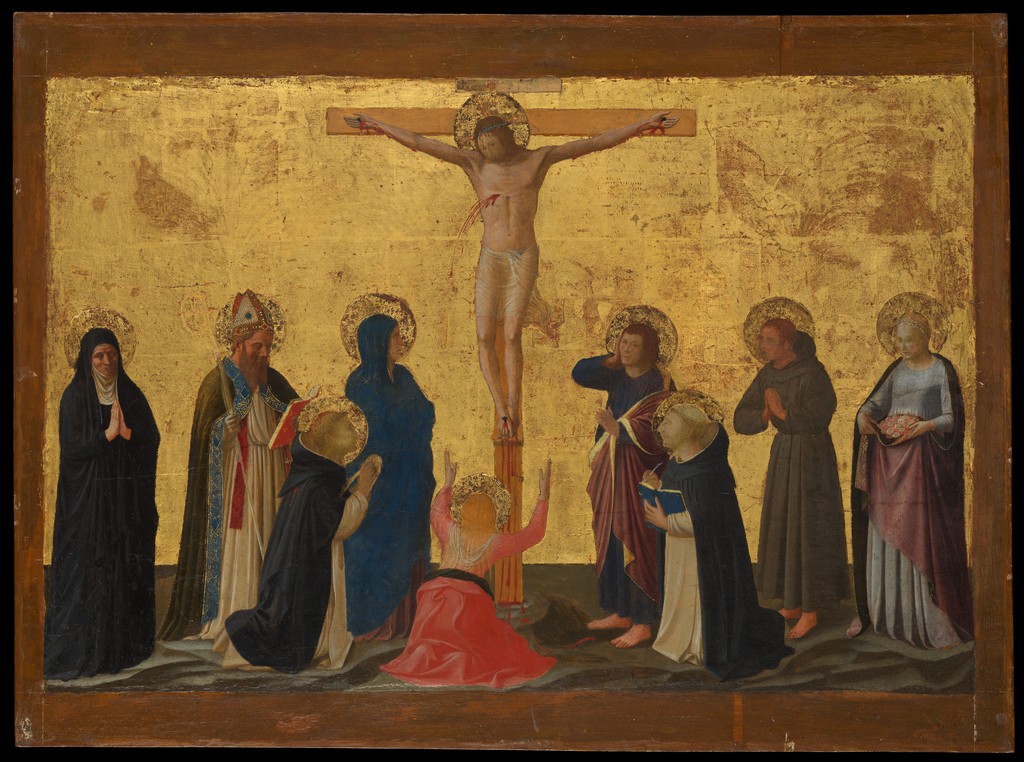
Fra Angelico, The Crucifixion, possibly circa 1440; The Met, 14.40.628. Made during the period of his San Marco frescoes, this museum painting provides context for the Florentine art that interested Rothko.
The Metropolitan Museum of Art, Bequest of Benjamin Altman, 1913; 14.40.628. Resized without cropping. [39]
Guggenheim Bilbao's Spanish-language account adds an earlier episode: the Art Institute of Chicago's 1954 exhibition used a compact, low-ceiling room and placed the Bilbao museum's vast Untitled (1952–53) near the entrance.[14] The museum's English object note says exhibition documents called that canvas No. 10, while Anfam later identified it as catalogue no. 483.[15] This is a separate canvas from MoMA's No. 10 (1950) and from the privately held 1952 Untitled in this guide. The Spanish curatorial record therefore improves both the history of how Rothko's scale was experienced and the accuracy of the object crosswalk. Bilbao's 2004 Paredes de luz exhibition also adapted a centenary presentation developed with Rothko's children at Fondation Beyeler in Basel.[16] The cross-country exhibition history is evidence of changing curatorial settings, not a single universal way to hang the paintings.
These institutional views do not replace object records. The Buffalo, MoMA, MOCA, Tate, NGA and SFMOMA pages linked here govern their own works' titles, media, sizes and accessions. A retrospective can connect works across countries and periods; a catalogue record keeps one physical painting distinct from another with a similar title. Reading both levels together is the core method of this cluster.
The Hague: comparing paths toward abstraction
The 2014–15 exhibition in The Hague placed Rothko in a museum with a major Mondrian collection. Its institutional account proposed a comparison of their development, while including less familiar early Rothko works alongside the classic paintings. The catalogue included contributions by Franz-W. Kaiser, Harry Cooper and Joost Zwagerman, and an interview with Henk van Os.[23]
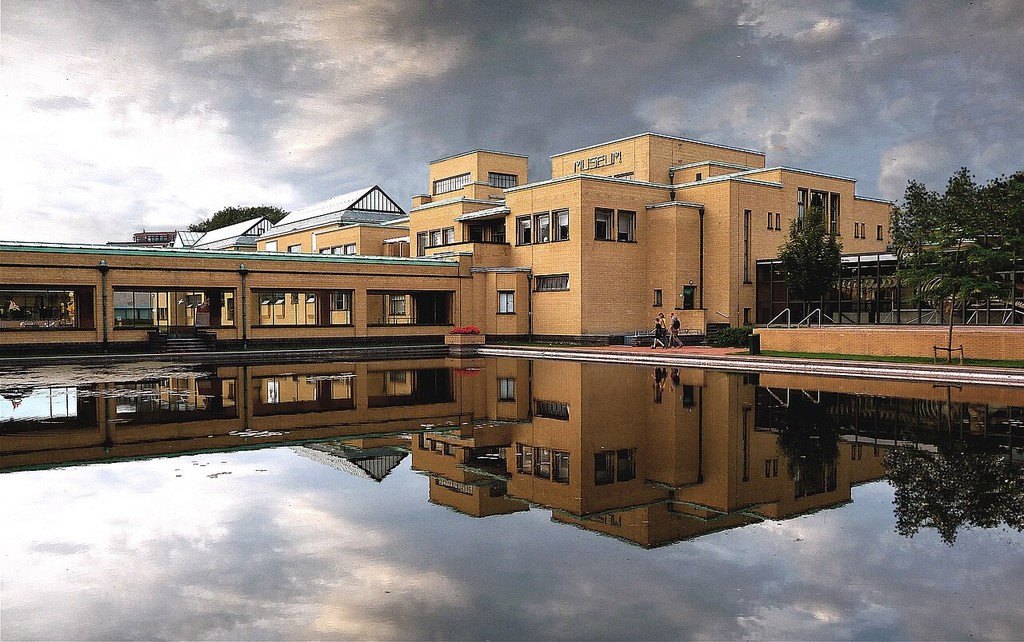
Kunstmuseum Den Haag, photographed in 2008. The museum’s 2014–15 Rothko exhibition compared his development with Mondrian’s.
Photograph: Roel Wijnants. Photograph remains CC BY-SA 3.0. Resized without cropping. [40]
This setting makes format and composition useful points of comparison. A shared interest in abstraction does not erase differences between a sharply articulated structure and a softly bounded field. The comparison can ask how each painter arrived at an abstract language and what kind of space that language offers the viewer. It also shows how a museum’s existing collection can shape the questions posed by a temporary exhibition.
Vienna: Rothko among historical collections
The Kunsthistorisches Museum’s first Austrian Rothko retrospective ran from 12 March to 30 June 2019. Its German annual report records more than forty major works and Jasper Sharp’s curatorship. The museum explicitly used the setting of its historical collections to explore Rothko’s interest in earlier art, with a room of Seagram paintings at the exhibition’s centre.[24]
The setting offered a different comparison from The Hague. Here the question concerned a modern painter’s relationship to a long history of making and looking. Bringing Rothko into a museum associated with old masters could make continuity and rupture visible together. The curatorial interpretation remained a proposal to examine, rather than proof that every mature canvas represents a particular historical source.
Oslo: the significance of paper
Nasjonalmuseet’s official Norwegian and English introduction to Malerier på papir in 2024 describes nearly eighty works and the first major presentation of Rothko in the Nordic region. Organised with the National Gallery of Art, it ranged from landscapes and portraits to Surrealist subjects and the characteristic colour fields. The institution framed paper as a way to challenge assumptions about what counts as a painting.[25]
This was a consequential shift of emphasis. An audience introduced to Rothko principally through paper encounters both the familiar rectangles and the works that preceded them. The support becomes a way to reassess the career. The exhibition also demonstrates why translating an artist guide involves more than translating famous titles: institutions in different countries can bring different bodies of work into public attention.
Japan: a new plan for the Rothko room
The Japanese-language Rothko Room Initiative, a collaboration between DIC and International House of Japan, describes a planned room in a new west wing designed by SANAA. The architects studied the DIC Kawamura, Tate and Houston Rothko spaces. The proposal joins an approach through gardens and a meditation area to a distinct room for the Seagram works, and the partners describe cultural links with the Rothko Chapel.[26]
The project extends the history of Rothko’s reception through architecture. Its proposed visitor sequence treats the approach to a painting as part of the experience. It remains a plan in the source consulted here, so it should not be described as a room already open to visitors. Its significance lies in the continuing effort to create settings in which the paintings can be encountered together.
Portland: returning to a formative city
Portland Art Museum’s account of its family partnership describes rotating loans of individual major paintings over two decades. The arrangement accompanied the decision to name the new pavilion for Rothko, whose childhood and first solo exhibition connected him to the city.[27] The museum’s current campus account confirms that the pavilion and transformed spaces are now open.[28]
This gives Portland’s relationship with the artist a present form. A rotating loan brings successive paintings into the city’s public life; the pavilion places his name within the museum’s physical identity. These are different kinds of commemoration, joined by the hope that an encounter with an actual painting can deepen the local knowledge of a painter who made his adult career elsewhere.
A route through the larger questions
For the chronological story, begin with the biography. For changes in form and material, use the paintings guide and its object directory. The Rothko Chapel follows a complete painted environment through architecture, music, civic purpose and conservation. The quotes page explains how the artist’s words were written, spoken and transmitted.
Reading these accounts together lets a particular canvas remain central while placing it in a wider history. A painting has a date, support and physical surface. It also moves between studios, collections, exhibitions and readers. Rothko’s continuing importance emerges through that combination: intensely particular objects keep opening questions about how art addresses human experience.
Collection records and further reading
Museum collection records govern the current title, medium, dimensions and accession of a museum-held work. Auction records can provide useful provenance and bibliographic citations for privately held paintings, but they are dated documents and do not establish present ownership. David Anfam's Mark Rothko: The Works on Canvas is cited directly only through a publicly available essay he wrote or attributed as a catalogue reference quoted by a public sale record; unseen entries are clearly marked for hardback verification. The object pages explain remaining gaps rather than filling them by guesswork.
The directory below leads to the individual artwork guides. Their collection links provide photographs and fuller records of each work. Contextual images introduce places connected with the artist, while the captions identify the building, location or historical object shown.
Rothko works in this guide
| Name | Date | Medium |
|---|---|---|
| Entrance to Subway | 1938 | Painting |
| Hierarchical Birds | 1944 | Painting |
| Slow Swirl at the Edge of the Sea | 1944 | Painting |
| No. 3/No. 13 | 1949 | Painting |
| Untitled (Violet, Black, Orange, Yellow on White and Red) | 1949 | Painting |
| White Center | 1950 | Painting |
| No. 10 | 1950 | Painting |
| No. 6 (Violet, Green and Red) | 1951 | Painting |
| Untitled | 1952 | Painting |
| No. 61 (Rust and Blue) | 1953 | Painting |
| No. 1 (Royal Red and Blue) | 1954 | Painting |
| Untitled (Yellow and Blue) | 1954 | Painting |
| Orange and Yellow | 1956 | Painting |
| Light Red over Black | 1957 | Painting |
| Four Darks in Red | 1958 | Painting |
| Black on Maroon | 1958 | Painting |
| No. 14 | 1960 | Painting |
| Orange, Red, Yellow | 1961 | Painting |
| Untitled (brown and gray) | 1969 | Painting |
| Untitled (Red on Red) | 1969 | Painting |
| Untitled (Black and Gray) | 1970 | Painting |
| Tentacles of Memory | 1945–46 | Drawing |
Frequently Asked Questions
Rothko is best known for large paintings in which softly bounded fields of colour appear to hover against a coloured ground. He reached this format around 1950 after years of portraits, city scenes and mythic imagery. His later commissions explored how several paintings could shape the experience of a whole room.[1]
No. His early work includes people, landscapes and New York subway scenes. In the 1940s he developed ambiguous figures and mythic forms before moving toward broad colour fields. Entrance to Subway, Hierarchical Birds and Slow Swirl at the Edge of the Sea reveal different stages of that development.[1]
He was born Marcus Rothkowitz in 1903 in Dvinsk, then part of the Russian Empire and now Daugavpils, Latvia. He immigrated to the United States as a child, grew up in Portland, Oregon, and established his adult artistic career in New York.[1]
Yes. Paper was a substantial part of his practice, including drawings, watercolours and large finished paintings. The National Gallery of Art reports more than 1,000 paintings on paper. An original painted sheet is distinct from a later printed reproduction of a Rothko image.[6]
No. The Seagram paintings were made for the Four Seasons restaurant in New York, but Rothko withdrew the commission. The Houston Chapel was a later commission for a dedicated space, with fourteen paintings completed in 1967. The Chapel opened in 1971, after his death.[4][5]
Begin with Slow Swirl at the Edge of the Sea for the mythic period, White Center for the emerging mature format, and Black on Maroon for the Seagram project. The paintings guide provides a wider choice across the career.
Discussion
Which documented work or source changed your understanding of Mark Rothko?
Reader Insights
Begin with a specific work, title and date.
Compare the object record with this career guide.
What still needs a catalogue or archive check?
Join the Conversation
Share an observation grounded in the work or its history.
References
- National Gallery of Art, “Mark Rothko,” artist chronology.
- Adolph & Esther Gottlieb Foundation, 1943 Jewell letters.
- Sotheby's, White Center and 2007 David Anfam essay.
- National Gallery of Art, “Mark Rothko: Seagram Murals”.
- Rothko Chapel, institutional history.
- Michaela Milgrom, “How Mark Rothko Made Paintings on Paper,” NGA, 2023.
- NGA, Mark Rothko: Works on Paper catalogue project.
- Phillips Collection, Rothko Room.
- Michaela Milgrom, “Artists Who Inspired Mark Rothko,” National Gallery of Art, 2023.
- Rothko Museum, Daugavpils, “Rothko. From the Family Collection”.
- Fondation Louis Vuitton, Mark Rothko retrospective (2023–24), French curatorial account.
- Fondazione Palazzo Strozzi, Rothko a Firenze, Italian press dossier (2026).
- Rothko Chapel, current conservation notice, checked October 2026.
- Guggenheim Bilbao Museoa, Spanish essay on Sin título, 1952–53.
- Guggenheim Bilbao Museoa, English object notes, including its Anfam no. 483 discussion.
- Guggenheim Bilbao Museoa, Mark Rothko: paredes de luz (2004), Spanish exhibition history.
- MoMA, 15 Americans, ed. Dorothy C. Miller (1952), foreword and exhibition structure; authorised catalogue consulted.
- NGA, Mark Rothko: Bodies in Space, institutional framing of painted and actual bodies across the career.
- Getty Research Institute, Frames of Viewing: Seeing Rothko, symposium programme, 28 February 2002, themes and participants; programme consulted, talks not treated as transcribed lectures.
- David Anfam, review of Seeing Rothko, The Art Newspaper, 1 March 2006, directly consulted critical essay, separate from the 1998 catalogue raisonné.
- NGA, Mark Rothko retrospective (1998), exhibition selection and organisation.
- NGA, “Major Exhibition of Mark Rothko’s Paintings on Paper Announced for 2023”, exhibition scope, book, museum distribution and research resources.
- Kunstmuseum Den Haag, Mark Rothko, 20 September 2014–1 March 2015, exhibition and catalogue account, read alongside its Dutch-language version.
- Kunsthistorisches Museum Vienna, Jahresbericht 2019, p. 17, German account of the 12 March–30 June 2019 exhibition.
- Nasjonalmuseet, official video introduction to Mark Rothko. Malerier på papir, 19 June 2024, Norwegian and English institutional descriptions of the exhibition; description consulted.
- DIC and International House of Japan, Rothko Room Initiative, Japanese project description, SANAA design and Chapel partnerships; planned project, not an opened visitor room.
- Portland Art Museum, “Honoring Mark Rothko’s Portland legacy” (1 June 2023), family loan partnership.
- Portland Art Museum, completed campus transformation, current account of the opened Rothko Pavilion, checked October 2026.
- NGA, Annual Report 2007, p. 19, gift of the manuscript for The Artist’s Reality.
- Harry Cooper, In the Tower: Mark Rothko, National Gallery of Art exhibition brochure, 2010, discussion of Rothko’s admiration for Matisse’s The Red Studio and French Window at Collioure.
- Fondation Louis Vuitton, Matisse: The Red Studio exhibition dossier, 2024, identification of Le Luxe II among the surviving paintings represented within the studio scene.
- The Seagram Building in 1958, photographed during the year Rothko accepted a commission for its Four Seasons restaurant. The photograph shows the building, not a Rothko mural. Photograph: Gottscho-Schleisner Collection; source record; Public domain. Resized to 1024px without cropping.
- Portrait of Henri Matisse. Carl Van Vechten. Library of Congress, Prints & Photographs Division, Carl Van Vechten Collection, LC-DIG-ds-07636. Source · Public domain; LOC collection policy.
- Henri Matisse, Le Luxe II. Henri Matisse, Le Luxe II; SMK – National Gallery of Denmark; KMSr76. Resized without cropping. Source · Public Domain Mark 1.0.
- John Russell Pope, Library, San Lorenzo. Courtesy National Gallery of Art, Washington; Gift of Mrs. John Russell Pope; 1939.2.8. Resized without cropping. Source · CC0 1.0.
- Rothko Chapel exterior from across the street, 2020. Photograph: WhisperToMe. Source · CC0 1.0.
- Lincoln graduates leaving Portland for Yale: Naimark, Director and Rothkowitz. Portrait credits printed in the item: Bushnell and Fink. Historic Oregon Newspapers, University of Oregon Libraries. Source · Public domain; archive reuse policy.
- Rothko In Night.jpg. Photograph: Karlis.Rasis. Photograph remains CC BY-SA 3.0. Resized without cropping. Source · CC BY-SA 3.0.
- Fra Angelico, The Crucifixion. The Metropolitan Museum of Art, Bequest of Benjamin Altman, 1913; 14.40.628. Resized without cropping. Source · CC0 1.0.
- Gemeente museum.jpg. Photograph: Roel Wijnants. Photograph remains CC BY-SA 3.0. Resized without cropping. Source · CC BY-SA 3.0.



