 by Tom Gurney
Tom Gurney BSc (Hons) is an art history expert with over 20 years experience
Published on June 19, 2020 / Updated on October 11, 2026
Email: tomgurney1@gmail.com / Phone: +44 7429 011000
Four Darks in Red: Introduction
Mark Rothko's Four Darks in Red is a 1958 oil painting on canvas in the Whitney Museum of American Art, accession 68.9. It measures 258.6 × 295.6 cm—almost three metres wide.[1] The Whitney's title and object record identify this canvas precisely. An older version of this site's page displayed an incorrect heading for another Rothko painting; the restored title belongs to the Whitney work and should remain distinct from Tate's Light Red over Black and the Seagram murals.
At a Glance
- ArtistMark Rothko
- Date1958 [1]
- MediumOil on canvas [1]
- Dimensions258.6 × 295.6 cm [1]
- CollectionWhitney Museum of American Art, 68.9 [1]
This work in Rothko’s career
No. 3/No. 13
1949Contents
- Four forms, many reds
- What the 1958 date does and does not mean
- A Whitney collection object
- A close-looking sequence
Four forms, many reds
The Whitney describes four dark horizontal areas of unequal proportions against a red ground.[1] Three are brownish red, while the broad second area reads closer to black. Calling the painting “red and black” would miss the internal range of crimson, rust, maroon and rose that becomes apparent with attention. The dark fields seem to come forward in some passages and sink into the ground in others. Their edges are soft enough to make the relation change rather than remain a fixed stack of bars.
The composition is also weighted unexpectedly. The deepest dark near the top could seem to press downward, while light within the lower red area gives a counterforce. The Whitney describes this as a reversal of visual gravity.[1] That phrase is an interpretation of the effect, not a law of perception. A viewer may test it by moving between the painting's centre and its edges, asking whether the darker upper form dominates or whether the lower glow alters the balance.
This is a canvas whose scale is part of the encounter. The image can be recognised on a screen, but the near ten-foot width changes how the colour surrounds a viewer. The Whitney encourages close viewing and notes the layered paint through which tones can appear to glow beneath others.[1] Such observations are tied to this object; they should not be turned into a single recipe for every painting Rothko made.
What the 1958 date does and does not mean
Rothko accepted the Seagram commission in 1958, producing a group of dark canvases intended for the Four Seasons restaurant before withdrawing them.[2] Four Darks in Red shares a year and a darker palette with that history. Yet the Whitney's record presents it as an individual work in its collection, not as a Seagram mural.[1] A broad stylistic resemblance cannot supply a commission history. The Seagram Murals guide follows works documented within that project, including Tate's Black on Maroon.
The painting also differs from Light Red over Black, the 1957 Tate canvas. The two titles could be confused in search results, especially when an old page heading was wrong. Here the Whitney's 1958 date, dimensions and accession give reliable anchors. Comparison can enrich an account of Rothko's changing use of red and dark forms, provided it does not merge separate objects.
A Whitney collection object
The museum records Four Darks in Red as a purchase made with funds from several named supporters, including the Friends of the Whitney Museum of American Art.[1] The accession number begins with 68, consistent with the museum's 1968 acquisition, but the exact transaction history should be read from its collection records rather than inferred from the number alone. The Whitney lists many later exhibitions, including its 1998 Mark Rothko presentation. Current display status can change; its object page is the place to check before a visit.
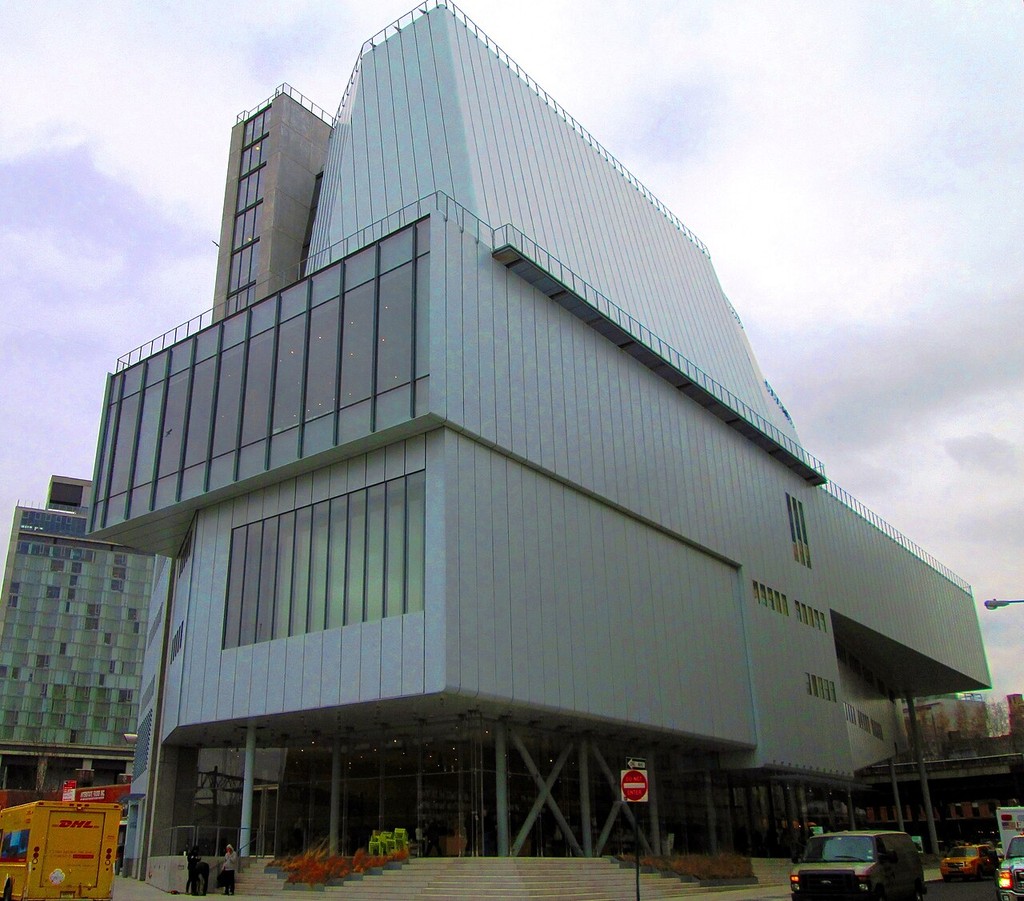
The Whitney Museum’s Gansevoort Street building in 2016. Four Darks in Red belongs to the Whitney’s collection.
Photograph: Beyond My Ken. Photograph remains CC BY-SA 4.0. Resized without cropping. [5]
The Whitney supplies a particularly helpful object description and an audio transcript that asks how the colour changes with time and distance.[1] Those teaching resources are evidence of one institution's reading, not proof that every viewer must feel the same emotion. Rothko's own public comments about tragedy, ecstasy and other fundamental experiences are often quoted, but a single phrase should not be applied mechanically to Four Darks in Red. What can be observed here is a careful organisation of four dark areas within a luminous red field.
The museum's image carries a Rothko copyright notice through Artists Rights Society.[1] This guide links to that image instead of copying it. David Anfam's catalogue raisonné of works on canvas remains an appropriate scholarly source to check for this work's entry and complete literature, but it has not yet been directly consulted for these details.[3]
The 2026 Palazzo Strozzi dossier lists the Whitney canvas among its exhibition works, gives the same 258.6 × 295.6 cm dimensions and accession 68.9, and cites it as Anfam catalogue number 611.[4] That published citation provides a lead to the catalogue; it is not a substitute for checking the hardback entry itself. The agreement on current owner, dimensions and accession strengthens the object match. The Italian exhibition's decision to show it in a career-spanning account also demonstrates that a dark 1958 work can be read beyond the Seagram commission, whose membership must be established separately.
The Whitney provides both English and Spanish audio transcripts for this painting.[1] The Spanish narration invites viewers to look for crimson, rust, maroon and a textured black, then to compare the effect from the middle of a room with the effect from closer to the canvas. This is a museum's bilingual teaching approach, not independent scientific analysis of the paint. It suggests a useful test for an in-person viewer: the dark regions may look nearly uniform from afar but separate into different temperatures, depths and degrees of reflection when seen closer. A remote reader can use the transcript while recognising that screen colour cannot verify the surface itself.
The Whitney's exhibition list is also a record of changing interpretations of the same object. It includes a 2005 exhibition called Landscape, a 2015 collection survey, a 2017–19 selection and a 2025 installation that placed the Rothko beside works by Andy Warhol and Rosalyn Drexler.[1] None of those settings proves Rothko intended a landscape, a Pop Art dialogue or a single national story. They show how museums can ask new questions of a stable canvas. The 2025 installation photograph is especially useful evidence for scale: the work occupies a very wide section of wall, and its neighbouring pictures change the rhythm of looking across the room. A web image of the canvas alone cannot show that curatorial context.
A close-looking sequence
First count the four dark forms and compare their widths. Then look at each dark against the red immediately around it: a brown-red can look almost black in one place and warmer in another. Follow the uppermost and lowest boundaries, where thin changes in colour may make an area expand or contract visually. Finally step back and ask where the painting seems heaviest. These observations are grounded in the Whitney canvas and leave room for differing responses.
Related works
- Light Red over Black is a separate 1957 Tate work.
- Black on Maroon is a documented Seagram canvas.
- The Seagram Murals explains the 1958 commission.
Rothko works in this guide
| Name | Date | Medium |
|---|---|---|
| Entrance to Subway | 1938 | Painting |
| Hierarchical Birds | 1944 | Painting |
| Slow Swirl at the Edge of the Sea | 1944 | Painting |
| No. 3/No. 13 | 1949 | Painting |
| Untitled (Violet, Black, Orange, Yellow on White and Red) | 1949 | Painting |
| White Center | 1950 | Painting |
| No. 10 | 1950 | Painting |
| No. 6 (Violet, Green and Red) | 1951 | Painting |
| Untitled | 1952 | Painting |
| No. 61 (Rust and Blue) | 1953 | Painting |
| No. 1 (Royal Red and Blue) | 1954 | Painting |
| Untitled (Yellow and Blue) | 1954 | Painting |
| Orange and Yellow | 1956 | Painting |
| Light Red over Black | 1957 | Painting |
| Four Darks in Red | 1958 | Painting |
| Black on Maroon | 1958 | Painting |
| No. 14 | 1960 | Painting |
| Orange, Red, Yellow | 1961 | Painting |
| Untitled (brown and gray) | 1969 | Painting |
| Untitled (Red on Red) | 1969 | Painting |
| Untitled (Black and Gray) | 1970 | Painting |
| Tentacles of Memory | 1945–46 | Drawing |
Frequently Asked Questions
It is in the Whitney Museum of American Art, accession 68.9. Rothko made the oil canvas in 1958. Its dimensions, 258.6 × 295.6 cm, give it a width of almost three metres.[1]
The Whitney describes four horizontal areas of unequal proportions against a red ground. Three are brownish red, while the broad second area is closer to black. Their changing edges and the range of reds make the composition more varied than a simple stack of black bars.[1]
Its 1958 date and dark palette do not establish membership in the Seagram project. The Whitney records it as an individual canvas. It is useful to compare it with the murals while preserving the separate identity and collection history of the work.[1][2]
The near three-metre width makes the colour relationship a broad physical encounter. The Whitney encourages close viewing and describes layered tones that can seem to glow beneath other passages. Moving attention between the upper dark area and lower red light can change the apparent balance.[1]
Discussion
What changes when you look at Four Darks in Red as a physical painting rather than a small reproduction?
Use the questions below to compare the work with its neighbours in Rothko’s career.
Reader Insights
Which edge or interval asks you to slow down?
How does this painting differ from the earlier and later works linked here?
What remains uncertain after reading the museum record and looking closely?
Join the Conversation
Share an observation grounded in the work or its documented history.
References
- Whitney Museum of American Art, Four Darks in Red, accession 68.9.
- National Gallery of Art, “Mark Rothko: Seagram Murals”.
- David Anfam, Mark Rothko: The Works on Canvas: A Catalogue Raisonné (National Gallery of Art and Yale University Press, 1998), bibliography at NGA; entry unverified here.
- Fondazione Palazzo Strozzi, Rothko a Firenze, Italian press dossier (2026), p. 7; published Anfam no. 611 and Whitney identity.
- Whitney Museum from west.jpg. Photograph: Beyond My Ken. Photograph remains CC BY-SA 4.0. Resized without cropping. Source · CC BY-SA 4.0.