


 by Tom Gurney
Tom Gurney BSc (Hons) is an art history expert with over 20 years experience
Published on June 19, 2020 / Updated on October 11, 2026
Email: tomgurney1@gmail.com / Phone: +44 7429 011000
Light Red over Black: Introduction
Light Red over Black is a 1957 oil painting on canvas in Tate's collection, T00275, measuring 232.7 × 152.7 cm.[1][7] The title describes a colour relationship, but it is also the precise name by which a reader can distinguish this work from other red-and-dark canvases. One older page in this cluster confused the heading of Four Darks in Red with this title. The two works have different dates and holders: Tate's Light Red over Black is from 1957; the Whitney's Four Darks in Red is from 1958.[2]
At a Glance
This work in Rothko’s career
No. 3/No. 13
1949Contents
- Looking beyond the title
- Position in the late 1950s
- The painting's route into Tate
- Medium, technique and evidence
- Looking questions and rights
Looking beyond the title
The name “Light Red over Black” invites the eye to locate a red area against a darker one. But “over” may refer to visual position, paint layering or a viewer's sense that one colour floats in front of another. These are not automatically the same thing. Tate describes two dark rectangles within a strong scarlet border in its print information, using the idea of a window as a visual comparison.[8] The canvas should be looked at for its actual edges and transitions before making a technical claim about the order in which Rothko applied paint. Its broad fields sit in a relationship that can appear simple in a small reproduction, while the real surface may show shifts in tone and opacity.
Rothko had reached a mature format of softly bounded colour areas by the early 1950s, according to the National Gallery of Art's chronology.[3] Within that format he varied the number, size and interaction of fields considerably. Light Red over Black belongs to that larger investigation. It does not illustrate a fixed formula that can be applied equally to a bright 1950 work such as White Center or to the darker Black on Maroon associated with the following year's Seagram commission.
Position in the late 1950s
The 1957 date places Light Red over Black before the 1958 Seagram commission. A shared use of red and black is not evidence that it was produced for the Four Seasons restaurant. The National Gallery dates the commission to June 1958 and describes an extensive group of canvases created afterward.[4] Chronology and collection records are stronger evidence of project membership than visual resemblance. Comparing the 1957 Tate work with a Seagram painting may illuminate a change in Rothko's treatment of dark fields; it should not merge their histories.
The Whitney's 1958 Four Darks in Red provides another useful distinction. Its four dark horizontal forms occupy an almost ten-foot-wide red canvas, and the Whitney describes the ways the colours appear to emerge and recede.[2] The title alone makes it easy to mix up the two works. Checking date, museum and measurements is a better habit than relying on memory of red and black tones.
The painting's route into Tate
Tate's account of modern American art dates its acquisition of T00275 to 1959 and connects the purchase to The New American Painting exhibition.[7] This is more exact than saying simply that the canvas later reached London. The museum describes the acquisition as the beginning of a sustained relationship with Rothko that culminated in his later gift of nine Seagram paintings. That institutional sequence does not make the 1957 picture a Seagram mural: it entered Tate through a separate purchase from a travelling exhibition before the gift of the darker group.
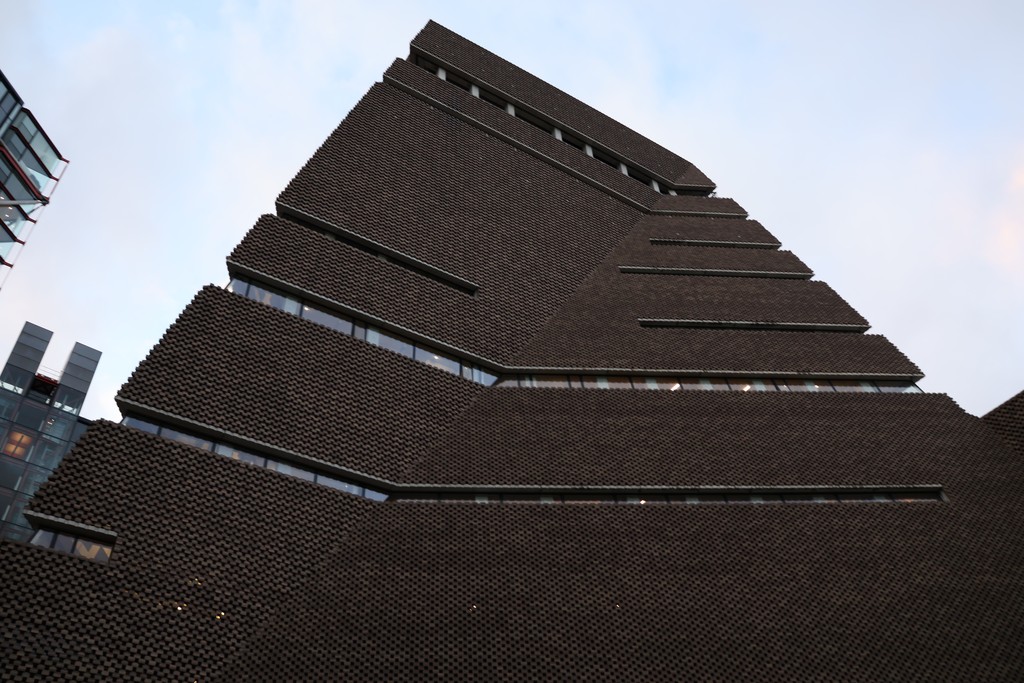
The Blavatnik Building at Tate Modern, photographed in 2024. Light Red Over Black belongs to Tate’s collection.
Photograph: DiscoA340. Photograph remains CC BY-SA 4.0. Resized without cropping. [11]
The same Tate timeline records Rothko's 1959 London visit and subsequent visits with British artists in Somerset and St Ives, including William Scott, Peter Lanyon, Alan Davie and Patrick Heron.[7] This places the acquisition in a transatlantic artistic exchange rather than treating Tate as merely the eventual storage place for a famous American work. The chronology should not be used to infer which of those artists saw or discussed this particular canvas; it documents Rothko's travel and Tate's purchase, not an object-level conversation.
Tate's longer research account identifies the Sidney Janis Gallery as the source of the purchase and places it within acquisitions considered by the museum's trustees after The New American Painting.[9] That makes the route more precise: the exhibition brought the painting into the British institutional conversation, while the transaction was arranged with Rothko's New York dealer. It also clarifies why this canvas matters to Tate's own collecting history. The 1959 acquisition came before the artist's later gift and helped establish a relationship in which Tate would become an important public home for his work. A chronology of the Seagram gift beginning with 1968 should not erase this earlier purchase or collapse the two acquisitions into a single event.
The painting returned to Whitechapel Gallery as the single canvas displayed alongside archival material in Rothko in Britain, a presentation marking the fiftieth anniversary of Rothko’s 1961 London solo exhibition.[10] Whitechapel’s interpretation panel identifies Light Red over Black as the first Rothko purchased by a British public collection. The display placed the 1957 painting beside original photographs, Rothko’s letters and recorded memories of viewers and artists. This is a documented later display of the specific canvas; it does not by itself prove that the painting hung in the original 1961 show. Whitechapel’s archive also records that Rothko gave instructions concerning lighting and hanging height for that show, but those instructions should not be mechanically applied to every later installation of the Tate painting.
Medium, technique and evidence
Rothko's canvases could involve complex layers and materials; a generic description of his method cannot establish the layer order on a specific painting. The National Gallery's study of separate works on paper shows how support, tape, brushwork and mounting varied from object to object.[5] That technical evidence should prompt questions about Light Red over Black, not be copied onto it. Any claim about this canvas's exact pigments or process needs Tate's object record or conservation analysis.
Tate's public shop entry confirms the title, date, medium and measurements; its research timeline supplies the accession and acquisition context.[1][7] Those records permit a basic object identity even while they leave exact pigments and layer order open. The Anfam canvas catalogue is a suitable next source for a fuller exhibition and provenance trail, but the book has not yet been consulted directly for this painting.[6]
Looking questions and rights
Start with the lighter red field and follow its edges. Does its apparent brightness change where the dark field comes near it? How much of the surrounding colour is needed to make the relation work? Step back to compare the main areas, then approach the surface if the painting is available on view. The questions connect the broad arrangement to its material presence without requiring a single emotional interpretation.
Tate's availability and display may change, so current visiting information should be checked with the museum. The Tate shop's sale of authorised prints is not a licence for this site to republish the image. This guide links to the museum's material and uses a neutral artwork card in its own directory.
Related works
- Four Darks in Red is the distinct 1958 Whitney canvas.
- Black on Maroon belongs to the 1958 Seagram group.
- White Center offers an earlier, brighter comparison.
Rothko works in this guide
| Name | Date | Medium |
|---|---|---|
| Entrance to Subway | 1938 | Painting |
| Hierarchical Birds | 1944 | Painting |
| Slow Swirl at the Edge of the Sea | 1944 | Painting |
| No. 3/No. 13 | 1949 | Painting |
| Untitled (Violet, Black, Orange, Yellow on White and Red) | 1949 | Painting |
| White Center | 1950 | Painting |
| No. 10 | 1950 | Painting |
| No. 6 (Violet, Green and Red) | 1951 | Painting |
| Untitled | 1952 | Painting |
| No. 61 (Rust and Blue) | 1953 | Painting |
| No. 1 (Royal Red and Blue) | 1954 | Painting |
| Untitled (Yellow and Blue) | 1954 | Painting |
| Orange and Yellow | 1956 | Painting |
| Light Red over Black | 1957 | Painting |
| Four Darks in Red | 1958 | Painting |
| Black on Maroon | 1958 | Painting |
| No. 14 | 1960 | Painting |
| Orange, Red, Yellow | 1961 | Painting |
| Untitled (brown and gray) | 1969 | Painting |
| Untitled (Red on Red) | 1969 | Painting |
| Untitled (Black and Gray) | 1970 | Painting |
| Tentacles of Memory | 1945–46 | Drawing |
Frequently Asked Questions
It is a 1957 oil painting on canvas in Tate’s collection, accession T00275, measuring 232.7 × 152.7 cm. Its title identifies a particular work, rather than serving as a general description of any Rothko painted in red and dark colours.[1][7]
Tate describes two dark rectangular forms within a strong scarlet border, using a window as a visual comparison. That description directs attention to enclosure and colour relationships. It should not be mistaken for proof of a literal window subject or a precise sequence of paint application.[8]
Discussion
What changes when you look at Light Red over Black as a physical painting rather than a small reproduction?
Use the questions below to compare the work with its neighbours in Rothko’s career.
Reader Insights
Which edge or interval asks you to slow down?
How does this painting differ from the earlier and later works linked here?
What remains uncertain after reading the museum record and looking closely?
Join the Conversation
Share an observation grounded in the work or its documented history.
References
- Tate, Light Red over Black, 1957, object information.
- Whitney Museum of American Art, Four Darks in Red, 1958, accession 68.9.
- National Gallery of Art, “Mark Rothko,” artist chronology.
- National Gallery of Art, “Mark Rothko: Seagram Murals”.
- Michaela Milgrom, “How Mark Rothko Made Paintings on Paper,” National Gallery of Art, 2023.
- David Anfam, Mark Rothko: The Works on Canvas: A Catalogue Raisonné (National Gallery of Art and Yale University Press, 1998), bibliographic lead; entry not directly checked.
- Tate, Modern American Art at Tate, 1950s timeline, on the 1959 acquisition of T00275 and Rothko's British visit. Tate's primary text was checked through its indexed accessible mirror because the main Tate reader returned 403 to automated opening.
- Tate, Light Red over Black mini-print object description, for the two dark forms and scarlet border; the print's dimensions are not the painting's dimensions.
- Tate, “American Art under John Rothenstein, 1938–64”, on the museum's purchase from the Sidney Janis Gallery.
- Whitechapel Gallery, Rothko in Britain and its interpretation panel.
- Exterior of Tate Modern (January 2024) 01.jpg. Photograph: DiscoA340. Photograph remains CC BY-SA 4.0. Resized without cropping. Source · CC BY-SA 4.0.

_01.jpg)