 by Tom Gurney
Tom Gurney BSc (Hons) is an art history expert with over 20 years experience
Published on June 19, 2020 / Updated on October 11, 2026
Email: tomgurney1@gmail.com / Phone: +44 7429 011000
No. 1 (Royal Red and Blue): Introduction
Rothko signed, titled and dated No. 1 (Royal Red and Blue) on the reverse in 1954, according to Sotheby's 2012 sale record. The oil canvas measures 288.9 × 171.5 cm.[1] The record supplies both a detailed exhibition trail and an indirect reference to David Anfam's catalogue raisonné: catalogue number 503, page 386.[1] That bibliographic identification is useful, although the catalogue entry itself has not yet been inspected here.
At a Glance
- ArtistMark Rothko
- Date1954 [1]
- MediumOil on canvas [1]
- Dimensions288.9 × 171.5 cm [1]
- CollectionPrivate collection (2012) [1]
This work in Rothko’s career
No. 3/No. 13
1949Contents
- An unusually documented title history
- The artist and the Chicago installation
- A mature format with changing relations
- Provenance and the sale record
An unusually documented title history
The painting appeared as No. 1 in an exhibition beginning at the Art Institute of Chicago in October 1954 and travelling to Providence. In 1955 the Sidney Janis Gallery showed it as Royal Red and Blue.[1] Those dated listings explain why both a number and a colour subtitle can be found in later references. They are not evidence of two separate canvases. The reverse inscription, 1954 date, dimensions and later provenance tie them to the Sotheby's lot.
Sotheby's identifies the Chicago presentation as Rothko's first one-person show in a major United States museum and describes this canvas as a culminating work in that installation.[1] That curatorial history gives No. 1 a more exact place in 1954 than a generic label of “early mature Rothko.” The venue and the later Providence showing also establish that the number was publicly attached to the painting while Rothko was alive. A full reconstruction of its position on the Chicago walls would require installation records rather than inference from the auction's retrospective prose.
Guggenheim Bilbao's Spanish-language object account independently describes the Chicago exhibition as a compact, low-ceiling gallery with eight canvases carefully placed.[3] It discusses another work: the Bilbao museum's immense Untitled of 1952–53, 299.5 × 442.5 cm, which it says hung freely near the entrance. Its English catalogue note explains that Chicago materials called that painting No. 10 and cites Anfam's proposed identification as no. 483.[4] The number in that historical exhibition is therefore an especially hazardous way to identify a Rothko. It is not MoMA's 1950 No. 10, nor this 1954 No. 1. The Bilbao account contributes evidence about how Rothko's large canvases met viewers in Chicago; it does not locate No. 1 on a particular wall.
The title's two named colours also invite a quick reading of the composition. Sotheby's describes an orange upper field, a royal red middle strip and a strong blue lower area.[1] The exact experience of those colours changes with scale and light; the canvas is nearly 2.9 metres tall. What looks like a neat stack on a phone is a large surface whose soft boundaries and tonal variations require time. A viewer can ask how the narrow red interval works between warmer and cooler expanses, and how the coloured ground contributes to their apparent separation.
The artist and the Chicago installation
The Sotheby's catalogue draws on Rothko's correspondence with Chicago curator Katharine Kuh, a more revealing source than the later subtitle alone. In June 1954 Kuh asked for the large red canvas for the exhibition. The catalogue connects that request with No. 1, while the September price list places it immediately below the enormous 1952–53 canvas now in Bilbao.[1] That ranking cannot be translated directly into artistic importance: a price reflected scale, supply and negotiation as well as Rothko's judgement. It does, however, show that the museum was choosing among particular works, rather than receiving an undifferentiated group of colour paintings.
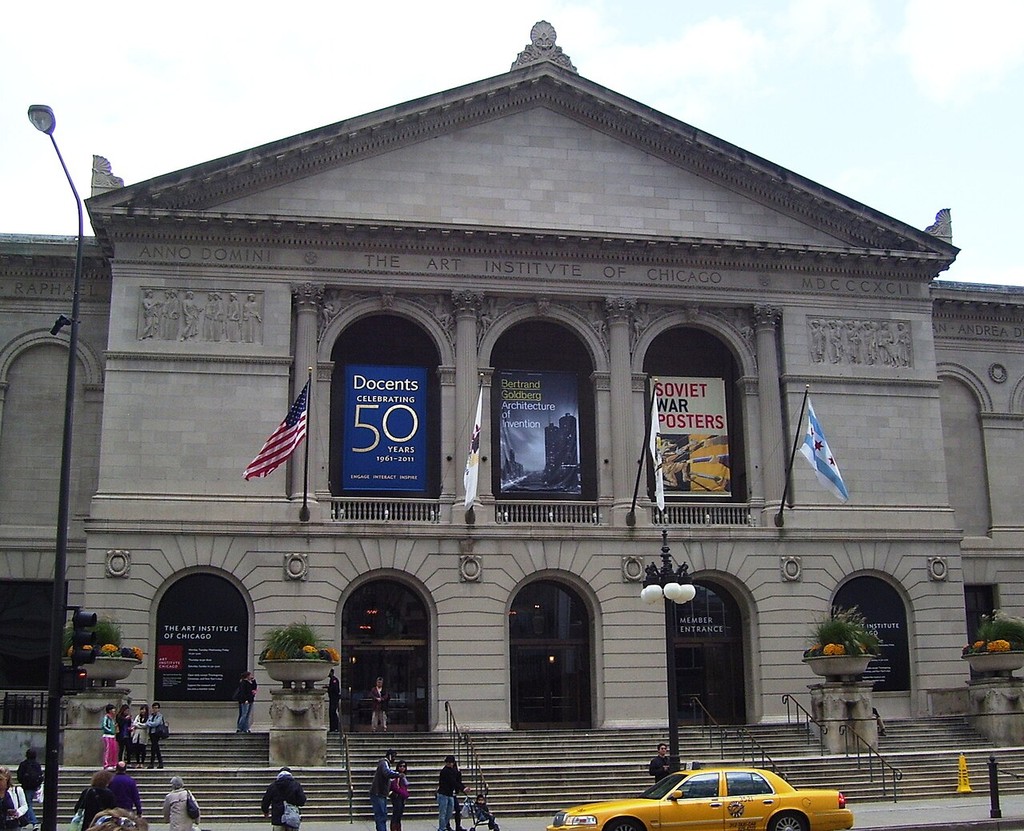
The Art Institute of Chicago’s main entrance in 2011. Rothko’s 1954 exhibition there is central to this painting’s title and installation history.
Photograph: Beyond My Ken. Photograph remains CC BY-SA 4.0. Resized without cropping. [6]
In September Rothko also discussed the installation with Kuh. As reported and excerpted by Sotheby's, he worried that an arrangement on expansive walls might turn the paintings into decoration.[1] This is significant for the present canvas: its nearly three-metre height did not make it an architectural covering. He wanted an encounter with an individual work, with enough room for its internal colour relations to hold attention. The auction's excerpts should be checked against the original letters before using them as a full account of Rothko's instructions, but they support an installation question worth taking into any gallery: what changes when a large painting is given its own wall rather than grouped into a pattern?
The exhibition sequence is also unusually well recorded. Chicago and Providence showed the work under its number in 1954–55; Sidney Janis gave it the colour subtitle in 1955. Sotheby's later lists it at the Corcoran in 1971, the Hirshhorn in 1976, the National Gallery of Art and Whitney in 1998–99, and Fort Worth in 2007–08.[1] These entries trace changes in curatorial setting over half a century. They do not imply that the painting was on permanent display at any of those museums. They also help explain why a museum or catalogue photograph may attach a different display title to the same signed object.
A mature format with changing relations
The National Gallery of Art dates Rothko's move to his familiar arrangement of broad, soft-edged colour areas to around 1950.[2] No. 1 is therefore not an experimental first attempt at abstraction; it is a distinctive 1954 development within an established language. The title's “No. 1” does not mean it was the first such painting he made. Numbered titles often describe an exhibition or catalogue sequence and must be attached to the exact object.
Compare the painting with No. 61 (Rust and Blue) of the previous year. Both are large canvases with colour terms in their modern titles, but their different proportions and tonal balances produce different relations. The comparison is more useful than a broad assertion that Rothko always painted the same rectangles.
Provenance and the sale record
Sotheby's documents a sequence beginning with acquisition from Rothko by Marlborough in 1969, followed by the Kreeger, Kasper and Heller collections, and a later owner who acquired it in 1982.[1] This is a sale-catalogue provenance trail as published in 2012; it is not proof of ownership in 2026. The public lot page displays a presale estimate of $35–50 million and requires login for the result.[1] Sotheby's separate post-sale video page reports that this canvas led the 13 November 2012 sale at $75.1 million.[5] That is a rounded historical result, not a current valuation or a price read from the restricted lot field.
The catalogue also gives Rothko estate number 5018.54.[1] Estate numbers are especially useful where Rothko's numbered exhibition titles recur: they provide another route to matching a photograph, listing or archival document to the canvas. They are not themselves statements about a painting's rank in his output. Read together, the reverse inscription, dimensions, estate number, 1954 Chicago listing and Anfam reference create a much firmer identification than the words “red and blue” would provide on their own.
The Anfam citation in Sotheby's literature section is unusually precise: no. 503, page 386, with an additional installation image on page 73.[1] A reader with the hardback can check the catalogue entry against the auction's title and dimensions. Until that check, the manuscript attributes the number to Sotheby's citation rather than pretending to quote Anfam directly. The painting image on the auction page is not licensed for reuse here.
Related works
- No. 61 (Rust and Blue) is a 1953 comparison.
- Untitled (Yellow and Blue) is another 1954 canvas with a documented title history.
- Rothko's paintings explains the wider format.
Rothko works in this guide
| Name | Date | Medium |
|---|---|---|
| Entrance to Subway | 1938 | Painting |
| Hierarchical Birds | 1944 | Painting |
| Slow Swirl at the Edge of the Sea | 1944 | Painting |
| No. 3/No. 13 | 1949 | Painting |
| Untitled (Violet, Black, Orange, Yellow on White and Red) | 1949 | Painting |
| White Center | 1950 | Painting |
| No. 10 | 1950 | Painting |
| No. 6 (Violet, Green and Red) | 1951 | Painting |
| Untitled | 1952 | Painting |
| No. 61 (Rust and Blue) | 1953 | Painting |
| No. 1 (Royal Red and Blue) | 1954 | Painting |
| Untitled (Yellow and Blue) | 1954 | Painting |
| Orange and Yellow | 1956 | Painting |
| Light Red over Black | 1957 | Painting |
| Four Darks in Red | 1958 | Painting |
| Black on Maroon | 1958 | Painting |
| No. 14 | 1960 | Painting |
| Orange, Red, Yellow | 1961 | Painting |
| Untitled (brown and gray) | 1969 | Painting |
| Untitled (Red on Red) | 1969 | Painting |
| Untitled (Black and Gray) | 1970 | Painting |
| Tentacles of Memory | 1945–46 | Drawing |
Frequently Asked Questions
It is a 1954 oil painting on canvas, measuring 288.9 × 171.5 cm. Sotheby’s records Rothko’s signature, title and date on the reverse. The large vertical format belongs to his established mature colour-field practice.[1]
The painting appeared as No. 1 in the 1954 Chicago exhibition and as Royal Red and Blue at Sidney Janis Gallery in 1955. The dated listings record different names for one canvas, rather than separate paintings.[1]
Yes. Sotheby’s exhibition history lists the show beginning in Chicago in October 1954 and travelling to Providence. That early public presentation helps locate the painting within Rothko’s career. It does not, by itself, establish its exact position on a particular gallery wall.[1]
The 2012 lot’s literature list cites David Anfam’s Mark Rothko: The Works on Canvas, no. 503, page 386. This is the auction catalogue’s reported bibliographic identification, distinct from directly quoting the book entry.[1]
Discussion
What changes when you look at No. 1 (Royal Red and Blue) as a physical painting rather than a small reproduction?
Use the questions below to compare the work with its neighbours in Rothko’s career.
Reader Insights
Which edge or interval asks you to slow down?
How does this painting differ from the earlier and later works linked here?
What remains uncertain after reading the museum record and looking closely?
Join the Conversation
Share an observation grounded in the work or its documented history.
References
- Sotheby's, No. 1 (Royal Red and Blue), lot 19, 2012, including its literature citation to David Anfam, Mark Rothko: The Works on Canvas (1998), no. 503, p. 386.
- National Gallery of Art, “Mark Rothko,” artist chronology.
- Guggenheim Bilbao Museoa, Spanish collection essay on its Sin título, 1952–53, describing the Chicago installation.
- Guggenheim Bilbao Museoa, English collection notes on Untitled, 1952–53, citing Anfam no. 483 for the Bilbao canvas and discussing its historical No. 10 exhibition label.
- Sotheby's, 2012 post-sale video record, reporting a rounded $75.1 million result for No. 1 (Royal Red and Blue).
- Art Institute of Chicago from across Michigan Avenue.jpg. Photograph: Beyond My Ken. Photograph remains CC BY-SA 4.0. Resized without cropping. Source · CC BY-SA 4.0.