


 by Tom Gurney
Tom Gurney BSc (Hons) is an art history expert with over 20 years experience
Published on June 19, 2020 / Updated on October 11, 2026
Email: tomgurney1@gmail.com / Phone: +44 7429 011000
Untitled (Black and Gray): Introduction
Untitled (Black and Gray) is a 1970 acrylic painting on canvas in the Museum of Contemporary Art, Los Angeles. MOCA gives its dimensions as 172.72 × 153.04 × 4.13 cm and its accession as 85.27, a gift of the Mark Rothko Foundation.[1] An older URL spells the final colour “grey”; the collection uses “Gray.” The more significant correction is that this is a canvas, distinct from the National Gallery of Art's 1969 Untitled (brown and gray) on paper.[2]
At a Glance
- ArtistMark Rothko
- Date1970 [1]
- MediumAcrylic on canvas [1]
- Dimensions172.72 × 153.04 × 4.13 cm [1]
- CollectionMOCA Los Angeles, 85.27 [1]
This work in Rothko’s career
Contents
- The late canvas as a physical object
- A title shared by many late concerns
- Distinguishing the NGA paper work
- Viewing and reproduction
The late canvas as a physical object
The museum's title directs attention to black and gray, but the work is more than a two-word palette. The broad dark and pale areas meet within a canvas almost 1.73 metres high. At that size, even a restrained set of colours occupies a substantial part of a viewer's field of vision. Compare the varying limits of the fields, the proportion of each to the whole and the point where one tone meets the other. The painting's surface may register differently as viewing distance changes; a small image is useful for identification but cannot supply the full experience of scale and material.
MOCA's medium line specifies acrylic on canvas.[1] This avoids two common shortcuts: calling all Rothko canvases oil paintings, and assuming the black-and-gray late works were all made on paper. The National Gallery's artist chronology notes Rothko's late move toward acrylic on both canvas and paper from 1968.[3] This painting is one example of that range, not a template for every late object. Its exact technical layering would require conservation documentation for accession 85.27.
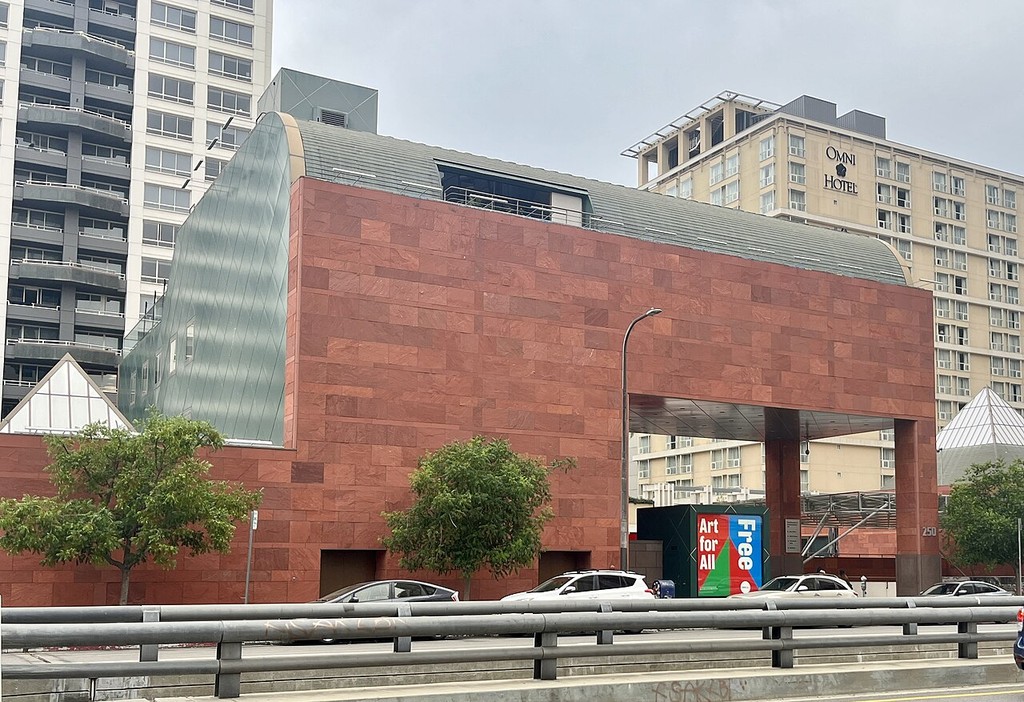
MOCA Grand Avenue in 2023. The museum holds the 1970 acrylic-on-canvas Untitled (Black and Gray), accession 85.27.
Photograph: Benoît Prieur. Resized without cropping. [8]
A title shared by many late concerns
Rothko made several works with muted or dark colour relationships in his final years. The 1970 date often tempts a purely biographical reading. Yet the painting has its own dimensions, medium, collection history and visual structure. Those facts should come first. A canvas made in the year of an artist's death is not automatically a self-portrait of despair, and the collection record does not assign that meaning. The late palette can be discussed as a deliberate set of visual relations without turning it into a diagnosis.
The National Gallery's conservation account of paper paintings is illuminating by comparison. It describes how Rothko used taped boundaries, layered acrylic and varied brushwork on documented paper sheets.[4] These observations show his sustained technical experimentation, but they do not prove that MOCA's canvas was made in the same sequence. Medium, support and surviving evidence must remain object-specific. In a responsible reading, comparison opens questions rather than erasing differences.
The NGA separates the late Brown and Grays on paper from Black on Grays on canvas and dates the emergence of both groups to late 1969.[6] MOCA dates this individual canvas to 1970.[1] The group name is therefore a way to frame a comparison, not a substitute for its museum date. NGA also documents late paper paintings in mauve, lavender, pink and pale blue.[6] Those simultaneous lighter experiments make it difficult to treat black and gray as the inevitable final stage of a career. The tonal restraint of this canvas remains a particular choice to examine in its own right.
A second institutional reading comes from the Fondation Louis Vuitton's 2023–24 retrospective. Its curators grouped Black and Gray canvases in a tall room with Giacometti sculptures and connected that spatial experiment to an unrealised Rothko proposal for UNESCO.[7] The exhibition account explicitly cautions against reducing the series to Rothko's death. This is a curatorial interpretation of a group, not evidence that MOCA accession 85.27 was among the canvases on those Paris walls. It helps frame a better viewing question: how does a dark rectangle act when a viewer moves through a room with other bodies and objects, rather than when it is isolated as a thumbnail? The late work remains concerned with pictorial and architectural space, even in a narrow palette.
Distinguishing the NGA paper work
The NGA owns Untitled (brown and gray), accession 1986.43.286, dated 1969 and listed as acrylic on paper.[2] MOCA's Untitled (Black and Gray) is accession 85.27, dated 1970 and listed as acrylic on canvas.[1] These are two artworks, two collections and two supports. Their similar colour names are a reason to check the records carefully, not to merge their histories. The paper-work guide follows NGA's object and the evolution of Rothko's Brown and Gray group.
MOCA credits this 1970 canvas as a gift from the Mark Rothko Foundation.[1] That is a collection-history point, not a complete provenance before the gift. David Anfam's catalogue raisonné covers works on canvas and is therefore a relevant source to consult for the painting's entry, title and history, but the entry has not yet been directly checked here.[5] The accession, measurements and medium in this guide come from MOCA's current record.
Viewing and reproduction
MOCA's object page is the most direct public record for the work and its image. The museum displays an artwork copyright notice for the Rothko heirs through Artists Rights Society.[1] A visitor can use that link to identify the canvas and check any current viewing information. This guide does not reproduce the painting without a licence.
Start with the relation of the two principal tones. Which appears to advance, and which seems to hold or absorb space? Then follow the boundary between them and the gap between each painted field and the canvas edge. Finally compare the proportions with an earlier work such as No. 61 (Rust and Blue). Both belong to Rothko's career, but the shift in date, medium and palette should discourage an account in which all broad-field paintings do the same thing.
Related works
- Untitled (brown and gray) is a different 1969 paper work.
- No. 61 (Rust and Blue) is an earlier MOCA canvas.
- Rothko's paintings places both in his wider practice.
Rothko works in this guide
| Name | Date | Medium |
|---|---|---|
| Entrance to Subway | 1938 | Painting |
| Hierarchical Birds | 1944 | Painting |
| Slow Swirl at the Edge of the Sea | 1944 | Painting |
| No. 3/No. 13 | 1949 | Painting |
| Untitled (Violet, Black, Orange, Yellow on White and Red) | 1949 | Painting |
| White Center | 1950 | Painting |
| No. 10 | 1950 | Painting |
| No. 6 (Violet, Green and Red) | 1951 | Painting |
| Untitled | 1952 | Painting |
| No. 61 (Rust and Blue) | 1953 | Painting |
| No. 1 (Royal Red and Blue) | 1954 | Painting |
| Untitled (Yellow and Blue) | 1954 | Painting |
| Orange and Yellow | 1956 | Painting |
| Light Red over Black | 1957 | Painting |
| Four Darks in Red | 1958 | Painting |
| Black on Maroon | 1958 | Painting |
| No. 14 | 1960 | Painting |
| Orange, Red, Yellow | 1961 | Painting |
| Untitled (brown and gray) | 1969 | Painting |
| Untitled (Red on Red) | 1969 | Painting |
| Untitled (Black and Gray) | 1970 | Painting |
| Tentacles of Memory | 1945–46 | Drawing |
Frequently Asked Questions
It is a 1970 acrylic painting on canvas in MOCA Los Angeles, accession 85.27. The museum records dimensions of 172.72 × 153.04 × 4.13 cm and a gift from the Mark Rothko Foundation. MOCA uses ‘Gray’ in its title.[1]
No. The NGA’s accession 1986.43.286 is acrylic on paper and dates to 1969. MOCA’s canvas dates to 1970. The difference in support is as substantial as the difference in title and year.[1][2]
A palette alone cannot establish a specific psychological explanation. The NGA describes two late dark groups alongside lighter paintings on paper. Looking at each work’s support, border and division of fields gives a more precise account of what is present.[4][6]
Untitled (Red on Red) is a bright 1969 oil painting on paper mounted on canvas. Setting it beside the 1970 acrylic canvas reveals variation in material, colour and scale within Rothko’s final years, rather than treating every late work as one repeated design.[4][6]
Discussion
What changes when you look at Untitled (Black and Gray) as a physical painting rather than a small reproduction?
Use the questions below to compare the work with its neighbours in Rothko’s career.
Reader Insights
Which edge or interval asks you to slow down?
How does this painting differ from the earlier and later works linked here?
What remains uncertain after reading the museum record and looking closely?
Join the Conversation
Share an observation grounded in the work or its documented history.
References
- The Museum of Contemporary Art, Los Angeles, Untitled (Black and Gray), accession 85.27.
- National Gallery of Art, Untitled (brown and gray), accession 1986.43.286.
- National Gallery of Art, “Mark Rothko,” artist chronology.
- Michaela Milgrom, “How Mark Rothko Made Paintings on Paper,” National Gallery of Art, 2023.
- David Anfam, Mark Rothko: The Works on Canvas: A Catalogue Raisonné (National Gallery of Art and Yale University Press, 1998), bibliographic lead in the NGA Rothko bibliography; specific entry unverified here.
- National Gallery of Art, “Who Is Mark Rothko? 9 Things to Know”, on the two late dark series and concurrent lighter works.
- Fondation Louis Vuitton, Mark Rothko retrospective, 2023–24, on its Black and Gray installation and the unrealised UNESCO context.
- The Museum of Contemporary Art from Grand Ave (July 2023).jpg. Photograph: Benoît Prieur. Resized without cropping. Source · CC0.

.jpg)