 by Tom Gurney
Tom Gurney BSc (Hons) is an art history expert with over 20 years experience
Published on June 19, 2020 / Updated on October 11, 2026
Email: tomgurney1@gmail.com / Phone: +44 7429 011000
Orange, Red, Yellow: Introduction
Orange, Red, Yellow is a large 1961 oil painting on canvas, 236.2 × 206.4 cm, signed and dated on the reverse. Christie's offered it from the estate of David Pincus in 2012 and cited David Anfam's catalogue raisonné as no. 693, page 550.[1] Those are verifiable object identifiers in the auction's record. The widely reported sale belongs to a particular 2012 event; claims that it remains the most expensive Rothko today would require a fresh market comparison and are not needed to understand the painting.
At a Glance
- ArtistMark Rothko
- Date1961 [1]
- MediumOil on canvas [1]
- Dimensions236.2 × 206.4 cm [1]
- CollectionPrivate collection (2012) [1]
This work in Rothko’s career
No. 3/No. 13
1949Contents
Warm colours, changing boundaries
The title's three colours can seem to explain the painting at a glance. Yet red appears both as a dominant field and as a surrounding or intervening tone, while orange and yellow change character beside it. At more than two metres in both dimensions, the canvas sets up an encounter far larger than a book illustration. A viewer can move from the overall balance to the edges of individual forms, noticing how a slightly different density of paint changes whether a field seems to advance or recede.
Christie's account describes a cooler, thinly painted crimson ground beneath warmer orange-red fields.[1] This is an auction-house reading of the work, helpful as a visual prompt but not a substitute for object-specific conservation. It supports a close-looking question: where does the underlying red appear through or around the brighter areas? The visual complexity lies in relations among colours that the short title names only broadly.
1961 in the career
Rothko made Orange, Red, Yellow after the Seagram commission and around the time of the Harvard mural commission. The National Gallery chronology dates the Harvard project to 1961, while its Seagram exhibition describes the earlier Four Seasons work.[2][3] This painting is not automatically a mural from either project. Christie's records it as an individual canvas with its own provenance and exhibition history.[1] The surrounding chronology shows Rothko's interest in how large colour fields occupy space, but the project identity must come from documentation, not format alone.
The painting was exhibited in London in 1964 and later in Philadelphia and Pennsylvania, according to Christie's lot record.[1] That history is a reminder that the canvas had a public life before its 2012 sale. Earlier publications illustrated it inverted, as the auction bibliography notes, so a reader using historical reproductions should pay attention to orientation. The Christie’s description of reverse signatures is an additional object clue when comparing catalogues.
Christie's dated exhibition list is more precise: Marlborough New London Gallery showed the canvas in February–March 1964, the Philadelphia Museum of Art included it in Philadelphia Collects: Art Since 1940 in 1986, and Penn State's Palmer Museum showed it in a Pincus collection selection in 1996.[1] Christie's also records an extended loan to the Philadelphia Museum of Art. Those episodes help explain why a painting held privately for decades entered public discussions and reproductions. The inverted 1964 and 1965 illustrations in its bibliography are a practical warning: reproductions can carry an orientation error even when the object, title and attribution are correct.
The reverse and stretcher inscriptions make orientation and identity unusually checkable. Christie's records Rothko's dated signature on the reverse and a further signature with initials on the stretcher.[1] An older upside-down illustration is therefore a publication problem, not evidence that the painter intended two equally authoritative orientations. The error also shows why the often repeated warm-colour description is insufficient on its own: a reader tracing this work through books must use date, dimensions, inscription and provenance alongside the visual arrangement. Anfam's catalogue citation provides another bibliographic anchor, though its entry remains to be checked directly.
The 1964 London exhibition places the painting within Rothko's lifetime, three years after its making. The 1986 Philadelphia and 1996 Pennsylvania displays then belong to the Pincus decades, long before the estate sale.[1] Those intervals matter because the canvas did not become significant only when the 2012 price made news. The auction's own bibliography lists Harold Rosenberg in Art in America in April 1964 and a 1965 modern-art survey, even though both reproduced it inverted.[1] They are evidence of early critical circulation; their interpretations would need direct reading before being quoted or summarised as arguments about the painting.
Provenance and Anfam
Christie's gives Marlborough galleries in New York and London in the provenance, followed by acquisition by the Pincus owner in 1967.[1] This is the published chain for that sale, not an assertion about the present owner. Its literature list refers to Anfam's Mark Rothko: The Works on Canvas (1998), catalogue no. 693, page 550. Because the Anfam page has not been read directly here, the number is reported as Christie's citation. The lot essay includes numerous further quotations and interpretations, but this page uses its documented object facts and keeps quotation claims separate.
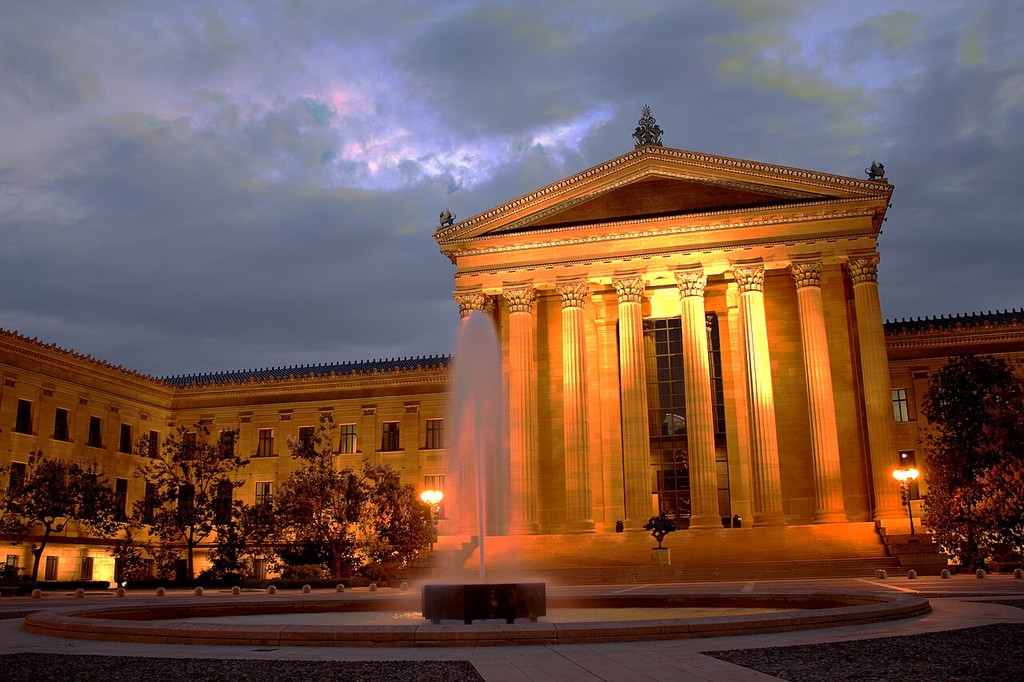
The Philadelphia Museum of Art in 2010. Orange, Red, Yellow was exhibited there in 1986 and entered the museum’s public history through an extended Pincus collection loan.
Photograph: Nfutvol. Photograph remains CC BY-SA 3.0. Resized without cropping. [5]
The sale photograph does not grant permission for independent reuse of the Rothko image. Readers can inspect the auction record through the link, while this guide uses text and neutral navigation cards. A close comparison with No. 14, 1960 at SFMOMA shows how different two large works from adjacent years can be even when warm colour is prominent in both.
Christie's own post-sale release records the 8 May 2012 price as $86,882,500.[4] That is a documented historical transaction, including auction premium, rather than a timeless valuation or a statement of current market rank. Its prominence in news coverage can obscure the painting's longer history of making, display and publication. The object evidence above gives readers firmer grounds to understand the canvas than a single headline number.
Related works
- No. 14, 1960 is a museum-held comparison.
- The Seagram Murals explains the prior commission.
- Rothko's paintings surveys the wider development.
Rothko works in this guide
| Name | Date | Medium |
|---|---|---|
| Entrance to Subway | 1938 | Painting |
| Hierarchical Birds | 1944 | Painting |
| Slow Swirl at the Edge of the Sea | 1944 | Painting |
| No. 3/No. 13 | 1949 | Painting |
| Untitled (Violet, Black, Orange, Yellow on White and Red) | 1949 | Painting |
| White Center | 1950 | Painting |
| No. 10 | 1950 | Painting |
| No. 6 (Violet, Green and Red) | 1951 | Painting |
| Untitled | 1952 | Painting |
| No. 61 (Rust and Blue) | 1953 | Painting |
| No. 1 (Royal Red and Blue) | 1954 | Painting |
| Untitled (Yellow and Blue) | 1954 | Painting |
| Orange and Yellow | 1956 | Painting |
| Light Red over Black | 1957 | Painting |
| Four Darks in Red | 1958 | Painting |
| Black on Maroon | 1958 | Painting |
| No. 14 | 1960 | Painting |
| Orange, Red, Yellow | 1961 | Painting |
| Untitled (brown and gray) | 1969 | Painting |
| Untitled (Red on Red) | 1969 | Painting |
| Untitled (Black and Gray) | 1970 | Painting |
| Tentacles of Memory | 1945–46 | Drawing |
Frequently Asked Questions
It is Rothko’s 1961 oil painting on canvas, measuring 236.2 × 206.4 cm and signed and dated on the reverse. Christie’s offered it from the estate of David Pincus in 2012. The three-colour title identifies a distinct canvas.[1]
No. Orange and Yellow is a separate 1956 work at Buffalo AKG. The 1961 Orange, Red, Yellow has different dimensions and provenance. Their shared warm palette makes comparison useful without making them the same painting.[1]
The title supplies colour names rather than an emotional instruction. Proportion, density, boundaries and surrounding ground affect the relationship between the fields. Reading the painting through those elements leaves room for different encounters instead of equating warm colour with one fixed mood.[1]
Its literature list gives catalogue no. 693, page 550, in Mark Rothko: The Works on Canvas. That is an attributed citation from the sale record, rather than a direct quotation of the 1998 book entry.[1]
Discussion
What changes when you look at Orange, Red, Yellow as a physical painting rather than a small reproduction?
Use the questions below to compare the work with its neighbours in Rothko’s career.
Reader Insights
Which edge or interval asks you to slow down?
How does this painting differ from the earlier and later works linked here?
What remains uncertain after reading the museum record and looking closely?
Join the Conversation
Share an observation grounded in the work or its documented history.
References
- Christie's, Orange, Red, Yellow, 2012 lot record, including its citation to David Anfam, Mark Rothko: The Works on Canvas (1998), no. 693, p. 550.
- National Gallery of Art, “Mark Rothko,” artist chronology.
- National Gallery of Art, “Mark Rothko: Seagram Murals”.
- Christie's, 8 May 2012 post-sale release, recording the realised result for lot 20.
- Philadelphia Art Museum.jpg. Photograph: Nfutvol. Photograph remains CC BY-SA 3.0. Resized without cropping. Source · CC BY-SA 3.0.