by Tom Gurney
Tom Gurney BSc (Hons) is an art history expert with over 20 years experience
Published on June 19, 2020 / Updated on October 11, 2026
Email: tomgurney1@gmail.com / Phone: +44 7429 011000
Untitled (Violet, Black, Orange, Yellow on White and Red): Introduction
The Solomon R. Guggenheim Museum identifies this 1949 Rothko oil painting as Untitled (Violet, Black, Orange, Yellow on White and Red), measuring 207 × 167.6 cm. Its accession is 78.246, a gift of Elaine and Werner Dannheisser and the Dannheisser Foundation.[1] The long descriptive title helps distinguish it from the many other Rothko works named Untitled, including a different 1949 painting at the National Gallery of Art. Accession and holding institution are essential identifiers here.
At a Glance
- ArtistMark Rothko
- Date1949 [1]
- MediumOil on canvas [1]
- Dimensions207 × 167.6 cm [1]
- CollectionSolomon R. Guggenheim Museum, 78.246 [1]
This work in Rothko’s career
No. 3/No. 13
1949Contents
- A 1949 transition
- Scale and the Guggenheim collection
- How to read a descriptive title
- Looking questions
A 1949 transition
The Guggenheim's 2012 Art of Another Kind material presents this work as an example of Rothko arriving at his mature idiom.[1] The National Gallery chronology places the change from mythic forms to broad, soft-edged colour fields across the late 1940s.[2] The painting sits at that junction: stacked colour areas dominate, while their relationships still invite comparison with the varied “multiform” arrangements of the preceding years. It is useful to think of 1949 as a period of decisions rather than a clean boundary between two styles.
The title lists violet, black, orange, yellow, white and red. Such a list sounds comprehensive, but it cannot describe the visual weight of each area or the way adjacent colours alter one another. The Guggenheim's account emphasises tensions between warm and cool and between vertical and horizontal.[1] Those are interpretive prompts grounded in the image, not a fixed code for the meaning of each colour. A viewer can begin with the widest bands and then notice the smaller intervals that hold or separate them.
Scale and the Guggenheim collection
At over two metres high, the canvas is a substantial object. Its scale matters because the rectangles are experienced in relation to a viewer's body and the room around them. The Guggenheim's exhibition text sets Rothko among artists of the New York School seeking intensity through abstract means.[1] This historical setting helps explain why a work without a depicted subject could still be meant to carry serious human concerns.
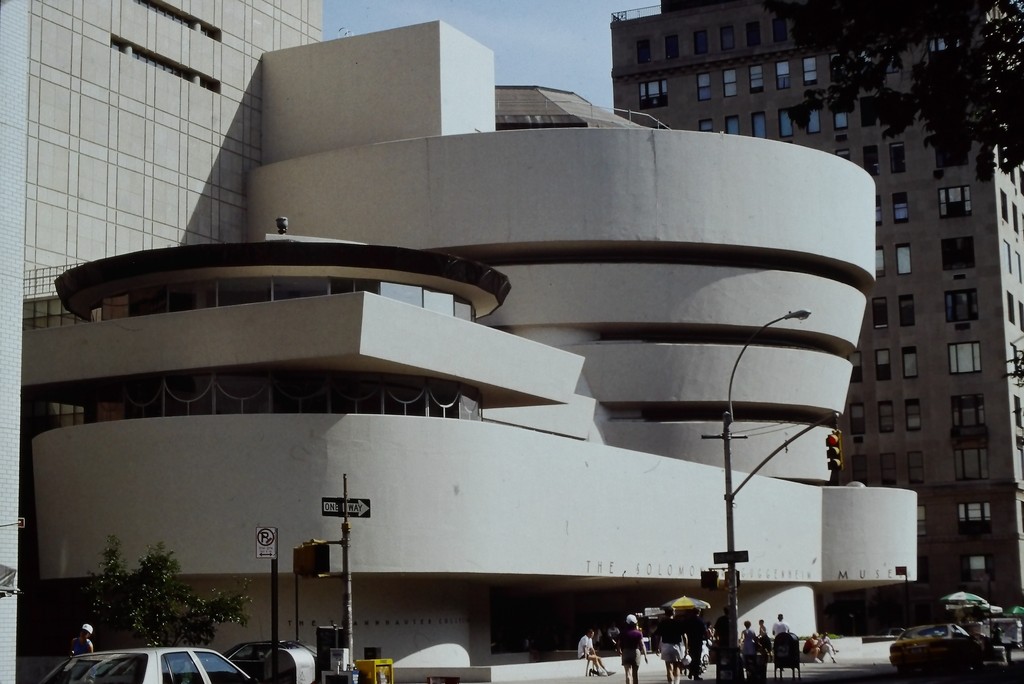
The Solomon R. Guggenheim Museum in New York, photographed in 1995. Untitled (1949) entered its collection through the 1978 Dannheisser gift.
Photograph: Bmzuckerman. Resized without cropping. [7]
The Dannheisser gift credit and accession 78.246 anchor the work in the Guggenheim collection.[1] They do not provide a full account of ownership before the gift. For that, Anfam's catalogue raisonné of canvases and museum archives should be checked directly. The currently accessible Guggenheim caption supports the title, year, medium, dimensions and gift credit; it does not itself grant rights to reproduce the painting.
The gift date in the accession, 1978, also matters for the painting's institutional history. It arrived in a museum that had organised a major Rothko retrospective in that year, but a gift credit does not by itself prove this particular canvas was displayed in that retrospective.[1][5] The Guggenheim later placed it in Art of Another Kind: International Abstraction and the Guggenheim, 1949–1960 in 2012.[1] That exhibition set Rothko among varied postwar approaches to abstraction and revisited a period when the museum's collection had been shaped by James Johnson Sweeney. This is a documented later curatorial setting, not a claim about Rothko's own intended neighbours for the canvas.
The National Gallery of Art's 1998 Rothko exhibition checklist supplies another dated public trace of this same Guggenheim object. It names the 1949 canvas with the long colour description and identifies the Dannheisser gift to the Guggenheim.[6] That checklist is useful because it connects title, year and institutional credit across two museums. It does not establish that every venue of the travelling 1998–99 retrospective installed this painting; a venue-specific checklist or installation view would be needed for that stronger claim. It also shows how a private gift can enter a later scholarly survey even when the exact pre-gift provenance remains to be researched.
How to read a descriptive title
The long title can be useful for finding the object, but it should not become a map in which each colour names one sharply bounded block. Guggenheim's interpretation stresses exchanges between hot and cold colour and between vertical and horizontal forces.[1] Those oppositions operate through relative size and placement, not just through the presence of six pigment names. One can compare the width of a dark band with the broader warm passages, then look at how the lighter ground remains visible around or between them. A screen reproduction may flatten those differences; the 207 cm height is part of what makes the colour areas bodily in a gallery.
The title's Untitled prefix also signals an editorial distinction. The colour words help differentiate this canvas in modern cataloguing, but they should not be assumed to be a sentence Rothko wrote on its reverse without inscription evidence. The Guggenheim's current name is the proper identifier for this page; the proposed Anfam hardback check may clarify whether the colour phrase appears in brackets, parentheses or an early exhibition list. The neighbouring 1949 MoMA and NGA works make that bibliographic precision necessary.[3]
The 1998 checklist presents the colour phrase in square brackets, whereas the Guggenheim's 2012 material sets it in parentheses.[1][6] The punctuation is not a new painting and does not prove a change by the artist. It is a sign that descriptive titles travel through different editorial systems. For a reader following an older book or image caption, accession 78.246, the 207 × 167.6 cm dimensions and the Dannheisser credit are more reliable matching points than whether the six colours sit in one form of bracket or another.
The work should be distinguished from MoMA's No. 3/No. 13, also from 1949. Both show Rothko refining a broad-field language, but they differ in title, dimensions, collection and exact colour arrangement. Likewise the NGA's 1949 Untitled is another object, not a second catalogue listing for Guggenheim 78.246.[3]
Looking questions
Follow the colour areas from the top of the canvas toward the bottom. Which interval seems most stable, and which changes as neighbouring tones come into view? Then ask how the white and red named in the title function as surrounding space rather than simply as additional “blocks.” The work's many colour terms can prompt looking, but the actual interaction among fields is what makes it specific. A small screen image can identify these relationships only in outline.
The Guggenheim caption carries a copyright notice for Rothko's heirs through Artists Rights Society.[1] This guide links to the museum material without copying the artwork. David Anfam's 1998 canvas catalogue remains a relevant bibliographic lead, but no entry number is claimed until a direct or reliably quoted reference is found.[4]
Related works
- No. 3/No. 13 is a separate 1949 MoMA canvas.
- White Center shows a 1950 development.
- Rothko's paintings explains the transition.
Rothko works in this guide
| Name | Date | Medium |
|---|---|---|
| Entrance to Subway | 1938 | Painting |
| Hierarchical Birds | 1944 | Painting |
| Slow Swirl at the Edge of the Sea | 1944 | Painting |
| No. 3/No. 13 | 1949 | Painting |
| Untitled (Violet, Black, Orange, Yellow on White and Red) | 1949 | Painting |
| White Center | 1950 | Painting |
| No. 10 | 1950 | Painting |
| No. 6 (Violet, Green and Red) | 1951 | Painting |
| Untitled | 1952 | Painting |
| No. 61 (Rust and Blue) | 1953 | Painting |
| No. 1 (Royal Red and Blue) | 1954 | Painting |
| Untitled (Yellow and Blue) | 1954 | Painting |
| Orange and Yellow | 1956 | Painting |
| Light Red over Black | 1957 | Painting |
| Four Darks in Red | 1958 | Painting |
| Black on Maroon | 1958 | Painting |
| No. 14 | 1960 | Painting |
| Orange, Red, Yellow | 1961 | Painting |
| Untitled (brown and gray) | 1969 | Painting |
| Untitled (Red on Red) | 1969 | Painting |
| Untitled (Black and Gray) | 1970 | Painting |
| Tentacles of Memory | 1945–46 | Drawing |
Frequently Asked Questions
This is the Guggenheim’s Untitled (Violet, Black, Orange, Yellow on White and Red), accession 78.246. It is an oil canvas measuring 207 × 167.6 cm, given by Elaine and Werner Dannheisser and the Dannheisser Foundation.[1]
No. The National Gallery of Art’s 1949 Untitled, accession 1986.43.138, is a different painting. The Guggenheim canvas’s descriptive title, dimensions and accession help keep the two objects distinct.[1][3]
The descriptive subtitle helps distinguish this painting from other untitled Rothkos. It names violet, black, orange, yellow, white and red, but naming the colours does not explain their proportions or interaction. The Guggenheim highlights tensions between warm and cool, and vertical and horizontal.[1]
Discussion
What changes when you look at Untitled (Violet, Black, Orange, Yellow on White and Red) as a physical painting rather than a small reproduction?
Use the questions below to compare the work with its neighbours in Rothko’s career.
Reader Insights
Which edge or interval asks you to slow down?
How does this painting differ from the earlier and later works linked here?
What remains uncertain after reading the museum record and looking closely?
Join the Conversation
Share an observation grounded in the work or its documented history.
References
- Solomon R. Guggenheim Museum, Art of Another Kind exhibition caption for Untitled (Violet, Black, Orange, Yellow on White and Red), accessed through the museum's indexed page; accession 78.246.
- National Gallery of Art, “Mark Rothko,” artist chronology.
- National Gallery of Art, separate Untitled, 1949, accession 1986.43.138.
- David Anfam, Mark Rothko: The Works on Canvas: A Catalogue Raisonné (National Gallery of Art and Yale University Press, 1998), bibliographic lead; entry not directly checked.
- Guggenheim, Rothko artist overview, including the museum's 1978 retrospective in the artist chronology.
- National Gallery of Art, 1998 Rothko exhibition checklist, listing the 1949 Guggenheim canvas and Dannheisser gift.
- Frank Lloyd Wright - New York, NY - Solomon R. Guggenheim Museum (L).jpg. Photograph: Bmzuckerman. Resized without cropping. Source · CC BY 4.0.