by Tom Gurney
Tom Gurney BSc (Hons) is an art history expert with over 20 years experience
Published on June 19, 2020 / Updated on October 11, 2026
Email: tomgurney1@gmail.com / Phone: +44 7429 011000
Rothko Chapel: Introduction
The Rothko Chapel is a place made through the meeting of painting, architecture, changing natural light and a public mission. Dominique and John de Menil commissioned Rothko in 1964 to create a sacred space in Houston. Rothko completed the fourteen-painting ensemble in 1967, died in 1970, and the Chapel opened in 1971.[1][2] Those fourteen works, rather than every study or alternate made during the commission, define the intended installation. The current display is temporarily incomplete: the Chapel says the East Triptych remains off-site for restoration after 2024 hurricane damage.[6] Their identity as a group is inseparable from the room, but a present-day visitor cannot assume that every panel is on its wall.
At a Glance
- LocationHouston, Texas [1]
- Commissioned1964 by John and Dominique de Menil [2]
- Paintings completed1967; fourteen-painting ensemble [1]
- Opened1971 [2]
Contents
- Fourteen paintings for one space
- The octagon and the arrangement of the paintings
- Founders, architects and purpose
- The 1964–71 sequence
- Conservation as evidence of making
- Hurricane Beryl and the current installation
- Broken Obelisk and the civic history of the site
- Morton Feldman’s Rothko Chapel
- Later artists and the Chapel’s continuing influence
- What scholars mean by a spiritual experience
- Books, catalogues and the different questions they address
- A historic building and a living institution
- How to encounter the paintings
- Further study
Fourteen paintings for one space
The Chapel's own history describes seven canvases with hard-edged black rectangles on maroon grounds and seven purple tonal paintings.[1] The installed ensemble has its own history within the larger project, which also included alternates and rejected studies. Rothko's later career included several commissions, yet this one reached the kind of purpose-built environment that the Seagram project never achieved.
The paintings can initially appear almost monochrome. Time in the room reveals shifts within maroon, purple and black and differences between edges. Natural light was important to Rothko, the Chapel notes, because it could disclose the nuances of the palette.[1] Such light also changes from hour to hour. A single photograph cannot reproduce the accumulated effect of all fourteen canvases, their spacing and the room's lighting. The installation brings those differences into relationships that no single representative panel can convey.
The Chapel's fact sheet gives a more precise accounting of the commission: fourteen paintings were designated for its walls, four alternates are stored at the Menil Collection, and two further paintings arrived with drawings and models from the Rothko Foundation in 1987 but had been rejected by the artist for the Chapel.[4] These three groups answer different questions. The intended fourteen describe the installation as conceived; the alternates and rejected works illuminate selection and revision. The fact sheet calls the first two groups eighteen paintings in total, then mentions the two rejected works separately. It would therefore be misleading to turn the Chapel into a twenty-painting installation or to present all twenty as equivalent final choices. The fact sheet predates the present conservation absence and cannot be used as a live display list.[6]
The same source records practical aspects of the making that are easy to lose in general descriptions of a dark room. It identifies oil paint on canvas and describes Rothko's preparation of pigments with binders, including rabbit-skin glue, egg-oil emulsion and polymer; it also mentions broad housepainter's brushes.[4] Those details establish a worked surface rather than an effortless monochrome field. They do not justify a recipe for any particular panel: a conservation report and individual catalogue entries would be needed before assigning a specific mixture or sequence to one canvas. The Chapel also says the canvases entered the finished building through its skylight.[4] Their scale and installation are part of the commission's material history.
The octagon and the arrangement of the paintings
The historic-place nomination describes an octagonal room whose main walls, corner walls and recessed north wall carry different arrangements. Three triptychs and five individual paintings make the fourteen-panel ensemble.[8]
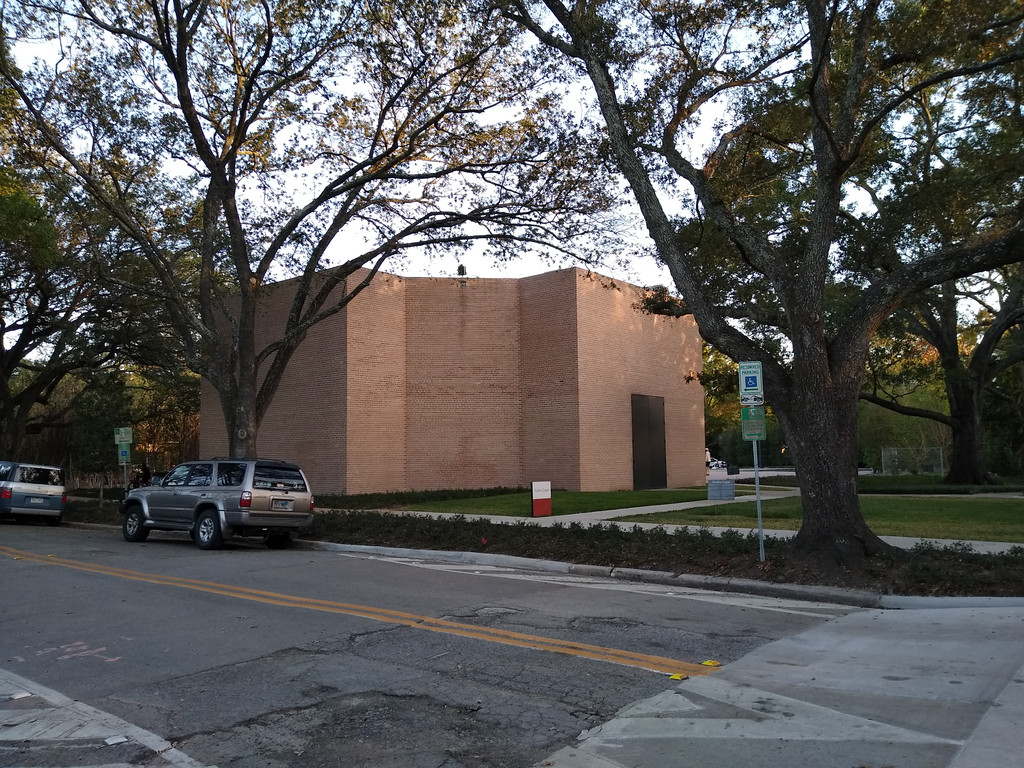
The Chapel’s brick exterior, photographed across a public street on 21 November 2020. Its enclosing walls provide context for the octagonal painted environment inside.
Photograph: WhisperToMe. [29]
| Position in the intended installation | Arrangement |
|---|---|
| North, in the recessed wall | Three tonal panels forming a triptych |
| East and west | A black-form triptych on each wall, with a taller central panel |
| South, at the entrance side | One black-form painting |
| Four diagonal walls | One tonal painting on each wall |
This plan gives the room several kinds of relationship. Opposite walls answer one another across a space occupied by the visitor. A triptych can be seen as a group and as three separate surfaces, while a single large canvas asks for a different distribution of attention. Turning changes which relation is most immediate. The room can never be taken in as one frontal image in the way that a reproduction presents an isolated painting.
The recess also matters. It places the northern group within a distinct architectural position, while the east–west groups establish another axis. The diagonal panels complicate a simple back-and-forth between two opposing walls. A viewer following the whole ensemble moves among these relationships, with the gaps, corners and changes in panel height remaining part of the experience.
The current absence of the East Triptych affects one of those relationships particularly clearly. The historical programme describes a pair of facing triptychs, but the complete visual exchange across that axis awaits the panels’ return.[6] Understanding the intended plan helps a visitor distinguish the present condition from the arrangement discussed in older scholarship.
Founders, architects and purpose
The project became a sacred space open beyond a single denomination. The Chapel names Philip Johnson, Howard Barnstone and Eugene Aubry among its architects.[1] Their collaboration and the later design changes shaped the room that now holds the paintings. The founders' interest in modern art and sacred architecture included visits to French projects connected with Matisse and Le Corbusier.[1][2] These are documented historical connections, not claims that Rothko copied their designs.
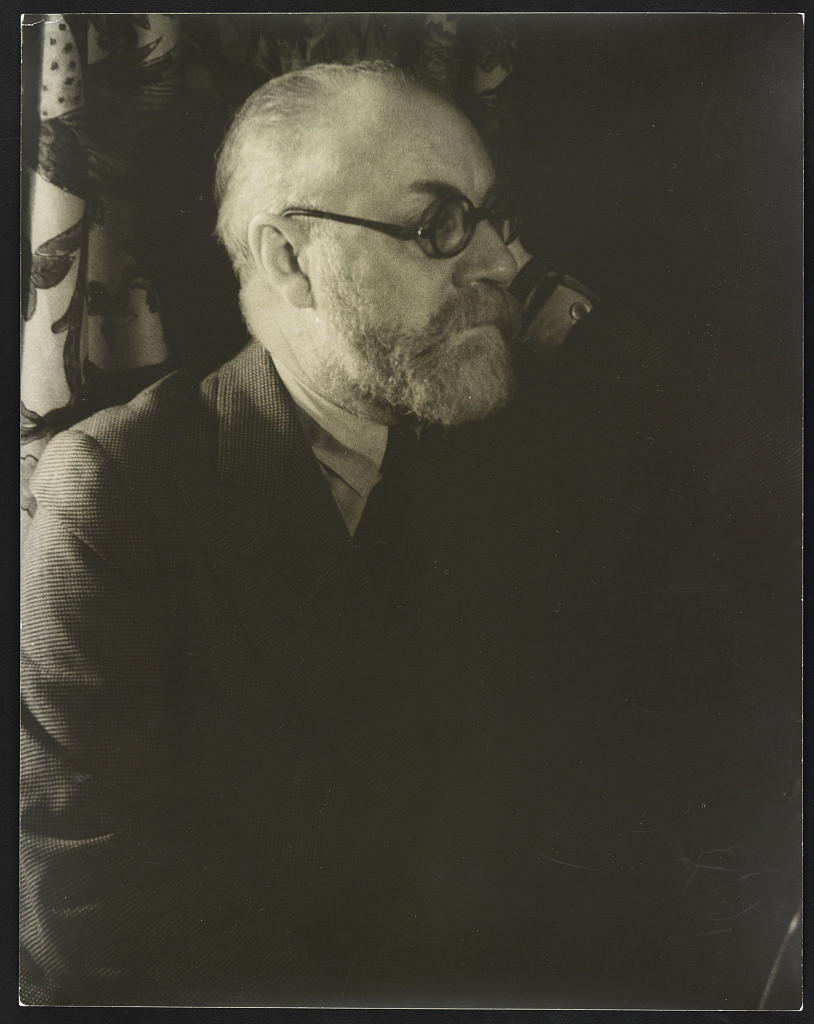
Henri Matisse, photographed on 20 May 1933. The Chapel’s institutional history places his French sacred-art project within the founders’ earlier journeys and interests.
Carl Van Vechten. Library of Congress, Prints & Photographs Division, Carl Van Vechten Collection, LC-DIG-ds-07636. [30]
The Chapel describes itself today as a spiritual space, a place for solitude and gathering, and a forum for dialogue and action.[1] This public mission has developed since its opening. Outside, Barnett Newman's Broken Obelisk stands above a reflecting pool and is dedicated to Martin Luther King Jr.[1] That work belongs to the Chapel's larger setting, but it is Newman's sculpture, not one of Rothko's fourteen paintings. The dedication and the Chapel's civil-rights programmes widen the meaning of the site beyond an art-only visit.
The institution is independent of the nearby Menil Collection, according to its fact sheet, although the de Menils founded both.[4] This distinction matters when describing ownership, visiting arrangements and the four alternates stored at the Menil. A shared founding history does not make the Chapel a gallery of the museum. The Chapel's use as a place for services by different religious communities likewise coexists with its art and civic programmes. Visitors need not adopt a particular faith to enter or interpret the paintings.[4]
The human-rights strand has a traceable history rather than being a modern caption added to an older artwork. The Chapel's timeline records its first Award for Commitment to Truth and Freedom in 1981, a visit by Desmond Tutu in 1986 and a visit by Nelson Mandela in 1991.[2] These events occurred after Rothko's death and should not be described as his programme. They do show how the founders and later stewards made the building a forum where contemplation and public advocacy meet. The timeline and current mission are the right evidence for that institutional story; the painted surfaces alone cannot prove it.
A memorial commission and an evolving sacred purpose
Frauke Josenhans’s 2021 account connects the commission to the death of the de Menils’ friend, curator Jermayne MacAgy, in 1964. A Catholic chapel associated with the University of St. Thomas developed into a space open beyond that original denomination. Josenhans also reads the three triptychs in relation to the history of Christian altarpieces, while emphasising the ensemble’s absence of a prescribed narrative.[9]
The change in purpose gives the history its particular complexity. The patrons brought a religious commitment; Rothko brought his practice as a painter and the ambition to shape a complete environment. The project acquired further institutional meanings as the building, organisation and programmes developed. Its openness was made through decisions over time and continues to be enacted through use.
French sacred art and a modern commission
The French background helps explain why the patrons sought a contemporary artist for a sacred building. In her authorised Oasis for Reflection excerpt, Pamela Smart places their ambitions within the renouveau catholique, whose advocates sought renewed engagement between Catholic life and the modern world. Marie-Alain Couturier was an important adviser in that history.[10]
Caitlin Turski Watson’s architectural study distinguishes the contributions of Couturier and Yves Congar: artistic and sensory renewal in one strand, ecumenical relationships in another. She traces how those concerns entered the project’s architecture and social purpose.[11] This provides a more specific background than the general claim that a rich collector wanted an impressive room. It locates the commission within a debate about how a modern building and modern art could participate in religious and public life.
The founders’ project as a subject of scholarship
Ryan Dohoney’s Saving Abstraction examines the relation between visual art, Feldman’s music and the de Menils’ religious ambitions. The accessible introduction argues that accounts treating the Chapel chiefly as secular or political can understate the role of religion in its early life. It also asks how abstraction, corporate wealth and spiritual renewal became entangled in this particular patronage.[12]
These questions keep the institution’s history in view alongside the paintings. How did a commission acquire its intended audience? Who supported the performances and gatherings? How did a space conceived for one kind of worship become available to others? Such questions do not diminish attention to colour or form. They explain the conditions in which the public encounter became possible.
The 1964–71 sequence
The commission began in 1964. The Chapel's account says Rothko completed the fourteen-painting suite in 1967 after more than two years of work.[1] A 1966 letter excerpted by the institution conveys the scale of the challenge as Rothko experienced it. The sequence runs from commission and making to completion, Rothko's death before installation, and the 1971 opening.[1][2]
The paintings were completed several years before the building opened. Rothko could test their relationships in the studio, but he never saw them installed in Houston. Later changes in light and building care form part of the work’s public history.
Light is an especially important part of that later history. The Chapel's fact sheet says that daytime illumination was intended to come from natural light, with artificial lighting used for evening programmes.[4] Subsequent building changes altered what viewers actually saw. In its restoration account, the institution describes a new skylight and the removal of an overhead baffle among interventions intended to improve daylight and the experience of the paintings.[5] A visitor's sense that the room is intimate and dark is therefore partly contingent on architecture and maintenance. It should not be projected backwards as an unchanged condition personally approved by Rothko in every detail.
The restoration also makes a useful distinction between care for a building and a claim about repainting the canvases. The Chapel's public report addresses lighting, an entrance vestibule and the building environment.[5] It does not, by itself, establish the treatment history of each canvas. Pigment change and previous intervention concern each painted object, while the architectural record explains the environment in which visitors encounter the ensemble. These histories meet in the room, but require different kinds of evidence.
Johnson, Barnstone and Aubry: a sequence of design
The National Register nomination dates Philip Johnson’s involvement to 1964–67, his withdrawal to November 1967, and Barnstone and Aubry’s subsequent work to the building’s completion in 1971. It records changes to siting and design, while recognising Johnson’s later consultation on the entrance and orientation.[8] Authorship is consequently distributed across a changing project, with Rothko’s decisions central to the collaboration.
The design dispute concerned the height of the space and how light would enter. The choice affected the paintings directly: a skylight could illuminate an entire ensemble, yet its shape and diffusion would influence where brightness accumulated. The painter’s New York studio and Houston’s daylight were different physical conditions. The architectural history makes that difference part of the problem the collaborators faced.
Smart’s excerpt describes a full-size mock-up of three walls in Rothko’s studio and a smaller model into which a viewer could place their head. She also follows the adjustments of stretchers and painted forms through accounts by assistants and other witnesses.[10] The room was therefore considered at several scales during the work’s making. A plan established geometry; the model tested the encompassing space; the studio arrangement brought full-size canvases into relation.
These methods illuminate a demanding kind of composition. Rothko had to consider what happened inside a panel and what happened between panels. A change in width, height or placement could affect a neighbouring work as well as the one revised. The commission required coordination among pictorial and architectural decisions, with the body of the future visitor part of the anticipated result.
The dedication as a lived event
Jack Tworkov’s journal of 1 March 1971 records the dedication weekend from the standpoint of an invited artist. He describes the evening service, the simple benches, the gathering of religious representatives and a return visit in daylight. He also recalls the dedication of Newman’s sculpture and encounters with the patrons and other guests.[13]
The entry includes a small correction to his own memory: an interrupted attempt to look at the paintings belonged to the next day, rather than the evening ceremony.[13] That detail makes the diary valuable as a situated account. Opening weekend combined close looking, public ritual, conversation and social arrangements. The subsequent image of a solitary visitor in silence describes one important use of the Chapel, while the first audience also experienced an active gathering.
Daylight after the 2019–20 restoration
Architecture Research Office describes replacing the central skylight with a new assembly designed to diffuse light and revising the visitor’s approach through the landscape. Its campus account separates completed Phase I work from proposed later elements, and relates the additional spaces to the Chapel’s public programmes.[15]
The lighting system has a more precise technical description in the Illuminating Engineering Society’s account. George Sexton Associates used louvers to distribute daylight. When daylight is insufficient, a photosensor activates concealed digital projectors that direct light towards the perimeter walls and paintings using suspended mirrors. Additional downlights serve general illumination and special events.[16]
The projectors here provide supplementary lighting. Harvard’s colour-compensation project uses projected images to counter the visible effects of pigment fading; that is a different intervention, explained in the paintings essay. The shared technology does not make the conservation purposes identical.
The skylight also changes the visitor’s relation to time. A room lit from above responds to the available daylight, while a system of diffusion and supplementary illumination moderates that response. Looking up and then returning to a panel can make the relation between source and painted surface easier to understand. Light remains a condition of seeing the work, with a documented history of design and adjustment.
Conservation as evidence of making
Carol Mancusi-Ungaro, a conservator who worked on the Chapel paintings for more than two decades, published an unusually direct account of why the surfaces' material structure matters.[7] She describes a whitish film that emerged on the black-form paintings within several years of the 1971 installation. Her team worked with one of Rothko's assistants to reconstruct aspects of the paint mixture and commissioned scientific analysis. The investigation linked the exudate to fatty acids from the egg-containing medium, rather than to an intentional pale rectangle. This is a case study of the Chapel's black-form works, not a formula to assign automatically to all Rothko canvases.
The conservator's more striking finding concerned planning. Graphite drawings on black paper supplied by the Rothko Foundation matched changes visible in the whitening patterns. They helped relate successive adjustments of the painted rectangles to the condition seen years later.[7] In other words, conservation did more than identify materials or remove an unwanted film: it revealed that the forms had been revised. Mancusi-Ungaro also notes how shifts in reflectivity, including the contrast between matte and glossier passages, can carry differences that a colour label misses. The fact sheet's simple “oil on canvas” designation remains useful as a summary, but the technical account explains why a single medium line cannot describe every surface effect.
The history of treatment also cautions against treating a photograph as an unchanging record of the artist's final appearance. Lighting, paint ageing and conservation decisions interact. A historical image can document a condition at a date; it cannot alone settle which passages were original intention, later change or treatment. The published scientific and documentary inquiry gives a better basis for that discussion than speculation from a web reproduction.
Hurricane Beryl and the current installation
The Chapel's conservation notice says that Hurricane Beryl brought a roof leak in July 2024, damaging parts of the building and four of Rothko's panels.[6] The institution closed through December 2024 and reopened on 17 December without the East Triptych. Its current notice says those three panels remain at an off-site conservation facility, with no announced return date. It also records the support of the Museum of Fine Arts, Houston, and the Menil Collection during assessment and restoration. This is a distinct conservation event from the earlier whitening investigation and from the 2019–20 building and light improvements.
For a visitor, the difference is practical and interpretive. The fourteen-panel programme still defines the work historically, but the current room cannot yet offer the complete arrangement that older descriptions assume. The absence is also evidence of the stewardship required by a permanent installation in a vulnerable physical building. The Chapel's own conservation page is the authoritative place to check the triptych's return before travelling; this article records the position as of October 2026 and does not predict a date.
Broken Obelisk and the civic history of the site
The Menil Collection’s archival essay on the unrealised Dream Monuments project places Broken Obelisk within a wider effort to bring ambitious contemporary art into Houston’s public spaces. It describes the de Menils’ proposed dedication to Martin Luther King Jr. near City Hall, the failure of that plan in 1969, and their eventual private purchase for the Chapel site. The dedication was the patrons’ choice rather than Newman’s original subject for the sculpture.[14]
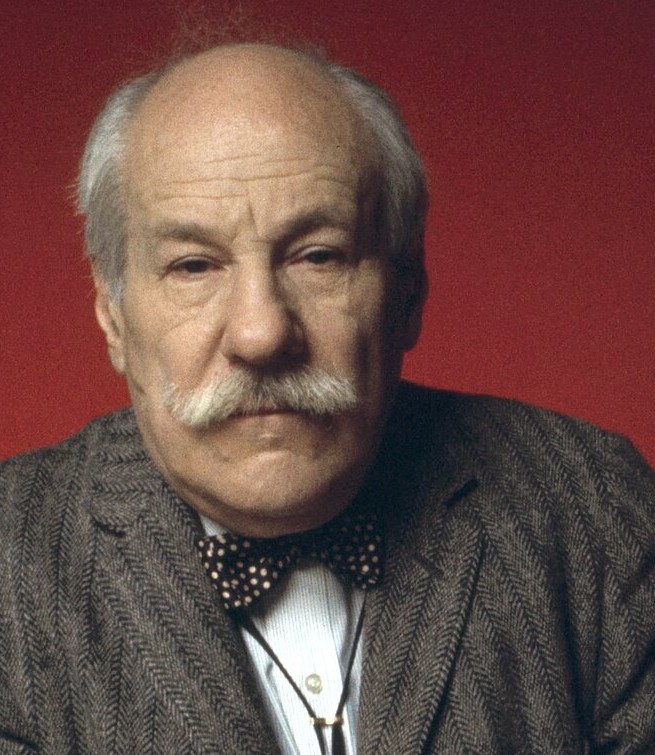
Barnett Newman, circa 1969, in a later portrait detail. His Broken Obelisk acquired its Martin Luther King Jr. dedication through the de Menils’ decision to place it at the Chapel.
Library of Congress, Prints & Photographs Division. Photograph: Bernard Gotfryd. Faithful portrait crop; no retouching or colour changes. [31]
That sequence helps explain why the outdoor work carries a civic meaning alongside its form. Its inversion and precarious meeting of obelisk and pyramid belong to Newman’s sculpture; the King dedication belongs to a particular history of placement and commemoration. Both can be encountered in the same object without being treated as identical acts of authorship.
The relation to the Chapel is also spatial. The pool and sculpture give the visitor something to approach before entering the painted room and something to encounter again on leaving. Turning between those places changes the scale and character of attention. The site joins distinct works and meanings within one public visit.
Morton Feldman’s Rothko Chapel
Feldman’s composition is among the most significant artistic responses to the building. Written in 1971, it was first performed at the Chapel on 9 April 1972, according to IRCAM’s work record. The forces include soprano, contralto, mixed choir, viola, celesta and percussion.[18] The music followed the opening of the building and Rothko’s death; it did not accompany the artist’s process as a finished score.
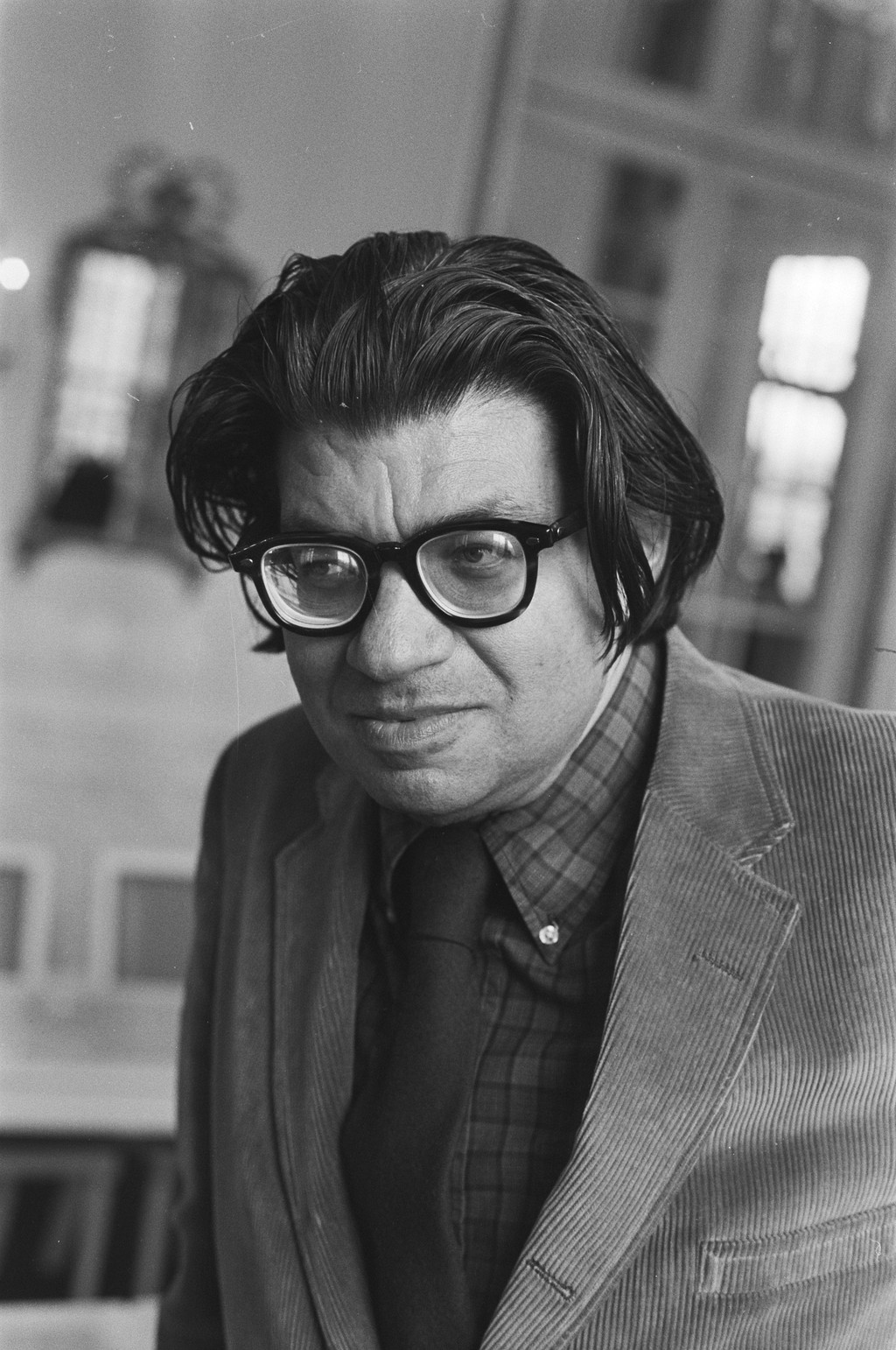
Morton Feldman at a Holland Festival press conference in Amsterdam’s Concertgebouw, 31 May 1976, four years after the Houston premiere of Rothko Chapel.
Photograph: Rob Bogaerts / Anefo. Nationaal Archief, 2.24.01.05, 928-6142. [32]
In his programme note, Feldman says that the room and paintings affected his choices of force, balance and timbre. He sought a sound that could fill the octagonal space rather than be heard as coming from a distant stage. He also explains why contrasting sections were needed to sustain in music the continuity he perceived in the paintings.[17]
The note identifies several personal musical references, including a viola melody he had written as a teenager and a soprano phrase composed on the day of Stravinsky’s funeral. Feldman describes the ending’s lyrical character and the work’s largely merged sections.[17] These details give the composition its own history. Its response to the paintings passes through the composer’s memories and musical decisions.
Hearing the work can open another approach to the ensemble. A sound unfolds in time and cannot be revisited instantly in the way the eye can return to a painted field. A choir also distributes human presence through a room. The comparison can attend to duration, proximity and changes in attention, allowing each art to retain its particular means.
Dohoney’s introduction emphasises this point: the music’s relation to the Chapel concerns a produced atmosphere rather than a direct translation of each panel into sound.[12] Listening therefore adds an interpretation and an encounter. It does not supply a code by which a musical phrase explains the meaning of one canvas.
Later artists and the Chapel’s continuing influence
Rice in 1975 and 2021
The Moody Center’s 2021 Artists and the Rothko Chapel: 50 Years of Inspiration exhibition returned to Harris Rosenstein’s 1975 Marden, Novros, Rothko: Painting in the Age of Actuality, supported by Dominique de Menil. The later presentation reunited works by Brice Marden and David Novros and brought them into a second section with Sam Gilliam, Sheila Hicks, Shirazeh Houshiary and Byron Kim. Its completed exhibition record gives the dates as 23 February–15 May 2021.[19]
This exhibition history gives influence a specific form. The Chapel becomes an occasion for other artists to make decisions about colour, material, space and attention. The resulting works can differ greatly from Rothko’s own. Following that difference is more revealing than searching only for paintings with similar rectangles.
Paint, architecture, fibre and movement
The Moody’s announcement connects Marden’s The Seasons with his experience of the Chapel and describes Novros’s 3 Rooms as an inquiry into painting and architecture. Gilliam’s watercolour brought a different handling and relationship to civil-rights history, while Hicks’s The Questioning Column used fibre outdoors. Works by Houshiary and Kim extended the discussion through other approaches to perception, movement and the night sky.[20]
The variety changes the question of legacy. One artist might respond to the organisation of a room, another to the public mission, another to colour encountered over time. The connection can survive a change of medium. An architectural arrangement and a fibre construction need not look alike to ask related questions about how a work occupies shared space.
Artists interpreting the experience
Christopher Rothko’s foreword to the 2021 catalogue reflects on the later exhibition’s widening of the original conversation. It brings additional artistic voices and approaches into a history once framed by a smaller group. In the same accessible catalogue selection, Shirazeh Houshiary’s essay “Breath” considers the tension at the edges of Rothko’s fields and connects her own thinking to movement, change and the relation between sensation and knowledge.[21]
Her account belongs to a later artist’s practice and interpretation. It shows how an experience of Rothko can become a point of departure for another kind of work. The catalogue’s artist writings and interviews complement historical scholarship by asking what the Chapel made possible for subsequent makers.[21]
What scholars mean by a spiritual experience
The word spiritual appears frequently in discussions of the Chapel, but it can describe different claims. It may refer to the founders’ religious purpose, a visitor’s reported experience, a philosophical account of transcendence, or the institution’s interfaith activity. Identifying which claim is being made gives the discussion greater precision.
Stoker: transcendence and the visitor’s history
Wessel Stoker’s 2008 article tests interpretations of the paintings through religious aesthetics. He questions a straightforward Stations of the Cross account of the fourteen canvases, because the arrangement does not establish that linear narrative. He also asks how a visitor’s historical and religious understanding contributes to an experience of transcendence. His own discussion includes an explicitly Christian perspective and Kierkegaard’s idea of repetition.[22]
The argument places limits on an easy claim that everyone encounters the same universal religious message. A shared room may be experienced by people with different memories, commitments and habits of attention. Stoker’s interpretation gives those differences a role in the encounter, while leaving the paintings’ relative openness important to what happens there.[22]
Christensen: an encounter that requires participation
Ruth Christensen’s 2017 RIHA Journal study examines the interaction between the painting and the person looking. Drawing on phenomenological ideas of presence and performance, she considers how the Chapel works involve bodily attention and active contemplation. The article also recognises limitations and paradoxes in the attempt to draw meaning from paintings that can appear dark and inaccessible.[23]
This is a useful account of experience as something developed in an encounter. Time spent looking, the position of the body and the viewer’s awareness of the room become part of the inquiry. The article offers a philosophical interpretation of those conditions; it does not establish that every visit must culminate in revelation.[23]
A Dutch debate about Jewish identity and abstraction
Jos Pouls’s 2017 Dutch essay in Streven, preserved by DBNL, reviews religious interpretations of Rothko and the Chapel. He finds simple explanations connecting Jewish identity directly to an alleged ban on images insufficient, pointing to the long figurative phase and the variety of Jewish artistic practice. His discussion also considers Cohen-Solal’s biographical emphasis on the artist’s Jewish background.[24]
The distinction matters because biography, iconography and religious experience ask different questions. An artist’s cultural identity may be central to a life without supplying a fixed meaning for every rectangle. A religious association can be compelling to a viewer without establishing the painter’s intended symbol. Reading these arguments alongside the actual figurative and abstract works makes the debate more exact.
Architecture and the people sharing it
Watson’s Common Ground proposes a relationship between the intimacy of scale, the shared experience of light and the Chapel’s social mission. Her account treats architecture as a participant in the encounter among visitors, drawing on ideas of bodily perception and mutual receptivity.[11]
This turns attention from an isolated person towards the people who share the space. One can sit alone while remaining aware of others. A public gathering can alter the room’s atmosphere while the paintings continue to occupy its walls. These are different situations through which the institution’s combination of contemplation and action becomes a lived practice.
Books, catalogues and the different questions they address
Sheldon Nodelman’s The Rothko Chapel Paintings: Origins, Structure, Meaning (1997) is a major sustained study of the installation. Its published contents proceed through the commission, architectural and pictorial programmes, chromatic organisation, axes of the room and relationships among the groups of panels.[25] This structure identifies why a study of the Chapel must consider an ensemble as well as individual canvases.
Susan J. Barnes’s The Rothko Chapel: An Act of Faith appeared in 1989; the Smithsonian record identifies that 126-page edition.[26] It is a key historical reading lead beside the later installation study. Pamela Smart’s Sacred Modern examines faith, activism, aesthetics and institutional practice in the Menil Collection through an ethnographic approach.[27] Its scope extends beyond the Chapel and provides a route into the founders’ larger cultural project.
The authorised excerpt from Smart and Stephen Fox’s Rothko Chapel: An Oasis for Reflection adds an accessible discussion of the room’s making and atmosphere.[10] Dohoney’s Saving Abstraction opens a musicological and religious history; the Moody catalogue supplies artists’ responses and a later exhibition context. Anfam’s Works on Canvas remains relevant to the individual canvases.[3] These books have different purposes, so a useful reading sequence can begin with the question that matters most: object identity, design, patronage, listening or the experience of looking.
The library records and publisher descriptions used here establish the scope of books whose full text has not been accessed. The detailed discussion of the open studies and authorised excerpts rests on the material actually available. Their reference entries make that distinction explicit.
A historic building and a living institution
The 2000 National Register nomination argues for the Chapel’s importance through modern art and architecture, and through its association with the de Menils’ social and cultural activity. It treats the building as the centre of a cultural institution.[8] Historic recognition records an argument about significance; stewardship continues through the building’s everyday use and care.
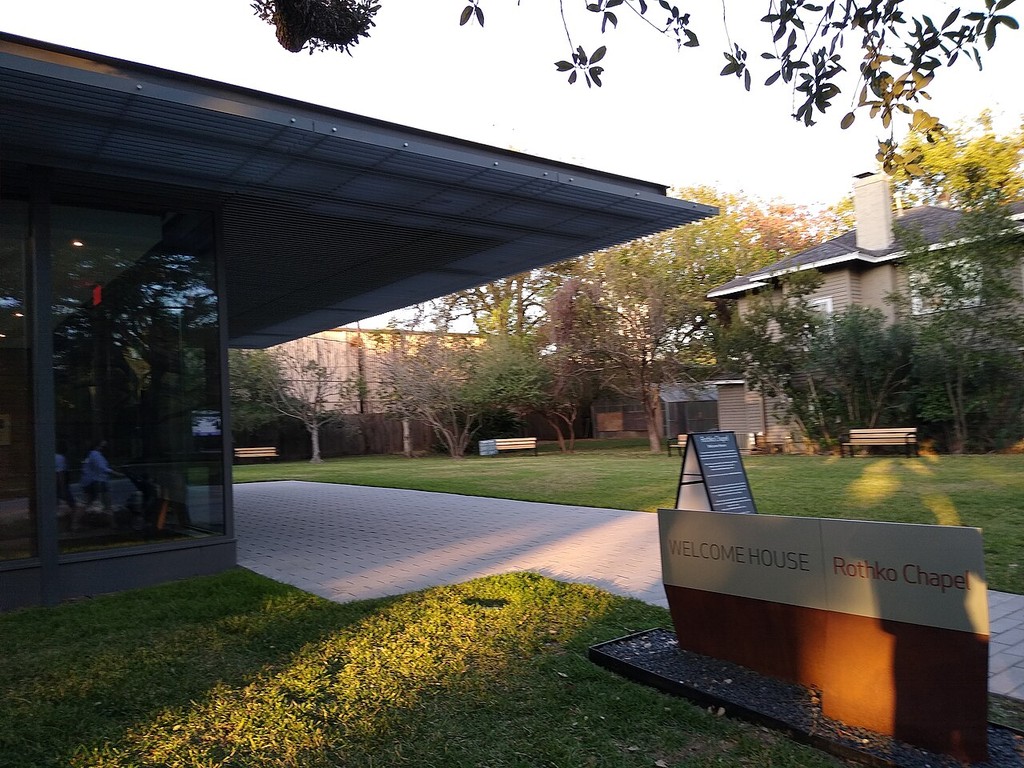
The Rothko Chapel’s Suzanne Deal Booth Welcome House in 2020, across Sul Ross Street from the Chapel. The building provides a separate setting for visitor orientation.
Photograph: WhisperToMe. Resized without cropping. [33]
The Chapel’s completed 55th-anniversary programme in February 2026 provides one recent example. It combined remarks and meditation in the sanctuary, music in the Reflection Garden, children’s readings in the Welcome House and access to archival ephemera.[28] Activities extended across the campus rather than requiring every public function to take place among the paintings.
That distribution gives the institution room to sustain different kinds of encounter. A quiet visit, a musical performance, a family activity and a historical display each bring people into relation with the site in a distinct way. The fourteen paintings remain the central artistic ensemble, while the public life around them continues to develop.
How to encounter the paintings
The ensemble encourages slow looking. A visitor may first register dark surfaces and then perceive differences in temperature, reflection and edge. Compare one wall with another before trying to assign a symbol to each canvas. The paintings were made to work with the whole space, so an isolated reproduction gives only partial information. The room is also a living place of reflection; its current visiting guidance should be followed rather than assuming the conditions of a museum gallery.
Rothko's sombre Chapel palette should not be treated as a simple forecast of his death. The commission was accepted while he was an established artist, and the paintings responded to a site, patrons and a demanding spatial problem.[1] Interpreting them through form, light and purpose yields a stronger account than a one-line biographical explanation. The 1958 Seagram project provides a useful comparison of an unrealised environment, while the Phillips Rothko Room[34] offers another, smaller installation context.
A slow visit can proceed from the room to the individual walls and back. First notice how the wall arrangements and the gaps between canvases affect your attention. Then compare the black forms on maroon grounds with the purple tonal works, allowing time for distinctions to emerge as your eyes adjust. Finally consider how the central light and the darkened surfaces alter each other. This is a viewing method, not a claim to decode a fixed message hidden in every painting. The Chapel's own fact sheet says Rothko did not explain the colours or supply a single authoritative meaning for the ensemble.[4]
For study at a distance, begin with the Chapel's historical account and fact sheet, then check its current conservation and visitor information if planning a trip.[4][6] Photographs can clarify the octagonal arrangement and the scale of the canvases, but exposure, colour balance and the moment of daylight can strongly change their appearance. A reproduced panel is also detached from the neighbouring canvases and from the silence or activity of the space. The installation’s changing light and relationships among walls are therefore central to studying the works together.
Further study
The Chapel’s own records provide photographs, historical documents and updates on the installation. Its painting ensemble can be followed through the scholarly books and studies listed below. For the individual canvas entries in Anfam, the catalogue itself remains the next source to consult.[3]
Related works
- The Seagram Murals were intended for a restaurant and later withdrawn.
- Rothko's biography places the Chapel commission in his life.
- Rothko's paintings traces the changing scale of his work.
Rothko works in this guide
| Name | Date | Medium |
|---|---|---|
| Entrance to Subway | 1938 | Painting |
| Hierarchical Birds | 1944 | Painting |
| Slow Swirl at the Edge of the Sea | 1944 | Painting |
| No. 3/No. 13 | 1949 | Painting |
| Untitled (Violet, Black, Orange, Yellow on White and Red) | 1949 | Painting |
| White Center | 1950 | Painting |
| No. 10 | 1950 | Painting |
| No. 6 (Violet, Green and Red) | 1951 | Painting |
| Untitled | 1952 | Painting |
| No. 61 (Rust and Blue) | 1953 | Painting |
| No. 1 (Royal Red and Blue) | 1954 | Painting |
| Untitled (Yellow and Blue) | 1954 | Painting |
| Orange and Yellow | 1956 | Painting |
| Light Red over Black | 1957 | Painting |
| Four Darks in Red | 1958 | Painting |
| Black on Maroon | 1958 | Painting |
| No. 14 | 1960 | Painting |
| Orange, Red, Yellow | 1961 | Painting |
| Untitled (brown and gray) | 1969 | Painting |
| Untitled (Red on Red) | 1969 | Painting |
| Untitled (Black and Gray) | 1970 | Painting |
| Tentacles of Memory | 1945–46 | Drawing |
Frequently Asked Questions
It is a dedicated space in Houston that brings Rothko’s paintings together with architecture, natural light and a public spiritual and civic mission. John and Dominique de Menil commissioned it in 1964. Rothko completed the intended fourteen-painting ensemble in 1967; the Chapel opened in 1971, after his death.[1][2]
The intended octagonal installation contains three triptychs and five individual canvases. The north, east and west walls each carry a triptych, while the remaining paintings occupy the entrance wall and diagonal walls. Those groupings create relationships across the room as a visitor turns and moves.[8]
No. The ensemble includes seven black-form paintings on maroon grounds and seven purple tonal paintings. Their surfaces can initially appear almost monochrome, but changing natural light and sustained attention reveal differences in tone, density and edges.[1]
The Chapel developed as a sacred space open beyond a single denomination. Its contemplative use coexists with gatherings, artistic programmes and human-rights activity. It is an independent institution, although it shares the de Menils’ founding history with the nearby Menil Collection.[1][4]
Discussion
Which documented work or source changed your understanding of Rothko Chapel?
Reader Insights
Begin with a specific work, title and date.
Compare the object record with this career guide.
What still needs a catalogue or archive check?
Join the Conversation
Share an observation grounded in the work or its history.
References
- Rothko Chapel, “About” and institutional history.
- Rothko Chapel, historical timeline.
- David Anfam, Mark Rothko: The Works on Canvas: A Catalogue Raisonné (National Gallery of Art and Yale University Press, 1998), relevant canvas catalogue; individual Chapel entries not directly checked.
- Rothko Chapel, institutional fact sheet, especially pages 3 and 5 for the painting count, materials, building and institutional status.
- Rothko Chapel, restoration and reopening account, for skylight, baffle and entrance work; its prospective reopening date is not used here as an actual completion date.
- Rothko Chapel, “Conservation Efforts”, current institutional notice on 2024 storm damage and the East Triptych's off-site restoration, checked October 2026.
- Carol Mancusi-Ungaro, “Material and Method in Modern Art: A Collaborative Challenge,” Scientific Examination of Art (National Academies Press, 2005), pp. 153–56, first-person Chapel conservation account.
- Stephen Fox, Rothko Chapel National Register of Historic Places nomination (2000), Texas Historical Commission, physical description, design chronology and statement of significance; full nomination consulted.
- Frauke V. Josenhans, “Artists and the Rothko Chapel: 50 Years of Inspiration,” Yale University Press, 15 September 2021, curator’s account of the commission and religious references.
- Pamela G. Smart, “Atmospheric Pressure,” authorised excerpt at Pace Gallery, 23 February 2021, from Rothko Chapel: An Oasis for Reflection, by Smart and Stephen Fox (Rizzoli Electa, 2021); excerpt consulted.
- Caitlin Turski Watson, “Common Ground: The Rothko Chapel and Architectural Activism,” ACSA Fall Conference proceedings (2017), pp. 5–8, full conference paper consulted.
- Ryan Dohoney, Saving Abstraction: Morton Feldman, the de Menils, and the Rothko Chapel (Oxford University Press, 2019), authorised preview, introduction pp. 1–10 and contents consulted; later chapters not accessed.
- Jack Tworkov Estate, journal entry of 1 March 1971, published 27 February 2021, account of the dedication and following day, with archival images and editorial notes.
- Menil Collection, “Monumental Dreams: A Story for Houston, ca. 1969”, archival essay, especially the discussion of Broken Obelisk and the proposed City Hall placement.
- Architecture Research Office, A New Campus for the Rothko Chapel, design-team account of the skylight, landscape and phased campus plan.
- Illuminating Engineering Society, “How They Did It: Rothko Chapel, Houston,” 14 April 2022, George Sexton Associates’ daylight and supplementary lighting system.
- Universal Edition, Morton Feldman, Rothko Chapel (1971), work record and composer’s programme note in Milestones for Orchestra 1945–2000, printed pp. 18–19; programme note consulted.
- IRCAM, The Rothko Chapel, work record and French programme note, 1971 composition and 9 April 1972 premiere in Houston.
- Moody Center for the Arts, Artists and the Rothko Chapel: 50 Years of Inspiration, 23 February–15 May 2021, completed exhibition record, historical section and participants.
- Moody Center for the Arts, 2021 exhibition announcement, descriptions of works by Marden, Novros, Gilliam, Hicks, Houshiary and Kim; dates taken from the completed exhibition record, not the advance announcement.
- Frauke V. Josenhans, ed., Artists and the Rothko Chapel: 50 Years of Inspiration (2021), authorised catalogue excerpts, Christopher Rothko’s foreword, pp. 6–9, Sam Gilliam conversation excerpt, and Shirazeh Houshiary’s “Breath,” pp. 96–97; six-page excerpt consulted.
- Wessel Stoker, “The Rothko Chapel Paintings and the ‘Urgency of the Transcendent Experience’,” International Journal for Philosophy of Religion 64 (2008), pp. 89–102, full open-access article consulted.
- Ruth Christensen, “Mark Rothko: Art as an Experience. The Significance of Interaction between Painting and Viewer in the Rothko Chapel,” RIHA Journal 0183 (15 December 2017), full open-access article held by the German National Library.
- Jos Pouls, “‘Near to Nothingness’: De Rothko-kapel in Houston,” Streven 84 (2017), pp. 125–34, DBNL, Dutch essay, especially the critique of single-cause religious interpretations.
- Canadian Centre for Architecture, library record and contents for Sheldon Nodelman, The Rothko Chapel Paintings: Origins, Structure, Meaning (1997), bibliographic and contents access; full book not consulted.
- Smithsonian Libraries and Archives, Susan J. Barnes, The Rothko Chapel: An Act of Faith (1989), 126-page edition, bibliographic record; full book not consulted.
- University of Texas Press, Pamela G. Smart, Sacred Modern: Faith, Activism, and Aesthetics in the Menil Collection, publisher’s description and contents; full book not consulted.
- Rothko Chapel, completed programme for its 55th anniversary, 28 February 2026, example of contemplative, musical, family and archival activities across the campus.
- Rothko Chapel exterior from across the street, 2020. Photograph: WhisperToMe. Source · CC0 1.0.
- Portrait of Henri Matisse. Carl Van Vechten. Library of Congress, Prints & Photographs Division, Carl Van Vechten Collection, LC-DIG-ds-07636. Source · Public domain; LOC collection policy.
- Newman Barnett.jpg. Library of Congress, Prints & Photographs Division. Photograph: Bernard Gotfryd. Faithful portrait crop; no retouching or colour changes. Source · Public domain; LOC donor release.
- Morton Feldman at Holland Festival press conference. Photograph: Rob Bogaerts / Anefo. Nationaal Archief, 2.24.01.05, 928-6142. Source · CC0 1.0.
- Rothko Chapel Welcome House A.jpg. Photograph: WhisperToMe. Resized without cropping. Source · CC0.
- Phillips Rothko Room.