by Tom Gurney
Tom Gurney BSc (Hons) is an art history expert with over 20 years experience
Published on June 19, 2020 / Updated on October 11, 2026
Email: tomgurney1@gmail.com / Phone: +44 7429 011000
Untitled (1952): Introduction
The work on this route is the tall Untitled oil canvas signed and dated 1952 on its reverse, offered by Christie's in 2014. It measures 261.6 × 158.7 cm.[1] Many Rothko paintings are untitled, so date alone is not a sufficient identifier. The signed reverse, dimensions, Christie's lot record and David Anfam catalogue citation—no. 480, page 365, as quoted by the auction house—identify this particular object.[1]
At a Glance
- ArtistMark Rothko
- Date1952 [1]
- MediumOil on canvas [1]
- Dimensions261.6 × 158.7 cm [1]
- CollectionPrivate collection (2014) [1]
This work in Rothko’s career
Contents
- A large 1952 canvas
- Provenance and exhibitions
- The studio context, with its evidential limits
- What the catalogue citation establishes
A large 1952 canvas
By 1952 Rothko had established the mature arrangement of broad, soft-edged colour fields that the National Gallery of Art dates to around 1950.[2] This painting is over 2.6 metres high, so the relation of its coloured areas is bodily as well as optical. The canvas can be described through its proportions and changing edges, but a printed or digital image reduces its scale severely. Looking at the auction record is useful for identification; it is not a replacement for encountering a work this large.
The year places it near the beginning of Rothko's sustained mature period. It is instructive to compare a 1950 canvas such as White Center with this 1952 Untitled: the same general language of broad colour does not make their ratios, tonal weights or histories identical. Such comparisons should follow the object facts rather than assuming a numbered sequence or a shared commission.
Provenance and exhibitions
Christie's published provenance begins with the artist's estate, then Marlborough, then Mr. and Mrs. Michael Klebanoff of Palm Beach, followed by an owner who acquired it from them.[1] The sale record gives a chain as the auction house knew it in 2014. It does not establish current ownership, so this page does not describe the painting as belonging to a named private collector today.
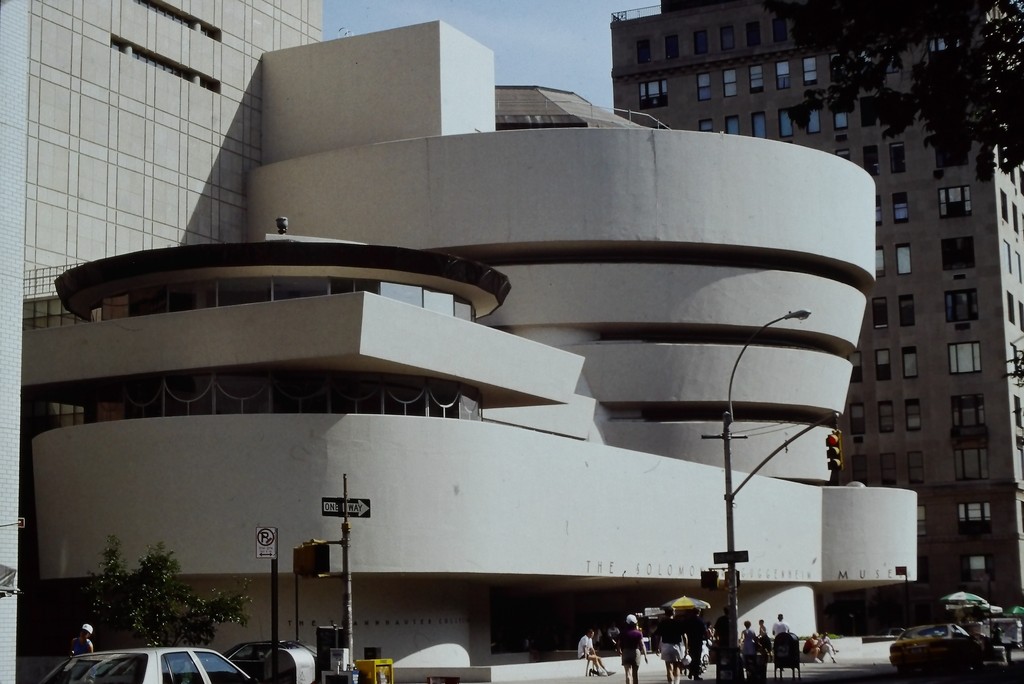
The Guggenheim Museum’s New York exterior in 1995. The museum presented the 1978 retrospective in which this 1952 canvas was exhibited.
Photograph: Bmzuckerman. Resized without cropping. [4]
The record lists the large 1978–79 Rothko retrospective that travelled from the Guggenheim in New York to Houston, Minneapolis and Los Angeles.[1] This exhibition history places the painting among works selected for a major reassessment of Rothko's career after his death. It does not tell us how each venue installed it; such details would require the exhibition archives or installation photographs.
The studio context, with its evidential limits
Christie's catalogue essay places the painting in the year Rothko moved to a larger studio at 106 West 53rd Street, close to MoMA.[1] The account describes higher ceilings and a distinctive floor through which light rose from the glass business below. This is a useful account of the setting in which larger canvases became possible, but the lot record does not document the exact day or room in which this canvas was painted. The chronology therefore supports a question about scale and working conditions, not a claim that the unusual studio light determined the precise hues of Untitled.
The auction essay characterises the two dominant areas as materially different: one softer and less solid, the other denser, with a blue lower passage.[1] This is more object-specific than a formula about Rothko's general use of rectangles. It invites the viewer to ask whether the upper and lower regions seem to occupy the same depth, and how the narrower border passages mediate their contrast. These are observations to test against the work, rather than a requirement to read the canvas as a literal earth and sky. The 1952 format, with its unusual height-to-width ratio, is essential to this visual pressure.
Christie's further describes three principal rectangular passages made with differing mixtures and brushwork.[1] The essay cites studio assistant Dan Rice's later recollection that Rothko used high-grade Bocour oil paint thinned with turpentine. That is testimony about his general studio practice, transmitted through an auction essay; it is not a pigment analysis or recipe for this individual canvas. Still, the testimony points the viewer toward a real material question. Thin paint can make the ground register through a field, while a denser application can hold the eye nearer the surface. The long canvas makes those changes in apparent depth especially noticeable as one reads downward rather than taking in the image as a small square on a screen.
The retrospective itinerary also invites a more exact question about scale. Christie's lists four venues between October 1978 and September 1979: the Guggenheim in New York, the Museum of Fine Arts, Houston, the Walker Art Center in Minneapolis and the Los Angeles County Museum of Art.[1] The same 1952 canvas entered four different architectural settings. Without installation photographs one cannot describe the wall or lighting at each stop, but the sequence demonstrates that its historical reception was shaped by more than one museum presentation. It makes the 2014 sale a later chapter in an already documented exhibition life.
What the catalogue citation establishes
Christie's literature section cites David Anfam's Mark Rothko: The Works on Canvas (1998), page 365, catalogue number 480.[1] This is an indirect but precise reference to the requested scholarly book. It supports the object's identification in the published catalogue. The individual entry has not been read directly, so this guide does not borrow undocumented analysis, a quotation or a catalogue-specific provenance claim. A photograph of page 365 could confirm the entry's wording and any variant title.
The auction essay is a seller's interpretation and can be read alongside museum accounts of Rothko's development. It should not become the only authority on the painting's meaning. A useful first question is how the large format sets up relations among the fields and the surrounding ground. The degree of softness at a boundary can make one colour seem to hover or retreat, changing the apparent depth of the surface.
Christie's image of the canvas is protected and is linked for readers rather than copied into this guide. The local artwork directory uses a neutral card, keeping the object's identity clear without implying rights to reproduce it.
Christie's post-sale record supplies one further dated chapter. It identifies this 1952 Untitled as lot 31 in its 13 May 2014 New York evening auction and reports $66,245,000 including buyer's premium.[3] The lot number, date, oil-on-canvas medium and 1952 identification link the result to the catalogue used above. This is a price from a particular transaction, not an estimate of present worth or evidence of a new owner today. The older retrospective and provenance records remain necessary to understand how the canvas reached that auction after decades in private hands.
Related works
- White Center is a 1950 comparison.
- No. 61 (Rust and Blue) follows in 1953.
- Rothko's paintings sets out the mature period.
Rothko works in this guide
| Name | Date | Medium |
|---|---|---|
| Entrance to Subway | 1938 | Painting |
| Hierarchical Birds | 1944 | Painting |
| Slow Swirl at the Edge of the Sea | 1944 | Painting |
| No. 3/No. 13 | 1949 | Painting |
| Untitled (Violet, Black, Orange, Yellow on White and Red) | 1949 | Painting |
| White Center | 1950 | Painting |
| No. 10 | 1950 | Painting |
| No. 6 (Violet, Green and Red) | 1951 | Painting |
| Untitled | 1952 | Painting |
| No. 61 (Rust and Blue) | 1953 | Painting |
| No. 1 (Royal Red and Blue) | 1954 | Painting |
| Untitled (Yellow and Blue) | 1954 | Painting |
| Orange and Yellow | 1956 | Painting |
| Light Red over Black | 1957 | Painting |
| Four Darks in Red | 1958 | Painting |
| Black on Maroon | 1958 | Painting |
| No. 14 | 1960 | Painting |
| Orange, Red, Yellow | 1961 | Painting |
| Untitled (brown and gray) | 1969 | Painting |
| Untitled (Red on Red) | 1969 | Painting |
| Untitled (Black and Gray) | 1970 | Painting |
| Tentacles of Memory | 1945–46 | Drawing |
Frequently Asked Questions
It is the tall oil canvas offered by Christie’s in 2014, measuring 261.6 × 158.7 cm and signed and dated 1952 on the reverse. Christie’s cites Anfam catalogue no. 480, page 365. These details distinguish it from other untitled Rothkos of the period.[1]
At 261.6 cm high, it is more than two and a half metres tall. Its narrower width of 158.7 cm makes the vertical arrangement particularly important. The size changes how the colour fields meet a viewer, compared with their appearance in a small photograph.[1]
Discussion
What changes when you look at Untitled (1952) as a physical painting rather than a small reproduction?
Use the questions below to compare the work with its neighbours in Rothko’s career.
Reader Insights
Which edge or interval asks you to slow down?
How does this painting differ from the earlier and later works linked here?
What remains uncertain after reading the museum record and looking closely?
Join the Conversation
Share an observation grounded in the work or its documented history.
References
- Christie's, Untitled, 1952, lot record, including literature citation to David Anfam, Mark Rothko: The Works on Canvas (1998), no. 480, p. 365.
- National Gallery of Art, “Mark Rothko,” artist chronology.
- Christie's, results for the 13 May 2014 Post-War and Contemporary Art Evening Sale, lot 31, recording the $66,245,000 result for the 1952 oil canvas.
- Frank Lloyd Wright - New York, NY - Solomon R. Guggenheim Museum (L).jpg. Photograph: Bmzuckerman. Resized without cropping. Source · CC BY 4.0.