by Tom Gurney
Tom Gurney BSc (Hons) is an art history expert with over 20 years experience
Published on June 19, 2020 / Updated on October 11, 2026
Email: tomgurney1@gmail.com / Phone: +44 7429 011000
White Center: Introduction
Rothko's White Center (Yellow, Pink and Lavender on Rose) is a 1950 oil painting on canvas measuring 205.8 × 141 cm. Sotheby's 2007 lot record says it is signed and dated on the reverse and cites David Anfam's catalogue raisonné as no. 444, page 337.[1] The same record includes a substantial catalogue essay written by Anfam himself. This gives the page an unusually direct, publicly accessible scholarly interpretation, while the exact text of the 1998 book entry remains to be checked against the hardback.
At a Glance
- ArtistMark Rothko
- Date1950 [1]
- MediumOil on canvas [1]
- Dimensions205.8 × 141 cm [1]
- CollectionPrivate collection (2007) [1]
This work in Rothko’s career
Contents
A painting at the mature threshold
Rothko arrived at his familiar stacked colour-field format after many years of figurative, mythic and increasingly abstract painting. The National Gallery of Art dates the fully developed arrangement of soft-edged luminous forms to around 1950.[2] Anfam's 2007 Sotheby's essay treats White Center as a particularly resolved work from that turning point.[1] Its large vertical format and multiple coloured areas make it a clear demonstration of Rothko's new language without suggesting that the language appeared without preparation.
The title lists yellow, pink, lavender and rose, yet it does not capture the changing relationships among them. A white interval sits near the centre, with darker and warmer areas above and below. Anfam asks readers to look beyond an apparent sequence of four shapes: the ground changes from orange lower down toward a more forceful red around the upper forms, while the white area and the band below it do not meet the surrounding colour in a uniform way.[1] This is a paraphrase of his publicly available 2007 essay, not a quotation from the inaccessible 1998 entry.
Surface and position
The canvas is over two metres high, so its “centre” is more than a small pale rectangle in a printed diagram. The relation of the white field to the surrounding rose and darker band changes as one steps closer or farther away. Anfam notes asymmetries in the white area's edges and differences between the lower, more even passage and more mottled areas above.[1] These observations offer a practical route into the painting: follow one boundary at a time instead of treating the coloured forms as fixed blocks.
The visual tension is not solely a matter of complementary colours. One area can appear to hover in front of the ground, while another seems to dissolve into it. The canvas holds a carefully made balance between bands and intervals. The title's colour names remain useful for identification, but close looking reveals why they are insufficient as an explanation.
Title and collection history
Sotheby's provenance records the painting at Sidney Janis Gallery, then with Eliza Bliss Parkinson before 1960 under the descriptive title Yellow, Pink, and Lavender on Rose. It returned to Janis in 1960 as White Center and was acquired that June by the owner who later consigned it.[1] Anfam's auction essay identifies that collector as David Rockefeller.[1] This trail explains the two title forms and locates the work within a significant private collection. The 2007 sale is a dated historical event, not a statement about current ownership or market rank.
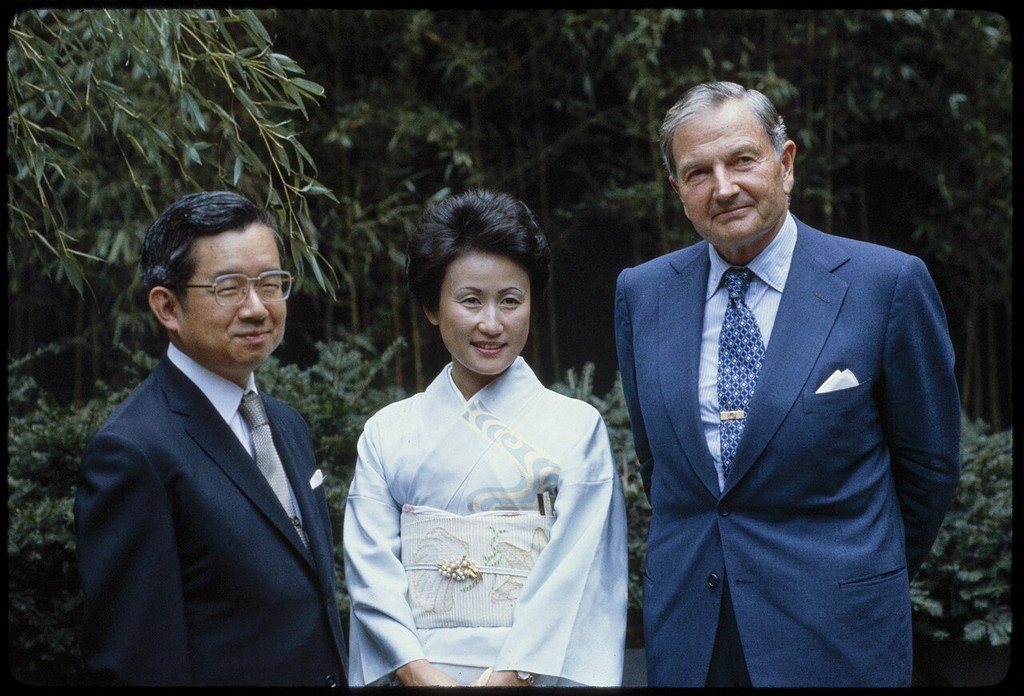
David Rockefeller at right, with Crown Prince Akihito and Crown Princess Michiko of Japan, in 1984. Rockefeller had acquired White Center privately in June 1960.
Library of Congress, Prints & Photographs Division. Photograph: Bernard Gotfryd. LC-DIG-gtfy-00289. Resized without cropping. [5]
The lot page lists exhibition appearances in Buffalo in 1960, at Smith College in 1985 and in the 1998–99 Rothko retrospective.[1] Those records add a public life to a painting often discussed chiefly through its price. Anfam no. 444, p. 337, is stated in Sotheby's literature list; the book's catalogue entry should still be read before adding a direct quotation or any unverified provenance detail. The Anfam essay on the same auction page is independently accessible and may be cited as such.
Christie's account of the Rockefeller collection adds a useful counterpoint to the Sotheby's provenance list. It says Dorothy C. Miller located White Center while David Rockefeller was developing an art committee for Chase Manhattan Bank, but Alfred Barr advised that David buy the painting personally; he did so in June 1960.[3] Sotheby's record also lists a Buffalo exhibition of paintings on loan from Chase Manhattan Bank that autumn.[1] These two accounts are not necessarily inconsistent: a privately owned work could be lent into a bank-related exhibition. They should not, however, be compressed into the false statement that Chase owned the painting. The dated sources identify acquisition and display as separate facts.
The 1998–99 retrospective took the painting through Washington, New York and Paris, according to Sotheby's exhibition list.[1] That international itinerary shows it in a historical survey long before its 2007 headline sale. Sotheby's later results summary gives the realised 2007 price as $72,840,000.[4] A price is a documented transaction, not a measure of what the colour relations mean or a perpetual rank in the market. For this page, the more distinctive scholarly resource remains Anfam's authored 2007 essay on how the lower ground thins, the upper red intensifies and the white edge changes character from side to side.[1]
The catalogue distinguishes a publication from an appearance on a wall. It lists White Center as illustrated in the 1978 Guggenheim travelling retrospective catalogue but explicitly says the canvas was not exhibited in that tour.[1] It was physically shown in the 1998–99 retrospective, according to the same exhibition list. This distinction is easy to lose when a book's checklist is treated as a complete list of works installed at every venue. The painting's reproduction in 1978 demonstrates scholarly visibility; it does not document a visitor encountering the original in a 1978 gallery.
Anfam's accessible 2007 essay also proposes comparisons beyond Rothko's own paintings. He relates the high-keyed orange, violet and lilac to Bonnard; considers whether certain Matisse paintings offer a precedent; and notes the tension between a relatively strict rectangular order and a sensuous, changeable surface.[1] These are Anfam's art-historical interpretations, not documented evidence that Rothko copied a specific Bonnard or saw the Matisse he names. They give readers a way to ask why apparently simple bands feel unsettled: the formal order is clear at a distance, yet the colour shifts and irregular edges resist a hard geometric reading close up.
How to compare it
Compare White Center with MoMA's No. 10 from the same year. Both belong to the early mature period, but their colour arrangements, proportions and collection histories differ. Then look at No. 61 (Rust and Blue) three years later. Rothko retained a broad-field language while changing its weight and tonal range. Such comparisons make the work's individuality clearer than a general account of “Rothko rectangles.”
The image in Sotheby's catalogue is protected by the Rothko heirs' copyright and is linked for study rather than copied here. This guide uses a neutral artwork card in its directory. A reproduction also cannot convey the full scale or shifting surface of the canvas; it should be treated as a reference for identification.
Related works
- No. 10 (1950) is another work at the threshold.
- No. 61 (Rust and Blue) is a later comparison.
- Rothko's paintings traces the larger development.
Rothko works in this guide
| Name | Date | Medium |
|---|---|---|
| Entrance to Subway | 1938 | Painting |
| Hierarchical Birds | 1944 | Painting |
| Slow Swirl at the Edge of the Sea | 1944 | Painting |
| No. 3/No. 13 | 1949 | Painting |
| Untitled (Violet, Black, Orange, Yellow on White and Red) | 1949 | Painting |
| White Center | 1950 | Painting |
| No. 10 | 1950 | Painting |
| No. 6 (Violet, Green and Red) | 1951 | Painting |
| Untitled | 1952 | Painting |
| No. 61 (Rust and Blue) | 1953 | Painting |
| No. 1 (Royal Red and Blue) | 1954 | Painting |
| Untitled (Yellow and Blue) | 1954 | Painting |
| Orange and Yellow | 1956 | Painting |
| Light Red over Black | 1957 | Painting |
| Four Darks in Red | 1958 | Painting |
| Black on Maroon | 1958 | Painting |
| No. 14 | 1960 | Painting |
| Orange, Red, Yellow | 1961 | Painting |
| Untitled (brown and gray) | 1969 | Painting |
| Untitled (Red on Red) | 1969 | Painting |
| Untitled (Black and Gray) | 1970 | Painting |
| Tentacles of Memory | 1945–46 | Drawing |
Frequently Asked Questions
White Center (Yellow, Pink and Lavender on Rose) is Rothko’s 1950 oil painting on canvas, measuring 205.8 × 141 cm. The pale central area belongs to an arrangement of coloured fields whose edges and surrounding ground remain varied rather than mechanically uniform.[1]
In his 2007 essay, David Anfam draws attention to differences in the white area’s boundaries and to changes in the surrounding rose ground. The centre is more than a colour named in the title: its relation to neighbouring fields helps determine the canvas’s balance and apparent depth.[1]
Yes. Sotheby’s provenance and Anfam’s accompanying essay identify Rockefeller as its collector. Christie’s account dates his personal purchase to June 1960. A bank-related exhibition loan should not be confused with ownership by Chase Manhattan Bank.[1][3]
Its literature list gives catalogue no. 444, page 337, in Mark Rothko: The Works on Canvas. That is a citation reported by Sotheby’s. Anfam’s authored 2007 essay on the lot page is a separate text from the 1998 catalogue entry.[1]
No. 10 at MoMA is also dated 1950. Comparing its cooler colour planes and narrower proportions with White Center helps reveal variation within the emerging mature format. The works have separate identities and collection histories.
Discussion
What changes when you look at White Center as a physical painting rather than a small reproduction?
Use the questions below to compare the work with its neighbours in Rothko’s career.
Reader Insights
Which edge or interval asks you to slow down?
How does this painting differ from the earlier and later works linked here?
What remains uncertain after reading the museum record and looking closely?
Join the Conversation
Share an observation grounded in the work or its documented history.
References
- Sotheby's, White Center (Yellow, Pink and Lavender on Rose), 2007 lot record and catalogue note by David Anfam. Its literature section cites Anfam, Mark Rothko: The Works on Canvas (1998), no. 444, p. 337.
- National Gallery of Art, “Mark Rothko,” artist chronology.
- Christie's, “The Rockefellers and the road to Modern Art”, on Miller, Barr and Rockefeller's June 1960 purchase.
- Sotheby's, 2000–19 annual top-lot results summary, reporting the 2007 result for White Center.
- Japanese Royal couple Akihito with Rockefeller, 1984.jpg. Library of Congress, Prints & Photographs Division. Photograph: Bernard Gotfryd. LC-DIG-gtfy-00289. Resized without cropping. Source · Public domain; LOC donor release.