by Tom Gurney
Tom Gurney BSc (Hons) is an art history expert with over 20 years experience
Published on June 19, 2020 / Updated on October 11, 2026
Email: tomgurney1@gmail.com / Phone: +44 7429 011000
Orange and Yellow: Introduction
Orange and Yellow is a 1956 oil painting on canvas at the Buffalo AKG Art Museum, accession K1956:8. The museum gives its support measurements as 231.14 × 180.34 cm and records it as a gift from Seymour H. Knox Jr. in the year it was made.[1] This close date between creation and acquisition makes the work's early collection history unusually clear. The museum's copyrighted image is available on its record for study, but its educational download notice does not permit reuse on this site.
At a Glance
- ArtistMark Rothko
- Date1956 [1]
- MediumOil on canvas [1]
- Dimensions231.14 × 180.34 cm [1]
- CollectionBuffalo AKG Art Museum, K1956:8 [1]
This work in Rothko’s career
No. 3/No. 13
1949Contents
The work as colour relation
The title names two warm colours, yet the canvas is not simply orange placed above yellow. The fields have changing densities and soft transitions. Their apparent brightness depends on the surrounding ground and the amount of space between them. A small reproduction can suggest the arrangement, but a work more than 2.3 metres high can fill much of a viewer's sight line. The viewer may first feel the contrast as a whole, then find variations at the edges and within the surfaces.
Buffalo AKG describes Rothko's mature format as two or three areas against a ground that both divides and unites them.[1] That formulation is useful for this painting: separation and connection happen together. The boundary of a form is not a mechanically ruled line. Colour can seem to cross it or be affected by the adjacent field. One should not assign a single meaning such as “joy” to the warm palette; the painting gives more to study than a colour association.
Making and material
The museum's account of Rothko's general method discusses thin layers applied by brush or rag and the resulting luminous effect.[1] Such a description helps a viewer look for variations in opacity, but it must not be treated as a full conservation report for accession K1956:8. Exact pigments, preparation and layer order would require object-specific examination. The National Gallery's conservation study of separate paintings on paper demonstrates how Rothko's techniques and supports could vary widely.[2]
Buffalo AKG's record also notes a reverse inscription including “TOP,” Rothko's signature and the date 1956.[1] That is a practical object detail: orientation is not just a matter of a reproducer's preference. Museum records can preserve such information even when a cropped image of the front cannot show it.
From Sidney Janis to Buffalo
The museum lists Sidney Janis Gallery in its provenance and says the work was sold to the Albright Art Gallery on 13 March 1956. Knox's gift credit places it in the collection that year.[1] Those facts give a firmer history than the vague claim that it was “acquired early.” The institution's names have changed over time, so the contemporary Albright Art Gallery in the provenance and today's Buffalo AKG refer to stages of one collection's history.
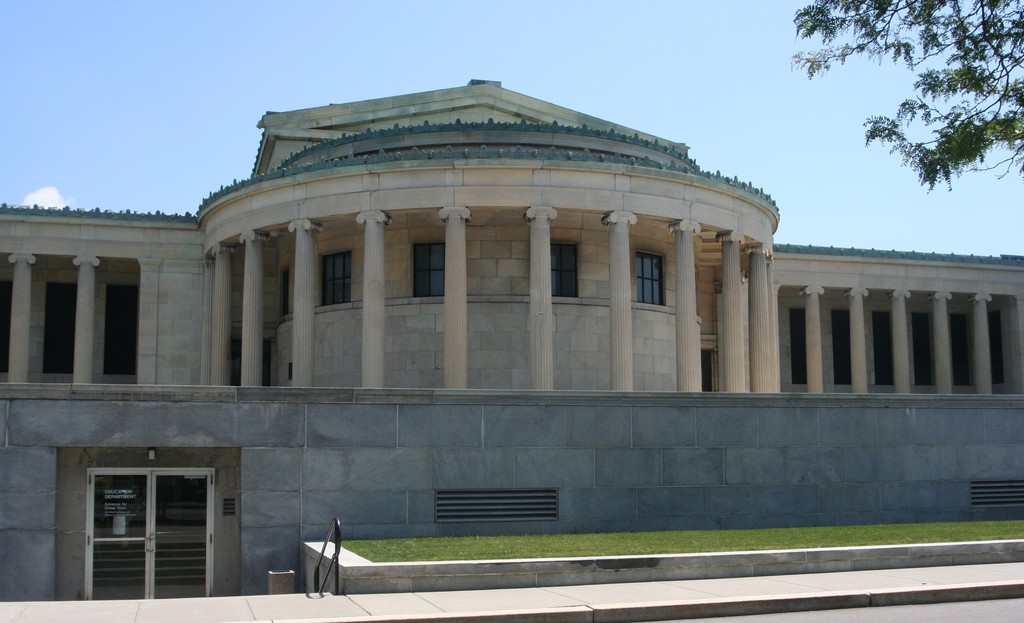
The Albright-Knox Art Gallery’s historic facade in 2006. Now the Buffalo AKG Art Museum, the institution holds Orange and Yellow.
Photograph: Dave Pape. Resized without cropping. [7]
The acquisition also belongs to a specific collecting programme. Buffalo AKG's history of director Gordon M. Smith says that Smith and Seymour H. Knox Jr. worked together to bring recent New York painting into the museum while it was still unfamiliar to many American museum audiences. It names Orange and Yellow among a group of major Abstract Expressionist acquisitions entered into the collection on a single day with Knox's support.[5] This local history explains why a 1956 Rothko was already in a public collection within months of its creation. It also prevents the story from being reduced to the artist's later fame: the Buffalo purchase was a contemporary institutional choice, made while the language of these canvases was still emerging in public view.
The two records use slightly different terms for the transaction. The object page gives the Janis sale date and Knox gift credit; the museum history describes Knox's financial role in a wider acquisition effort.[1][5] They should be read together without inventing a private interval of ownership or an undocumented commission. The museum's accession number remains the most dependable identifier when an exhibition checklist uses the older “Albright Art Gallery” name.
The work appeared in MoMA's major Rothko exhibition of January–March 1961. Its contemporary checklist names Orange and Yellow, dates it 1956, describes it as oil on canvas and credits the Albright Art Gallery in Buffalo.[4] That record shows the canvas travelling into a full-career presentation only five years after the Buffalo acquisition. It is an exhibition history point, not a change of owner: the checklist's lender line and the current Buffalo AKG accession together establish continuity of institutional identification. It also gives readers a second dated source against which to check later title or medium confusion.
There is an even closer contemporary witness. Buffalo AKG's archive identifies a photograph of Rothko standing with Orange and Yellow at the Albright Art Gallery on 15 May 1957, during the members' opening of Contemporary Art: Acquisitions 1954–1957.[6] The museum's account says the exhibition introduced a group of recent acquisitions and shows Rothko alongside Philip Guston, Franz Kline, Robert Motherwell, Jimmy Ernst and patron Seymour H. Knox Jr. The photograph documents that Rothko saw his canvas in the Buffalo galleries within a year of its acquisition. It does not by itself tell us what he thought of the hang or whether he gave the museum installation instructions; those claims would need correspondence or an interview.
The 1957 show also places the painting within a collecting argument. Buffalo was presenting works purchased or received while the painters were active, rather than waiting for a later retrospective to confer historical status.[6] Orange and Yellow can thus be read through two public settings: the museum's own acquisition display in 1957 and MoMA's Rothko survey in 1961. One framed it amid new contemporary purchases; the other made it part of an individual career. Neither setting changes the painted object's measurements, title or Buffalo accession.
The distinction between support and framed dimensions matters when comparing it with other large Rothkos. Buffalo AKG separately records a 91 × 71 inch canvas support and a larger framed size.[1] A printed poster, a gallery frame and the painted support all occupy different physical footprints. Discussion of the proportions of Rothko's colour fields should use the support measurements, while planning a display or transport would require the framed dimensions and conservation information. The museum's reverse inscription, including its “TOP” instruction, further shows that orientation is an object fact rather than an editorial preference.
The painting predates the Seagram commission and the Houston Chapel. Its large scale and warm palette belong to Rothko's mature work, but it was not made for either project. Compare Four Darks in Red from 1958 to see a markedly darker red relation, or Orange, Red, Yellow from 1961 for a later, differently proportioned warm palette. The repeated use of red, orange and yellow does not make the canvases a single series.
Anfam's 1998 catalogue raisonné is the appropriate scholarly source for a canvas catalogue number and fuller literature.[3] A corresponding entry has not yet been directly checked for Orange and Yellow, so this guide relies on Buffalo AKG's current collection record for its measurable facts. The museum marks image downloads educational only and separately directs other uses through permissions.[1]
Related works
- Four Darks in Red provides a darker 1958 comparison.
- Orange, Red, Yellow is a distinct 1961 canvas.
- Rothko's paintings surveys the mature period.
Rothko works in this guide
| Name | Date | Medium |
|---|---|---|
| Entrance to Subway | 1938 | Painting |
| Hierarchical Birds | 1944 | Painting |
| Slow Swirl at the Edge of the Sea | 1944 | Painting |
| No. 3/No. 13 | 1949 | Painting |
| Untitled (Violet, Black, Orange, Yellow on White and Red) | 1949 | Painting |
| White Center | 1950 | Painting |
| No. 10 | 1950 | Painting |
| No. 6 (Violet, Green and Red) | 1951 | Painting |
| Untitled | 1952 | Painting |
| No. 61 (Rust and Blue) | 1953 | Painting |
| No. 1 (Royal Red and Blue) | 1954 | Painting |
| Untitled (Yellow and Blue) | 1954 | Painting |
| Orange and Yellow | 1956 | Painting |
| Light Red over Black | 1957 | Painting |
| Four Darks in Red | 1958 | Painting |
| Black on Maroon | 1958 | Painting |
| No. 14 | 1960 | Painting |
| Orange, Red, Yellow | 1961 | Painting |
| Untitled (brown and gray) | 1969 | Painting |
| Untitled (Red on Red) | 1969 | Painting |
| Untitled (Black and Gray) | 1970 | Painting |
| Tentacles of Memory | 1945–46 | Drawing |
Frequently Asked Questions
It is in the Buffalo AKG Art Museum, accession K1956:8. The museum dates the oil canvas to 1956 and records it as a gift of Seymour H. Knox Jr. in the same year. Its support measures 231.14 × 180.34 cm.[1]
The broad fields have changing densities, soft transitions and a surrounding ground that both separates and connects them. Buffalo AKG describes the mature format through that relationship. The colours’ apparent brightness depends on their neighbours and proportions.[1]
Yes. Buffalo AKG’s archive account identifies Rothko with the canvas at the opening of Contemporary Art: Acquisitions 1954–1957 on 15 May 1957. The photograph records a particular exhibition encounter after the museum’s 1956 acquisition.[6]
No. Orange, Red, Yellow is a separate 1961 painting. Buffalo’s Orange and Yellow dates to 1956 and has its own dimensions and acquisition history. Similar warm palettes should not replace exact titles and dates.[1]
Discussion
What changes when you look at Orange and Yellow as a physical painting rather than a small reproduction?
Use the questions below to compare the work with its neighbours in Rothko’s career.
Reader Insights
Which edge or interval asks you to slow down?
How does this painting differ from the earlier and later works linked here?
What remains uncertain after reading the museum record and looking closely?
Join the Conversation
Share an observation grounded in the work or its documented history.
References
- Buffalo AKG Art Museum, Orange and Yellow, accession K1956:8.
- Michaela Milgrom, “How Mark Rothko Made Paintings on Paper,” National Gallery of Art, 2023.
- David Anfam, Mark Rothko: The Works on Canvas: A Catalogue Raisonné (National Gallery of Art and Yale University Press, 1998), bibliography at NGA; object entry not directly checked.
- Museum of Modern Art, 18 January 1961 Rothko exhibition checklist, p. 4, contemporary Albright Art Gallery listing.
- Buffalo AKG Art Museum, Gordon M. Smith biography, on the Smith–Knox acquisition programme and Orange and Yellow.
- Buffalo AKG Art Museum, archive photograph and account of Contemporary Art: Acquisitions 1954–1957, including Rothko with the canvas at the 15 May 1957 opening.
- Albright-Knox Art Gallery 1.jpg. Photograph: Dave Pape. Resized without cropping. Source · Public-domain dedication.