 by Tom Gurney
Tom Gurney BSc (Hons) is an art history expert with over 20 years experience
Published on June 19, 2020 / Updated on October 11, 2026
Email: tomgurney1@gmail.com / Phone: +44 7429 011000
Hierarchical Birds: Introduction
Hierarchical Birds is a 1944 oil painting on canvas in the National Gallery of Art, Washington. NGA gives the canvas dimensions as 100.7 × 80.5 cm and accession number 1986.43.20.[1] The work belongs to Rothko's mythic and Surrealist period, a long way from the broad colour fields for which he is most familiar. Its title and birdlike forms offer clues, but neither fixes a single narrative. The painting rewards a close reading of how forms emerge from layered zones of colour.
At a Glance
- ArtistMark Rothko
- Date1944 [1]
- MediumOil on canvas [1]
- Dimensions100.7 × 80.5 cm [1]
- CollectionNational Gallery of Art, 1986.43.20 [1]
This work in Rothko’s career
No. 3/No. 13
1949Contents
- A layered image rather than a simple bird picture
- Rothko's 1940s investigation
- A documented early exhibition history
- The painting's later international life
- How the image changes with attention
A layered image rather than a simple bird picture
The museum's visual description identifies two birdlike creatures occupying much of a vertical composition. Behind and through them are three differently coloured horizontal zones: pink and blue high up, earthier tones in the middle, and mint green and white toward the bottom.[1] A viewer may follow a head, wing or tail before losing it among lines and washes. That instability is part of the image's force. The creatures seem simultaneously present and difficult to isolate from their surroundings.
The right-hand figure is easier to recognise as a bird, with an eye and a rising neck. The left-hand arrangement is less settled. Lines that could be plumage become abstract marks; white and peach passages can be read in several ways. The painting's vertical division and horizontal strata therefore work against a straightforward natural-history reading. The title calls the figures “hierarchical,” inviting questions about rank, sequence or spiritual order, but the NGA record does not prescribe a specific myth or religious programme.[1] A responsible interpretation can note these possibilities without presenting one as a documented intention.
Rothko's 1940s investigation
Rothko's National Gallery biography describes the later 1930s through 1946 as a period of interest in Greek mythology, Surrealism and forms that allude to human and animal life. It also notes his use of automatic drawing and his encounter with Surrealist artists in New York.[2] Hierarchical Birds fits that broad trajectory while remaining a particular painted object. Its creatures are visible enough to attract names, but their interlocking shapes keep identification fluid. This was part of Rothko's effort to move beyond the isolated figures and city scenes of his 1930s work.
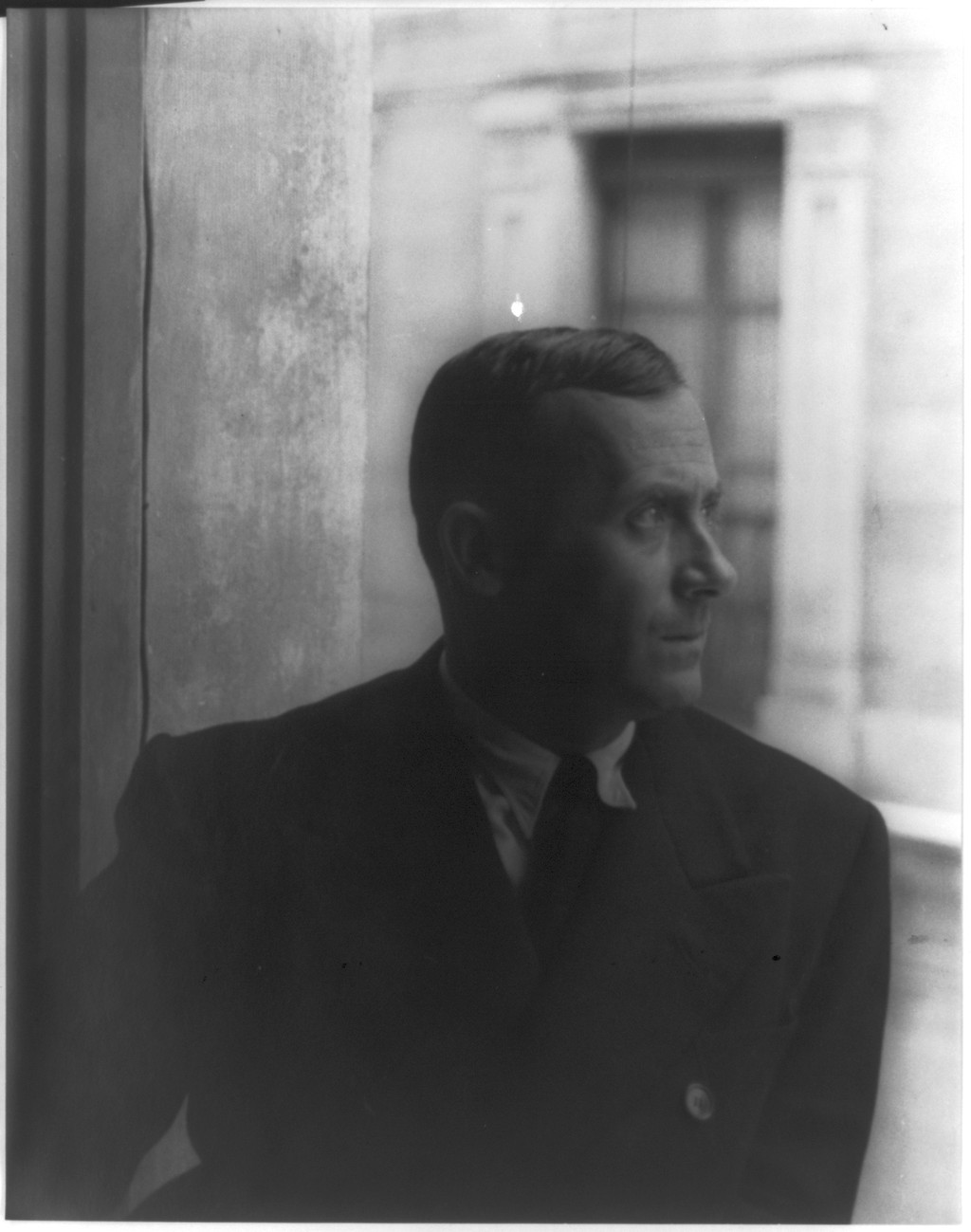
Joan Miró in Barcelona, 13 June 1935, photographed by Carl Van Vechten. The National Gallery identifies Miró among Rothko’s Surrealist influences.
Library of Congress, Prints & Photographs Division, Carl Van Vechten Collection; LC-USZ62-42511. Resized without cropping. [4]
The painting dates to the same year as Slow Swirl at the Edge of the Sea, now at MoMA. Both works involve ambiguous organic forms, but their scale, orientation and particular arrangements differ. The comparison helps dismantle the idea that Rothko moved in one jump from subway scenes to rectangular colour fields. A period of mythic subjects and mobile forms lay between them, followed by further changes in the later 1940s.
A documented early exhibition history
NGA's object record lists Hierarchical Birds in Rothko's 1945 exhibition at Peggy Guggenheim's Art of This Century gallery as number 3. It also records a 1946 showing in San Francisco and Santa Barbara.[1] These entries give the work a clear public history close to its making. They should not be confused with a claim that Peggy Guggenheim owned this particular canvas: an exhibition venue and an owner are different facts. The NGA provenance starts with Rothko, then his estate, and follows transfers involving Marlborough and the Rothko Foundation before the Foundation's 1986 gift to the Gallery.[1]
This record is unusually useful because it joins medium, measurements, early exhibitions and later provenance in one institutional source. It also shows why object-specific documentation is preferable to a generic account of a style. A statement about what Rothko was making in 1944 gives historical context; the accession and exhibition entries show where this painting went. The two kinds of evidence complement each other.
The painting's later international life
NGA's exhibition history follows this canvas beyond the United States: the 1987–88 Rothko survey took it to London, Madrid and Cologne; the 1998–99 retrospective listed it in Washington, New York and Paris; and the 1996 Pintura Estadounidense: Expresionismo Abstracto placed it in a Mexico City account of American abstraction.[1] The museum record also lists the 2019 Vienna exhibition Mark Rothko: Dramaturg der Form. These are specific records of one early painting, rather than evidence that the 1940s phase vanished from later understandings of Rothko. They show how curators in several languages have repeatedly included the mythic image when presenting the full career.
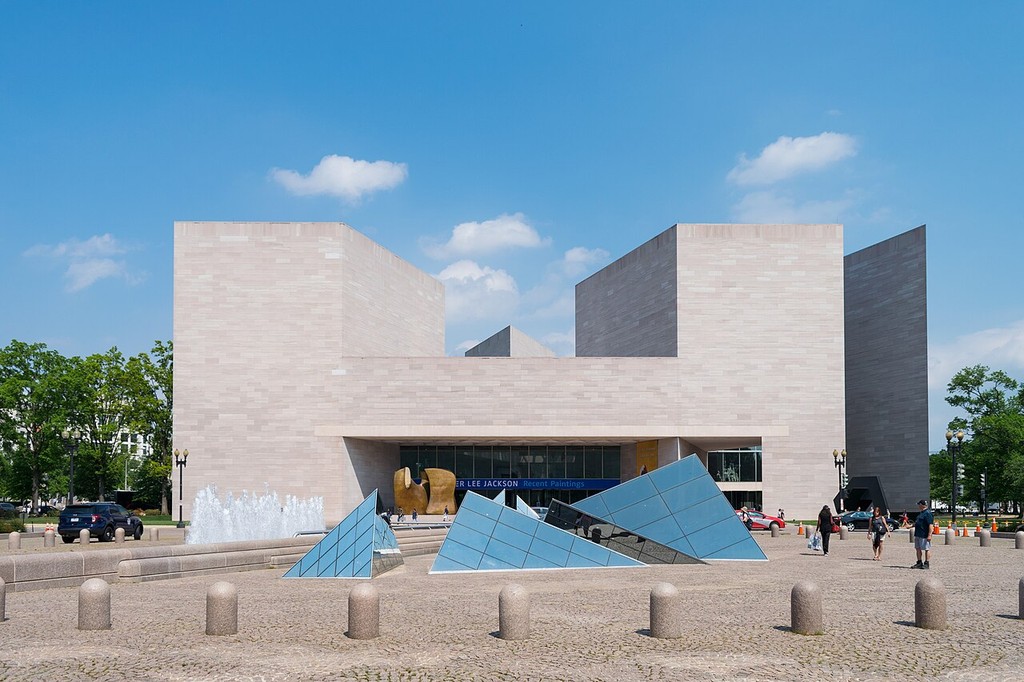
The National Gallery of Art’s East Building in 2019. The Gallery’s collection and exhibition records preserve the history of Hierarchical Birds, accession 1986.43.20.
Photograph: Difference engine. Photograph remains CC BY-SA 4.0. Resized without cropping. [5]
The same NGA bibliography cites the canvas as no. 239 in David Anfam's 1998 catalogue raisonné.[1] That number is therefore traceable through the holding museum, even though Anfam's individual entry has not been read for this edition. The NGA bibliography is a reliable lead for checking the hardback's reproduction and discussion; it does not license a paraphrase of what Anfam wrote.
How the image changes with attention
Begin at the broad coloured zones. Their horizontal divisions may suggest a stage or layered environment, but they do not form an ordinary landscape. Then follow a single dark line across the painting. At some points it appears to describe a creature; elsewhere it becomes part of a larger pattern. Next look at the lighter washes around the figures. They can bring one part forward and leave another uncertain. The work's title can be held in mind without demanding that every mark answer to it.
NGA marks the canvas as not on view in its current record and says its media are unavailable for download.[1] The linked museum object page is the source for the image and current collection information. This guide does not copy the copyrighted painting. Anfam no. 239 is an institutional bibliographic citation, not a claim to have consulted the entry itself.[3]
Related works
- Slow Swirl at the Edge of the Sea is another 1944 painting of ambiguous forms.
- Tentacles of Memory shows a later paper work from the same broad phase.
- Rothko's paintings follows the move toward abstraction.
Rothko works in this guide
| Name | Date | Medium |
|---|---|---|
| Entrance to Subway | 1938 | Painting |
| Hierarchical Birds | 1944 | Painting |
| Slow Swirl at the Edge of the Sea | 1944 | Painting |
| No. 3/No. 13 | 1949 | Painting |
| Untitled (Violet, Black, Orange, Yellow on White and Red) | 1949 | Painting |
| White Center | 1950 | Painting |
| No. 10 | 1950 | Painting |
| No. 6 (Violet, Green and Red) | 1951 | Painting |
| Untitled | 1952 | Painting |
| No. 61 (Rust and Blue) | 1953 | Painting |
| No. 1 (Royal Red and Blue) | 1954 | Painting |
| Untitled (Yellow and Blue) | 1954 | Painting |
| Orange and Yellow | 1956 | Painting |
| Light Red over Black | 1957 | Painting |
| Four Darks in Red | 1958 | Painting |
| Black on Maroon | 1958 | Painting |
| No. 14 | 1960 | Painting |
| Orange, Red, Yellow | 1961 | Painting |
| Untitled (brown and gray) | 1969 | Painting |
| Untitled (Red on Red) | 1969 | Painting |
| Untitled (Black and Gray) | 1970 | Painting |
| Tentacles of Memory | 1945–46 | Drawing |
Frequently Asked Questions
It is a 1944 oil painting on canvas in the National Gallery of Art, Washington, accession 1986.43.20. Measuring 100.7 × 80.5 cm, it belongs to Rothko’s mythic and Surrealist period, before the mature stacked colour fields.[1]
The NGA describes two birdlike creatures within a vertical composition crossed by differently coloured horizontal zones. Recognisable eyes, necks or plumage mingle with ambiguous lines and washes. The forms emerge from the surrounding colour rather than remaining neatly separated from it.[1]
The title invites ideas of rank, order and birdlike beings, but the NGA record does not prescribe one named myth or religious narrative. The uncertainty of the forms remains part of the painting. A possible association should not be treated as Rothko’s documented explanation.[1]
Its horizontal colour zones offer one point of comparison with later paintings, but its creatures still belong to the mythic imagery of the 1940s. Rothko’s shift toward broad colour fields developed over the later part of that decade rather than making this painting an example of the mature format.[1][2]
Discussion
What changes when you look at Hierarchical Birds as a physical painting rather than a small reproduction?
Use the questions below to compare the work with its neighbours in Rothko’s career.
Reader Insights
Which edge or interval asks you to slow down?
How does this painting differ from the earlier and later works linked here?
What remains uncertain after reading the museum record and looking closely?
Join the Conversation
Share an observation grounded in the work or its documented history.
References
- National Gallery of Art, Hierarchical Birds, accession 1986.43.20.
- National Gallery of Art, “Mark Rothko,” artist chronology.
- David Anfam, Mark Rothko: The Works on Canvas: A Catalogue Raisonné (National Gallery of Art and Yale University Press, 1998), no. 239 as cited in the NGA object's bibliography; entry text awaits direct verification.
- Joan Miró, Barcelona. Library of Congress, Prints & Photographs Division, Carl Van Vechten Collection; LC-USZ62-42511. Resized without cropping. Source · Public domain; LOC gift record.
- East Building of the National Gallery of Art, 2019.jpg. Photograph: Difference engine. Photograph remains CC BY-SA 4.0. Resized without cropping. Source · CC BY-SA 4.0.