by Tom Gurney
Tom Gurney BSc (Hons) is an art history expert with over 20 years experience
Published on June 19, 2020 / Updated on October 11, 2026
Email: tomgurney1@gmail.com / Phone: +44 7429 011000
No. 61 (Rust and Blue): Introduction
No. 61 (Rust and Blue) is a 1953 oil painting in the Museum of Contemporary Art, Los Angeles. MOCA records it under the extended title No. 61 (Rust and Blue) [Brown Blue, Brown on Blue], accession 84.9. It measures 292.74 × 233.68 cm, with a depth of 4.45 cm.[1] These details identify one particular canvas in a career that contains many numbered and colour-named works. The shorter site route Number 61 is an alternate-name guide to this same painting, not a second Rothko object.
At a Glance
- ArtistMark Rothko
- Date1953 [1]
- MediumOil on canvas [1]
- Dimensions292.74 × 233.68 × 4.45 cm [1]
- CollectionMOCA Los Angeles, 84.9 [1]
This work in Rothko’s career
No. 3/No. 13
1949Contents
- The object and its names
- Colour on a large canvas
- 1953 in Rothko's development
- Collection history and the Panza credit
- Questions for close looking
The object and its names
Rothko's numerical titles often carry little of the descriptive information readers expect from a painting title. Here the words “Rust and Blue” give a useful colour cue, while the bracketed wording in MOCA's record preserves additional naming attached to the work. The two descriptions should not be treated as separate paintings. The accession number, dimensions, date and owner tie the title variants to MOCA's single object.[1]
The distinction matters on a web site where old pages and search results can multiply a work accidentally. A visitor following “No. 61,” “Number 61” or “Rust and Blue” should reach the same object record. This page uses MOCA's present title as its anchor and retains the other labels as discovery aids. It does not assert that every historical label was chosen by Rothko himself; that would require the underlying catalogue and exhibition documentation.
Colour on a large canvas
The dimensions make No. 61 a painting that approaches the viewer's bodily scale. Its surface is over 2.9 metres high. MOCA's collection image shows broad, superposed areas of muted, dark colour rather than a sharply ruled geometric design.[1] What can first read as a set of rectangles changes when one follows the edges: they are uneven and visually porous, allowing the neighbouring colours to affect one another. Rust, blue and brown are more useful as starting names than as a complete account of the surface.
The painting asks for two speeds of attention. From farther away, the large fields establish a vertical rhythm and a strong whole. Closer to it, differences within a field and the softness of boundaries become more conspicuous. This is one reason a small photograph is a poor substitute for a canvas of this scale. It can record the general arrangement but cannot reliably convey the relation between paint, light and viewing distance. The image in MOCA's object record is useful for identification; an in-person encounter may change how its colour and proportions feel.
It is tempting to assign a fixed emotion to the dark palette. Rothko's format does not dictate a single response, however, and the work should not be collapsed into a biographical mood. Describing what is materially present—the scale, changing edges, stacked fields and relation of warm to cool tones—gives a firmer basis for interpretation. A viewer may then ask what those relationships do rather than what they supposedly stand for.
1953 in Rothko's development
The National Gallery of Art places Rothko's move away from mythic and Surrealist forms in the later 1940s and identifies his mature arrangement of soft-edged colour areas by about 1950.[2] No. 61 therefore belongs to an established compositional practice, although its particular colour balance is not interchangeable with a 1950 or 1960 canvas. Compare White Center for a brighter 1950 arrangement, or No. 14, 1960 for a later orange and blue relationship. Those comparisons show how Rothko varied proportion, tone and edge within a recurring format.
The 1953 date also precedes his better-known architectural commissions. No. 61 is an independent painting. It should not be folded into the Seagram cycle, the Harvard murals or the Rothko Chapel simply because those projects are important to his later career. Chronology can illuminate its place in the artist's practice without supplying an undocumented commission history.
Collection history and the Panza credit
MOCA credits No. 61 to its Panza Collection.[1] That credit is a collection fact, not a complete provenance chain. It tells a reader where the painting is held and how the museum records its acquisition context, but it does not establish every earlier owner or exhibition. David Anfam's 1998 catalogue raisonné is the relevant scholarly source for checking the object's catalogue number, title variants and full history; its detailed entry has not yet been consulted here.[3] Those fields should be added only against the entry itself or another primary record.
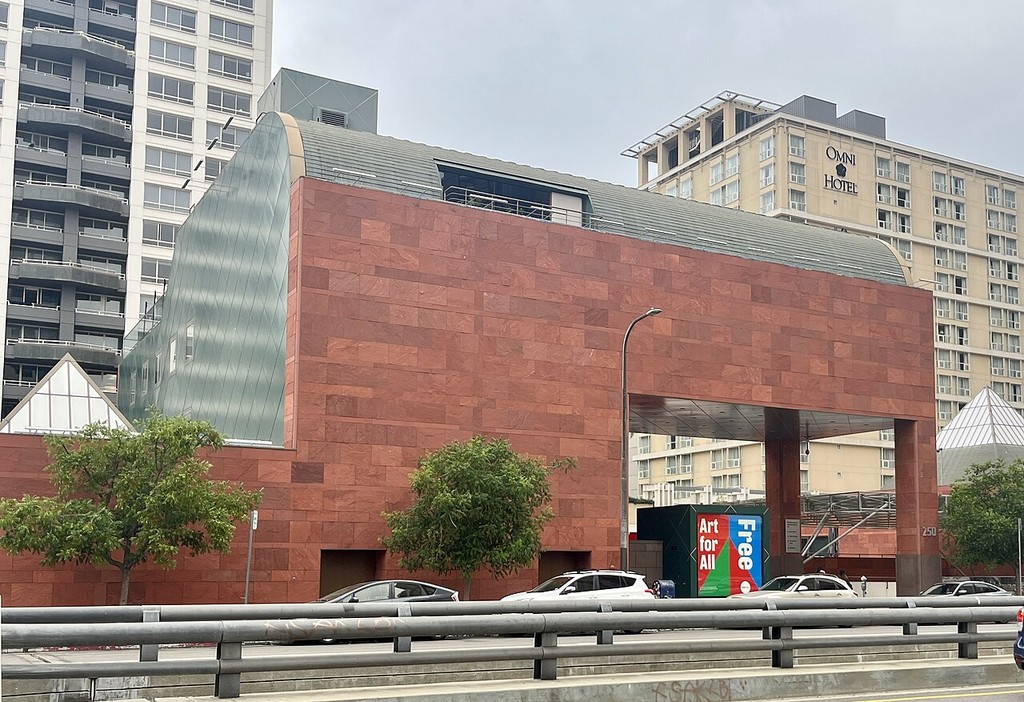
MOCA Grand Avenue, Los Angeles, in 2023. The museum owns No. 61 (Rust and Blue), with its Panza Collection credit.
Photograph: Benoît Prieur. Resized without cropping. [4]
The work's current display status can change. MOCA's object page is the appropriate first stop for its present collection information and any available viewing details. The museum also identifies the artwork copyright as held through the Rothko heirs and Artists Rights Society.[1] That notice is why this guide links to the museum record rather than reproducing the painting without a licence.
Questions for close looking
Start with the relation between the upper and lower areas. Is one field visually heavier, or does the surrounding blue alter that balance? Follow an edge from left to right and notice where it seems firm and where it appears to dissolve. Look at the rust-toned passages next to cooler blue: the colours interact at their boundaries, rather than occupying sealed compartments. Finally, compare the work's almost three-metre height with your own scale. That size is part of the object, not merely a statistic in the catalogue.
Related works
- Number 61: alternate-name guide explains the duplicate legacy route.
- White Center gives an earlier comparison in the mature format.
- No. 14, 1960 offers a later comparison of large colour fields.
Rothko works in this guide
| Name | Date | Medium |
|---|---|---|
| Entrance to Subway | 1938 | Painting |
| Hierarchical Birds | 1944 | Painting |
| Slow Swirl at the Edge of the Sea | 1944 | Painting |
| No. 3/No. 13 | 1949 | Painting |
| Untitled (Violet, Black, Orange, Yellow on White and Red) | 1949 | Painting |
| White Center | 1950 | Painting |
| No. 10 | 1950 | Painting |
| No. 6 (Violet, Green and Red) | 1951 | Painting |
| Untitled | 1952 | Painting |
| No. 61 (Rust and Blue) | 1953 | Painting |
| No. 1 (Royal Red and Blue) | 1954 | Painting |
| Untitled (Yellow and Blue) | 1954 | Painting |
| Orange and Yellow | 1956 | Painting |
| Light Red over Black | 1957 | Painting |
| Four Darks in Red | 1958 | Painting |
| Black on Maroon | 1958 | Painting |
| No. 14 | 1960 | Painting |
| Orange, Red, Yellow | 1961 | Painting |
| Untitled (brown and gray) | 1969 | Painting |
| Untitled (Red on Red) | 1969 | Painting |
| Untitled (Black and Gray) | 1970 | Painting |
| Tentacles of Memory | 1945–46 | Drawing |
Frequently Asked Questions
It belongs to the Museum of Contemporary Art, Los Angeles, accession 84.9. MOCA dates the oil canvas to 1953 and records a height of 292.74 cm and width of 233.68 cm. The museum’s credit identifies it with the Panza Collection.[1]
No. ‘Number 61’, ‘No. 61’ and ‘Rust and Blue’ refer here to the same MOCA canvas. The extended title also includes Brown Blue, Brown on Blue. These naming variations do not establish multiple objects.[1]
Look at the relationship between rust, brown and blue, then follow the uneven boundaries of the stacked areas. The surrounding colour affects each field’s apparent weight. Its almost three-metre height makes viewing distance a substantial part of that encounter.[1]
It is an independent 1953 canvas that predates those later commissions. It can be compared with the painted environments without being assigned to either project. The White Center guide offers an earlier comparison within the mature format.[1][2]
Discussion
What changes when you look at No. 61 (Rust and Blue) as a physical painting rather than a small reproduction?
Use the questions below to compare the work with its neighbours in Rothko’s career.
Reader Insights
Which edge or interval asks you to slow down?
How does this painting differ from the earlier and later works linked here?
What remains uncertain after reading the museum record and looking closely?
Join the Conversation
Share an observation grounded in the work or its documented history.
References
- The Museum of Contemporary Art, Los Angeles, No. 61 (Rust and Blue) [Brown Blue, Brown on Blue], accession 84.9.
- National Gallery of Art, “Mark Rothko,” artist chronology.
- David Anfam, Mark Rothko: The Works on Canvas: A Catalogue Raisonné (National Gallery of Art and Yale University Press, 1998), bibliographic lead cited by the National Gallery of Art's Rothko bibliography. Specific entry and page remain to be checked against the book.
- The Museum of Contemporary Art from Grand Ave (July 2023).jpg. Photograph: Benoît Prieur. Resized without cropping. Source · CC0.