by Tom Gurney
Tom Gurney BSc (Hons) is an art history expert with over 20 years experience
Published on June 19, 2020 / Updated on October 11, 2026
Email: tomgurney1@gmail.com / Phone: +44 7429 011000
No. 3/No. 13: Introduction
The painting long described on this site as “Magenta, Black, Green on Orange” is the Museum of Modern Art's No. 3/No. 13 of 1949. MoMA records it as oil on canvas, 216.5 × 164.8 cm, object 428.1981.[1] The colour phrase remains a useful description and search route, but it is not the museum's current title. Naming the work correctly matters especially here: 1949 sits at a threshold in Rothko's move toward the stacked, soft-edged fields of his mature practice.
At a Glance
- ArtistMark Rothko
- Date1949 [1]
- MediumOil on canvas [1]
- Dimensions216.5 × 164.8 cm [1]
- CollectionMoMA, 428.1981 [1]
This work in Rothko’s career
Contents
The 1949 threshold
MoMA calls No. 3/No. 13 an early example of a structure Rothko continued to investigate for more than two decades: blocks of colour hover against a coloured ground, separated by narrow intervals.[1] Earlier works such as Slow Swirl at the Edge of the Sea had ambiguous creaturelike forms. By 1949 the subject has shifted toward the behaviour of colour, edge and space. The change was gradual; Rothko's National Gallery chronology places the removal of mythic and Surrealist elements over the late 1940s rather than at one instant.[2]
The painting's numbering may seem dry beside its colour, but the title is part of the object's history. It does not tell the viewer what emotion to feel or what scene to find. The old descriptive phrase can help identify the canvas in conversation, yet the collection number is more reliable for scholarship and linking. This page therefore uses MoMA's title in its heading and keeps the route as an access path for readers who know the colour alias.
Colour and edge
MoMA singles out the green bar against orange as an area of optical vibration.[1] That effect comes from a specific relation between neighbouring colours, not from green or orange in isolation. Elsewhere, close tones can make a block seem to emerge only faintly from the ground. The edges are irregular and soft, which complicates the apparently simple arrangement. Rather than a set of flat rectangles, the surface offers degrees of opacity and depth.
The museum's published account discusses scumbling and translucent layers in the painting.[1] This is useful object-specific interpretive evidence, but the technique is best seen as a relation among layers of paint, not as a recipe that automatically applies to every Rothko. The National Gallery's conservation study of separate paper works shows how varied his supports and working methods could be.[3] A careful viewer should ask what is visible in this canvas and which technical claims belong to other objects.
Scale intensifies the effect. At over two metres high, No. 3/No. 13 occupies more of the viewer's visual field than a page or screen can suggest. Stepping back clarifies the arrangement of the bars; approaching it can make subtle changes in colour and texture apparent. The narrow intervals between fields may begin to look active rather than empty. The painting's colour relationships then become part of an encounter with a physical surface.
In the collection
MoMA credits the canvas as a bequest of Mrs. Mark Rothko through the Mark Rothko Foundation.[1] The museum marks it as not currently on view. Both facts may be checked on the current object page before a visit, since display locations change. The record also lists the 1970 MoMA Rothko tribute among installation views, a sign of the painting's place in the museum's presentation history.[1] An installation photograph may show how a work was displayed, but it should not be treated as a reproduction licence for a new publication.
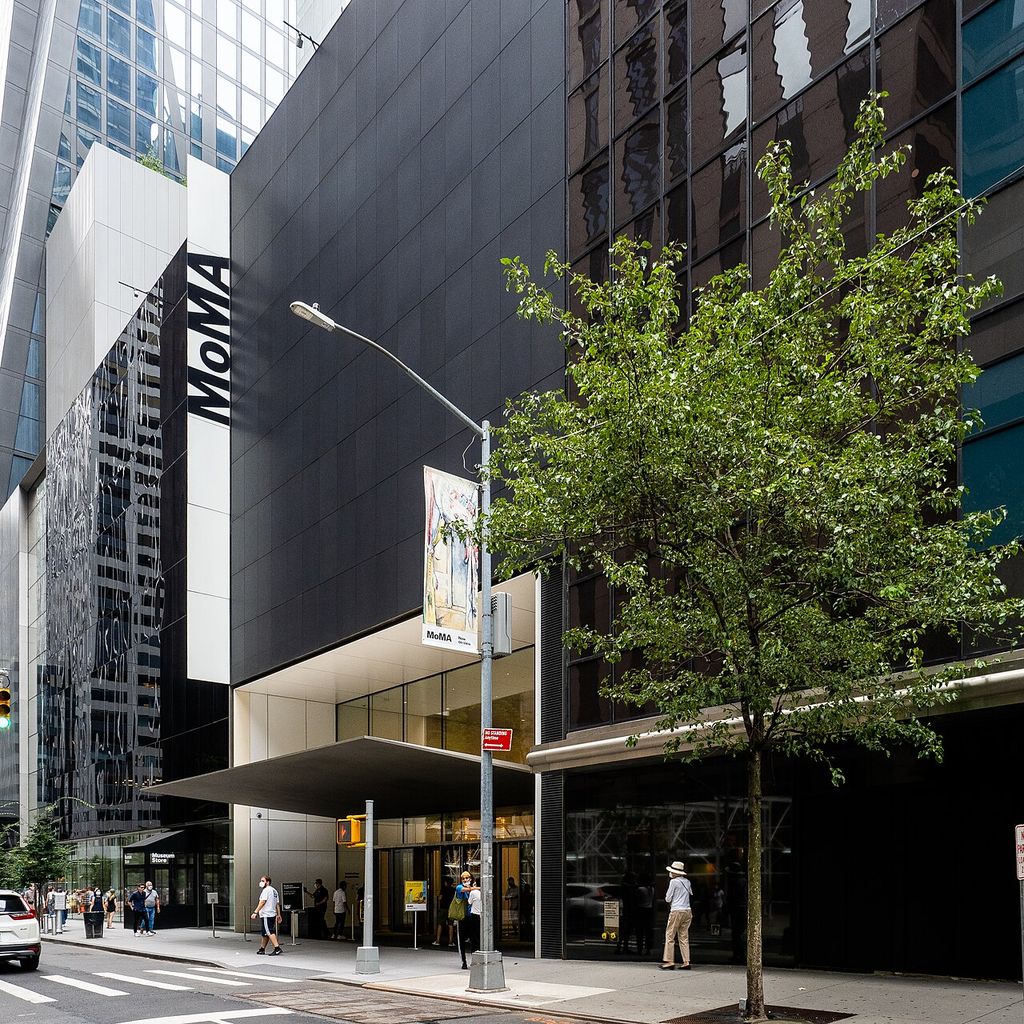
MoMA’s New York exterior in 2021. The museum holds Rothko’s No. 3/No. 13, also described through its magenta, black, green and orange colours.
Photograph: ajay_suresh. Resized without cropping. [6]
David Anfam's 1998 catalogue raisonné covers Rothko's canvases and is an appropriate next check for this work's full catalogue entry and exhibition record.[4] That entry has not been directly consulted here. MoMA's current title, measurements, medium and object number are the verified identifiers used on this page. The painting image remains protected by the Rothko heirs' copyright, so this guide links to the museum record rather than displaying a copy.
Palazzo Strozzi's 2026 Italian exhibition dossier identifies this MoMA canvas as Anfam catalogue number 410 and records it among the works used to explain the 1948–49 transition toward the classic format.[5] That is a published secondary citation to Anfam, not a direct reading of the hardback entry. The dossier prints a height of 261.5 cm, whereas MoMA's current owning-institution record gives 216.5 cm with the same 164.8 cm width and accession 428.1981.[1][5] The height figures cannot both describe the same support as printed. This guide follows MoMA for dimensions and flags the discrepancy for a future check against Anfam and the exhibition's original object list; the discrepancy is a reason to keep the accession visible, not to merge the work with another 1949 canvas.
The Florence exhibition is also evidence of how the painting was used in a recent comparative argument. Its curators present No. 3/No. 13 as an early, significant instance of forms becoming more ordered after the irregular multiforms.[5] That account complements MoMA's description of softly separated colour blocks, but it is an interpretation of the career sequence, not a new technical report on this canvas. The viewer can test the claim by comparing the relative regularity of its fields with a documented 1947 or 1948 multiform rather than relying on a single reproduction.
Questions for close looking
Follow one colour field around its whole perimeter. Does its edge remain equally firm? Then compare the green bar with the orange ground immediately beside it and with a more distant part of the surface. How does the ground alter the bar's apparent intensity? Notice that the title offers numbers, while the old route offers colour names; neither can replace the painting's precise relations of shape, layer and scale. A comparison with MoMA's No. 10 of 1950 shows how quickly Rothko could change proportions within an emerging format.
Related works
- No. 10 (1950) is a MoMA painting from the following year.
- Untitled (1949) is a separate Guggenheim canvas.
- Rothko's paintings traces the broader development.
Rothko works in this guide
| Name | Date | Medium |
|---|---|---|
| Entrance to Subway | 1938 | Painting |
| Hierarchical Birds | 1944 | Painting |
| Slow Swirl at the Edge of the Sea | 1944 | Painting |
| No. 3/No. 13 | 1949 | Painting |
| Untitled (Violet, Black, Orange, Yellow on White and Red) | 1949 | Painting |
| White Center | 1950 | Painting |
| No. 10 | 1950 | Painting |
| No. 6 (Violet, Green and Red) | 1951 | Painting |
| Untitled | 1952 | Painting |
| No. 61 (Rust and Blue) | 1953 | Painting |
| No. 1 (Royal Red and Blue) | 1954 | Painting |
| Untitled (Yellow and Blue) | 1954 | Painting |
| Orange and Yellow | 1956 | Painting |
| Light Red over Black | 1957 | Painting |
| Four Darks in Red | 1958 | Painting |
| Black on Maroon | 1958 | Painting |
| No. 14 | 1960 | Painting |
| Orange, Red, Yellow | 1961 | Painting |
| Untitled (brown and gray) | 1969 | Painting |
| Untitled (Red on Red) | 1969 | Painting |
| Untitled (Black and Gray) | 1970 | Painting |
| Tentacles of Memory | 1945–46 | Drawing |
Frequently Asked Questions
MoMA calls the 1949 canvas No. 3/No. 13. ‘Magenta, Black, Green on Orange’ is a descriptive colour phrase associated with this route, rather than the museum’s title. MoMA object 428.1981 identifies the particular painting.[1]
The painting is oil on canvas, measuring 216.5 × 164.8 cm. Its large, vertical format gives the stacked colour areas a physical scale that a small reproduction cannot convey. The date is 1949.[1]
The canvas is an early example of the hovering colour fields Rothko continued to explore. His earlier mythic figures had gradually become less recognisable through the late 1940s. This painting helps locate the transition without implying that all his work changed at once.[1][2]
Look at the intervals, the surrounding ground and the softness of the boundaries. The blocks do not behave like isolated, sharply ruled shapes. Their apparent weight and position change through the way neighbouring colours and edges meet.[1]
Discussion
What changes when you look at No. 3/No. 13 as a physical painting rather than a small reproduction?
Use the questions below to compare the work with its neighbours in Rothko’s career.
Reader Insights
Which edge or interval asks you to slow down?
How does this painting differ from the earlier and later works linked here?
What remains uncertain after reading the museum record and looking closely?
Join the Conversation
Share an observation grounded in the work or its documented history.
References
- Museum of Modern Art, No. 3/No. 13, object 428.1981.
- National Gallery of Art, “Mark Rothko,” artist chronology.
- Michaela Milgrom, “How Mark Rothko Made Paintings on Paper,” National Gallery of Art, 2023.
- David Anfam, Mark Rothko: The Works on Canvas: A Catalogue Raisonné (National Gallery of Art and Yale University Press, 1998), bibliography at NGA; specific entry not yet checked.
- Fondazione Palazzo Strozzi, Rothko a Firenze, Italian press dossier (2026), pp. 6 and 11; published Anfam no. 410 and a dimension conflicting with MoMA's current record.
- MoMA exterior in 2021. Photograph: ajay_suresh. Resized without cropping. Source · CC BY 2.0.