 by Tom Gurney
Tom Gurney BSc (Hons) is an art history expert with over 20 years experience
Published on October 11, 2026 / Updated on October 11, 2026
Email: tomgurney1@gmail.com / Phone: +44 7429 011000
Entrance to Subway: Introduction
Mark Rothko's Entrance to Subway belongs to the New York pictures he made before the paintings of floating colour fields for which he is best known. Completed in 1938, it places figures within the hard geometry of a subway entrance. The stairs and enclosing architecture are as important as the people: the station's rectangular forms compress the scene and give the journey below street level a palpable weight. The National Gallery of Art's 1998 Rothko exhibition checklist identifies the work as an oil painting on canvas measuring 86.4 × 117.5 cm (34 × 46¼ inches), then in the collection of Kate Rothko Prizel.[1]
At a Glance
- ArtistMark Rothko
- Date1938 [1]
- MediumOil on canvas [1]
- Dimensions86.4 × 117.5 cm [1]
- CollectionKate Rothko Prizel collection (1998) [1]
This work in Rothko’s career
Contents
- A subway entrance rather than a view of a train
- Figures and architecture
- Where the painting fits in Rothko's career
- Exhibition and later reception
A subway entrance rather than a view of a train
The title directs attention to a threshold. People descend from the city into an underground system, while darker areas of the composition obscure how far the space continues. The architecture makes an ordinary commute appear strange and uncertain. This is not a documentary plan of a particular station, and its importance does not depend on identifying one. It is a picture about the experience of entering a constricted urban space, seen through Rothko's deliberate simplification of figure and setting.
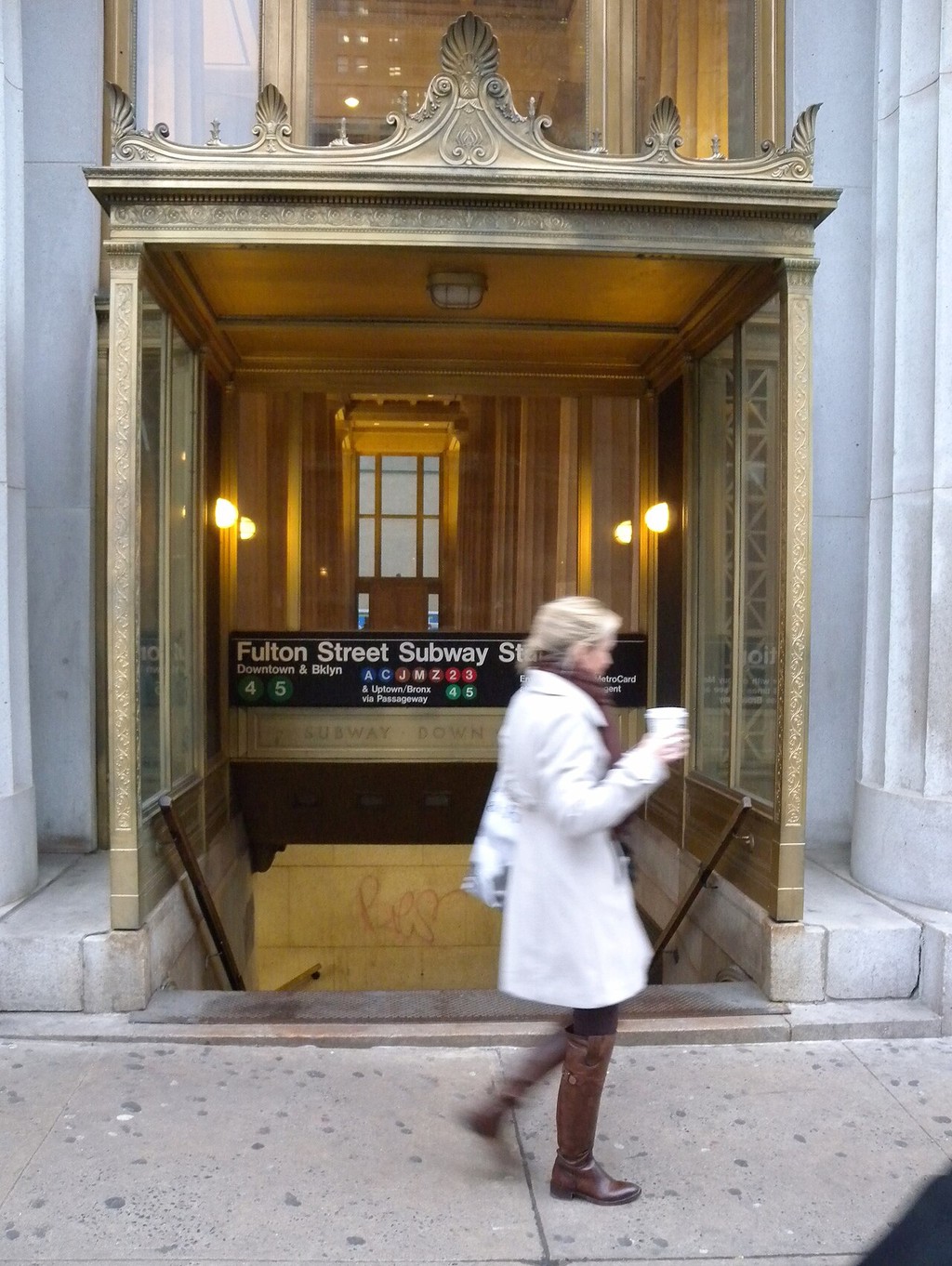
A former Fulton Street subway entrance on Dey Street, photographed in 2010. This modern street-to-station transition offers an architectural comparison with Rothko’s 1938 subject.
Photograph: Jim.henderson. Resized without cropping. [10]
Rothko returned repeatedly to subway platforms, entrances and travellers during the 1930s. The National Gallery of Art describes his Works Progress Administration years as a period in which he painted subway scenes that stressed the isolation of riders.[2] Its online Works on Paper catalogue records sketchbooks used in New York streets and in the subway system. Those drawings show that urban observation was part of a sustained working practice, rather than a single detour before abstraction.[3] A sketch and a painting can be related without being the same object or proof of a direct preparatory sequence; the surviving evidence should be read at that level.
The Gallery's detailed account of Gyral Sketch Book 2, dated 1938 to about 1940, makes that practice more concrete. The inexpensive spiral pad contains drawings in graphite, ink and water-based paint, some made rapidly and apparently in public settings. The catalogue identifies street and subway figures among its subjects and notes relationships between several sketches and canvases dated 1937–39 by Anfam.[3] It does not designate a particular page as the preparatory drawing for Entrance to Subway. What it does establish is a habit of recording posture, waiting and movement while testing how a figure fits inside a narrow urban space. In the painting, that observed world is transformed into a more controlled arrangement of stairs, opening and dark passage.
Figures and architecture
The people in Entrance to Subway are legible as travellers, but Rothko does not make them individual portraits. Their elongated shapes and muted gestures are set against stairs, walls and dark openings. Looking across the painting, the eye alternates between human silhouettes and the more insistent rectangular passages around them. The apparent quietness of the encounter contrasts with the noise associated with the New York subway. A Christie's catalogue essay later singled out this work as the best-known of Rothko's subway pictures and noted the shadowed entrance and the descent to a lower platform.[4]
It would be too simple to call the picture an early version of a mature Rothko rectangle. The 1938 work still depends on people, an identifiable setting and an implied action. Yet its architecture already gives large areas of the surface a distinct expressive role. The walls and voids do more than locate the figures: they control the painting's rhythm and the viewer's sense of confinement. That observation can help explain a continuity of concern with space without pretending that Rothko had already settled on the abstract language of the 1950s.
Where the painting fits in Rothko's career
Rothko had moved to New York after leaving Yale and developed his art through study, teaching and contact with other artists. The city offered a subject close to daily life. In the early pictures he tried portraits, interiors and streets as well as subway scenes. Later in the 1930s and 1940s his imagery shifted toward myth and more ambiguous forms; by the late 1940s, the recognisable figures had largely given way to open areas of colour.[2] The subway works therefore document one important stage in a long series of changes, not a crude prelude to a predetermined destination.
The Entrance to Subway title also needs careful handling because Rothko made several similarly themed works. The National Gallery of Art owns an Untitled (subway) dated about 1937 and an Underground Fantasy dated about 1940. They have different measurements and collection records.[5][6] Anfam's Mark Rothko: The Works on Canvas lists Entrance to Subway and several other subway subjects separately in its accessible index.[7] The book's detailed entry is subscription restricted, so the exhibition checklist and owning-institution records provide the object-specific facts used here.
The NGA's Untitled (subway) offers a particularly useful comparison because its museum record describes a platform with waiting figures and architectural supports.[5] Entrance to Subway shifts the subject to descent and the moment of crossing from street to station. That change in viewpoint alters the role of the human figures: they are not simply waiting within a long platform, but moving into a space the viewer cannot fully see. Underground Fantasy then indicates that Rothko continued to revisit the subject around 1940.[6] These are three distinct solutions to the subway problem, not variant titles for one picture. The 1998 checklist's dimensions and ownership line anchor the present canvas amid that family of related works.
Exhibition and later reception
Rothko chose Entrance to Subway for the 1961 Museum of Modern Art retrospective, according to a Christie's catalogue essay.[4] That later choice matters: he did not present only the familiar colour-field pictures when representing his career. The painting was also included in the National Gallery of Art's 1998 Rothko exhibition checklist.[1]
The painting has also been reproduced in the publication for Gottlieb/Rothko: The Realist Years, held at New York gallery 125 Newbury in May–July 2025.[8] The publication gives the alternative identifying titles “Subway Station” and “Subway Scene” in braces and repeats the canvas measurement of 34 × 46¼ inches. On the facing page is Adolph Gottlieb’s South Ferry Waiting Room (c. 1929), an especially useful comparison: both artists made transit interiors subjects of serious modern painting, but their different arrangements of figures and enclosing architecture resist a simple claim of direct influence. The gallery’s accompanying essay presents the early realist work as an independent part of the artists’ careers rather than merely a route to their later abstraction. Reproduction in the catalogue confirms renewed scholarly attention to Entrance to Subway; the online selected-works list does not establish that this particular canvas was physically hung in the 2025 exhibition. The early urban work has continued to attract attention because it makes clear how many visual problems Rothko considered before the classic format emerged: the relation of figure to ground, the emotional force of a large enclosing shape, and the ability of a setting to change how a viewer feels near a painting.
Nothing in the available institutional record establishes that the scene was intended as a literal statement about a specific political event or that a particular rider is the artist. The strongest reading begins with what the picture and documented career establish: Rothko made the modern city into an unsettling, carefully organised environment. His later move away from pictured people did not erase his interest in how a painting might place a viewer inside an experience.
Related works
For other New York subjects, see Rothko's biography and the paintings overview. Hierarchical Birds shows how different his imagery became by 1944; No. 3/No. 13 shows the later move toward broad colour areas. These works are separate objects, connected here to trace the changing questions Rothko asked of painting.
Rothko works in this guide
| Name | Date | Medium |
|---|---|---|
| Entrance to Subway | 1938 | Painting |
| Hierarchical Birds | 1944 | Painting |
| Slow Swirl at the Edge of the Sea | 1944 | Painting |
| No. 3/No. 13 | 1949 | Painting |
| Untitled (Violet, Black, Orange, Yellow on White and Red) | 1949 | Painting |
| White Center | 1950 | Painting |
| No. 10 | 1950 | Painting |
| No. 6 (Violet, Green and Red) | 1951 | Painting |
| Untitled | 1952 | Painting |
| No. 61 (Rust and Blue) | 1953 | Painting |
| No. 1 (Royal Red and Blue) | 1954 | Painting |
| Untitled (Yellow and Blue) | 1954 | Painting |
| Orange and Yellow | 1956 | Painting |
| Light Red over Black | 1957 | Painting |
| Four Darks in Red | 1958 | Painting |
| Black on Maroon | 1958 | Painting |
| No. 14 | 1960 | Painting |
| Orange, Red, Yellow | 1961 | Painting |
| Untitled (brown and gray) | 1969 | Painting |
| Untitled (Red on Red) | 1969 | Painting |
| Untitled (Black and Gray) | 1970 | Painting |
| Tentacles of Memory | 1945–46 | Drawing |
Frequently Asked Questions
It is Rothko’s 1938 oil painting of figures within the architecture of a New York subway entrance. The NGA’s 1998 exhibition checklist records dimensions of 86.4 × 117.5 cm and the collection of Kate Rothko Prizel at that date. It belongs to his figurative city pictures.[1]
The painting centres on an entrance, stairs and the enclosing space around travellers, rather than a view of a train. Its simplified architecture makes an ordinary urban journey feel constricted and uncertain. Identifying a particular station is not necessary to understand that relationship between figures and space.
No. The NGA’s Untitled (subway) is a separate work, dated about 1937, with its own dimensions and accession 1986.43.113. Similar subjects should not obscure the difference between the two paintings.[5]
Yes. The NGA’s paper catalogue records street and subway subjects in his sketchbooks. Gyral Sketch Book 2, dated 1938 to about 1940, shows a sustained interest in urban figures. It does not identify one particular page as the preparatory drawing for this canvas.[3]
Discussion
What changes when you look at Entrance to Subway as a physical painting rather than a small reproduction?
Use the questions below to compare the work with its neighbours in Rothko’s career.
Reader Insights
Which edge or interval asks you to slow down?
How does this painting differ from the earlier and later works linked here?
What remains uncertain after reading the museum record and looking closely?
Join the Conversation
Share an observation grounded in the work or its documented history.
References
- National Gallery of Art, 1998 Mark Rothko exhibition checklist, entry 9.
- National Gallery of Art, Mark Rothko artist record.
- National Gallery of Art, The Scribble-In Book and Gyral Sketch Book 2.
- Christie's, catalogue essay for Untitled (Rust, Blacks on Plum), discussion of the subway pictures and 1961 retrospective.
- National Gallery of Art, Untitled (subway), accession 1986.43.113.
- National Gallery of Art, Underground Fantasy, accession 1986.43.130.
- David Anfam, Mark Rothko: The Works on Canvas—Catalogue Raisonné (National Gallery of Art and Yale University Press, 1998), accessible index only.
- 125 Newbury, Gottlieb/Rothko: The Realist Years exhibition page and May 2025 exhibition publication, pp. 8–9.
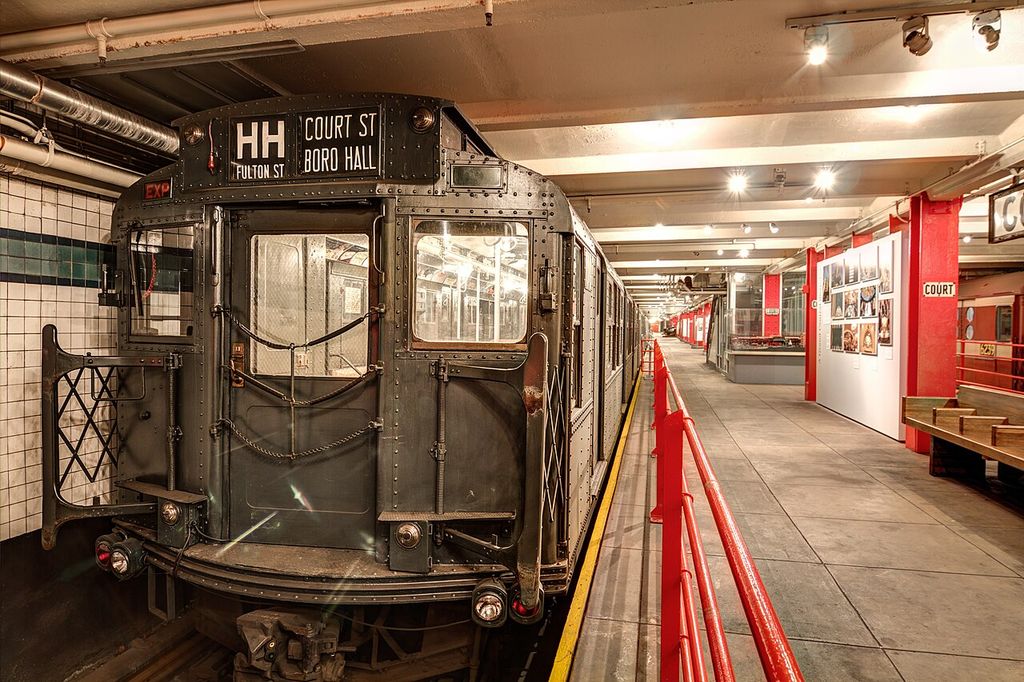
- A New York IND R1 car built in 1930, photographed at the Transit Museum in 2013. This is subway context, not Rothko’s painting or an identified station in it. Photograph: MTAPhotos; source record; CC BY 2.0. Resized to 1024px without cropping.
- Fulton IRT 195 Bwy st jeh.jpg. Photograph: Jim.henderson. Resized without cropping. Source · CC0 1.0.