by Tom Gurney
Tom Gurney BSc (Hons) is an art history expert with over 20 years experience
Published on June 19, 2020 / Updated on October 11, 2026
Email: tomgurney1@gmail.com / Phone: +44 7429 011000
Mark Rothko’s biography: Introduction
Mark Rothko's path from immigrant child to one of the most consequential American painters of the twentieth century was neither direct nor confined to the colour-field canvases for which he is now known. He was born Marcus Rothkowitz in Dvinsk in 1903, moved with his family to Portland, Oregon, then made his adult career in New York. Over more than four decades he passed through figurative city paintings, mythic and Surrealist imagery, increasingly abstract colour arrangements, large canvases and site-specific commissions.[1] His development brought teaching, family life, artistic friendships, public argument and institutional recognition into a changing relationship with the work.
At a Glance
- Lived1903–1970 [1]
- Birth nameMarcus Rothkowitz [1]
- Born / workedDvinsk (now Daugavpils) / New York [1]
- TrainingArt Students League; studied with Max Weber [1]
Explore Rothko’s career
Figurative and urban
1930sMyth and Surrealism
1940–46Colour fields
1947–61Murals and late paper
1958–70Adolph Gottlieb: joint 1943 statement
1943Clyfford Still: California teaching context
1947–49No. 3/No. 13
1949White Center
1950Black on Maroon
1958Rothko Chapel
1964–67Four stages of Rothko’s work
People within built space
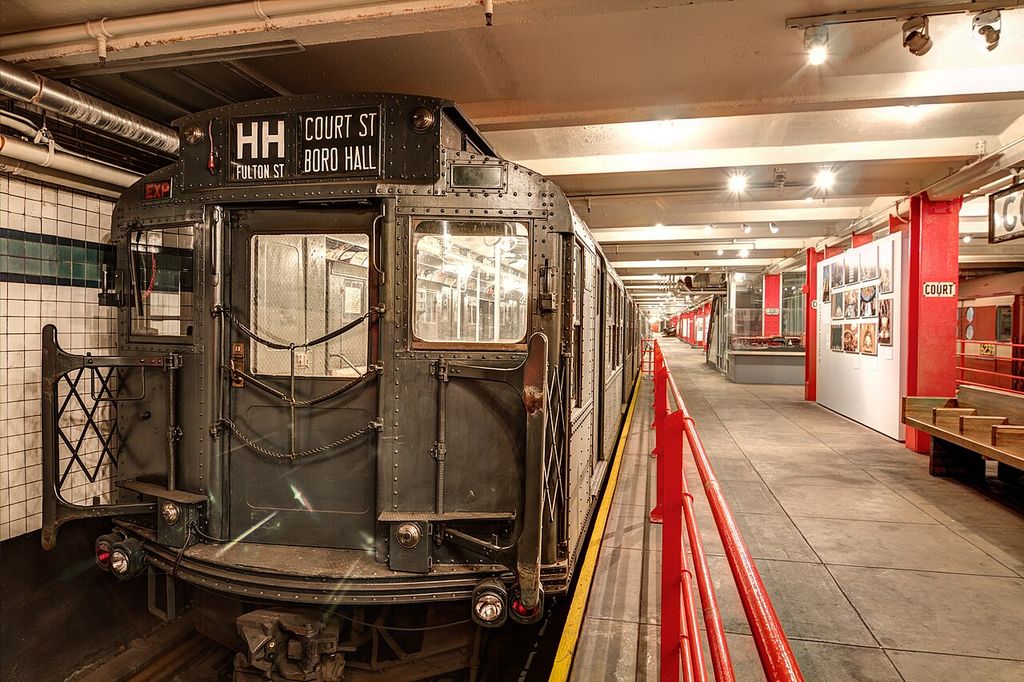
Early portraits, city scenes and subway paintings explore the relation between figures and New York architecture.
Forms that resist one fixed story
Works such as Hierarchical Birds use mythic and organic imagery. Rothko and Gottlieb debated serious subject matter in their jointly signed 1943 statement.
Large, soft-edged areas
The 1949 transition leads to White Center and a varied mature format. Scale, edge and surrounding ground make each painting distinct.
Architecture, acrylic and paper
The Seagram project and Rothko Chapel ask how paintings occupy rooms, while late work continues on canvas and paper.
Contents
- 1903–1923: Dvinsk, Portland and Yale
- 1924–1939: learning, teaching and city pictures
- 1940–1946: myth, collaboration and Surrealism
- 1947–1954: the move to colour fields
- 1955–1963: scale and the Seagram decision
- 1964–1970: Houston and late materials
- After 1970: the estate, Foundation and public collections
- How the biography has been researched
- Continuing exhibitions and catalogue research
1903–1923: Dvinsk, Portland and Yale
Rothko was born on 25 September 1903 in Dvinsk, then in the Russian Empire and now Daugavpils, Latvia. The National Gallery of Art names his parents Jacob and Anna Goldin Rothkowitz and records that, at ten, he travelled with his mother and sister to join his father and brothers in Portland.[1] That move placed the family in the United States before Rothko's artistic career began.
He attended Yale University from 1921 to 1923 on a scholarship, according to the NGA chronology, then left for New York.[1] A later narrative can make the move sound like the inevitable first step toward modern painting; the historical record is more open. His training, work and friendships took shape over several years. The Art Students League in New York was one place he studied, with George Bridgman and Max Weber among the instructors named by the Gallery. Rothko did not simply inherit a finished style from a teacher; he encountered a range of artistic possibilities in a city where modern art institutions and communities were expanding.
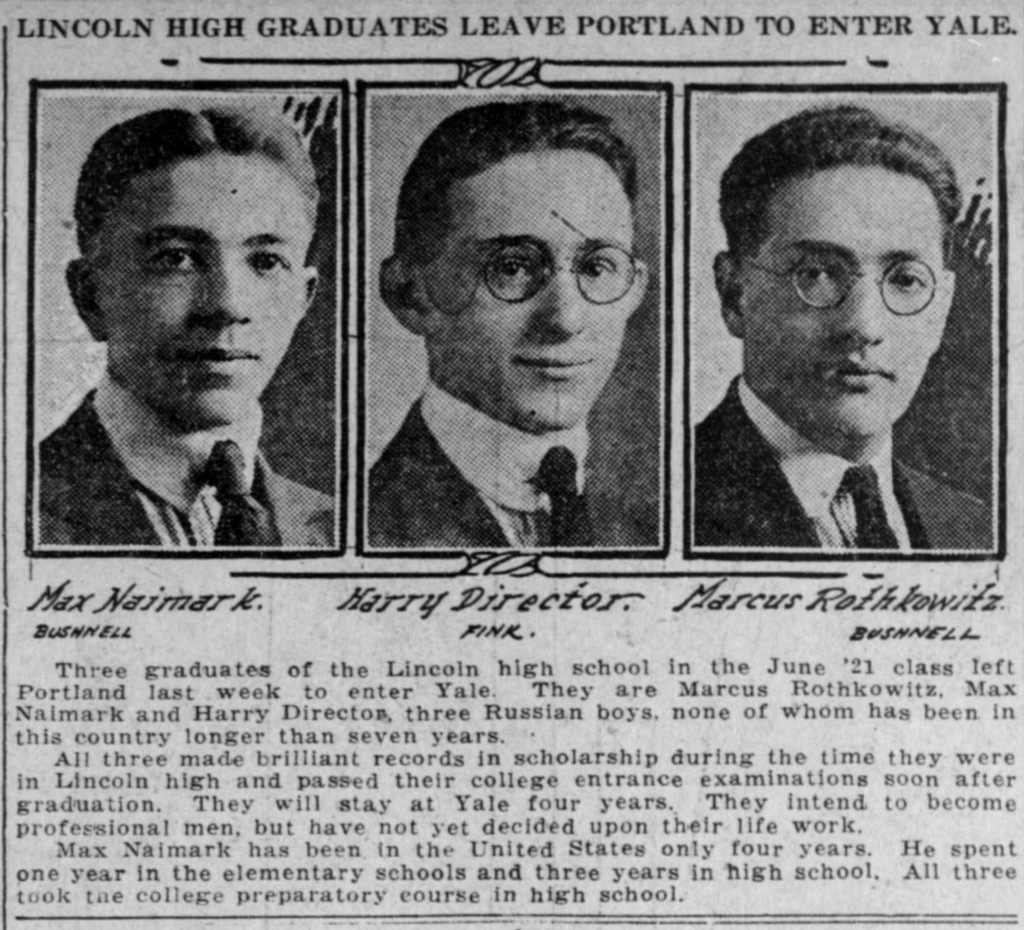
Marcus Rothkowitz, later known as Mark Rothko, at right, with Max Naimark at left and Harry Director at centre, as named in a Yale-bound students item. The Sunday Oregonian, 18 September 1921, section three, page 6. Detail preserves the complete item; the date is its publication date.
Portrait credits printed in the item: Bushnell and Fink. Historic Oregon Newspapers, University of Oregon Libraries. [37]
Daugavpils is more than a place-name in the first line of a biography. The Rothko Museum there opened in 2013 and, through collaboration with the artist's children, presents rotating works from the family collection. Its current account says twenty-four different family-collection works have been shown since opening.[13] The museum cautions through its curatorial approach against reading each painting as a direct illustration of the artist's childhood. That is a useful distinction here: the city is a documented biographical origin and a present-day place of interpretation, while specific claims about how a childhood memory produced a later colour or form would need stronger evidence.
A migration made in stages
The family’s move occurred over several years. Art historian Abigail Susik’s account for the Oregon Historical Society records Jacob’s arrival in Portland in 1910, followed by the older sons in early 1913 and then Marcus, his mother and sister. An uncle’s clothing business helped connect the family to the city. Marcus learned English, sold newspapers and assisted in his father’s business. Jacob died in March 1914, shortly after the family’s reunion. The children’s employment then became more important to the household.[23]
These circumstances put education and work together in Rothko’s early life. His interests included literature, music and drama as well as the visual arts. The change of country introduced a new language and school system while leaving family connections to the old world intact. Dvinsk and Portland supplied different settings for an adolescence that cannot be summarised by the later public identity of an American painter.
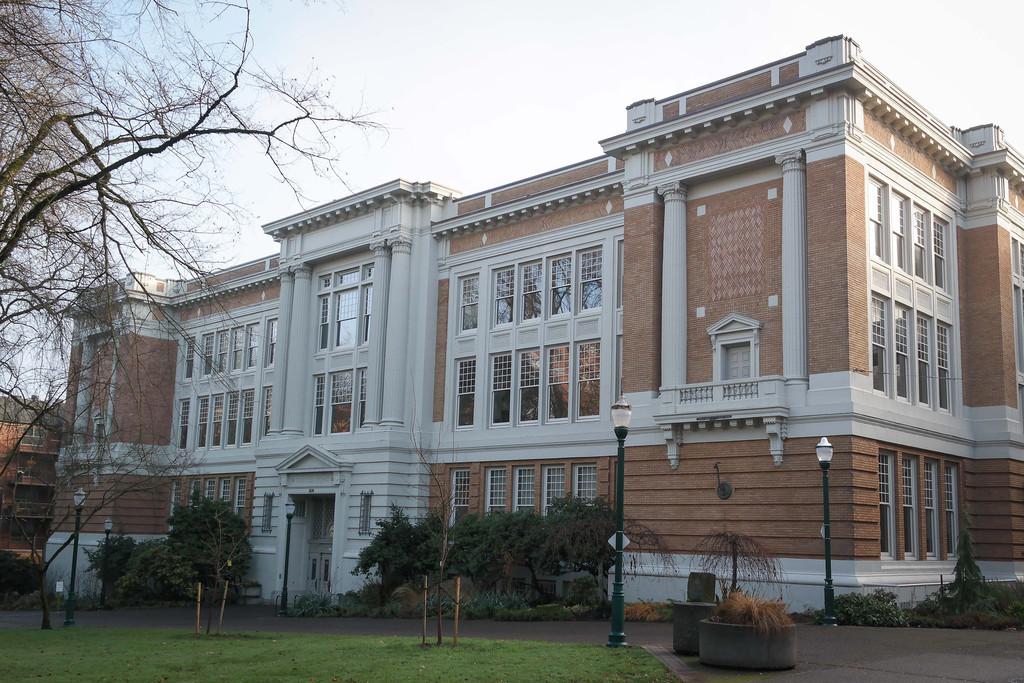
Lincoln Hall in Portland, photographed on 3 January 2014. This was the Lincoln High School building Rothko attended; it later became part of Portland State University.
Photograph: Visitor7. Resized; photograph remains CC BY-SA 3.0. [38]
Annie Cohen-Solal’s biography, published in Yale’s Jewish Lives series, places immigration and Jewish identity centrally within her account, including Rothko’s sense of exclusion at Yale.[34] This adds social context to the fact that he left without a degree. It also makes his later institutional recognition a history of changing access and standing, rather than an uncomplicated progression through elite education.
1924–1939: learning, teaching and city pictures
Rothko enrolled at the Art Students League in 1924 and later sustained a long position teaching children at the Center Academy of the Brooklyn Jewish Center, beginning in 1929.[1] Teaching continued for more than twenty years. It was part of the practical structure of his life while he developed as an artist and exhibited work. An account focused only on famous late canvases misses that long overlap of teaching and painting.
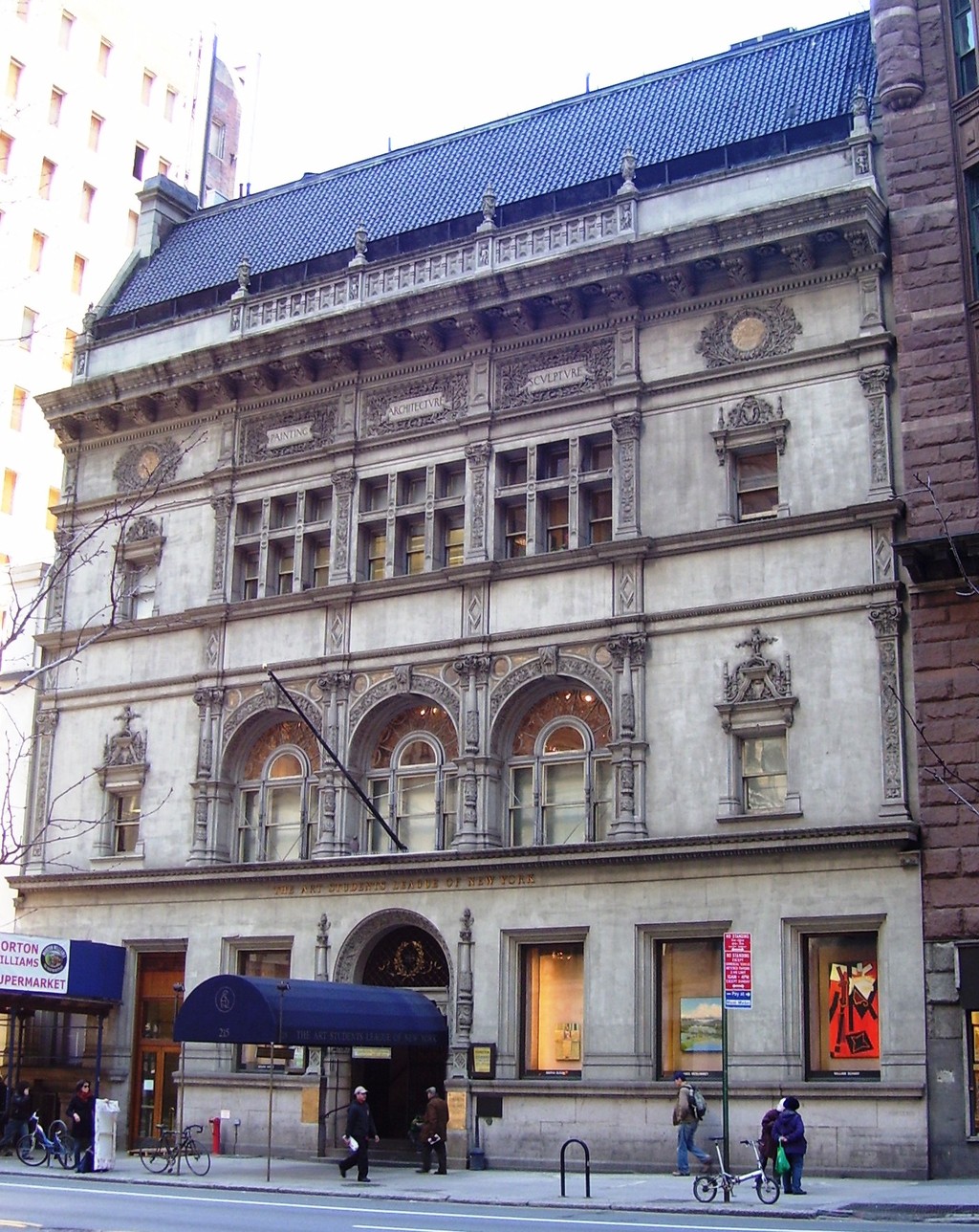
The Art Students League on West 57th Street, photographed in 2011. Rothko’s studies there connected him with Max Weber’s teaching.
Photograph: Beyond My Ken. Photograph remains CC BY-SA 4.0. Resized without cropping. [39]
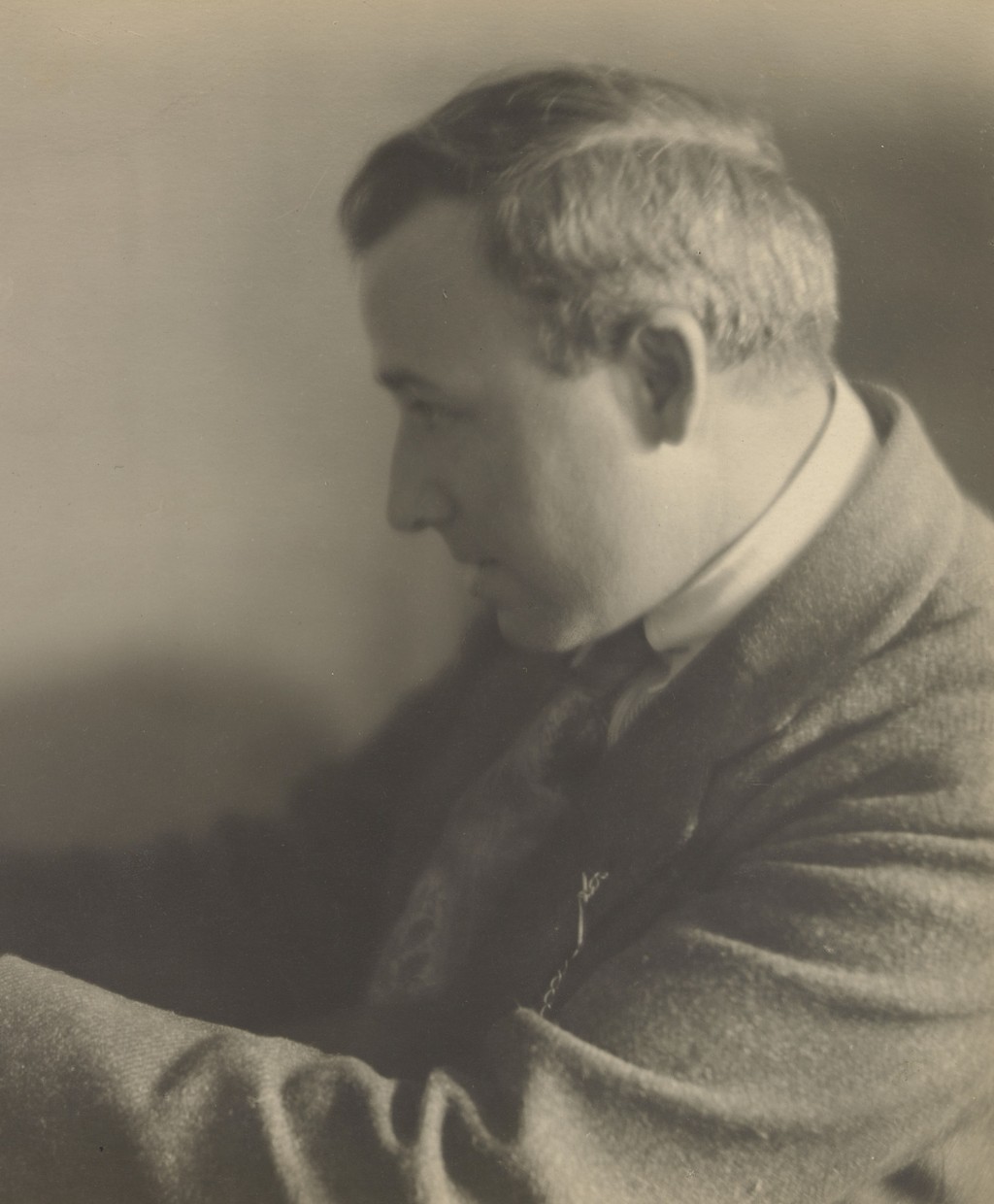
Max Weber, circa 1916, in a portrait detail by Clara Sipprell. Rothko studied with Weber at the Art Students League in the 1920s.
Clara Sipprell; National Portrait Gallery, Smithsonian Institution; bequest of Phyllis Fenner; NPG.82.202. Faithful portrait detail crop; no retouching or colour changes. [40]
His first solo exhibition was in Portland in 1933; a New York solo show followed a few months later. The latter included landscapes, nudes, portraits and city scenes.[1] Rothko was still working with recognisable subjects. In the mid-1930s he participated in Gallery Secession, then formed the Ten with artists including Adolph Gottlieb and Ilya Bolotowsky. The group exhibited together eight times from 1935 to 1939, according to the NGA.[1] Its existence shows Rothko embedded in artist networks rather than painting in isolation.
Guggenheim Bilbao's chronology supplies a wider view of that network: a 1928 Opportunity Galleries group exhibition brought Rothko together with Milton Avery and Louis Harris; he met Gottlieb in 1929 and Barnett Newman in 1936.[22] It also records that the Ten exhibited at Galerie Bonaparte in Paris in 1936, while Rothko himself remained based in the United States. The chronology distinguishes an early international exhibition from his later international travel; a painting shown abroad is not proof that the artist visited that city. Rothko became a US citizen in 1938, and by 1940 had shortened his name, according to the Bilbao institutional timeline.[22] Such dated details matter more than a compressed story in which he seemed to emerge only with colour-field painting after the war.
The New York subway became one subject in these years. The NGA says his WPA period included subway scenes that emphasised the isolation of riders.[1] Entrance to Subway, dated 1938 in an NGA exhibition checklist, is an object-specific route into that work. The figures and architectural spaces matter: they show Rothko exploring how a built environment can shape human presence. The later removal of figures from his paintings should not erase the questions he was asking here.
The 2026 Palazzo Strozzi retrospective offers a material detail about this early period. Its curators describe small figurative paintings made on gesso-prepared boards, a support associated with European painting traditions, alongside portraits, nudes, still lifes and urban scenes.[14] They compare the architectural tension of Interior (1936) with Michelangelo's Medici tombs. That is a curatorial visual comparison, not proof that Rothko had already visited Florence: his first documented trip came later. It does, however, challenge the idea that early figuration was only unformed practice. He was already choosing supports and historical references that could give a scene more than documentary meaning.
Exhibiting and organising during the Depression
Cohen-Solal’s authorised book excerpt describes an early career spread across several modest galleries and artist initiatives. Exhibition participation was frequent while sales remained limited. She treats Rothko’s role in the Ten and in wider organisations, including the Artists’ Union and American Artists’ Congress, as part of artists’ struggle for recognition and better working conditions. Her account places citizenship in 1938 and the adoption of the shorter name in 1940 within this period of public and personal change.[24]
The group activity has a concrete object record. The National Gallery lists Street Scene, dated 1936/1937, in the Ten’s 1937 auction to benefit Spanish children and in the 1938 American Artists’ Congress exhibition.[25] The record connects one early painting to a public cause and to organised artistic life. It also preserves the signature “Rothkowitz,” joining an object’s physical history to the change of name described in the chronologies.
Such evidence gives the early career more texture than the image of a solitary painter waiting to discover abstraction. Showing work required colleagues, venues, organisers and audiences. Political commitments could affect which groups artists joined or left; exhibitions could serve relief efforts as well as commercial sales. Those circumstances form part of the setting in which Rothko developed his ideas about the artist’s place in society.
Teaching also entered the exhibition story. Susik records that the 1933 Portland show included work by Rothko’s Brooklyn pupils alongside his own watercolours and tempera sketches. The visit with Edith Sachar involved an inexpensive journey across the country and camping in Washington Park.[23] The exhibition joined a return to family with the activity that helped support his New York life. The pupils’ inclusion makes his role as a teacher visible in the record of his first solo presentation.
1940–1946: myth, collaboration and Surrealism
Rothko's paintings changed substantially in the 1940s. The NGA describes oil and watercolour works drawing on Greek myth, Christian tragedy, so-called “primitive” art and Surrealist techniques such as automatic drawing.[1] These historical terms come from the museum's account; today they also call for care about the cultural sources they compress. Rothko and Gottlieb jointly wrote to critic Edward Alden Jewell in 1943 after a review of their mythic paintings. The Gottlieb Foundation's archive shows that they combined their responses into one signed document about imagination, serious subject matter and large simple shapes.[2] Quotations from it require credit to both artists.
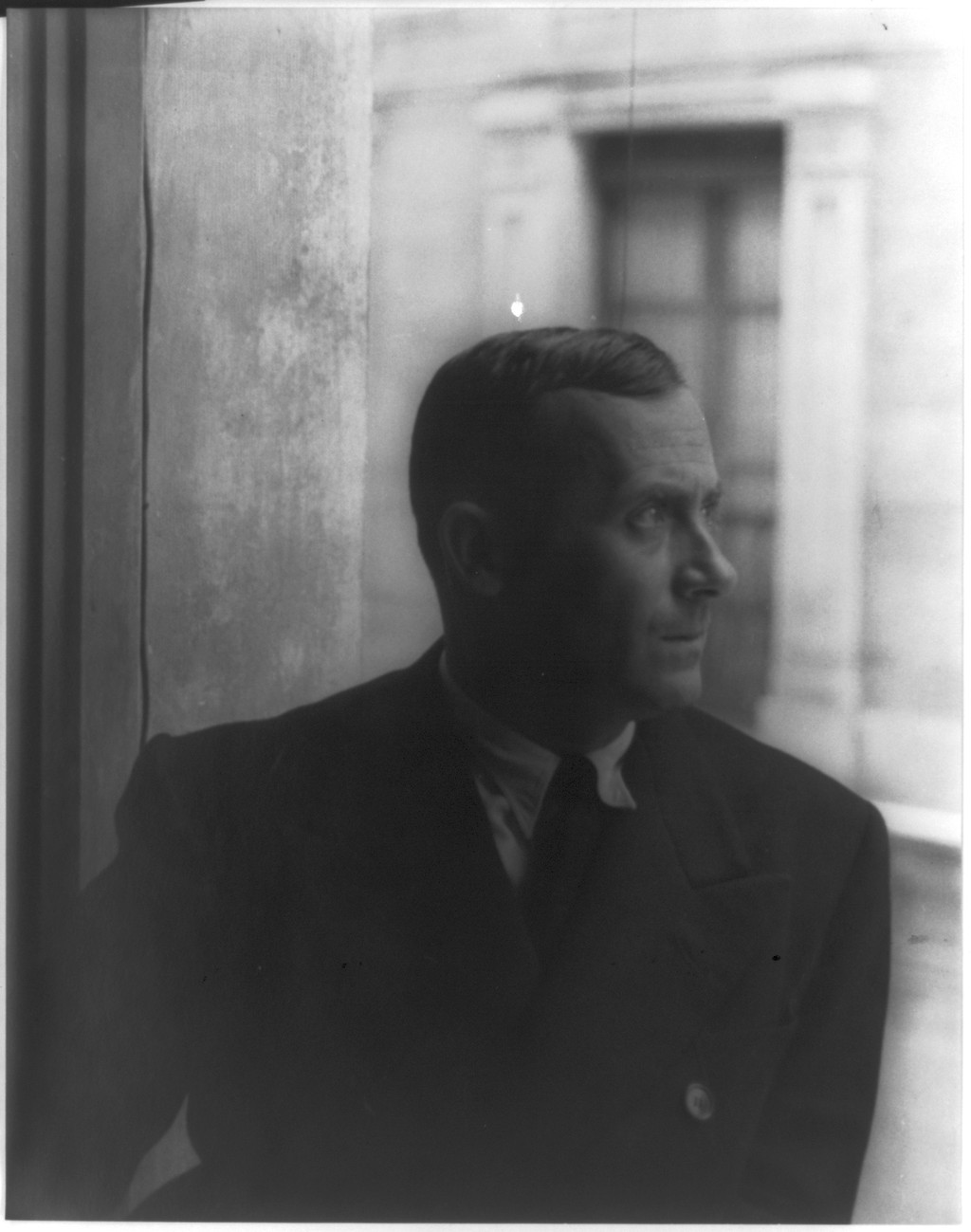
Joan Miró in Barcelona, 13 June 1935, photographed by Carl Van Vechten. The National Gallery identifies Miró among Rothko’s Surrealist influences.
Library of Congress, Prints & Photographs Division, Carl Van Vechten Collection; LC-USZ62-42511. Resized without cropping. [41]
Hierarchical Birds and Slow Swirl at the Edge of the Sea are both from 1944 yet differ in scale, orientation and how their creaturelike forms appear. The latter was shown at Peggy Guggenheim's Art of This Century in 1945 and then acquired by Guggenheim, MoMA records.[3] The NGA lists Hierarchical Birds in the same 1945 exhibition.[4] Tentacles of Memory, a drawing of about 1945–46, adds a paper example of the period. This was a sustained investigation, not a brief detour before “real” Rothko paintings began.
Rothko also took part in organisations and debates among New York artists. The NGA records a 1940 break with the American Artists' Congress and the founding of the Federation of Modern Painters and Sculptors with colleagues.[1] In 1948 he joined William Baziotes, David Hare and Robert Motherwell in the short-lived Subjects of the Artist school. Such collaborations help situate the public statements and exhibitions. They do not reduce his painting to a group's doctrine.
The institutional exhibition trail shows where this work was encountered while Rothko was still searching for his later format. Guggenheim Bilbao lists a 1945 presentation at Art of This Century, a 1946 exhibition at the San Francisco Museum of Art that travelled to Santa Barbara, a 1947 summer teaching post at the California School of Fine Arts, and regular exhibitions at Betty Parsons Gallery from that year.[22] NGA's object history confirms Hierarchical Birds in the 1945 and 1946 shows.[4] Comparing a broad artist chronology with an individual work record prevents a generic “Rothko showed there” statement from becoming a false claim that every surviving early canvas appeared in every venue.
The Strozzi curators place Greek, Roman and Babylonian myth among the sources investigated in the early 1940s, with works such as Room in Karnak and Tiresias.[14] Their account draws attention to quick marks, abrasions and rubbed paint surfaces in this period. These specific procedures help explain why the shift toward the later colour fields was a change in handling and pictorial space as well as a change in subject. The transition did not instantly erase every earlier concern with scale or the viewer; it altered how those concerns appeared on the surface.
New York and California were connected
Rothko’s teaching in California belongs to a wider exchange between the two coasts. SFMOMA curator Janet Bishop places his summers at the California School of Fine Arts in 1947 and 1949 beside Clyfford Still’s longer tenure and Ad Reinhardt’s later visit. The San Francisco museum had already shown Rothko in 1946, within a sequence of exhibitions introducing Gorky, Still, Pollock and Motherwell to the region.[26]
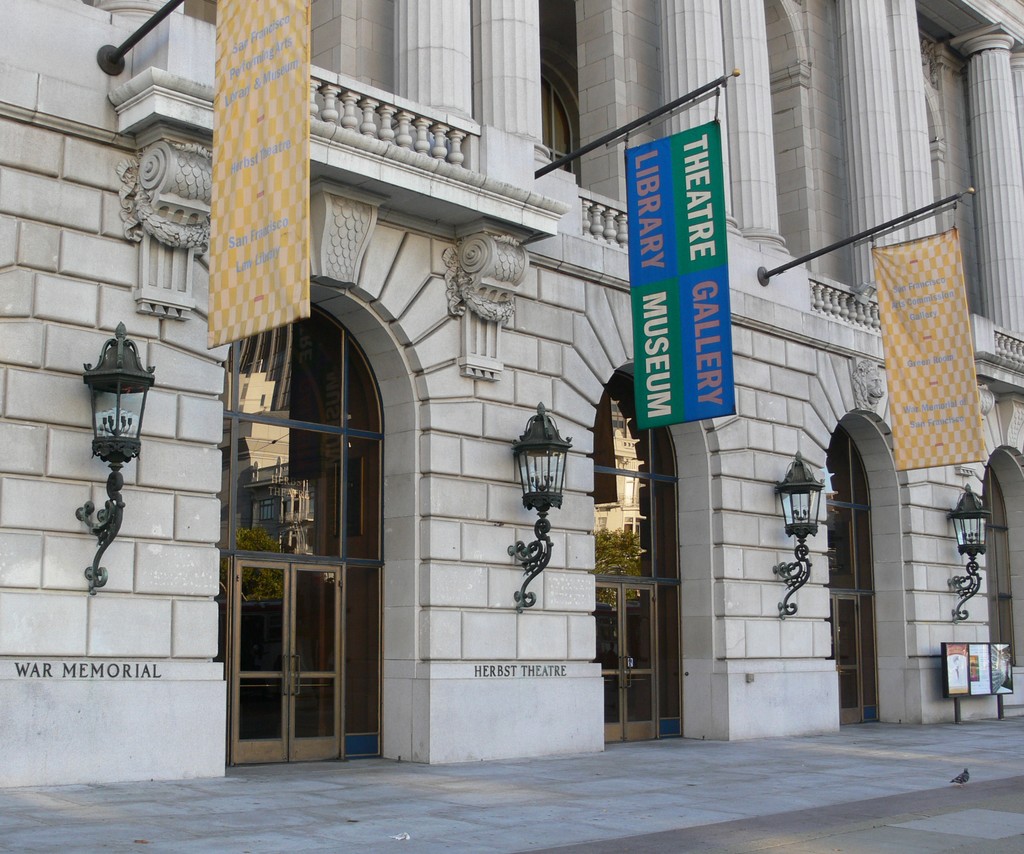
San Francisco’s War Memorial Veterans Building in 2008. The San Francisco Museum of Art opened on its fourth floor in 1935, providing the institutional setting for Rothko’s early California recognition.
Photograph: Photo: Andreas Praefcke. Resized without cropping. [42]
Bishop’s account also describes the importance of local annual exhibitions and the later emergence of Bay Area Figurative Painting. This context shows that the reception of abstraction remained active and contested. Rothko’s presence contributed to a community where artists could respond in different directions. It would overstate the evidence to describe every later Bay Area artist as his pupil or to treat their work as the product of one teacher.
The 1961 MoMA catalogue records further teaching appointments: Brooklyn College from 1951 to 1954, the University of Colorado at Boulder in 1955 and Tulane University in the winter of 1956.[27] These appointments widen the geography of a career generally associated with New York studios. They also extend the teaching story beyond the familiar twenty-year period of children’s classes.
1947–1954: the move to colour fields
The change from mythic forms to non-objective painting unfolded during the late 1940s. The NGA says Rothko had removed Surrealist and mythic imagery by 1947, and by around 1950 had settled on the broad, soft-edged rectangles associated with his mature practice.[1] That description is a useful chronology, though works from the threshold show experimentation rather than a single switch. MoMA's No. 3/No. 13 and the Guggenheim's Untitled (Violet, Black, Orange, Yellow on White and Red) both date to 1949 but have distinct colour structures and histories.
The 1950 canvases White Center and MoMA's No. 10 show how varied the emerging format could be. Anfam's publicly available 2007 essay on White Center treats it as an especially resolved painting of that threshold and draws attention to subtle changes of ground and edge.[5] It is a direct essay by the scholar, separate from the still-unchecked entry in his 1998 catalogue raisonné. The move toward colour fields did not mean colour alone was decorative; Rothko's museum-recorded statements emphasise the experience a painting could create.[6]
Rothko's recognition increased. The NGA records a one-person exhibition at the Art Institute of Chicago in 1954.[1] No. 1 (Royal Red and Blue) appeared in the Chicago exhibition and later at Sidney Janis Gallery, where a title variant was used. Auction records quote Anfam catalogue numbers for that and several other canvases, giving this site a way to link exact objects to the printed scholarship without pretending to have read inaccessible entries. The mature paintings were large, but their individual proportions, palettes and titles continued to vary.
Guggenheim Bilbao's Spanish object study gives the Chicago exhibition a physical shape: eight large works were arranged in a relatively small, low-ceiling room, and its own Untitled (1952–53) hung freely near the entrance.[19] That painting is a separate, exceptionally broad canvas, 299.5 × 442.5 cm, which Bilbao's English note relates to an exhibition label No. 10 and Anfam no. 483.[20] It is neither MoMA's 1950 No. 10 nor the privately held 1952 Untitled studied elsewhere in this cluster. This documented installation demonstrates why Rothko's interest in viewer proximity is a question of rooms and hangs as well as of canvas dimensions. It also demonstrates why numerical exhibition labels must be tied to exact works.
Another experiment in sustained viewing emerged at the Phillips Collection. Its institutional history says Duncan Phillips bought Green and Maroon in 1957, then two more Rothkos from a 1960 one-person exhibition, and designated a small room for them in the new museum building.[21] A fourth canvas was added in 1964. The room used one painting on each wall, low lighting and seating; when Rothko visited in 1961 he recommended still lower light and a simple bench. The museum says the 2006 relocation preserved the original room's dimensions and orientation. This sequence is distinct from a commission: Phillips assembled and installed acquired paintings, with Rothko involved in refining their viewing conditions. It forms a useful middle case between a single canvas in a general gallery and the later Chapel conceived as a complete environment.
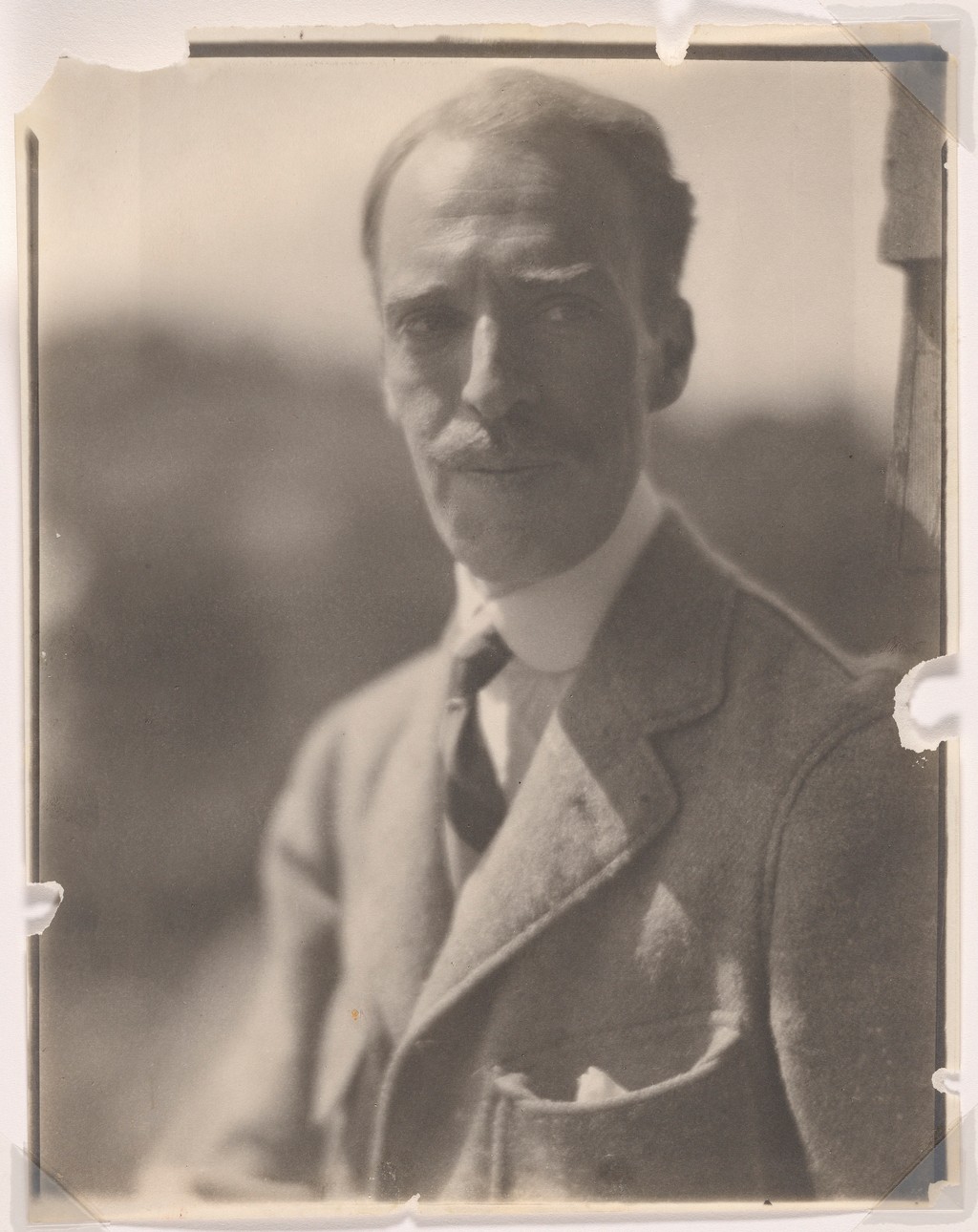
Duncan Phillips, circa 1921, photographed by Clara Sipprell. He later acquired the paintings assembled in the Phillips Collection’s Rothko Room.
Clara Sipprell; National Portrait Gallery, Smithsonian Institution; bequest of Phyllis Fenner; NPG.82.200. Resized without cropping. [43]
In 1950 Rothko travelled in Europe, including Italy. Palazzo Strozzi's account records his encounter with Fra Angelico's frescoes at San Marco and Michelangelo's Laurentian Library vestibule in Florence, and a return to Florence in 1966.[14] The National Gallery separately dates a Laurentian Library visit to summer 1959 during the Seagram period.[15] The Italian dossier also records travel in Italy in 1959, though it is less explicit about a second library visit then. These accounts agree that the Florentine sites entered Rothko's thinking; they do not yield one unambiguous first-and-only encounter. The Seagram guide keeps that dating question visible rather than assigning every portal-like mural form to a single trip.
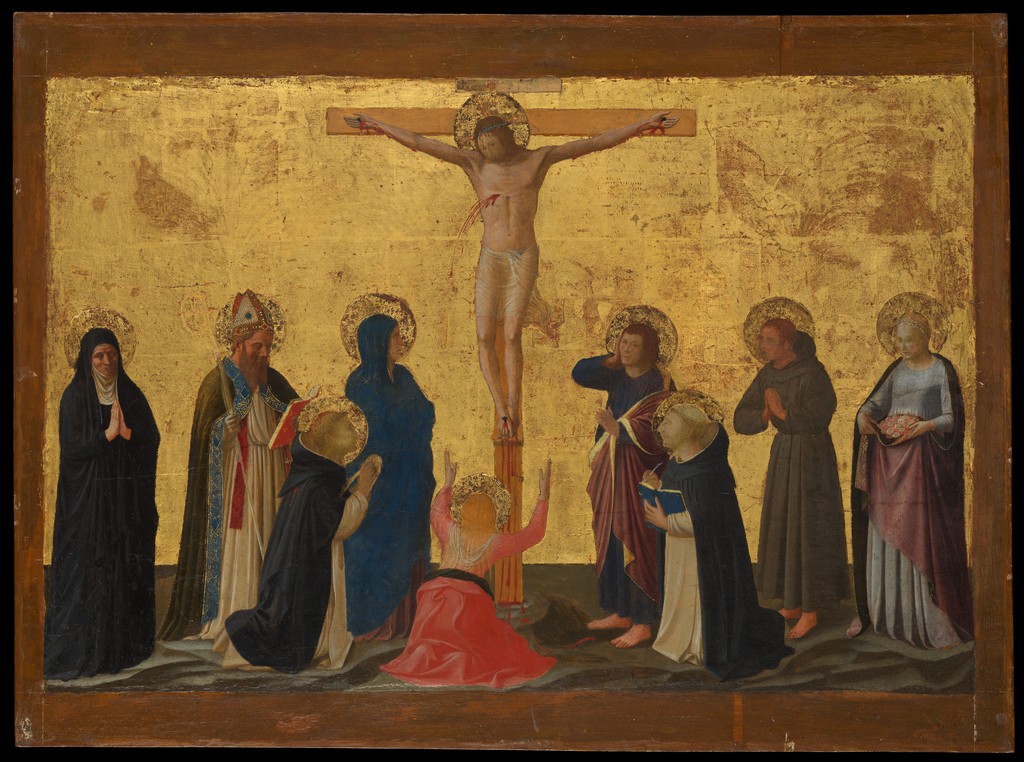
Fra Angelico, The Crucifixion, possibly circa 1440; The Met, 14.40.628. Made during the period of his San Marco frescoes, this museum painting provides context for the Florentine art that interested Rothko.
The Metropolitan Museum of Art, Bequest of Benjamin Altman, 1913; 14.40.628. Resized without cropping. [44]
Curators, collectors and museum recognition
MoMA’s archive preserves Dorothy C. Miller’s notes from a 1951 gallery visit as she prepared Fifteen Americans. The museum explains that Philip Johnson subsequently bought the painting discussed in the notes from Betty Parsons and gave it to MoMA in March 1952, making it the first Rothko in the permanent collection.[28] This is a specific chain of looking, selection, purchase and gift. It gives institutional recognition a practical history.
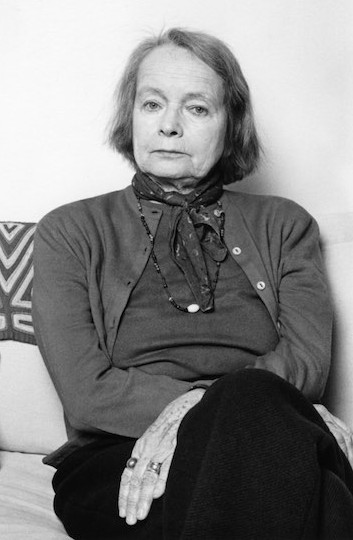
Betty Parsons in a 1977 portrait detail by Lynn Gilbert. Her gallery was part of the earlier acquisition history that brought Rothko’s No. 10 (1950) into MoMA.
Photograph: Lynn Gilbert, 1977. Photograph and portrait crop remain CC BY-SA 4.0. Faithful portrait detail crop; no retouching or colour changes. [45]
A curator’s sustained attention and a collector’s acquisition could change where a work would be seen. Once a painting entered a public collection, its audiences extended beyond the commercial gallery. The dates matter: MoMA acquired Rothko before the 1954 Chicago exhibition and almost a decade before its own retrospective. His rise involved several institutions acting at different times.
The distinction between a museum acquisition and an exhibition is especially useful here. A work can be shown on loan without entering the museum’s collection; a collection work may remain in storage between displays. Rothko’s public career followed both paths. The paintings guide traces individual objects alongside the larger exhibitions that brought them together.
1955–1963: scale and the Seagram decision
Buffalo's Orange and Yellow entered the Albright Art Gallery collection in 1956, the year it was painted.[7] Tate's Light Red over Black followed in 1957. In 1958 Rothko accepted a commission for the Four Seasons restaurant in the Seagram Building. He made more than thirty dark canvases for a room with seven available places, then withdrew from the arrangement as he questioned its suitability for his art, according to the National Gallery.[8] The Seagram guide separates the secure documentary outline from later anecdotes.
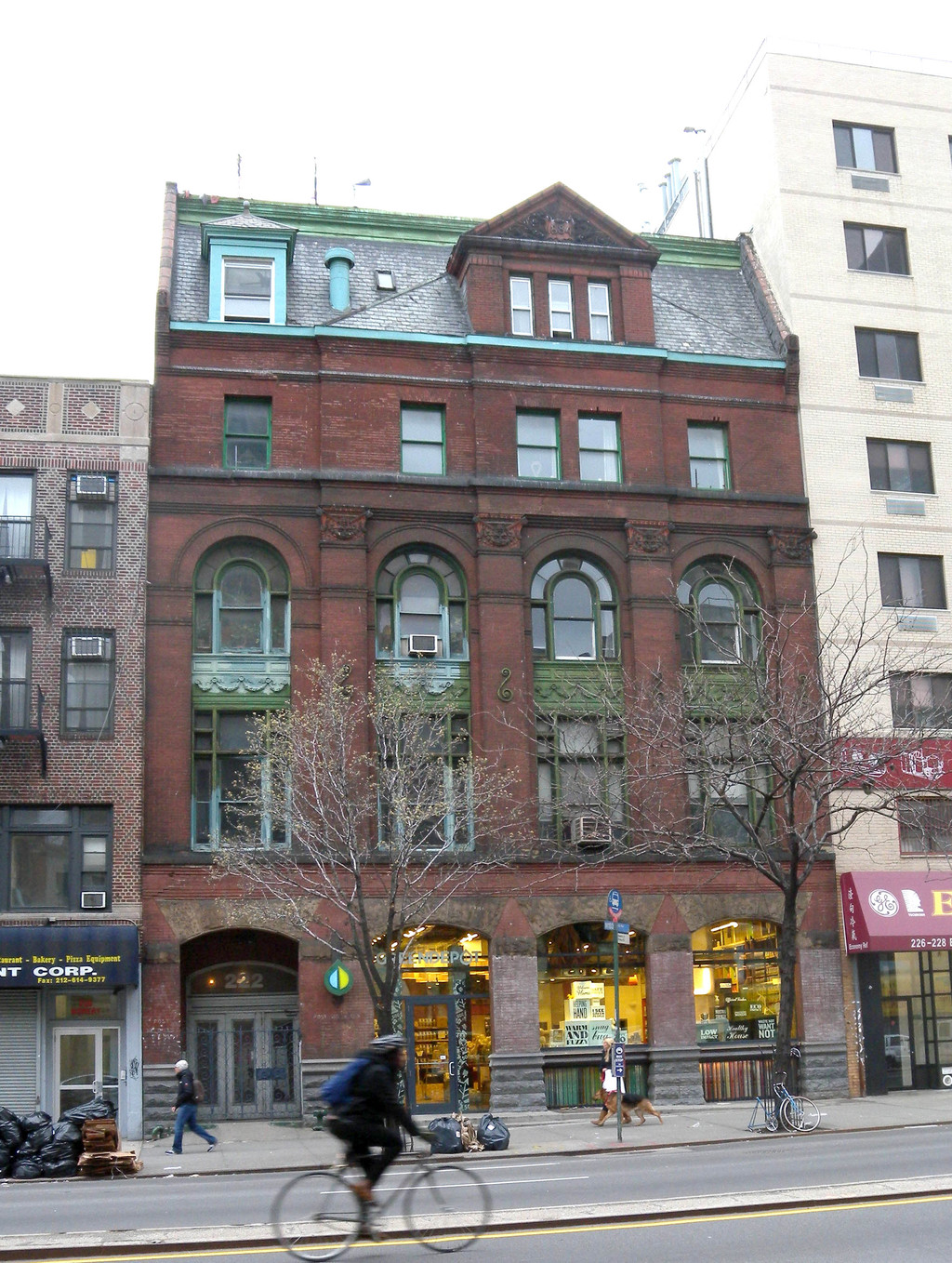
The former YMCA building at 222 Bowery, photographed on 7 April 2009. Rothko began work on the Seagram commission in a studio in this building in 1958.
Photograph: Jim.henderson; released into the public domain by the photographer. [46]
Tate's Black on Maroon of 1958 is tied to the project and later became the subject of a major conservation response after damage in 2012. The Whitney's Four Darks in Red is a separate 1958 painting; a dark palette and shared year do not prove commission membership. This distinction is representative of the method used throughout the cluster: relate works, but keep their object identities intact.
The Seagram withdrawal did not end Rothko's interest in how a set of paintings could occupy a room. The NGA chronology records a second commission for Harvard in 1961.[1] In the same period Rothko painted canvases including SFMOMA's No. 14, 1960 and the 1961 Orange, Red, Yellow, which later appeared in the Pincus collection. These individual works should not be folded into a mural project just because their years are close.
His public standing changed as these projects developed. MoMA's contemporary press release for its January–March 1961 exhibition describes fifty-five works from 1945 onward, including eleven mural paintings shown for the first time.[16] Peter Selz's selection placed early watercolours and 1947–49 canvases alongside mature and recent works. The museum's international-program archive records that forty-eight paintings then circulated from 1961 to 1963 through London, Amsterdam, Brussels, Basel, Rome and Paris.[17] Fifty-five at New York and forty-eight on the travelling circuit are counts for different exhibition stages, not contradictory totals for Rothko's oeuvre. The archive also lists the artist's installation suggestions among surviving files, though the finding aid alone does not disclose their full text.
The 1958 Venice Biennale and the 1961 travelling exhibition matter to biography because they changed the audiences encountering the work. MoMA's 1961 release lists Rothko among four artists selected for the US presentation in Venice and records earlier group appearances at MoMA.[16] By this point Rothko was not a belatedly discovered solitary painter. He was negotiating major exhibitions, large private and public commissions, and the ways curators would arrange his work. That context makes the Seagram withdrawal a specific decision about one venue, not a general rejection of visibility.
The international sequence did not jump directly from Venice to MoMA. Guggenheim Bilbao records Rothko at Documenta 2 in Kassel in 1959 and a Phillips Collection exhibition in 1960, then the 1961 MoMA exhibition and its European itinerary.[22] It dates the Harvard mural commission to 1962, specifying six canvases made and five installed, and notes a 1963 exclusive contract with Marlborough Gallery.[22] These facts place questions of public exhibition, institutional patronage and commercial representation in the same years. The Seagram choice belongs within that crowded chronology. It should not be narrated as the single event that defined his relationship with collectors, museums or viewers.
International circulation and the living artist
The New American Painting travelled through eight European countries in 1958–59 before its New York presentation at MoMA from 28 May to 8 September 1959. The museum’s record identifies seventeen participating artists and preserves the catalogue, checklist and installation photographs.[29] Rothko was therefore being encountered within a large account of recent American painting as well as through his own exhibitions.
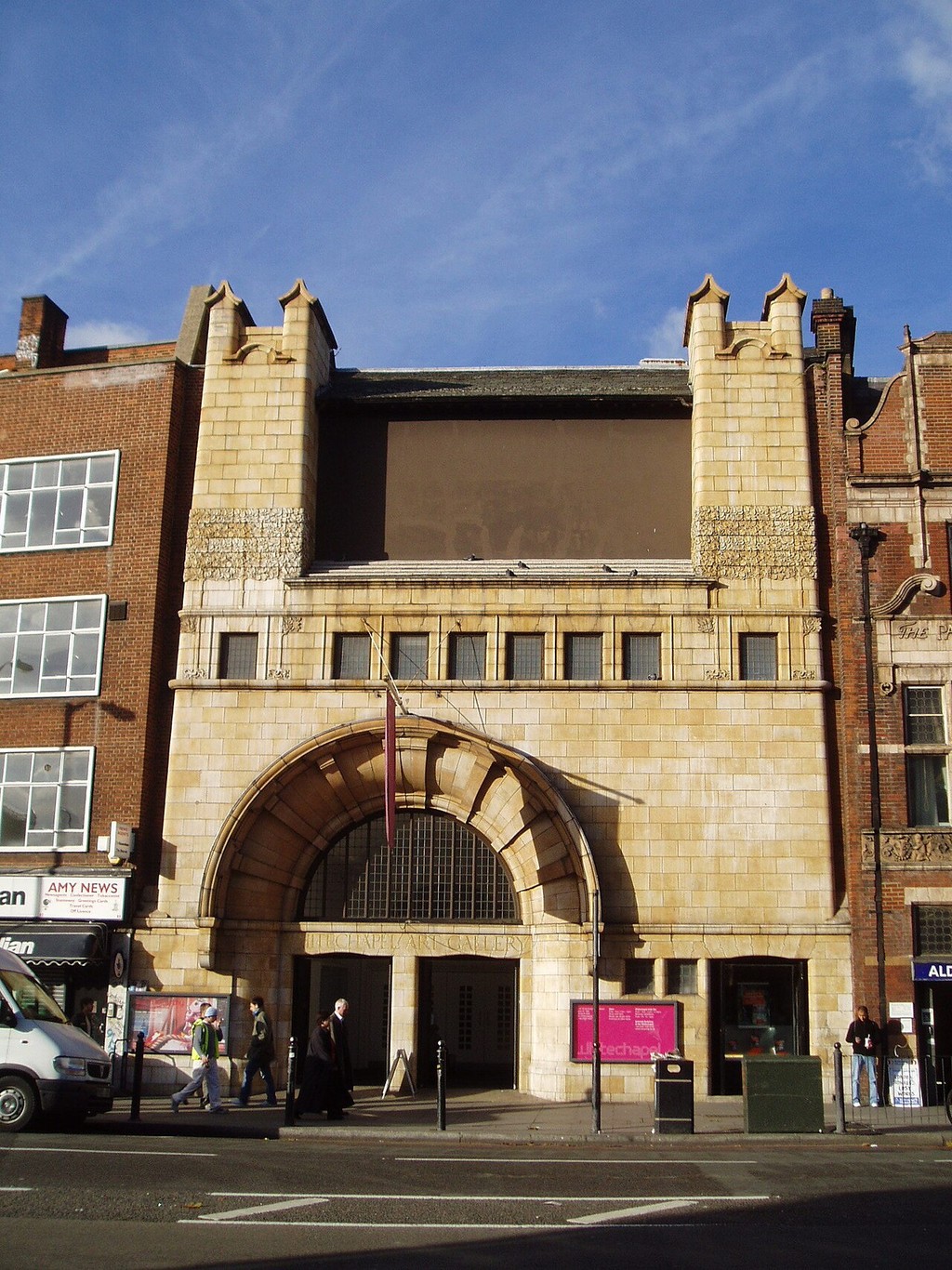
Whitechapel Gallery’s London facade in 2005. Its archive preserves records of the 1961 Rothko exhibition.
Photograph: Steve Cadman. Photograph remains CC BY-SA 2.0. Resized without cropping. [47]
Group presentation and individual retrospective produced different kinds of visibility. In a group show, viewers compared his painting with the work of peers. The later MoMA retrospective could place successive stages of his own development together. Both were significant to his international reputation, although neither represented the totality of the work.
The acknowledgments of Selz’s 1961 catalogue thank Rothko for close cooperation in preparing the exhibition and book, and for lending many paintings himself.[27] This is contemporary evidence of his participation. It complicates a familiar account in which institutional display appears to have happened around an entirely withdrawn painter. Rothko could be concerned about reception while engaging directly with a major retrospective.
1964–1970: Houston and late materials
Dominique and John de Menil commissioned Rothko to create a sacred space in Houston in 1964. The Chapel's own history says he completed fourteen installed canvases in 1967; the room opened in 1971, after his death.[9] The Rothko Chapel guide follows the ensemble, architectural collaborators and changing natural light. The fourteen are not every work Rothko made while considering the commission. The project was a realised painted environment in a way the Seagram room never became.
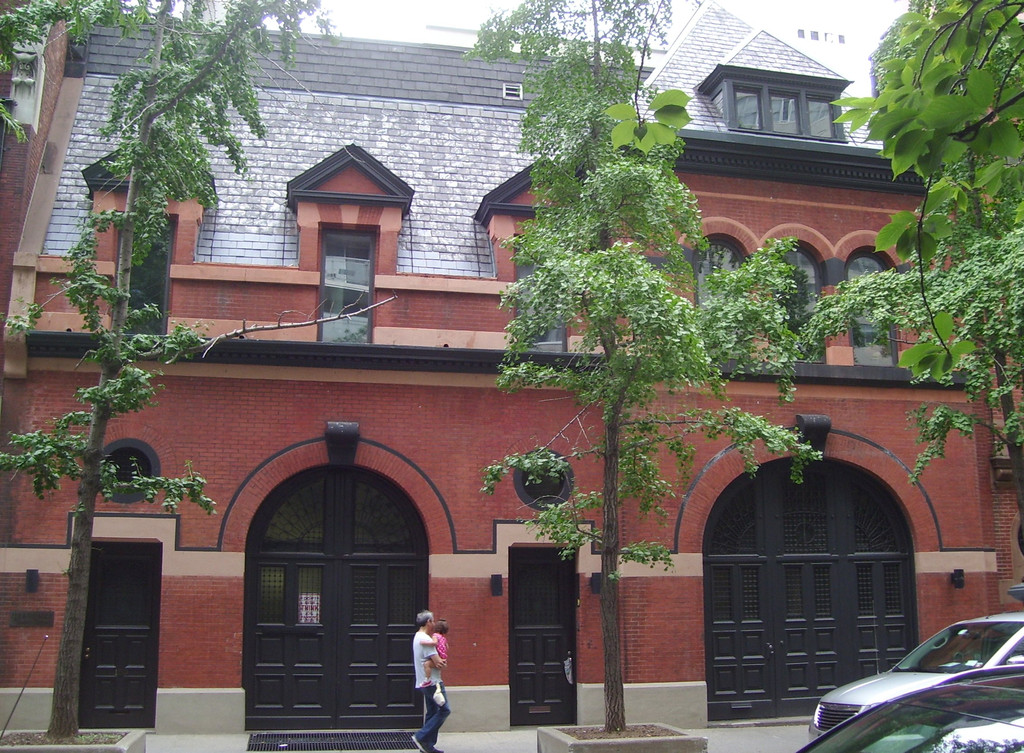
153 East 69th Street, photographed on 19 August 2012. The former Rothko studio later became the Urasenke Chanoyu Center; this view shows the street exterior.
Photograph: Beyond My Ken. Resized; photograph remains CC BY-SA 4.0. [48]
Rothko also worked extensively on paper. The NGA says he made more than 1,000 paintings on paper across his lifetime and used varied mounting and painting methods.[10] From 1968 he increasingly used acrylic on paper and canvas, its chronology states.[1] The NGA's Untitled (brown and gray) is a 1969 acrylic paper work; MOCA's Untitled (Black and Gray) is a distinct 1970 acrylic canvas. Sotheby's Untitled (Red on Red) is oil on paper mounted on canvas, showing that the final years did not consist only of black and gray work.
The Fondation Louis Vuitton's French account of its 2023–24 retrospective makes the late range especially clear. It places brighter canvases of 1967 and an unfinished final red painting against the assumption that Rothko's palette only darkened. It also presents the Black and Gray works near figures by Alberto Giacometti, recalling an unrealised UNESCO room project.[18] Palazzo Strozzi's dossier describes a 1969 return to canvas and an eighteen-painting Black and Grey group, alongside large late paper series in dark, grey and unexpectedly delicate pastel-like colours.[14] These are curatorial accounts of different but overlapping bodies of work. They support a more varied late chronology than a single “black paintings” category; individual medium and date remain governed by each object's collection record.
The late paintings are often treated as direct evidence of the artist's mental state. A date and dark palette alone cannot establish that reading. Rothko died by suicide in his New York studio in February 1970, as NGA and Guggenheim chronologies record.[1][11] The late works also have their own material and visual histories. Institutional records, conservation research and the developing works-on-paper catalogue show continued decisions about support, border, colour and mounting. Biography can give context without reducing every painting to a symptom.
The final years also contained public and organisational acts. Guggenheim Bilbao's chronology records Rothko's election to the National Institute of Arts and Letters in 1968, an honorary Yale doctorate in 1969, and the founding of the Mark Rothko Foundation in that year.[22] Tate dedicated a gallery to him in 1970. These dated markers do not cancel the health difficulties the chronology also records, but they prevent a retrospective account of the last paintings from becoming solely a story of withdrawal. The Foundation's later gifts explain why so many museum collection records name it in their credit lines; each accession still needs to be checked separately for its own transfer history.
Illness and continued work
The 2024 published conversation between curator Adam Greenhalgh, Christopher Rothko and David Ebony identifies the April 1968 illness as an aortic aneurysm, rather than the heart attack sometimes named in retellings. It also describes the continued production of finished paintings on paper and stresses the presence of bright colour in the final period.[30]
Illness altered the circumstances of working without yielding a single visual consequence. Different supports, sizes and paint types offered different possibilities. The late works therefore need to be read through their particular making, rather than assigned collectively to one emotional category. A light paper painting and a dark canvas from adjacent years may belong to distinct sequences even when both are discussed under the heading of “late Rothko.”
This distinction is especially important when considering the Chapel. Its canvases were substantially completed before the 1968 illness. Their dark palette followed a commission developed over several years. The chronological sequence itself prevents the room from becoming a simple illustration of the artist’s final health crisis.
After 1970: the estate, Foundation and public collections
The history of Rothko’s work continued through an unusually consequential estate dispute. The official New York Court of Appeals opinion in Matter of Rothko, decided on 22 November 1977, describes how the estate’s paintings were sold and consigned to Marlborough and its affiliates soon after his death. Kate Rothko challenged the transactions and the executors’ conduct, with the Attorney General acting for the charitable beneficiaries. The court upheld the central findings concerning conflicts of interest and breach of duties.[31]
The judgement distinguishes among the three executors and examines their different relationships to the dealer. Its subject is the administration of the estate: who controlled the works, what obligations they owed and how the estate should be restored after improper transactions. It is not a judgement about the aesthetic merit of the paintings. The distinction matters because the case is often recalled only through spectacular prices or a broad story of corruption.
For the paintings, the dispute affected provenance and access. Works transferred out of the studio could return to the estate; later distribution could place them in museums. A collection record’s sequence of dealer consignment, return and gift can therefore preserve the consequences of the case within the history of an individual object. The National Gallery’s Street Scene record, for example, lists consignment in 1970, transfer back in 1977 and eventual gift to the Gallery in 1986.[25]
The National Gallery’s Foundation finding aid records a new board in 1977 with Donald M. Blinken as president, and the equal division of the estate between the children and Foundation in 1979. The Foundation supported artists and arts organisations, lent works, undertook inventory and conservation, and planned a substantial distribution to museums. The NGA received the largest share. The Foundation concluded its activities in 1988, with records and other non-art holdings becoming part of the Gallery’s research resources.[32]
This posthumous activity affected which Rothkos became available for sustained public study. The familiar mature canvases formed only part of the material. Early works, drawings, paper paintings, photographs and administrative records could disclose stages and decisions that a small selection of famous pictures concealed. The combination of collections and archives made possible a broader history of the artist’s practice.
How the biography has been researched
James E. B. Breslin’s Mark Rothko: A Biography, first published in 1993, is a major long-form study. The University of Chicago Press describes its basis in personal papers and more than a hundred interviews. Its contents move through family life, economic circumstances, friendships, recognition, commissions and the final years.[33] The breadth of that research indicates why a biography must attend to working life and relationships as well as changes in style.
Cohen-Solal’s 2015 biography gives another emphasis to the same career, placing the immigrant, Jewish artist within the changing American art world.[34] These books can ask different questions of shared events. One may assemble intimate testimony at length; another may foreground the institutions and social conditions through which the artist moved. Their existence is also a reason to resist treating a short chronology as a complete explanation of a life.
The Smithsonian’s Foundation-funded Mark Rothko and His Times project interviewed thirty people between 1981 and 1985, concentrating particularly on the years before 1950. Its register includes family members, fellow artists, dealers and curators; interviews with Katharine Kuh, Jacob Kainen and Joseph Solman also document their own careers.[35] This preserves multiple perspectives on the early period rather than a single retrospective voice.
Oral history records memory in conversation. A dated exhibition catalogue can establish what was publicly shown; a witness may describe a studio visit or working habit that no checklist records. The two forms of evidence can strengthen one another while answering different questions. A recollection made decades later remains a recollection, even when it comes from someone close to Rothko.
The same breadth of evidence helps explain why Rothko’s biography continues to change. Conservation can reveal a revised form. An archive can clarify a loan, a journey or an installation proposal. A catalogue can identify a painting that had circulated under several titles. The history of the artist is therefore connected to the history of how his work has been documented, cared for and made public.
Continuing exhibitions and catalogue research
Rothko's works now appear in museums and private collections across the world. The Phillips Collection's four-painting Rothko Room, the dispersed Seagram canvases, MoMA's individual holdings and the Houston Chapel offer sharply different viewing conditions. Anfam's 1998 Works on Canvas is the principal printed catalogue for canvases; the NGA's online works-on-paper project is still being compiled.[12] The distinction matters because a paper work mounted on canvas does not automatically belong in a canvas catalogue.
Institutional histories also frame his reception differently. The Daugavpils museum rotates a small selection from the family collection in his birthplace.[13] A 2023–24 Paris retrospective assembled roughly 115 works from museums and private lenders.[18] Florence's 2026 project brought more than seventy works into Palazzo Strozzi and placed selected works in conversation with historical sites at San Marco and the Laurentian Library.[14] These exhibitions are not neutral inventories of “best works”: each asks a distinct question of the oeuvre—birthplace and family stewardship, full-career range, or the relation to Italian art and architecture. Their records are valuable evidence for how Rothko is studied now, while the object pages still need their own ownership and medium checks.
The catalogue raisonné and the developing paper catalogue provide different parts of this continuing research. Precise object studies connect the broader life story to particular works, while new exhibitions bring works from separated collections into conversation.
Rothko works in this guide
| Name | Date | Medium |
|---|---|---|
| Entrance to Subway | 1938 | Painting |
| Hierarchical Birds | 1944 | Painting |
| Slow Swirl at the Edge of the Sea | 1944 | Painting |
| No. 3/No. 13 | 1949 | Painting |
| Untitled (Violet, Black, Orange, Yellow on White and Red) | 1949 | Painting |
| White Center | 1950 | Painting |
| No. 10 | 1950 | Painting |
| No. 6 (Violet, Green and Red) | 1951 | Painting |
| Untitled | 1952 | Painting |
| No. 61 (Rust and Blue) | 1953 | Painting |
| No. 1 (Royal Red and Blue) | 1954 | Painting |
| Untitled (Yellow and Blue) | 1954 | Painting |
| Orange and Yellow | 1956 | Painting |
| Light Red over Black | 1957 | Painting |
| Four Darks in Red | 1958 | Painting |
| Black on Maroon | 1958 | Painting |
| No. 14 | 1960 | Painting |
| Orange, Red, Yellow | 1961 | Painting |
| Untitled (brown and gray) | 1969 | Painting |
| Untitled (Red on Red) | 1969 | Painting |
| Untitled (Black and Gray) | 1970 | Painting |
| Tentacles of Memory | 1945–46 | Drawing |
Frequently Asked Questions
He was born Marcus Rothkowitz in Dvinsk in 1903. His family immigrated to the United States during his childhood, and Portland became his formative American home. He later used the name Mark Rothko, under which his paintings, exhibitions and writings became internationally known.[1][23][24]
Yes. He attended Yale from 1921 to 1923 but left without completing a degree. He moved to New York and studied at the Art Students League, where Max Weber was an important teacher. University attendance and his later artistic training were separate stages of his education.[1]
Yes. He taught children at the Center Academy of the Brooklyn Jewish Center for more than twenty years. Teaching was a sustained part of his working life, alongside exhibiting and painting, rather than a brief occupation before he became an artist.[1][27]
The change unfolded through the later 1940s. Mythic figures gave way to less recognisable arrangements often called multiforms, followed by broad, softly edged colour areas. By around 1950, paintings such as White Center show the emerging mature format. The stages overlap rather than changing on a single date.[1][5]
The Seagram project, the Harvard murals and the Rothko Chapel were major commissions involving paintings and their settings. Their histories differ: he withdrew the Seagram paintings from the proposed restaurant, while the Chapel’s fourteen-painting ensemble was completed for a dedicated Houston space.[1][8][9]
Discussion
Which documented work or source changed your understanding of Mark Rothko’s biography?
Reader Insights
Begin with a specific work, title and date.
Compare the object record with this career guide.
What still needs a catalogue or archive check?
Join the Conversation
Share an observation grounded in the work or its history.
References
- National Gallery of Art, “Mark Rothko,” artist chronology.
- Adolph & Esther Gottlieb Foundation, 1943 Jewell letters.
- MoMA, Slow Swirl at the Edge of the Sea.
- NGA, Hierarchical Birds.
- Sotheby's, White Center and 2007 David Anfam essay.
- NGA, “Who Is Mark Rothko? 9 Things to Know”.
- Buffalo AKG, Orange and Yellow.
- NGA, “Mark Rothko: Seagram Murals”.
- Rothko Chapel, institutional history.
- Michaela Milgrom, “How Mark Rothko Made Paintings on Paper,” NGA, 2023.
- Guggenheim, Mark Rothko artist record.
- NGA, Mark Rothko: Works on Paper online catalogue project; David Anfam, Mark Rothko: The Works on Canvas (1998), bibliography in the NGA artist record.
- Rothko Museum, Daugavpils, “Rothko. From the Family Collection”, 2026–29 display and institutional history.
- Fondazione Palazzo Strozzi, Rothko a Firenze, Italian press dossier (2026), especially pp. 2–4 and 11–16.
- National Gallery of Art, “Artists Who Inspired Mark Rothko”, on Michelangelo and the 1959 date.
- Museum of Modern Art, 18 January 1961 Rothko exhibition press release and checklist.
- MoMA International Program archive, Rothko exhibition itinerary and files.
- Fondation Louis Vuitton, Mark Rothko retrospective (2023–24), French curatorial account.
- Guggenheim Bilbao Museoa, Spanish collection essay on Sin título, 1952–53, on the 1954 Chicago installation.
- Guggenheim Bilbao Museoa, English collection notes on Untitled, 1952–53, including the historical No. 10 identification and Anfam no. 483 citation.
- The Phillips Collection, “The Rothko Room”, collection and installation history.
- Guggenheim Bilbao Museoa, Rothko artist chronology, for dated exhibitions, teaching, citizenship, Harvard commission and gallery contract.
- Abigail Susik, “Mark Rothko (1903–1970),” The Oregon Encyclopedia, Oregon Historical Society, family migration, Portland childhood and 1933 return.
- Annie Cohen-Solal, Mark Rothko: Toward the Light in the Chapel (Yale, 2015), authorised excerpt, “How Marcus Rothkowitz Became Mark Rothko”, consulted for early exhibition networks and artist organisations.
- NGA, Street Scene, 1936/1937, accession 1986.43.45, 1937 Spanish Children benefit and later provenance.
- Janet Bishop, “Bay Area Figurative Painting and the San Francisco Art Association Annuals,” authorised excerpt from 75 Years of Looking Forward, SFMOMA (2010), California teaching and exhibition context.
- Peter Selz, Mark Rothko (MoMA, 1961), pp. 7–8, teaching appointments, and acknowledgments; authorised complete catalogue consulted.
- MoMA Archives, Dorothy C. Miller’s notes on Mark Rothko, 1951, curatorial visit and first MoMA acquisition.
- MoMA, The New American Painting as Shown in Eight European Countries, 1958–1959, original exhibition record and catalogue.
- Adam Greenhalgh, Christopher Rothko and David Ebony, “Mark Rothko’s Sublime Works on Paper,” Yale University Press (19 March 2024), health chronology and late paper practice; published interview consulted.
- New York Court of Appeals, Matter of Rothko, 43 N.Y.2d 305 (22 November 1977), official judicial opinion.
- NGA Archives, finding aid SC.040, Mark Rothko Foundation Records, 1958–2003 (2023), pp. 1–2 historical note and collection description; full finding aid consulted, underlying boxes not accessed.
- James E. B. Breslin, Mark Rothko: A Biography (University of Chicago Press; first published 1993), publisher’s account of research base and contents; whole biography not accessed.
- Yale University Press, Annie Cohen-Solal, Mark Rothko: Toward the Light in the Chapel (2015), publisher’s account of the biography’s scope.
- Smithsonian Archives of American Art, Mark Rothko and His Times, 1981–85 oral-history project and interview register.
- A 1930 IND subway car, photographed in 2013. It is context for Rothko’s New York years, not an identified setting in one of his paintings. Photograph: MTAPhotos; source record; CC BY 2.0. Resized to 1024px without cropping.
- Lincoln graduates leaving Portland for Yale: Naimark, Director and Rothkowitz. Portrait credits printed in the item: Bushnell and Fink. Historic Oregon Newspapers, University of Oregon Libraries. Source · Public domain; archive reuse policy.
- Lincoln Hall, former Lincoln High School, Portland. Photograph: Visitor7. Resized; photograph remains CC BY-SA 3.0. Source · CC BY-SA 3.0.
- Art Students League 215 West 57th Street.jpg. Photograph: Beyond My Ken. Photograph remains CC BY-SA 4.0. Resized without cropping. Source · CC BY-SA 4.0.
- Max Weber, portrait detail. Clara Sipprell; National Portrait Gallery, Smithsonian Institution; bequest of Phyllis Fenner; NPG.82.202. Faithful portrait detail crop; no retouching or colour changes. Source · CC0 1.0.
- Joan Miró, Barcelona. Library of Congress, Prints & Photographs Division, Carl Van Vechten Collection; LC-USZ62-42511. Resized without cropping. Source · Public domain; LOC gift record.
- War Memorial Veterans Building entrance.jpg. Photograph: Photo: Andreas Praefcke. Resized without cropping. Source · CC BY 3.0.
- Duncan Phillips. Clara Sipprell; National Portrait Gallery, Smithsonian Institution; bequest of Phyllis Fenner; NPG.82.200. Resized without cropping. Source · CC0 1.0.
- Fra Angelico, The Crucifixion. The Metropolitan Museum of Art, Bequest of Benjamin Altman, 1913; 14.40.628. Resized without cropping. Source · CC0 1.0.
- Betty Parsons, portrait detail. Photograph: Lynn Gilbert, 1977. Photograph and portrait crop remain CC BY-SA 4.0. Faithful portrait detail crop; no retouching or colour changes. Source · CC BY-SA 4.0.
- YMCA 222 Bowery jeh.JPG. Photograph: Jim.henderson; released into the public domain by the photographer. Source · Public-domain dedication.
- The Whitechapel Gallery 2005.jpg. Photograph: Steve Cadman. Photograph remains CC BY-SA 2.0. Resized without cropping. Source · CC BY-SA 2.0.
- 153 East 69th Street.jpg. Photograph: Beyond My Ken. Resized; photograph remains CC BY-SA 4.0. Source · CC BY-SA 4.0.