by Tom Gurney
Tom Gurney BSc (Hons) is an art history expert with over 20 years experience
Published on June 19, 2020 / Updated on October 11, 2026
Email: tomgurney1@gmail.com / Phone: +44 7429 011000
Seagram Murals: Introduction
In June 1958 Rothko accepted a commission to make paintings for a dining room in the Four Seasons restaurant in Manhattan's Seagram Building. The National Gallery of Art says he worked from autumn 1958 into 1959 and made more than thirty canvases, even though the room had places for seven. He ultimately withdrew the group from the restaurant.[1] This is the documented outline of the Seagram project. It involved an intended environment, a much larger body of work than the room required, and a decision that changed where the paintings could be seen.
At a Glance
- ArtistMark Rothko
- Dates1958–1959 [1]
- MediumOil on canvas [2]
- Intended settingFour Seasons restaurant, New York [1]
- CommissionWithdrawn before installation [1]
Contents
- A commission for a modern building
- More than thirty canvases for seven places
- Why Rothko withdrew
- Florence and architecture
- Looking and sources
A commission for a modern building
The Seagram Building on Park Avenue was a new modernist skyscraper associated with Mies van der Rohe and Philip Johnson. The Four Seasons dining room was the intended location for Rothko's paintings.[1] A 1958 photograph of the building, linked and credited on this page, can help locate that architectural context; it does not show the murals or their proposed installation. The commission asked Rothko to think about art as part of a room rather than as isolated canvases placed on neutral walls.
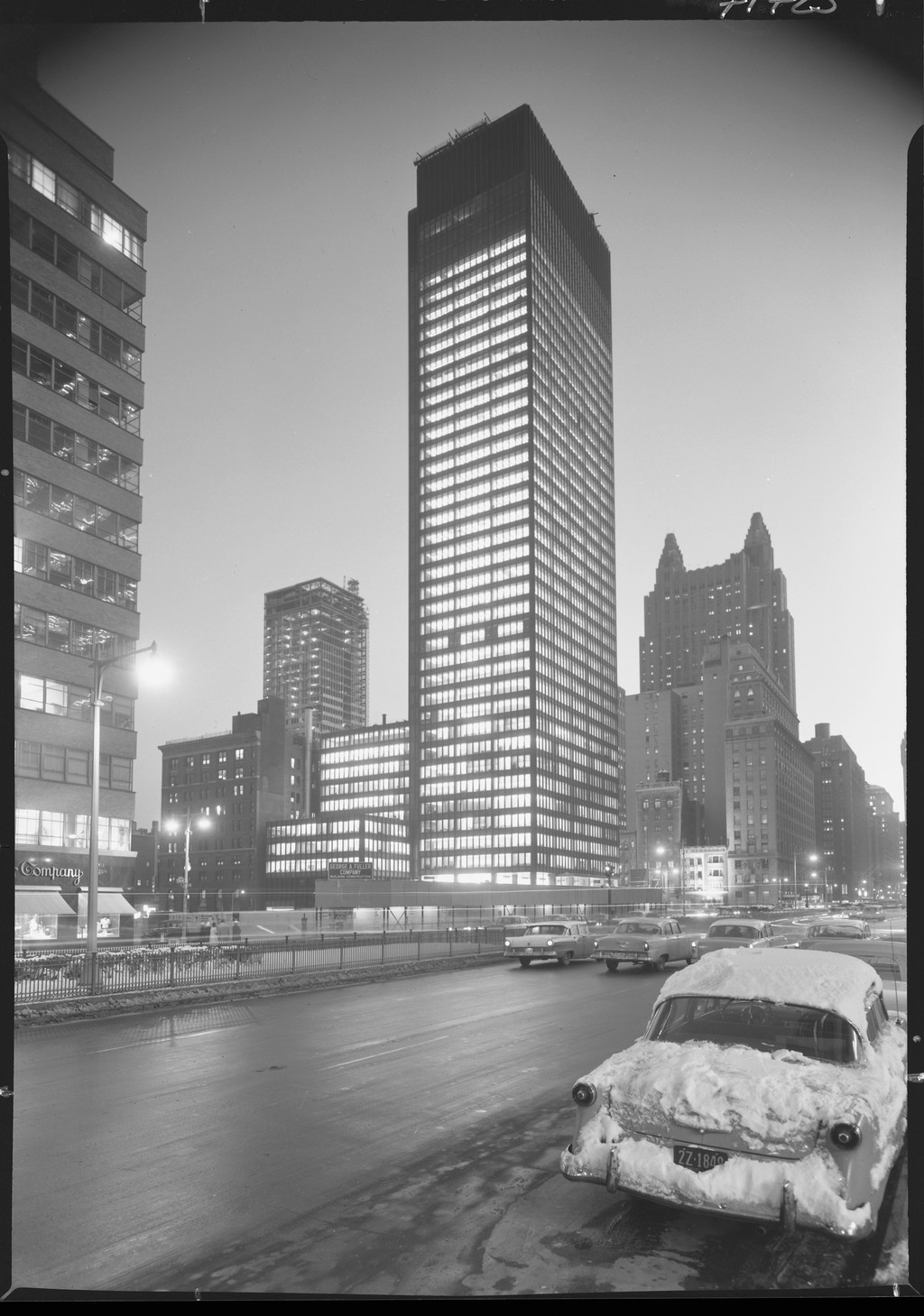
Seagram Building, night view, 3 January 1958. The Four Seasons restaurant in this building became the intended setting for Rothko’s mural commission later that year.
Library of Congress, Prints & Photographs Division, Gottscho-Schleisner Collection; LC-G612-71723; LC-DIG-gsc-5a16908. Resized without cropping. [10]
The restaurant setting was part of the commission's meaning from the beginning. Seven wall positions in a high-profile commercial interior would have asked diners to meet the paintings in intervals between conversation and service, under conditions Rothko could not fully control.[1] The later decision to withdraw them cannot be understood only as a change of ownership. It also ended this particular encounter between paintings, architecture and an audience. When museums later assemble Seagram works, their installations make new relationships visible, but they cannot reproduce the social circumstances of the proposed room.
The National Gallery describes the works as wine-dark paintings with ambiguous portal-like shapes.[1] Their palette and structure depart from the brighter, floating fields of some earlier 1950s paintings. The shapes can suggest openings or blocked passages without depicting literal windows or doors. That ambiguity matters in an architectural setting: a painted form can make a wall feel more open or more enclosing. Rothko's own language of a “closed space,” quoted by the Gallery, points to the intensity he sought.[1] It should not be mistaken for a technical blueprint of the restaurant.
More than thirty canvases for seven places
The difference between the number produced and the seven positions available is fundamental. Rothko was not simply completing seven preselected panels. He was exploring alternatives and relationships among paintings over many months.[1] A later collection's “Seagram mural” label can therefore refer to a work arising from the project even if it never occupied the restaurant wall. The eventual withdrawal means there is no completed Four Seasons installation to reconstruct as though visitors once encountered it there.
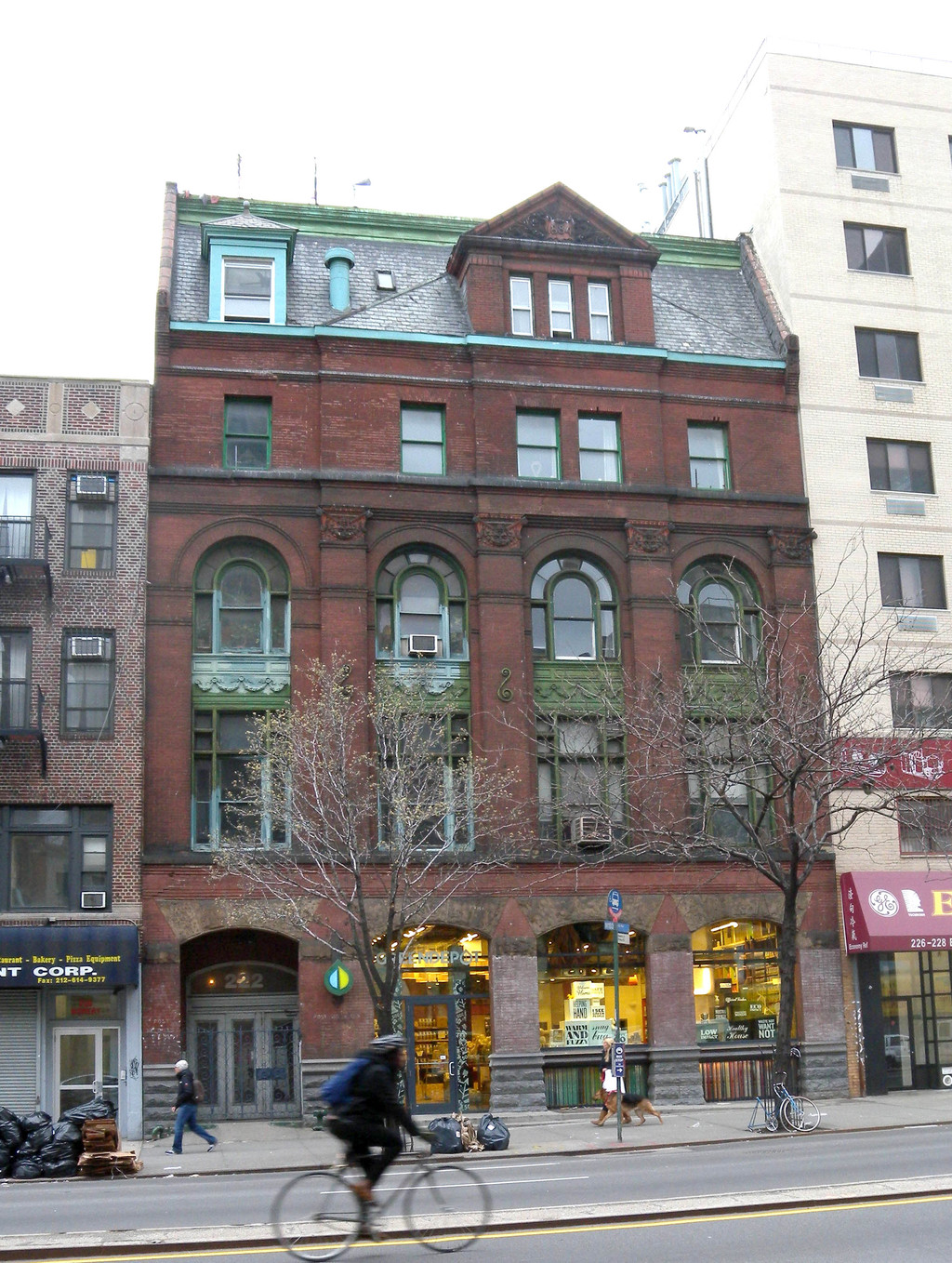
Rothko’s former studio building at 222 Bowery, photographed in 2009. It belongs to the working history of the Seagram project.
Photograph: Jim.henderson; released into the public domain by the photographer. [11]
This production count also resists the idea of a fixed seven-picture narrative. More than thirty canvases made for seven possible positions imply comparison and rejection, but the Gallery's short exhibition history does not identify a final seven-work sequence.[1] A modern guide should therefore avoid assigning specific canvases to restaurant walls on the basis of resemblance alone. Project membership, a possible installation candidate and an installed work are distinct statuses. The last category is empty for the Four Seasons because the commission was cancelled.
Palazzo Strozzi's 2026 dossier provides a more physical account of Rothko's preparation: he rented a former gymnasium on the Bowery and erected scaffolding to match the restaurant walls' proportions.[6] That detail helps explain why these paintings cannot be studied as easel works that happened to be large. Rothko was testing the relation between picture scale and room scale before any restaurant installation could occur. It also connects the series to small studies on textured paper, where proportions and intervals could be tried without committing immediately to a full-sized canvas.[6] The studies are evidence of spatial planning; they do not supply a definitive final hanging order.
A contemporary source makes the series' early reception unusually clear. MoMA's January 1961 exhibition press release says Peter Selz showed eleven of the 1958–59 mural works for the first time and described three separate series made over eight months.[7] The release calls some canvases as long as fifteen feet. Its language about dark red openings is Selz's curatorial reading at that date, not a set of titles Rothko assigned. The same exhibition placed early watercolours, 1947–49 transition paintings, mature works and four 1960 canvases around the murals. This gives us a documented sequence of how a major museum presented the project immediately after the withdrawal, rather than a retrospective reconstruction many decades later.
The group later became dispersed among institutions. The National Gallery received several works related to the project from the Rothko Foundation in 1985 and 1986.[1] Tate holds paintings associated with the commission, including Black on Maroon of 1958.[2] Each museum work has its own accession, date, dimensions and conservation history. “The Seagram Murals” is a project label, not a single object with one size and owner.
The Gallery's 2011–12 presentation placed three Foundation-gift paintings together in its East Building.[1] That exhibition is evidence of one later curatorial grouping, not evidence that those three had originally been selected as neighbours for the restaurant. Tate's Seagram works have their own subsequent installation history, while an individual object such as its 1958 Black on Maroon needs to be distinguished from other paintings carrying that title or a close colour description. Dates and accession numbers do more reliable work here than the general label “mural.”
The French Fondation Louis Vuitton's 2023–24 retrospective adds another stage in this afterlife: it presented the nine Seagram paintings that Rothko gave to Tate in 1969, a group intended for a dedicated room in the Tate collection.[8] That nine-work gift and MoMA's earlier eleven-work selection are separate historical groupings, neither identical to the seven positions in the unbuilt restaurant installation. Their difference is a useful guard against casually calling any museum installation “the original Seagram room.” A curator can reassemble a powerful environment, but its evidence must be described as a later choice.
Why Rothko withdrew
The National Gallery states that Rothko increasingly doubted a luxury restaurant was the appropriate venue for this art and cancelled the arrangement.[1] That is more secure than colourful versions of a dinner conversation or a wish to anger diners, which are often retold without an original source. The episode can be discussed as a conflict between the intended public experience and the social character of the setting. The exact wording and timing of Rothko's private remarks would require letters or reliable contemporary testimony.
Withdrawal did not mean the work was abandoned. The completed canvases remained part of Rothko's practice, and later installations have tested their power in different rooms. Yet a museum gallery is not the same context as the proposed restaurant. Different light, spacing and neighbours can change how a dark portal shape appears. Looking at the works now is therefore both an encounter with individual paintings and a reflection on a site that was never realised.
Florence and architecture
Rothko's interest in the Laurentian Library in Florence is discussed by the National Gallery and Tate in relation to his architectural thinking.[2][3] The Library's compressed vestibule and Michelangelo's stair have been compared with a sense of enclosure in Rothko's murals. The comparison is useful when it is documented, but it should not be inflated into a claim that a specific Seagram canvas copies a specific window or doorway.
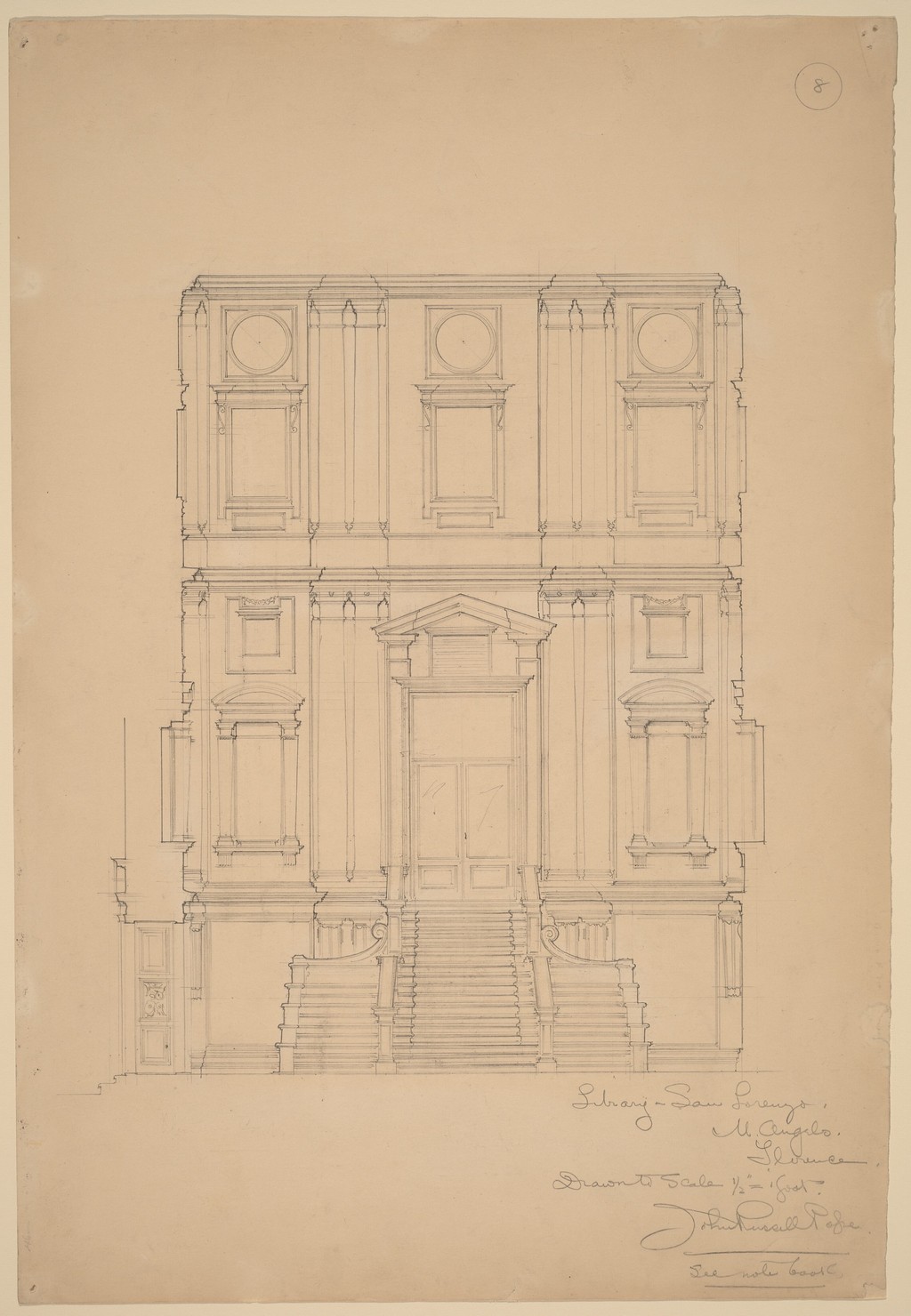
John Russell Pope, Library, San Lorenzo, circa 1896; graphite. This historical measured drawing shows the wall and stair arrangement of Michelangelo’s Laurentian Library vestibule, the Florentine space later linked to Rothko’s Seagram murals.
Courtesy National Gallery of Art, Washington; Gift of Mrs. John Russell Pope; 1939.2.8. Resized without cropping. [12]
The institutional chronologies require care. The National Gallery says Rothko visited Michelangelo's Laurentian Library in summer 1959 and later cited its vestibule as an inspiration for the Seagram series.[3] Palazzo Strozzi's Italian dossier instead identifies a first visit to the vestibule in 1950 and a return to Florence in 1966, while also recording Italian travel in 1959.[6] Its account says the earlier encounter was remembered during the Seagram work. The sources agree on the artistic connection but differ in how they date the library encounter. Until the underlying travel documents are checked, the safest formulation is that Rothko knew the vestibule before or during the Seagram project and later connected its enclosed space to the murals. The vestibule's blocked openings and heavy wall surfaces are a documented comparison, not proof that any single canvas copies a particular window.
Palazzo Strozzi's 2026 exhibition placed two Seagram studies in the Laurentian Library vestibule and five other small Rothko works in dialogue with Fra Angelico's frescoes at San Marco.[6] These were contemporary curatorial juxtapositions, not displays Rothko arranged. They let present-day viewers test a spatial analogy in a real architectural site. The dossier identifies one Laurentian study of 1958 as watercolour and oil on watercolour paper, with dimensions and a family collection credit. That medium is significant: the public history of the Seagram project includes preparatory paper work as well as the large canvases. A catalogue of canvases alone cannot account for every stage of the commission.
The Seagram experience preceded the Harvard murals and the Rothko Chapel, both actual later commissions.[4] They were different projects with different sites and dates. The Seagram paintings are often treated as a turning point because Rothko attempted to make a whole painted environment, then refused the agreed destination. That historical sequence matters more than an oversimplified story of a single angry decision.
Looking and sources
Begin with the documented Tate and NGA works. Compare their dates, widths and dark portal forms, and note where one painting gives a sense of an opening while another seems more closed. Do not assume they were all meant to hang together in their current arrangement. For Anfam's catalogue raisonné, the individual canvas entries and project discussion should be checked against the hardback before assigning catalogue numbers or reconstructing a final intended order.[5]
A useful viewing exercise is to compare an individual canvas with a photograph of the Seagram Building, while keeping their evidentiary roles separate. The building photograph tells us about the site and period, not the never-realised mural arrangement. The painting's museum record tells us about that object, not which restaurant wall it would have occupied. Then compare the Seagram group with the later Chapel commission: both invited Rothko to consider a room as a whole, but one ended in withdrawal and the other in a permanent, purpose-built installation. This difference is more informative than treating their dark palettes as identical symbols.
The Rothko images are copyrighted and not reproduced in this guide. The historic Seagram photograph provides architectural context only, with its source and rights statement attached. The current museum records remain the place to inspect the canvases and their object-specific details.
Related works
- Black on Maroon (1958) is a Tate Seagram canvas.
- Four Darks in Red is a same-year Whitney comparison, not documented here as a mural.
- The Rothko Chapel is a later completed environment.
Rothko works in this guide
| Name | Date | Medium |
|---|---|---|
| Entrance to Subway | 1938 | Painting |
| Hierarchical Birds | 1944 | Painting |
| Slow Swirl at the Edge of the Sea | 1944 | Painting |
| No. 3/No. 13 | 1949 | Painting |
| Untitled (Violet, Black, Orange, Yellow on White and Red) | 1949 | Painting |
| White Center | 1950 | Painting |
| No. 10 | 1950 | Painting |
| No. 6 (Violet, Green and Red) | 1951 | Painting |
| Untitled | 1952 | Painting |
| No. 61 (Rust and Blue) | 1953 | Painting |
| No. 1 (Royal Red and Blue) | 1954 | Painting |
| Untitled (Yellow and Blue) | 1954 | Painting |
| Orange and Yellow | 1956 | Painting |
| Light Red over Black | 1957 | Painting |
| Four Darks in Red | 1958 | Painting |
| Black on Maroon | 1958 | Painting |
| No. 14 | 1960 | Painting |
| Orange, Red, Yellow | 1961 | Painting |
| Untitled (brown and gray) | 1969 | Painting |
| Untitled (Red on Red) | 1969 | Painting |
| Untitled (Black and Gray) | 1970 | Painting |
| Tentacles of Memory | 1945–46 | Drawing |
Frequently Asked Questions
They are paintings made in 1958–59 for the proposed Four Seasons restaurant installation in New York’s Seagram Building. Rothko explored dark colour and portal-like forms in relation to a room. The commission was withdrawn, so the paintings were never installed at their intended restaurant.[1]
The National Gallery of Art describes more than thirty canvases produced for seven possible wall positions. That larger body of work includes alternatives rather than a single completed seven-picture restaurant sequence. Later museum groupings should be understood through their own installation histories.[1]
The National Gallery’s account says he increasingly doubted that a luxury restaurant was an appropriate setting for his paintings. The decision concerned the intended experience and social context of the work. Colourful stories about exact dinner-table remarks need to be distinguished from this institutional account.[1]
Paintings associated with the project later entered separate collections, including Tate and the National Gallery of Art. Tate’s 1958 Black on Maroon is one such canvas. Each object has its own date, dimensions, acquisition and conservation history.[1][2]
Institutional accounts connect Rothko’s interest in the Florentine vestibule with the murals’ enclosed, portal-like spaces. The sources differ over the visit chronology, so the connection is more secure than a single harmonised travel date. It does not establish that one canvas copies a particular architectural opening.[3][6]
No. They belong to an earlier New York commission. The Rothko Chapel was a later Houston project that reached a dedicated installation. The two commissions both concern a room, but their patrons, settings and outcomes differ.[4]
Discussion
Which documented work or source changed your understanding of Seagram Murals?
Reader Insights
Begin with a specific work, title and date.
Compare the object record with this career guide.
What still needs a catalogue or archive check?
Join the Conversation
Share an observation grounded in the work or its history.
References
- National Gallery of Art, “Mark Rothko: Seagram Murals”.
- Tate, Black on Maroon, 1958, object information.
- National Gallery of Art, “Artists Who Inspired Mark Rothko”.
- National Gallery of Art, “Mark Rothko,” artist chronology.
- David Anfam, Mark Rothko: The Works on Canvas: A Catalogue Raisonné (National Gallery of Art and Yale University Press, 1998), bibliographic lead for individual canvas entries; not directly consulted for this project essay.
- Fondazione Palazzo Strozzi, Rothko a Firenze, Italian press dossier (2026), pp. 11–16; the dossier's visit chronology is compared with the NGA account rather than silently harmonised.
- Museum of Modern Art, 18 January 1961 Rothko exhibition press release and checklist, pp. 1–4.
- Fondation Louis Vuitton, Mark Rothko retrospective (2023–24), French curatorial account.
- The Seagram Building photographed in 1958. This architectural context image does not show Rothko’s murals or their proposed dining-room installation. Photograph: Gottscho-Schleisner Collection; source record; Public domain. Resized to 1024px without cropping.
- Seagram Building, night view. Library of Congress, Prints & Photographs Division, Gottscho-Schleisner Collection; LC-G612-71723; LC-DIG-gsc-5a16908. Resized without cropping. Source · Public domain; heirs’ release.
- YMCA 222 Bowery jeh.JPG. Photograph: Jim.henderson; released into the public domain by the photographer. Source · Public-domain dedication.
- John Russell Pope, Library, San Lorenzo. Courtesy National Gallery of Art, Washington; Gift of Mrs. John Russell Pope; 1939.2.8. Resized without cropping. Source · CC0 1.0.