by Tom Gurney
Tom Gurney BSc (Hons) is an art history expert with over 20 years experience
Published on June 19, 2020 / Updated on October 11, 2026
Email: tomgurney1@gmail.com / Phone: +44 7429 011000
Rothko’s drawings: Introduction
Rothko's drawings belong to a much larger practice on paper that spans his figurative work, 1940s experiments and late abstract paintings. The National Gallery of Art's ongoing Rothko works-on-paper catalogue expects to document approximately 2,600 works, while its conservation account says Rothko made more than 1,000 paintings on paper.[1][2] Those numbers describe overlapping categories and stages of cataloguing; they should not be added together as a count of “drawings.” A useful guide must identify the medium and support of each object rather than treat every sheet as a sketch or every paper painting as a print.
At a Glance
- ArtistMark Rothko (1903–1970)
- MediaGraphite, ink, watercolour and acrylic [2]
- SupportsPaper and mounted sheets [2]
- Featured workTentacles of Memory, circa 1945–46 [3]
Contents
- What counts as a drawing?
- Early figures and the 1940s
- Paper was a finished arena
- Studies for architectural commissions
- Drawings, paintings on paper and prints
- How to read a paper object record
What counts as a drawing?
Museum classifications are object-specific. SFMOMA catalogues Tentacles of Memory, ca. 1945–46, as a drawing in ink and watercolour on paper.[3] The work combines line and coloured wash. Its classification does not make it a preparatory study for a named canvas. It is a finished collection object with a title, date, medium, dimensions and acquisition history. NGA's later Untitled (brown and gray), by contrast, is catalogued as acrylic on paper: a painting on a sheet, not a drawing simply because the support is paper.[4]
The difference is not always visually obvious in a thumbnail. A pencil line, ink wash, watercolour, acrylic field and mounted paper support can occur in close proximity across an artist's practice. Catalogues choose labels based on materials and curatorial study. Readers should use those labels as precise descriptions of the individual work and remain alert to revisions when new conservation evidence appears.
Early figures and the 1940s
Rothko made drawings while working through figurative and mythic subjects before his mature colour-field paintings. The National Gallery chronology describes his interest in Greek mythology, Surrealism and automatic drawing during the period reaching to 1946.[5] In such work, a line may call up a human or animal form but then dissolve into a more open arrangement. Tentacles of Memory offers an accessible example of ink and watercolour whose title invites associations without fixing one depicted scene.[3]
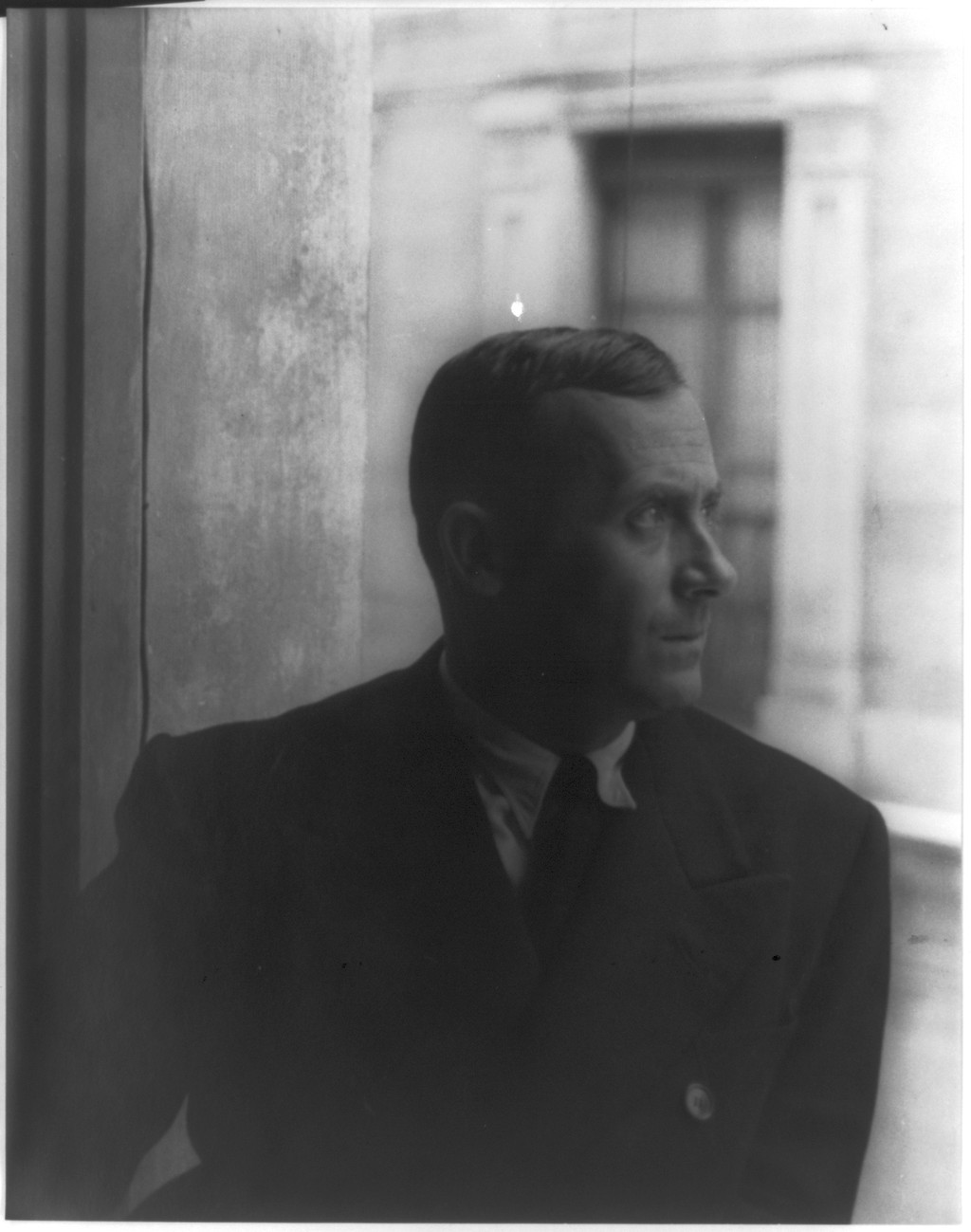
Joan Miró in Barcelona, 13 June 1935, photographed by Carl Van Vechten. The National Gallery identifies Miró among Rothko’s Surrealist influences.
Library of Congress, Prints & Photographs Division, Carl Van Vechten Collection; LC-USZ62-42511. Resized without cropping. [7]
Drawings can clarify an artist's working questions, but they should not automatically be called “studies for” later canvases. That relation requires documentary or visual evidence specific to the pair. A close-looking comparison between a 1940s sheet and Slow Swirl at the Edge of the Sea of 1944 can show shared organic motion, yet it does not prove direct preparation. The two works may be independent experiments within a broad period.
The Italian Palazzo Strozzi dossier describes a change in the character of Rothko's marks across this period. Its curators note rapid signs, abrasion and rubbing in early mythic and neo-Surrealist works, followed by a movement toward irregular colour masses in the 1946–47 multiforms.[6] This interpretation directs a reader to process as well as iconography: an unstable drawn or rubbed mark can suggest a body without fixing one, while later colour areas increasingly carry the relation between parts. A drawing may expose a decision that remains less obvious in a large finished canvas, but the dossier's broad chronology should not be assigned to Tentacles of Memory as a specific production account without technical examination of that sheet.
Paper was a finished arena
The National Gallery's 2023 study shows how Rothko worked with taped sheets, wet paper, ink, watercolour, acrylic, layered brushwork and later mounting decisions.[2] The museum reports that he exhibited, sold and gave paintings on paper, and regarded some among his best work. This challenges the simple hierarchy in which a paper work is always an unfinished draft for a canvas. A sheet's edge and mount can be as important to its viewing as its painted centre.
In the late Brown and Gray group, NGA describes experimentation with masking tape and borders of exposed white paper.[2] But this is evidence about documented sheets in that group, not a universal formula. A medium guide should connect readers to individual records so that claims about materials remain attached to the right object. The Gallery's online catalogue is still growing and should be consulted as it expands.[1]
The NGA's conservation account offers unusually concrete evidence of a mid-1940s working sheet: a watercolour on Whatman paper was taped on all four sides to an upright board, worked while wet and then cut or torn away, leaving traces of old tape.[2] By the late 1960s, Rothko used two large plywood easels for paintings on paper, with a pulley system on one that had previously served canvas work. Paint marks left outside the attached sheets form silhouettes of completed compositions on the easel. These details complicate the idea that paper always meant small scale or casual preparation. They also show why the surviving edge of a sheet can be evidence of the work's making, not a disposable margin.
Presentation was another artistic choice. According to the NGA, Rothko sometimes showed 1940s watercolours in slim frames without mats or mounted them directly to a support. For some classic-format paintings on paper he sought display without glass, attaching the sheet to linen or board and then to a stretcher or strainer.[2] A present-day mount can reflect historical evidence and conservation judgement; it is not itself proof that every similar paper work left the studio in the same condition. The paper catalogue's developing object records should eventually allow those choices to be described one work at a time.
Studies for architectural commissions
There are documented preparatory paper works as well as independent paper paintings. Palazzo Strozzi's 2026 exhibition brought together studies for the Seagram and Harvard murals, including small drawings in ink and graphite and Harvard studies in ink, watercolour and graphite.[6] Its account stresses Rothko's testing of proportions, pauses and intervals between forms. A Seagram study displayed in the Laurentian Library vestibule is identified in the dossier as watercolour and oil on watercolour paper, measuring 75.6 × 55.6 cm, in the Kate Rothko Prizel and Ilya Prizel collection.[6] That is a specific documented study; it should not be confused with one of the finished mural canvases or with an editioned print.
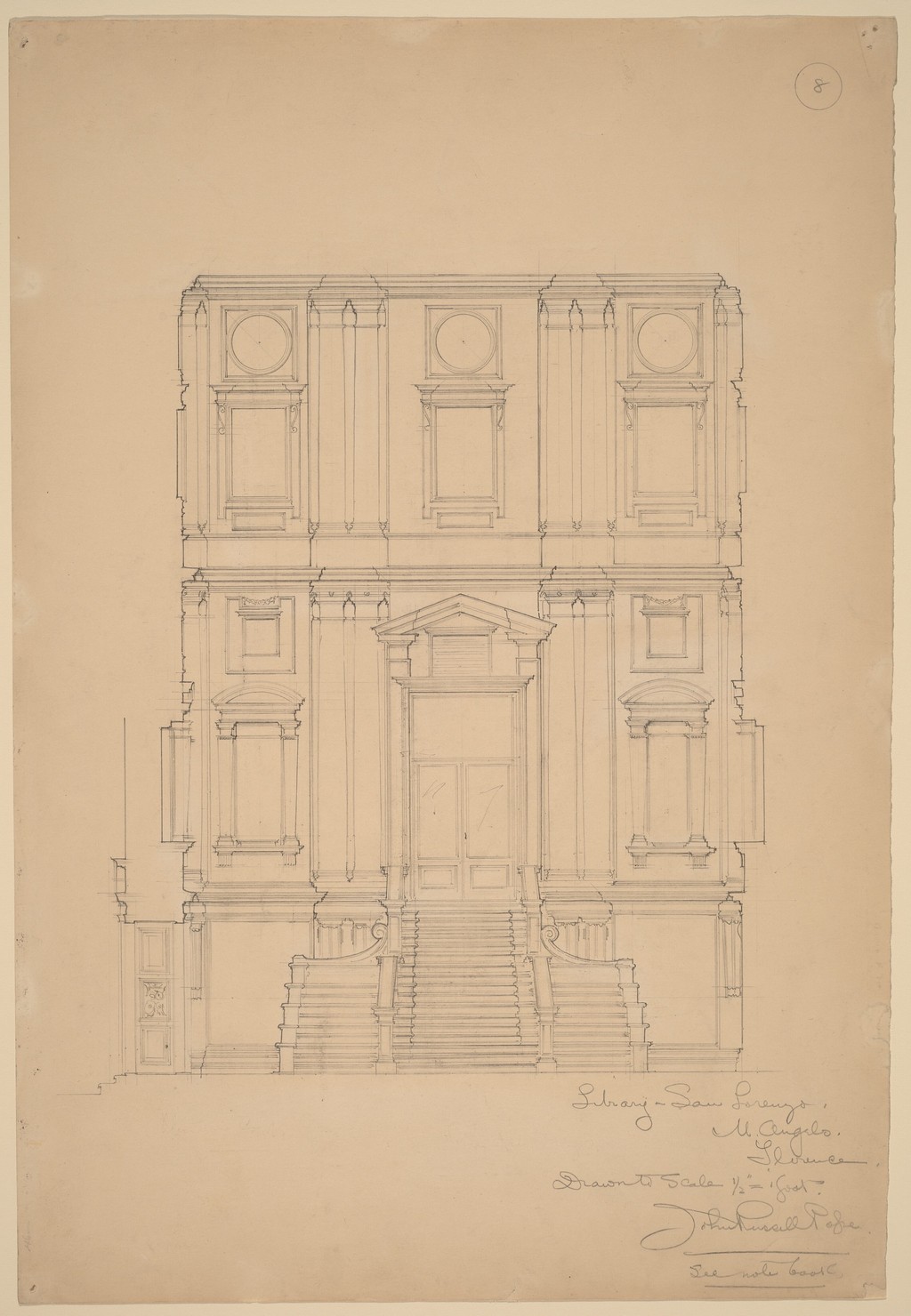
John Russell Pope, Library, San Lorenzo, circa 1896; graphite. This historical measured drawing shows the wall and stair arrangement of Michelangelo’s Laurentian Library vestibule, the Florentine space later linked to Rothko’s Seagram murals.
Courtesy National Gallery of Art, Washington; Gift of Mrs. John Russell Pope; 1939.2.8. Resized without cropping. [8]
The commission context makes the word “study” meaningful here: the work participates in a project with a proposed room, known canvases and surviving planning material. Even so, a study cannot automatically be matched to one wall position. The paper works can reveal alternative proportions and colour relations that a final group may not retain. They also make clear that the canvas catalogue raisonné and the emerging paper catalogue address connected but distinct bodies of evidence.
Drawings, paintings on paper and prints
A drawing is an original work made by Rothko on a support. A painting on paper is also an original artwork, even when mounted to canvas or board. A commercial print of a Rothko painting is a reproduction made later through a printing process. These categories answer different reader questions. The prints guide helps buyers understand reproductions and permissions, while the paintings guide follows original canvases and painted sheets.
The distinction has a rights consequence as well as an art-historical one. Museums may show an original work online while restricting downloads or publication uses. SFMOMA's Tentacles of Memory record names the Rothko heirs and Artists Rights Society in its copyright line.[3] This guide links to those records and uses contextual or neutral imagery rather than reproducing protected drawings.
How to read a paper object record
Begin with the exact title and accession number. Check the date, which may be approximate, then read the full medium line: “ink and watercolour on paper” says something different from “acrylic on paper.” Look for sheet dimensions and mounting, which may have changed after the initial painting. Finally ask whether the catalogue identifies an exhibition, provenance or relation to another work. Where no relation is documented, leave it open. That method lets the diversity of Rothko's paper practice emerge without forcing every sheet into a single category.
Related works
- Tentacles of Memory is SFMOMA's ink and watercolour drawing.
- Untitled (brown and gray) is an NGA acrylic painting on paper.
- Rothko's paintings covers his canvas and paper paintings.
Rothko works in this guide
| Name | Date | Medium |
|---|---|---|
| Entrance to Subway | 1938 | Painting |
| Hierarchical Birds | 1944 | Painting |
| Slow Swirl at the Edge of the Sea | 1944 | Painting |
| No. 3/No. 13 | 1949 | Painting |
| Untitled (Violet, Black, Orange, Yellow on White and Red) | 1949 | Painting |
| White Center | 1950 | Painting |
| No. 10 | 1950 | Painting |
| No. 6 (Violet, Green and Red) | 1951 | Painting |
| Untitled | 1952 | Painting |
| No. 61 (Rust and Blue) | 1953 | Painting |
| No. 1 (Royal Red and Blue) | 1954 | Painting |
| Untitled (Yellow and Blue) | 1954 | Painting |
| Orange and Yellow | 1956 | Painting |
| Light Red over Black | 1957 | Painting |
| Four Darks in Red | 1958 | Painting |
| Black on Maroon | 1958 | Painting |
| No. 14 | 1960 | Painting |
| Orange, Red, Yellow | 1961 | Painting |
| Untitled (brown and gray) | 1969 | Painting |
| Untitled (Red on Red) | 1969 | Painting |
| Untitled (Black and Gray) | 1970 | Painting |
| Tentacles of Memory | 1945–46 | Drawing |
Frequently Asked Questions
Yes. Drawing was part of his figurative and mythic work, and his paper practice continued across the career. SFMOMA’s Tentacles of Memory, dated about 1945–46, is an ink and watercolour drawing. The NGA’s paper catalogue also addresses sketchbooks, drawings and paintings on sheets.[1][3]
No. Museums distinguish objects by their materials and classification. Tentacles of Memory is catalogued as a drawing, while the NGA’s 1969 Untitled (brown and gray) is an acrylic painting on paper. The support alone does not determine the category.[3][4]
No. Rothko treated many paper paintings as finished works and exhibited, sold or gave them. Some sheets are documented studies for commissions, but a direct relationship to a particular canvas should not be assumed simply because two works share similar forms.[2][6]
His paper practice includes graphite, ink, watercolour, oil and acrylic, with different combinations across periods. He sometimes attached sheets to boards or easels while working and made separate decisions about mounting and display. The exact medium belongs to the individual object.[2][6]
Yes. The Palazzo Strozzi exhibition dossier describes small paper studies associated with both commissions, using materials including ink, graphite and watercolour. These works let Rothko test proportions and intervals; they are distinct from the large finished mural canvases.[6]
An original drawing or painting on paper was made directly by Rothko. A later reproduction copies an existing image through a printing process. Mounting an original painted sheet on canvas or board does not turn it into a commercial print.[2] The prints guide explains that distinction further.
Discussion
Which documented work or source changed your understanding of Rothko’s drawings?
Reader Insights
Begin with a specific work, title and date.
Compare the object record with this career guide.
What still needs a catalogue or archive check?
Join the Conversation
Share an observation grounded in the work or its history.
References
- National Gallery of Art, Mark Rothko: Works on Paper online catalogue project.
- Michaela Milgrom, “How Mark Rothko Made Paintings on Paper,” National Gallery of Art, 2023.
- SFMOMA, Tentacles of Memory, accession 46.2794.
- National Gallery of Art, Untitled (brown and gray), accession 1986.43.286.
- National Gallery of Art, “Mark Rothko,” artist chronology.
- Fondazione Palazzo Strozzi, Rothko a Firenze, Italian press dossier (2026), pp. 10–16, on working marks, mural studies and the Laurentian display.
- Joan Miró, Barcelona. Library of Congress, Prints & Photographs Division, Carl Van Vechten Collection; LC-USZ62-42511. Resized without cropping. Source · Public domain; LOC gift record.
- John Russell Pope, Library, San Lorenzo. Courtesy National Gallery of Art, Washington; Gift of Mrs. John Russell Pope; 1939.2.8. Resized without cropping. Source · CC0 1.0.