by Tom Gurney
Tom Gurney BSc (Hons) is an art history expert with over 20 years experience
Published on June 19, 2020 / Updated on October 11, 2026
Email: tomgurney1@gmail.com / Phone: +44 7429 011000
Rothko prints: Introduction
Many readers who search for “Mark Rothko prints” are looking for a poster or authorised reproduction of a famous painting. That is a practical search, but it is not the same as asking about an original printmaking oeuvre. A print sold by a museum shop normally reproduces a canvas or paper painting through a later process; the original artwork retains its own date, medium, owner and copyright. Tate offers authorised custom reproductions of Rothko works, for example, but its product pages describe prints of Tate paintings, not evidence that Rothko made those images as original editions.[1]
At a Glance
- ArtistMark Rothko (1903–1970)
- ReproductionsPosters and prints of existing paintings [1]
- Original paper worksDrawings and paintings made directly on paper [3]
- Featured paintingBlack on Maroon, 1958 [1]
Contents
- Three different things called a print
- How to identify what a shop is selling
- Original paper works are different
- Choosing a reproduction responsibly
Three different things called a print
First, a museum poster or fine-art reproduction copies an existing Rothko artwork. It may be printed in a stated size on paper or another support, with quality and licensing controlled by the seller. Second, an original work on paper was made by Rothko himself using watercolour, ink, oil, acrylic or other media. It is not a “print” merely because it is on paper. Third, an original editioned print would require evidence that Rothko made or authorised a printmaking edition with a documented process and edition details. The sources checked for this guide do not establish a large original print oeuvre, so the page does not claim one.
The National Gallery's works-on-paper catalogue is expected to document approximately 2,600 paper works as research proceeds.[2] Its conservation essay says Rothko made more than 1,000 paintings on paper.[3] These statements demonstrate the scale of his original paper practice, but they do not reclassify those sheets as lithographs, screenprints or posters. A product title such as “Rothko print” should therefore be read together with the product description and the original museum object record.
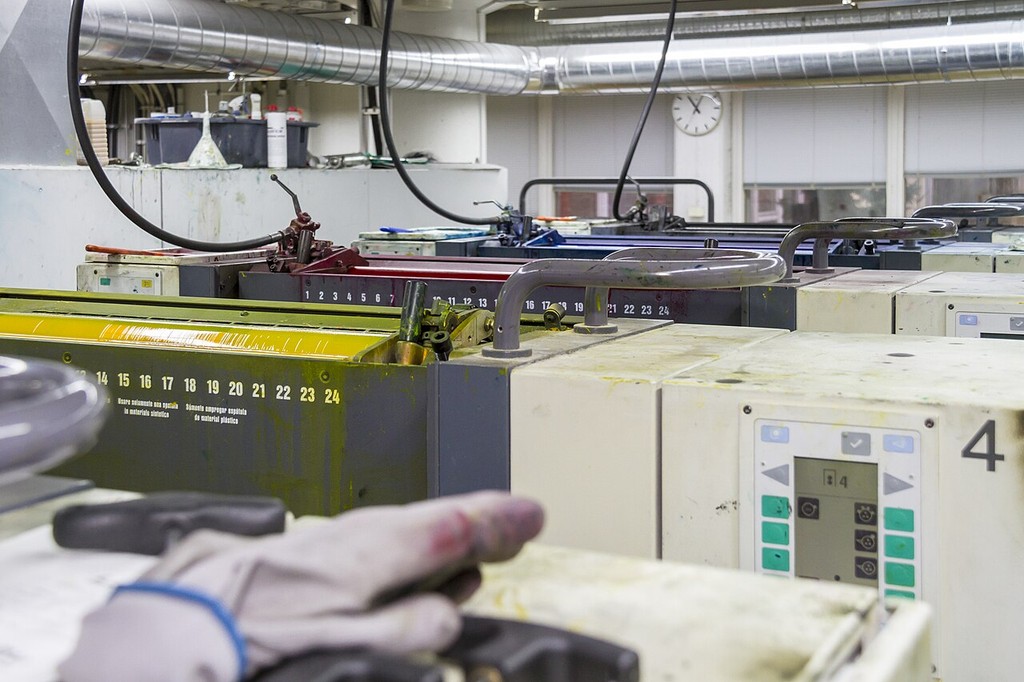
A MAN Roland sheetfed offset press, photographed in 2013. This production machinery illustrates one reproduction process; the photograph makes no claim about the manufacture of a particular Rothko edition.
Photograph: Aatu Dorochenko. Photograph remains CC BY-SA 4.0. Resized without cropping. [6]
How to identify what a shop is selling
Look for the phrase “reproduction of” or “custom print” and the name of the original artwork. Tate's shop page for Black on Maroon lists the 1958 oil canvas as the source work and separately offers a printed product.[1] The canvas's date and dimensions are not the dimensions or creation date of the new print. The shop may allow a choice of product size, frame or material. Such choices are commercial specifications, not historical variants of Rothko's painting.
Check who produces the print and whether it is licensed by the rights holder. Rothko's paintings remain subject to the copyright of his heirs, typically administered through Artists Rights Society in the United States. The museum's own copyright line and product licence are relevant. A seller's use of a Rothko image should not be assumed authorised because it appears online. Before buying, compare the seller's stated source, image orientation, crop, colour claims and return terms. Even a licensed reproduction cannot give the same scale, paint surface and changing light as the original.
Tate's Seagram portfolio is a useful concrete example of the language to read. Its product description calls the four sheets giclée reproductions on cotton-rag paper, gives a product size of 40 × 30 cm for each, and names the reproduced paintings, including works titled Black on Maroon from both 1958 and 1959.[5] Those specifications describe a contemporary print product. They do not alter the date, medium or dimensions of the source canvases, and the four printed images are not four newly discovered Rothko printmaking editions. The repeated title also shows why the source painting's year and collection record belong beside the shop description.
Original paper works are different
NGA's conservation account describes Rothko working directly on sheets, taping them to boards or easels, layering colour, and sometimes mounting completed paintings for display.[3] These objects are original paintings on paper, not mechanically reproduced editions. Untitled (brown and gray) is one such NGA acrylic sheet. Untitled (Red on Red) is oil on paper later mounted on canvas; the mount does not make the painted sheet a print or a canvas painting. Tentacles of Memory is classified as a drawing in ink and watercolour.[4]
The distinction matters for scholarship and for shopping. An original paper object is unique and may have a provenance, exhibition history and conservation record. A museum reproduction is a newly manufactured product. Its quality may be high, but its price does not convey ownership of the underlying artwork or its copyright. A “limited edition” claim also needs a stated edition size, producer and authorisation; it should not be inferred from a numbered Rothko painting title.
Choosing a reproduction responsibly
For a specific painting, begin with the current holding museum's object page. Verify the title and date there, because Rothko repeated numbers and colour descriptors. Then check whether the museum shop or an authorised publisher offers a corresponding print. A picture of Black on Maroon dated 1958 is not interchangeable with a different 1959 canvas of the same title.[1] Similarly, this site's No. 61 and Number 61 routes refer to one MOCA work, not two product images.
Reproduction colour is especially sensitive in Rothko's work. Screens differ, print processes have their own colour range, and a source photograph depends on lighting. A seller can promise a particular paper and process but not a perfect substitute for a painting's surface. The safest expectation is a clearly identified, authorised interpretation of the image at the chosen size. This guide provides art-historical identification rather than a catalogue of products whose stock and price would quickly change.
Size claims need similar care. A product may offer a larger format than another seller, but both could remain much smaller than a canvas whose fields occupy a viewer's peripheral vision. Cropping to fit a standard paper ratio can also remove the painted margins that determine how Rothko's colour areas meet the edge. The print buyer should compare the full composition shown by the holding museum with the product preview and ask whether borders have been included, trimmed or recoloured. These checks protect the identity of the work and help set realistic expectations of what a reproduction can convey.
Related works
- Rothko's drawings explains original works on paper.
- Rothko's paintings links the original canvases and paper works.
- Black on Maroon shows why exact date and title matter.
Rothko works in this guide
| Name | Date | Medium |
|---|---|---|
| Entrance to Subway | 1938 | Painting |
| Hierarchical Birds | 1944 | Painting |
| Slow Swirl at the Edge of the Sea | 1944 | Painting |
| No. 3/No. 13 | 1949 | Painting |
| Untitled (Violet, Black, Orange, Yellow on White and Red) | 1949 | Painting |
| White Center | 1950 | Painting |
| No. 10 | 1950 | Painting |
| No. 6 (Violet, Green and Red) | 1951 | Painting |
| Untitled | 1952 | Painting |
| No. 61 (Rust and Blue) | 1953 | Painting |
| No. 1 (Royal Red and Blue) | 1954 | Painting |
| Untitled (Yellow and Blue) | 1954 | Painting |
| Orange and Yellow | 1956 | Painting |
| Light Red over Black | 1957 | Painting |
| Four Darks in Red | 1958 | Painting |
| Black on Maroon | 1958 | Painting |
| No. 14 | 1960 | Painting |
| Orange, Red, Yellow | 1961 | Painting |
| Untitled (brown and gray) | 1969 | Painting |
| Untitled (Red on Red) | 1969 | Painting |
| Untitled (Black and Gray) | 1970 | Painting |
| Tentacles of Memory | 1945–46 | Drawing |
Frequently Asked Questions
It commonly means a later poster or reproduction of an existing Rothko painting. The print is a separate object from the original artwork, with its own size and production details. A museum-shop reproduction is not an original drawing or painting made by Rothko.[1]
No. His drawings and paper paintings were made directly with materials such as ink, watercolour, oil or acrylic. Tentacles of Memory, for example, is a drawing, not a printed edition. Being on paper does not make an artwork a print.[3][4]
No. The painting remains an original work on paper; canvas is its mount. Rothko made and displayed paper paintings in different ways. The Untitled (Red on Red) guide discusses a 1969 oil painting on paper mounted on canvas.[3]
The source photograph, lighting, screen and printing process all affect how colour is conveyed. A reproduction also reduces the original’s changing paint surface and often its scale. Use it to study the arrangement while recognising that it offers a different encounter from the painting itself.
Discussion
Which documented work or source changed your understanding of Rothko prints?
Reader Insights
Begin with a specific work, title and date.
Compare the object record with this career guide.
What still needs a catalogue or archive check?
Join the Conversation
Share an observation grounded in the work or its history.
References
- Tate Shop, Black on Maroon, 1958, authorised custom-print product and source-object details.
- National Gallery of Art, Mark Rothko: Works on Paper online catalogue project.
- Michaela Milgrom, “How Mark Rothko Made Paintings on Paper,” National Gallery of Art, 2023.
- SFMOMA, Tentacles of Memory, accession 46.2794.
- Tate Shop, Seagram Murals reproduction portfolio, contemporary product description and source-painting titles.
- Offset printing press 2.jpg. Photograph: Aatu Dorochenko. Photograph remains CC BY-SA 4.0. Resized without cropping. Source · CC BY-SA 4.0.