by Tom Gurney
Tom Gurney BSc (Hons) is an art history expert with over 20 years experience
Published on June 19, 2020 / Updated on October 11, 2026
Email: tomgurney1@gmail.com / Phone: +44 7429 011000
Number 61: Introduction
The painting sought as “Number 61” is Mark Rothko's No. 61 (Rust and Blue) of 1953. The Museum of Contemporary Art, Los Angeles, records a single oil canvas under the fuller title No. 61 (Rust and Blue) [Brown Blue, Brown on Blue] and accession number 84.9.[1] This route remains available because readers may search for the number written as a word. The full object study is on the No. 61 (Rust and Blue) page.
At a Glance
- ArtistMark Rothko
- Date1953 [1]
- MediumOil on canvas [1]
- Dimensions292.74 × 233.68 × 4.45 cm [1]
- CollectionMOCA Los Angeles, 84.9 [1]
This work in Rothko’s career
Contents
One painting, several names
It is easy to mistake a numerical title and a colour subtitle for different entries when they appear in separate lists. MOCA's accession number provides a stable identifier. Its record gives the date as 1953, the medium as oil on canvas and the dimensions as 292.74 × 233.68 × 4.45 cm.[1] Those facts belong to the same work whether a source says “No. 61,” “Number 61” or “Rust and Blue.”
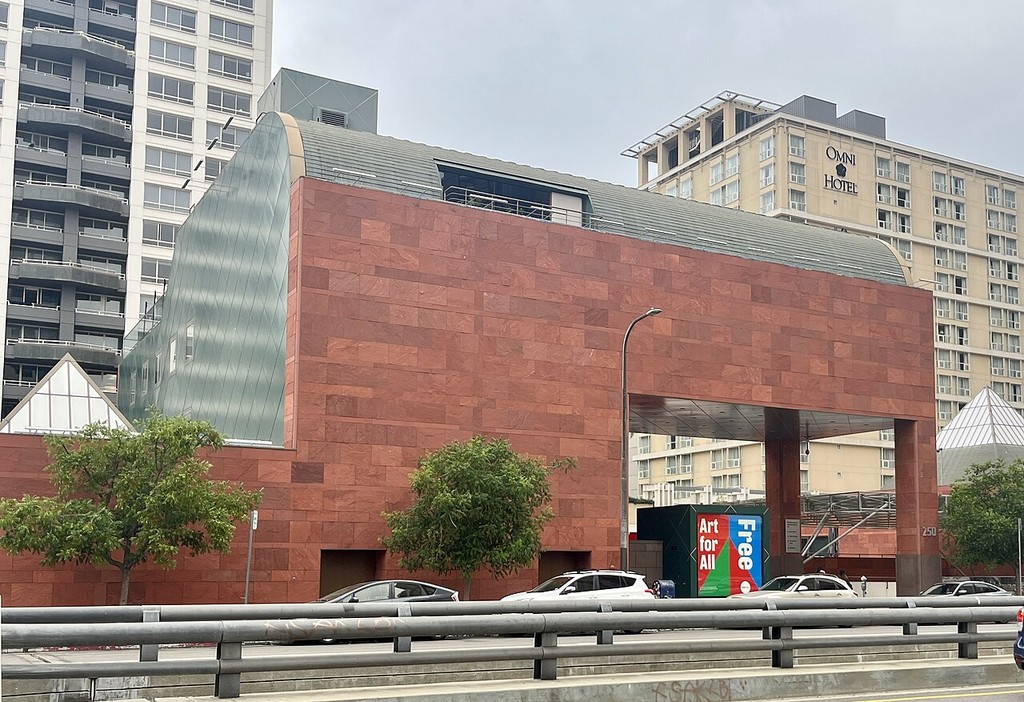
MOCA Grand Avenue in 2023. This guide’s Number 61 and No. 61 (Rust and Blue) pages identify the same canvas in MOCA’s collection.
Photograph: Benoît Prieur. Resized without cropping. [3]
The square-bracketed phrase in MOCA's record—“Brown Blue, Brown on Blue”—is another recorded name, not evidence of a second canvas. The history of each form of the title would need to be checked against early exhibition catalogues and the entry in David Anfam's catalogue raisonné. Until that cross-check, it is safest to preserve MOCA's present cataloguing and describe the short versions as alternate ways to find the painting.[2]
Why the distinction matters
Rothko used numbers for more than one painting and also changed the relationship between titles and colour descriptions across his career. A number alone can therefore be an unreliable search key. For example, No. 10 of 1950 at the Museum of Modern Art is distinct from other Rothko paintings bearing that number. A museum accession, date, measurements and holding institution are stronger identifiers than a short title in isolation.
The two No. 61 pages on this site once risked looking like independent artwork entries. Keeping this brief route as a naming guide allows existing links to remain useful while directing detailed reading to one principal object page. Both routes refer to MOCA 84.9. Any later decision to merge their URLs should be based on a review of incoming links and search records; it would not change the art-historical identity of the painting.
What to look for
The canvas is very large, just under three metres high. MOCA's image presents broad dark areas of rust, brown and blue with soft boundaries.[1] The colours are not confined to crisp geometric boxes. Their transitions make the surrounding field active and can alter the apparent weight of the upper and lower portions. Read the full painting guide for a closer account of scale, colour and its place in Rothko's 1950s work.
It is useful to compare No. 61 with a work from another moment. White Center is dated 1950 and has a much brighter balance; No. 14, 1960 brings a different relation between warm and cool colour at comparable physical scale. These are comparisons in Rothko's practice, not claims that the three paintings form a series.
MOCA owns the work and credits it to the Panza Collection.[1] The museum's record should be checked for current collection and display information. Its artwork image is copyrighted, so this guide links to the museum record rather than reproducing it.
Related works
Rothko works in this guide
| Name | Date | Medium |
|---|---|---|
| Entrance to Subway | 1938 | Painting |
| Hierarchical Birds | 1944 | Painting |
| Slow Swirl at the Edge of the Sea | 1944 | Painting |
| No. 3/No. 13 | 1949 | Painting |
| Untitled (Violet, Black, Orange, Yellow on White and Red) | 1949 | Painting |
| White Center | 1950 | Painting |
| No. 10 | 1950 | Painting |
| No. 6 (Violet, Green and Red) | 1951 | Painting |
| Untitled | 1952 | Painting |
| No. 61 (Rust and Blue) | 1953 | Painting |
| No. 1 (Royal Red and Blue) | 1954 | Painting |
| Untitled (Yellow and Blue) | 1954 | Painting |
| Orange and Yellow | 1956 | Painting |
| Light Red over Black | 1957 | Painting |
| Four Darks in Red | 1958 | Painting |
| Black on Maroon | 1958 | Painting |
| No. 14 | 1960 | Painting |
| Orange, Red, Yellow | 1961 | Painting |
| Untitled (brown and gray) | 1969 | Painting |
| Untitled (Red on Red) | 1969 | Painting |
| Untitled (Black and Gray) | 1970 | Painting |
| Tentacles of Memory | 1945–46 | Drawing |
Frequently Asked Questions
It is Rothko’s 1953 No. 61 (Rust and Blue) at MOCA Los Angeles, accession 84.9. The museum’s extended title includes Brown Blue, Brown on Blue. ‘Number 61’ is another way of finding the same work.[1]
No. Rust and Blue and the bracketed Brown Blue, Brown on Blue are recorded names attached to one oil painting. Its 1953 date, MOCA accession and dimensions establish the common identity.[1]
MOCA records dimensions of 292.74 × 233.68 × 4.45 cm. The first two figures describe its large painted format; the third is depth. A reduced image cannot reproduce the almost three-metre height that shapes its physical encounter.[1]
The No. 61 (Rust and Blue) page follows the canvas’s colour relationships, place in Rothko’s 1950s work and MOCA collection credit. This alternate-name guide helps readers reach that same painting through the number written as a word.
Discussion
What changes when you look at Number 61 as a physical painting rather than a small reproduction?
Use the questions below to compare the work with its neighbours in Rothko’s career.
Reader Insights
Which edge or interval asks you to slow down?
How does this painting differ from the earlier and later works linked here?
What remains uncertain after reading the museum record and looking closely?
Join the Conversation
Share an observation grounded in the work or its documented history.
References
- The Museum of Contemporary Art, Los Angeles, No. 61 (Rust and Blue) [Brown Blue, Brown on Blue], accession 84.9.
- David Anfam, Mark Rothko: The Works on Canvas: A Catalogue Raisonné (National Gallery of Art and Yale University Press, 1998), bibliographic lead cited in the National Gallery of Art's Rothko bibliography. Entry and title history await direct verification.
- The Museum of Contemporary Art from Grand Ave (July 2023).jpg. Photograph: Benoît Prieur. Resized without cropping. Source · CC0.